




Introduction
Product design is a complex and iterative engineering process that involves critical decision-making at each stage. This process generally begins with the identification of a specific need o problem, followed by a structured sequence of activities aimed at finding the optimal solution, and concludes with a detailed product description (Hsu and Woon, Reference Hsu and Woon1998).
Among the various stages of product design, the conceptual design phase is particularly significant because it is where abstract ideas begin to take tangible form. At this stage, creativity plays an important role in determining the originality, feasibility, and functionality of the resulting designs. To enhance and structure the ideation process, various conceptual design methodologies have been developed. These methodologies systematize the generation, evaluation, and refinement of ideas, leading to more innovative, practical, and well-founded design solutions.
Previous studies have shown that the use of conceptual design methodologies enhances the creativity of the results (Chulvi et al., Reference Chulvi, Mulet, Chakrabarti, López-Mesa and González-Cruz2012; Mose Biskjaer et al., Reference Mose Biskjaer, Dalsgaard and Halskov2017). Therefore, employing such methodologies could impact the findings of previous studies that compared human creativity with that of AI. This raises an important consideration regarding past research comparing human creativity to that of artificial intelligence (AI): if human creativity can be significantly influenced by structured design methodologies, the same could potentially apply to AI-generated outputs.
By exploring the relationship between structured design methodologies and AI-generated creativity, future research could help refine the integration of AI into the design process, optimizing the collaboration between human designers and AI-driven design tools. Understanding these dynamics is crucial for developing more effective, adaptive, and innovative design systems that leverage the strengths of both human intuition and AI computational efficiency.
However, AIs can also be trained to use the same creative design methodologies. In this case, it is also relevant to study whether the use of design methodologies can enhance the creativity of the results generated by AIs.
Literature review
Conceptual design
Pahl and Beitz (Reference Pahl and Beitz2007) describe the design process in four phases: task clarification, conceptual design, embodiment design, and detailed design. The Conceptual Design phase of products involves establishing a function structure, seeking solutions, and combining them into variants. Finally, the best variant is evaluated to obtain the best concept. In this phase of the design process, abstract ideas are developed using approximate concrete representations (Takala, Reference Takala and Akman1989). For Briggs and Reinig (Reference Briggs and Reinig2007), the conceptual phase is the phase in which relevant ideas and concepts are developed. For Hsu and Woon (Reference Hsu and Woon1998), factors such as costs, performance, reliability, safety, and the environmental impact of a product are significantly affected by the decisions made in the conceptual design phase. Once the detailed design phase has been reached, it is difficult or impossible to correct the deficiencies of a design concept created in the conceptual phase (Pahl et al., Reference Pahl, Beitz, Feldhusen and Grote1996; Hsu and Liu, Reference Hsu and Liu2000). As Zimmer and Zablit (Reference Zimmer and Zablit2001) assert, conceptual design represents more than 70% of the costs and performance of the product being designed.
Creativity in design
To achieve good design results, it is necessary to introduce quality at the beginning of the process and maintain it until the end (Pahl and Beitz, Reference Pahl and Beitz1996). For de Silva Garza and Maher (Reference de Silva Garza and Maher1996) and Gero and Kazakov (Reference Gero and Kazakov1996), design is a phenomenon that involves the search for new ideas or improved designs. Creativity will help achieve novel and socially valued products (Mumford and Gustafson, Reference Mumford and Gustafson1988). Mayer summarized several definitions of creativity as the “creation of new and useful products that include both ideas and concrete objects” (Mayer, Reference Mayer and Sternberg1999, p. 450). For Gero (Reference Gero1996), it helps achieve a new, unexpected, and valuable result.
Conceptual design is related to creativity (Altshuller, Reference Altshuller1984). Creative design is often considered an important feature of good design (Dorst and Cross, Reference Dorst and Cross2001; Barbieri and Muzzupappa, Reference Barbieri and Muzzupappa2024). If many ideas are created during the conceptual design, there may be many options to choose from and, consequently, it is more likely to achieve a good design (Benami and Jin, Reference Benami and Jin2002). Roozenburg and Eekels (Reference Roozenburg and Eekels1995) believe that many ideas should be considered before selecting the best ones. According to Stal and Turkiyyah (Reference Stal and Turkiyyah1996), creative design involves the generation of new search spaces.
Artificial intelligence in design
The need for competitiveness when launching new products on the market leads to conceptual design relying on collaboration, AI, and information technologies (Wang, Reference Wang2002). The emergence of AI has also had a significant impact on design engineering. Its rapid development has led designers to consider it as an additional method for generating creative ideas (Oktradiksa et al., Reference Oktradiksa, Bhakti, Kurniawan and Rahman2021).
Since the introduction of AI in the early 1960s, it has been considered to aid design thinking through the simulation and modeling of design options. There are numerous articles dealing with the use of AI in the conceptual phase of the design process, as shown by Khanolkar et al. (Reference Khanolkar, Vrolijk and Olechowski2023) in their literature review. Chen et al. (Reference Chen, Xiao, Chen, Sun, Childs and Han2024a) propose to integrate generative models to enrich conceptual design and interpreting creative combinational designs (Chen et al., Reference Chen, Jing, Tsang, Wang, Sun and Luo2024b). There are also tools for improving processes and cognitive skills, such as creativity (Liu et al., Reference Liu, Wang, Qi and Fu2022). According to Verganti et al. (Reference Verganti, Vendraminelli and Iansiti2020), the role of AI in innovation and design processes is a mental process that requires experience and creativity for engineers and designers. Holford (Reference Holford2019) points out that creativity experts have begun to debate and evaluate how AI could complement, enhance, replace, restrict, or perhaps destroy human capacity for creativity. Runco (Reference Runco2023) has identified this emerging trend as artificial creativity (AC) due to the emerging use of powerful AI-large language model (LLM) chatbots for creative efforts. LLMs enable machines to process and produce text similar to human texts (Sarker, Reference Sarker2024). LLMs Models such as GPT-4 can generate coherent, human-like text. These models do not “think” or “create” in the human sense, instead, they process large amounts of data and generate responses based on statistical patterns. Runco (Reference Runco2023) introduces the concept of “pseudo-creativity,” which refers to outputs that appear creative on the surface, but lack genuine originality or deep meaning. This concept may apply to AI-generated creations, which can emulate creative patterns without necessarily involving divergent thought processes or human intentionality. The main capabilities acquired by LLMs include context learning, following instructions and step-by-step reasoning (Wei et al., Reference Wei, Wang, Schuurmans, Bosma, Xia, Chi and Zhou2022). Although existing studies demonstrate their potential for solving engineering and idea-generation problems (Wang et al., Reference Wang, Zuo, Cai, Yin, Childs, Sun and Chen2023; Han et al., Reference Han, Nanda and Moghaddam2023; Zhu, Zhang, et al., Reference Zhu, Zhang and Luo2023; Zhu et al., Reference Zhu and Luo2022), there is a lack of transparency and control over their reasoning processes. Users only receive results without knowing the reasoning applied for their ideation (Jiang and Luo, Reference Jiang and Luo2024).
Many of the concerns about AI creativity refer to a mismatch between the functionality of these technologies and the types of experiences that fit human needs and desires (Batista and Hagler, Reference Batista and Hagler2022; Allred and Aragon, Reference Allred and Aragon2023; Vinchon et al., Reference Vinchon, Lubart, Bartolotta, Gironnay, Botella, Bourgeois-Bougrine and Gaggioli2023).
The advantages of AI methods are that they shorten design processes, obtain precise results, and reduce overall design costs. In addition, their execution is superior compared to humans due to their high computational capacity, big data processing, and objective decision-making ability (Liao et al., Reference Liao, Hansen and Chai2020; Allison et al., Reference Allison, Cardin, McComb, Ren, Selva, Tucker and Zhao2022). According to Catarau-Cotutiu et al. (Reference Catarau-Cotutiu, Mondragon and Alonso2022) and Russell and Norvig (Reference Russell and Norvig2016), AI models are capable of learning and representing knowledge, identifying patterns and knowledge structures, and using them to establish useful and appropriate connections and inferences. AI models use a process known as representational learning, in which the model learns to identify and represent features of the data that help it identify patterns and generalizable rules that describe the data meaningfully (Boden, Reference Boden2004; Vear and Poltronieri, Reference Vear and Poltronieri2022). For all these reasons, AI tools support human creativity by providing explicit representations of relevant knowledge, knowledge structures, and generative rules at different levels of representational abstraction (Boden, Reference Boden2004).
Use of generative AI in creative process
There are numerous studies recently conducted in relation to the use of generative AI (GenAI) in creative processes. GenAI (Cui et al., Reference Cui, van Esch and Phelan2024) is based on large linguistic models that produce human-like language (OpenAI, 2023). OpenAI trains its text generation models using machine learning algorithms (Scharth, Reference Scharth2022). Among these studies, the research of Guzik et al. (Reference Guzik, Byrge and Gilde2023) stands out, highlighting the potential of AC in which a leading AI-LLM chatbot, Chat GPT, showed exceptional creative potential that far exceeds that of individual humans, measured and evaluated independently with the Torrance Tests of Creative Thinking (Torrance, Reference Torrance1966, Reference Torrance1974). Other work experiences focused on enhancing creativity in interior design have shown that integrating GenAI boosts creativity by offering alternative design suggestions based on input criteria. Several tools, like Chat GPT and Gemini, become valuable collaborators when generating interior designs, selecting color palettes, and suggesting furniture arrangements, thus expanding the spectrum of design possibilities (Rane et al., Reference Rane, Choudhary and Rane2023). On the other hand, there are tools that use LLMs to automate design methodologies, such as AutoTRIZ (Jiang and Luo, Reference Jiang and Luo2024), or that leverage the Function-Behavior-Structure ontology (FBS) to generate high-quality design concepts (Chen et al., Reference Chen, Zuo, Cai, Yin, Zhang, Sun and Wang2024c). Previous studies by Haase and Hanel (Reference Haase and Hanel2023) compare ideas obtained by humans against six generative artificial intelligence (GAI) chatbots: alpa.ai, Copy.ai, Chat GPT (versions 3 and 4), Studio.ai, and YouChat. Humans and a specifically trained AI independently evaluated the quality and quantity of the ideas. The results show that there are no qualitative differences between the creativity generated by AI and that generated by humans, although the way of generating ideas does differ, leading to the belief that GAIs can be valuable assistants in the creative process. Urban et al. (Reference Urban, Děchtěrenko, Lukavský, Hrabalová, Svacha, Brom and Urban2024), for their part, investigated the impact of Chat GPT on performance in a complex task performed by university students solved using Chat GPT versus other students who did not use it. The use of Chat GPT significantly improved self-efficacy for task resolution and increased the quality, elaboration, and originality of the solutions. Participants who used Chat GPT perceived the task as easier and requiring less mental effort. However, the use of Chat GPT did not make the task resolution more interesting. To achieve this, a series of formal or prescriptive methods are applied to initiate the design process by functionally decomposing the problem. For instance, Pahl and Beitz (Reference Pahl and Beitz1996) present a structured approach to engineering design based on the functional decomposition of problems. Ulrich and Eppinger (Reference Ulrich and Eppinger1995) explore product development strategies and how formal methods can be applied to optimize design. Other authors understand and redefine design problems by applying functional decomposition methods (Otto and Wood, Reference Otto and Wood2001). Ullman (Reference Ullman1997) emphasizes the importance of creativity in design and the use of systematic tools to support it. Jones (Reference Jones1987) proposes systematic approaches to solving design problems through innovation and experimentation. In this regard, Tomiyama et al. (Reference Tomiyama, Gu, Jin, Lutters, Kind and Kimura2009) conducted a comprehensive review and classification of various design methods, analyzing their utility for both industrial applications and educational purposes.
However, these tests have been carried out with free use of ideation, both human and AI. That is, no methodology has been used to enhance the creativity of the ideas.
Research question
This leads us to pose the following research question:
RQ: Can the application of creative design methodologies by GenAIs enhance the creativity of the resulting products?
This study aims to compare the creativity of designs generated by human designers and GenAI using a conceptual design methodology, while also analyzing the key parameters that define creativity. The aim of the study is to compare the creativity of the results obtained by designers and by a GenAI, when applying a conceptual design methodology in the idea generation process, also including the individual analysis of the parameters that define creativity. For this purpose, in the present study, an AI and Design Engineering students were asked to solve creative design problems using the SCAMPER methodology (Eberle, Reference Eberle1971), following the guidelines set out in “Methodology” section. In “Results” section, the results provided by the AI are compared with those carried out by the students in terms of creativity. The implications of these results are analyzed in “Discussion” section, leading to the conclusions indicated in “Conclusions” section.
Methodology
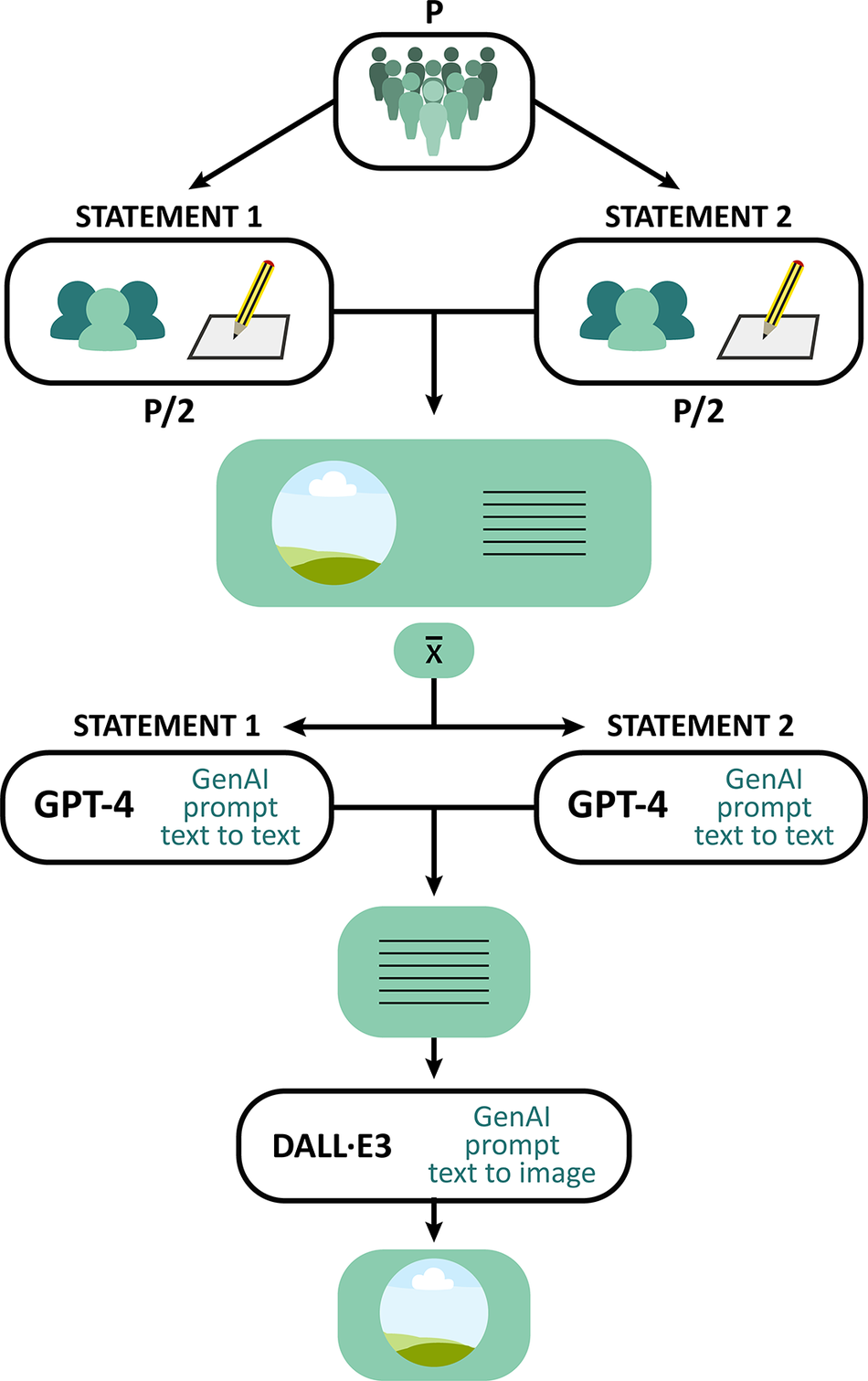
The experimental phase of the study is described in Figure 1. This phase was divided into two parts. The first involved the collaboration of Engineering Design students, while for the second, an AI program that uses GPT-4 technology was used.
Applied methodology scheme.
For the development of the first part of the experiment, the voluntary collaboration of 22 final year Engineering Design students was counted on, with an average age of 22.32 years (st. dev. 1.09). Of these, 13 were women and 9 were men. All of them provided informed consent. This research adhered to the American Psychological Association Code of Ethics and received approval from the Institutional Review Board at the Universitat Jaume I (CEISH/40/2022).
They were randomly divided into two equitative groups. Each groups received one or two different problem statements to solve:
Statement 1:
Applying the SCAMPER methodology, develop as many ideas as possible about new creative concepts of URBAN TRANSPORT FOR 2 PEOPLE.
Use a different sheet to capture each of the different ideas. You can use sketches and words to explain the idea.
Statement 2:
Applying the SCAMPER methodology, develop as many ideas as possible about new creative concepts of SMALL URBAN ECO-PARK.
Use a different sheet to capture each of the different ideas. You can use sketches and words to explain the idea.
Once the participants had read the problem, they were given the opportunity to consult with the researchers any doubts related to the statement. When they stated that they had a clear task, they were informed that they had 45 min to carry out the experiment. Ten minutes before the end of these 45 min they were also warned, in order to have enough time to finish capturing the final idea or ideas well.
The second part of the experiment involves the resolution of creative design problems by an AI. For this function, a generative conversational AI was used that uses a GPT-4 engine. The AI was asked to solve the same two design problems as the participants in the first phase, introducing the same statements separately. For each of the problems, the AI was asked to obtain the same number of solutions as the average of the solutions provided by the students. The result was the elaboration of four solutions, a synthesis of the SCAMPER answers elaborated by the IA itself.
Since the students’ proposals had a graphical representation in addition to the written one, in order to present contents of the same type for their evaluation, for each of the solutions proposed by the AI in text form, they were introduced into an AI image generation (DALL·E3) to generate the graphic vision that accompanies the written description of the solution.
Scamper
As a design methodology, the use of SCAMPER (Eberle, Reference Eberle1971) has been considered. It is a straightforward methodology that allows solving a problem or transforming an existing idea into something new and different (Serrat, Reference Serrat2017). SCAMPER was developed by De Bono (Reference De Bono2000) and serves as an acronym representing different thinking techniques. Each letter stands for a specific approach: substitute (considering alternative ideas or objects in place of existing ones); combine (generating new ideas by merging related or unrelated concepts); adapt (adjusting an existing object to fit a particular situation or environment); modify (altering an object by expanding, reducing, or transforming it); put to other uses (applying an object in a different context, situation, or location); eliminate (enhancing something by removing parts of it or analyzing the impact of its removal); rearrange/reverse (changing the structure, sequence, or direction of something to explore new possibilities, ideas, or outcomes).
This method has been selected because it works in a similar way to AI, it structures thought processes into questions, generates answers separately, and compiles the results. The operability of the SCAMPER method and the architecture of AI models share structural principles related to information modification, recombination and optimization. The participating students in the experiment have already been trained in this design methodology, and it has been verified that the generative conversational AI based on GPT-4 used in the experiment claimed to be capable of applying it. To verify this, the AI was asked about the SCAMPER methodology, requested to use it to solve a problem, and subsequently asked to explain how it was applied. The results of the AI explanation can be found in the Supplementary Material.
Creativity assessment
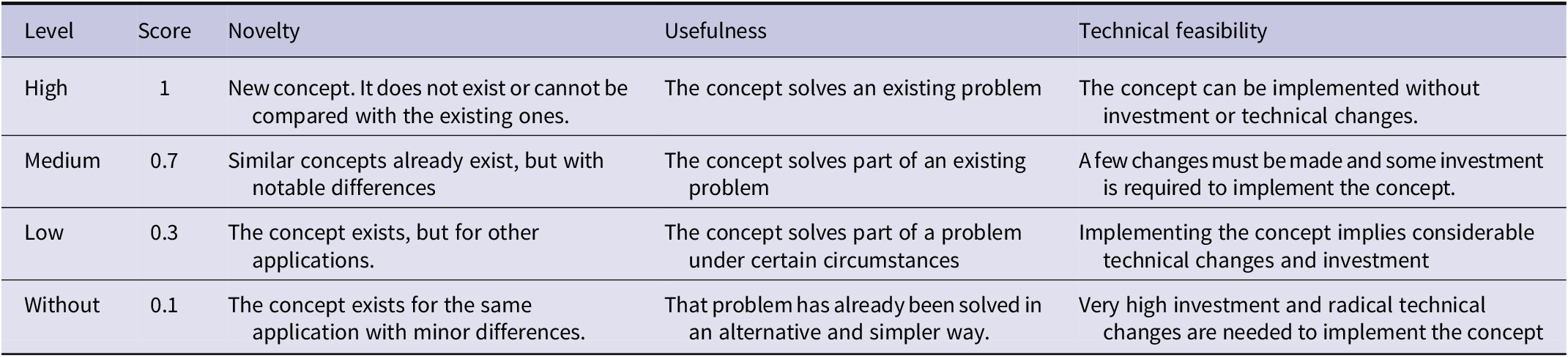
To assess creativity, the metric proposed by López-Forniés et al. (Reference López-Forniés, Sierra-Pérez, Boschmonart-Rives and Gabarrell2017) was employed. This metric considers the value of creativity (C) as the product of three distinct parameters: novelty (N), usefulness (U), and technical feasibility (T). Several studies have applied this metric to the evaluation of conceptual proposals. (Maccioni et al., Reference Maccioni, Borgianni and Pigosso2021; Ruiz-Pastor et al., Reference Ruiz-Pastor, Chulvi, Mulet and Royo2022, Reference Ruiz-Pastor, Chulvi, Royo and Sampaio2023). For novelty, it is understood how unusual or unexpected a concept is compared to other similar solutions addressing the same problem. Essentially, it captures the degree of originality inherent in the idea. Usefulness is related to how appropriate and practical the concept is for solving the intended problem. It evaluates whether the proposed solution aligns well with the problem it aims to address. Technical feasibility refers to the ease of translating the concept into reality. It takes into account the necessary technology for manufacturing or implementation, as well as the required investment to adapt it.
López-Forniés et al. (Reference López-Forniés, Sierra-Pérez, Boschmonart-Rives and Gabarrell2017) provide specific values to assign to each of these parameters based on whether their fulfillment level is categorized as high, medium, low, or not achieved. These values are outlined in Table 1 of their metric.
Values for assessing creativity, according to López-Forniés et al. (Reference López-Forniés, Sierra-Pérez, Boschmonart-Rives and Gabarrell2017)
The creativity assessment was performed independently by two expert evaluators in the field of design engineering, with 17 and 10 years of experience, respectively, in the evaluation of creative design. The inter-rater reliability was calculated using a Fleiss Kappa evaluation, and the resultant inter-rater agreement was 0.879.
Results
As a result of the initial experimental phase involving student participation, the average number of solutions contributed using the SCAMPER technique was extracted. Specifically, each participant provided an average of 4.2 solutions. This data were then used to request the number of solutions from the AI, rounded to the nearest integer (n = 4).
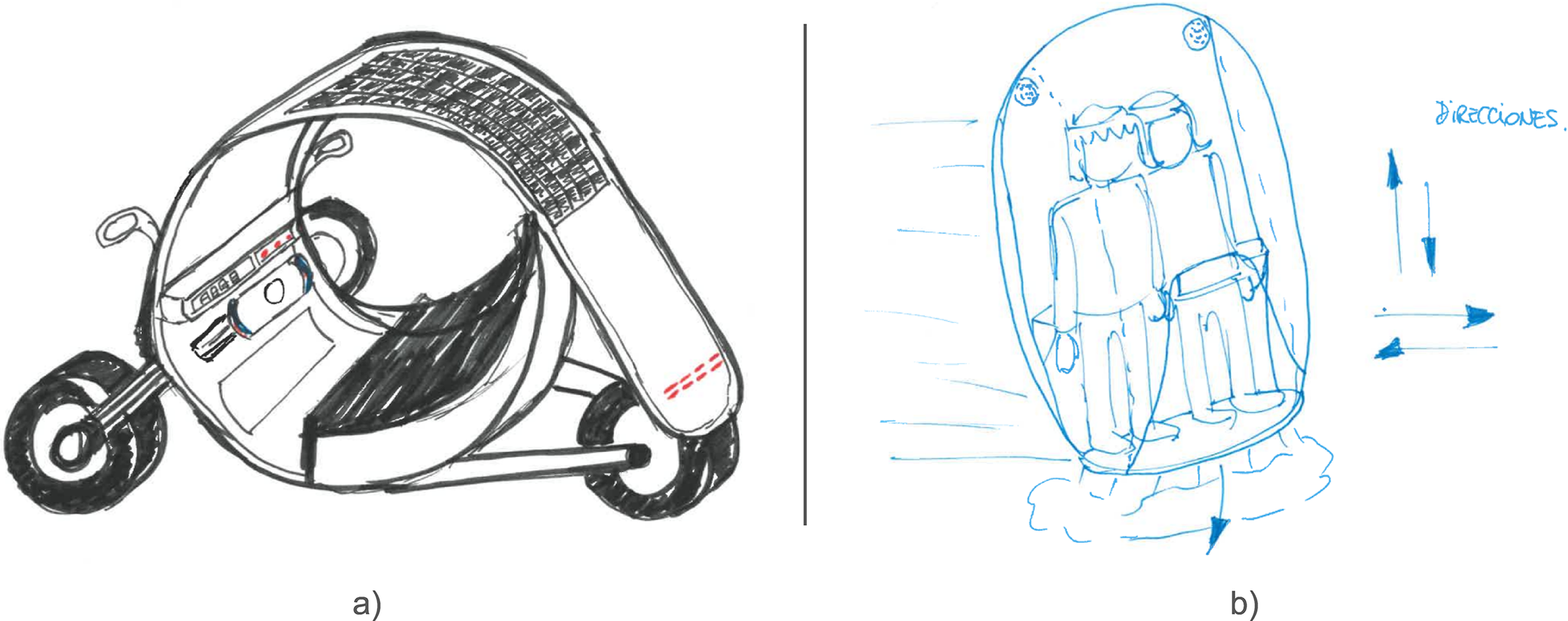
Figure 2 shows two examples of results obtained by the students once they have applied the SCAMPER method, while Figure 3 shows those obtained by the AI following the same process.
Students’ conceptual solutions.
AI conceptual solutions.

All solutions contributed by both students and the AI were evaluated using the metric proposed by López-Forniés et al. (Reference López-Forniés, Sierra-Pérez, Boschmonart-Rives and Gabarrell2017). Table 2 displays the maximum creativity values (C max) achieved by each participant and by the AI for each problem. From this table, one participant was excluded due to significantly disparate values, presumably resulting from an interpretation error in the problem statement. Similarly, the table also presents the novelty, usefulness, and technical feasibility values for the solution that yielded the maximum creativity score, labeled as N(C max), U(C max), and T(C max), respectively. Additionally, it includes the maximum novelty (N max), usefulness (U max), and technical feasibility (T max) values obtained from any of the solutions, regardless of whether they corresponded to the one with the highest creativity score or not.
Results of maximum creativity

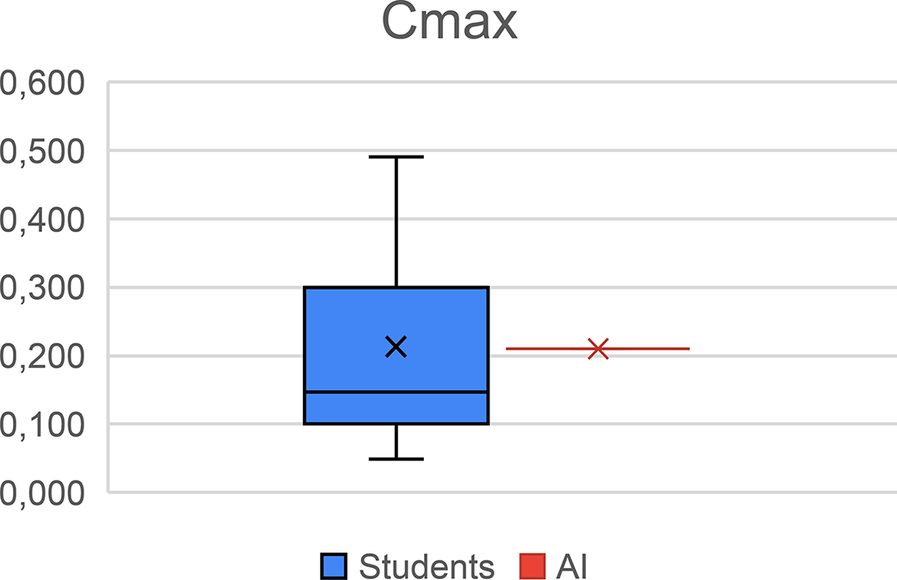
Analyzing the results from this table, Figure 4 illustrates the normal distribution and the mean values of C max for both students and the AI. Here, it can be seen that while the median value obtained by the AI (0.210) surpasses that achieved by the students (0.147), their mean values are nearly identical: 0.210 for the AI compared to 0.213 for the students.
C max values distribution.
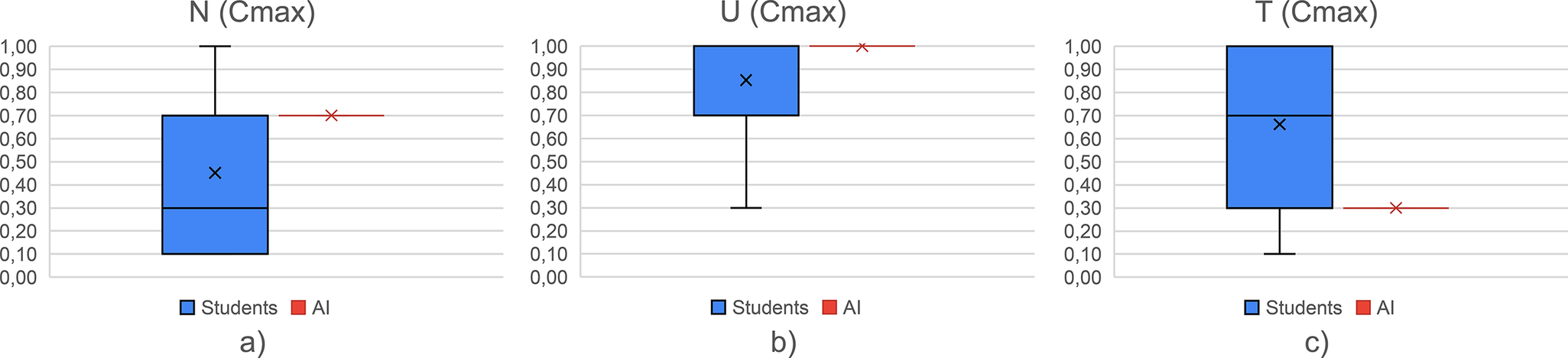
Regarding the novelty, usefulness, and technical feasibility values of the solutions with the highest creativity, Figure 5a shows that the novelty of the most creative solutions generated by the AI is located in the percentile 75 of novelty values presented by the most creative solutions of the students. The average value of the AI (0.700) is in this case higher than the average value of the students (0.452). Referring to usefulness, Figure 5b shows that the median of the AI values coincides with the median of the student results. In this case, the average value of the AI (1.000) is higher than the average value of the students (0.852). Finally, regarding the values of the technical feasibility of the most creative solutions, Figure 5c shows that the median of the AI solutions is located in the percentile 25 of the solutions provided by the students. For this parameter, the average of the AI (0.300) is lower than the average of the student solutions (0.662).
(a) N(C max) values distribution; (b) U(C max) values distribution; (c) T(C max) values distribution.
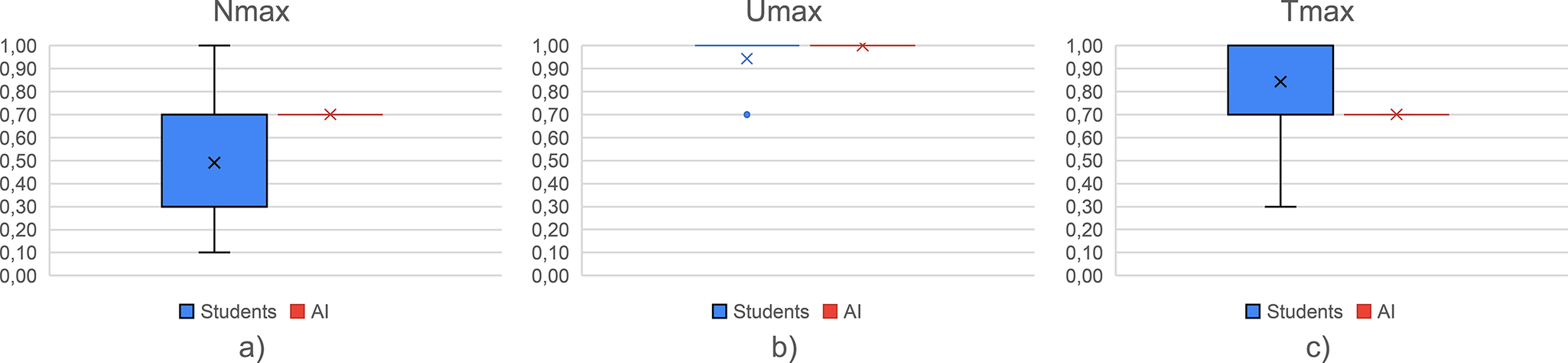
On the other hand, the maximum novelty, usefulness, and technical feasibility values achieved by any of the solutions provided by both the students and the AI have been analyzed individually. In the case of maximum novelty, the most novel solution provided by the AI is located in the 75th percentile of the most novel solutions presented by the students, as can be seen in Figure 6a. In this case, the average of the maximum novelty of the AI (0.700) is higher than the average of the maximum novelties of the students (0.490). For the parameter of maximum usefulness achieved, Figure 6b shows that the medians of the results of the AI and the students are coincident. The average of the maximum usefulness of the solutions generated by the AI (1.000) is slightly higher than the average of the solutions proposed by the students (0.943). Finally, Figure 6c shows the distribution of the maximum technical feasibility values of the solutions proposed by each student compared to those of the AI. In this figure, it can be observed how the median of the AI values is located in the 25th percentile of the values obtained by the students. The average of the maximum technical feasibility of the student solutions (0.843) is higher than the average of the results presented by the AI (0.700).
(a) N max values distribution; (b) U max values distribution; (c) T max values distribution.
Discussion
Regarding the application of the SCAMPER design methodology, the AI demonstrated a level of creativity comparable to the mean of the students and even exceeded the median in the two proposed problems. So, it could be affirmed that, according to these results, the application of creative design methodologies, SCAMPER in this case, by GenAIs enhance the creativity of the resulting concepts (RQ). These results would be in line with Haase and Hanel (Reference Haase and Hanel2023), where similar creativity results were observed between ideas generated by AI and humans. However, the fact that the AI’s creativity results are within the average range of students results also implies that its output is sufficient but not excellent. In other words, there are quite a few students who have achieved better creativity scores. It can be assumed, therefore, that at a professional level, the AI used for this research (at the time of the study) would be insufficient when working independently, as it is generally expected that a design engineering professional would produce better results than a student. However, this does not rule out that the AI can serve as an assistant to professionals so that they can improve their creative outcomes. In fact, this has already been demonstrated in other fields, such as architectural design (Rane et al., Reference Rane, Choudhary and Rane2023) and literature (Doshi and Hauser, Reference Doshi and Hauser2023). Future work along the same line would involve investigating whether this creativity boost also occurs in product design.
Regarding novelty, however, the results of the AI using the SCAMPER design methodology have been better. Both the novelty of the most creative solution and the maximum achieved by any solution are located in the 75th percentile of the students. This would indicate that the AI can serve as a source of inspiration for new ideas in the conceptual phase, demonstrating in a practical way what was already theorized in their work by Yüksel et al. (Reference Yüksel, Börklü, Sezer and Canyurt2023).
The case of the usefulness of the solutions presented is more particular. Although the results of the AI are in the average of the maximum utility achieved by the students in any of their solutions, and in the 75th percentile in the most creative solution, these values coincide with the maximum utility rating in both cases. This indicates that both the students and the AI are capable of achieving the optimal utility demanded by the statements. On the one hand, this implies that the AI can achieve results as useful as those of a human, but on the other hand it also indicates that it will not help to present any improvement in this aspect.
Lastly, regarding technical feasibility, if compared with the maximum values achieved by the students or with the most creative solution, it can be seen in Figures 5 and 6 how the AI results are located in the 25th percentile. This indicates a poor AI performance compared to the students. This data imply that, under current conditions, this technical part of the design should be left in human hands. The results obtained are difficult to develop with current technology. Technical feasibility requires scientific and engineering knowledge and experience in the field of innovation, among others (Arkhipenko, Reference Arkhipenko2016; Shuldeshova, Reference Shuldeshova2016). However, discerning shortcomings also helps to discern possibilities for improvement. This data indicate to AI developers that one of the possibilities for improving these tools is to link them with technical programs that can assist in this aspect of the development of their solutions. Retrieval augmented generation (RAG) could be a solution to enhance LLMs with specific technical data and domain-specific knowledge extracted from user manuals or support documents (Gao et al., Reference Gao, Xiong, Gao, Jia, Pan, Bi, Dai, Sun and Wang2023; Liu et al., Reference Liu, Kang and Han2024).
The study presents, however, certain limitations that must be taken into consideration. First of all, it’s important to note that AIs in general, and GPT in particular, evolve constantly and at a very rapid pace. Therefore, it would be convenient to replicate the study after a certain period of time, carrying out a longitudinal study, to analyze how the results obtained by IA may vary throughout its evolution.
Another limitation of this study is that it was conducted with students. It is reasonable to assume that if professional designers had participated, human performance would have been stronger, likely placing AI results in a lower percentile. Testing this hypothesis remains a task for future research, which could also explore the extent to which these tools genuinely support professional design work.
Finally, it should also be noted that the study was carried out using a single simple creative design methodology. Therefore, it would be of interest to replicate the experiment using different design methodologies, to check if the results are analogous to those presented in this study. In this regard, the present study has resorted to a general-purpose AI. Therefore, it would be worth considering the possibility of training a specific AI for the application of creative design methodologies for the development of creative conceptual design proposals, which presumably could improve the results obtained. It would also be interesting to create a tool that automates the SCAMPER process, similar to AutoTriz (Jiang and Luo, Reference Jiang and Luo2024), that simplifies the complexity of the resources and concepts, and that is independent of the users’ knowledge and reasoning experience, thus not limiting its feasibility.
Conclusions
This study aims to build on previous research by guiding a GenAI model based on GPT-4 to apply a design methodology in the creation of innovative concepts. This article compares the creativity of designs produced by human designers and GenAI using a conceptual design methodology, while examining the key factors that define creativity.
To compare the results, the AI was given the same statements as the human participants. It was asked to obtain an average number of solutions equivalent to those obtained by the students. Once these solutions were obtained in text format using GPT-4, the DALL·E3 program was asked to create them as images to obtain the same as those made by the people, drawings with the final ideas based on the application of the SCAMPER methodology.
The overall conclusion of the work could be summarized in that the solutions provided by the AI when applying the SCAMPER design methodology are as creative as the average of the students, using the same methodology. Initially, this would be a good result for the AI. However, it also indicates that the results are not excellent and, at a professional level, they would likely fall a bit short.
In terms of usefulness, it also reaches the same level as the students. In this case, as it is the maximum value in both cases, it can be indicated that it is a good performance of the AI. It is capable of providing a solution that well resolves what has been requested.
While the AI has performed well in generating novel ideas, it has struggled with their technical feasibility. In other words, it excels in the “creative design” aspect of the task but lacks in the “engineering” component, as shown by the evaluation of the “technical feasibility” parameter. Therefore, for the moment, human capacity is mandatory to be able to materialize ideas into technically viable products.
Therefore, it could be said that AI is useful for inspiring designers in their search for novel ideas. This answers the RQ’s “Can the application of creative design methodologies by GenAIs enhance the creativity of the resulting products?” Its use is advised as an assistance tool in the conceptual phase of idea generation. However, it needs further development of the ideas by the designer, especially to give them the necessary technical feasibility to be able to materialize them.
Supplementary material
The supplementary material for this article can be found at http://doi.org/10.1017/S0890060425100036.
Competing interests
The authors declare no competing interests exist.


 Open access

