





Speakers use language to convey meaning to others. One representation that supports this ability is syntax, which allows novel meanings to be communicated through the ordering of words. This ability requires that syntactic structures have some independence from meaning, such that they can be used to create novel sentences (Chomsky, Reference Chomsky1957). Since the need to convey novel meanings is universal, it is assumed that all languages must have some ways to create independence between syntactic structures and meaning. But at the same time, it is possible that languages have different degrees of separation between structures and meaning. To examine this issue, the relationship between meaning and structures was examined in Japanese, a language with a number of different syntactic constraints than English.
Evidence in support of the independence of structures and meaning comes from work on structural priming, which is a tendency for people to repeat previously heard syntactic structures (Bock, Reference Bock1986). For example, if one hears a double object dative prime sentence such as the wealthy widow gave the church an old Mercedes before seeing a picture that could be described with a prepositional dative the musician handed the guitar to the boy or a double object dative the musician handed the boy the guitar, there is a greater tendency to use the same structure as the prime sentence (e.g., double object dative). Studies have found that priming occurs even when the prime and target differ in words and meanings, which implies that syntactic structures are isolable from meaning (Bock, Reference Bock1989; Bock & Loebell, Reference Bock and Loebell1990; Branigan, Reference Branigan2007; Pickering & Ferreira, Reference Pickering and Ferreira2008).
Studies of the role of meaning in priming have examined whether it is influenced by the compositionality of the prime. Compositionality is the idea that the meaning of a whole sentence can be determined by its structure and the meaning of its parts (Frege, Reference Frege1948). For example, the verb–particle combination pull off a sweatshirt can be understood in terms of the meaning of the verb pull (application of force), the particle off (direction is away from the body), and the noun phrase (NP) a sweatshirt (the referent that will be acted upon). One way to examine the link between structures and meaning is to use idioms, where the meaning of the whole phrase cannot be derived compositionally from the meaning of the parts (Nunberg, Sag, & Wasow, Reference Nunberg, Sag and Wasow1994). For example, an idiomatic verb–particle combination like pull off a robbery implies that the robbery was completed successfully, and this meaning cannot be transparently derived from the meanings of pull and off.
Konopka and Bock (Reference Konopka and Bock2009) examined structural priming with these idiomatic and non-idiomatic verb–particle combinations. They used target structures where speakers had a choice to place the particle before the NP the high prices scared off the customer (VERB PARTICLE NP) or after the NP The high prices scared the customers off (VERB NP PARTICLE). The non-idiomatic prime pull off a sweatshirt has a VERB PARTICLE NP structure, which biased participants to choose the same structure when describing the target. The meaning of the idiomatic prime pull off a robbery implies that it should have a VERB NP structure and this structure should not prime VERB PARTICLE NP targets. But they found that both idiomatic and non-idiomatic primes increased production of the same structures on the target suggesting idioms make use of compositional structures that do not reflect their meaning. They also compared frozen idioms like The New York Mets brought up the rear and flexible idioms like the teenager shot off his mouth/his mouth off and found similar priming from these two types (they had numerically more priming from flexible idioms, but it was not significant). Thus, this study suggested that even though frozen and flexible idioms are not compositional and must be stored as wholes, there is a level of syntactic processing where they can prime compositional structures.
Another compositional structure that has been studied is the dative alternation. For example, the meaning of the double object dative sentence the musician handed the boy the guitar can be understood in terms of the meaning of the verb and nouns, combined with the meaning of the double object dative structure (Goldberg, Reference Goldberg1995). One way to encode the contribution of the structure is in terms of thematic roles associated with different sentence positions: the musician is in the AGENT role (initial possessor of the object), the guitar is in the PATIENT role (the object that is transferred), and the boy is in the RECIPIENT role (the possessor of the object at end of the event). The double object dative has a surface syntactic structure that can be characterized by NPs combined with the verb (NP VERB NP NP), and the AGENT is mapped to the first NP, RECIPIENT to the second NP, and PATIENT to the third NP. The prepositional dative sentence the musician handed the guitar to the boy has a prepositional phrase (PP) that changes its surface structure (NP VERB NP PP) and the order of PATIENT and RECIPIENT is switched. It is thought that the double object dative emphasizes that the recipient could possess the patient at the end of the event (Green, Reference Green1974), while the prepositional dative emphasizes the caused motion of the patient, but the meaning of these two constructions is similar enough to allow people to alternate between these two structures without consciously knowing why they chose one structure or the other.
To examine the role of idiomatic meaning in the dative, Ziegler et al. (Reference Ziegler, Snedeker and Wittenberg2018) compared compositional dative primes with non-compositional give structures. They tested idioms like Mary gave Tom a cold shoulder, which means that Mary ignored Tom, and light verb structures like Mary gave Tom a hug, which means that Mary hugged Tom. Unlike datives, these utterances are not fully compositional, because Tom does not possess the cold shoulder and the hug at the end of the event. They found structural priming from both of these types of structures to compositional dative give targets and this suggests that the difference in meaning was not sufficient to block priming. But they also found compositional datives primed more than the other structures, which demonstrates that meaning overlap creates a boost above the effect of structure. Other studies using reaction times have found evidence that idiom processing involves both idiomatic and compositional representations (Cutting & Bock, Reference Cutting and Bock1997; Sprenger, Levelt, & Kempen, Reference Sprenger, Levelt and Kempen2006). Together, these studies support a hybrid account, where structure and meaning both contribute to priming.
Theories of structural priming have argued that it is a type of linguistic adaptation, where the language system is adapting to its input (Dell & Chang, Reference Dell and Chang2014). One mechanism that can explain this adaptation is implicit learning in the language production system (Bock, Dell, Chang, & Onishi, Reference Bock, Dell, Chang and Onishi2007; Bock & Griffin, Reference Bock and Griffin2000). When prime sentences are comprehended on this account, learning takes place and this yields small changes in the structures which bias the speaker to reuse the same structures in their own productions. This account was implemented in a connectionist model that learned to map between messages (sentence meaning) and English sentences (Chang, Dell, & Bock, Reference Chang, Dell and Bock2006). Although this mapping process started with meaning in the form of role-concept pairings, the model learned abstract syntactic representations that allowed it to generalize across prime–target pairs with different meanings. This system demonstrated that syntactic representations that are partially independent of meaning can be learned using the same mechanism that creates priming in adults. This ability is consistent with the above-mentioned studies which found priming from structurally similar idioms to compositional structures that differed in meaning. It is also consistent with frameworks like construction grammar (Goldberg, Reference Goldberg1995), where constructions can be linked based on only surface syntactic similarity. That is, an idiom like “X gave Y a cold shoulder” would be a special construction that is linked to the double object dative construction, but where the meaning has been changed to [X ignored Y]. The difference in meaning for the idiom does not block the linking of these constructions based on structural similarity. Other accounts of priming do not make strong assumptions about the linguistic formalisms that are used (Pickering & Branigan, Reference Pickering and Branigan1998), and hence they can be made compatible with different assumptions about the abstractness of syntax. Thus, theories of priming are compatible with syntactic representations that can be independent of meaning (Bock & Loebell, Reference Bock and Loebell1990) but also allow that roles or meaning can modulate priming (Chang, Bock, & Goldberg, Reference Chang, Bock and Goldberg2003; Ziegler et al., Reference Ziegler, Snedeker and Wittenberg2018).
If the idiom priming results arise from mechanisms within the human sentence production architecture, then there should be evidence for the independence of syntactic representations in other languages. To examine this prediction, we tested structural priming in Japanese, which is quite different from English in the nature of its syntactic constraints (Shibatani, Miyagawa, & Noda, Reference Shibatani, Miyagawa and Noda2017). Japanese is a verb-final language with case markers that signal the role of the nouns in a sentence. The English double object dative sentence the fireman told the old man the colleague’s story can be expressed by the Japanese sentence in (1) with the gloss below.

NPs in Japanese are case marked by particles that signal who did what to whom. In active sentences with dative verbs (e.g., tsutaeta “told”), the nominative ga particle signals the agent subject, the dative ni particle signals the recipient indirect object, and the accusative o particle signals the patient object (furthermore, subjects and objects can be topicalized by changing their particle to wa). Sentence (1) shows the canonical order in Japanese (Yatsushiro, Reference Yatsushiro2003), where the ni-marked phrase precedes the o-marked phrase. This order is similar to the order of NPs in the English double object. But it is possible to scramble arguments in Japanese and a common alternative is the order in (2), which corresponds to the order of NPs in the English prepositional dative the fireman told the colleague’s story to the old man. Syntactic theories of Japanese typically treat particles as being cliticized to NPs, where shoobooshi ga is a type of noun phrase (NP-ga) (Hale, Reference Hale1980; Kuroda, Reference Kuroda1965). Scrambling is seen as the movement of these case-marked phrases within a tree structure, typically from base-generated canonical ga-ni-o-v to scrambled ga-o-ni-v for dative verbs (Hoji, Reference Hoji1985).
Theories have proposed that scrambling is one of several mechanisms that are involved in sentence production. Bock and Levelt (Reference Bock, Levelt and Gernsbacher1994) proposed a theory of sentence production with one stage for function assignment and another for positional processing. The function assignment stage would assign syntactic functions (e.g., subject, object) to lemmas associated with the NPs in the sentence. English syntactic alternations like the dative alternation often involve changes in the function assignment stage. In the prepositional dative sentence the fireman told the story to the man, the story lemma is assigned the object function, while in the double object dative version, the man lemma is assigned this function. Since these structures differ in their syntactic function assignment, one way to explain English dative–dative priming studies is to argue that priming changes structural preferences in function assignment. The positional processing stage determines the actual position of these phrases in the sentence (this is also called linearization). It is in this stage that scrambling can occur (e.g., the fireman told to the man the story), although this is fairly rare in English and often depends on phrase weight (Arnold, Losongco, Wasow, & Ginstrom, Reference Arnold, Losongco, Wasow and Ginstrom2000; Wasow, Reference Wasow2002). In contrast, Japanese syntactic alternations do not change syntactic functions and the only changes in order are due to scrambling in the positional stage. Several studies have found priming due to changes in positional processing in various structures in Japanese, Dutch, and German (Arai, Reference Arai2012; Arai & Mazuka, Reference Arai and Mazuka2014; Arai, Nakamura, & Mazuka, Reference Arai, Nakamura and Mazuka2015; Hartsuiker, Kolk, & Huiskamp, Reference Hartsuiker, Kolk and Huiskamp1999; Hartsuiker & Westenberg, Reference Hartsuiker and Westenberg2000; Köhne, Pickering, & Branigan, Reference Köhne, Pickering and Branigan2014; Pappert & Pechmann, Reference Pappert and Pechmann2014; Tanaka, Tamaoka, & Sakai, Reference Tanaka, Tamaoka and Sakai2007; Yamashita, Chang, & Hirose, Reference Yamashita, Chang and Hirose2002).
Existing studies suggest that both function assignment and positional-level processing can influence priming. But some work has argued against the need for two separate stages and proposed a single-stage account (Pickering, Branigan, & McLean, Reference Pickering, Branigan and McLean2002). Within a single-stage account, however, it still seems necessary to assume some difference between the operations/structures that are used for function assignment and scrambling in order to explain differences in the magnitude of priming effects. Köhne et al. (Reference Köhne, Pickering and Branigan2014) did a priming study comparing German double objects, shifted/scrambled double objects, and prepositional datives. Shifted double objects and prepositional datives are both alternatives to the dominant double object structure in German. They found that prepositional dative primes increased prepositional datives by 27.7% compared to double object primes, but shifted double object primes only increased shifted double object structures by 7.6%. Hartsuiker and Kolk (Reference Hartsuiker and Kolk1998) found weaker priming in Dutch for shifted prepositional datives compared to double object datives, relative to their production after prepositional dative primes. These studies suggest that function assignment and scrambling-related positional processing have some independence and in this work, we assume that there is some difference in the mechanisms that support these processes, even if they are in the same stage.
In many languages, scrambling is an additional choice that can be optionally applied after function assignment selects the basic structure. But Japanese does not have a way to change the structure of a dative at the functional level, and hence positional-level processing is the only way of changing the word order in datives. In this work, we are interested in whether meaning influences positional-level processing in Japanese in the same way as in other languages that use alternations that vary in function assignment. To examine this issue, we tested priming using Japanese body-part idioms (McVeigh, Reference McVeigh1996) that are superficially similar to datives.
There is a body-part o-idiom kimo o hiyashita (3) that can be literally translated as “chilled my liver,” but which actually means to be scared of something that is marked by the ni-marked argument (e.g., the colleague’s story). This idiom has a surface structure that is superficially similar to the canonical dative sentence in (1) with the ni-marked NP before the o-marked NP. A different kind of idiom is the ni-idiom kimo ni meijita (4), which might be literally translated as “inscribed on my liver” in English, but actually means to keep something in mind and the argument for this verb is marked with the o particle. The ni-idiom has a surface structure that is similar to the scrambled dative sentence in (2) with the o-marked NP before the ni-marked phrase. If priming depends on surface similarity, then these Japanese idioms should prime datives.
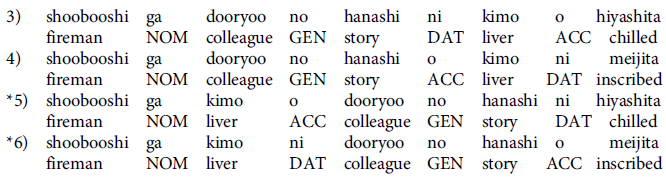
One difference between the idioms and dative structures is that scrambling is not possible in idioms (5 and 6 are unacceptable), and the inability to scramble is argued to arise from the way these idioms are base generated (Kishimoto, Reference Kishimoto2008; Miyagawa & Tsujioka, Reference Miyagawa and Tsujioka2004). It is not clear how to incorporate constraints on scrambling into production accounts with functional and positional processing mechanisms. Existing English work with idioms (Konopka & Bock, Reference Konopka and Bock2009) has not found strong differences in priming between flexible idioms which can scramble (e.g., shot off his mouth/his mouth off) and frozen idioms which cannot (e.g., brought up the rear). This predicts that the frozen body-part idioms in Japanese should also prime like dative structures.
But an alternative account is that speakers use production representations that are finely tuned to the particular language that they are speaking. This account allows for the possibility of substantial cross-linguistic differences in production. Support for this comes from the finding that English structural priming is insensitive to tense/aspect variation in the verb (Pickering & Branigan, Reference Pickering and Branigan1998), but German priming is changed by these manipulations (Chang, Baumann, Pappert, & Fitz, Reference Chang, Baumann, Pappert and Fitz2015). Evidence for differences in Japanese production processing comes from studies that have found that animacy can influence positional processing in scrambling in Japanese (Tanaka, Branigan, McLean, & Pickering, Reference Tanaka, Branigan, McLean and Pickering2011), but not positional processing in English (McDonald, Bock, & Kelly, Reference McDonald, Bock and Kelly1993). Connectionist models of production have been developed which can explain these cross-linguistic processing differences as a result of the language acquisition algorithm that is used to learn these languages in the first place (Japanese: Chang, Reference Chang2009; German: Chang et al., Reference Chang, Baumann, Pappert and Fitz2015). Furthermore, the same model can also explain structural priming by applying the learning algorithm to the prime sentences (Chang et al., Reference Chang, Dell and Bock2006). This account predicts that Japanese can differ from English in the way that idiomatic meaning is used in priming, and that will be examined in the first study.
Experiment 1: Idiom and dative priming in Japanese
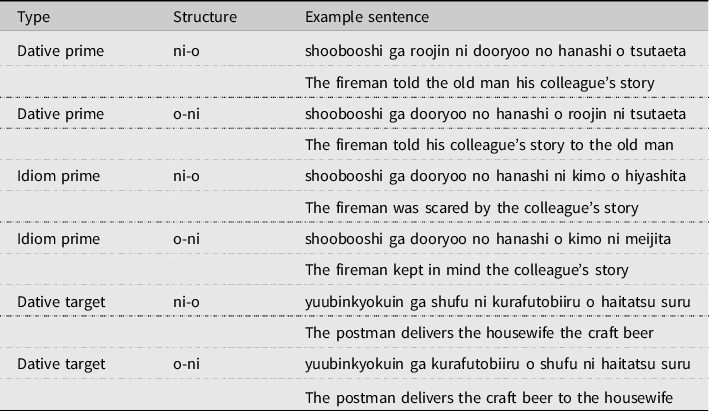
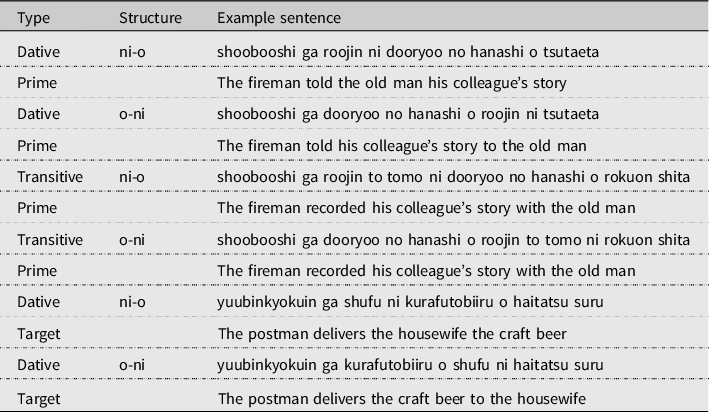
To examine how meaning influences structural priming in Japanese, we examined how the production of compositional dative targets was influenced by compositional and idiomatic prime sentences. For the target sentence, a prompt-based method that has been successful at eliciting different structures in Japanese was used (Yamashita & Chang, Reference Yamashita and Chang2001). Words from the target sentences were shown on the screen and participants had to order them and add particles (e.g., ga, ni, o) to produce a complete sentence. For example, the meaning for the sentence The postman delivers craft beer to the housewife would be elicited by showing the Japanese words haitatsu suru (deliver), yuubinkyokuin (postman), shufu (housewife), kurafutobiiru (craft beer) on the screen, and most speakers produced one of the two target sentences at the bottom of Table 1 with either ni-marked phrase before o-marked phrase (ni-o) or vice versa (o-ni). The target sentence was preceded by a prime sentence that was either a dative or idiom type (top part of Table 1). The compositional dative primes had a dative verb (e.g., told) and could appear in the canonical ni-o or scrambled o-ni structure. The idiom primes used the previously mentioned body-part idioms. Since scrambling was not possible, different idioms using the same body part were paired together. Thus, the ni-o structure was instantiated with the o-idiom (e.g., kimo o hiyashita) and the o-ni order used the ni-idiom (e.g., kimo ni meijita).
Dative and idiom stimuli for Experiment 1
There are three patterns of results that are theoretically relevant for understanding the relationship between meaning and structure. One possibility is that structural priming from idioms to datives will be similar in magnitude to dative–dative priming. This is consistent with previous studies that have found similar priming of compositional structures from non-compositional idioms as from compositional primes (Konopka & Bock, Reference Konopka and Bock2009). It is also consistent with some Japanese linguistic theories that have argued that dative-like idioms are structurally similar to datives (Miyagawa & Tsujioka, Reference Miyagawa and Tsujioka2004). Another possibility is that dative priming will be bigger from datives than from idioms, because idioms have less compositional meaning overlap with datives than other datives. This was found in English dative-like idioms in Ziegler et al. (Reference Ziegler, Snedeker and Wittenberg2018), although they used the same verb between prime and target, so the compositional meaning boost in that study may depend on verb overlap (lexical boost, Pickering & Branigan, Reference Pickering and Branigan1998). The present study uses different verbs on primes and targets, so it is possible to see if the compositional meaning boost exists when different verbs are used. Finally, it is possible that idioms will not prime datives. If this is the case, it suggests that idiomatic meaning may change structures sufficiently to block priming in Japanese.
Participants
The participants were 64 native Japanese speakers from the University of Tokyo community. Participants were paid 500 Japanese yen for the study, which took approximately 30 mins to complete. The work was conducted with the formal approval of the Ethics Review Committee for Experimental Research with Human Subjects at the University of Tokyo.
Stimuli
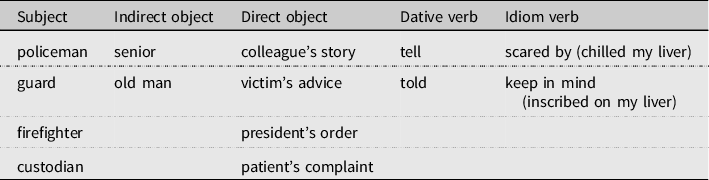
To create the prime sentences, eight idioms were selected which had an accusative-marked body part combined with a verb. For each body part, an alternative idiom was found that was ni-marked (Table 2).
Idiom stimuli used for Experiment 1

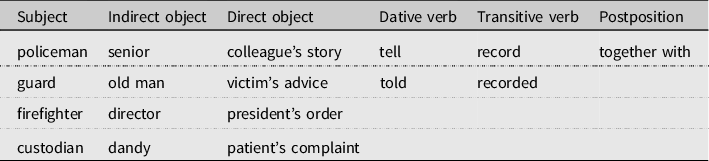
Since the ni- and o-idioms differed in meaning, it was desirable to compare them within each participant. To implement this within-participant design, eight dative verbs were paired with each body-part idiom to create eight superitems (see Table 3 for an example of one superitem). Four different sets of subject and object NPs were rotated through the ni-o dative and o-ni idiom sentences within each superitem. In addition, the dative sentences had four indirect object NPs and present/past tense forms of the verb. There were a total of 64 datives and 64 idiom prime sentences (half in o-ni/ni-o) and 64 dative target sentences. In contrast to other priming studies, where one sentence from an item is seen by each participant, in this study, participants saw four sentences (dative ni-o, dative o-ni, idiom ni-o, idiom o-ni) from the eight possible sentences in each superitem, such that there was no overlap of NPs or verb forms across the sentences for each participant (see Chang et al. (Reference Chang, Bock and Goldberg2003) for another priming study with superitems). Each prime–target pair was separated by a filler sentence with two NPs and a non-dative verb.
Example of words used for one superitem in Experiment 1
The study was done twice with two different methods for counterbalancing (24 in the first counterbalance and 40 participants in the second counterbalance). The motivation for the change in counterbalancing depends on the second study, so it will be explained later. But since the results were similar across the two counterbalances, an analysis of the combined dataset was done with counterbalancing as a factor to see if it interacted with structure or type. The first counterbalance was four lists that alternated between ni-o and o-ni structure for adjacent prime–target pairs and between dative and idiom types after two prime–target pairs. The second counterbalance was designed such that each prime–target pair was preceded by equal numbers of both ni-o and o-ni structures (balancing any inference from adjacent prime-target pairs). Each participant saw 16 datives and 16 idiom prime target pairs that were sampled from the possible dative and idiom primes in order to fit the constraints of the counterbalancing and ensure that there was no repetition of nouns or verbs for primes or targets. Stimuli and analysis files for all of the studies can be found at https://osf.io/46b5w/?view_only=f96b9e9eb9e745a2824fcb12e25f462e.
Procedure
The experiment appeared as a sequence of whole sentence reading and sentence production trials. The whole sentence reading trials showed a whole sentence in the center of the screen and participants were told to memorize the sentence. When participants pressed the spacebar, they were shown a picture of a mouth and this was a signal to say the sentence that they had memorized. The sentence production trials showed a verb and three NPs on the screen in a square pattern. In this square, the verb was in the top left, the agent was in the bottom right, and the recipient and patient were randomly positioned in the other two positions. Since Japanese written script is either left-to-right (starting with the top row and moving down) or top-bottom (starting with the rightmost column and moving left), the arrangement of elements on the screen made it difficult to use these standard strategies in this task and this created more variation in word order. Since there were no particles in the production trial stimuli, participants had to add these particles as they ordered the NPs. The whole sentence reading task was used for primes, while the target and fillers used the sentence production task. Utterances were recorded in both tasks.
Coding
For the data from the first counterbalance, the audio recordings of the target sentences were transcribed by Japanese coders. For the second counterbalance, the audio recordings were automatically transcribed by the Apple speech-to-text system (Apple Inc., 2019) and then the transcriptions were corrected and checked by a Japanese coder. This method appears to reduce the fatigue associated with typing the transcriptions and it allowed the transcriber to focus more on checking the match between the sentence and the audio. For both counterbalances, coding was done by taking the transcribed utterance and converting it into a structural code (e.g., gnov). For each of the target NPs, we checked if the NP was correctly produced and if this was the case, we replaced it with a position-specific code (e.g., P1 ga P2 o P3 ni V). When the position-specific code and particle were correct, then the structural code contained a letter representing that element (e.g., P1 ga P2 o P3 ni V $ \to $
gonv). Changes in verb tense were allowed. Changes in the NPs were allowed as long as animacy was the same as the target. Since the goal was to examine the choice in the order of ni- and o-arguments, changes to dative particles were not allowed (e.g., ni
$ \to $
gonv). Changes in verb tense were allowed. Changes in the NPs were allowed as long as animacy was the same as the target. Since the goal was to examine the choice in the order of ni- and o-arguments, changes to dative particles were not allowed (e.g., ni $ \to $
e), but the use of topic marking particle wa for the subject was allowed. The structural code was then used to identify cases where three arguments were produced with the target verb. Of these structures, we coded o-arguments were before ni-arguments (o-ni production = 1) and the reverse order (ni-o production = 0). Utterances with other word orders or large changes to the words/meaning were removed from the analysis, which allows us to focus on the structures that conveyed the same target meaning. A similar percentage of utterances was removed for both counterbalances (first counterbalance: 12%, second counterbalance: 13%), which suggests that the difference in the counterbalance and the coding procedure did not strongly biased the proportion of trials with data for examining priming. We reported mixed models in this paper, but similar results with a bayesian analysis can be found here https://osf.io/46b5w/?view_only=f96b9e9eb9e745a2824fcb12e25f462e.
$ \to $
e), but the use of topic marking particle wa for the subject was allowed. The structural code was then used to identify cases where three arguments were produced with the target verb. Of these structures, we coded o-arguments were before ni-arguments (o-ni production = 1) and the reverse order (ni-o production = 0). Utterances with other word orders or large changes to the words/meaning were removed from the analysis, which allows us to focus on the structures that conveyed the same target meaning. A similar percentage of utterances was removed for both counterbalances (first counterbalance: 12%, second counterbalance: 13%), which suggests that the difference in the counterbalance and the coding procedure did not strongly biased the proportion of trials with data for examining priming. We reported mixed models in this paper, but similar results with a bayesian analysis can be found here https://osf.io/46b5w/?view_only=f96b9e9eb9e745a2824fcb12e25f462e.
Results
A logistic mixed-effect model was used to predict o-ni production with structure, type, and counterbalance crossed (50,000 iterations were applied with the bobyqa optimizer). The maximal random effect structure that converged for this dataset was identified (Barr, Levy, Scheepers, & Tily, Reference Barr, Levy, Scheepers and Tily2013) and there were no random slopes for either participants or items (coefficient of determination: the variance explained by the fixed effects ${R^2}$
m=0.063, the variance explained by the whole model
${R^2}$
m=0.063, the variance explained by the whole model ${R^2}$
c=0.282). As recommended by Barr et al. (Reference Barr, Levy, Scheepers and Tily2013) as well as the developers of the mixed model software (Bocker, Reference Bocker2021), likelihood-ratio tests were performed by comparing models that were the same except for the rightmost term. Terms were removed from the right until no terms were available (akin to type I sequential sum of squares in ANOVA). Only the highest order significant terms were interpreted. In the text, we report p values from these model comparisons.
${R^2}$
c=0.282). As recommended by Barr et al. (Reference Barr, Levy, Scheepers and Tily2013) as well as the developers of the mixed model software (Bocker, Reference Bocker2021), likelihood-ratio tests were performed by comparing models that were the same except for the rightmost term. Terms were removed from the right until no terms were available (akin to type I sequential sum of squares in ANOVA). Only the highest order significant terms were interpreted. In the text, we report p values from these model comparisons.
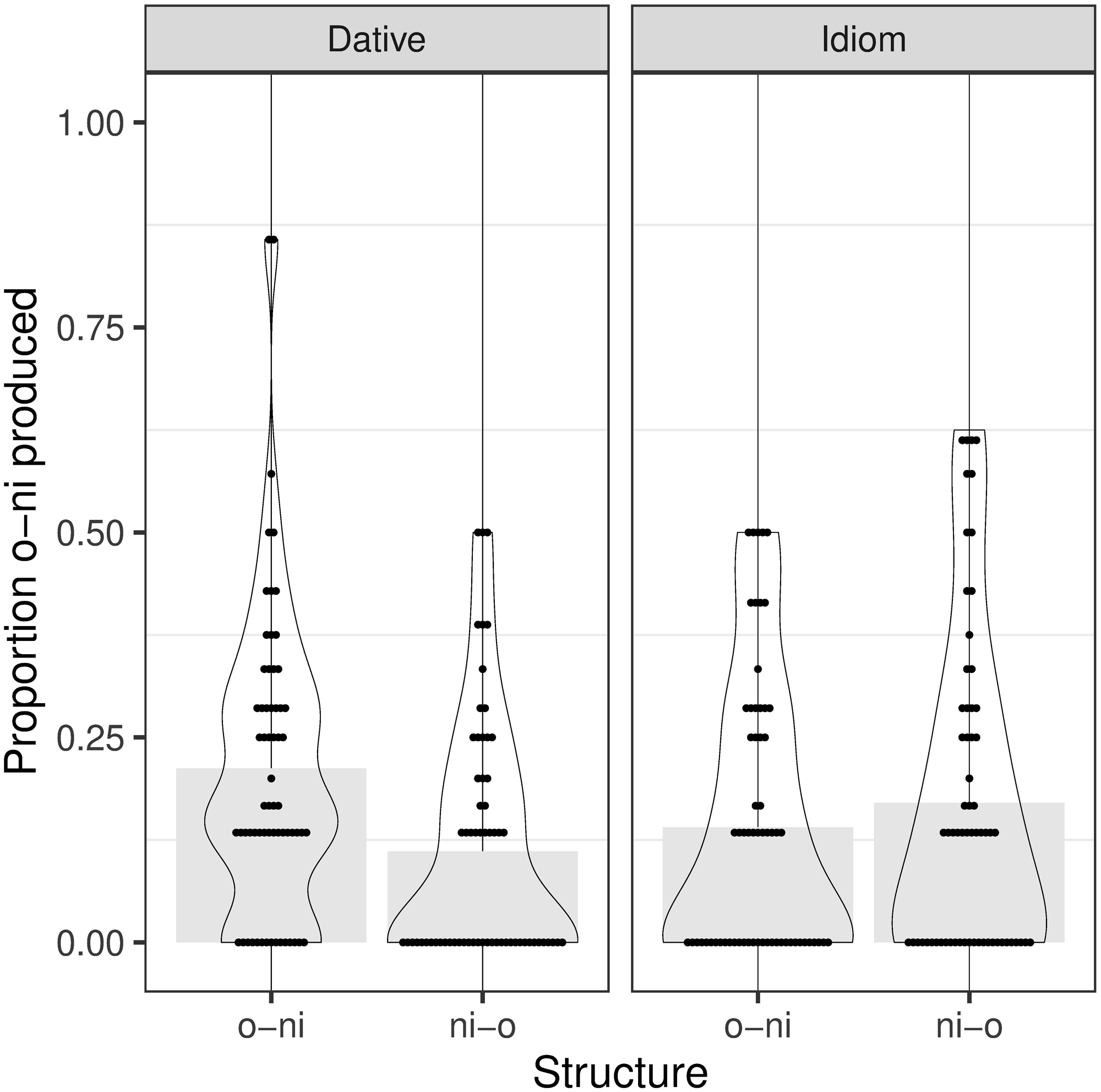
The results are depicted in Figure 1. The means for each condition are shown by the light and dark grey bars, the violin bars show the distribution, and the dots in the stacked dot plots show the average results for participants. There was no main effect of type (p = .970) or structure (p = .122), but there was a significant interaction between structure and type ( $\beta $
= 1.3, SE = 0.32,
$\beta $
= 1.3, SE = 0.32, ${\chi ^2}\;$
= 15.83, CI = [0.66,1.9], p < .001). Since there was an interaction, posthocs were performed adjusting for the number of comparisons (Hothorn et al., Reference Hothorn, Bretz, Westfall, Heiberger, Schuetzenmeister and Scheibe2019; Lenth, Singmann, Love, Buerkner, & Herve, Reference Lenth, Singmann, Love, Buerkner and Herve2019). The interaction was due to greater use of o-ni target descriptions after o-ni primes compared to the ni-o primes in the dative condition (z = 3.6, p < .001), but no difference in the idiom condition (p = .436). In addition, the violin lines in Figure 1 show that the distribution is quite different for the two structures in the dative condition. In the dative ni-o condition, the highest participant proportion of o-ni dative structures is 0.5, but in the o-ni condition, three participants show higher levels of priming. But the biggest difference is due to the fact that there were 20 more participants in the ni-o condition who did not produce any scrambled o-ni structures. In contrast in the idiom condition, the distribution is similar across the two prime structures. Critically, the lack of priming in the idiom condition is not just due to a weak effect, but also the effect is in the wrong direction (more o-ni structures are produced after ni-o primes). There was a main effect of counterbalance (
${\chi ^2}\;$
= 15.83, CI = [0.66,1.9], p < .001). Since there was an interaction, posthocs were performed adjusting for the number of comparisons (Hothorn et al., Reference Hothorn, Bretz, Westfall, Heiberger, Schuetzenmeister and Scheibe2019; Lenth, Singmann, Love, Buerkner, & Herve, Reference Lenth, Singmann, Love, Buerkner and Herve2019). The interaction was due to greater use of o-ni target descriptions after o-ni primes compared to the ni-o primes in the dative condition (z = 3.6, p < .001), but no difference in the idiom condition (p = .436). In addition, the violin lines in Figure 1 show that the distribution is quite different for the two structures in the dative condition. In the dative ni-o condition, the highest participant proportion of o-ni dative structures is 0.5, but in the o-ni condition, three participants show higher levels of priming. But the biggest difference is due to the fact that there were 20 more participants in the ni-o condition who did not produce any scrambled o-ni structures. In contrast in the idiom condition, the distribution is similar across the two prime structures. Critically, the lack of priming in the idiom condition is not just due to a weak effect, but also the effect is in the wrong direction (more o-ni structures are produced after ni-o primes). There was a main effect of counterbalance ( $\beta $
= 0.79, SE = 0.36,
$\beta $
= 0.79, SE = 0.36, ${\chi ^2}\;$
= 4.49, CI = [0.09,1.5], p = .034), but there was no interaction of counterbalance with any other variable. This means that the counterbalance did not strongly influence the priming variables in the study and this justifies the aggregation of the data from the two counterbalances.
${\chi ^2}\;$
= 4.49, CI = [0.09,1.5], p = .034), but there was no interaction of counterbalance with any other variable. This means that the counterbalance did not strongly influence the priming variables in the study and this justifies the aggregation of the data from the two counterbalances.
Proportion o-ni produced by structure and type for Experiment 1.
The significant interaction in this study demonstrates that there was dative–dative priming, but no idiom–dative priming. This is different from what has been found in English, where non-compositional idioms primed structurally similar compositional structures (Konopka & Bock, Reference Konopka and Bock2009; Ziegler et al., Reference Ziegler, Snedeker and Wittenberg2018). The results are also at odds with linguistic theoretical work arguing that dative-like idioms and datives have similar structures (Miyagawa & Tsujioka, Reference Miyagawa and Tsujioka2004). To better understand these results, it is necessary to disentangle compositionality from other differences in meaning. The idiom verbs in this study were created from body-part verb combination, where the body part does not have an independent role in the event (the liver is not actually used to feel scared). Thus, the non-compositional nature of idiomatic meaning could reduce priming on dative targets. To examine this issue, the next study used structures that were more compositionally similar to datives.
Experiment 2: Transitive and dative priming in Japanese
The lack of idiom–dative priming in Experiment 1 could be due to the non-compositional nature of idioms. To examine this issue, we used transitive locative structures which have different meanings from datives, but which have a similar number of meaning elements that compositionally create the overall meaning. Bock and Loebell (Reference Bock and Loebell1990) examined transitive–dative priming in English by comparing the effect of dative and transitive locative primes on the description of dative targets (e.g., double object A musician passed a boy a guitar; prepositional dative A musician passed a guitar to a boy). To test dative priming, they preceded the target with double object primes (e.g., The wealthy widow gave the church an old Mercedes) and prepositional dative primes (e.g., The wealthy widow gave an old Mercedes to the church), where the verb was a dative verb that required a patient (e.g., Mercedes) and a recipient (e.g., church). To see if priming could take place based on the surface structure, they tested prepositional locative primes (e.g., The wealthy widow drove an old Mercedes to the church), where the verb was transitive and the PP was a location, rather than a recipient. They found that dative priming was the same from prepositional locatives compared to prepositional datives, which means that the recipient role overlap in dative–dative priming did not strongly influence priming. In combination with other studies that varied overlap between prime and target (e.g., Bock, Reference Bock1989), it was argued that structural priming involved abstract syntactic structures.
Various studies have found that structural priming can be modulated by thematic role overlap between the prime and target (Chang et al., Reference Chang, Bock and Goldberg2003; Pappert & Pechmann, Reference Pappert and Pechmann2014; Vernice, Pickering, & Hartsuiker, Reference Vernice, Pickering and Hartsuiker2012). Ziegler and Snedeker (Reference Ziegler and Snedeker2018) reexamined the dative study in Bock and Loebell (Reference Bock and Loebell1990) by changing the stimuli and testing a large number of participants. They found a difference between prepositional datives and prepositional locatives on dative priming and they argued this was due to the reduced overlap between the location thematic role with the dative recipient role as compared to the same role in dative prime–target pairs. Thus, there is evidence that structural priming is increased by meaning overlap and this suggests that structure sharing is reduced when different roles are used. If the meaning of dative-like idioms in Japanese reduces their overlap with datives, then that could explain the lack of priming in Experiment 1.
To examine this issue, Japanese dative and transitive primes were tested with dative targets. In Table 4, the dative primes and targets were similar to the items that were used in Experiment 1. Transitive items had the same noun arguments as the dative items, but the verb was changed to a transitive verb (e.g., recorded). To ensure that the ni-marked argument was not viewed as a traditional recipient, one of four postpositions was added to the ni-marked NP (e.g., roojin to tomo ni “together with the old man”). Within Japanese theories, it has been argued that the meaning of these ni-marked phrases changes its structural configuration (Matsuoka, Reference Matsuoka2003). In particular, these types of phrases would be postpositions, where the ni particle is not cliticized to the NP, but instead creates its own postpositional phrase (Miyagawa, Reference Miyagawa1989; Sadakane & Koizumi, Reference Sadakane and Koizumi1995). These theories predict that transitives with ni-adjuncts will not prime datives with ni-arguments, because they have different structures. Previous studies have found transitive–dative priming in Japanese (Yamashita et al., Reference Yamashita, Chang and Hirose2002), but it is worth replicating these findings with the same dative target stimuli that were used in Experiment 1. There are three outcomes for this study that are theoretically interpretable. If priming from transitives to datives is the same as dative–dative priming, that would imply that priming involves abstract structures that are independent of meaning (Bock & Loebell, Reference Bock and Loebell1990). On the other hand, if priming is larger for datives than transitives, then that would suggest that role overlap in meaning can impact priming and this suggests that structures are yoked to role meaning in some way (Ziegler & Snedeker, Reference Ziegler and Snedeker2018). It is also possible that transitives will not prime datives and this would suggest that scrambling-based priming can be blocked by changes in meaning.
Dative and transitive stimuli for Experiment 2
Method
The participants were 64 native Japanese speakers from the University of Tokyo community excluding those from the previous study. The experiment procedure was the same as in Experiment 1. The dative target phrases/verbs, dative primes, and filler sentences were similar to those from Experiment 1. The idiom items from Experiment 1 were replaced with transitive sentences that used the same nouns as the dative items. The ni-marked argument in the transitive sentences was marked with one of four postpositional forms (no kawari ni “instead of,” no tame ni “for,” to tomo ni “with,” and to issho ni “with”) in a verb-specific way, such that each list had an equal number of each form. The dative and transitive stimuli could appear in either the ni-o or o-ni structure. Each participant saw four sentences with unique noun/verb phrases from the eight possible sentences in each of the eight superitems (Table 5 shows a single superitem with examples of the different lexical elements).
Example of words used for one superitem in Experiment 2
As in Experiment 1, two counterbalances with four lists each were used (24 participants were in the first counterbalance, 40 in the second counterbalance). The first counterbalance alternated between ni-o and o-ni structure for each adjacent prime–target pairs and between dative and transitive types after two prime–target pairs. The second counterbalance was designed such that each prime–target pair was preceded by equal numbers of both ni-o and o-ni structures. Each participant saw 16 dative and 16 transitive prime target pairs sampled from the 64 datives and 64 transitive prime sentences (half in o-ni/ni-o) and 64 dative target sentences in order to fit the constraints of the counterbalancing and avoid repetition of nouns or verbs for primes or targets within each participant. The coding procedure was similar to the procedure from Experiment 1 except the tape was fully transcribed by Japanese coders. Utterances which involved large changes in words or meaning were removed, but a similar percentage was removed for both counterbalances (first counterbalance: 12%, second counterbalance: 11%).
Results
A logistic mixed-effect model was used to predict o-ni production with structure, type, and counterbalance crossed (50,000 iterations were applied with the bobyqa optimizer). The maximal random effect structure for the data was identified, and there were no random slopes for either participants or items (coefficient of determination: the variance explained by the fixed effects ${R^2}$
m=0.011, the variance explained by the whole model
${R^2}$
m=0.011, the variance explained by the whole model ${R^2}$
c=0.244). In this study, there was a main effect of structure (
${R^2}$
c=0.244). In this study, there was a main effect of structure ( $\beta $
= 0.26, SE = 0.13,
$\beta $
= 0.26, SE = 0.13, ${\chi ^2}\;$
= 5.34, CI = [0,0.53], p = .021), but no main effect of type (p = .390) nor interaction (p = .977). As shown in Figure 2, the main effect of structure was due to greater o-ni target production after o-ni primes for both dative and transitive primes. The lack of an interaction of structure and type means that the magnitude of priming from transitives to datives was similar to the priming from datives to datives. The difference in the distribution for o-ni vs ni-o appears to be bigger for datives than transitives, but actually there are similar differences in the distribution for both types. At the low end of the distribution, the difference in the number of participants who produced no scrambled structures for ni-o vs o-ni was six in the datives and nine in the transitive condition. At the high end, the number of participants who produced more than 30% o-ni structures was three greater in the o-ni condition than the ni-o condition for the dative, and five higher in the transitive. Thus, in addition to the similarity in the average priming effect in the dative and transitive conditions, there were similar differences in the distribution for o-ni and ni-o for each type. These results are consistent with English priming studies which found no difference between transitive and datives (Bock & Loebell, Reference Bock and Loebell1990). A strong effect of role overlap was not found in the present study as has been found in some English priming studies (Ziegler & Snedeker, Reference Ziegler and Snedeker2018). The transitives had non-recipient ni-marked adjuncts that were different from the recipient ni-marked arguments in the datives (Sadakane & Koizumi, Reference Sadakane and Koizumi1995), but these transitives primed datives in a similar manner to dative primes.
${\chi ^2}\;$
= 5.34, CI = [0,0.53], p = .021), but no main effect of type (p = .390) nor interaction (p = .977). As shown in Figure 2, the main effect of structure was due to greater o-ni target production after o-ni primes for both dative and transitive primes. The lack of an interaction of structure and type means that the magnitude of priming from transitives to datives was similar to the priming from datives to datives. The difference in the distribution for o-ni vs ni-o appears to be bigger for datives than transitives, but actually there are similar differences in the distribution for both types. At the low end of the distribution, the difference in the number of participants who produced no scrambled structures for ni-o vs o-ni was six in the datives and nine in the transitive condition. At the high end, the number of participants who produced more than 30% o-ni structures was three greater in the o-ni condition than the ni-o condition for the dative, and five higher in the transitive. Thus, in addition to the similarity in the average priming effect in the dative and transitive conditions, there were similar differences in the distribution for o-ni and ni-o for each type. These results are consistent with English priming studies which found no difference between transitive and datives (Bock & Loebell, Reference Bock and Loebell1990). A strong effect of role overlap was not found in the present study as has been found in some English priming studies (Ziegler & Snedeker, Reference Ziegler and Snedeker2018). The transitives had non-recipient ni-marked adjuncts that were different from the recipient ni-marked arguments in the datives (Sadakane & Koizumi, Reference Sadakane and Koizumi1995), but these transitives primed datives in a similar manner to dative primes.
Proportion o-ni produced by structure and type for Experiment 2.

In this study, there were no main effects or interactions with counterbalance, which supports our approach of aggregating the data from the two counterbalances. Initially, the first counterbalance was used for the idiom study and then the transitive study. The transitive study had a weak dative priming effect and this was thought to be due to the way that the first counterbalance alternated between structures for each prime–target pair. In that counterbalance, a dative o-ni prime would sometimes be followed by its target, a filler, a dative ni-o prime, and its target. In this sequence, the last target is preceded by a ni-o prime, so priming would be greater use of the ni-o structure. But if the priming from the first o-ni prime persists and influences the last target, that will create anti-priming. To reduce this effect, the second counterbalance was developed which insured that each trial was proceeded by both ni-o and o-ni primes in equal numbers. Since these counterbalances were run at different times, there were some differences in the way that the data were coded. But as can be seen from the results, none of the differences in the two counterbalances interacted with priming and hence they have been collapsed together.
In this study, transitives primed datives, but dative-like idioms did not prime in Experiment 1. To directly compare these results, a model was fitted to the combined data from both studies with prime structure and type (idiom, transitive, dative). Type was coded using a Helmert coding, which had one contrast comparing idioms and transitives, and another orthogonal contrast comparing datives with these structures. The maximal model had no random slopes for participants (coefficient of determination: the variance explained by the fixed effects ${R^2}$
m = 0.012, the variance explained by the whole model
${R^2}$
m = 0.012, the variance explained by the whole model ${R^2}$
c = 0.186). There was a main effect of structure (
${R^2}$
c = 0.186). There was a main effect of structure ( $\beta $
= 0.2, SE = 0.1,
$\beta $
= 0.2, SE = 0.1, ${\chi ^2}\;$
= 9.57, CI = [0,0.39], p = .002), an interaction of dative with the two other structures (
${\chi ^2}\;$
= 9.57, CI = [0,0.39], p = .002), an interaction of dative with the two other structures ( $\beta $
= 0.34, SE = 0.12,
$\beta $
= 0.34, SE = 0.12, ${\chi ^2}\;$
= 7.11, CI = [0.09,0.58], p = .0077), and an interaction of structure with the idiom/transitive contrast (
${\chi ^2}\;$
= 7.11, CI = [0.09,0.58], p = .0077), and an interaction of structure with the idiom/transitive contrast ( $\beta $
= 0.56, SE = 0.27,
$\beta $
= 0.56, SE = 0.27, ${\chi ^2}\;$
= 4.17, CI = [0.04,1.09], p = .041). The last contrast demonstrates that transitives prime datives more than idioms, which implies that scrambling-based priming in Japanese may depend on the compositional meaning of transitives.
${\chi ^2}\;$
= 4.17, CI = [0.04,1.09], p = .041). The last contrast demonstrates that transitives prime datives more than idioms, which implies that scrambling-based priming in Japanese may depend on the compositional meaning of transitives.
Discussion
The present studies examined how meaning influences the syntactic representations that are used in scrambling in Japanese. English studies have found that structural priming can occur when there is structural similarity between primes and targets, even if the primes differ greatly from the targets in their roles or meaning (Bock & Loebell, Reference Bock and Loebell1990; Konopka & Bock, Reference Konopka and Bock2009; Ziegler et al., Reference Ziegler, Snedeker and Wittenberg2018). However, this evidence for priming based on the syntactic structure may depend in part on the fact that many languages tend to use a combination of functional and positional processing to encode syntactic alternations. In contrast, Japanese uses mainly positional processing to encode alternations and constraints on scrambling in idioms may change the relationship between meaning and structures. To see if this is the case, meaning was manipulated in dative priming in Japanese. In the two studies, it was found that dative o-ni scrambled primes increased the use of o-ni structures on dative targets relative to ni-o primes and this priming effect is consistent with priming of scrambled structures in other languages (Köhne et al., Reference Köhne, Pickering and Branigan2014). This dative–dative priming effect was compared with two other structures that were superficially similar to datives in terms of their case-marked phrases, but which differed in their meaning. In Experiment 1, it was found that idioms do not prime datives, but in Experiment 2, transitives did prime datives. This pattern of results is not straightforwardly explained by existing theories.
The results in the transitive–dative priming study are similar to studies in English (Bock & Loebell, Reference Bock and Loebell1990), which have found that structural similarity is sufficient to support priming even with differences in thematic roles. For example in the transitive prime The fireman recorded his colleague’s story with the old man, the old man could be viewed as an additional agent of the verb record, because he is helping with the recording of the story. This role is quite different from the recipient role in the dative targets and yet priming was found from transitives to datives. This result is at odds with theories that predict that priming depends strongly on thematic role overlap (Goldberg, Reference Goldberg1995; Ziegler & Snedeker, Reference Ziegler and Snedeker2018). Since the effect of role overlap can be small, it may require more participants to find this difference and we leave this issue for future studies that are better designed to examine it. The present results simply demonstrate that differences in role meaning will not necessarily block transitive–dative priming and this is broadly consistent with what has been found in English.
The lack of priming from idioms to datives is the one result that is different from what would be predicted from the work in English (Konopka & Bock, Reference Konopka and Bock2009; Ziegler et al., Reference Ziegler, Snedeker and Wittenberg2018). One of the main differences between the idioms and transitive primes was in the compositionality of their meaning. The transitives had three concepts that each contributed a part to the meaning (e.g., fireman, story, old man) and that is similar to the three concepts in the dative targets (e.g., postman, craft beer, housewife). In contrast, the idiom primes had verbs that incorporated one of the NPs (e.g., chilled the liver) and hence they only had two truly compositional concepts (e.g., fireman, story). But these differences also exist in English idioms and studies with those idioms have found priming of datives (Ziegler et al., Reference Ziegler, Snedeker and Wittenberg2018). One way to explain the difference between the languages is to argue that positional-level processes are more sensitive to idiomatic meaning than functional processing, and hence the Japanese scrambling alternations may be different from the English dative alternation that change syntactic functions. But this account cannot explain the priming from idiomatic verb–particle sentences in English (Konopka & Bock, Reference Konopka and Bock2009), which also does not involve syntactic function assignment and only uses positional processing (e.g., the particle off is scrambled, scared off the customer vs scared the customer off). Thus in order to explain the lack of idiom priming in Japanese, it seems necessary to argue that idiomatic meaning has a different relationship to positional processing in English and Japanese.
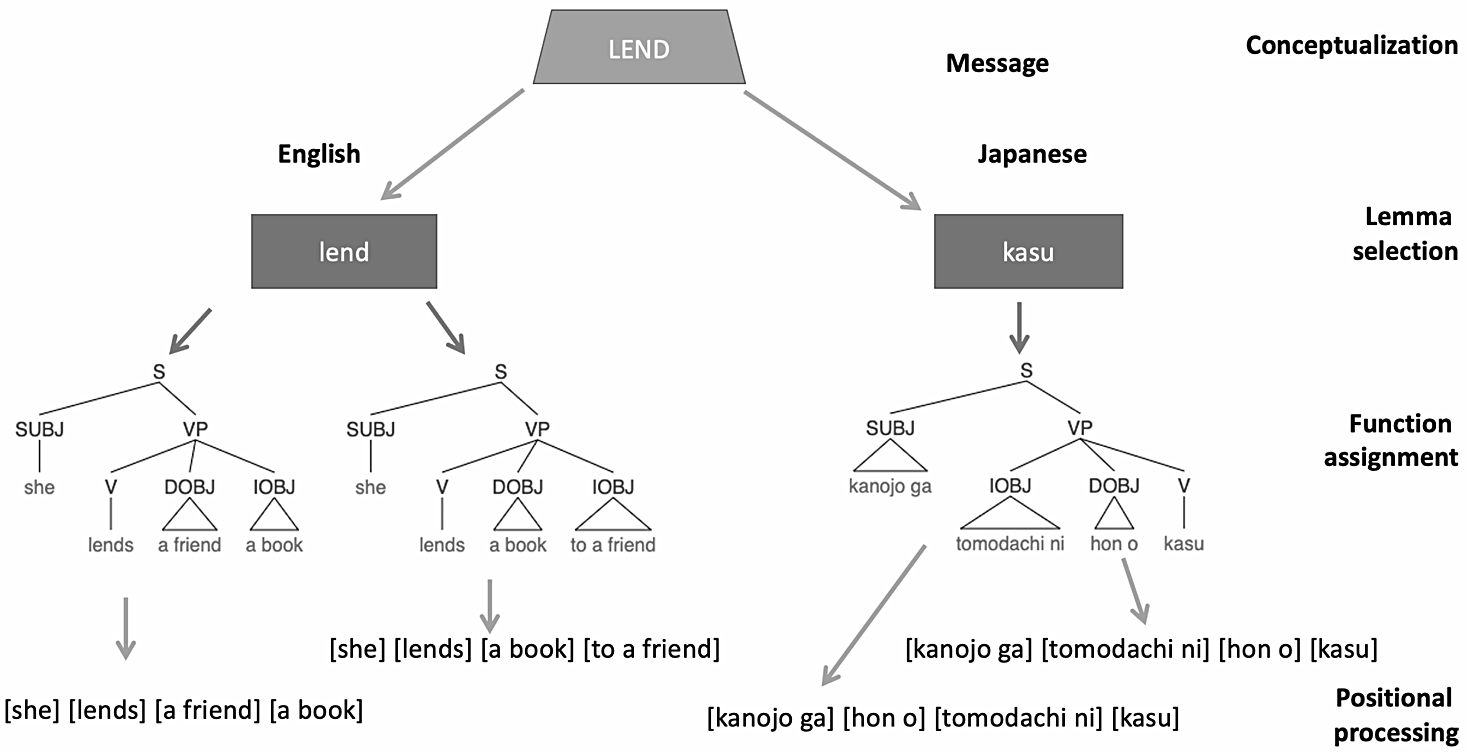
To examine how idiomatic constraints might differ in English and Japanese, we will sketch out how Bock and Levelt’s (Reference Bock, Levelt and Gernsbacher1994) model of grammatical encoding might be applied to priming with compositional datives and idioms. Figure 3 shows how compositional datives might be planned. The first step is conceptualization, where the speaker creates a message, which in this example involves a woman that is lending a book to a friend. The next step is lemma selection and in English, the lemma “lend” is activated by the action concept of LEND in the message. Next function assignment takes place where the arguments are mapped to syntactic functions like direct object (DOBJ) or indirect object (IOBJ). Since compositional datives have two possible mappings, two different structures are possible. Finally, these structures are linearized in positional processing. Since scrambling is not common in English, the double object and prepositional dative structures are the two main alternatives that are generated. In Japanese, the message concept for LEND activates the lemma for kasu (ignoring variation in verb forms, Chang, Tatsumi, Hayakawa, Yoshizaki, & Oka, Reference Chang, Tatsumi, Hayakawa, Yoshizaki and Oka2021). But there is only one way to assign syntactic functions and therefore only one structure is possible in function assignment. In positional processing, scrambling is common in Japanese and multiple linearizations are possible.
English and Japanese compositional datives in grammatical encoding.

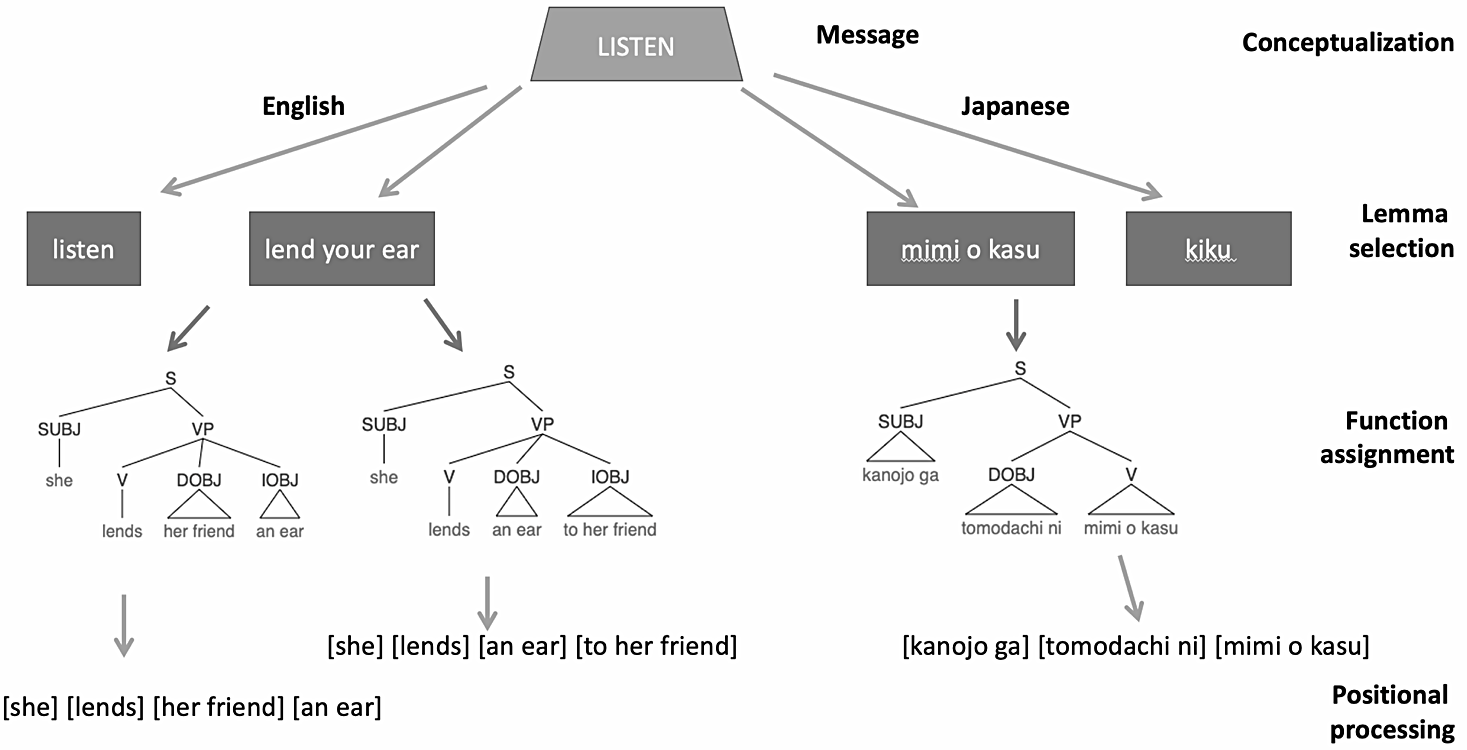
Figure 4 shows how the English idiom “lend an ear” and the similar Japanese idiom mimi o kasu can be generated. Since both idioms have the meaning of listening to someone, we assume that the message has a concept of LISTEN. In lemma selection, this can cause various verb lemmas to become activated (e.g., “listen” or kiku). But in this example, we assume superlemmas for the idioms “lend an ear” or mimi o kasu are activated and selected for some reason. In English, the idiom “lend an ear” can appear in both prepositional datives and double objects, so it would make sense to use the same structures that are used in compositional datives. Then these structures are linearized in positional processing in a similar way to compositional datives. On this account, the reason that idiomatic structures prime compositional dative structures (Ziegler et al., Reference Ziegler, Snedeker and Wittenberg2018) is because of the structural similarity at either the functional or positional level.
English and Japanese idioms in grammatical encoding.
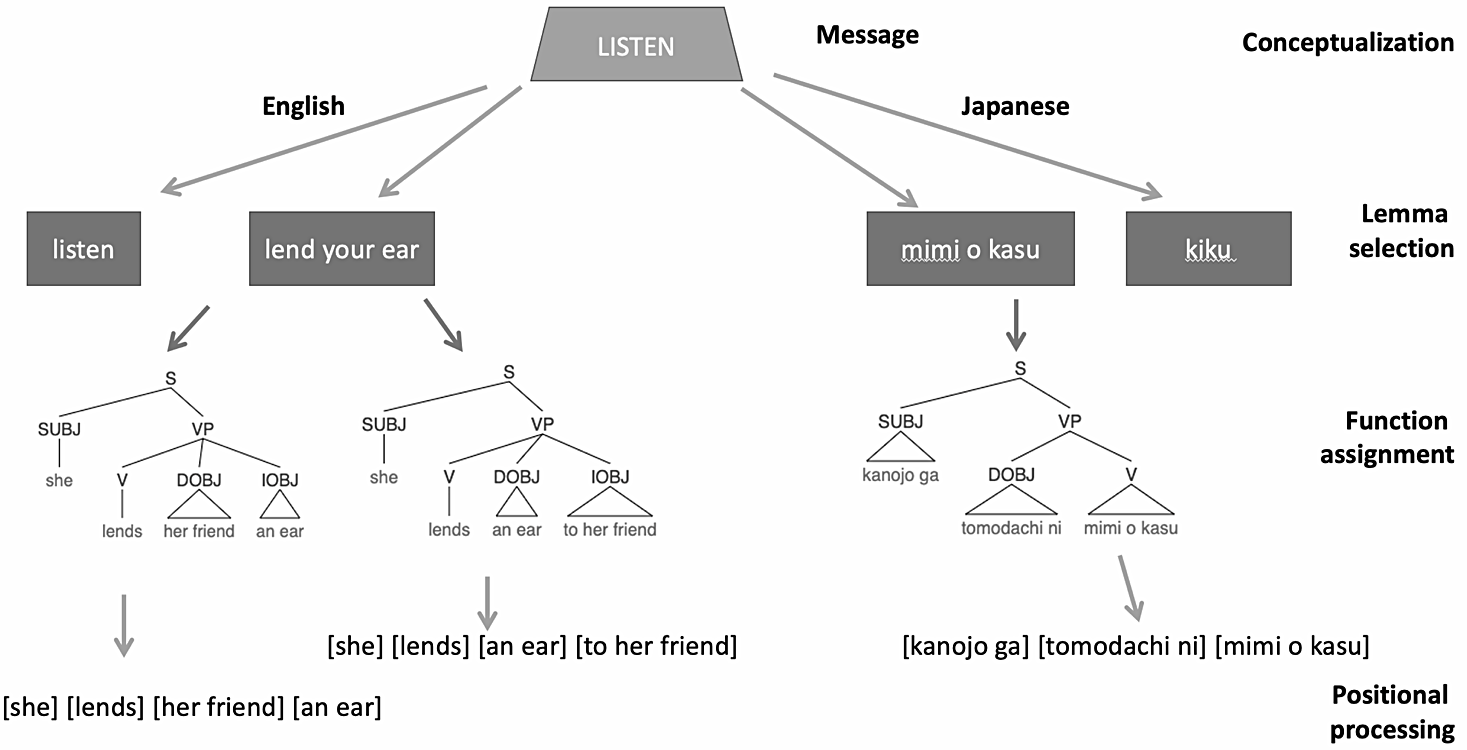
Evidence for positional-level priming in studies of verb particle movement in English (Konopka & Bock, Reference Konopka and Bock2009) and scrambled structures in German and Dutch (Hartsuiker & Westenberg, Reference Hartsuiker and Westenberg2000; Pappert & Pechmann, Reference Pappert and Pechmann2014) predicts that there should be positional priming in Japanese. But the idiomatic Japanese structures in Experiment 1 did not prime datives, which suggests that there is no overlap at either the functional or positional levels. In addition, it is necessary to restrict scrambling of the NP “mimi o.” One way to implement that is to assume that the verb representation is a multiword unit at both the functional and positional levels (e.g., mimi o kasu). This makes the functional-level structure for an idiom different from the one used for datives and that explains the lack of priming between the two. To explain Experiment 2, we assume that transitive structures with three NPs make use of the same structures as datives at both levels and that allows priming between the two.
In the English example, we have used a flexible idiom that can appear in two structures. But there are also frozen idioms that need to be restricted. Ziegler et al. (Reference Ziegler, Snedeker and Wittenberg2018) used idioms that only occurred in the double object (“the audience gives the performer his due”) or the prepositional dative (“The spirit of change gives rise to a new era of leadership”). In this account, the superlemma for these idioms would only be attached to a single structure at the functional level and a single linearization at the positional level. But it has been shown that frozen idioms prime compositional structures in the same way as flexible structures (Konopka & Bock, Reference Konopka and Bock2009; Ziegler et al., Reference Ziegler, Snedeker and Wittenberg2018), and this is explained in this account by assuming that English idioms use the same structures as compositional verbs at the functional and positional levels. Thus, the links between the superlemma and the structures in function assignment can explain restrictions on word order in frozen idioms, but shared structures can explain why priming is similar for frozen and flexible idioms in English.
Although this is just one account of how priming might work within grammatical encoding theory, there are still many open questions. For example, how does the English system know that idioms use the same structures at the functional/positional level, while the Japanese system uses distinct structures for idioms? How does the Japanese system know to use the same structures for transitive and datives? Also, there is some evidence that scrambling can occur with Japanese idioms under specific conditions (e.g. scrambling multiple arguments and prosodic phrasing, Agbayani, Golston, & Ishii, Reference Agbayani, Golston and Ishii2015). How can this account explain the restriction on scrambling with single arguments as well as the conditions where scrambling of idioms is more acceptable? These are challenging to explain within grammatical encoding theory as it is not integrated with a language acquisition theory that could explain how the different English and Japanese representations were learned.
One account that integrates language learning and sentence production is the Dual-path model (Chang, Reference Chang2002), which is a connectionist model that learns production representations that can map from a message to a sequence of words. Starting with no syntactic knowledge of the language being learned, the model can learn to produce sentences in English and Japanese at similar levels of accuracy even with differences in scrambling and argument omission (Chang, Reference Chang2009). For word order phenomena, it was shown that the model learned different types of constraints in each language (e.g., depending more on meaning in Japanese, more on lexical constraints in English). While grammatical encoding assumes that verb lemma selection takes place early in all languages, a learning-based account like the Dual-path model predicts that lemma selection will depend on the position where verb-related decisions must be made in each language and this is consistent with some of the variation that is seen in verb planning in English (Schnur, Costa, & Caramazza, Reference Schnur, Costa and Caramazza2002), Japanese (Momma, Slevc, & Phillips, Reference Momma, Slevc and Phillips2016), and German (Schriefers, Teruel, & Meinshausen, Reference Schriefers, Teruel and Meinshausen1998). Finally, learning is not just needed to explain the differences in the representations that are used in different languages, but it is also critical for explaining structural priming itself (Bock & Griffin, Reference Bock and Griffin2000). The learning algorithm in the Dual-path model can explain structural priming as implicit learning, and it provides the widest coverage of priming data of any explicit model (Chang et al., Reference Chang, Baumann, Pappert and Fitz2015, Reference Chang, Dell and Bock2006). Thus, although the account of Japanese and English priming that is presented here is still incomplete, the multiple differences in production between these languages suggest that language learning plays an important role in the process.
The present work found that the relationship between idiomatic meaning and structures priming was different in Japanese compared to previous studies in English. These results add to a growing literature suggesting that production can vary in response to the unique set of syntactic representations and constraints in particular languages. The existence of production differences should not be surprising, because of the large number of linguistic differences between languages. For example, English speakers have two main dative structures, but Japanese speakers have 24 different ways to express a dative when we consider scrambling, argument omission, and topicalization. The present work has only examined a small subset of the factors that differ between these languages, and more work is needed to fully understand the nature of Japanese sentence production.
Acknowledgements
We would like to thank the support of the Japanese Society for the Promotion of Science Invitation Fellowship for Research in Japan (FY2016, University of Tokyo). Franklin Chang was a member of the ESRC International Centre for Language and Communicative Development (LuCiD), and the support of the Economic and Social Research Council (ES/L008955/1) is gratefully acknowledged. We would like to thank Takeshi Kishiyama and Masaki Sone for their help with the study.



 Open access

