





Introduction
Bilingualism, the ability to effectively communicate in more than one language, is a common trait uniting the majority of people on our planet (Grosjean, Reference Grosjean2010). This trend towards bilingualism is driven, in part, by the diverse linguistic landscapes around the globe (UNESCO Decade of the Indigenous Language 2022–2032), as well as sociolinguistic influences as a consequence of globalization, migration, and technology, often necessitating proficiency in a second or even third language (Da Silva et al., Reference Da Silva, McLaughlin and Richards2007). Bilingualism carries with it undeniable benefits in social and linguistic domains, the most obvious being the ability to communicate with a larger, more diverse population of interlocutors. Although the economic, social, and linguistic benefits of bilingualism are widely accepted, there is considerable debate surrounding the claim that using more than one language can result in general cognitive benefits (Antoniou, Reference Antoniou2019; Bialystok & Craik, Reference Bialystok and Craik2022; De Bruin & Della Sala, Reference De Bruin, Della Sala and Schwieter2019; Paap, Reference Paap2019). One focus of this debate is whether previously reported cognitive effects attributed to bilingualism are actually the result of highly correlated non-linguistic variables that co-occur with formal and informal use of more than one language such as higher levels of education, mobility, migration, and socioeconomic status (SES).
Because both a bilingual’s languages are thought to be simultaneously active (Abutalebi & Green, Reference Abutalebi and Green2007; Costa et al., Reference Costa, Roelstraete and Hartsuiker2006; Hermans et al., Reference Hermans, Bongaerts, De Bot and Schreuder1998; Kroll et al., Reference Kroll, Dussias, Bogulski and Kroff2012), and because intrusion errors among bilinguals are rare (Gollan & Ferreira, Reference Gollan and Ferreira2009), some underlying inhibitory process must be recruited in support of successful communication (Green, Reference Green1998). Additionally, identification of the appropriate language to use in a given context requires monitoring and attending to salient linguistic cues (Costa et al., Reference Costa, Hernández and Sebastián-Gallés2008). Both of these are accomplished through the effort of language control networks, with specific demands on these networks varying based on the interactional context in which a bilingual finds themselves (Abutalebi & Green, Reference Abutalebi and Green2007). The experience of successfully managing two languages is thought to impact on cognitive control (also referred to as executive function), attentional functions that are goal-directed, and composed of multiple, separable abilities including updating, shifting, and inhibition (Friedman & Miyake, Reference Friedman and Miyake2017; Miyake et al., Reference Miyake, Friedman, Emerson, Witzki, Howerter and Wager2000). Compared to monolinguals, bilinguals are expected to demonstrate improved performance on tasks that measure inhibition or attentional control (Bialystok, Reference Bialystok2017; Bialystok & Craik, Reference Bialystok and Craik2022) including the Simon task (Simon & Rudell, Reference Simon and Rudell1967), Flanker task (Eriksen & Eriksen, Reference Eriksen and Eriksen1974), and Attention Network Test (ANT; Fan et al., Reference Fan, McCandliss, Sommer, Raz and Posner2002). To date, bilingual effects on cognitive control have been identified across a diverse range of populations at different points during development (Grundy, Reference Grundy2020; Van den Noort et al., Reference Van den Noort, Struys, Bosch, Jaswetz, Perriard, Yeo, Barisch, Vermeire, Lee and Lim2019). Generally, these effects are more readily observed in samples who demonstrate higher degrees of bilingualism, including those with higher levels of second language proficiency (e.g., Vega-Mendoza et al., Reference Vega-Mendoza, West, Sorace and Bak2015).
While many studies have investigated the non-linguistic benefits of bilingualism, few have explored whether the related experience of bidialectalism, the use of two dialects, provides similar benefits. Unlike bilingualism, which can involve the use of two highly dissimilar (i.e., more linguistically distant) languages that differ significantly across a range of dimensions, bidialectals use a distinct second form of communication that overlaps considerably with the standard form (or dialect) of a language (Chambers & Trudgill, Reference Chambers and Trudgill1998). Bidialectalism, like bilingualism, should require the inhibition of an unneeded dialect as well as monitoring and attending to linguistic cues in order to communicate successfully. However, given the overlap between the standard form of a language and a dialect, the cognitive demands associated with bidialectalism may potentially be higher than bilingualism. Based on the Bilingual Interactive Activation Plus model (BIA+; Dijkstra & Van Heuven, Reference Dijkstra and Van Heuven2002), the high degree of similarity between the standard form of a language and a dialect should lead to the activation of more shared lexical representations compared to those active between two languages. This increased cross-linguistic interference places higher demands on cognitive control, which should manifest as improved inhibition and attentional control on those same tasks in which bilingual effects are reported including the Simon, Flanker, and ANT (reviewed in Carthery-Goulart et al., Reference Carthery-Goulart, Privitera and Weekes2023). More recent accounts have highlighted cross-linguistic interference at the phonological level as a potential mechanism for bidialectal effects on cognitive control (Wu et al., Reference Wu, Dang, Zhang, Zhang and Guo2023).
To date, there have been few investigations of the influence of bidialectalism on cognitive control. Across these limited extant studies, reported findings have been mixed. In children, positive bidialectal effects (i.e., improved performance associated with bidialectalism) have been identified in cognitive control composite scores reflecting both working memory and inhibition (Antoniou et al., Reference Antoniou, Grohmann, Kambanaros and Katsos2016), although null effects on inhibition have also been reported (Ross & Melinger, Reference Ross and Melinger2017). A similar pattern can be seen in studies conducted in older adults, with support for improved inhibition and attentional control in bidialectals (Hsu, Reference Hsu2021), as well as null findings in these same dimensions reported in other samples (Kirk et al., Reference Kirk, Fiala, Scott-Brown and Kempe2014).
Compared with children and elders, young adults are less likely to use dialect, although considerable heterogeneity can be observed within and between samples (e.g., Goeman & Jongenburger, Reference Goeman and Jongenburger2009). Despite this trend, a number of past studies have investigated bidialectal effects on cognitive control in young adults, mirroring the significant focus on this age group seen in the broader literature on bilingual effects (Privitera & Weekes, Reference Privitera and Weekes2023; Ware et al., Reference Ware, Kirkovski and Lum2020). Similar to those patterns observed in child and elder samples, findings in young adults are mixed. Relative to monolinguals, bidialectal young adults have demonstrated enhanced deployment of general attention (Wu et al., Reference Wu, Dang, Zhang, Zhang and Guo2023), improved general cognitive control (Antoniou & Spanoudis, Reference Antoniou and Spanoudis2020) and working memory (Oschwald et al., Reference Oschwald, Schättin, Von Bastian and Souza2018), as well as null effects on inhibition (Scaltritti et al., Reference Scaltritti, Peressotti and Miozzo2017; Wu et al., Reference Wu, Zhang and Guo2016). Investigations of the impact of differences in a person’s degree of bidialectalism have reported improved inhibition in more dialect-dominant speakers (Poarch et al., Reference Poarch, Vanhove and Berthele2019), as well as null findings associated with higher levels of dialect familiarity (Scaltritti et al., Reference Scaltritti, Peressotti and Miozzo2017). Taken together, findings support the potential for positive bidialectal effects on cognitive control in young adults, but the conditions under which these effects emerge are unclear.
Previous studies on the influence of bidialectalism have focused primarily on dialects of Indo-European languages. Comparatively little work has explored this interesting question in populations sampled from Asia, including China (e.g., Wu et al., Reference Wu, Zhang and Guo2016, Reference Wu, Dang, Zhang, Zhang and Guo2023). From a linguistic perspective, China provides an ideal environment in which to study questions related to dialect. The diverse linguistic landscape of China is home to at least seven official dialect groups along with dozens, if not hundreds of sub-dialects (Kurpaska, Reference Kurpaska2010). The majority of the Mainland Chinese population speak a regional dialect in addition to Mandarin (普通话), the country’s official language (Li & Lee, Reference Li and Lee2004). Dialects in China range dramatically in their mutual intelligibility, with some, like the local dialect of Wenzhou city in Zhejiang province (温州话), being almost completely unintelligible to speakers of other Chinese dialects (Tang & Van Heuven, Reference Tang and Van Heuven2015). It should be noted that these differences are primarily at the phonemic level and that Chinese dialects are highly similar to Mandarin in grammar, syntax, and semantics (Li & Bisang, Reference Li and Bisang2012). Beyond experience with Mandarin and dialect, changes in national education policy have resulted in generations of Chinese Mainlanders participating in compulsory English language training, generally beginning in primary school and continuing through the first two years of university (Hu, Reference Hu2005). Considering these conditions, investigators must account for differences not only in potentially confounding non-linguistic variables but also in bilingual language experience in order to identify the impact of bidialectalism on cognitive control.
Of note is the observation that methodological choices may impact on the emergence of significant bidialectal effects on cognitive control, a well-established phenomenon in the wider literature on bilingual effects (e.g., Privitera et al., Reference Privitera, Momenian and Weekes2023b; Van den Noort et al., Reference Van den Noort, Struys, Bosch, Jaswetz, Perriard, Yeo, Barisch, Vermeire, Lee and Lim2019). This observation is most clearly illustrated in two studies by Wu and colleagues (Reference Wu, Zhang and Guo2016; Reference Wu, Dang, Zhang, Zhang and Guo2023). While an initial investigation into the influence of Chinese bidialectalism (relative to use of only Mandarin) on inhibition and attentional control yielded null results (Wu et al., Reference Wu, Zhang and Guo2016), reanalysis of this same dataset using diffusion modeling (Ratcliff & McKoon, Reference Ratcliff and McKoon2008) resulted in the identification of a significant bidialectal effect on non-decision time (Wu et al., Reference Wu, Dang, Zhang, Zhang and Guo2023). Specifically, this result was observed for both congruent and incongruent trials in a Flanker task, supporting that dialect usage may enhance the deployment of general attention and not any specific domain of cognitive control. This finding also aligns with the most recent position in the broader literature on bilingual effects on cognitive control (Bialystok & Craik, Reference Bialystok and Craik2022), further suggesting that bilingual and bidialectal effects may manifest similarly in measures of attentional control.
Between-groups designs where assignment is based exclusively on language status perpetuate the ecologically flawed view of bilingualism, and by extension bidialectalism, as a categorical variable (Luk & Bialystok, Reference Luk and Bialystok2013; Rothman et al., Reference Rothman, Bayram, DeLuca, Di Pisa, Dunabeitia, Gharibi, Hao, Kolb, Kubota and Kupisch2023). The complex, multi-dimensional nature of language experience can and should be viewed as multiple continuums on which any given person can vary considerably (Dash et al., Reference Dash, Joanette and Ansaldo2022). Additionally, assignment to groups based on a single dimension of language experience (e.g., dominance) ignores nontrivial variation in other dimensions (e.g., Poarch et al., Reference Poarch, Vanhove and Berthele2019). Furthermore, the common use of exclusively fixed-effects methods of analysis further limits the strength of conclusions we can draw from previous investigations. Specifically, use of these methods of analysis ignores that participants can differ considerably in their baseline and trial-to-trial task performance. These methods treat individual differences as noise and reduce their impact through averaging across trials and groups. These individual differences may not be noise but may be of theoretical importance. These limits can be overcome through the use of mixed-effects methods of analysis (e.g., linear mixed-effects models; LMEM) that model individual differences in both language experience and task performance (Linck & Cunnings, Reference Linck and Cunnings2015). These methods are not new and have enjoyed extensive use in the field of psycholinguistics (e.g., Baayen et al., Reference Baayen, Davidson and Bates2008), with recent calls for wider adoption in the behavioral sciences (Meteyard & Davies, Reference Meteyard and Davies2020). Use of exclusively fixed-effects methods of analysis can lead to misleading findings and may, in part, be responsible for the mixed results that permeate both the bilingual and bidialectal effects literature (Privitera et al., Reference Privitera, Momenian and Weekes2023b; Privitera & Weekes, Reference Privitera and Weekes2023). While some notable previous studies have employed LMEMs in the investigation of bilingual effects on cognitive control (e.g., Privitera et al., Reference Privitera, Momenian and Weekes2022, Reference Privitera, Momenian and Weekes2023a; Samuel et al., Reference Samuel, Roehr-Brackin, Pak and Kim2018), no study on the influence of bidialectalism has used these methods.
The present study aims to test whether experience with Chinese dialect confers additional benefits in cognitive control beyond those associated with bilingualism and correlated non-linguistic variables. Specifically, we investigated whether differences in self-reported dialect proficiency were associated with improved performance on the Simon task, ANT, and an ANT-derived Flanker task, while controlling for differences in language experience and other background variables in a sample of Mandarin-English bilingual bidialectals. Because participants were recruited from an English-immersive environment where dialect was not regularly used, proficiency was selected as the dimension of focus for dialect experience over alternative dimensions such as dominance. This decision was also motivated by previous reports of positive bilingual effects associated with higher levels of second language proficiency (Arredondo et al., Reference Arredondo, Hu, Satterfield and Kovelman2017; Novitskiy et al., Reference Novitskiy, Shtyrov and Myachykov2019; Privitera et al., Reference Privitera, Momenian and Weekes2022, Reference Privitera, Momenian and Weekes2023a; Xie, Reference Xie2018). If the cognitive demands of managing two dialects are similar to those of managing two different languages, then higher levels of dialect proficiency should be associated with improved inhibition and attentional control on both tasks. Crucially, if dialect experience confers additional benefits, this improved task performance should emerge when controlling for differences in language experience and other background variables.
Materials and methods
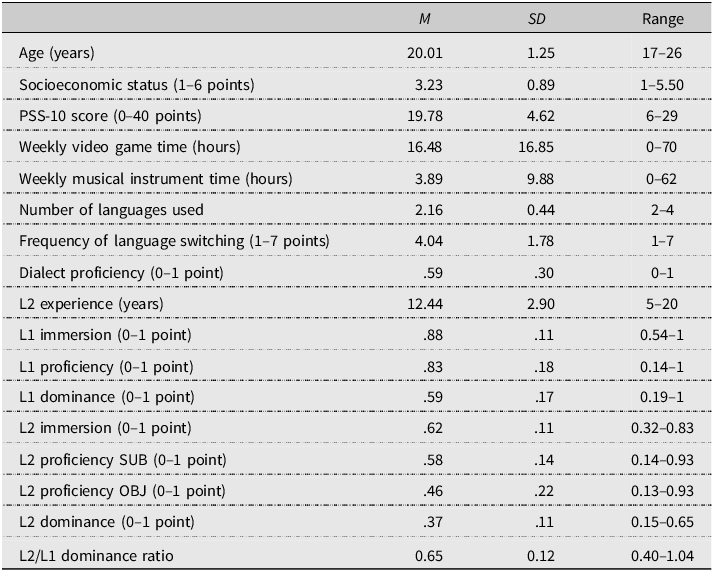
Seventy-four Mandarin-English speaking bilingual bidialectal university students (50 females; Mage = 20.01 years, SDage = 1.25 years) were recruited from a Sino-American university located in Mainland China. All participants were native Mandarin (L1) speakers with an average of 12.44 years of experience using English and an L2 (± 2.90 years). All participants were enrolled full-time in an American undergraduate curriculum program where English was the primary language of instruction and assessment. Written informed consent was collected from all participants. Approval for this study was granted by the Wenzhou-Kean University Institutional Review Board (#WKUIRB2022-006).
Language experience and background measures
Participants first completed Language History Questionnaire (LHQ-3). A full description of this instrument can be found in the original article (Li et al., Reference Li, Zhang, Yu and Zhao2020). To briefly summarize, the LHQ-3 contains a series of self-report questions that assess three separable dimensions of language experience in all languages a participant reports using: proficiency, immersion, and dominance. Proficiency is assessed by asking participants to rate how well they listen, speak, read, and write in a given language using a 7-point Likert scale from “1=very poor” to “7=excellent.” Immersion and dominance are assessed using a series of questions about the number of hours spent engaged in specific activities in a given language, with the dominance score further weighted by reported proficiency. For each dimension, an aggregate score ranging from 0 to 1 is generated. Additionally, a fourth index of bilingual language experience, a dominance ratio, can be calculated using the dominance scores for any two assessed languages. Depending on the dominance scores for a given pair of languages, the dominance ratio may exceed 1.
Proficiency data were collected from participants based on their experience with Mandarin, English, and Chinese dialect. Participants were also asked to indicate which dialect they had experience using. Dialect proficiency ratings were limited to listening and speaking because differences between Chinese dialects generally manifest only in spoken communication. For participants with no experience with dialect, proficiency scores for both listening and speaking were recorded as 0. A composite dialect proficiency score (henceforth dialect proficiency) was calculated as the average proficiency for listening and speaking in dialect. Subjective ratings for immersion and dominance were obtained for both Mandarin and English. Finally, objective English proficiency was assessed using a multiple-choice English vocabulary test consisting of 30 items. Objective proficiency was calculated based on the total number of correct responses given and ranged from 0–1. Finally, participants reported on basic demographic details, weekly use of video games and musical instruments, language switching frequency, perceived stress (PSS-10; Cohen, Reference Cohen1988), and family education level as a proxy for SES (Wermelinger et al., Reference Wermelinger, Gampe and Daum2017).
Measures of cognitive control
Simon task
A two-color Simon task (Privitera et al., Reference Privitera, Momenian and Weekes2022) was administered online. Prior to the start of the task, participants were instructed to place their left index finger on the “Q” key and their right index finger on the “P” key on their computer’s keyboard. At the beginning of each trial, a fixation cross (black; 2.54 cm line; 2.54 cm thick) was presented on a white background for 300 ms before disappearing. Depending on the trial condition, the target stimulus, either a blue or brown square (2.54 × 2.54 cm), appeared in one of three locations: left, center, or right, relative to the fixation cross that was previously on the screen. In response to the presentation of each stimulus, participants were asked to press one of two different keys on a standard keyboard based only on the stimulus color. Button and color mapping were counterbalanced across participants with half instructed to press the “Q” button for a blue square and “P” button for a brown square, and the other half receiving the reversed directions. Stimuli remained on the screen until a response was given, followed by a blank screen for 500 ms. Given the color of the stimulus and the mapping of color to the response key, three trial conditions were generated: congruent (match between stimulus and response key location), incongruent (mismatch between stimulus and response key location), and neutral (target stimulus in the center). In total, six practice trials with feedback and 84 experimental trials without feedback were presented. Trial presentation was randomized and included equal proportions of each of the possible conditions.
Attention network test
Participants completed an online version of the ANT (Fan et al., Reference Fan, McCandliss, Sommer, Raz and Posner2002). The task was split into three separate phases which were administered in the same order to all participants: a no-cue practice phase with feedback (12 trials); a cued practice phase with feedback (12 trials); and a testing phase containing both no-cue and cued trials (3 blocks each containing 96 trials, 288 trials total). Trial presentation was randomized across all phases. Prior to the start of a practice phase, participants were instructed to place their left index finger on the Q key and their right index finger on the P key of their computer keyboard and to focus on the fixation cross during the entire task (i.e., not to move their eyes to the target). A reminder of the stimuli-response mapping remained visible at the top of the screen during both practice phases.
Full details for the ANT can be found in the original paper (Fan et al., Reference Fan, McCandliss, Sommer, Raz and Posner2002). Briefly, task stimuli consisted of a center target arrow and two flanking stimuli on either side presented either above or below a central fixation cross. Flanking stimuli were either arrows pointing in the same (congruent trials) or opposite (incongruent trials) direction as the target arrow, or lines identical in length and thickness to the target arrow (neutral trials). During the testing phase, the three trial conditions were presented in equal proportions as either no-cue, center cue (asterisk where fixation cross was); double cue (asterisks above and below the fixation cross); or spatial cue (asterisks either above or below the fixation cross based on where the task stimuli were going to appear). Participants were instructed to press the Q key with their left index finger or the P key with their right index finger based on the direction of target arrow. Stimuli remained on screen until a response was given. Flanker task trials were derived from no-cue trials and resulted in the inclusion of 72 trials per participant with 24 trials for each of the three congruency conditions.
General administration procedures
All data were collected online using the Gorilla online experiment builder (for details on timing accuracy and sensitivity see Anwyl-Irvine et al., Reference Anwyl-Irvine, Massonnié, Flitton, Kirkham and Evershed2020). The decision to collect data online was made due to strict pandemic restrictions in Mainland China. Participants were sent a link to the experiment through email and were asked to find a quiet area where they could focus and complete the tasks on a desktop computer or laptop. After clicking the online task link, participants were screened based on the device they were using, with the detection of tablet or smartphone login resulting in automatic rejection. They were further instructed to maximize the size of their browser screen prior to starting the experiment and to avoid using their phone or engaging in other distracting activities. Informed consent was collected from all participants prior to the start of the experiment followed by demographic details and the LHQ-3. Next, either the Simon task or ANT was completed followed by the PSS-10 and both picture-naming tasks (picture-naming data not analyzed in the present study). The completion of all tasks took around 30 minutes for each participant with breaks available after each phase of the experiment. All written aspects of this study including the informed consent form, language experience and background questionnaires, task directions, and debriefing were provided in both Chinese and English.
Statistical analysis
A within-subjects design was used to investigate whether differences in language experience impacted on cognitive control. Reaction time (RT) data were analyzed with linear mixed-effects models using the lmer function from the lme4 package (Version 1.1–26; Bates et al., Reference Bates, Mächler, Bolker and Walker2015) in R (Version 4.0.5; R Core Team, 2023). While still uncommon, the application of linear mixed-effects models in the investigation of bilingual effects on cognitive control allows for consideration of individual differences in language experience and task performance during modeling (Privitera & Weekes, Reference Privitera and Weekes2023). Full analysis details can be found in our previous work (Privitera et al., Reference Privitera, Momenian and Weekes2022, Reference Privitera, Momenian and Weekes2023a). Here, we briefly describe the procedure. RT Data from all correct trials with RTs longer than 150 ms and shorter than 2000 ms were included in our analysis. These cutoffs were selected in order to maximize the likelihood that an authentic bidialectal effect could be identified (Zhou & Krott, Reference Zhou and Krott2016) while also ensuring that data met the distributional assumptions for modeling. Prior to model fitting, RT data were log transformed to address issues with non-normality.
Multicollinearity between predictor variables was assessed using variance inflation factor (VIF). Models initially contained main effects for gender, task order, block (ANT and Flanker only), age, reported stress, video game experience, musical instrument experience, SES, number of languages used, language switching, L1 proficiency, L1 dominance, L2 proficiency, L2 immersion, L2 dominance, L2/L1 dominance ratio, dialect proficiency, and cue condition (ANT only). Additionally, interactions with congruency were included for language switching, L2 proficiency, L2 immersion, L2 dominance, and L2/L1 dominance ratio based on our a priori expectation that differences in these variables would impact on inhibition. Identical interactions between language experience variables and cue condition were also included in the ANT model. Random effects structure fitting began with a maximal model which included random participant intercepts and random by-participant slopes for congruency and cue condition where appropriate (Barr et al., Reference Barr, Levy, Scheepers and Tily2013). Finally, absolute standardized residuals exceeding 2.5 standard deviations were removed in order to address non-normal residual distribution (Baayen & Milin, Reference Baayen and Milin2010).
Results
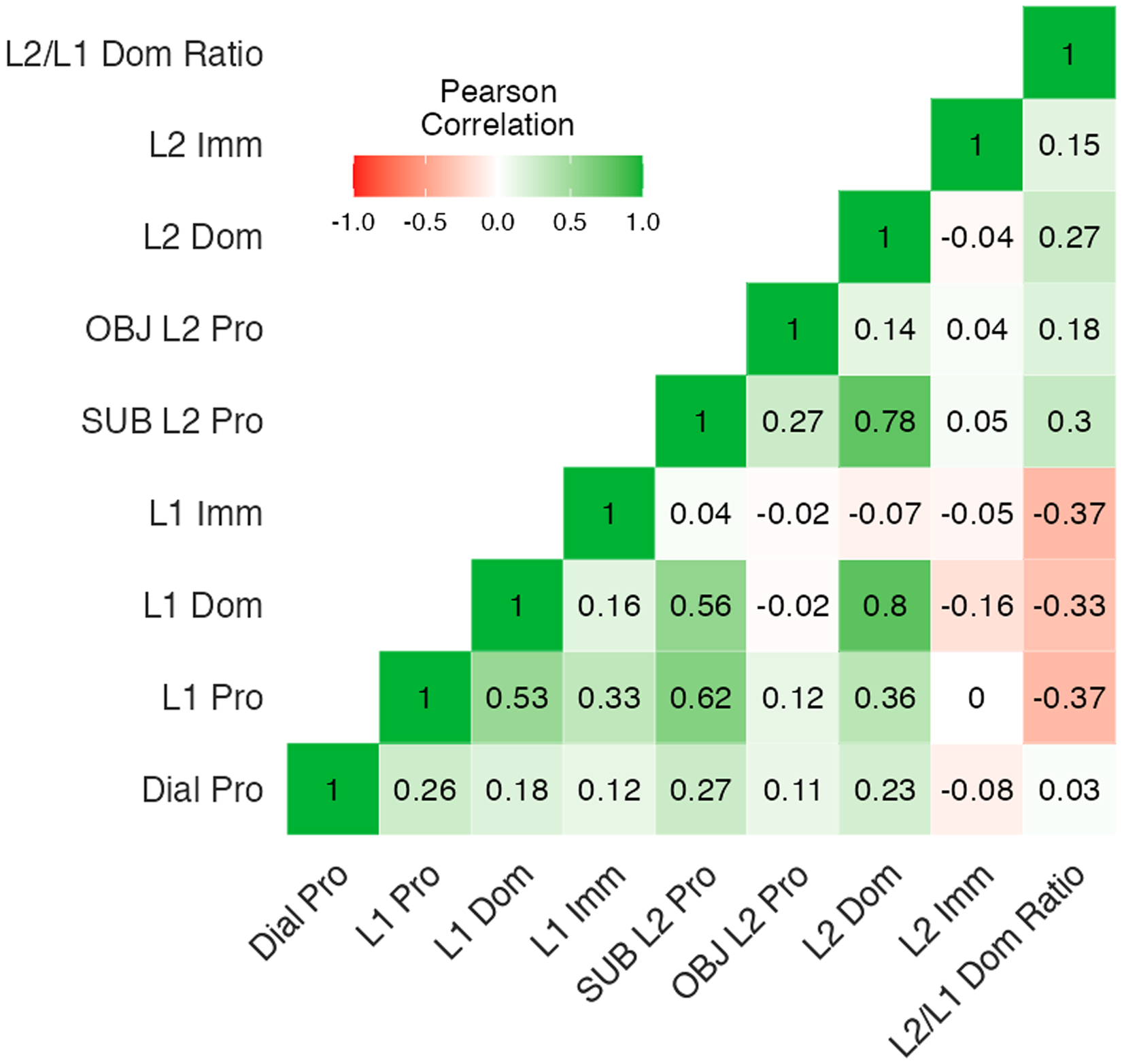
Language history and other background details for our sample are summarized in Table 1. Participants reported using a diverse range of different Chinese dialects including the Beijing dialect, Shanghai dialect from the East, Sichuan dialect from the Southwest, Chaoshan dialect from the Southeast, and Changsha dialect from central China (complete dialect list and frequencies presented in Supplementary Table 1). Participants also reported using additional languages including Spanish (n = 4), Japanese (n = 3), French (n = 2), and Korean (n = 2). While all participants were native Mandarin speakers using English as an L2, there was considerable heterogeneity in their language experience. Correlations between dimensions of language experience are presented in Figure 1. Finally, only results of interest from behavioral task analyses are reported in each section below, and in their respective tables. Full model results for all analyses can be accessed on Open Science Framework (https://doi.org/10.17605/OSF.IO/TSMBQ).
Demographic and language history data
Correlation heatmap between dimensions of language experience.
Simon results
Prior to analysis, data were removed from one participant who had completed the experiment twice and five participants with accuracy below 70%. This resulted in the inclusion of 5297 trials from 68 participants (47 females; Mage = 20.06 years, SDage = 1.27 years). Simon task performance results are summarized in Table 2.
Summary of Simon task performance by item congruency condition

Assessment of multicollinearity resulted in the removal of L1 dominance from our model due to high VIF (32.49). Additionally, subjective L2 proficiency had high VIF even after the removal of L1 dominance (7.00). Replacing subjective L2 proficiency with objective L2 proficiency addressed these issues (for evidence in support of these measures being equivalents when included in models, see Zhou & Privitera, Reference Zhou and Privitera2024), reducing VIF between variables to levels below our threshold (>5; Craney & Surles, Reference Craney and Surles2002). Maximal models which included random participant intercepts and by-participant random slopes for congruency did not converge. For this reason, our final model only contained random participant intercepts. Finally, trimming of residuals greater than 2.5 SD resulted in the removal of 157 trials. After trimming, model residuals were approximately normally distributed.
Congruency was initially sum coded (−1, 0, 1) during model fitting to assess main effects and then dummy coded with congruent set as the reference levels to assess for simple effects. With the congruent condition set as the reference level, a significant effect of congruency for the incongruent condition with a positive coefficient indicates the presence of the classic Simon effect. A language effect on monitoring would present as a significant main effect of L2 proficiency, L2 immersion, L2/L1 dominance ratio, or dialect proficiency. A language effect on inhibition would present as a significant interaction between any of these variables and the incongruent condition with the congruent condition set as the reference level. For both main effects and interactions, negative coefficients would represent improved task performance associated with higher bilingual or bidialectal experience.
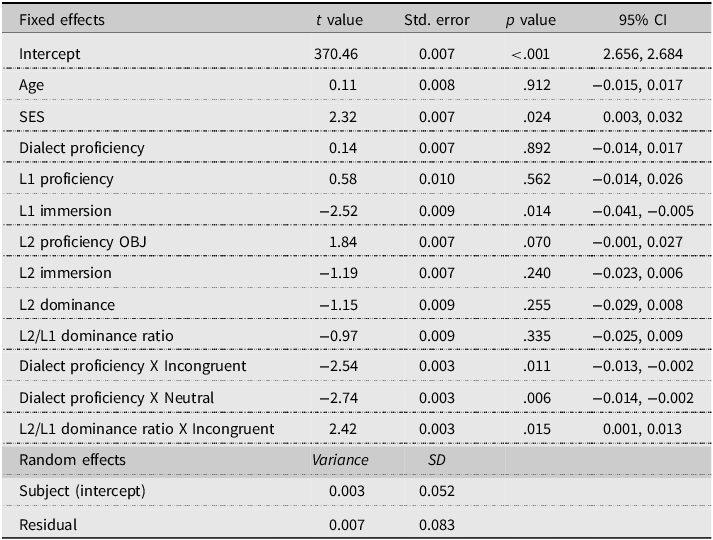
The presence of a significant effect of incongruent trial condition with a positive coefficient confirmed the presence of a Simon effect. While there was no main effect of dialect proficiency, significant interactions between dialect proficiency and congruency were observed. Specifically, higher levels of reported dialect proficiency were associated with faster incongruent and neutral trial RTs relative to congruent trials. However, visual inspection of Figure 2A reveals that this is actually the result of slower RTs on congruent trials and not improved performance on incongruent and neutral trials. A significant main effect of SES was observed, with higher reported levels associated with slower global RTs. A significant main effect of L1 immersion was also observed, with higher levels associated with faster global RTs. Finally, a marginally significant main effect of objective L2 proficiency was observed, with higher levels associated with slower global RTs. Model results of interest are summarized in Table 3.
Cue condition interactions with reported dialect proficiency for the Simon (A) and Flanker tasks (B). Reaction time is plotted on its original scale for display purposes (95% confidence interval).

Summary of Simon task effects and interactions of interest
Attention network test results
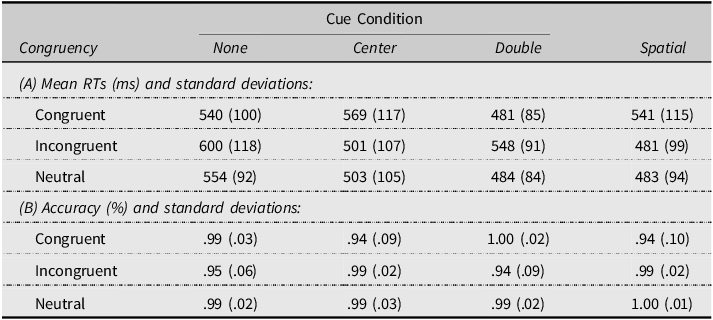
Prior to analysis, data were removed from one participant who had completed the experiment twice, three participants with accuracy below 70%, and two participants with high average RTs greater than 2.5 SD above the sample average. This resulted in the inclusion of 18,855 trials from 68 participants (46 females; Mage = 19.97 years, SDage = 1.27 years). ANT performance results are summarized in Table 4.
Summary of ANT performance by item congruency and cue condition
Assessment of multicollinearity resulted in the removal of L1 dominance from our model due to high VIF (32.99). Additionally, subjective L2 proficiency had high VIF even after the removal of L1 dominance (7.93). Replacing subjective L2 proficiency with objective L2 proficiency addressed these issues, reducing VIF between variables to levels below our threshold (>5; Craney & Surles, Reference Craney and Surles2002). Maximal models which included random participant intercepts and by-participant random slopes for order, block, congruency, and cue condition did not converge. Attempts at simplifying our random effects structure resulted in a model with a singular fit. For this reason, our final model only contained random participant intercepts. Finally, trimming of residuals greater than 2.5 SD resulted in the removal of 549 trials. After trimming, model residuals were approximately normally distributed.
In order to assess for language effects on the function of the three attentional networks (i.e., alerting, orienting, and executive control), the categorical variable item congruency was sum coded and cue condition was dummy coded with one level set as a reference level allowing estimates to be compared to the grand mean across item congruency conditions. Appropriate reference levels for comparison were set based on guidance outlined in the original study (Fan et al., Reference Fan, McCandliss, Sommer, Raz and Posner2002). For both main effects and interactions, negative coefficients would represent improved task performance associated with higher bilingual or bidialectal experience.
The function of the alerting network was assessed by calculating the difference between the no-cue and double-cue conditions. With the no-cue condition set as the reference level, a language effect on alerting would present as a significant interaction between any language experience variable and the double-cue condition (Costa et al., Reference Costa, Hernández and Sebastián-Gallés2008). Orienting network efficiency was calculated based on the difference between the center cue (temporally informative but spatially irrelevant) and spatial cue conditions. With the center cue condition set as the reference level, a language effect on orienting would present as a significant interaction between any language experience variable and the spatial cue condition with a negative coefficient. Executive control network function was measured by first sum coding the cue condition variable to allow for the average of each congruency condition to be compared to the grand mean across cue conditions and then dummy coding item congruency with the congruent condition set as the reference level. Under these conditions, a significant interaction between any language experience variable and the incongruent condition would support the presence of a language effect on executive control.
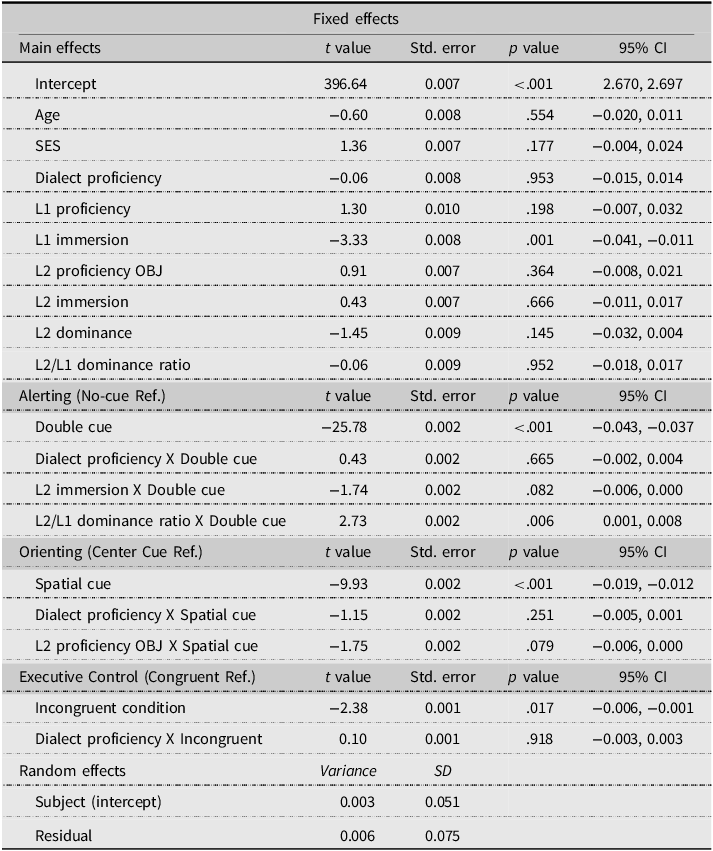
Model results of interest are summarized in Table 5. Crucially, dialect proficiency was not associated with any differences in attentional network function across alerting, orienting, and executive attention. A significant main effect of L1 immersion was identified, with higher levels associated with faster global RTs. Alerting network analysis identified a significant interaction between L2/L1 dominance ratio and the double-cue condition, with higher levels of L2/L1 dominance ratio associated with decreased alerting effects (i.e., slower performance on double-cue trials relative to no-cue trials). Additionally, there was a marginally significant interaction between L2 immersion and the double-cue condition, with higher levels of L2 immersion associated with increased alerting effects (i.e., faster performance on double-cue trials relative to no-cue trials). Orienting network analysis revealed a marginally significant interaction between objective L2 proficiency and spatial cue condition with higher levels associated with increased orienting effects (i.e., faster performance on spatial cue trials relative to center cue trials). Analysis of executive attention network function identified no significant or marginally significant findings.
Summary of ANT effects and interactions of interest
ANT-derived Flanker results
A separate model was built using only no-cue trials from the ANT to provide the equivalent of Flanker task data. This was done in order to analyze performance on a stimulus-stimulus conflict task that was not influenced by the presence of different cue conditions. In total, 4722 no-cue trials from 68 participants were included in our analysis. Flanker task performance results (i.e., no-cue trial results by congruency condition) can be found in Table 4. During the analysis of Flanker task trials, coding of variables and the conditions under which a language effect would be supported were identical to those described for the Simon task. Trimming of residuals greater than 2.5 SD resulted in the removal of 132 trials. After trimming, model residuals were approximately normally distributed.
The presence of a significant effect of incongruent trial condition with a positive coefficient confirmed the presence of a Flanker effect. Regarding our hypothesis, there was no main effect of dialect proficiency nor interaction with congruency identified (Figure 2B). Mirroring the result observed during the modeling of Simon task data, a significant main effect of L1 immersion was observed, with higher levels associated with faster global RTs. Model results of interest are summarized in Table 6.
Summary of ANT-derived Flanker task effects and interactions of interest

Discussion
The present work adds to the small number of extant studies investigating the influence of bidialectalism on cognitive control. Similar to previous investigations conducted in samples of young adult Chinese bidialectals, we report null findings regarding the influence of dialect use, specifically proficiency, on performance across a series of cognitive control tasks. Unlike previous investigations, these null findings emerged when modeling individual differences in bilingual and bidialectal experience as well as individual differences in task performance across participants. We did, however, identify significant influences of non-dialect linguistic and non-linguistic variables on task performance, extending our understanding of how differences across a range of variables can impact on cognitive control. Together, our findings support that the influence of dialect experience on cognitive control in bilingual, dialectally heterogeneous samples in L2 immersive contexts may be small or null, even when controlling for differences in language experience. Additionally, our findings further underscore the importance of assessing and modeling nontrivial individual differences across linguistic and non-linguistic variables when investigating the influence of language experience on cognitive control.
Dialect proficiency and cognitive control
Similar to bilingualism, successful communication in bidialectals is thought to necessitate inhibition of the unneeded dialect as well as monitoring and attending to salient linguistic cues, thereby conferring domain-general benefits in cognitive control. Considering the observation that bilingual effects on cognitive control may not emerge in less proficient bilinguals (e.g., Vega-Mendoza et al., Reference Vega-Mendoza, West, Sorace and Bak2015) and that positive bilingual effects associated with higher levels of L2 proficiency have been previously reported (e.g., Arredondo et al., Reference Arredondo, Hu, Satterfield and Kovelman2017; Novitskiy et al., Reference Novitskiy, Shtyrov and Myachykov2019; Privitera et al., Reference Privitera, Momenian and Weekes2022, Reference Privitera, Momenian and Weekes2023a; Xie, Reference Xie2018), we hypothesized that higher levels of dialect proficiency would be associated with improved performance on tasks measuring inhibition and attentional control. Unexpectedly, our findings do not support the hypothesis that higher levels of dialect proficiency are associated with improved inhibition and attentional control. Studies on the impact of dialect experience on Simon and Flanker task performance have previously reported null findings (Bosma & Blom, Reference Bosma and Blom2017; Kirk et al., Reference Kirk, Fiala, Scott-Brown and Kempe2014; Oschwald et al., Reference Oschwald, Schättin, Von Bastian and Souza2018; Ross & Melinger, Reference Ross and Melinger2017; Wu et al., Reference Wu, Zhang and Guo2016), although the lack of focus on dialect proficiency prevents direct comparisons with the present study (for null findings associated with higher levels of dialect familiarity, a composite measure that, in part, reflects differences in proficiency, see Scaltritti et al., Reference Scaltritti, Peressotti and Miozzo2017). Alternatively, in light of findings from Oschwald and colleagues (Reference Oschwald, Schättin, Von Bastian and Souza2018), the influence of dialect experience on cognitive control may manifest in dimensions not measured in the present study, including working memory.
In the present study, we report that higher levels of dialect proficiency were associated with reduced facilitation from congruent trials (i.e., slower RTs) on the Simon task only. While both the Simon task and ANT purportedly measure differences in inhibition, previous investigations of bilingual effects on cognitive control have reported task-specific findings (Paap et al., Reference Paap, Johnson and Sawi2014; Privitera et al., Reference Privitera, Momenian and Weekes2022; Ware et al., Reference Ware, Kirkovski and Lum2020). These are thought, in part, to result from differences in the nature of conflict between commonly used tasks (Kornblum, Reference Kornblum1994; Xia et al., Reference Xia, Bak, Sorace and Vega-Mendoza2021). Specifically, while the incongruent trial conflict presented on the Simon task is stimulus-response in nature (i.e., color of the square conflicts with its spatial location which drives the response tendency), the ANT, and by extension the Flanker task, present stimulus-stimulus conflict (i.e., center arrow conflicts with flanking arrows). The specific pattern of findings observed in the present study suggests that the experience of developing proficiency in a dialect may rely more on the resolution of stimulus-response conflict as significant influences of dialect proficiency were observed only on the Simon task.
Interestingly, the observed association between higher levels of dialect proficiency and slower RTs on congruent trials could be misinterpreted as improved inhibition due to stable RTs on incongruent trials. When investigating how differences in language experience influence inhibition, reduced interference effects can result under two different conditions: 1) higher levels of any relevant linguistic variable are associated with faster performance on incongruent trials relative to congruent trials, or; 2) higher levels of any relevant linguistic variable are associated with slower performance on congruent trials relative to incongruent trials. The latter of these two conditions, observed in the present study, has previously been cited as evidence against improved inhibition as a consequence of bilingualism (Paap et al., Reference Paap, Johnson and Sawi2015). We report that higher levels of dialect proficiency are associated with slower congruent trial RTs, but stable RTs on incongruent trials. Contrasts between these two trial conditions give the impression of a reduced conflict effect (i.e., improved inhibition) associated with higher levels of dialect proficiency, but visual inspection of plotted data confirms that reduced differences between incongruent and congruent trial RTs are due exclusively to slower performance on the latter. In the study by Poarch and colleagues (Reference Poarch, Vanhove and Berthele2019), it is unclear whether the improved inhibition reported was a consequence of improved performance on incongruent trials or worse performance on congruent trials. For this reason, it is unknown whether reduced facilitation associated with higher dialect experience has been previously reported. One possible explanation for reduced facilitation associated with higher levels of dialect proficiency could relate to the increased cognitive demands associated with maintaining stable performance on more difficult incongruent trials. As a consequence, performance on congruent trials suffers, with participants requiring more time in order to make a response. This explanation, while speculative, is further supported by the similar pattern of results observed for neutral trials relative to congruent trials (Table 3, Figure 2A).
Our lack of support for general cognitive benefits associated with dialect proficiency may have also resulted from the socioeconomic characteristics of our sample. While differences in SES, operationalized as family education level, were accounted for during analyses, our sample would likely be considered high SES when compared to the general population. Participants in the present study were recruited from a private, English-immersive, American university campus located in Mainland China. Tuition costs and English language entrance requirements are significantly higher at this university when compared to public universities in the local area. For this reason, students in our sample came from high SES families who can not only afford to pay much higher tuition rates for university study but could also afford additional English tutoring during primary and secondary school in order to reach a sufficient level of proficiency for study exclusively in an L2 immersive environment. Morton and Harper (Reference Morton and Harper2007) were among the first to highlight SES as a significant variable for consideration when investigating the influence of language experience on cognitive control. While they reported no influence of language experience, specifically bilingualism, on Simon task performance, they did observe a significant influence of SES, with higher-status children outperforming those of lower status on measures of accuracy. More recently, Naeem and colleagues (Reference Naeem, Filippi, Periche-Tomas, Papageorgiou and Bright2018) identified that cognitive benefits associated with bilingualism may be modulated by SES. In their work, differences in Simon task RTs between monolingual and bilingual samples only emerged in the low SES group. Taking this into consideration, any cognitive benefits associated with dialect proficiency may have potentially been masked by the benefits associated with our sample’s high SES. Future work in lower SES bidialectal samples may create the conditions under which any general cognitive benefits associated with dialect experience are more likely to emerge.
It is worth noting that the present study was conducted in a sample of dialectally heterogeneous Mandarin-English bilingual young adults in an L2 immersive context. To date, most studies have been conducted in samples of bidialectals who are homogenous in their dialectal profile (e.g., Antoniou et al., Reference Antoniou, Grohmann, Kambanaros and Katsos2016; Oschwald et al., Reference Oschwald, Schättin, Von Bastian and Souza2018; Poarch et al., Reference Poarch, Vanhove and Berthele2019). Considering the diverse range of mutual intelligibility found across Chinese dialects (Tang & Van Heuven, Reference Tang and Van Heuven2015), heterogeneous groups may differ considerably in whether they reflect low or high levels of overlap with Mandarin. Predictions from the BIA+ model (Dijkstra & Van Heuven, Reference Dijkstra and Van Heuven2002) would support that higher levels of overlap between Mandarin and a dialect would place the highest demands on cognitive control as a consequence of cross-linguistic interference, possibly at the phonological level (Wu et al., Reference Wu, Dang, Zhang, Zhang and Guo2023), resulting in improved performance on tasks that measure inhibition and attentional control. While the demands on cognitive control and expected cognitive benefits may be more straightforward to predict in dialectally homogeneous samples, the dialectal heterogeneity present in our sample makes this task difficult. Under these conditions, the potentially high demands associated with use of a dialect that is highly similar to Mandarin may be diluted by participants who are using a dialect with low levels of mutual intelligibility. Future work in more dialectally homogeneous samples is needed in order to better understand these findings.
Influence of other variables
Beyond our null findings regarding the influence of dialect proficiency, we did identify a number of significant linguistic and non-linguistic variables that impacted on cognitive control. The most consistent finding across all behavioral tasks was that of faster global RTs (i.e., improved monitoring) associated with higher reported levels of L1 (Mandarin) immersion. To the best of our knowledge, no previous studies have investigated the influence of L1 immersion on cognitive control. However, positive associations between other dimensions of L1 experience and cognitive control have been reported. In a sample of bilinguals using English as their L2 but reporting a diverse group of L1s, higher levels of subjective L1 proficiency were associated with faster global RTs on a Stroop task (Tse & Altarriba, Reference Tse and Altarriba2012). This finding suggests that differences in L1 experience may also impact on cognitive control, although further work is needed to better understand the specific influence of differences in L1 immersion. Additional significant findings were task-specific and were both associated with worse performance. Higher levels of SES were associated with slower performance across all trial types on the Simon task. As mentioned earlier, higher SES is thought to underlie improved cognitive control (Hackman et al., Reference Hackman, Gallop, Evans and Farah2015; Noble et al., Reference Noble, McCandliss and Farah2007), and has been cited as an alternative explanation for the purported “bilingual advantage” (Morton & Harper, Reference Morton and Harper2007; Paap et al., Reference Paap, Johnson and Sawi2015). Considering the high SES of our sample overall, and our operationalization of SES as family education level, this unexpected result may not actually reflect the influence of SES on task performance but may be specific to the influence of family education in high SES samples.
Finally, we observed a significant influence of L2/L1 dominance ratio on alerting network function, with decreased alerting effects associated with higher L2 usage relative to L1 usage. A recent synthesis of work investigating the influence of language experience on ANT performance did not identify reliable effects of bilingualism on alerting network function (Arora & Klein, Reference Arora and Klein2020). While the studies included in this synthesis were conducted in samples recruited from multilingual environments that were L1-immersive, our sample was in an L2-immersive environment. One interpretation is that bilinguals who are more L2 dominant are less reliant on linguistic cues (i.e., alerting cues) in an L2-dominant environment due to their experience with the dominant language. For these bilinguals, there would be less of a need to monitor the environment to know which language is needed compared to environments where there are more linguistically diverse interlocutors. Again, future work is needed in order to better understand how unique linguistic environments impact attentional control.
Limitations of the present work
Findings from this work should be considered in light of a few limitations. The most significant limitations concern the characteristics of our sample. All participants would be considered bilingual given their language profile although this may be impossible to avoid due to the decade-old introduction of compulsory English education in China (Hu, Reference Hu2005; Privitera, Reference Privitera2023). While it is possible that the benefits of bidialectalism are obscured by the influence of bilingualism, we at least partially address this in our analyses through the inclusion of control variables related to bilingual language experience. Recruitment of bilinguals who do not use dialect as a comparison group would also possibly address this issue, but this is extremely difficult to do in China considering the widespread use of dialect. This too is addressed through our operationalization of both bilingualism and bidialectalism as continuous variables, allowing us to assess the graded influence of each. Our sample also reported using a wide range of different Chinese dialects. As previously mentioned, Chinese dialects vary considerably in their mutual intelligibility (Tang & Van Heuven, Reference Tang and Van Heuven2015), and it is unclear whether the findings of the present study would be replicated in a less diverse sample of bidialectals. Additionally, our assessment of dialect experience was limited to proficiency. While assessment of dialect dominance and immersion would have provided further insight into the linguistic background of our participants, the non-dialect speaking context from which they were recruited as well as expected difficulties in recalling when dialect was acquired relative to (sometimes highly similar) Mandarin led us to forego further assessment. Our use of the Simon task, ANT, and the ANT-derived Flanker task limits the conclusions we can draw to only a few dimensions of cognitive control. Future work should investigate how dialect experience impacts on other dimensions of cognitive control including shifting and updating. Finally, while our sample size aligned with those used in similar, albeit methodologically different investigations (e.g., Poarch et al., Reference Poarch, Vanhove and Berthele2019; Wu et al., Reference Wu, Zhang and Guo2016), simulation-based post hoc power analyses using the simr package in R (Green & MacLeod, Reference Green and MacLeod2016) suggest that our study may have lacked sufficient power to detect the influence of dialect proficiency. Specifically, analyses based on 1000 simulations revealed power (1−β) of .48 to detect an effect of dialect proficiency in the ANT models and .61 for the Simon task model. These findings suggest that any potential effect of dialect proficiency is likely smaller than initially expected and that higher numbers of subjects are needed in order to investigate these effects while controlling for other dimensions of language experience. We acknowledge that observed power analyses are controversial (e.g., Hoenig & Heisey, Reference Hoenig and Heisey2001), but present these findings in the interest of better informing future work.
Conclusion
Findings from the present study do not support the conclusion that higher Chinese dialect proficiency is associated with improved cognitive control. However, we do provide consistent evidence in support of improved monitoring associated with higher levels of L1 immersion. The present study contributes to our understanding of the boundary conditions of non-linguistic benefits associated with dialect experience, supporting that these benefits, if they do exist, are potentially masked by the influence of bilingualism and SES. Additional work is needed in order to better understand the conditions under which these benefits may emerge. Future work should also take into consideration the significant diversity across Chinese dialects and explore whether mutual intelligibility between Mandarin and a specific dialect modulates the influence of dialect experience on cognitive control. Findings from this and future studies can inform discussions around the benefits of dialect usage and can possibly contribute to efforts aimed at promoting the preservation of dialects, especially in areas where these linguistic traditions are dying.
Replication package
Data and code are available on Open Science Framework https://doi.org/10.17605/OSF.IO/TSMBQ.
Supplementary material
To view supplementary material for this article, please visit https://doi.org/10.1017/S0142716424000286
Acknowledgments
This work was supported by an internal research grant from Wenzhou-Kean University awarded to the author (grant number IRSPK202205). Parts of this manuscript were presented at the 2022 Annual Meeting of the Cognitive Science Society.
Competing interests
All authors declare that they have no conflicts of interest.


 Open access

