





Citizen science and environmental literacy
The participation of citizens in the process of scientific construction is not new, particularly in the field of sciences, where the collection of large amounts of samples and data plays an important role. Citizen science is more than an approach to scientific research where data is collected by citizens in favour of the scientific community. On the one hand, citizen science has made it possible to democratise science as it literally becomes open to the community, where citizens can be an active and integral part of the whole scientific process and, therefore, more inclusive (Hecker et al., Reference Hecker, Haklay, Bowser, Makuch, Vogel, Bonn, Hecker, Haklay, Bowser, Makuch, Vogel and Bonn2018). On the other hand, citizen science can promote science education and science literacy, and in particular environmental education and literacy (e.g. Zeegers et al., Reference Zeegers, Paige, Lloyd and Roetman2012), through citizen engagement in science through socially relevant contexts such as marine pollution by microplastics (Paradinas et al., Reference Paradinas, James, Quinn, Dale and Narayanaswamy2021; Setälä et al., Reference Setälä, Tirroniemi and Lehtiniemi2022). With citizen science having great potential to involve the younger public in science, through appropriate pedagogical dynamics, a bridge can be established between the contents addressed in the scientific subjects and the socially relevant contexts, such as sustainability-related contexts, in which these projects are inserted (e.g. Kelemen-Finan et al., Reference Kelemen-Finan, Scheuch and Winter2018). Regarding the impact of citizen science on students’ science and environmental literacy, particularly in its affective domain, the literature reveals the contributions of this involvement are vast, but difficult to assess and widely differentiated (Harlin et al., Reference Harlin, Kloetzer, Patton, Leonhard, Hecker, Haklay, Bowser, Makuch, Vogel and Bonn2018). In this way, it is crucial to comprehend how citizens’ engagement in citizen science projects fosters positive attitudes towards the environment, specifically regarding emergent environmental issues like marine pollution caused by (micro)plastics.
Attitudes towards the environment and marine litter
Recent decades have seen the emergence of new challenges and environmental problems, to which society must respond (Srbinovski & Stanisic, Reference Srbinovski and Stanišić2020). Thus, promoting the affective domain of environmental literacy is an important tool to counteract the consequences of human activity and industrial production on the environment, such as marine litter and, particularly, the microplastics therein. Therefore, environmental education emerges as “an approach, a philosophy, a tool, and a profession” (Monroe, Andrews, & Biedenweg, Reference Monroe, Andrews and Biedenweg2008) with the objective of understanding environmental problems, while raising environmentally literate citizens and addresses the environment and sustainable resources and promotes positive attitudes towards the environment (Biber et al., Reference Biber, Cankorur, Güler and Demir2022). Environmental education “empowers the individual to make informed decisions and act responsibly while dealing with these issues and problems” (Faize & Akhtar, Reference Faize and Akhtar2020, p. 2). In this regard, Korkmaz et al. (2018), mention that environmental education is important to promote the development of affective connections with nature, fostering the interest, pro-environment behaviours and attitudes of citizens; while also arguing that awareness of environmental issues is more effective when fostered up to adolescence. As such, it is essential that curricula also focus on environmental education, which should emphasise promoting environmental literacy in all its dimensions and, specifically, in the attitude domain.
Milfont and Duckitt (Reference Milfont and Duckitt2010) define attitudes towards the environment as the assessment of the natural environment that individuals perform based on their perceptions, which are related to the level of affinity the individual has with the environment. Liu and Chen (Reference Liu and Chen2020) describe attitudes towards the environment in more detail, referring that they are a factor that directly influences an individual’s environmental awareness, because if he or she exhibits positive attitudes towards a certain issue related to the environment, he or she is also more likely to adopt more favourable and responsible behaviours towards the environment.
Several initiatives have been carried out at a global level related to environmental literacy and particularly with the promotion of pro-environmental attitudes related to the marine litter problem. For example, Hartley et al. (Reference Hartley, Pahl, Veiga, Vlachogianni, Vasconcelos, Maes and Thompson2018) conducted the first large-scale European study aiming to explore the public’s perceptions about marine litter. The authors concluded that the public recognise that marine litter is a global problem and show high levels of concern about this topic. Also, according to these authors, “participants who were older, female, had a higher educational level, accessibility to and experience of the coast and marine litter, reported greater concern, personal motivation, competence, social support, and who placed higher value on the coast, reported greater willingness to act” (p. 953). These factors are consistent with theories of environmental behaviour and empirical research into other environmental issues (Gifford, Reference Gifford2014). Hartley et al. (Reference Hartley, Pahl, Veiga, Vlachogianni, Vasconcelos, Maes and Thompson2018) also emphasise the need to actively engage citizens in approaches related to marine litter, as they found that the more litter people saw on beaches and coastal regions, the greater were their concern about this topic and the more predisposed they were to act.
In Portugal, some work has been published on the characterisation of marine litter, especially microplastics found in coastal regions (e.g. Prata et al., Reference Prata, Costa, Lopes, Duarte and Rocha-Santos2020). There are also some citizen science projects to promote pro-environmental attitudes and behaviours about this subject (e.g. the initiatives of the Portuguese Association of Marine Litter (2022) or the Coastwatch projects (2022)), which actively involve primary and/or secondary school students. However, the impact of project participation on students’ attitudes, behaviours or values is still poorly explored. As such, it is important to develop projects that promote environmental education among young people and which focus on assessing the impact of these approaches not only on the cognitive domain (e.g. Araújo et al., Reference Araújo, Morais and Paiva2021), but also on the affective domain as it was intended to be done with the development of PVC – Perceiving the Value of Chemistry behind water and microplastics, an educational citizen science project as described below in more detail.
The PVC citizen science project
The environmental problem addressed in the PVC project was selected due to three main reasons: i) meet the objectives of the United Nations Decade of Ocean Science for Sustainable Development (United Nations, 2022), ii) the contamination of coastal waters by (micro)plastics, which are increasingly current and relevant issues for society and scientific community (e.g., Mercogliano et al., Reference Mercogliano, Anastasio, Avio, Regoli, Colavita and Santonicola2020) and iii) Portugal is a country with a large coastal area and strong historical ties to the sea. Thus, emerged the idea of developing a citizen science project, with a strong educational component, which aimed to monitor the quality of coastal waters and marine litter in the Northern Coast of Portugal, also intended to promote positive attitudes and awareness towards the environmental issues explored. Thus, the PVC project actively involved students in four main phases that took place in the classroom, in the chemistry laboratory, in field visits and in extra-classroom moments: 1) online tasks such as guided searches, video visualisation, interpretation and creation of posters and infographics to raise awareness of marine litter, especially the presence of (micro)plastics in coastal waters and its consequences aimed to highlight the relevance of chemistry and its preventive role in combating these environmental scourges. This stage took place during the autumn and winter months so that stage 2) sampling of coastal waters and beach plastics, could take place in suitable weather conditions so that students could safely collect the coastal waters. The stages 2) and 3) conducting a physicochemical analysis of the water and identifying (micro)plastics aimed to promote the learning of Chemistry curriculum contents underlying the project; and the stage 4) focussed on project dissemination to mobilise acquired knowledge and to develop communication skills (Araújo et al., Reference Araújo, Morais and Paiva2022).
Therefore, this study intended to gather students’ attitudes towards the environment and marine litter before their involvement in the PVC project and the following null (H0) and alternative (H1) hypotheses were pointed out:
H0: Students participation in the PVC project does not promote positive changes in their attitudes towards environment.
H1: Students participation in PVC project contributes significantly to positive changes in their attitudes towards the environment.
Methods
Participants
The PVC project took place during 2018/2019 school year and included 574 students, from 26 Chemistry classes, attending middle school (aged 12–14 in Portuguese schools – 7th, 8th and 9th grades). The classes involved in the PVC project were from four schools in the Northern Coastal Region of Portugal and were taught by nine teachers who revealed interest and willingness to collaborate in this research. Considering the number of classes taught by each teacher, they randomly choose six of their classes (132 students, 65 boys and 67 girls) to be part of the control group (CG) and 20 classes (442 students, 208 boys and 234 girls) to be part of the experimental group (EG). Both groups, according to students’ school year, receive the same chemistry instruction. As the environment-related contents explored in the PVC project were transversal to the 7th, 8th and 9th grades, all students were engaged in similar educational and awareness activities. In each school class, students from EG worked on the project for seven months, in small groups comprising two to five members. The implementation of the various phases of the PVC project was actively conducted by the teachers involved, who collaborated in this research by monitoring their students’ participation in the project and helping to apply the data collection instruments, in close collaboration with the researchers.
All participation in the study was voluntary. The parents or legal guardians of the students signed an informed consent form, which described students’ participation in the research and the activities in which they would be involved and ensured the anonymity and confidentiality of personal data complying with national data protection legislation.
Procedures
Attitudes towards the environment and marine litter scale design
The field of behavioural sciences and psychology has been contributing to the area of the environmental studies by developing a considerable number of scales that intend to access public environmental concerns and attitudes. Some of the most relevant and used scales are the scale for the measurement of ecological attitudes and knowledge (Maloney et al., Reference Maloney, Ward and Braucht1975), the scale for environmental concern (Weigel & Weigel, Reference Weigel and Weigel1978), the New Environmental Paradigm (NEP) scale (Dunlap & van Liere, Reference Dunlap and Van Liere1978), the Two Major Environmental Values (2-MEV) scale (Bogner & Wiseman, Reference Bogner and Wiseman1999), the Environmental Attitudes Inventory (Milfont & Duckitt, Reference Milfont and Duckitt2010) or the Revised Environmental Identity Scale (Clayton et al., Reference Clayton, Czellar, Nartova-Bochaver, Skibins, Salazar, Tseng and Monge-Rodriguez2021). Also, it is worth mentioning that some of the authors of this article had previously conducted other research studies using these scales, which makes them more familiar with their psychometric properties (Morais et al., Reference Morais, Moreira, Teixeira and Aguiar2022). However, none of those scales focussed on the most crucial aspects explored in the PVC project: the contamination of marine environments by plastics and microplastics. As such, we felt the need to develop a new attitude scale, inspired by other examples from the literature, which would be appropriate for the research objectives and the age range of participating students.
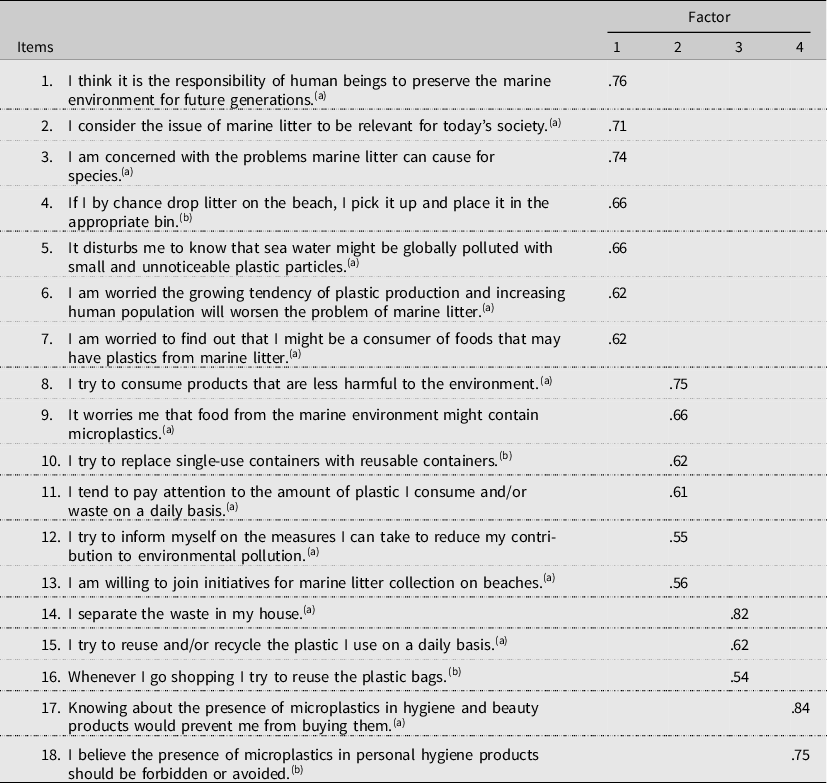
Teixeira (Reference Teixeira2018) developed an attitudinal scale to know the attitudes of university students about the environmental theme of marine litter in a broader sense. So, to better address our research goals, the Attitudes towards the Environment and Marine Litter (ATEML) Scale was developed comprising 18 statements, 13 of which are retrieved and adapted from the scale developed by Teixeira (Reference Teixeira2018) and five of our own authorship (as shown below in Table 1). Items selected from Teixeira’s scale related to environmental sustainability and to marine litter and the items of our own authorship were about students’ pro-environmental behaviours and their perspectives about microplastics which were the main topics addressed within PVC project. For content validation purposes, the attitude scale was first answered, by two students of each school year of the middle school, in a total of six students, who were not involved in the CG or EG groups. This procedure was adopted to guarantee that all statements presented were intelligible and understandable. Subsequently, the scale was submitted for analysis by two teachers specialised in Science Education.
Table 1. Principal component analysis with Varimax rotation of the ATEML Scale
Items adapted from Teixeira (Reference Teixeira2018)(a) and self-authorship items(b).
The final version of the ATEML Scale includes 18 statements, for students to express their level of agreement using a 7-point Likert scale (1 = Strongly disagree; 2 = Disagree; 3 = Partially disagree; 4 = Neither agree nor disagree; 5 = Partially agree; 6 = Agree; 7 = Strongly agree). Moreover, students also answered a set of questions that aimed to collect sociodemographic information, such as gender and grade. The attitude scale was anonymised and coded so that students’ responses could be compared between the different moments of application.
An exploratory factor analysis was conducted to define the factors present in the attitude scale. Thus, students’ responses to the scale, when applied as a pre-test, were subjected to a principal component analysis (PCA) with Varimax rotation, from which emerged four factors that explain 60.5% of the variance (above the desired minimum of 60%) (Tabachnik & Fidell, Reference Tabachnik and Fidell2006). The Kaiser–Meyer–Olkin Measure of Sampling Adequacy (KMO) indicated the adequacy of the sample was marvellous (KMO = .94) (Kaiser, 1974). The Bartlett’s Test of Sphericity was statistically significant (χ 2 (153) = 7211.03, p < .001), allowing us to conclude that the variables are sufficiently correlated to conduct a PCA. Table 1 displays the items of the correlation matrix with saturation values above 0.50 (Field, Reference Field2009), organised by factor.
Subsequently, we proceeded with the interpretation of results emerging from the PCA and defined the dimensions underlying each factor:
-
1. Collective – dimension related to society’s awareness towards environmental problems, particularly global behaviours adopted by humans in order to preserve the environment (items 1–7);
-
2. Personal – dimension related to individual behaviours and concerns regarding this issue (items 8–13);
-
3. Recycling and reuse – dimension related to personal behaviour in a more specific domain, such as recycling and plastic reuse (items 14–16);
-
4. Microplastics – dimension related to awareness of the presence of microplastics in the environment (items 17 and 18).
Data collection
The attitude scale was answered by the participating students, as a pre-test, at the beginning of the 2018/2019 school year, from September to October 2018. After the completion of the PVC project, between May and June 2019, the same scale was also answered by all participating students, as a post-test. The collection of this data was monitored by the teachers during one of their classes.
Results
The internal consistency of the ATEML Scale was also analysed (using the IBM SPSS Statistics software (version 25)). The reliability analysis (Cronbach’s alpha) reveals good internal consistency values for dimensions 1. Collective (0.875) and 2. Personal (0.803). Dimensions 3. Recycling and reuse (0.635) and 4. Microplastics (0.651) show moderate values regarding the internal consistency of the scale. The value of Cronbach’s Alpha is above 0.60 for all dimensions, thus the scale has moderate reliability. Nonetheless, the dimensions of this attitude scale exhibit acceptable internal consistency (Briggs & Cheek, Reference Briggs and Cheek1986).
The results show that, overall, before their participation in the PVC project, students presented very positive attitudes towards the four dimensions under analysis, with their answers to the attitude scale, applied as a pre-test, revealing a mean value above 5 on the measurement scale (Table 2).
Table 2. Descriptive analysis of the dimensions of the ATEML Scale: Pre-test

The values above refer to the measurement scale of 1 to 7.
To better understand how the PVC project contributed to changes in students’ attitudes, the results of the pre-test application of this scale were compared with the results obtained in the post-test, for both groups.
Comparison of results between the experimental group and the control group
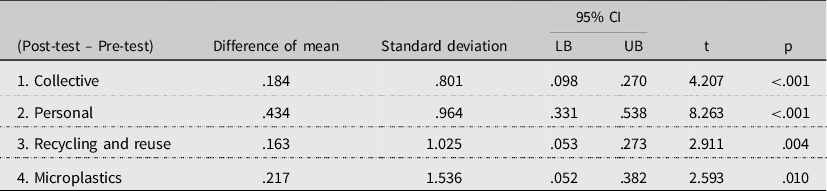
Given the existence of small differences in the means of all dimensions of the scale, in the pre-test, for each group (see Tables 3 and 5) we can consider that the attitudes of CG and EG were equivalent. In Table 3 presents the mean values for EG students’ responses, and respective standard deviations, in both moments of application of the ATEML Scale. These results were subjected to a paired samples t-test, as presented in Table 4, which revealed that the mean value significantly increases from pre- to post-test, for all dimensions. Since the attitude changes observed in EG are statistically significant for all the analysed dimensions (p value <.05), unlike the changes observed in the CG (Table 6) the null hypothesis was rejected.
Table 3. Presentation of the mean values for the dimensions of the ATEML Scale, as pre-test and post-test in the EG
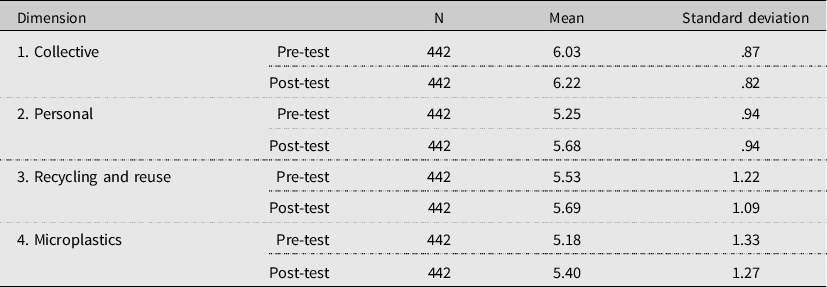
Table 4. Comparison between the dimensions of the ATEML Scale, as pre-test and post-test, in the EG
CI– 95% Confidence interval (Field, Reference Field2009) LB–Lower bound UB–Upper bound.
The same procedures were used to compare the attitudes of students in the CG. Thus, Table 5 presents the mean values for students’ responses and respective standard deviations, in both moments of application. Similarly, the paired samples t-test (Table 6) allows us to conclude that, in the CG, only dimensions 1. Collective and 2. Personal revealed significant changes from pre- to post-test. In dimension, 1. Collective, the students from the CG expressed less positive attitudes in the post-test than in the pre-test, as opposed to what was observed in dimension 2. Personal. On the other hand, no statistically significant differences were found for the results of dimension 3. Recycling and reuse and 4. Microplastics.
Table 5. Presentation of the mean values for the dimensions of the ATEML Scale, as pre-test and post-test, in the CG
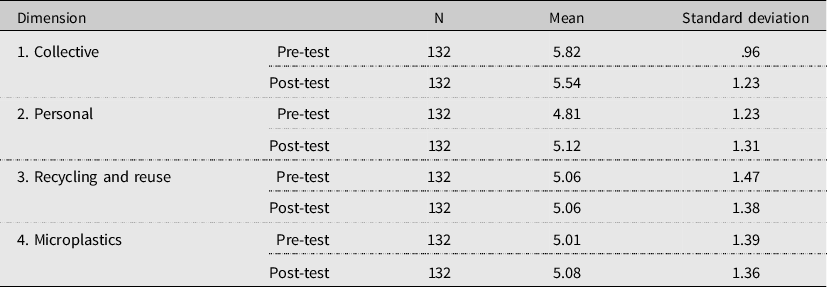
Table 6. Comparison between the dimensions of the ATEML Scale, as pre-test and post-test, in the CG
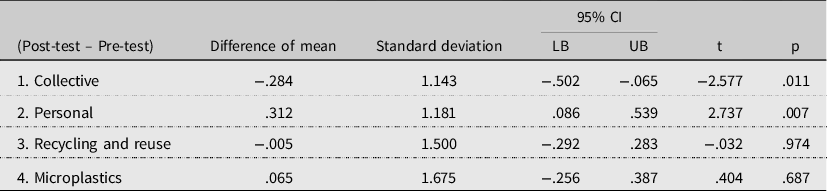
CI–95% Confidence Interval (Field, Reference Field2009) LB–Lower bound UB–Upper bound.
A more detailed analysis of students’ responses to the attitude scale showed that, regarding the results of the pre-test (and of the post-test), all items of this scale presented, for both groups, mean values above the intermediate point (4) of the scale (Table 7).
Table 7. Descriptive analysis of the students’ responses (CG and EG) to the ATEML Scale: pre-test and post-test
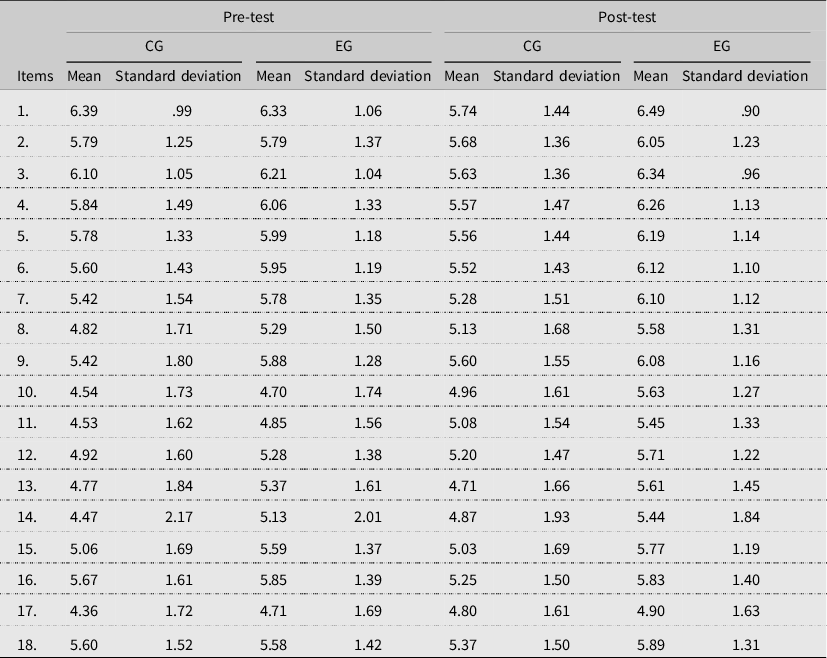
Specifically, for the CG, items 17, 14, 11 and 10 are those with the lowest mean values. In the case of the EG, items 10, 17 and 11 present the lowest results. On the other hand, the response means are higher for items 1, in both groups. Furthermore, similar to the pre-test results, the results of the attitude scale applied as a post-test reveal that the values for each item are above the intermediate point of the measurement scale. In this case, for the CG, we positively emphasise items 3, 2 and 1. Conversely, for the EG, it is items 4, 3 and 1 that obtain the most positive attitudes from students. On the other hand, items 13 and 17 are those which exhibit a lower mean value for the CG. However, for the EG, item 17 is the only one with a mean value below 5 points on the measurement scale. Overall, there is a tendency for the results of EG students in the post-test to be considerably higher than those of students from the CG.
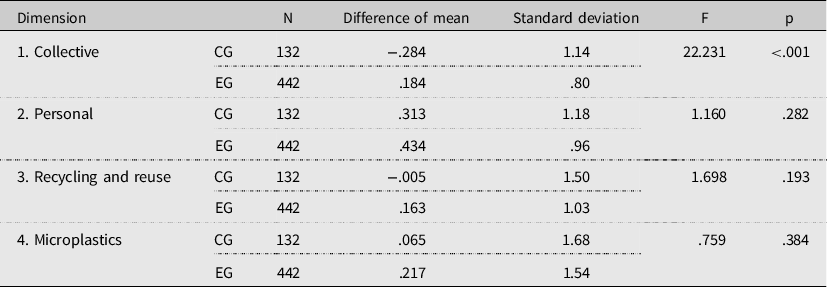
Therefore, to examine the significance of the differences between groups, observed in the variations from pre- to post-test, the results of this attitude scale were submitted to an ANOVA analysis. As such, Table 8 systematises the results of Tables 4 and 6, and the results of the statistical test conducted. From the analysis of Table 8, it is possible to conclude that significant variations only occur between groups for dimension 1. Collective, where the changes in attitudes, from pre- to post-test, are positive for the EG and negative for the CG. The same tendency was also found for dimension 3. Recycling and reuse, although, in this case, the differences were not statistically significant. Dimensions 2. Personal and 4. Microplastics also showed no statistically significant differences in the attitude changes of both groups. Nevertheless, the changes observed in the EG were always more positive than those observed in the CG.
Table 8. Comparison of variations in the dimensions of the ATEML, from pre-test to post-test, between the CG and EG
Since the literature reveals that gender can be a differentiating variable for students’ attitudes towards the environment (Hartley et al., Reference Hartley, Pahl, Veiga, Vlachogianni, Vasconcelos, Maes and Thompson2018; Srbinovski, Reference Srbinovski2019), we considered relevant to examine whether these differences in attitudes between boys and girls were also present in this research.
Effect of gender on the variation from pre-test to post-test, for the CG and EG
Table 9 shows the variation in attitudes occurring from pre- to post-test, in the EG and CG, for boys and girls. It is possible to observe that, for CG, the variation in dimension 1. Collective is negative for both boys and girls. However, it is the boys who exhibit a more negative change in attitudes for this dimension. On the other hand, in the EG, the same dimension revealed positive attitude changes for both boys and girls, with girls revealing a more positive change than boys.
Table 9. Relationship between the variations in the dimensions of the ATEML Scale, from pre-test to post-teste, and gender

Regarding dimension 2. Personal, both groups exhibited positive attitude changes from pre- to post-test. In the CG, the mean value of boys’ responses increased more than that of girls. Conversely, in the EG, girls presented more positive changes between the two moments of data collection. For dimension 3. Recycling and reuse, girls revealed more positive attitude changes than boys. For this dimension, in the CG, girls exhibited more positive attitudes in the post-test, whereas boys revealed a negative attitude change. In the EG, both boys and girls exhibited more positive attitudes in the post-test, with girls presenting more positive attitudes than boys. For the final dimension of this scale, 4. Microplastics, in the CG, the mean value of boys’ attitudes decreased, from pre- to post-test, as opposed to what occurred for girls. In the EG, the changes in attitudes for boys and girls were positive, with girls revealing more positive attitude changes for this dimension, when compared to boys.
To determine whether the attitude changes of students in each group differ according to gender, an ANOVA analysis was conducted. The results of this statistical test (1. Collective: F 1,442 = 0.009, p = .923; 2. Personal: F 1,452 = 0.720, p = .397; 3. Recycling and reuse: F 1,442 = 0.003, p = .955; 4. Microplastics: F 1,452 = 0.250, p = .618) indicate the pattern of interactions for the attitude changes between groups does not differ according to gender.
Discussion
As issues related to the environment have sparked the interest of society in general, there is a growing concern, from citizens, regarding the potential consequences of environmental issues for their daily lives (European Commission, 2014). Thus, citizens often exhibit positive attitudes towards the environment (Korkmaz et al., Reference Korkmaz, Fakir and Alkan2017; Srbinovski, Reference Srbinovski2019). Indeed, as reported in the literature (e.g, Hartley et al., Reference Hartley, Pahl, Veiga, Vlachogianni, Vasconcelos, Maes and Thompson2018; Lucrezi & Digun-Aweto, Reference Lucrezi and Digun-Aweto2020; Teixeira, Reference Teixeira2018), the public tends to be aware of environmental problems, such as marine litter, and recognise the need for measures to solve or minimise these problems. However, these ideas do not translate, as would be expected, into behaviours and actions. For this reason, promoting positive attitudes towards the environment should be an important focus of environmental education, since adolescence is the developmental stage where this promotion is most effective in order for behavioural changes to take place (Korkmaz et al., Reference Korkmaz, Fakir and Alkan2017). As such, we considered it important to examine the impact of participation in the PVC project on the attitudes of middle school students.
From the results we concluded that, as indicated in the literature (e.g, Hartley et al., Reference Hartley, Pahl, Veiga, Vlachogianni, Vasconcelos, Maes and Thompson2018; Srbinovski, Reference Srbinovski2019), in the pre-test, students from both groups exhibited clearly positive attitudes towards the four dimensions emerging from the scale. Of these, we highlight dimension 1. Collective as the one for which students presented the most positive attitudes and, conversely, dimension 2. Personal as the one for which students exhibited the least positive attitudes. Dimension 4. Microplastics presents very low mean values when compared to the remaining dimensions of the scale, possibly because this topic was unfamiliar to many of the students. An overall analysis of these results also suggests the attitudes of the EG students in the pre-test were slightly more positive than those of the CG. This difference may be explained by the fact that, when answering the attitude scale, the PVC project was presented to EG students, with great emphasis being given to the environmental context explored, which may have immediately awakened the sensitivity of these students to issues related to ocean pollution by microplastics.
From the analysis of students’ responses to the post-test, we found that, for the CG, large attitude changes were observed in dimensions 1. Collective, where students exhibited significantly less positive attitudes. Conversely, for dimension 2. Personal, the attitudes were significantly more positive, which may suggest greater concern with personal actions in favour of the environment. Although these students were not directly involved in the intervention program, the awareness-raising activities developed in schools, within the scope of the PVC project, focussed on what everyone could do or which habits or behaviours each of us could change to mitigate the marine litter. So, this could be a reason that may have positively influenced dimension 2. Personal for these students. Nonetheless, it also can be argued these findings result from the involvement of these students in other projects or from environmental awareness campaigns in the media. However, dimension 2. Personal, for which students exhibited the most positive attitudes, comprise items clearly focussed on the context explored by the PVC project. Additionally, the informal observations and conversations with students reported by teachers may help to support these results. For the same reason, as expected, dimension 4. Microplastics slightly increased, with this increase also possibly being a consequence of the awareness raised within the schools. It is worthwhile to point out that other formal and informal sustainability-related dissemination activities that often occur in schools and daily life contexts could bias the pre-and post-test results. Moreover, even though we did not promote intentional contact between CG and the PVC project, the project dissemination activities were organised for the whole school community, which means that CG students could have been reached in some way. However, the post-test results of the EG reveal a significant positive change in attitudes, for all dimensions, which suggests the effectiveness of the project in promoting personal behaviours and actions towards marine litter and microplastics pollution. Lucrezi and Digun-Aweto (Reference Lucrezi and Digun-Aweto2020) suggest the involvement of individuals in pro-environmental initiatives promotes more positive attitudes and behaviours, which may justify the results found for the EG students.
As reported in the literature (e.g. Hartley et al., Reference Hartley, Pahl, Veiga, Vlachogianni, Vasconcelos, Maes and Thompson2018; Lucrezi & Digun-Aweto, Reference Lucrezi and Digun-Aweto2020), gender could be a fact that influences attitudes towards environment. So, in terms of the differences in attitude changes between boys and girls, we found, from pre- to post-test, that the attitude changes in girls from both groups are, overall, greater than the attitude changes observed in boys, as pointed out in the referred literature. We also found that boys in the CG expressed less positive attitudes in the post-test, whereas boys in the EG exhibited more positive attitudes, which suggests the positive impact of the PVC project on boys’ awareness and attitudes. Although, overall, girls in the CG had more positive attitudes in the post-test, we also observed that the attitude changes of girls in the EG were considerably more positive, corroborating the idea that the PVC project had a positive impact on students’ attitude changes.
The PVC project contributed to promote more positive attitudes in the EG towards these environmental problems, also revealing good indicators of the contribution of the project towards behavioural changes in the participating students, but whose true impact can only be measured in a more longitudinal study (Araújo et al., Reference Araújo, Morais and Paiva2023).
According to European Commission (2014), a large proportion of European citizens reveal that, after the media, conversations with family members and other close people, as well as participation in events, are the most important sources of information regarding the environment. Moreover, conversations and shared activities with family members are seen as important sources of information and awareness-making regarding other socio-scientific issues (Paiva et al., Reference Paiva, Morais and Moreira2017). Thus, given the PVC project’s scientific dissemination component, we also highlight its contribution to promoting environmental awareness in this community.
Conclusion
Students’ involvement in educational citizen science projects, particularly if contextualised with current and relevant environmental situations, as was the case of the PVC project, promote the affective dimension of environmental literacy. Despite study limitations, its findings gave us good indicators of the positive impact of this project on students’ attitude changes regarding the environment and the marine litter. So, this educational experience, profiles a positive way to raise students’ awareness of the marine litter problem, promoting opportunities to enhance an environmental literate society by linking and relating the environmental education to other areas such as chemistry education and its fundamental contents (Araújo et al., Reference Araújo, Morais and Paiva2015, Reference Araújo, Morais and Paiva2021, Reference Araújo, Morais and Paiva2022; Morais et al., Reference Morais, Ferreira and Araújo2021).
Acknowledgements
The authors gratefully acknowledge the teachers and students who took part in this project and greatly contributed to its success.
Financial support
This work is financially supported by National Funds through FCT – Fundação para a Ciência e a Tecnologia, I.P. under the projects UIDB/00081/2020 (CIQUP), LA/P/0056/2020 and UIDB/00194/2020 (CIDTFF).
Competing interests
None.
Ethical standards
Nothing to note.
José Luís Araújo is an Assistant Professor in the Department of Education and Psychology at the University of Aveiro. He is also an integrated member of Research Group 2 – Science, Technology, and Innovation, and LEduC – Open Laboratory for Science Education at the Research Center on Didactics and Technology in the Education of Trainers (CIDTFF). His research focuses on chemistry and physics teaching and outreach, and on public engagement in scientific research, particularly through citizen science approaches.
Carla Morais is an Assistant Professor and member of the Science Education Unit at the Faculty of Science of the University of Porto. She is also a member of the Centre for Research in Chemistry at the University of Porto (CIQUP – RG5: Education, Science Communication and Society). Her areas of interest include professional development and pedagogic practices for Physics and Chemistry teachers; dissemination models and processes for scientific knowledge and the involvement and participation of citizens in Science; technological and digital ecologies in Science Education and Communication.
João Carlos Paiva is an Associate Professor in the Chemistry Department (Education), of the Faculty of Sciences of the University of Porto – PORTUGAL. He is the coordinator of the Education, Science Communication and Society area in the Centre for Research in Chemistry of the University of Porto (CIQUP). He has a particular interest in research on the subject of science-education-religion.


 Open access

