

The 2025 volume of Britannia is my final one as editor and it has been a privilege to hold the role. In many ways the study of Roman Britain is in an exciting place, and every year brings new discoveries. Much of this comes from the commercial sector where development funds fieldwork carried out by skilled professional teams, using financial resources at a level increasingly absent in the university sector. This volume is no exception with large-scale studies of pottery from the Ouse valley and the heating-system tiles of Roman London demonstrating the possibilities of such large-scale data. However, Roman Britain is still an area where independent scholars, museum-based archaeologists and community archaeology groups continue to have an impact and Britannia continues to see important contributions from these sectors. The re-evaluation of material from earlier excavations provides a rich source of data, and papers from Wroxeter and Silchester show the potential of such approaches, while a new appraisal of the enigmatic figure from the Brading mosaic shows that even antiquarian discoveries still repay fresh assessment. I am pleased that Britannia also raises awareness of the challenges and structural inequalities that face many in the field, exemplified by Sadie Watson, Francesca Mazzilli and Kayt Hawkins’s paper showing how predominantly female finds specialists can be marginalised as authors.
While we should recognise and celebrate the continuing vitality of Roman Britain as a field of study, we cannot be blind to the threats that we also face in this field (and in archaeology and the humanities as a whole). Archaeology in the university sector is in a position that can politely be described as challenging, with those of us engaged in the study of Roman Britain at universities forming an ever-dwindling band. The declining number of archaeologists in UK universities, coupled with the burden of ever-growing administrative and regulatory process, means that tasks like editing Britannia take place in the evenings and at weekends, although combining the editorship with being Head of Department at Nottingham was my own fault rather than a result of sectoral malaise!
Alongside the broader challenges facing the humanities, the increased trend towards open access, while undoubtedly positive in many respects, presents profound financial challenges to journals such as Britannia that are dependent upon subscriber income. The need to streamline production processes is manifested visually in the adoption of a common template for CUP’s humanities journals, which readers will note in the changed appearance of this issue of Britannia. Likewise, as highlighted in last year’s editorial, the ability of university-based writers to utilise institutional open access arrangements with publishers in a way that is not available to those outside the HE system risks creating tiers of privilege among Britannia’s diverse author base.
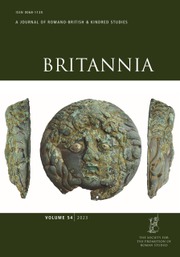
Despite these challenges, the Roman past continues to exert an enduring fascination on people from all walks of life in Britain. The public enthusiasm that greets discoveries like the Ketton mosaic that features on this volume’s cover underlines the value that the broader public sees in the research that we publish in these pages.
The publication of the journal would not be possible without the authors who take time to write the papers, the peer-reviewers who give their time and expertise for no public recognition, the compilers of the different sections of the Roman Britain in 20XX section, and the book reviewers. My work as editor has been helped inestimably by our editorial board, by Anne Chippindale our copy editor, and Fiona Haarer who does so much to keep the Roman Society running smoothly. I leave my successor in their safe hands.
Obituaries
The last year has seen the loss of two important figures who have contributed to the study of Roman Britain.
Kay Hartley was one of the leading scholars of Roman pottery in Britain, particularly mortaria. She published multiple assemblages of the latter from Britain and Europe and was a founder member of the Study Group for Roman Pottery. She also had the foresight and generosity to digitise her extraordinary archive of mortaria records and make it freely available via the Archaeological Data Service, creating a long-lasting legacy of her knowledge and work.
Ralph Jackson was senior curator of Romano-British collections at the British Museum and a world-leading authority on Roman medicine and its associated material culture. He worked on key assemblages of medical equipment, including that from the Surgeon’s House in Rimini, and also published the standard work on the so-called ‘cosmetic grinders’ of Roman Britain. Alongside this work he also co-directed important excavations at Stonea and Ashwell.


