





Hostname: page-component-5d84bcc8dc-6jkbs Total loading time: 0 Render date: 2026-09-11T05:51:00.902Z Has data issue: false hasContentIssue false

THE DIFFERENCE ANALOGUE OF THE TUMURA–HAYMAN–CLUNIE THEOREM

Published online by Cambridge University Press:  06 November 2023

MINGLIANG FANG
Affiliation:
School of Sciences, Hangzhou Dianzi University, Hangzhou 310012, PR China e-mail: mlfang@hdu.edu.cn
HUI LI*
Affiliation:
School of Science, China University of Mining and Technology-Beijing, Beijing 100083, PR China
XIAO YAO
Affiliation:
School of Mathematical Sciences and LPMC, Nankai University, Tianjin 300071, PR China e-mail: yaoxiao@nankai.edu.cn

Abstract

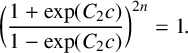
We prove a difference analogue of the celebrated Tumura–Hayman–Clunie theorem. Let f be a transcendental entire function, let c be a nonzero constant and let n be a positive integer. If f and $\Delta _c^n f$ omit zero in the whole complex plane, then either $f(z)=\exp (h_1(z)+C_1 z)$, where $h_1$ is an entire function of period c and $\exp (C_1 c)\neq 1$, or $f(z)=\exp (h_2(z)+C_2 z)$, where $h_2$ is an entire function of period $2c$ and $C_2$ satisfies

$$ \begin{align*} \bigg(\frac{1+\exp(C_2c)}{1-\exp(C_2 c)}\bigg)^{2n}=1. \end{align*} $$

Information

Type
Research Article
Copyright
© The Author(s), 2023. Published by Cambridge University Press on behalf of Australian Mathematical Publishing Association Inc.

Access options

Get access to the full version of this content by using one of the access options below. (Log in options will check for institutional or personal access. Content may require purchase if you do not have access.)

Article purchase

Temporarily unavailable