

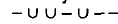
 appears as clausula to a stanza which includes dochmiacs, but it does not follow directly on them, and the dochmiacs themselves are of the forms
  /
/  , and, once,
  . This is merely an example of the colon acting as an all-purpose clausula.
 / as the catalectic form for dactyls. Raven's list of ‘catalectic’ dactylic cola (G.M.2 49) is interesting, but not all the examples are beyond dispute. Pers. 882 (= 891):
 is probably not a separate colon, since the passage continues
  …, so that the proposed division is actually in the middle of a dactylic metron (
 ). Dale (L.M.2, 40) while making the point that the dactylic sequence is uninterrupted, prefers Murray's layout on the page, following word end in preference to metron-end. But that is not, strictly speaking, a colometry. Eum. 1042 (= 1046), however, is a genuine example for it coincides with verse-end, shown by brevis in longo in the strophe and hiatus in the antistrophe. Eum. 533 = 545, not one of Raven's examples, is also unambiguous, since the next colon begins
  ….
…. ). Pindar's preference is not so strong: he has 48 pendant clausulae in the epinicians to 33 blunt. In the dactyloepitrite poems alone, however, the proportion is higher: 29 to 15. Dactylo-epitrite has no catalectic form, so the preference for pendant clausulae manifests itself independently of catalexis.
 which, formally, has the effect of bringing one
  to the beginning of a colon. The other two, however, remain embedded in mid-verse. To place all the syncopated metra at colon-end, as in my colometry, probably makes the verse easier to read rhythmically. The problem of layout here is a modern one. In performance, one supposes, the passage must have run:
  Or, avoiding any implication about musical realization, one can notate the rhythmic pattern a b a b a a.
 (where
  applies to the subordinate clause and
  to the main clause, as here) is, according to Denniston (Particles, 98–9), ‘exceedingly rare’. Bentley's transposition
  ates the rarity and produces a pair of identical cola of the form
  (cf. Thesm. 1034–5, with Dale's comment, quoted above, p. 20).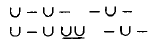
 had not Boeckh's method of locating verse-ends shown that the true division is:
 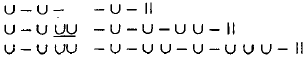 .
. : unlike the other epithets, its function here is to complete the meaning of the verb (‘abides re-arising’). That it should be rhythmically marked out in some way is not inappropriate. In any case, Dale is subscribing to the highly dubious interpretation of
  as adjectival. Fraenkel (ad loc.) puts with overwhelming force the case for the view shared by most modern editors (Wilamowitz, Verrall, Denniston and Page) that it is substantival in apposition to
  : ‘There abides, terrible, re-arising, a treacherous housekeeper: Wrath…’
 , 1967, 65–73) suggests an intermediate situation: obligatory word-end without metrical pause. A similar concept seems to underlie Dale's ‘obligatory colon-end’. I do not see how this hypothesis can be either proved or disproved (cf. Lustrum 15, 1970, 52). The practice of Pindar, at least, suggests straight alternatives; either the possibility of synartesis, or metrical pause.
 ) is so exceptional that it seems to me mislead ing to notate
  . See also Dale, L.M.2 153.
 to mark vowel-sounds shortened by epic correption. He also uses Maas's finale mark,
  , for final elements in abstract metrical schemes, as distinct from scansions. This is particularly useful for the description of stichic metres and ready-made stanzas, such as the sapphic and alcaic, to show points where synaphea is generally broken.
Crossref Citations

This article has been cited by the following publications. This list is generated based on data provided by Crossref.
Stinton, T. C. W.
1977.
Notes on Greek tragedy, II.
The Journal of Hellenic Studies,
Vol. 97,
Issue. ,
p.
127.
Parker, L. P. E.
1988.
Eupolis the unruly.
Proceedings of the Cambridge Philological Society,
Vol. 34,
Issue. ,
p.
115.
Willink, C. W.
1990.
The Parodos of Euripides' Helen (164–90).
The Classical Quarterly,
Vol. 40,
Issue. 1,
p.
77.
Willink, C. W.
1992.
Euripides, Supplices 42–70.
The Classical Quarterly,
Vol. 42,
Issue. 1,
p.
41.
Willink, C. W.
2007.
Euripides,Hippolytus732–75.
The Cambridge Classical Journal,
Vol. 53,
Issue. ,
p.
253.
2013.
The Encyclopedia of Greek Tragedy.
p.
822.