

 , found in most MSS, should probably be retained in line 1 (Van der Weiden, p. 64) and is used henceforth

 (frs. 84–95 Wehrli): they were commonly couched in dactylic or iambic verse, not in lyric.
 ] remains difficult’ and ‘we cannot be certain to what exactly “stretched out like a rope” refers’.
 vom Munde kam, also seine Aussprache. Mit dem Namen des Buchstaben hat das nichts zu tun.’
 etc.: Buck, pp. 57–8, 70, 71.
 . Boeotian has phonological features found in Doric dialects (Buck, pp. 345–6).
 is balanced by
  (line 10): there too the current situation is contrasted with a former one still vivid in the poet's memory,
  .
. the a did not come out true from men's mouth, it did not live up to its promise, because of the pipe accompaniment. His new dithyramb has quite a different sound.‘ However, an association with the
  here is unconvincing:
  is descriptive of singing (
 ) rather than alluding to any particular
  , and the
  element cannot be overlooked (see below, Section V).
  is perhaps related to the bird so named (LSJ s.v.
  ): such ‘imitative’ nomoi included the Pythian nome (see n. 44 below), and cf. Alcman's
 (PMG 40).
 (fr. 16J W). The only candidate for an asigmatic dithyramb by Lasos is the
  cited by Athenaeus (we have only the title), whose attribution to Lasos was debated in antiquity
 (PapHerc 994, col. 37, 8–11) reads:
 –‘not even Lasos’ compositions that are most elaborated in such a way do this sort of thing’ (sc. omit the sigma?).
 in Vorsokr.10 68 B 18 b) era dunque viva gia verso la fine del sec. VI.’
 to the manner of performance of the dithyramb (see further below, n. 59), and Privitera (1988) raised the question of ‘Feffetto spettacolare’ of the
  but neither attempted to consider its aural impact
 as echoing the construction of
 describes voices that are ‘fine and concentrated, like those of cicadas, grasshoppers, and nightingales, and in general all those voices that are refined and have no extraneous sound accompanying them’ (Ps.-Arist. De Audibilibus 804a21).
 were derived from
  (fr. 86 W, see n. 7 above), may have been partly responsible for its being misleadingly characterized as an intellectual diversion; despite Lasos’ penchant for wordplay (see below, n. 50), the omission of the sigma was not a gimmick
 was to test their ‘ring’,
  .
. , relating it to an original sense of ‘counterfeit’ coin, one of several money terms borrowed by the Greeks from Phoenicia
 , but musical onomatopoeia occurs in dithyrambs of the late fifth century. Timotheus, for instance, was said to have imitated a storm in his Nauplius and Semele's birthpangs in his Semele(Athenaeus 8.337f, 352a).
 (Laws 669e6). Dionysius of Halicarnassus writes:

 (De comp. verb. 14.80, p. 54 U.-R.).
 (Ba. 1017–18). In the parodos of the Bacchae the sibilance is notable (
 ): Euripides was conscious of its power for dramatic effect (the locus classicus is Medea 476–1; see dayman, p. 69).
 , but Lasos' concern had a more practical aspect.
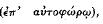 ), but perhaps this dramatizes what may have been an act of stylistic detective work on Lasos' part.
 (Hesychius s.v.). His fourth-century biographer Chamaeleon reported two anecdotes (fr. 30 Wehrli): in one Lasos puns that a raw fish might also be
  (not ‘cooked’ but ‘visible’), in the other he plays on the different meanings of
  (‘catch’ and ‘possess’)
 (Stobaeus 3.29.70):
 .
. ) on music. West (1992, p. 225) suggests that he may actually have coined the word
  , first attested shortly afterwards in Pindar and Epicharmus
 (line 11) has been translated ‘spittle-destroying reed’, but it also suggests ‘hiss-suppressing reed’.
 as ‘land-measure’ (Hdt. 2.6) as well as ‘rush, reed’, but strangely concludes that ‘in both cases the interpretation is “monotonous"’.
 does not take account of the word's connotation of ‘straightness’ or its close connection here with the sound of san.
 suggested ‘not indeed that the old Dithyrambs crawled along, but at least that they do not dance’: he related Pindar's lines to Arion's institution of a ‘stationary chorus’. Privitera (1988) objected that as the verb is qualified by d-zro
  , it cannot refer to the choreutai, but to ‘come l'ode e il san uscivano, come venivano cantati’ (p. 131 n. 19). Although this may be strictly the case, the verb in context (as Bowra saw) encompasses the movement of both the sound and the singers.
 . West (1992), Zimmermann et al. have also sought to explain
  as ‘long-winded’ by analogy with the
  of Aristophanes, Frogs 1296 (schol. ad loc. refers to
  , ‘a rope-winder's songs’).
 : Pickard-Cambridge, DFA, p. 262. Pindar's chorus may also have wielded KporaXa, like the Olympians in their dance (line 10). Audible ‘conducting’ was common well into the modern period: the story of how in 1687 the composer Jean Baptiste Lully died from an abscess which developed after he struck his foot with the rod he was using to conduct a choir is well-known to music students. Rousseau, in his Dictionary of Music (1767), writing about a conductor of the Paris opera, mentions ‘le bruit insupportable de son baton qui couvre et amortit tout l'effet de la Symphonie’ (see further under ‘Conducting’ in
  , suggesting that the aulete stood on the step of the central altar.
 ; see Photios s. v.), set up in a central public space such as the agora: on one occasion (perhaps in 498 B.C.) such a structure collapsed, killing many spectators (Sudas.v.
 ). The earliest surviving stone theatre is that of Dionysos at Athens: part of its construction appears to date to the early fifth century.
 suggest that the aulete was expected to dance as well as play (cf. Arist. Poetics 1461b31). The aulete Pronomos of Thebes was famous for his gyrations:
  (Paus. 9.12.4).
 rather than
  may indicate the stationary (non-processional) aspect of the circular dance depicted (as may
  ).
). . ‘Dionysos the column’: Clement of Alexandria (Strom. 1.24) quotes a late oracular verse
 similarly to connote ‘spread out in a circle around a central point’:

 does not occur elsewhere in Pindar, so a contrastive use of
  cannot be categorically ruled out.
 ‘and now’ (as opposed to
  ‘but now’) still contains some element of temporal contrast, e.g. Soph. O. C. 932
 (‘I said it before, and I say it again now)
 for gates opening, e.g. 01. 6.27
 (‘compound words are particularly suited to dithyrambs’).
 .Athenaeus 15.682 (cf. Eustathius, Comment, in II. 1295.14)
 {
{ has the same root). LSJ
  III.2 has ‘central part of a rose’ (citing Ps.-Arist. Pr. 907a20); if this were thought to constitute its nectary,
  would also connote ‘fragrant-centred’.
 (within a different metrical unit) was not offensive to Pindar: cf.Isthm. 5.12–13
  .
. Par excellence; ja, Dithyrambos und
  werden als Synonyme gebraucht’ (Zimmermann, p. 25). Cf. Pickard-Cambridge (DTC, p. 32): ‘The name "circular chorus”, which always means dithyramb, was probably derived from the dancers being arranged in a circle, instead of in rectangular formation as dramatic choruses were.’ As these quotations show, commentators recognize that the synonymity was functional, but not semantic.
 (P– 25), while Privitera writes: ‘Quasi certamente era ciclico gia il coro istituito da Arione a Corinto’ (1988, p. 129). Van der Weiden alone has cautiously suggested that ‘the introduction of the circular dance would not be incompatible with the picture of Lasus as it emerges from other sources’(p. 10).
 (Philologus, Suppl. Band XXVII, 1933).
 itself has been linked to
  (etymologically related to triumphus), signifying a kind of procession.
 were m fact rectangular formations danced in a circular orchestra is an attempt to square the circle. It seems likely that at least the less formal dithyrambic performances, such as those we find portrayed on vases, took place in the agora and other non-circular arenas until quite a late date, even after they were called
  m Pindar fr. 75 the gods are summoned to the ‘richly-adorned and glorious agora’.
 , Plut. Symp. Quaest. 1.1.5.
 also alludes to the ox that was won as the prize for the best dithyramb.
 .
. (FGrH 463 F 1).
 can be held, perhaps by contrast with the
  of Proclus, to allude to the dancers not changing their location (that is, dancing ‘on the spot’ as suggested by Pindar's
  , cf. n. 73 above), the beginnings of a change from a processional dance may already be implied. Webster (p. 68) tentatively makes this suggestion, and connects the stationary form (cf. stasimon) with the triads of Stesichorus (p. 77; cf. Pickard-Cambridge, DTC, pp. 11–12). In classical times, however,
 simply meant ‘to assemble a chorus*
 Tzetzes (Lye p. 252 Miller) attempts to reconcile both traditions:
 (Xaflpiov codd. dett.)’

Crossref Citations

This article has been cited by the following publications. This list is generated based on data provided by Crossref.
D'ANGOUR, ARMAND J.
1999.
ARCHINUS, EUCLEIDES AND THE REFORM OF THE ATHENIAN ALPHABET.
Bulletin of the Institute of Classical Studies,
Vol. 43,
Issue. 1,
p.
109.
Sheldon, John S.
2003.
Iranian Evidence for Pindar's ‘Spurious San’?.
Antichthon,
Vol. 37,
Issue. ,
p.
52.
Hedreen, Guy
2004.
The Return of Hephaistos, Dionysiac Processional Ritual and the Creation of a Visual Narrative.
The Journal of Hellenic Studies,
Vol. 124,
Issue. ,
p.
38.
Bacchylides
and
Maehler, H.
2004.
Bacchylides.
Burdorf, Dieter
Fasbender, Christoph
and
Moennighoff, Burkhard
2007.
Metzler Lexikon Literatur.
p.
138.
Sheldon, J. S.
2009.
The Wider Context: Common Elements in Indo-Iranian, Greek and other Poetic Traditions and Mythologies. By M. L. West. (Indo-European Poetry and Myth). pp. xii, 525. Oxford, Oxford University Press, 2007..
Journal of the Royal Asiatic Society,
Vol. 19,
Issue. 4,
p.
509.
Steiner, Deborah
2011.
Dancing with the Stars :Choreiain the Third Stasimon of Euripides’Helen.
Classical Philology,
Vol. 106,
Issue. 4,
p.
299.
Rotstein, Andrea
2012.
Mousikoi Agones and the Conceptualization of Genre in Ancient Greece.
Classical Antiquity,
Vol. 31,
Issue. 1,
p.
92.
Mossman, Judith
2013.
A Companion to Plutarch.
p.
437.
Kurke, Leslie
2013.
Pindar's Pythian 11 and the Oresteia.
Classical Antiquity,
Vol. 32,
Issue. 1,
p.
101.
Phillips, Tom
2013.
EPINICIAN VARIATIONS: MUSIC AND TEXT IN PINDAR,PYTHIANS2 AND 12.
The Classical Quarterly,
Vol. 63,
Issue. 1,
p.
37.
2013.
The Encyclopedia of Greek Tragedy.
p.
926.
2013.
The Encyclopedia of Greek Tragedy.
p.
288.
Hardie, Alex
2015.
A DITHYRAMB FOR AUGUSTUS: HORACE,ODES4.2.
The Classical Quarterly,
Vol. 65,
Issue. 1,
p.
253.
D'Angour, Armand
2015.
A Companion to Ancient Aesthetics.
p.
188.
Steiner, Deborah
2015.
The Poetics of Sound: Callimachus’ Rereading of Pindar Fragment 70B S.-M..
Classical Philology,
Vol. 110,
Issue. 2,
p.
99.
Almazova, Nina
2017.
De tibicine Pythico ludisque Nemeis.
Mnemosyne,
Vol. 70,
Issue. 1,
p.
150.
Sheets‐Johnstone, Maxine
2019.
A Jungian perspective on the unity of mind and body and its relevance to 21st‐century politics.
Psychotherapy and Politics International,
Vol. 17,
Issue. 3,
D'Angour, Armand
2020.
A Companion to Ancient Greek and Roman Music.
p.
409.
Soyöz, Ufuk
2022.
Once upon a time in PERGAMON: Reality and representation in the Hellenistic city.
Digital Applications in Archaeology and Cultural Heritage,
Vol. 25,
Issue. ,
p.
e00223.