

 si cui boles
  pro tuo uendito.’ The antonomasia, the euphonic sibilance, and the mannered rhythm (the five-word line with fourth foot homodyne; the spondaic fifth foot) are all prominent in Cicero's hexameter. The line is a humorously concocted example of affected and Grecizing narrative. But it is also a line which, Atticus is to suppose,
  would value; presumably therefore it is meant to hit off characteristics of their style. Cicero must in fact be
  .
.
 ). The real alternative to the yardstick of
  is, I suppose, worth or seriousness of content: cf. Aristotle's
  (Poetics 1449b) etc. (Brink, p.18). Callimachus is in many respects close to l'art pour l'art.

 ; and the scholiast on this passage tells us that ‘Callimachus also used the metre.’ Cf.
  ).
). of Eratosthenes may have been for an actual wedding; those that Philodemus has in mind certainly are.
 , written for Cornelius Gallus to draw upon and put
  (presumably what we should call epyllions)
  Many of the stories derive from Euphorion. On Gallus and Euphorion see below, §VIII.
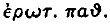 (cf. n.55 above) 4 (Oenone and Paris).
Crossref Citations

This article has been cited by the following publications. This list is generated based on data provided by Crossref.
Tuplin, Christopher
1979.
Cantores Euphorionis again.
The Classical Quarterly,
Vol. 29,
Issue. 2,
p.
358.
Kennedy, Duncan F.
1982.
Gallus and The Culex.
The Classical Quarterly,
Vol. 32,
Issue. 2,
p.
371.
Rutherford, R. B.
1989.
Virgil's Poetic Ambitions in Eclogue 6.
Greece and Rome,
Vol. 36,
Issue. 1,
p.
42.
Gibson, B. J.
1995.
Catullus 1.5–7.
The Classical Quarterly,
Vol. 45,
Issue. 2,
p.
569.
1996.
>Lesbia< und >Juventius<: Zwei libelli im Corpus Catullianum.
p.
319.
2005.
A Companion to Latin Literature.
p.
406.
Johnson, W. R.
2007.
A Companion to Catullus.
p.
173.
Edwards Davis, Josiah
2012.
The Encyclopedia of Ancient History.
2013.
The Virgil Encyclopedia.
p.
580.
2013.
The Virgil Encyclopedia.
p.
265.
Sistakou, Evina
2013.
Euphorion et les mythes.
p.
225.
Cowan, Robert
2014.
Cinna’s Trouser Snake – or the Biter Bit? Alternative Interpretations of Cinna fr. 12FRP.
Antichthon,
Vol. 48,
Issue. ,
p.
95.
Hendren, T. George
2016.
Catullus’s Ameana Cycle as Literary Criticism.
Mnemosyne,
Vol. 69,
Issue. 2,
p.
262.
Nethercut, Jason S.
2018.
The Alexandrian Footnote in Lucretius’ De Rerum Natura.
Mnemosyne,
Vol. 71,
Issue. 1,
p.
75.
Damon, Cynthia
and
Farrell, Joseph
2020.
Ennius' <I>Annals</I>.
Fulkerson, Laurel
2020.
Trapped between Scylla and Ciris: Some Thoughts on Poetic Structure.
Dictynna,
Vol. 17,
Issue. ,
Schafer, John Kyrin
2020.
Catullus through his Books.
Bowditch, Phebe Lowell
2023.
Roman Love Elegy and the Eros of Empire.
p.
261.
Fedeli, Giacomo
2023.
HORACE IN LOVE, HORACE ON LOVE.
The Classical Quarterly,
Vol. 73,
Issue. 1,
p.
213.
Green, Peter
Anžlovar, Ana
Bobovnik, Nena
Gerl, Jošt Yoshinaka
Iljaš, Domen
Movrin, David
Skubic, Meta
and
Škraban, Kajetan
2023.
Peter Green: Katul in njegov čas.
Clotho,
Vol. 5,
Issue. 1,
p.
319.