

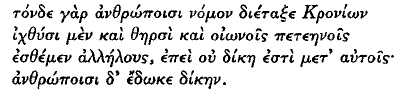

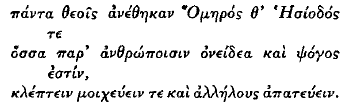
 This certainly suggests that he saw a discrepancy in these poets between the portrayal of the gods as the champions of ‘right’ and the gods' own behaviour to each other. In this view he was almost certainly unique, for, as Lloyd-Jones points out (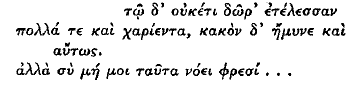


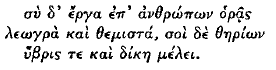
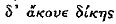 (exhortation). I am indebted to Prof. Gould for drawing my attention to a similar interpretation of this fable by
 .
.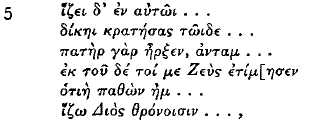 a vital point is that Zeus won (κρατήσας). Lloyd-Jones's statement that ‘lines 6 and 7 seem to have said that Zeus gained his victory justly, because his father began the fight’ might appear to imply that Zeus had Dike on his side because he was attacked. But I would argue that Zeus had Dike on his side because having been attacked he took successful counter measures. In other words, he would not have had Dike on his side if he had failed in his attempt to take vengeance. It is when the attacker is worsted, and only then, that Dike ‘crosses over’ to his victim, and this, I suggest, is what is meant, in the lines of the Choephori quoted, by the phrase ‘τò δίκαιον μεταβαίνει’.




Crossref Citations

This article has been cited by the following publications. This list is generated based on data provided by Crossref.
Gill, David
1980.
Aspects of Religious Morality in Early Greek Epic.
Harvard Theological Review,
Vol. 73,
Issue. 3-4,
p.
373.
Zanker, G.
1986.
THE WORKS AND DAYS: HESIOD'S BEGGAR'S OPERA?.
Bulletin of the Institute of Classical Studies,
Vol. 33,
Issue. 1,
p.
26.
Kirby, John T.
1992.
Rhetoric and Poetics in Hesiod.
Ramus,
Vol. 21,
Issue. 1,
p.
34.
Hölkeskamp, Karl-J.
1993.
Written law in archaic Greece.
Proceedings of the Cambridge Philological Society,
Vol. 38,
Issue. ,
p.
87.
Che Jayoung
2012.
Cultural Assimilation Shown in the Concepts of Justice·Labour·War in the Ancient Greek Epics and the Hebrew Bible - Centering on the Hesiodos' Works and Days.
The Journal of Classical Studies,
Vol. null,
Issue. 31,
p.
37.