

 , he declares,
  , so he rejects
  , ⋯οιδήν in favour of the delicate cicada's
  which is heard at its best in
  and other poetic genres that are
  . Three separate but related targets are singled out for attack: long continuous poems, epic subjects, and the grand style.
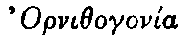 of Boio (if this is the correct spelling of nis name), which was translated by Ovid's friend Aemilius Macer (Tr. 4. 10. 43–4), Nicander's five books of
  , the prose collection of
  by Eratosthenes and Parthenius’
  (probably, like the extant
  , a mixture of prose and verse), Calvus's Io, and Cinna's Smyrna. Our knowledge of these depends on testimonia and fragments. Extant examples include Moschus’ Europa and Silenus’ song in Virgil's sixth Eclogue.
 øάρµακον; with which the dramatist reveals Phaedra's bewildered and desperate capitulation.

 . But Homer does not give it the extended heroic treatment, as Ovid does.
Crossref Citations

This article has been cited by the following publications. This list is generated based on data provided by Crossref.
Leach, Eleanor Winsor
1974.
Ekphrasis and the Theme of Artistic Failure in Ovid's Metamorphoses.
Ramus,
Vol. 3,
Issue. 2,
p.
102.
Bass, R. C.
1977.
Some Aspects Of The Structure Of The Phaethon Episode In Ovid'sMetamorphoses.
The Classical Quarterly,
Vol. 27,
Issue. 2,
p.
402.
Segal, Charles
1978.
The Magic of Orpheus and the Ambiguities of Language.
Ramus,
Vol. 7,
Issue. 2,
p.
106.
Lateiner, Donald
1984.
Mythic and Non-Mythic Artists in Ovid's Metamorphoses.
Ramus,
Vol. 13,
Issue. 1,
p.
1.
Davis, P.J.
1999.
‘Since My Part has Been Well Played’: Conflicting Evaluations of Augustus.
Ramus,
Vol. 28,
Issue. 1,
p.
1.
Peek, Philip S.
2001.
Black Humour in Ovid's Metamorphoses.
Ramus,
Vol. 30,
Issue. 2,
p.
128.
Peek, Philip S.
2003.
Procne, Philomela, Tereus in Ovid'sMetamorphoses:A Narratological Approach.
Antichthon,
Vol. 37,
Issue. ,
p.
32.
Resinski, Rebecca
2014.
Ovidian Ambivalence and Responses to Myrrha in Zimmerman’s Metamorphoses and Bidart’s Desire.
International Journal of the Classical Tradition,
Vol. 21,
Issue. 3,
p.
273.
Río Torres-Murciano, Antonio
2016.
La sphragís de las Metamorfosis de Ovidio (XV 871-879). Metempsicosis, apoteosis y perdurabilidad literaria.
Emerita,
Vol. 84,
Issue. 2,
p.
269.
Hoces Sánchez, Mª Carmen
2016.
Iamque opus exegi: la oda III 30 de Horacio en palabras de Ovidio.
Emerita,
Vol. 84,
Issue. 1,
p.
99.
Bakhouche, Béatrice
2019.
L’architecture des Métamorphoses d’Ovide.
Giornale Italiano di Filologia,
Vol. 71,
Issue. ,
p.
235.
Janssen, Diederik F
2020.
From Libidines nefandæ to sexual perversions.
History of Psychiatry,
Vol. 31,
Issue. 4,
p.
421.
Boyd, Barbara Weiden
2022.
Ovidian Linearities.
Dictynna,
Vol. 19,
Issue. ,
Georgievska-Shine, Aneta
2023.
Recognitions and Their Echoes in Titian’s Poesie.
I Tatti Studies in the Italian Renaissance,
Vol. 26,
Issue. 2,
p.
297.
McMorran, Will
2025.
Sensing Violence.
Hicks-Bartlett, Alani
2025.
“Que de fame ait cors, ame et vie”: Authorial Manipulation and the Matter of Pygmalion in the Roman de la Rose and Ovid’s Metamorphoses
.
Comparative Literature,
Vol. 77,
Issue. 1,
p.
82.