

Hostname: page-component-5db58dd55d-d6ndz Total loading time: 0 Render date: 2026-05-25T07:35:13.036Z Has data issue: false hasContentIssue false

Sharp bounds for decomposing graphs into edges and triangles

Published online by Cambridge University Press:  12 October 2020

Adam Blumenthal
Affiliation:
Department of Mathematics and Computer Science, Westminster College, New Wilmington, PA, USA
Bernard Lidický*
Affiliation:
Department of Mathematics, Iowa State University, Ames, IA 50011, USA
Yanitsa Pehova
Affiliation:
Mathematics Institute, University of Warwick, Coventry CV4 7AL, UK
Florian Pfender
Affiliation:
Department of Mathematical and Statistical Sciences, University of Colorado Denver, CO 80217, USA
Oleg Pikhurko
Affiliation:
Mathematics Institute and DIMAP, University of Warwick, Coventry CV4 7AL, UK
Jan Volec
Affiliation:
Department of Mathematics, Faculty of Nuclear Sciences and Physical Engineering, Czech Technical University in Prague, Trojanova 13, 120 00 Prague, Czech Republic
*
*Corresponding author. Email: lidicky@iastate.edu
Rights & Permissions [Opens in a new window]

Abstract

Core share and HTML view are not available for this content. However, as you have access to this content, a full PDF is available via the 'Save PDF' action button.

For a real constant α, let $\pi _3^\alpha (G)$ be the minimum of twice the number of K2’s plus α times the number of K3’s over all edge decompositions of G into copies of K2 and K3, where Kr denotes the complete graph on r vertices. Let $\pi _3^\alpha (n)$ be the maximum of $\pi _3^\alpha (G)$ over all graphs G with n vertices.

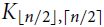
The extremal function $\pi _3^3(n)$ was first studied by Győri and Tuza (Studia Sci. Math. Hungar. 22 (1987) 315–320). In recent progress on this problem, Král’, Lidický, Martins and Pehova (Combin. Probab. Comput. 28 (2019) 465–472) proved via flag algebras that$\pi _3^3(n) \le (1/2 + o(1)){n^2}$. We extend their result by determining the exact value of $\pi _3^\alpha (n)$ and the set of extremal graphs for all α and sufficiently large n. In particular, we show for α = 3 that Kn and the complete bipartite graph ${K_{\lfloor n/2 \rfloor,\lceil n/2 \rceil }}$ are the only possible extremal examples for large n.

Information

Type
Paper
Creative Commons
Creative Common License - CCCreative Common License - BY
This is an Open Access article, distributed under the terms of the Creative Commons Attribution licence (http://creativecommons.org/licenses/by/4.0/), which permits unrestricted re-use, distribution, and reproduction in any medium, provided the original work is properly cited.
Copyright
© The Author(s) (2020)
