



Introduction
Since the expansion of mass democracy in Western Europe, radical left parties (RLPs) have played a major role in many party systems. Their electoral weight has varied over time and across countries. While some RLPs have always been small electorally, others have been very significant in terms of popular support. However, despite their continuing presence in many Western democracies, they have not received a great deal of scholarly attention in recent decades from a comparative perspective. The lack of cross-national analyses focusing on RLP electoral performance is very much in evidence. The question of why RLPs have been popular in some countries while, in others, they have been comparatively weaker, has rarely been raised or empirically examined (however, see an exception in the recent work of March and Rommerskirchen, Reference March and Rommerskirchen2011, Reference March and Rommerskirchen2012). Yet, the differences between parties sharing similar policies and programmatic stances have widened in recent times. While The Left (Déi Lénk) in Luxembourg gained 3.3% of the vote in 2009 (obtaining 1 MP out of 60), the combination of percentages won that same year by the two Greek RLPs (Kommounistiko Komm Elladas, KKE, the Communist Party of Greece, and Syriza, the Coalition of the Radical Left) was 12.1, increasing to 31.4 3 years later. While the Spanish radical left (Izquierda Unida, United Left) experienced a severe electoral crisis during the 2000s, its support decreasing from around 10% of the vote in 1996 to around 3% in 2008, the Dutch Socialist Party (Socialistische Partij) went through a period of growth, with almost opposite results (3.5% in 1998, 10% in 2010). This is a sizeable electorate that is little known and rarely studied. This article provides the first detailed comparative examination of the key individual-level factors, which account for the electoral support of RLPs in Western Europe.
Following previous studies (Hudson, Reference Hudson2000, Reference Hudson2012; Dunphy, Reference Dunphy2004; March, Reference March2011), which agree on the definition and component parties of the RLP family, this article examines the vote for parties that share a common aim – that of the radical transformation of the current economic and social system, guided by strong values of social justice and wealth redistribution. These parties, placed to the left of Social Democrat and Green Parties, are Communist, former Communist, and radical Socialist parties.
The continuous presence and relevance of the radical left in West European party systems, their uneven strength and their survival over periods of varying socio-political climate, make the absence of comparative empirical accounts of their electorate an important gap in the analysis of contemporary party politics and electoral behaviour. That these variations over time, and across countries, have received so little attention is surprising, particularly when compared with the volume of scholarship on other small-party families, such as that of the Green Party and those of the Radical Right. There is a shortage of studies analysing RLPs comparatively, both regarding their organizational evolution and their electoral support. The literature consists mainly of valuable case studies or collections of country case studies, and only exceptionally of accounts of the organizational evolution of a limited number of RLPs with a comparative vocation (Bell, Reference Bell1993a; Bull and Heywood, Reference Bull and Heywood1994; Bull, Reference Bull1995; Agosti, Reference Agosti1999; Bosco, Reference Bosco2000; Hudson, Reference Hudson2000, Reference Hudson2012; Botella and Ramiro, Reference Botella and Ramiro2003; Backes and Moreau, Reference Backes and Moreau2008). In addition, as well as not focusing specifically on the cross-national empirical examination of RLP electorates, much of the existing literature is somewhat dated, covering mostly the crises and transformations of the 1980s and 1990s.Footnote 1
Notwithstanding their differences, many of these studies offer only a cursory examination of the electoral performance of RLPs. However, two major exceptions are the very valuable analysis of the factors influencing the vote for Die Linke (Bowyer and Vail, Reference Bowyer and Vail2011, expanding on previous work by Doerschler and Banaszak, Reference Doerschler and Banaszak2007), and the account of the success of the Trotskyist lists in the 2002 French presidential election by Sperber (Reference Sartori2010). Both share the limitation of being case studies on the electoral performance of RLPs in a specific national setting. The only study that has provided an examination of the variation in the electoral support for RLPs across Europe is that of March and Rommerskirchen (Reference March and Rommerskirchen2011, Reference March and Rommerskirchen2012), who evaluate the factors accounting for the uneven levels of RLP vote in Western and Eastern Europe between 1990 and 2008, though only using aggregate data. The study by Visser et al. (Reference Visser, Lubbers, Kraaykamp and Jaspers2014) does use a comparative cross-national approach but their focus is on radical left ideology (expressed through the left–right scale) instead of electoral support for RLPs.
In trying to address this major gap in the literature, this article proposes, for the first time, an individual-level account of the varying RLP vote across Western Europe, exploring the role of a wide range of individual-level variables. Taking advantage of the time series provided by the European Election Study (EES), the period under observation will span the two decades between the end of the 1980s and the end of the 2000s. In so doing, this article does not intend to advance a definite account of all the relevant variables explaining the RLP vote in Western Europe. In particular, it does not take into consideration the system-level factors – such as institutional features, party competition characteristics and short-term socio-economic conditions – that very probably affect RLP voting.Footnote 2 The purpose of the analyses presented in this article is more modest: to offer the first examination of the role of some potentially important individual social background and attitudinal factors in the RLP vote.
The next section outlines the theoretical framework of these analyses. It reviews the role of some potentially influential variables that are thought to be associated with the working-class milieu traditionally linked to electoral support for RLPs. Two sets of factors constitute the main focus: social background variables, and ideological and political orientations. The following section presents the data and the methodology used in this study. The focus will then move to the estimation of the effect of the different individual-level factors on the prediction of the RLP vote. Finally, after discussion of the main findings of the analyses, their main implications are summarized.
Accounting for RLP voting: a theoretical framework
Social background factors
Theories linking social structure and voting patterns have traditionally highlighted the reliance of left-wing parties (Socialists and Communists) on disadvantaged social groups (Lipset and Rokkan, Reference Lipset and Rokkan1967; Przeworski and Sprague, Reference Piven1986; Franklin et al., Reference Franklin, Mackie and Valen1992; Nieuwbeerta, Reference Nieuwbeerta1995). An abundant literature has particularly examined the association between working-class status and the left-wing vote and, consequently, the processes of de-alignment and weakening of class voting and electoral loyalties due to modernization processes (Clark et al., Reference Clark, Lipset and Rempel1993; Nieuwbeerta, Reference Nieuwbeerta1995).
Although traditional Communist and RLPs never were the most supported among the working class – not even in the case of the most electorally successful Communist parties (Moschonas, Reference Moschonas2002) – their electorates were, in the past, mostly composed of the working class (Tannahill, Reference Taggart and Szczerbiak1978). In fact, many accounts of the Communist electoral decline during the 1970s and 1980s posit the existence of a very strong relation between social structure and the Communist vote, arguing the electoral dependence of these parties on their working-class constituencies. Indeed, the main cause adduced in multiple academic accounts of the Communist electoral decline during those decades was the change in the class structure of Western societies.
According to this line of argumentation, Communist parties declined electorally due to the disappearance or reduction in the size of certain social groups on which these parties based their electoral strength.Footnote 3 The diminishing size of the traditional working class, the peasantry, agricultural workers and the crisis of some strongly unionized economic sectors – such as mining and heavy industry, which were electoral and organizational strongholds of left-wing unions and RLPs – are mentioned as key elements explaining the Communist electoral crisis without pointing to cross-national empirical evidence (Lazar, Reference Lazar1988, Reference Lazar2000; Waller and Fennema, Reference Waller1988; Waller, Reference Visser, Lubbers, Kraaykamp and Jaspers1989; Bell, Reference Bell1993b; Bull, Reference Bull1994, Reference Bull1995; Bull and Heywood, Reference Bull and Heywood1994; Agosti, Reference Agosti1999).Footnote 4
The working class is thought to have constituted the core electorate of some RLPs (Michelat and Simon, Reference Michelat and Simon2004) and the stronghold that allowed the latter to maintain some support even in the worst of electoral times. Similar arguments are found in other recent analyses. Studying party fragmentation in France, Chiche et al. (Reference Chiche, Haegel and Tiberj2002: 212) find that the only significant professional category that had a positive and statistically significant effect on the Communist vote (compared to the vote for the Socialist party) was precisely that of the blue-collar worker. Thus, it is not only that a strong relationship between the working class and the radical left in Western Europe had been established by many authors, but also that the survival of RLPs is predicated on the existence of a radical-left political subculture sustained by certain social groups (e.g. the working class) who are characterized by ideological and behavioural traits – particularly ideological radicalism and union membership. Accordingly, those individuals who belong to the working class are expected to be more likely to vote for RLPs (Hypothesis 1).
However, developments in West European party politics might affect the relative relevance of the role of the traditional working class in the RLP vote. In some sections of the working class, RLPs might face competition not only from Socialist parties but also from new radical right organizations.Footnote 5 These developments have meant that some RLPs have retained only a very small share of working-class support (Lavabre and Platone, Reference Lavabre and Platone2003; Knapp, Reference Knapp2004). In contrast, groups that do not belong to the traditional working class have been attracted, in some instances, by RLPs. Some sections of the middle classes, particularly professional categories working in public services, already identified as one of the pillars of the electorate of left-libertarian parties (Kitschelt, Reference Kitschelt1989), sometimes support RLPs (González, Reference González2004). The following three hypotheses assess the existence of patterns in relation to social-class ‘niches’. It is expected that, following traditional patterns of electoral behaviour regarding RLPs, manual workers in public (Hypothesis 2a) and private industries (Hypothesis 2b), and professionals in the public sector (Hypothesis 2c) are more likely to vote for RLPs.
Similarly, connections with social actors who lead individuals to self-identify with the less-privileged social groups and to be mobilized as such – thus making them the ‘natural’ voting block for leftist parties – are expected to foster RLP voting. Unions have, notoriously and traditionally, performed these socializing and mobilizing roles and union membership has often been linked to left-wing voting. Despite unions’ past role as key mobilizing agents of the vote for Socialist and Communist parties, it is often argued that this association between unions and left-wing voting has been notably weaker in the last few decades due to the looser links between unions and parties, declining union membership, and the reduction in size of the most unionized and traditional industries in Western countries (Gray and Caul, Reference Gray and Caul2000; Norris, Reference Norris2002: 27). So what is the current role of unionization in the RLP vote? Has the allegedly weakening role of unions affected the suggested relationship between union membership and the RLP vote? In their analysis of the vote for Die Linke, Bowyer and Vail (Reference Bowyer and Vail2011) found that unionization had a positive effect. It is likely that this effect will hold true in a cross-national examination, and it is expected that union membership will increase the probability of the electorate voting for RLPs (Hypothesis 3).
Following group-interest theory,Footnote 6 Visser et al. (Reference Visser, Lubbers, Kraaykamp and Jaspers2014) find that certain traits associated with the least well-off social strata, foster larger levels of support for radical-left ideologies. Thus, variables related to lower socio-economic status and the lesser availability of economic resources might also foster RLP voting. The findings from case studies such as those by Oijevaar and Kraaykamp (Reference Oijevaar and Kraaykamp2005) and Bowyer and Vail (Reference Bowyer and Vail2011), partially confirm these expectations but the evidence is far from unequivocal. In fact, Bowyer and Vail (Reference Bowyer and Vail2011) found that, in the German case, lower levels of education do not increase the likelihood of a vote for Die Linke, as those with higher levels of education are more likely to be RLP voters. Nor did Sperber (Reference Sartori2010) find a significant effect of the level of education on the vote for French Trotskyst parties in 2002. Therefore, there is no consensual expectation regarding education levels. Yet, the influence of educational attainment as a potential determinant of the vote for RLP will be examined, and in line with some scholarship it is expected that higher levels of education reduce the support for RLP (Hypothesis 4).
Regarding other key socio-demographic variables, Ranger (Reference Ranger1986) found that, despite the survival of traditional radical left subcultures in certain rural regions, the Communist electoral decline during the 1980s implied that most of the radical left voters were increasingly concentrated in urban areas. Simultaneously, the economic decline hit the electoral appeal of the Communists harder for the youngest voters but had relatively less effect on support among older groups associated with declining economic sectors (Ranger, Reference Ranger1986). The difficulties which Communist parties faced in reaching young voters intensified with the emergence of new parties in Western Europe – some of them anti-establishment organizations directly competing with the radical left – that attracted considerable numbers and higher proportions of younger voters.Footnote 7
Based on these insights, we should find a greater probability of votes for RLPs among those living in urban areas (Hypothesis 5), and among those who are relatively older (Hypothesis 6). However, given that some country studies have also found that radical left recovery and survival were based – at least partially – not only on the stabilization of their working-class support but also on their gains in certain sectors of the new middle classes (González, Reference González2004), the effects of age may have changed over time. RLP inroads into new middle-class electorates might have intensified the ‘urbanisation’ of their electoral support, but may also have softened the relatively older age of their electorates. Therefore, referring at least to the effect of age, there are competing expectations.
Ideological factors and political orientations
Previous case studies, understandably, have found positive effects of ideological variables on the vote for RLPs (Doerschler and Banaszak, Reference Doerschler and Banaszak2007; Sperber, Reference Sartori2010; Bowyer and Vail, Reference Bowyer and Vail2011). RLPs are electorally small organizations that are likely to receive the vote of only the most ideologically radicalized of voters. Even if ideological radicalization can be a by-product of party allegiance, in this article it is considered to predate vote choice. Consequently, it is expected that more extreme left-wing placements in the ideological left–right scale foster RLP voting (Hypothesis 7). For similar reasons, it is expected that not identifying with any religion – an orientation closer to the original radical left ideological antagonism towards religion – will increase the chances of voting for RLPs (Hypothesis 8).Footnote 8
Variation in RLP voting may also be explained by a set of attitudes broadly associated with political dissatisfaction. Holding attitudes of dissatisfaction with democracy has been found to foster voting for other radical parties, with many case studies and comparative investigations unveiling this association for the radical right (see, among others, Ignazi, Reference Ignazi1992; Mayer, Reference Mayer1999; Lubbers and Scheepers, Reference Lubbers and Scheepers2000; Lubbers et al., Reference Lubbers, Gijsberts and Scheepers2002). These attitudes may form part of an ideologically motivated regime-‘protest’ vote – as conceptualized by van der Brug et al. (2005: 541) – in which, in contrast to the classic protest vote against political elites and establishment parties, the voter is more ideology- or policy-guided.
Political dissatisfaction can be expressed through relatively higher levels of dissatisfaction with democracy, but also through negative evaluations of the process of European integration. These attitudes find political representation in the policies defended by RLPs which, to a greater or lesser degree, all emphasize the deficiencies of both national political systems and the way in which European integration is undertaken (Taggart and Szczerbiak, Reference Sperber2008).Footnote 9 For the specific case of the radical left, March and Rommerskirchen (Reference March and Rommerskirchen2011, Reference March and Rommerskirchen2012) found a positive relation between their measure of aggregate RLP electoral support and the proportion of Euro-sceptics in the country. Therefore, it is expected that those individuals who express dissatisfaction with democracy (Hypothesis 9), or have negative opinions about EU membership (Hypothesis 10) will show a higher likelihood of voting for RLPs.
Data and methodology
The data and cases
These 10 hypotheses and theoretical expectations will be examined using data from 13 West European countries in the period between 1989 and 2009. The data come from the five data sets produced by the EES project carried out in 1989, 1994, 1999, 2004 and 2009. These surveys contain representative samples of individuals in each member-state of the EU at each time point. The five studies were designed using similar criteria and include many questions asked in an identical format. The analyses are carried out by merging the EES trend file produced by Marsh and Mikhaylov,Footnote 10 which includes the surveys for the 1989–2004 period (EES, 2008), with the 2009 survey file (EES, 2009). The studies include questions about public opinion and voting behaviour in both national and European Parliament (EP) elections, allowing cross-national and over-time analyses for the period on which this article focuses and for most of the countries in which there are significant RLPs.
There are advantages and disadvantages in using the EES as the data source. The main advantage is the existence of a relatively coherent time series of key variables spanning two decades. The main disadvantage is that the EES only reflects voter behaviour and vote recollection shortly after the EP elections. Voting behaviour in these elections shows special features related to their second-order-election nature that make their use as general indicators of party preferences imperfect. It also implies that the EES surveys were undertaken in each country at different moments of their national electoral cycle, and that voting behaviour in national parliamentary elections is recollected at a time that is varyingly distant from the date of the national general elections across countries. Unfortunately, the alternative of using national election studies has its own problems, as finding comparable questions for most of the key socio-structural and attitudinal variables is difficult. Under these circumstances, the preferred choice was to maximize the possibilities for the cross-national and over-time comparison of very similar or identical questions for a long period of time (1989–2009) with the EES, and to minimize distortion through the use of a combination of variables regarding voting behaviour that will be explained later.Footnote 11
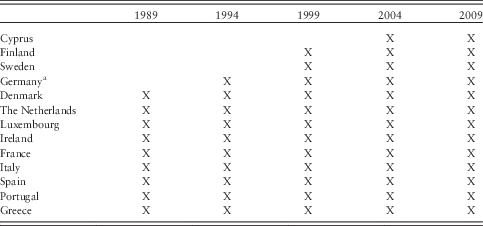
The countries included in the analyses are those where an RLP party has gained parliamentary representation in either the national parliamentary elections or the EP elections on at least one occasion during the period observed. This parliamentary representation criterion allows the inclusion in the analysis of all RLPs which can be considered relevant, during the period of interest, due to their capacity to alter the dynamics of party competition (Sartori, Reference Ranger1976) in their countries (at least in the left-to-centre political space). This criterion excludes some electorally minor and organizationally tiny radical groups (in a party family already characterized by the small size of its components), whose electorate could possibly respond to different social and political dynamics. The inclusion of very small, and electorally very irrelevant parties, might be justified to avoid selection bias in a study aimed at explaining the relative success of RLPs. However, following Arzheimer and Carter (Reference Arzheimer and Carter2006: 426), this inclusion is not necessary in a study of individual voting decisions and, in fact, could instead distort the analyses. As a result of these criteria, the selected countries are Cyprus, Denmark, Finland, France, Germany, Greece, Ireland, Italy, Luxembourg, the Netherlands, Portugal, Spain and Sweden. Table 1 lists the parties included. The EES includes countries that were EU member-states at the time of the survey; this implies that not all the 13 countries are included in all five surveys (see Appendix 1).Footnote 12
Table 1 Countries and radical left parties (RLPs) included in the study, 1989–2009

Sinn Féin could be considered an RLP both in the United Kingdom and in Ireland but, given that its main political placements are based in the nationalist divide, it is considered as mainly an ethno-territorial party and is not included in this study.
This study, in contrast to those of March and Rommerskirchen (Reference March and Rommerskirchen2011, Reference March and Rommerskirchen2012), excludes East European countries and their RLPs. Even assuming some degree of internal heterogeneity among the Western European RLPs included in this study, the diversity would be notably larger if Eastern European parties were included. It is therefore deemed preferable to limit these internal discrepancies and, consequently, to restrict our observation to the more-similar Western parties.
RLPs share a combination of ideological features that makes them very similar to each other yet distinct from Social Democrats and Greens. Although there are differences in the degree to which they consider themselves, and declare to be, Socialist, Communist or anti-capitalist, all aim to transform the social and economic status quo into an alternative system. The radical left is characterized by its strong emphasis on the existence of social inequalities caused by the nature of the capitalist economic system. In this sense, RLPs all want to transform capitalism in a meaningful way, following similar values of profound social justice and redistribution (Hudson, Reference Hudson2000, Reference Hudson2012; March, Reference March2011; March and Rommerskirchen, Reference March and Rommerskirchen2012). These ideological similarities are reflected in the participation of most of the parties studied in common transnational networks, both in the EP (the European United Left–Nordic Green Left parliamentary group) and outside it (in the Party of the European Left). Finally, these parties empirically cluster together when their position in the left–right ideological dimension is analysed (March and Rommerskirchen, Reference March and Rommerskirchen2012) and they are placed as far to the left as possible in all the expert surveys (Castles and Mair, Reference Castles and Mair1984; Laver and Hunt, Reference Laver and Hunt1992; Huber and Inglehart, Reference Huber and Inglehart1995).
The timeframe of this study spans from 1989 to 2009. The starting date, the late 1980s, coincides with the final crisis of Soviet Socialism, when the prestige of radical left ideology in Western Europe reached its lowest evaluation from the public, and many RLPs were living a period of deep electoral decline and internal turmoil that lasted until the mid-1990s (Bell, Reference Bell1993b; Bull and Heywood, Reference Bull and Heywood1994). Thus, the data set covers a period of 20 years, with many ups and downs for RLPs in Western Europe.
Measurement of key variables and modelling strategy
RLP electoral support is measured with dichotomous variables that combine the answers to three questions asking respondents to name the party they voted for (i) in the most recent national parliamentary (general) election and (ii) in the latest EP election, and (iii) the party for which they intended to vote in the next general election. From these questions, a first outcome variable is created differentiating between those who, in any of these three questions, mentioned an RLP listed in Table1 (value of 1), and those who voted and intend to vote for any other party (value of 0). Hence, we can think of this variable as identifying the ‘wide’ RLP electorate: the individuals who are ‘floating’ around the RLP space and who, at least occasionally, vote for these parties. A second outcome variable identifying the ‘core’ RLP electorate is created by differentiating between those who mentioned an RLP in all three questions on voting behaviour (value of 1), and the rest of the respondents (value of 0). Using these two variables – distinguishing both the ‘core’ and the ‘wide’ electorate – allows us to explore the existence of the potentially differing effects of some variables on several types of RLP voters, defined by their voting loyalty.
The questions included in the EES surveys prevent the creation of a proper ‘objective’ social-class variable. The questions related to occupation and socio-economic status were unfortunately not harmonized in the five surveys. Nevertheless, the EES does include a question about subjective social class in all waves. The relationship between objective and subjective social class is strong, although reference-group processes weaken the self-identification of the least socio-economically advantaged individuals with underprivileged strata and increase the identification with the middle classes (Kelley and Evans, Reference Kelley and Evans1995). Yet, the use of a subjective social-class indicator has advantages for the study of RLP voting. Magri (Reference Magri2011: 13), for example, has argued that it is precisely the existence of an ideologically committed electorate (linked to the party through different organizational channels), which allowed the survival of some Communist parties, despite the intense processes of socio-economic modernization which altered Western societies. Hence, some of the RLP electorate might be formed by a politically and class-aware radicalized sector of working-class voters. The operationalization of working-class membership through the subjective social-class question will allow an exploration of the role of working-class awareness on RLP voting. The question includes five categories of response: working class, lower-middle class, middle class, upper-middle class and upper class. A dummy variable distinguishes between those identifying as working class (1) and the rest (0). Equally, trade-union membership has been operationalized as a dichotomous variable (being a union member or not).
In addition, through the (partial) questions on occupation and sector of employment, three dummy variables are generated which identify the respondent as either (i) a manual worker in state industry, (ii) a manual worker in private industry, or (iii) a public-service professional, and compares them to all other occupations and work situations. Unfortunately, these variables are only available for the 3 years 1989, 1994, and 2009, and are analysed in a separate model.
Age is a continuous variable measured in years. The level of formal education is operationalized through a question asking for the age at which the respondent ceased full-time education. Owing to coding limitations in the original surveys for certain years, education has been summarized in four ordered categories: up to 14 years of age (reference category), between 15 and 18 years, between 19 and 20 years, and 21+ years. The question about residential habitat included three response categories (rural area or village, small or middle-sized town, large town or suburbs) that have been collapsed into a dummy variable distinguishing those living in large towns or suburbs (1) and the rest (0).
Ideology is measured through standard self-placement on a 1–10 left–right scale.Footnote 13 Religion is measured with a dichotomous variable that distinguishes between those who consider themselves as belonging to a religious denomination (0) and those who do not (1). In addition, the models include two indicators of religious attendance that identify those who never or rarely attend religious services, and those who attend only occasionally, and compare them to respondents with more frequent attendance. The two attitudinal variables related to political dissatisfaction/satisfaction were transformed into dichotomous variables. One operationalizes dissatisfaction with democracy, establishing two categories: not at all satisfied (1), and very-fairly-not very satisfied (0). The opinion concerning EU membership, distinguished between those who were opposed to it (1) and those who were not (0).
With these variables and with multilevel analyses, the remainder of the article assesses the hypotheses outlined earlier. Multilevel models allow assessment of the influence of (survey respondents’) individual-level characteristics while controlling for the clustered nature of the data (individuals within countries). Given that the dependent variables are dichotomous (1=electoral support for the RLP; 0=electoral support for any other party), several logistic regression models were fitted, using the Xtmelogit procedure in STATA.
Results
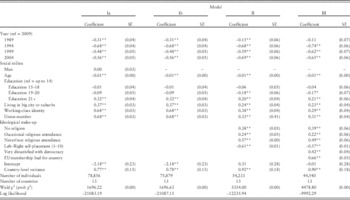
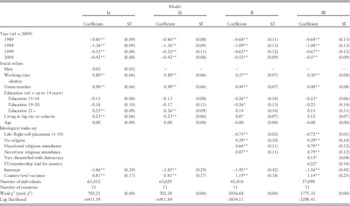
Tables 2 and 3 present the estimates and the variance components of four logistic multilevel models, which aim to explain the probability of an elector voting for an RLP in 13 Western European countries in the 1989–2009 period. Table 2 shows the results using the outcome variable on the ‘wide’ RLP electorate; Table 3, the results of the same models but using instead the ‘core’ RLP electorate outcome variable. Then, in Table 4, we see the results of two models that include the occupation variables available only for the 1989, 1994, and 2009 data sets, for both ‘wide’ and ‘core’ RLP electorates.
Table 2 Individual-level predictors of electoral support for radical left parties (RLPs) (‘wide’ RLP electorate), logistic multilevel models
*P⩽0.05; **P⩽0.01.
Table 3 Individual-level predictors of electoral support for radical left parties (RLP) (‘core’ RLP electorate), logistic multilevel models
*P⩽0.05; **P⩽0.01.
Table 4 Individual-level predictors of radical left parties (RLP) voting, logistic multilevel model for 1989, 1994, 2009, including the role of manual workers and public-sector professionals in state industry and public services

*P⩽0.05; **P⩽0.01.
In Table 2 Models Ia and Ib – the main social-milieu background characteristics – are introduced. A first result to highlight is that, although the survey year was included fundamentally as a control variable of the over-time nature of the data set, the effect of the year is quite large and statistically significant in most cases. RLP voting was more likely in 2009 than in any of the previous years, and less likely in 1994. In addition, as the results of Model Ia show, men are not significantly more likely to vote for an RLP than women; therefore, this variable – whose potential effect was not considered among our core hypotheses – will not be introduced in subsequent models.
Model Ib repeats the examination of social-milieu characteristics, excluding gender. Self-identification with the working class and being a union member increase the probability of voting for RLPs. These two variables have an important positive effect on the direction advanced in Hypothesis 1 and Hypothesis 3. The effect of education (Hypothesis 4) is a complex one. Those who ceased full-time education between 15 and 18 years of age are not significantly different to the reference group (education up to 14 years of age), and the same can be said about those having studied full-time until 19–20 years of age. However, having stopped formal education at 21 years or more has a significant and positive effect compared with the reference group of individuals with lower levels of formal education. Therefore, those with higher levels of education (probably university studies, though this is not directly measured) are more likely to vote for RLPs than individuals who left full-time education at an early age. The effect is, thus, not linear and (as we will see in Models II and III) there are indications that there might be a curvilinear relationship by which both the least- and the most-educated groups are more likely to vote for an RLP. Living in a big city or a suburb has a positive effect on support for RLPs, as suggested by Hypothesis 5. Age has a statistically significant effect (older individuals are less likely to vote for RLPs), and the data reject Hypothesis 6, which suggests that older voters are more likely to be supporters of these parties.
Model II adds three socio-political attitudinal and behavioural variables – on ideology and religiosity. Regarding these variables, the hypotheses stated that being a leftist (Hypothesis 7) and not belonging to any religion (Hypothesis 8) would increase the likelihood of electoral support for RLPs. As expected, these hypotheses are supported by the results. The large negative coefficient for the ideology variable indicates that this is a key variable and that each increased position towards the right (on a 1–10 scale, where 10 means the most radical right position) makes it less likely that someone will vote for an RLP. Moreover, although both the lack of a religious adscription and only rare/occasional attendance at religious services increase the probability of a vote for an RLP, it is interesting to note that attendance patterns are stronger predictors than adscription. In addition, the inclusion of these variables changes the coefficients for some of the educational indicators in such a way that a V-shaped curvilinear relationship is apparent. Equally, it considerably reduces the effect of working-class identity and union membership, though these remain significant and important predictors.
Finally, Model III introduces two more attitudinal variables – dissatisfaction with democracy (Hypothesis 9) and negative opinion about the EU membership of the respondent’s country (Hypothesis 10). As expected, these two variables affect the probability of voting for an RLP. Those not at all satisfied with democracy and those who think that EU membership is bad for their country are more likely to vote for an RLP. The z-values of these variables (not shown in Table 2) indicate that these political orientations have considerable effects on RLP voting.
Examination of the country-level variance suggests that including these last six socio-political attitudinal and behavioural variables increases, rather than decreases, the variance across countries, compared with that for the model which includes social-milieu variables. Therefore, the cross-national differences in RLP voting are not accounted for by dissimilarities in the number of individuals with these attitudes across the countries included in the study. Quite the opposite, it seems that accounting for compositional effects, the cross-national differences are even greater. Moreover, examination of this country-level variance with random-slopes coefficients for a number of variables (not shown) suggested that there is significant – and in some cases, quite substantial – variation in the effect of some individual-level predictors across countries. In particular, the effect of gender varies considerably across countries, and this contributes to the non-significant average effect shown in Table 2. In some countries, women are more likely to vote for RLPs whereas, in others, it is men; in yet others gender is not a significant variable. Equally, while in most countries identifying with the working class has a significant and positive effect on RLP voting, in Denmark the effect is negative and significant. While these cross-national variations do not question the usefulness of the overall model, they suggest that the RLP electorate is not fully homogeneous across Western Europe.
Table 3 shows the results of these same models but now using, as the dependent variable, the one identifying the RLP ‘core’ electorate.Footnote 14 The results are mostly consistent with those which referred to the ‘wide’ RLP electorate. Most of the variables have similar effects on the likelihood of voting for an RLP. Some of the social-milieu variables, such as working-class self-identification and union membership, relevantly increase the likelihood of supporting RLPs. The ideological and attitudinal variables (ideology, religiosity, dissatisfaction with democracy, and negative opinions about EU membership) also have consistent effects. However, there are some differences worth noting. The effect of age is not statistically significant, and the same happens with another variable associated with the social milieu: living in a city or suburb. The effects of education are again relatively complex, although the existence of a U-shaped curvilinear relationship is suggested by the pattern of effects of the education indicators.
As with the previous set of models, we find relevant cross-national variation when random-slope models are estimated. In particular, age – which is not a significant predictor in the average model – shows a significant random effect because age is a significant predictor in France (with a positive coefficient) for the ‘core’ RLP electorate but not significant for all other countries. Similarly, the effect of dissatisfaction with democracy also varies across countries: in Cyprus, where the RLP has been very successful, being dissatisfied with democracy reduces the probability of voting RLP.
Finally, to examine, at least in an indicative fashion, the effect of certain occupational positions associated with the working-class milieu, the role of which has been highlighted in previous accounts of RLP electoral performance, two final models include indicators for manual workers in both state and private industry, and for professionals in the public sector. Hypothesis 2a, Hypothesis 2b, and Hypothesis 2c all stated that being part of these occupational categories will increase the likelihood of electorally supporting RLPs. As mentioned before, this information is not provided in all the EES surveys, hence the analysis is restricted to data for the 1989, 1994, and 2009 surveys. Table 4 shows the estimates for these three variables on the probability of being part of both the ‘wide’ and the ‘core’ RLP electorates.
Being a manual worker in state industry (the stronghold of the unionized working class) is significant and increases the likelihood of being part of the ‘wide’ RLP electorate, but it is not statistically significant for the ‘core’ RLP electorate. Manual workers in private industry and public-service professionals are not significantly more likely to vote for RLPs. Yet, even controlling for occupation, working-class identification and union membership continue to be important predictors of RLP voting, both for the ‘wide’ and for the ‘core’ electorates, suggesting that identity and organizational mobilization processes might be as, or more, important than strictly social positions.
Besides this, the introduction of these variables does not decisively change the impact of the majority of variables analysed earlier for the ‘wide’ RLP electorate. Regarding the ‘core’ RLP electorate, the effects of most of the independent variables also hold, but two political-attitude variables (dissatisfaction with democracy and negative opinion on country EU membership) cease to be significant in these models.
Discussion and conclusion
The aim of this article has been to contribute to the closing of the gap in the empirical study of RLP electorates in Western Europe through examination of the effect of certain key individual-level variables. The findings show that some individual characteristics and attitudes decisively help to account for the likelihood of voting for an RLP. The results confirm many of the expectations derived from the literature in this field. Identifying with the working class, being a union member, not belonging to any religion (and having only occasional or rare attendance at religious services), being a leftist, being dissatisfied with democracy, and having a negative opinion of the EU membership of one’s country all significantly increase the probability of voting for an RLP. The results are quite consistent for both ‘wide’ and ‘core’ RLP electorates.
The role of educational attainment is a complex and non-linear one. For both the ‘wide’ and the ‘core’ electorate, individuals with the highest educational levels show the largest probability of voting for a RLP. Also, for both types of electorates those who ceased formal education at a very young age have relatively high probabilities of voting for RLPs. Invariably, individuals with intermediate levels of education are less likely to vote for RLPs. However, there are slight differences in the shape of this curvilinear relationship for the ‘wide’ and the ‘core’ voters: whereas a curvilinear V-shaped effect is apparent for the ‘wide’ electorate (see Figure 1), a U-shaped effect of the level of education is visible for the ‘core’ voters (see Figure 2). What these results suggest is that RLPs have been able to combine two very different constituencies: the low-skilled individuals – traditionally attached to these parties – and highly skilled voters – for which they compete with the left-libertarian/Green parties (Kitschelt, Reference Kitschelt1989). Hence, there is no longer an obvious reliance of RLPs on disadvantaged social groups, as previously argued (Franklin et al., Reference Franklin, Mackie and Valen1992; Bull and Heywood, Reference Bull and Heywood1994; Nieuwbeerta, Reference Nieuwbeerta1995), and the findings contrast with those of Visser et al. (Reference Visser, Lubbers, Kraaykamp and Jaspers2014) in relation to ideology. Instead, the results are – to a certain degree – in line with those of Bowyer and Vail (Reference Bowyer and Vail2011), as the analyses presented here also show that those with the highest levels of education are the most inclined to vote for RLPs.

Figure 1 Probability to vote for RLP (‘wide’ electorate).
Note: The figure depicts the estimated probabilities of voting for a RLP in (i) the most recent national parliamentary (general) election, (ii) in the latest EP election, or (iii) in the next general election. Source: Estimates derived from Model III in Table 2.

Figure 2 Probability to vote for RLP (‘core’ electorate).
Note: The figure depicts the estimated probabilities of voting for a RLP in (i) the most recent national parliamentary (general) election, (ii) in the latest EP election, and (iii) in the next general election. Source: Estimates derived from Model III in Table 3.
The main differences between the effects of the factors examined on both the ‘wide’ and the ‘core’ RLP electorates refer to the influence of age and of living in urban areas. Whereas ‘core’ RLP electorate is no different to the rest of the electorate in relation to their age profile – and is, certainly, not an aging electorate – the ‘wide’ electorate of these parties is younger than the average electorate. This is an interesting finding, as it suggests that RLPs are occasionally successful in attracting younger voters, who seem to be a floating electorate for these parties. Similarly, urban voters are more likely to be part of the ‘wide’ RLP electorate, but do not particularly constitute their ‘core’ electorate. These results are consistent with the characterization of younger voters as more sophisticated and volatile (Gomez, Reference Gomez2012, Reference Gomez2013). Manual workers in state industries are also part of the floating electorate, and occasionally support RLPs while no longer appearing to be their ‘core’ electorate.
Yet, the findings highlight the continued relevance of key individual-level factors related to a set of characteristics associated with a social and political radical-left milieu in fostering the likelihood of voting for an RLP. They also emphasise the sustained relevance of a set of variables that often have been considered important for the RLP vote (working-class identification, unionization, and ideology) despite the important social and political transformations experienced by Western European countries and their RLPs in the last 20 years.
The results also point to the importance of attitudinal variables relating to the ‘disaffected voter’ syndrome (see, e.g., Pharr and Putnam, Reference Pharr and Putnam2000), such as dissatisfaction with democracy and euro-scepticism, both for the ‘wider’, more fluid, RLP electorate, and for the ‘core’ RLP electorate composed of the most loyal voters. The role of these two attitudinal variables deserves further examination, given the increase in levels of dissatisfaction with democracy and with the EU during the economic crisis.
Nevertheless, these findings also stress the importance of conducting further analyses with other data sets that will enable examination of the differences between the various subtypes of RLP, as well as a more detailed exploration of the social background of the electorate. This is particularly interesting given that the results presented in this article suggest that the RLP electorate is not fully homogeneous across Western European countries on a number of individual attributes. Finally, future stages of this research agenda will require the consideration of contextual and system-level variables in order to measure the influence of the institutional setting, of the short-term evolution of the economy, and of the strategic behaviour of parties – both RLPs and their main competitors – on the RLP electorate.
Acknowledgements
The authors thank Laura Morales, Raúl Gómez, Jane Fielding, Ian Brunton-Smith, Rick Whitaker, Jennifer Fitzgerald, the anonymous reviewers of EPSR, and the participants in the APSA 2013 panel and in the LIWEPOP workshop of the University of Leicester for their helpful comments to previous versions of this article. This research has been made possible by the financial support of grant CSO2012-38665 of the Spanish Ministry of Economy and Competitiveness.
Appendix 1
Table A1 Countries included in the study per year
Appendix 2

Figure A1 The overlap between high propensity to vote (PTV) to RLPs and high PTV RRPs.
Note: The black squares mark the percentage of respondents who gave a score of 7 or higher for the PTV question regarding the given RLP who also gave a score of 7 or higher for the PTV question regarding the RRP in their country. The RRPs considered are: DF for DK, Perussuomaliset for FI, FN for FR, LAOS for GR, Lega Nord for IT, PVV for NL, and SD for SE. The PTV scale was on a 0–10 range. The figure expresses the Pearson correlation coefficient between both PTV scores. *P⩽0.10; **P⩽0.05; n.s. is not significant for P⩽0.10.
Source: European Elections Study 2009 survey



