


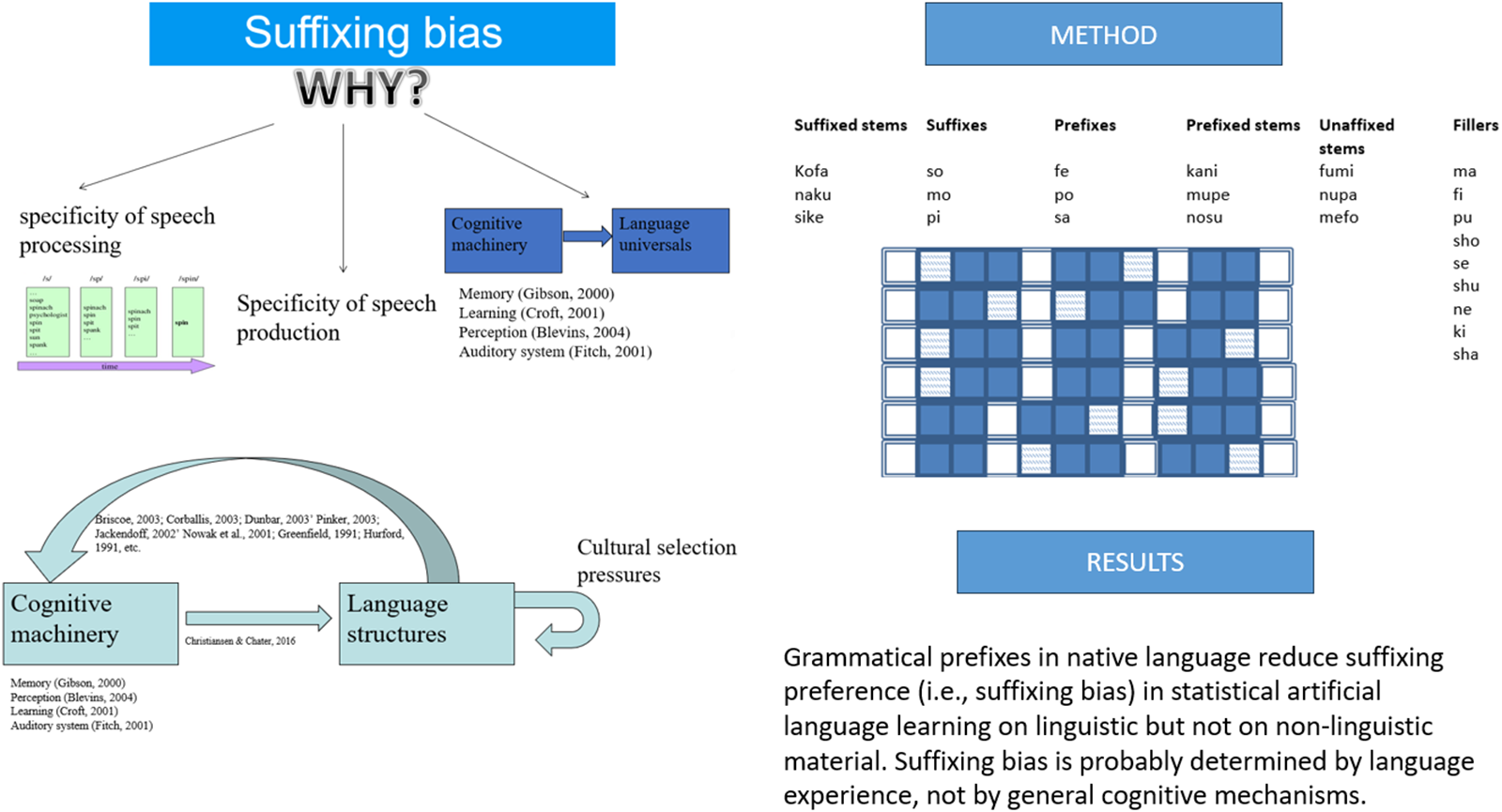


Social media summary
We discuss why we say walked and not edwalk to speak about the past, or pens and not spen to talk about multiple objects.
Introduction
Appending an affix to the word stem is one of the most frequently exploited means to express grammatical meaning (e.g. tense-aspect, number, case, person, interrogation, subordination). An affix can be appended before the stem (i.e. prefix), after the stem (i.e. suffix), embedded within the stem (i.e. infix), or adding morphemes consisting of two parts, with one part preceding the root, and the other part following the root (i.e. circumfix).Footnote 1 Other morphological processes stem from diachronic processes (e.g. run–ran; mouse–mice) or mergers of two paradigms (go–went–gone, with go–gone pair from a verb gān, and went – past tense stemming from the verb wend). In this study, however, we zoom on basic affixation strategies: suffixation and prefixation.
Across the world’s languages, suffixes are used substantially more frequently than prefixes to express grammatical meaning (and infixes are exceptionally rare compared to the other two types of affixes). Although linguists have identified a clear preference for suffixing in world’s languages (Cutler et al., Reference Cutler, Hawkins and Gilligan1985; Dryer, Reference Dryer, Haspelmath, Dryer, Gil and Comrie2005; Greenberg, Reference Greenberg and Greenberg1957; Hawkins & Gilligan, Reference Hawkins and Gilligan1988; Sapir, Reference Sapir1921), the distinction is not strictly categorical, with some languages expressing grammatical meaning by both suffixes and prefixes (e.g. Basque, Irish Gaelic, etc.). In the World Atlas of Language Structures, Dryer (Reference Dryer, Haspelmath, Dryer, Gil and Comrie2005) classified languages on a spectrum from strongly suffixing to strongly prefixing, and the number of the former is 4.5 times larger than the latter, recapitulating a strong skew towards right-hand branching across the world’s languages in syntax (Antinucci et al., Reference Antinucci, Duranti and Gebert1979; Grosu & Thompson, Reference Grosu and Thompson1977; Hawkins, Reference Hawkins1983).
There are competing theories about the origin of this bias. A large body of literature has shown that language structures are determined by general cognitive constraints on auditory perception (Blevins, Reference Blevins2004; Mackintosh, Reference Mackintosh1975; Neath, Reference Neath1993; Repp, Reference Repp1992), learning (Croft, Reference Croft2001; Hall, Reference Hall1991; Kersten et al., Reference Kersten, Goldstone and Schaffert1998), memory (Gibson, Reference Gibson, Marantz, Miyashita and O’Neil2000), and psychological resistance to fusing prefixing material in favor of fusing suffixing material (Enrique-Arias, Reference Enrique-Arias2002). These constraints define domain-general cognitive mechanisms, which act to select those variants of language code that are more easily processed by existing cognitive mechanisms. The selected variants are modified and passed on to the next generations by means of social learning and cultural evolution (Christiansen & Chater, Reference Christiansen and Chater2001; Dienes et al., Reference Dienes, Altmann and Gao1999; Lewis et al., Reference Lewis, Vasishth and Van Dyke2006; Saygin et al., Reference Saygin, Dick, Wilson, Dronkers and Bates2003; Smith et al., Reference Smith, Jones, Landau, Gershkoff-Stowe and Samuelson2002). The general cognitive mechanisms evolved for processing the non-linguistic environment under pressure from natural selection and available neural and cognitive resources, that is, constraints on learning, perception, memory, attention, as well as anatomical constraints on articulation (Christiansen & Chater, Reference Christiansen and Chater2001; Ordin et al., Reference Ordin, Polyanskaya and Samuel2021). Within this framework, domain-general processes that make the beginning of the auditory sequences more salient and therefore more easily memorized and recalled might have resulted in suffixing bias in languages. Anatomical speech production machinery makes the onsets of speech sequences more salient, contributing to perceptual salience. For example, pitch resetting after inhalations marks the left edges of the discrete speech sequences (‘left’ and ‘right’ are used in temporal, not in spatial aspect, as in the auditory modality segmental information is unfolding temporarily, not spatially). At the onsets of constituents, the phonetic contrasts between voiced and voiceless segments are preserved more easily than at the end of the constituents, directing attention to the left edges.
Alternatively, it can be argued that suffixes can be more easily processed by the cognitive machinery that is tuned specifically for speech processing, that is, this bias is speech-specific and not domain-general. For example, the interference of grammatical prefixes with lexical access could explain the skew towards using suffixes over prefixes across world’s languages (Clark, Reference Clark, Gelman and Byrnes1991; Cutler et al., Reference Cutler, Hawkins and Gilligan1985; Hawkins & Cutler, Reference Hawkins, Cutler and Hawkins1988). The beginning of the word is more important for lexical access than the end of the word, because the pool of potential word candidates becomes increasingly narrower as more and more segmental information becomes available (Erdeljac & Mildner, Reference Erdeljac and Mildner1999; Marslen-Wilson, Reference Marslen-Wilson1987; Rodd, Reference Rodd2004). Therefore, left-most segments are most critical for the word activation, and variation at the left edge of the word impedes word recognition.
This account in terms of lexical access also fits with evidence from connectionist modelling, which demonstrates how constraints on memory and computation efficiency lead to increasing computational demands as a function of sequence length, hence processing the end of the sequence is more difficult than the beginning of the sequence. It is thus preferable to place information that is less relevant for lexical access towards the end of the sequence. Using connectionist modelling, Gasser (Reference Gasser1994) showed that suffixed words are more easily processed compared to prefixed words. In his computational simulations using the connectionist approach, the model accepted stimuli phoneme by phoneme and used a backpropagation learning algorithm to detect stems and morphemes in words with suffixes (e.g. vibuni–vibuna), prefixes (e.g. ivibun–avibun), infixes (e.g. vikbun–vinbun), circumfixes (ivibuni–avibuna), mutations (e.g. vibun–viban), and deletions (e.g. vibun–vibu). The model itself was physiologically motivated (based on the physiological properties of the signal propagation in neural networks) and it identified the stems of suffixed words much better than those of prefixed words. This is an emergent approach to suffixing bias, which also draws on common physiological principles of information processing.
The discussion about the origin of the suffixing bias is ongoing. Experiments by Hupp et al. (Reference Hupp, Sloutsky and Culicover2014) showed that native speakers of English (a strongly suffixing language) exhibit a preference for language and non-language sequences with variable endings (i.e. suffixes). The authors advocated a domain-general origin of suffix preferences, which potentially emerged from cognitive processes outside the language domain and was transferred to language (or ended up shaping languages). However, it could be argued that the flexible nature of the general cognitive mechanisms underlying suffixing preference that is promoted by Hupp et al. (Reference Hupp, Sloutsky and Culicover2014) allows for the transfer of an essential bias to non-language domain. The plausibility and possibility of this interpretation was explored by Martin and Culbertson (Reference Martin and Culbertson2020), who demonstrated that speakers of a strongly prefixing Bantu language exhibit different preferences in similarity judgement tasks both on linguistic and non-linguistic material, and their responses were opposite to those of native English speakers. This finding agrees with some studies showing that exposure to certain regularities in speech can influence how similar regularities are processed in non-speech sequences (Marcus et al., Reference Marcus, Fernandes and Johnson2007).
The debate on the origin of any typological bias is difficult to resolve. If the suffixing preference is defined by the general cognitive machinery, it could still be reversed by experience with prefixation in the native language. Prefixation might emerge in particular languages by social learning, cultural evolution, and random fluctuations in diachronic development. Once prefixation is established, it can spread across a linguistic population because people try to adapt to cultural norms. Efficient processing of speech is a cornerstone of human cognition, adapting general cognitive machinery for a better processing of new typological properties. As the general cognitive machinery underlies processing of non-linguistic stimuli as well, new properties of the linguistic code could feedback on general cognitive mechanisms and impact the cognitive constraints and preferences, even if they are not defined by such constraints and mechanisms at the time they emerged.
Despite this challenge, the primary objective of the current study is to further address the question of whether suffixing bias is speech-specific, or whether it stems from general cognitive mechanisms that (1) are recycled for speech processing; and (2) shape the language code to be more easily processable by pre-existing cognitive machinery. The experiment was conducted with monolingual speakers of Spanish (a strongly suffixing language) and Basque–Spanish bilinguals (Basque uses both suffixes and prefixes to express grammatical meanings). Such Basque–Spanish bilinguals have more experience with linguistic prefixes compared to monolinguals.
We used an artificial language learning paradigm (Saffran et al., Reference Saffran, Aslin and Newport1996) to study how adding a prefix or suffix to the recurrent stem-like constituents will interfere with learning and recognition of these constituents by statistical learning mechanisms. Statistical learning (SL) is a set of evolutionarily ancient cognitive abilities for processing sequential environmental stimuli (Conway, Reference Conway2020) that are shared by taxonomically different species (Kikuchi et al., Reference Kikuchi, Sedley, Griffiths and Petkov2018; Milne et al., Reference Milne, Petkov and Wilson2018). Ordin et al. (Reference Ordin, Polyanskaya and Soto2020, Reference Ordin, Polyanskaya and Samuel2021) have suggested that, in the auditory modality, SL mechanisms evolved to detect breaks in statistical regularities within continuous environmental sensory inputs, that is, within a flow of statistical cues. Such breeches of statistical regularities in the flow of environmental stimuli correspond to rapid changes in the environment, which require behavioural response. In natural speech, such breaks often correspond to the beginning of linguistic constituents such as words or phrases, which allows for recycling SL for speech processing to detect discrete constituents in a continuous acoustic stream. This turns on a cascade of other cognitive processes related to extraction of the discrete constituents from a continuous sensory input, memorization (committing of these constituents to memory), categorization of these constituents into (grammatical) classes, semantic mapping, etc. If we see that suffixed sequences are more easily detected and recognized than prefixed sequences, and this preference is stronger or exclusive on linguistic material across two populations, we will be able to argue for a language-specific origin (i.e. specific to language faculty) of the suffixing bias. If, on the other hand, the suffixing advantage turns out to be stronger on non-linguistic than on linguistic material, it would be in line with the suffixing bias in world’s languages being shaped by general cognitive constraints and mechanisms. An effect of native language can be observed by looking at differences in the strength of suffixing preference in Spanish and Basque populations (Spanish is a strongly suffixing language, and Basque has both grammatical affixes and prefixes – a more detailed justification for the language choice is in the Methods section).
Method
We used a statistical learning paradigm, when participants first listen to a continuous acoustic stream with embedded recurrent sequences (familiarization speech stream), and during a post-familiarization recognition test they need to listen to short sequences and report whether this sequence is a word (a recurrent sequence listed from the familiarization speech stream) from the artificial language they listened to or a not (a foil composed of the same sounds as recurrent sequences but arranged in a different order). A different version of a post-familiarization recognition test includes presenting a pair of sequences and asking participants to choose which sequence in the pair is a word from the artificial language they listened to.
The project was approved by the ethical board of the Basque Center on Cognition, Brain and Language (BCBL), approval received on 26 April 2021, reference number 260421MK.
Participants
All participants were students from the University of the Basque Country and Murcia University. We recruited Basque–Spanish bilinguals (AoA – age of acquisition – is 2 years for both languages) from the province of Gipuzkoa in the Basque country (N = 60, one participant was excluded because he did not show up for the second session). The bilinguals were functioning daily in both languages, the languages were not separated by social domains (e.g. both Basque and Spanish were used interchangeably as professional, educational and home languages). Participants were equally proficient in both languages (based on the lexical tests administered to all participants in the BCBL database, and the inclusion criterion was that they performed equally well in the lexical and language tests in both languages). Native Spanish monolinguals were recruited in Murcia (N = 36) and in the Basque Country (San Sebastian) from those students who had arrived in the Basque Country no more than 4 months before the onset of the experiment (N = 44, two additional participants were also tested, but their data were excluded because they did not show up for the second experimental session). In total, we analysed the data from 59 bilinguals and 78 monolinguals. None of the participants reported any speech/language/hearing disorders. For participation in the experiment, participants received a compensation of 10 Euro. All participants signed a written informed consent form.
Material
We adapted a classical artificial language learning experiment (Saffran et al., Reference Saffran, Aslin and Newport1996) for the auditory modality, using CV (consonant-vowel) syllables as linguistic speech material (session 1) and non-verbalizable sounds as non-linguistic speech material (session 2). The order of sessions was counterbalanced across participants. As linguistic material, we used 18 syllables arranged into nine bi-syllabic constituents (referred to as stems further on), each syllable could only be used in one of the constituents. Three other syllables were used to model suffixes (syllables so, mo, and pi), and three more syllables were used to model prefixes (syllables fe, po, and sa). The nine stems were divided into three equal groups. In the first group, the three stems could be paired with any of the three prefixes, resulting in nine possible prefixed ‘words’; in the second group, the three stems could be paired with any of the three suffixes, resulting in nine possible suffixed words; and in the third group, the three stems did not take any affix, resulting in three unaffixed words. For example, a stem kofa from the group of suffixed constituents could be used as kofaso, kofamo, or kofapi. A stem kani from the group of prefixed constituents could be used as fekani, pokani, or sekani. A stem fumi from the group of stems that did not receive any affixes was always used as fumi.
An important typological distinction between Basque and Spanish, which is relevant to our task, is that Spanish is a prepositional language, whereas Basque is a postpositional language (functional words are attached to the right). For example, preposition ‘in’ in the phrase ‘in a house’ will occur before the noun in Spanish (en casa), and after the noun in Basque (extean). This typological difference might influence the segmentation of a continuous stream of syllables into word-like constituents (De la Cruz-Pavía et al., Reference De la Cruz-Pavía, Elordieta, Sebastián-Gallés and Laka2014). Frequent syllables are sometimes interpreted by Basque-dominant speakers as postpositions, and by Spanish monolinguals as prepositions in artificial language learning experiments. This determined the need of introducing functional words (i.e. pre-/postpositions, articles, interrogative particles) separately from affixes. We added nine ‘filler’ syllables that were inserted between words. The list of all possible stems, affixes and fillers is presented in Table 1.
The list of prefixes, suffixes, stems and fillers used in the linguistic material. Each suffixed stem was used with each suffix, hence providing an equal number of occurrences of KOFA-SO, KOFA-MO, KOFA-PI, NAKU-SO, NAKU-MO, etc. The same is applied to prefixed stems and prefixes

The speech stream (i.e. artificial language) for familiarization exposure was composed of blocks (Fig. 1). Each block included six arrangements of three words, in counter-balanced order of prefixed (pref) and suffixed (suff) syllabic sequences and bi-syllabic words (stem-only), making up eight syllables: (1) pref + suff + stem-only; (2) suff + pref + stem-only; (3) pref + stem-only + suff; (4) suff + pref + stem-only; (5) stem-only + suff + pref; (6) stem-only + pref + suff. The arrangements were randomized within each block. Sixty blocks were created for a complete familiarization stream. In total, each word was embedded into familiarization speech stream 120 times. Each affixed word was used equal number of times with each suffix or prefix. Each filler was used equal number of times to separate the words. These blocks were used to synthesize a continuous familiarization stream in MBROLA (Dutoit et al., Reference Dutoit, Pagel, Pierret, Bataille and van der Vrecken1996), using IT3 (Italian male) voice, with duration of C = 100 ms and V = 140 ms, F0 = 120 Hz (monotone). The resulting stream was 15.8 minutes long.
Frames (rows) show the six possible combinations of words, affixes, and fillers. Each square represents a syllable: filled squares represent bi-syllabic stems; patterned squares represent affixes, with suffixes appended after and prefixes before the stem; unfilled squares are fillers (likely to be interpreted as prepositions or postpositions, depending on biases determined by listeners’ native languages). Auditory sequences include six frames, randomly concatenated such that each frame is used an equal number of times.

In the resulting stream, the forward transitional probabilities (TPs) between syllables within stems were the highest (100%), between an affix and a stem – intermediate (33%), and between syllables in those syllabic pairs, in which at least one of the syllables was a filler – the lowest (2.8–11%). Thus, TPs allow for detecting the boundaries between fillers and affixes (lowest TPs), affixes and stems, and between syllables within stems (highest TPs), and discriminating between fillers (modelling functional words) and affixes. The full table of TPs is presented in Table 2.
The transitional probabilities between syllables in different syllabic pairs

For the post-familiarization recognition test, we synthesized the tri-syllabic suffixed and prefixed words and bi-syllabic unaffixed stems as separate tokens. For each participant, the same set of three stems was used. We chose one instance of a suffixed stem + suffix (giving three suffixed words as test tokens). That is, if one participant had kofa-so, naku-mo, and sike-pi as suffixed test tokens, another participant could have kofa-mo, naku-pi, and sike-so as suffixed test tokens. Each version of a suffixed word was used equal number of times in the familiarization stream. In the same fashions, we created three unique sets of prefixed words for test tokens.
Additionally, we synthesized three bi-syllabic and six tri-syllabic foils, using the same inventory of syllables used in the familiarization stream. In foils, we combined pairwise those syllables that never co-occurred consecutively in the familiarization stream. For example, a token consisting of a suffix followed by a prefix followed by stem-final syllable is an example of a tri-syllabic foil because in the familiarization stream, a suffix and a prefix syllables never occurred consecutively, and a prefix was never followed by a stem-final syllable. Three sets of possible foils were created and one of the sets was used for each individual participant. The acoustic parameters in the test tokens were the same as in the familiarization stream. Hence, the test tokens were either words (suffixed, prefixed or unaffixed stems) or foils (tri- and bi-syllabic).
As non-linguistic material, we used non-verbalizable noises (sounds of door screaking, footsteps, branch rattling, wind, etc.), which were concatenated into familiarization stream following the same structure as in the linguistic material (one unique sound for one syllable), modelling non-linguistic suffixed and prefixed sequences and fixed bi-syllabic sequences. The stream duration was 19.8 min (it was longer than the linguistic stream because each sound was longer than the CV syllable, but the number of sounds is equal to the number of syllables). Thus, the statistical structure and TPs between sounds were identical to those manifested in linguistic material. Before the sounds were concatenated into a familiarization stream, duration of each sound was equalized to 300 ms and then intensity was normalized to 80 dB, so that none of the sounds stands out in perceived loudness or length, ensuring that participants could rely solely on statistical (not acoustic) cues to extract discrete and recurrent constituents. Suffixed, prefixed and unaffixed sequences (i.e. non-linguistic words) as well as three bi- and six tri-syllabic foils were prepared for the post-familiarization recognition test using the same approach employed to prepare the linguistic tokens. A part of the familiarization stream and the test items can be found as audio files in the supplementary material.
Procedure
The experiment was programmed in PsychoPy and run in the laboratory conditions. The experiment contained two sessions – one on linguistic and the other on non-linguistic material – in a counter-balanced order across participants. We used explicit instructions. Participants were told that they would listen to an ‘alien language’, and they would have to detect and memorize the words of this language. Following each type of familiarization, recognition tests were administered.
During the first test, participants listened to a separate token, which was either a word – prefixed, suffixed or unaffixed – or a foil. For each participant a set of three bi-syllabic and six tri-syllabic foils were used. In total, 18 trials were administered. On each trial, participants had to respond whether they thought it was a sequence from the familiarization stream or not.
During the second test, we administered a two-alternative forced-choice test, when participants heard a pair of tokens. One token in each pair was a suffixed word, and the other token was a prefixed word, both were legal constituents used during familiarization equal number of times. We asked participants to choose which token – first or second – was more likely to be a sequence from the familiarization stream. This test aimed to estimate the suffixing versus prefixing preference in bilingual and monolingual samples at the group level. Each suffixed and prefixed constituent was used twice, once in the first position in the pair, and once in the second position in the pair, each time with a different affix, which yielded six trials in total.
The procedure for the non-linguistic session was identical. Each session – linguistic and non-linguistic – was approximately 25 minutes in duration.
Results
Test 1: learnability of suffixed and prefixed sequences in different linguistic populations
In order to be sure that the material – linguistic and non-linguistic – is learnable, we calculated the overall number of correct responses for each participant (accepted stems, suffixed and prefixed sequences and rejected foils) and compared this number with what would be expected by chance (50%, or 9 correct responses out of 18 trials could be given by chance). If morphological properties of native language have no effect on detecting, memorizing and recognition of recurrent word-like constituents in a novel language, we should not see a difference between linguistic populations. Hence, we used Bayesian approach to data analysis, which allows for estimating the strength of support for null hypothesis and use it as evidence of absence of the difference, when the conventional frequentist approaches would only allow stating the absence of evidence that two groups are different. Given that by nature the number of correct responses is an ordinal rather than interval variable, which means that the assumption of normality is likely violated, we applied the Bayesian Mann–Whitney tests with 5 chains of 1000 repetitions and calculated the Bayes factors (BF) using full Cauchy with scaling factor = 0.7 (in Cohens d units), which prioritizes neither the null nor the alternative hypotheses (a-priori both hypotheses are equally likely). The analysis was done separately on tests with linguistic and non-linguistic material. All Bayesian tests were run in JASP v. 0.19.1.
Two-tailed tests comparing the number of correct responses with what would be expected by chance (N = 9) revealed that linguistic material was processable and sequences were learnable at an above-chance level in both populations: by Basque–Spanish speakers (M = 11.1, SE = .26), BF10 = 79,400, and by Spanish monolinguals (M = 10.385, SE = .216), BF10 = 10,600, which is decisive evidence that the material was learnt. However, non-linguistic material is learnt only by monolinguals (M = 9.615, SE = .198), BF10 = 15.834, which is strong evidence that the number of correct responses is above chance. Basque–Spanish bilinguals perform at a chance level (M = 9.3, SE = .225), BF10 = .351, which is moderate but positive evidence in support of the absence of difference from the group-level performance that would be expected by chance. The result pattern is displayed on Fig. 2.
The number of correct responses per group (Basque–Spanish bilinguals and Spanish monolinguals) and material type (linguistic and non-linguistic). The plot in the left column display means and 95% CI. The plot in the middle column displays probability density, individual datapoints, medians, and top and bottom quartiles as whiskers. The dotted line stands for the chance level (50% – 9 correct responses can be given by chance). The plot in the right column shows prior and posterior probabilities (with 95% credible interval) for the difference in the number of correct responses per sample and the average number of correct responses that could be expected by chance. The dots show prior and posterior density at the test value. The pie chart represents the estimated degree of support for the null (H0, unfilled part of the chart) and alternative (H1, filled part of the chart) hypotheses.

During the test, participants had to endorse or reject an item as a word from the alien language, and the test items could be recurrent sequences from the artificial language (i.e. familiarization stream) or foils. That is, correct responses could be hits (recurrent sequences endorsed as potential words from the alien language) and correct rejections (rejected foils). High performance can rely on efficiency of rejection and accuracy of endorsement. Ordin et al. (Reference Ordin, Polyanskaya and Soto2020) showed that endorsement relies on successful retrieval of items from memory. Rejection, on the other hand, relies on detecting the transitions between syllables that violate the regularities embedded into the familiarization stream presented for learning. Given that endorsement and rejection rely on different cognitive mechanisms that have a distinct neural underpinning (Ordin et al., Reference Ordin, Polyanskaya and Soto2020), we decided to use the False Discover Rate (FDR) approach (a common analytic technique in evaluating the efficiency of pattern recognition algorithms and diagnostic tests) to analyse the efficiency of rejection and efficiency of endorsement separately.
Precision (i.e. general accuracy) in a recognition test (i.e. the proportion of words among endorsed tokens, or the percentage of correct responses) can be achieved by high sensitivity, or recall (i.e. the proportion of endorsed words among all presented words) and specificity (i.e. the proportion of foils that were not endorsed). That is, precision in the test is a product of how well people endorse the words and reject the foils. Given the structure of the recognition test, the same level of precision achieved by individuals in two different groups can be the result of high specificity and average recall in one group and average specificity and high level of recall in the second group. Therefore, we compared performance in the recognition test between Basque and monolingual Spanish speakers by focusing on precision, recall and specificity separately. The values on these measures vary between 0 and 1, and this is not dependent on the number of trials presented to each individual. Besides, given that these values are ratios, we convert ordinal variables (number of correct or false responses) into interval variables, which allows for using parametric tests (if the normality assumption is not violated).
We calculated precision, recall and specificity separately on linguistic and on non-linguistic material, and compared these values between Basque–Spanish bilinguals and Spanish monolinguals using Bayesian tests, two-tailed, full Cauchy’s scaling factor = .707 (see Table 3).
Comparing precision, recall and specificity on linguistic and non-linguistic material between Basque and monolingual Spanish participants, on linguistic and non-linguistic material

Overall, the data showed that Basque–Spanish bilinguals are better at recognition accuracy (recall, or sensitivity) of embedded constituents compared to Spanish monolinguals. The rejection accuracy, which is based on detecting the violations of transitional probabilities, is not modulated by properties of the native language(s). This can be explained by the fact that the breaks in statistical regularities are universally more salient. Ordin et al. (Reference Ordin, Polyanskaya and Soto2020) suggested that violations of statistical structure in acoustic or visual perceptual flow cue environmental changes that require a behavioural response. Faster detection of events that require behavioural response provides individual fitness boost (increase the chances of survival and reproduction), hence the neurocognitive mechanisms underlying detection of low TPs is evolutionary stable and is less affected by ontogenetic influences (Ordin et al., Reference Ordin, Polyanskaya and Samuel2021). By ontogenetic influences we mean factors that might affect the development of individuals, including factors pertaining to properties of the ambient language. Detecting recurrent constituents in the environment is a by-product of a more ancient mechanisms that have been honed for tracking breaches in statistical congruency (i.e. troughs in the TPs), and is more easily modulated by individual experiences. That is why we see the effect of the native language on recall (endorsement efficiency), but not on specificity (rejection accuracy).
I suggest that the improved recall in the group of Basque–Spanish bilinguals compared to Spanish monolinguals is accounted for by enhanced experience with the prefixed words in the former group (the Basque language makes use of inflectional prefixes, the Spanish language has no inflectional prefixes). To ensure that the enhanced recall is driven by better recognition of prefixed linguistic sequences, we compared the percentage of endorsed prefixes sequences (hits_prefixed) and endorsed suffixed sequences (hits_suffixed) by Basque–Spanish bilinguals and Spanish monolinguals using Bayesian independent samples Mann–Whitney tests (full Cauchy with scaling factor = .707, both the alternative and the null hypotheses are equally likely, 5 chains of 1000 repetitions and repeatability seed 10, to enhance the test robustness). We predicted that Basque–Spanish bilinguals, due to their experience with grammatical prefixes, will endorse more prefixed sequences on linguistic material than Spanish monolinguals, hence the test is one-tailed. Given the data (M = 76.8% of presented prefixed sequences are endorsed by Basque–Spanish bilinguals, SE = 3.15, and 62.8% of presented prefixed sequences are endorsed by Spanish monolinguals, SE = 3.55), the alternative hypothesis (that Basque–Spanish bilinguals endorse more prefixed sequences) is 4 times more likely than the null hypothesis, BF10 = 4.151. For the rate of endorsement of the suffixed sequences (two-tailed, because we test the hypothesis that endorsement rate on suffixed sequences is different, without specifying the direction of difference), the zero hypothesis is 3.5 times more likely, BF10 = .285. The analysis showed that Basque bilinguals indeed recognize prefixed sequences better than Spanish monolinguals, and suffixed sequences are recognized equally well in both groups. This result pattern is shown in Fig. 3.
Prior and posterior probabilities (with 95% credible interval) and strength of evidence for the alternative and the null hypotheses given the observed data. Left: Basque–Spanish bilinguals recognize prefixed sequences better than Spanish monolinguals (the alternative hypothesis is 4 times more likely than the null hypothesis – Basque bilinguals do not recognize prefixed sequences better than Spanish monolinguals). Right: Basque–Spanish bilinguals and Spanish monolinguals recognize suffixed sequences equally likely (the null hypothesis is 3.5 times more likely than the alternative hypothesis – there is difference in recognition rate of prefixed suffixes between the groups). The pie charts represent the estimated degree of support for the null (H0, unfilled part of the chart) and alternative (H1, filled part of the chart) hypotheses.

Test 2: prefix preference
In recognition test 2, participants had to listen to a pair of sequences – one prefixed and one suffixed, both of which had occurred in the familiarization stream an equal number of times – and selected which they thought was more likely to be a word from the alien language they listened to. As both responses are correct, test 2 probes participants’ preference for an affix appended at the end (suffix) versus at the beginning (prefix) of the stem.
First, we ran Bayesian Mann–Whitney one-sample two-tailed tests (full Cauchy, scaling factor = .707, 5 chains of 1000 repetitions) to compare the number of preferred prefixed sequences with what would be expected by chance (50%). Given those data, Basque–Spanish speakers selected linguistic prefixed sequences (M = 47.74%, SE = 2.149) at a rate that is not different from what would be expected by chance (BF10 = 243, the null hypothesis is over 4 times more likely than the alternative). Spanish monolingual speakers (M = 41.88%, SE = 2.21) select linguistic prefixed sequences at a rate that is lower than what would be expected by chance (BF10 = 68.86, providing decisive evidence for the hypothesis that the rate of endorsement is different from 50% chance level). Direct comparison between groups, however, provides ambiguous results (BF10 = 1.153, suggesting that, given the data, there is almost equal evidence to support the null and the alternative hypothesis). The data cannot confirm that the preference for suffixed over prefixed sequences in the group of Spanish monolinguals and the lack of this preference in the groups of Basque–Spanish bilinguals does not provide sufficient evidence that Basque speakers, on average, select more prefixed sequences. I suggest that the lack of preference in the group of bilinguals lead to higher volatility in answers at the individual level, which obscures the group-level differences that would be expected if one group exhibits a suffixing preference, and the other group – a prefixing preference.
On non-linguistic material the data support the hypothesis that neither Basque–Spanish bilinguals (M = 49.43%, SE = 2.89) nor Spanish monolinguals (M = 50.0%, SE = 2.375) revealed a suffix-over-prefix (or reverse) preference (BF10 = .148 for Basque speakers and BF10 = .132 for Spanish monolingual speakers, providing a very strong evidence for the null and showing that, given the data, the null hypothesis is 6.8 times more likely in the former group, and 7.57 times more likely in the latter group).
These results suggest a modulatory effect of the native language on the suffixing bias on linguistic material. Bilinguals accept both linguistic prefixed and suffixed sequences at an equal rate, while monolinguals show a stronger preference for suffixed sequences (and consequently do not select prefixed sequences). The result pattern is displayed in Fig. 4 (bilinguals) and Fig. 4 (monolinguals).
(a) The percentage of prefixed sequences (preferred over suffixed sequences) on linguistic (left) and non-linguistic (right) material by Basque–Spanish bilinguals. The upper plots display probability density, individual datapoints, medians, top and bottom quartiles as whiskers. The bottom plots show prior and posterior probabilities (with 95% credible interval) for the difference in the number of selected prefixed sequences by participants and the number that could be expected by chance. The dots show prior and posterior density at the test value. The pie chart represents the estimated degree of support for the null (H0, unfilled part of the chart) and alternative (H1, filled part of the chart) hypotheses. (b) The percentage of prefixed sequences (preferred over suffixed sequences) on linguistic (left) and non-linguistic (right) material by Spanish monolinguals. The upper plots display probability density, individual datapoints, medians, top and bottom quartiles as whiskers. The bottom plots show prior and posterior probabilities (with 95% credible interval) for the difference in the number of selected prefixed sequences by participants and the number that could be expected by chance. The dots show prior and posterior density at the test value. The pie chart represents the estimated degree of support for the null (H0, unfilled part of the chart) and alternative (H1, filled part of the chart) hypotheses.

Results overview
Overall, the analysis of both tests shows that better recall in the recognition test on linguistic material in the group of Basque bilinguals is driven by better recognition and endorsement rate of prefixed sequences, which is probably driven by familiarity with inflectional prefixes in their native language. The effect is not observed on non-linguistic material, suggesting that the strategies tuned for processing peculiarities of native language morphology are not transferred from linguistic to non-linguistic domain. Also, we observed a preference for suffixed over prefixed linguistic sequences in the group of Spanish monolinguals, which is not transferred to non-linguistic material either. Experience with the Basque language that utilizes both suffixes and prefixes overrides the suffixing preference, so that Basque–Spanish bilinguals exhibit neither prefixing nor suffixing preferences. Taken together, this pattern indicates that the typological suffixing bias is probably restricted to language and it is the properties of the ambient language rather than properties of the domain-general cognitive systems that lead to the emergence of cognitive bias in processing of speech-like perceptual input.
Discussion
In the current study, we attempted to address the question regarding the origin of the suffixing bias. The term suffixing bias in this sense refers to typological distribution of the world’s languages in the spectrum from strongly suffixing to strongly prefixing, not to cognitive bias. However, cognitive bias – constraints on learning, perception, memory, attention, and articulatory movements that make the beginning of the auditory sequences more salient and more easily memorized – might shape the language structures by disfavoring variable parts (i.e. prefixes) at the word onsets. In other words, cognitive domain-general suffixing bias might be the origin of the typological bias in distribution of affixation language properties. Alternatively, suffixing bias be a domain-specific phenomenon restricted only to language, and draw on peculiarities pertaining to speech processing rather than on domain-general memory, learning and perception mechanisms. To address the question of the suffixing bias origin, we used statistical learning experiments, in which embedded words were either suffixed, or prefixed, or unaffixed. The artificial languages were composed of either linguistic material (syllables) or non-linguistic material (noises). The experiment had two post-familiarization tests: preference test, when participants had to choose between a prefixed and a suffixed words from an artificial language, and a test, in which participants had to listen to an acoustic sequence (syllables for linguistic material and noises for non-linguistic material, which was either a recurrent sequence that occurred multiple times during the learning stage, or a foil) and to report whether it was a word from an artificial language or not. The experiment was run in the population of Spanish monolinguals (Spanish uses only suffixes to express grammatical meanings) and in the population of Basque bilinguals (Basque uses both suffixes and prefixes to express grammatical meanings, hence Basque–Spanish bilinguals have more experience with processing prefixes than Spanish monolinguals).
The data show that the preference for suffixed over prefixed linguistic sequences is modulated by the presence of grammatical prefixes in the native language: if the native language of an individual uses both prefixes and suffixes to express grammatical functions, then individuals manifest no preference for suffixed versus prefixed sequences in a recognition test in a Saffran-style artificial language learning experiment. Although we showed it for one pair of languages (Basque and Spanish), this conclusion agrees with the conclusion of Martin and Culbertson (Reference Martin and Culbertson2020), who used English and a heavily prefixing Bantu language Kîîtharaka. Martin and Culbertson (Reference Martin and Culbertson2020) showed that if the native language of an individual manifests grammatical functions solely by prefixes, then the suffixing bias is overturned, and instead a prefixing preference can emerge. However, contrary to previous studies, we did not observe any influence of typological properties in the native language morphology on the preference for suffixed or prefixed non-linguistic sequences, suggesting that the effect is limited to the linguistic domain. Probably, the difference in result patterns across studies can be accounted for by different methodological approaches. Earlier empirical results were based on similarity judgements (e.g. people had to judge whether ‘to-ta-be’ or ‘be-to-ta’ is more similar to ‘to-ta’) or another task, in which the sequences – linguistic and non-linguistic – are presented in isolation. However, statistical learning experiments include detecting the boundaries between discrete constituents in a continuous sensory input, extracting these sequences, memory encoding (committing the extracted sequences to memory) and decoding (retrieval of the memorized sequences from memory) during the recognition test. The underlying cognitive processes are different from those implicated during similarity judgement. The typological properties of an ambient language can exercise an effect on a single cognitive mechanism or on a limited set of such mechanisms that are implicated by task execution, while an ability relying on a large set of cognitive mechanisms (e.g. statistical learning) is more robust to the influence of task-irrelevant influences. That is why similarity judgement of non-linguistic sequences is affected by native language properties to the greater degree than performance in statistical learning on non-linguistic material.
As a multifaceted ability that relies on a whole set of cognitive mechanisms, statistical learning is evolutionary ancient and emerged for non-linguistic purposes, including the need to structure environmental sensory input and build internal models of the worlds (Badcock et al., Reference Badcock, Friston, Ramstead, Ploeger and Hohwy2019; Friston, Reference Friston2005). This ability was then recycled for speech processing in the Homo genus. Should the suffixing bias be linked to the general-purpose mechanisms, then we would have observed it on non-linguistic material. As the preference can only be observed on linguistic stimuli and it is interacting with the typological properties of the ambient language, the phenomenon is probably limited to language domain, and is not a result of evolutionary adaptation of language code to pre-installed cognitive machinery.
We also found that overall, Basque speakers perform better than Spanish monolinguals, and higher precision is explained by better recognition of prefixed sequences in the former group. Individuals in both groups reject foils efficiently. Detection of statistical incongruencies is a more fundamental product of tracking statistical regularities that functions in any type of environment (Ordin et al., Reference Ordin, Polyanskaya and Soto2020, Reference Ordin, Polyanskaya and Samuel2021), thus it is more robust to environmental differences, including differences in linguistic environment, and we did not observe any difference between groups in specificity. Recall, or recognition of statistically congruent tokens, by contrast, is more subject to the effect of native language because linguistic constituents are defined differently across languages, both grammatically and prosodically. Statistical learning is used for structuring a continuous speech flow and building internal models of the recurrent constituents (Badcock et al., Reference Badcock, Friston, Ramstead, Ploeger and Hohwy2019), with further cognitive processing happening on these internal models, which may differ depending on individual experience with differential sets of grammatical and prosodic cues.
The results can potentially be accounted for bilingual by advantage in language domain in one of the groups. Although the existence of a bilingual advantage in statistical learning is still debated, with evidence both for and against it (Weiss et al., Reference Weiss, Schwob and Lebkuecher2019 for review), a series of previous studies involving Basque–Spanish bilinguals versus Spanish monolinguals did not reveal significant differences between populations (Aguasvivas et al., Reference Aguasvivas, Cespón and Carreiras2024; Ordin et al., Reference Ordin, Polyanskaya, Laka and Nespor2017). Good and bad learners are distributed equally in both populations, and when the samples are collected randomly, so that each individual has an equal chance to be included in the sample, no differences between bilingual and monolingual groups is observed in performance on the recognition test. As in earlier artificial language learning studies, in which the morphological properties were not modelled, the differences between bilingual and monolingual populations under study were not observed at cognitive level, and we assume that the difference in this task is explained by the effect of the presence of inflectional prefixes in Basque. We cannot exclude the possibility that bilinguals are more attuned to novel language features due to the need to handle multiple languages and thus have heightened awareness of novel language features, but at the same time Basque–Spanish bilinguals did not have to treat prefixes as novel linguistic properties because they were in one of their native languages (Basque); therefore, it is more likely that the effect is explained by their previous experience with this feature via acquisition of Basque rather than by heightened linguistic awareness due to bilingualism per se.
It is important to mention two limitations of the study. First, our theoretical assumption is based on the reality of the typological suffixing bias. However, it is important to emphasize that many typological biases are not held true after controlling for the genealogical relations or for the confounds related to geographical distribution of languages. For example, a long-established bias that object–verb (OV) order precludes the possibility of prefixing inflexions, whereas verb–object (VO) allows both suffixing and prefixing (Bybee et al., Reference Bybee, Pagliuca, Perkin, Croft, Kemmer and Keith1990; Dryer, Reference Dryer1992, Reference Dryer2011) seems less convincing once genealogical and areal potential confounds are controlled for (Guzmán Naranjo & Becker, Reference Guzmán Naranjo and Becker2022). The observed tendency across world’s languages to express grammatical meanings by suffixes can be a result of rapid vertical (cross-generation adaptation and diachronic development) and/or horizontal transfer (e.g. language contacts) of a preference that emerged in a particular population and then spread across geographical regions by means of social learning.
The second limitation is related to the fact that the artificial language has no semantics. Potentially, suffixes and prefixes may play different roles in statistical learning when learning a language where constituents are mapping to meaning (Hoppe et al., Reference Hoppe, Rij, Hendriks and Ramscar2020; St. Clair et al., Reference Clair, C., Monaghan and Ramscar2009; Vujović et al., Reference Vujović, Ramscar and Wonnacott2021). In a series of simulations and experiments, including artificial language learning, it was shown that suffixes facilitated categorization of artificial language units into classes (similar to splitting the lexical units into grammatical categories), and prefixes facilitated learning of stems following the prefix (Hoppe et al., Reference Hoppe, Rij, Hendriks and Ramscar2020; St. Clair et al., Reference Clair, C., Monaghan and Ramscar2009). A large-scale hypothesis-driven study (N = 434) did not replicate earlier findings in a straightforward way (Vujović et al., Reference Vujović, Ramscar and Wonnacott2021). The differences between functional load of prefixes and suffixes are more subtle and modulated by frequency of cues used for processing: participants in a suffix condition were better able discriminate between frequent, but uninformative cues and low-frequency, informative cues which led to different patterns of generalization. However, the current finding suggests that dividing morphologically complex constituents into stems and affixes is possible based on the relative frequency of the composing syllables and their co-occurrences, without recourse to semantic meaning. Although there might be some additional differences between prefixing and suffixing once you bring in a reference word (Hoppe et al., Reference Hoppe, Rij, Hendriks and Ramscar2020; Vujović et al., Reference Vujović, Ramscar and Wonnacott2021), the current study shows that some differences can be observed even without this.
In sum, the preference for suffixes or prefixes is modulated by the morphology of the native language and is only observed on linguistic material. Accuracy in discrimination between prefixed words that recurrently occurred in the familiarization stream and the foils is higher in Basque–Spanish bilinguals (who have experience with processing grammatical prefixes) than in Spanish monolinguals (who do not have this experience); this between-group difference is only evident on linguistic material and draws on better recall (proportion of accepted words to the total number of all presented words, or endorsement accuracy), not on differences between groups in specificity (proportion of rejected foils to the total number of all presented foils, or rejection accuracy). We argued that specificity is affected by natural selection pressure and it is the same for suffixed and prefixed sequences on all types of material and in both investigated populations. Recall is subject to the influence of native language in the course of individual development (more exposure to prefixes results in better recall of prefixed sequences), but this effect is constrained to linguistic material. As an overall conclusion, we found no support for pre-linguistic domain-general preference for suffixed sequences. Our results provide some evidence in favor of a linguistic origin of the suffixing bias. The suffixing preference of individuals within a particular linguistic community can be modulated by the typological properties of the ambient language in this community, or position of the native language in the spectrum from suffixing to prefixing languages.
Supplementary material
The supplementary material for this article can be found at https://doi.org/10.1017/ehs.2025.6.
Acknowledgements
I am thankful to the reviewers who provided useful comments during the evaluation process. I am also thankful to Dr Leona Polyanskaya who helped in preparing the stimuli and collecting the data, and for providing means for open access.
Author contributions
The work was done by MO.
Financial support
This work was possible due to the support from the European Research Council Executive Agency (ERCEA), grant Nº101041475 TypoMetaLing (PI – Dr Leona Polyanskaya).
Competing interests
No conflict of interest to declare.
Research transparency and reproducibility interest
The data that support the findings of this study are openly available in the Figshare repository https://figshare.com/s/e51a211fde4c4f43121b; DOI: 10.6084/m9.figshare.27925566.


 Open access

