


No CrossRef data available.
Article contents
Tablets for Lord Amherst
Published online by Cambridge University Press: 07 August 2014
Extract
In the years around the turn of the present century, relying on the contacts and expertise of Theophilus Goldridge Pinches, Lord William Amhurst Tyssen-Amherst, 1st Baron Amherst of Hackney (1835–1909), put together what came to be one of the most wide-ranging and important collections of cuneiform tablets to have been assembled in private hands in this country. Since the publication of Volume 1 of The Amherst Tablets in 1908 by Pinches, followed much later by E. Sollberger's The Pinches Manuscript, the Amherst Collection has been familiar enough among Assyriologists, but perhaps less has been known of the collector, and of his other collections. The Museum at the family estate of Didlington Hall, Northwold, Norfolk, contained in its heyday a much broader range of material than cuneiform inscriptions. From the Near Eastern world there were very extensive collections of Egyptian papyri and antiquities, but the Hall also housed remarkable accumulations of incunabula and printed books, porcelain, tapestries, sculpture and other works of art. It is evident that the specific pursuit of cuneiform sources was inspired by a profound interest in the origin and development of writing and printing.
The survival of a group of private letters covering the years 1896–1910, from Lord Amherst to Pinches, with some draft reply letters from Pinches and other relevant documents, has entailed the preservation of unusual information about the process of acquisition and the sources of the tablets themselves. The present paper offers a summary of this information, in the hope of conveying something of the circumstances and motives at play at such a period.
Information
- Type
- Research Article
- Information
- Copyright
- Copyright © The British Institute for the Study of Iraq 1996
References
1 Pinches, T. G., The Amherst Tablets, being an Account of the Babylonian Inscriptions in the Collection of the Right Hon. Lord Amherst of Hackney, F.S.A. at Didlington Hall, Norfolk 1. Texts of the Period extending to and including the Reign of Bûr-Sin (about 2500 B.C.), London: Bernard Quaritch, 1908 Google Scholar, and Sollberger, Edmond, The Pinches Manuscript (Materiali per il vocabolario neosumerico = MVN 5), Rome: Multigrafica Editrice, 1978 Google Scholar.
2 For his work in Egyptian archaeology, as also that of his eldest daughter Mary Rothes Margaret Cecil (1857–1919), see the brief sketch in Bierbrier, M. J. (ed.), Who Was Who in Egyptology, 3rd rev. ed. (London, 1995), p. 14 Google Scholar.
3 See the summary description (by H.R.T.) in the Dictionary of National Biography Second Supp. 1 (London, 1912), pp. 40–1Google Scholar, and the anonymous booklet entitled Didlington Hall, a product evidently once bestowed on visitors. The library itself was fabulous, including such items as seventeen Caxtons; see de Ricci, Seymour, A Hand-List of a Collection of Books and Manuscripts Belonging to the Right Hon. Lord Amherst of Hackney (Cambridge, 1906)Google Scholar; idem, English Collectors of Books and Manuscripts (1530–1930) and their Marks of Ownership (Sandars Lectures 1929–30), pp. 165–6. The book sales (for which the catalogues are themselves remarkable) took place at Sotheby's on 3rd Dec. 1908 and 24th March 1909. Lord Amherst's 1734 Stradivari violin may be found documented in Hill, W. H., Hill, A. F. and Hill, A. E., Antonio Stradivari, his Life and Work (London, 1902), pp. 89 and 265 Google Scholar. The sale of Egyptian and Oriental antiquities at Sotheby's in June 1921 lasted five days, 13–17th June 1921; see Sotheby, Wilkinson and Hodge, Catalogue of the Amherst Collection of Egyptian and Oriental Antiquities; for the tablet sales in detail see below. The Amherst papyri, namely Egyptian, Greek, Latin and Coptic, went to the Pierpoint Morgan library in about 1913, where they rejoined the Caxtons, which had been bought earlier en bloc.
4 It is a great pleasure here to acknowledge the kindness and enthusiastic support of Leonard T. Pinches Esq., in granting me access to the collection of T. G. Pinches's papers, and for permitting the use of the letters excerpted here. A few other pertinent documents are to be found among the archive of Amherst papers housed in the Norfolk Record Office, Norwich, kindly drawn to my attention by Dr C. N. Reeves, which are here quoted under such numbers as “MC 84/162” by generous permission of Jean Kennedy, County Archivist for Norfolk. Through the kindness of the present Lady Amherst of Hackney the Department of Western Asiatic Antiquities now holds a typescript copy of a manuscript catalogue prepared by Pinches in 1933 for insurance purposes that lists the remaining tablets still owned by the estate following the first Sotheby's sale (17th June 1921), and some use has been made of this document here. Note that in quotations from these sources three dots means the omission from the full text of material not relevant here; square brackets enclose an explanatory interpolation by the present writer.
5 Pinches at this time was still at the British Museum. His troubles with E. A. Wallis Budge, Keeper of the Department of Egyptian and Assyrian Antiquities, who finally engineered his dismissal by the Trustees in 1899, were becoming increasingly bothersome. A. H. Sayce was one (together with F. Delitzsch, J. Oppert and F. Hommel) who wrote a testimonial on Pinches's behalf in 1899, while Sayce's own friendship with Lord Amherst is referred to in his autobiographical Reminiscences (London, 1923), pp. 292 and 321 Google Scholar. Pinches himself must have been acquainted with Lord Amherst at least since 1876 when he was elected to membership of the Society of Biblical Archaeology, of which Amherst had been a member since its inception (see TSBA V/2 (1877), p. 575 Google Scholar; ibid. I/2 (1872), List of Members).
6 As Pinches's involvement with the collection grew, conservation, repair and joining were entrusted at first to Mr Augustus Ready (on whose family see Budge, E. A. Wallis, Rise and Progress, pp. 149–54Google Scholar), who was, however, slow and expensive [18th Aug. 1899: “If you see Mr Ready or are writing to him please say that I think he is very dilatory in not returning my tablets, restored, sooner”]. Pinches thus tried his hand at coping with salt problems himself [15th Oct. 1905: “I am very glad to hear you have been so successful with the new process of cleaning the tablets. The ‘fleecy clouds’ are most poetical allusions”], or tablet envelopes [17th Feb. 1905: “You have indeed been successful with your experiments of opening the tablets, and it makes us independent of Mr Ready. I will settle his account as soon as he sends it in and you have examined it”]. The 1933 catalogue singles out four tablets in particular that had been dealt with by Ready: Lot 36 (No. 198): “An excellent tablet, somewhat mutilated, but preserved and repaired by Mr. Ready very successfully”; Lot 44 (No. 221): “A large, unbaked clay tablet, solidified to a certain extent by Mr. Ready”; Lot 52 (No. 243): “A much-defaced unbaked clay tablet which has been treated (to preserve it) by Mr. Ready”; and HR 4: “A large tablet… (Preserved and repaired by Mr. Ready of the British Museum. Surface inclined to crumble away. Apparently a slight whitish deposit on the surface)”.
7 This suggests that the acquisition of tablets began in about 1894. There is no evidence as to how many clay tablets were already in the collection at this time, or indeed whence they were procured.
8 The appreciation of environmental effects on clay tablets reflected in this letter is interesting. Some of these offending glass show-cases were auctioned off at the end of the Sotheby's sale held in 1921.
9 This is the basic numbering system of the tablets that was instituted from the beginning. Pinches was later inclined to group the tablets by “acquisition date” after the style adopted in the British Museum; see below.
10 This is W. T. Burbush, whose own supplier in the present case is alluded to in the following letter of 24th March 1898: “I doubt if Mr Burbush will be able to get his Baghdad friend to sell the box 7 separately at a fair price.” In fact Burbush, together with his partner Mr Menni, acted as agent for the firm of Messrs A. Messayeh and A. Auraha of Baghdad. It is clear that Burbush was able to proceed with very little independent authority, but was responsible for disposing of the firm's imports to the British Museum, and, very discreetly (so as not to anger Budge), certain other interested parties. Budge was evidently extremely tardy in paying for his consignments, and many of Burbush's surviving letters in the British Museum lament this fact, pleading urgency due to pressure from Baghdad, and his own poor health. His rapidly ensuing death in 1898 throws his letters to Budge into rather poignant perspective. Messrs Korkis represented another branch of the same firm.
N.B. The following lots of tablets were acquired by the British Museum from Burbush at this period: 94-10-16, 1–175a; 95-10-6,1-243, and 98-2-5,1328. Korkis and Co. seem to have been responsible only for 98-7-11, 1–258.
11 These four provenances merit some comment:
(a) Tello: “in 1893–1894 c. 30,000 tablets robbed by the natives” according to Pallis, S. A., Antiquity of Iraq, p. 361 Google Scholar; cf. Jones, T. B., AS 20, pp. 41–61, esp. pp. 41–8Google Scholar.
(b) “Nimroud”: this stands of course for Birs Nimrud = Borsippa (and not Calah). The collection, like later collections, possessed very few tablets in Assyrian script (see below), while it becomes evident later that “box 7” contained part of an archive from Borsippa; see fnn. 15 and 20. It is interesting that in the surviving draft manuscript of the lecture referred to below in fn. 20, the opening sentence reads in part “… which, according to the statements on the wrappers of the greater part of them, and internal evidence in the case of the remainder…,” in contrast to “… which, according to the information furnished or from internal evidence…” in the printed version. This throws an interesting fight on the way tablets arrived packaged from the East, and the seriousness with which contemporary dealers' provenances should perhaps sometimes be taken.
(c) Babylon at Hillah had been mined for bricks since time immemorial, and must have produced tablets for the market since there was first an interest in such things.
(d) The extent to which Nippur tablets found their way on to the market at this period is uncertain. The first season of excavations there by the University of Pennsylvania, led by J. P. Peters, had commenced in 1889. As is clear from surviving correspondence, Peters had wanted Pinches to be his epigrapher, but in the end an American was preferred for chauvinistic reasons at Hilprecht's urging (“the national honor and the scientific character of this first great American enterprise in Babylonia would seem to require the addition of an American Assyriologist”), a view which led to the appointment of R. F. Harper; see Hilprecht, H. V., Explorations in Bible Lands, pp. 297–8Google Scholar; Kuklick, B., Puritans in Babylon (Princeton Univ. Press, 1996), p. 31 Google Scholar. Peters several times in 1891 sent copies of royal inscriptions from the field to Pinches, once, anxious about strays, asking (1st Sept. 1891): “Have any tablets from Niffer turned up in England?” Later he wrote from St Michael's Church, 225 West 99th Street, New York (sometime after 1900) as follows:
Hilprecht is now asserting that before we reached Nippur in 1889 the Arabs had gotten numerous tablets from there, which were sold at various places. He says that there were tablets from Nippur in the Berlin Museum. I have written to Delitzsch about that. Now I want to know if you recollect any tablets purchased and coming into the British Museum or anything that came from Nippur before we began to explore that place? Certainly the mound itself showed no evidence of any digging by Arabs at all, and all our investigation at the time of the sources of supply led us to conclude that no tablets were brought from that region to the market. The market was then supplied from Babylon, Sippara, Borsippa and a few neighboring mounds, and a little later Telloh tablets began to come in.
The British Museum Kassite documents which look like Nippur texts and were published in CT 51, 16–40 Google Scholar (96-3-28 collection, purchased from Jemeelah Hanna Binny of Baghdad in 1894), are in fact recorded as being from Nippur.
Much printer's ink has been employed on the history of the early seasons at Nippur, but it is perhaps worthwhile to quote a graphic letter from R. F. Harper dated “In camp at Niffer, April 1st, 1889” that must have done something to dispel any regrets as to field epigraphy still harboured by Pinches:
This expedition has been a disgraceful failure to date, and it will continue to be a failure as long as it remains in the field. Peters is most incompetent. He has made one mistake after another. He has ruined what might have been a success. I leave in Baghdad [sic], Dr Hilprecht will in all probability leave also. Peters will want an Assyriologist. He may apply to you and offer you a goodly sum as salary. He will also make everything out to be in a pink condition. Beware! Do not have anything to do with this expedition even if he offers a salary of £1000. It would be death to you. This is the advice of a friend who has been on the ground and who knows the inside of everything. Again you could not stand the climate and the food. Between heat and cold, sandstorms, vermin, poor food, poor accommodation, etc., etc. life is a burden here at Niffer.
12 See fn. 4 above.
13 Forged cuneiform tablets had bedevilled collectors since the far-off days of Claudius James Rich, whose collection assembled in the 1830s already included spurious examples of both tablets and barrel cylinders; see Jones, M. (ed.), Fake? The Art of Deception (London 1990), p. 165 No. 169Google Scholar. As with the Rich specimens, the majority of nineteenth-century cuneiform forgeries were produced with the help of impressions from real inscriptions using Iraqi clay, and in many cases can only be detected by an experienced cuneiformist; see Leichty, E., “A Remarkable Forger”, Expedition 12 (1970), pp. 17–21 Google Scholar, describing examples in the University Museum, Philadelphia, and others, somewhat dissimilar, in the Oriental Insitute, Chicago.
A batch of about 60 pieces evidently from the same source as the Philadelphia fakes has recently come to light in the British Museum, identified by an exact label in Pinches's hand as “Forgeries. Fragments of casts of tablets made in the East”, and safely packed away where they could do no harm. Where the underlying originals have been identified so far (with help from Dr Cornelia Wunsch), all derive, like the Philadelphia specimens illustrated by Leichty, from BM 41402 = 81-6-25, 13 (Nbn 13) and 41399 = 81-6-25, 10 (5 R 67, 1) in a variety of juxtapositions.
The forged Philadelphia tablets CBS 192–311 were purchased in London on 21st July 1888 by R. F. Harper from the antiquities dealer Yusuf M. Shemtob, a Baghdadi Jew from a family with other dealers, who played a major role in controlling the trade in Mesopotamian antiquities from the early 1870s on; see Budge, E. A. W., By Nile and Tigris 1, pp. 128–9Google Scholar; for a photograph of Shemtob, deriving from a lantern slide once used by Pinches to illustrate popular lectures, see Reade, J. E., Iraq 55 (1993), p. 53 Fig. 15CrossRefGoogle Scholar. Note that the 81-6-25 collection in the British Museum was purchased from Shemtob. It was suggested by Leichty, ibid. pp. 20–1, that he may have been responsible for the importing, if not the manufacture, of the faked tablets, although in JCS 36 (1984), p. 3 Google Scholar he is quoted by M. deJ. Ellis as being “of the opinion that the casts he described in Expedition 12 (1970) 17–21 Google Scholar, both those at the University Museum and the very different-appearing ones in the Oriental Institute, were made in the last century by a conservator in the British Museum, who had been given permission to produce casts for private resale.” This latter suggestion is certainly incorrect, and is in any case ruled out by the clay itself. The 45 Burbush fakes can be seen from the present archive certainly to have arrived mixed in with the imported material as received from Iraq. Compare the tone of a letter Burbush wrote on 30th Dec. 1897 to Pinches:
With regard to the business part I must acknowledge my disappointment at your report, and that there should be so many forgeries, verily these Eastern people are beyond belief mongers …
It seems clear, then, that fakes were added earlier on in the chain between Baghdad and London, and that in this case the Iraqi suppliers of Messrs Messayeh and Auraha, if not they themselves, salted faked specimens among the genuine in their bumper export bundles. Master copies must have been prepared from the two British Museum tablets before they were sold on, i.e. certainly before June 1881. The extent to which Joseph Shemtob was aware of this practice or was responsible for it remains open, but little can have gone on in the trade of which he was entirely unaware; compare the composite Shemtob “tablet” illustrated by Reade, op. cit., p. 54 Fig. 17. Note also that a cast of BM 41402, in unbaked clay and considerably smaller than the original, is now in the Rijksmuseum, Leiden (numbered LKA 1158), apparently procured from the dealer Géjou.
14 It is not clear from the correspondence when it was agreed that the collection should be formally published in toto by Pinches, but it is probable that Lord Amherst had the idea in mind from his initial invitation. He had already sponsored handsome volumes of his Egyptian and Greek papyri (see Newberry, P. E., The Amherst Papyri, being an Account of the Egyptian Papyri in the Collection of the Right Hon. Lord Amherst of Hackney, F.S.A. at Didlington Hall, Norfolk, with an Appendix on a Coptic Papyrus by Crum, W. E., London: Bernard Quaritch, 1899 Google Scholar, and Grenfell, B. P. and Hunt, A. S., The Amherst Papyri, being an Account of the Greek Papyri in the Collection of Lord Amherst of Hackney, London: Bernard Quaritch, 1900 Google Scholar). The tablets were scheduled to appear in three volumes of matching size and format.
15 Pinches reported several times to Lord Amherst about progress on Box 7, submitting (according to a letter dated 13th Nov. 1898) both a photograph and his copy of “no. 26” of that box to demonstrate how the tablets might look when published, so that his Lordship responded: “I gather that on the whole the Tablets prove to be quite as interesting as you expected which is very satisfactory and I think that when we get them all together in order they will form an important collection for publication.” His impatience to see the results led to the terse injunction to Mr Ready recorded in fn. 6 above, but by 6th Dec. he wrote to Pinches à propos of this group: “The Eponym dated tablet seems to be of considerable interest and I have no doubt I shall like what Mr Ready has done for it[,] it is the only way to preserve them when they begin to go. I hope we may soon be able to publish some.” This last-mentioned tablet is evidently the Ubaru piece discussed in fn. 20 below.
16 It is evident from surviving private letters from Naaman to Pinches dating from 1893 (when they first met, through H. Rassam, who described him in a letter of 9th Apr. 1893 as “a Syrian native of Baghdad who is a Clerk in Mr Homsi's Office”) to 1913, that they were on the best of terms. Naaman's letters came from the following addresses: 23 Granville Place, Portman Sq. (1893); 58 Twyford Mansions, Little Marylebone St, London W. (1905); 23 Dudley Gardens, West Ealing, London (1907); c/o Messrs Homsy (from whom the Museum purchased many lots of tablets) and 37 St. Mary Axe, London E.C. (1901); 372 Edgware Rd, London W. (1908); and 255 Edgware Rd (1910). Pinches bought many tablets himself from Naaman, and, it appears, sometimes helped him to find clients other than Lord Amherst. Two of these letters in particular are quoted here as conveying much of the antiquities scene at the beginning of the present century.
(1) dated 14th Nov. 1908:
A friend out in the East writes to me that he has found a sensational piece of antiquity at Nippar. This is the translation of what he writes about it. “It is a golden diadem in the shape of a crescent, 14 centimetres in diameter. The edges are raised up as though to hold a lining, probably of silver, as the back still has a whittish [sic] colour. The diadem is plain, has 26 lines of hieratic cuneiform inscription. I have compared this inscription upon a seal cylinder plate I found in a French book published by M. Maspéro and have ascertained that the inscription in this cylinder tallies exactly with the first two lines on the diadem. According to Maspéro, the said cylinder is the royal seal of Sargon, King of Babylon and not Assyria, about 3800 B.C.”
You must not take the opinion of my correspondent as that of an Assyriologist. He only conjectures. What he says regarding the reign of Sargon, seems to be pretty nearly accurate if this Sargon as mentioned in your book, page 150 2nd line [i.e. Pinches, T. G., Old Testament, 1902 Google Scholar]. But the most important question is the price asked for this diadem, which my friend did not wish to pay before consulting me … The price asked for this diadem is £2000 which seems too high to me.
(2) dated 17th Nov. 1908:
I am much obliged for the useful information you were so good to give me regarding the diadem. I need hardly say that this information and my query will be strictly confidential between us … [no more is heard of this object]. Of one thing you must not be astonished and that is the price asked in the East, not only for this diadem, but for any and every other antiquity that comes to the market. My brother wrote to me a month ago about a lot of 60 matched Tello tablets that were offered to him and for which he bid 5/- a piece all round. But their owner had the audacity to ask 15/- and would not sell them for less. And so on and on, for other things at more or less fantastic prices. The good old days of tablets at 1 piastre a piece are gone by …
It was Naaman who sold Isabelle Pinches (née Bertin) her collection of tablets ( Sollberger, E., MVN 5 3 Google Scholar); a letter of 15th July 1913 reads:
I have a lot of 270 Drehem tablets, mostly small and in fair condition, not very good. I wish to sell them very cheap, less than what they cost in charges from Baghdad. Do you know of anyone who would buy them? The price is £13-10-0.
After receiving payment from Pinches Naaman wrote, discreetly, on 17th July 1913:
All I ask you is never to mention this price to any mortal, it will do me harm, as I shall never have tablets to sell at such a figure, nor anything near it. I hope in studying them at your leisure, you may find them more interesting … I am afraid they are rather heavy for you to carry. I suggest an 8 taxi to your door … I shall prepare for you a formal receipt for reasons we dwelled upon some time ago — the world is so wicked nowadays …
In fact, Mrs Pinches also worked on them herself; she had studied cuneiform with her husband and her brother Georges, and some of her hand-copies survive. One further interesting point emerging from the Naaman-Pinches correspondence is that collections of cylinder seals arriving from the East at this period also contained many forgeries.
N.B. The following lots of tablets were acquired by the British Museum from Naaman at this period: 93-5-13, 10–13; 1902-4-17, 1; 1903-10-13, 1–251; 1905-5-15, 1–611; 1905-11-13, 1–66; 1906-5-12, 1–319; 1906-7-17, 1; 1908-4-13, 1–10; 1908-10-12, 1–4; 1909-1-27, 1–2; 1909-5-12, 1–10; 191011-12, 1–19; 1912-7-8, 1; 1913-7-12, 1–63 and 1914-4-8, 1–117. Naaman, it may be observed, also supplied a good quantity of Egyptian antiquities to the British Museum at this time.
17 The letter from Naaman offering these tablets survives (Norfolk Record Office, MC 84/162 527 x 6). The prices wanted for them by Naaman's (unnamed) client were quoted as follows:
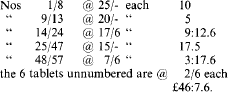
The letter concludes: “At these prices you can select what you like, but for clearing the lot the price asked is £40.”
18 Two letters among the surviving correspondence between Pinches and Rassam concern these tablets, one of 28th March 1898 and the other of 23rd June 1898, which reads:
Please to tell him that the Antiquities are not mine but were sent to my care from the Irack by my friend [elsewhere “cousin”] Josef Halabi and they are to be called the “Nassariah Collection”. Nassariah is situated in southern Babylonia and not far from the ruins of Niffar and Tel-Loh.
Rassam, as can be seen from his letters to Pinches, only occasionally acted as an intermediary in this way. Note here also the packet of copies marked “Sent by Rassam, 1895”, partly the work of Pinches, now published in Sollberger, , MVN 5 Google Scholar; cf. ibid. p. 3, and the still unrecovered bilingual fragment copied by Pinches in 1888 apparently then in Rassam's possession, later published in Lambert, W. G., BWL, pp. 190–1, Pl. 49 (cf. p. 333)Google Scholar. Certain Neo-Assyrian tablets and other antiquities formerly in Rassam's hands were presented by his daughter in 1924 to the Museum at Hove (cf. Weidner, E. F., AfO 11 (1936–1937), pp. 358–9Google Scholar); this material subsequently came to the British Museum in 1953 (now BM 131653–89 (1953-10-10, 1–37).
19 The name is written again where it looks like “Meuni”; but both this and “Meurie” are evidently errors for Menni.
20 The first-mentioned tablet is described in the 1933 manuscript list (see fn. 4) as follows:
A large and well-baked tablet. 4½ in. high by nearly 2 in. wide with the remains of 18 lines of writing on the obverse and right-hand edge, 25 lines on the reverse and the edge below it, and two lines of writing with an erased line between on the left hand edge. An account, in tabular form, of deliveries of wool. The headings are probably to be translated “woollen cloth” “dress-material” “clothes” etc. On the edge are the words “Total: 10 talents 50 mana of woollen cloth (and) dress-material; 2½ talents received”, and “Month Elul, day 20th, year 12th. Sagarakti-Šuriaš” the last being the name of the king, with an unusual two-syllable sign. A tablet of some importance. Kassite period.
It is hard to account for the form “Sarrinti-surias” above, since Pinches was evidently fully aware of the correct reading of the name, even in this unusual version; for the known spellings cf. Brinkman, J. A., MSKH 1, pp. 305–6Google Scholar.
The other tablets specifically mentioned here formed the subject of an address by Pinches entitled “Notes upon a Small Collection of Tablets from the Birs Nimroud Belonging to Lord Amherst of Hackney” given at the XIII International Orientalists' Congress in Hamburg, September 1902, published in Verhandlungen des XIII Internationalen Orientalisten-Kongresses (Leiden, 1904) Sektion V, pp. 267–70Google Scholar, where the article concluded: “Lord Amherst of Hackney purposes publishing all the above inscriptions, together with many others of more than ordinary interest, in the series of volumes upon his collections which he is now bringing out. The original paper, of which the above is a résumé, will probably appear in the Proceedings of the Society of Biblical Archaeology.” This projected fuller publication seems never to have appeared. Pinches's edition of the Amherst tablet dated by the eponymy of Ubar, šakin ṭēmi of Babylon, was published posthumously by Weidner, E. F. in AfO 13 (1939–1941), pp. 51–4Google Scholar. On 13th Dec. 1905 Pinches read a paper at the Society of Biblical Archaeology entitled “Notes upon some Tablets of the period of Hammurabi's dynasty”; cf. PSBA 27, pp. 263 and 266 Google Scholar. The talk was not published, but a summary survives in manuscript:
The tablets dealt with are some of those belonging to Lord A. of H., and consist of contracts and letters, the former generally rolled over with impressions of the cylinder-seals of the parties concerned. The contracts are of several classes, and include loans, receipts, sales, quittances, and lists of various kinds. These documents refer to silver, oil, grain, houses, slaves, etc., and are of very varying interest and value. Noteworthy are those expressly stating that the silver lent was not to bear interest, the loan advanced by Šamaš (i.e. by the administration of his temple), the apparently periodical offering to his temple, the sale of the houses of Abil-îli and Urra-kubi, etc. The more especially interesting points, however, are the dates referring to the many captures (apparently) of the city Isin, the date recording the destruction of Kamari, and a tablet containing the names of four slaves, with remarks concerning them. Two of these slaves seem to have been prisoners, and they were apparently recaptured whilst attempting to escape from Babylonia by the road to Harran, the city where Abraham sojourned after leaving Ur of the Chaldees. Among other things, these inscriptions touch upon many points dealing with the manners, customs, and laws of the Babylonians, and incidentally bear witness to the power and wealth of the temples of the land.
21 This object remains unidentified. 22See The Amherst Tablets, pp. 43 and 77; either tablet could be meant here.
23 It is not quite certain whether “cylinders” here means cylinder seals or inscribed clay objects, but the former seems more likely. Pinches's private diary for 1903 records a visit to Didlington Hall from 25–29th Aug. in which he “Revised Prof. Sayce's copies. Looked over and began sorting out others”, noting on 28th Aug.: “Found fragment of 5th tablet of the Gilgameš-Series”. Mention is made of this same piece in the Collins sent by Isabelle Pinches to Lady Amherst, after their return to London, dated 30th Aug. 1903 (Norfolk Record Office, MC 84/162 527 x 6):
I enjoyed so much the few days I spent with you. You have so many interesting objects besides the tablets that one gets quite fascinated. I am so glad that Dr. Pinches has been able to identify the place of the fragment of the tablet belonging to the Flood-series, and to think that it is a bit missing in the Tablets is too delightful!
Nothing more is known of this Gilgameš fragment, which is not itemised in Pinches's 1933 catalogue of the collection. Where is it now?
24 The “egg-shaped tablet” from Naaman is described as follows in the 1933 manuscript:
Clay “bead” in the form of an egg, with hole for string. Length 1½ in. Eight lines of writing. List of amounts of produce with names of recipients. Date about 1800 B.C. (N.5.)
25 Mr Macgregor is the Rev. William Macgregor (1848–1937), whose own private collection of Egyptian antiquities was a very remarkable one; see Who Was Who in Egyptology, pp. 267–8 and refs.
26 This solitary Amarna fragment is no doubt that mentioned in The Amherst Tablets, p. vii, of which Pinches remarked “no additional material of importance is contained therein”. This Amarna fragment was bought at the Sotheby's sale in 1921 by Howard Carter (Friday 17th June, lot 831A). The Amherst piece has been tentatively identified by Walker, C. B. F., JCS 31 (1974), p. 249 Google Scholar, with the fragment BM E58364, presented to the BM by Percy Newberry, on the reasonable assumption that Carter might well have passed the piece on to Newberry. The matter is not entirely straightforward, however. The auction catalogue (p. 74) does imply that the fragment was discovered at Amarna as a result of Lord Amherst's archaeological work at the site (carried out, as it happens, by Howard Carter), as was true of the other pieces in that section of the sale. This may, however, be erroneous in the case of the fragment, since the letter quoted above makes it certain that the Amherst piece was presented by Rev. Macgregor.
Re-examination of BM E58364 discloses that “obv.” and “rev.” as published are to be reversed (the beginning therefore reads [um]-ma mx […]), and that both top and bottom edges as well as the left edge are preserved, so that the full number of lines is preserved (obv. 1–7; lower edge 8–10; rev. 11–15; the trace copied as “obv.” 6 (below LÚ DUB.S[AR …]) is to be ignored). It is hard to envisage how much exactly is lost from the right side of the tablet, but at least two-thirds is missing. One is therefore dealing with a long broad thin tablet of very unusual shape, written parallel to the long axis (in other words, like a Late Assyrian or Babylonian letter, but written and held sideways). See also now Moran, W. L., The Amarna Letters, p. 383 sub EA 382Google Scholar. Comparison with Pinches's description of the Amherst piece in the following quotation thus seems to make it far from likely that BM E58364 is to be identified with Lord Amherst's Amarna tablet.
27 Lord Amherst would have been chagrined at the prices raised by the first sale of his tablets ( Sotheby, , Wilkinson, and Hodge, , Catalogue of the Amherst Collection of Egyptian and Oriental Antiquities, Friday 17th 06 1921 Google Scholar); at any rate the sale of the collection stopped at that point; cf. fn. 38 below.
28 This very practical attitude resulted in several other sales from Naaman of similar material.
29 This is the only mention in this archive of Haig and Co., who do not seem to have been suppliers to the British Museum.
30 The concept behind acquisitions of seeking out “one each of the series” at one time was certainly at play in the British Museum too, and may to some extent show Pinches's influence over Lord Amherst.
31 The Greek rendering of Labaši-Marduk.
32 This letter was dictated to another daughter, Sybil. The “reminder” to Pinches which she has put in parentheses and quotation marks was presumably a remark concerning which it was unclear whether or not it was meant to be included.
33 The Naram-Sin text is that subsequently published by H. G. Güterbock from an incomplete Pinches copy in AfO 13 (1939–1940), pp. 46–9Google Scholar. This was acquired for the British Museum with a group of other literary pieces from the Amherst 1906/2 collection (see fn. 44), including the “Hymns to Pap-Due-Garra” edited by Pinches, in JRAS Cent. Supp. 1924, pp. 62–86 Google Scholar, for which no provenance was given; a new edition of all these pieces will be given by the present writer. The other Sumerian text is perhaps that in the same Amherst collection described in the 1933 catalogue as “Very broken tablet — part of a large text. Lamentations for Damu (Tammuz) and En-urta”, which seems to have disappeared.
34 That Susa tablets should be casually in circulation at this period is worthy of note. Two Late Elamite tablets had been in the British Museum since 1882, although these were registered as coming from Sippar; see Walker, C. B. F., Iran 18 (1980), p. 79 CrossRefGoogle Scholar. Several letters to Pinches from W. Harding Smith from about this time mention cylinder seals from Susa being readily available.
35 An identically worded letter also dated 20th Feb. 1907 was sent by the firm to L. W. King at the British Museum, offering the kudurru at a price finally agreed by the seller to be £200. Other letters dated 3rd April, 24th June, 24th Sept. and 26th Sept. from Shashoua and Dunnoos, now preserved in the British Museum, show that Budge and his colleagues valued the object at £150, and made a last offer of £175, refusing to split the difference with an extra £12/10/-, so the offer came to nothing. A private letter that later came to Pinches from the College of Arms reveals that this kudurru was bought at the sale by Archibald G. B. Russell (Rouge Croix), together with “an inscribed Brick, from the temple of Bel, and a stela (in two pieces) bearing twenty-six lines of text in cuneiform characters”. The whereabouts of this material is unknown to the present writer.
36 Paper, title page, preface, photographic plates and especially the coloured map at the end of the book were each repeatedy discussed. Much care was also lavished on the paper, concerning which Lord Amherst wrote on 14th Feb. 1904:
I have a very great aversion to anything like clayed paper which makes the book so intolerably heavy, but 1 would not mind trying to get some paper made which would be light and last like the old-fashioned hand-made paper of 400 years ago and more — which is as sound and good as the day the book was printed.
Thus the paper used, although machine-made, is of excellent quality, bearing his Lordship's arms in the watermark, and at the time of writing at least vindicates the connoisseur's expectations. Many of these details were supervised by Lord Amherst's daughter May W. Cecil, who, inviting Pinches to lunch in a letter of 10th Feb. 1908, wrote:
Miss Bell, a friend of mine who wrote a book you may have seen called “The Desert and the Sown” on her travels to the East of Palestine, who was excavating in Asia Minor and discovered Hittite inscriptions last year, will be here.
Lord Amherst himself, much exercised about the location of “Ain Kadeis”, wrote on 3rd July of that year:
I shall suggest that “Ain Kadeis” in the south of Syria near the “Negeb” might be added partly as I have taken a great deal of trouble and expense in getting it located properly on the Map and because thanks to my many friends who have taken the matter up and urged the completion of the Palestine Exploration Map by means of the topographical Survey in connection with this settlement of the Egyptian and Turkish Boundary, this has been done. Mr Jennings Bramley worked very hard for me and spent a long time dodging the Turkish sentries when it was supposed he was crossing the Egyptian boundary … I should like you to see this new Map which Mr Armstrong the (?Assistant) Secretary of the Palestine Exploration Fund at 38 Conduit Street, will shew you … This reminds me that Mr Armstrong shewed me a “new map”, a German one which seems to shew a great lot of information near the new Haj Railway, but whether only conjecture or not I am doubtful. Armstrong knows the country between the Dead Sea and Akabah as he, as a Royal Engineer, was on the original Survey years ago so he is definitely interested in the matter but alas! getting very infirm.
37 Lord Amherst wrote on 14th Dec. 1908 that he had received an advance copy of the “Book” and “we are all delighted with it. It looks even better than I expected.” Earlier that month, in a letter dated on the 11th, he had confided to Pinches: “I am nearly distracted with the work of arranging the sale of my Books and the Works of Art which latter are today and Saturday.” As sketched in the bibliographical article referred to above in fn. 2 the need for this sale was brought about “owing to the dishonesty of a solicitor entrusted with the administration of estate and trust funds.” The extreme severity of the blow can be gauged from a later letter Pinches wrote to Randolph Berens (1st Oct. 1915) in a stormy exchange of views about the cost of publishing the Royal Asiatic Society's monographs of the Berens collection:
As you know, I edited for Lord Amherst of Hackney the “Amherst Tablets”, a quarto volume. The contents of this are precisely similar to nos. 1–93 of the Berens Collection. The number of tablets contained therein is 122, and there are 5 plates, a map, and a geographical list. The whole cost him about £300, which he paid just after he had suffered his great loss of about £300,000.
On 27th Dec. 1908 Lord Amherst, in his penultimate letter to Pinches, admitted being “rather fagged with all the worry we have just gone through”, and although he wrote on 12th Jan., of coming to London that week to settle the price of the volume so that it could be put on sale, by 16th Jan. 1909 he had died.
38 The accompanying letter with this catalogue explains how the original plan to dispose of the entire collection was stopped after the first auction in 1921:
On the death of the first Lord Amherst of Hackney, the publication of the “Amherst Tablets” was stopped, and it was decided to sell the remainder of the Collection by auction … Difficulties arose, and the completion of this Auction Catalogue was delayed, the sale being, in the end, practically abandoned. For this there was good reason, as the result of the sale of the Harding Smith Collection by Messrs Sotheby had been decidedly disappointing.
39 Mostly Ur III; some OB admin., and letters in envelopes. Twelve of the Ur III texts are published in Sollberger, E., MVN 5 Google Scholar, where their numbers are quoted as follows: 1, 3, 5, 7?, 8,25,45,46, 52, 54, 89, 91. Note that these numbers do not correspond with the order of these tablets within Pinches's Lots 1–16, but the tablets seem to overlap.
40 Predominantly Ur III, including various tablets from Nippur (39, 206, 207, 209), Gungunum of Larsa (39, 207, 208, 211, 220), Kassite tablets (40, 210, 217 and the tablet quoted above in fn. 20), and scattered OB and LB (224–64). Some 84 of these tablets, almost all Ur III, had been copied by Pinches for the continuation of the work, and these copies are published in Sollberger, E., MVN 5 Google Scholar, where the numbers fortunately do correspond exactly with the numbers of these tablets within Pinches's Lots 17–58: 92–110, 112–13, 118, 120, 122, 124–7, 129–30, 132, 133–4, 144–6, 149–50, 152, 155–61, 163–4, 166–8, 170, 172, 174, 176–83, 187–93, 195, 197–8, 200–5, 216, 218–20 and 222–3.
Of the missing numbers from this sequence, Nos. 111, 114–16, 119, 123, 128, 131, 135–6, 143, 145, 151, 162, 165, 169, 171, 173, 175, 184–6, 194, 196, 199, 211 and 213 are for unknown reasons not itemised in Pinches's catalogue either.
Pinches had also copied most of the Late Babylonian documents that fell within this group, and after his death this material was entrusted by Weidner for publication to Ungnad, whose abbreviated report came out in AfO 19 (1959–1960), pp. 74–81 Google Scholar. This publication accounted for Amherst Collection Nos. 225–6 and 228–61. Tablets 117, 145 and 206 are indicated as having crumbled beyond rescue, while a few other tablets are described in the catalogue without having a number at all.
41 N here is J. J. Naaman; cf. fn. 24 above for this collection.
42 Collection Dec. '05: for the purchase of these 79 tablets for £10 from J. J. Naaman see above, p. 11.
43 This collection was acquired before Pinches became involved with the collection.
44 In the manuscript this collection was first called “1892”, then changed to “1903”, but it is clear that it should really be “1906/1”, in view of the letters quoted above. As will be shown elsewhere, this particular group, acquired from Naaman, has close connections with the British Museum Bu. 88-5-12 collection, on which see Budge, E. A. Wallis, ZA 3 (1888), pp. 211–30Google Scholar, as well as with material now in Berlin.
45 Within the publication The Amherst Tablets itself, one encounters the following numbering systems or collections:
No numbers at all: AT 1–17, 21, 22, 24, 52 and 121
Plain running numbers: AT 18 = No. 41, AT 19 = 90, AT 20 = 143, AT 27 = 2, AT 28 = 196, AT 33 = 173, AT 34 = 75, AT 35 = 165, AT 40 = 49, AT 42 = 30, AT 44 = 42, AT 47 = 13, AT 48 = 35, AT 49 = 10, AR 53 = 154, AT 55 = 115, AT 56 = 185, AT 57 = 23, AT 59 = 199, AT 62 = 194, 194, AT 66 = 9, AT 73 = 31, AT 75 = 81, AT 83 = 186, AT 90 = 114, AT 91 = 131, AT 93 = 88, AT 94 = 76, AT 96 = 151, AT 98 = 111, AT 99 = 184, AT 100 = 28, AT 101 = 119, AT 102 = 128, AT 104 = 153, AT 107 = 116, AT 109 = 34, AT 110 = 73 AT 112 = 79, AT 114 = 162 AT 115 = 55, AT 116 = 171, AT 117 = 147, AT 118 = 169, AT 119 = 175, AT Appendix = 136
Collection Dec. '05: thirty-six of these tablets appeared in The Amherst Tablets: No. 7 = AT 23, 8 = AT 25, 10 = AT 26, 13 = AT 37, 16 = AT 41, 17 = AT 46, 18 = AT 51, 19 = AT 43, 28 = AT 68,29 = AT 78, 30 = AT 70, 31 = AT 71, 32 = AT 77, 33 = AT 72, 34 = AT 74, 35–6 = AT 80, 37 = AT 82, 38 = AT 81, 39 = AT 87, 40 = AT 97, 41 = AT 106, 45 = AT 67, 46 = AT 113, 48 = AT 95, 50 = AT 105, 52 = AT 108, 53 = AT 39, 54 = AT 36, 59 = AT 103, 63 = AT 60, 64 = AT 63, 66 = AT 92, 68 = AT 79, 70 = AT 70, 77 = AT 76,79 = AT 65, AT 85 = 137, AT 86 = 135, AT 88 = 123
Collection 1904, presumably also bought from J. J. Naaman: No. 8 = AT 29, 12 = AT 30
Collection 1905, presumably also bought from J. J. Naaman: AT 84
Collection Apr. '06: No. 4 = AT 120
Collection Burb. (= W. T. Burbush): No. 44 = AT 31
Collection Burb. I: No. 73 = AT 45
Collection R (= H. Rassam): AT 32, 38, 54, 58, 61, 64, 69, 89
Collection R. I: AT 50, MVN 5
On the other hand these additional collections occur in MVN 5:
Collection “Naaman” (= N.1–35 above?)
Collection “Grosvenor Sq.” and, finally, 3 unnumbered.
Note that tablets from the Amherst collection characteristically bear neatly written numbers on small paper labels in the form of a half-circle, for a good example see the photograph in The Amherst Tablets pl. V No. 4 obv. The present writer is grateful to P. J. Watson for the information that 22 tablets (AT 1, 7–8, 11, 14–15, 22, 27–8, 31–2, 33–5, 40, 58, 61–2, 64, 66, 69 and 91) from The Amherst Tablets sold off at the first Amherst sale are now in Birmingham City Museum; a further 27 published in his Catalogue of Cuneiform Tablets in Birmingham City Museum 1. Neo-Sumerian Texts from Drehem are noted as being ex-Amherst although apparently not stemming from the sale in June 1921, see ibid, pp. 8–10.