


Thus, through an exchange, or rather through a bizarre and unfortunate reversal, church music in the theatre is more ecclesiastical than in the church itself.
Camille BellaigueFootnote 1In an article in the Revue des deux mondes of 1904, the French critic Camille Bellaigue described the incorporation of church music into contemporary opera, referring to anticipated examples by Meyerbeer and Gounod; to works less well known today, such as Lalo’s Le roi d’Ys (which quotes the Te Deum); and also (quite extensively) to Wagner’s Parsifal, the ‘masterpiece […] or the miracle of theatrical art that is not only religious but liturgical’.Footnote 2 Briefly, Bellaigue’s twofold argument reads as follows. First, music in the church had relinquished its virtue by emulating the profane music of the theatre – this narrative of decadence in church music is, of course, a topos in nineteenth-century French discourse, and one of the ideas that fuelled the rediscovery of repertories such as Gregorian chant and Palestrinian polyphony.Footnote 3 Second, and more original, is Bellaigue’s stance towards opera, which (according to him) had in turn approached church music – a development that the rather conservative Bellaigue, fond of both opera and sacred music, surprisingly endorses.
In a brief reference to Jules Massenet’s opera Le jongleur de Notre-Dame, Bellaigue lauds the work in unusual terms: ‘Most recently, the truly religious musician of Le jongleur de Notre-Dame drew a fine sketch, half-Gregorian, half-Palestrinian, conforming to the most orthodox Schola.’Footnote 4 Moreover, it was (according to Bellaigue) after all not Massenet’s fault that his Méditation had ‘entered the “ordinary” of the wedding mass’.Footnote 5 In mentioning Gregorian chant and Palestrina, Bellaigue refers to the two repertories that had become esteemed as ideals of sacred music, at least in France. He alludes furthermore to the motto of the Parisian Schola Cantorum and to the corresponding papal motu proprio of 1903, both of which proclaimed a tripartite hierarchy: Gregorian chant, polyphony in the style of Palestrina and contemporary music.Footnote 6 It is therefore no surprise that Bellaigue’s article was reprinted the following year in the Schola Cantorum’s periodical, La tribune de Saint-Gervais. Footnote 7
The present article traces the ideas evoked by Bellaigue and starts from the observation that French fin-de-siècle opera abounds with musical references to religion and religious music. The focus will be placed on (more or less) verbatim appropriations of Gregorian chant, drawing on research into the French plainchant revival of the late nineteenth and early twentieth centuries.
The French debate on Gregorian chant around 1900 can be described as a multilayered discourse, reaching into different fields of knowledge. Research on this debate has concentrated on the attempted philological rediscovery of plainchant and the subsequent dispute surrounding the Editio Vaticana;Footnote 8 on the cultural contexts of the chant ‘revival’, especially at the Benedictine Abbey of Solesmes;Footnote 9 and, more recently, on the economic and political issues and conflicts to which the growing importance of Gregorian chant was linked in the late nineteenth century.Footnote 10 The traditional narrative, stemming from the nineteenth century itself, that Gregorian chant had been restored to its full glory by French scholars from Solesmes and elsewhere has been deconstructed, leading to a more nuanced and less teleological view of nineteenth-century conceptualizations of what is still commonly called Gregorian chant.Footnote 11 It has only rarely been examined, however, whether and how these conceptualizations influenced musical discourse and composition in general,Footnote 12 not just in liturgical music.Footnote 13 If it is true, as has often been claimed, that French music around 1900 is characterized by the use of modality,Footnote 14 one should ask, for example, whether this observation can be linked to the debate about modality that took place in France from about 1850 well into the twentieth century, even if the modes of Gregorian chant for plainchant accompanimentFootnote 15 were only one of several sources for modality.Footnote 16 Furthermore, one could ask if the idea of ‘free’ rhythm, a very important concept in the French debate about chant singing around 1900,Footnote 17 might have influenced notions of rhythmical flexibility in compositions at that time. But there are even more direct and indisputable references to plainchant in French music at the fin de siècle, in a repertory traditionally considered distant or even opposed to sacred music. French opera at that time often references sacred music and not infrequently includes explicit quotations of chant melodies.
In this article, I examine three case studies of such quotations and appropriations: the operas Le rêve by Alfred Bruneau (1891), L’étranger by Vincent d’Indy (1903) and Le jongleur de Notre-Dame by Jules Massenet (1902).Footnote 18 Among the contexts relevant to these case studies are specific traditions of French opera, such as exoticism and local colour, but also (I argue) the different light in which historical church music such as Gregorian chant was viewed at the end of the nineteenth century, after some decades had been spent exploring rediscovered repertories. Gregorian chant had become more readily available after its ‘restoration’ as church music. Under the dialectic premiss of historicismFootnote 19 arose an entanglement of both rational and ‘scientific’, but also speculative and enthusiastic, preoccupation with the past, as well as a fascination with the otherness of ancient music. The French music critic Joseph d’Ortigue, for example, saw plainchant as ‘the junction of ancient and modern music’.Footnote 20 He emphasized the alterity of chant, postulating a dichotomy of plainchant and ‘music’ based on fundamental differences in harmony and rhythm.Footnote 21
It is not the purpose of this study to examine the direct influence Gregorian chant may or may not have had on specific composers. Rather, it is to consider more general layers of French musical discourse around 1900, a discourse imprinted by plainchant and by the lively debates that surrounded it. Familiarity with that repertory, I argue, may be indirect and does not necessarily result from wide-ranging personal experience as a listener or performer. Remarks on this topic must remain preliminary at this stage, since the history of plainchant performance in fin-de-siècle France has yet to be written. One may assume a certain familiarity with plainchant (in a broad sense), at least for Catholic composersFootnote 22 – even for those who did not participate in the debates surrounding plainchant restoration and performance. In France, plainchant had had a continuous presence in the liturgy, even if it had at times been altered more than elsewhere and may have been, as ‘neo-Gallican chant’ or ‘plain-chant musical’, very different from what is normally considered ‘Gregorian’ chant, especially during the seventeenth and eighteenth centuries.Footnote 23 The nineteenth century is usually viewed as a period of return to the Gregorian tradition. Even though this depiction may be in need of refinement (it is for example hardly clear when and to what extent results of scholarly efforts such as new chant books were implemented throughout the French churches),Footnote 24 a strong presence of this partly traditional, partly rediscovered repertory in French musical life of the fin de siècle may be supposed.
Comparison of three operas reveals various dramaturgical uses of chant quotations, which might be linked to the aesthetical and ideological convictions of their respective authors. Reception processes become tangible in quotations, where the reference to a given repertory is usually explicit and undeniable – quotations in music are, according to Zofia Lissa, supposed to be recognizable,Footnote 25 even if their intention may remain opaque. Analysis shows whether and in what way the ‘incorporation of a relatively brief segment of existing music’ can be defined as quotation in each case. According to J. Peter Burkholder, a quotation is characterized by the fact that ‘the borrowed material is presented exactly or nearly so, but is not part of the main substance of the work, as it would be if used as a Cantus firmus, Refrain, fugue subject or theme in Variations or other forms, or if presented complete in a Contrafactum, setting […], Intabulation, transcription, Medley or Potpourri’.Footnote 26
The three operas examined here present differing cases of the use of pre-existing material. In contrast to the sources usually under discussion in case studies on quotation or Zitat, however, Gregorian chants are not strictly speaking musical ‘works’, and references to a specific author (such as is probably the case in, say, Debussy’s quotation of Wagner’s Tristan und Isolde in his Golliwogg’s Cakewalk) are usually not implied. Rather, chant quotations refer to a large and diverse repertory, and their intentions can be equally diverse. Before the three case studies are addressed, some preliminary remarks on religious scenes and quotations in French opera are necessary.
Local, historical and religious colour: religious scenes and quotations in French opera
The fact that the use of church music, and specifically of plainchant melodies, occurs in various French operas at the fin de siècle may be explained by a number of specific features of this repertory. The first and most obvious factor is the French tradition of historical opera ranging back at least to Giacomo Meyerbeer and commonly linked to what has been called – especially by English- and German-speaking researchers – grand opera, a term rarely found in primary sources.Footnote 27 An important concept for grand opera is the idea of couleur locale, especially when historically or geographically distant settings are used. Victor Hugo’s Préface de Cromwell has been mentioned as one source for this important idea of French art in the nineteenth century. Hugo uses not only the term couleur locale, but also couleur des temps, which highlights the fact that this technique may also be applied to depictions of chronologically distant areas.Footnote 28
Anselm Gerhard has shown how couleur locale in French opera of the early nineteenth century is often created by using characteristic melodies. Gerhard quotes Antoine Reicha’s comment on couleur locale, which recommends that opera composers ‘introduce a national air sometimes, or rather a song, because their airs are better known and have more melodic interest’.Footnote 29 The use of melodic fragments happens, one could argue, in a quotation-like manner,Footnote 30 even if the authenticity of the melodic extract – an essential feature in traditional definitions of quotation – seems to be of less importance, at least at this early stage. Meyerbeer famously used the Lutheran chorale Ein feste Burg ist unser Gott in his opera Les Huguenots, but also the invented Ad nos, ad salutarem undam in Le prophète. Footnote 31 After Meyerbeer, composers of the nineteenth and twentieth centuries used quotations of songs, hymns and anthems in instrumental music as a tool of semanticization.Footnote 32
A second factor especially specific to nineteenth-century French opera is a considerable predilection for religious subjects and particularly for church scenes. Robert Schuster’s voluminous study on church scenes, although not dealing exclusively with French opera, clearly shows the particular development that occurred in this country. According to Schuster, church scenes occurred frequently after Grétry’s La rosière républicaine (1794), where they were treated in a satirical manner.Footnote 33 A first attempt at historical accuracy seems to occur in Spontini’s Berlin opera Agnes von Hohenstaufen (1829).Footnote 34 Another famous example of a church scene (with a reference to the Dies irae) is of course Gounod’s Faust (1859/69).Footnote 35 Gounod used quotations of plainchant in later works: Lauda Sion appears, for example, with a French text in the five-act version of Mireille (1864), and Vexilla regis in his incidental music to Jeanne d’Arc (1873).Footnote 36 Using a topical expression of nineteenth-century French plainchant discourse, d’Ortigue criticized Gounod for the homorhythmic quotation in Mireille. According to d’Ortigue, Gounod had ‘hammered (martelé) this chant in the manner of old Parisian cantors’.Footnote 37 Not all church scenes, however, contain melodic references to actual sacred music. It appears that liturgical texts in new settings appear more frequently and earlier than precise quotations of chant; the use of the texts Te Deum in Halévy’s La juive (1835) and Ave Maria in Gounod’s La nonne sanglante (1854) are examples of this tendency.
A third (and somewhat paradoxical) aspect is the well-known preference for exotic settings in French opera and other arts. The term ‘exotic’, it has been argued, became a basic concept of aesthetics in France in the nineteenth century.Footnote 38 Exoticism can be described as one of the strategies of ‘othering’ that have become an important focus of historically orientated cultural studies.Footnote 39 In Grove Music Online, Ralph P. Locke has defined exoticism in music as
The evocation of a place, people or social milieu that is (or is perceived or imagined to be) profoundly different from accepted local norms in its attitudes, customs and morals. Exoticizing tendencies can be found in many musical cultures […] The exotic locale that is evoked may be relatively nearby (e.g. a rural French village, in an opera composed for Paris) or quite distant.Footnote 40
At first sight, it may appear misleading to relate the use of Gregorian chant to musical exoticism, since Gregorian chant is considered an integral part of Europe’s musical heritage. The musical and dramaturgical strategies of its incorporation, however, are comparable. Some of the common stylistic devices used to create ‘exotic’ effects,Footnote 41 especially the use of modal scales and bare textures, are often also commonly found when Gregorian chant or other ancient music is evoked.Footnote 42 On a more general level, it could be said that exoticism and archaism have structural similarities. Tzvetan Todorov, in his analysis of exoticism in France, has pointed out that observations with regard to ‘savage’ cultures were often made in relation to a more primitive era of Europe’s ‘own’ cultural heritage.Footnote 43 French views on Gregorian chant in the nineteenth century are situated within this dialectic of alterity and identity. It might even be argued that this repertory resembles to some extent an ‘invented tradition’ in the sense of Eric Hobsbawm.Footnote 44 Variance of opinion on this matter is not in the least astonishing, given the diversity of repertory subsumed under the terms plainchant and Gregorian chant. On the one hand, chant could be considered strange or difficult. An example of this tendency might be the account of the Benedictine monk Augustin Gatard from as late as 1913:
Everything in this strange music appears anomalous: the tonality, which is so different from our modern tonality; the rhythm, or rather what one calls the absence of rhythm, since one does not find the regular return of strong beats that seem to be a necessity in the music of our days; the purportedly barbarian manner in which melody is attached to words, without regard to quantity or to accentuation; the interminable vocalises that burden certain pieces, whereas others are overly simple.Footnote 45
On the other hand, Gregorian chant could, despite these difficulties, be viewed as a familiar, essentially French music. Louis Laloy described French composers from Berlioz to Debussy as being profoundly familiar with the Gregorian repertory and its characteristic musical features such as modality and free rhythm, with German composers such as Wagner or Strauss being their polar opposites. After comparing the rediscovery of these musical traits to the influence of ‘exotic music, that of the Orient or Far East’,Footnote 46 Laloy returns to the importance of Gregorian chant to French music and concludes:
All the freedom of our music, all its variety of accents, all its richness of harmony and all its ease of appeal is indebted to Gregorian chant, in which is revived, as in the ogives and rosettes of our cathedrals, the spirit of the Christian Middle Ages, with all the refined naivety, delicate purity, harmonious fantasy and nervous and robust grace that it contains.Footnote 47
Given the fascination of the French fin de siècle with cathedrals, it may not come as a surprise that two of the three operas considered here take place primarily in the vicinity of sacred buildings from the Middle Ages.
Beyond couleur locale: Alfred Bruneau, Le rêve
Alfred Bruneau’s Le rêve, based on a novel by Émile Zola, premièred on 18 June 1891 at the Opéra-Comique in Paris. Many contemporaries regarded it as a landmark in French operatic history. Preceding Gustave Charpentier’s Louise of 1900, Le rêve has furthermore been viewed as the starting point for naturalism in French opera.Footnote 48 It represents a somewhat special case in Bruneau’s oeuvre as an opera that refers strongly to religious themes. Bruneau’s choice of subject, however, was somewhat coincidental. Initially, the composer had been interested in Zola’s novel La faute de l’abbé Mouret, the rights of which had already been granted to Massenet.Footnote 49 But Bruneau was also fascinated with Zola’s new novel Le rêve, which had been proposed by Zola as a possible substitute. Louis Gallet’s libretto to some extent changed the nature of the story, converting Zola’s naturalistic novel into a more conventional opera libretto.Footnote 50
Bruneau’s music is partially influenced by Wagnerism (and thus typical of French opera of the fin de siècle) in its use of leitmotifs. As early as 1896, Bruneau’s friend Étienne Destranges even published a motivic guide comparable to those written by Hans von Wolzogen for Wagner’s works.Footnote 51 Previous research has therefore focused on the questions of WagnerismFootnote 52 and naturalismFootnote 53 in Le rêve. To declare Le rêve a naturalist piece, as has often been done, is not self-evidently correct: Zola’s naturalism implies a quasi-scientific observation of society from a heavily rationalist or even deterministic point of view (and through a particular interest in socially marginalized groups). In that respect (it has often been said), Zola’s 1888 novel Le rêve is a less typical example. In a review of the opera in Le Figaro, it was even noted that it was ‘the first book by Émile Zola which mothers could allow their daughters to read without danger’.Footnote 54 Some scholars have noted how Le rêve opens a new chapter in Zola’s oeuvre in which a certain affinity with symbols is noticeable, a stage that is sometimes called ‘naturalisme élargi’.Footnote 55
Le rêve was staged in a contemporary nineteenth-century setting and the costumes were, according to Bruneau, ‘ultra-modernes’ and provoked some ridicule.Footnote 56 The plot, however, might as well take place in the past. The story centres on Angélique, the foster daughter of Hubert and Hubertine, who work as embroiderers in the close vicinity of a cathedral in the (fictional or fictionalized)Footnote 57 city of Beaumont in France. Besides her own work, Angélique is interested only in religion, especially the Golden Legend. This important collection of stories of the lives of saints from the thirteenth century was highly popular at the fin de siècle. Footnote 58 As a result of her obsession with saints, Angélique hears mysterious voices inside the cathedral. In the case of the novel at least, this should be taken as a psychological phenomenon induced by her state of mind. Her ‘dream’ is to lead a legendary life herself: she wants to marry a nobleman and enter heaven in the afterlife – that is what these voices tell her. The subsequent course of the plot more or less exactly fulfils this dream, with Félicien being the prince whom she is finally allowed to marry despite attempts by his father, the bishop Jean d’Hautecœur, to prevent it. In a somewhat peculiar twist at the end, Angélique receives the last rites since she is about to die (seemingly by her own decision and driven by the voices she hears). The bishop then grants his permission for them to marry. Angélique happily reawakens. At the climax of the solemn wedding celebrations – a concluding scene cut for the first performance at the Opéra-Comique – she eventually dies, her destiny having been fulfilled.
Zola, who famously regarded his novels as ‘experiments’,Footnote 59 was interested in the influence of a certain milieu on individual psychology. He called Angélique ‘a soul from another epoch’,Footnote 60 and even considered her preferred reading material, the tales of the Golden Legend, as a part of her social milieu:
This milieu is also made of the legends she has read, of the faith she has absorbed in this climate, of the beyond in which she bathes, of her belief in miracles, of the supernatural in one word. All this is anti-rationalistic.Footnote 61
It is noteworthy that the Golden Legend had been central to Zola’s concept of the novel from the first drafts onwards.Footnote 62 However, as Steven Huebner has argued, this aspect of milieu study becomes far less important in the operatic version.Footnote 63 In the novel, Angélique is initially a stubborn and even somewhat imbecilic child, whose focus on religion stems from a lack of other interests. In the opera, however, she becomes a one-dimensional femme fragile, with the story consequently being less sociological and more sentimental.
Bruneau’s music plays an important role in this change of focus as it supplies a musical illustration of Angélique’s infatuation with Christianity, which is depicted less critically than in the novel. In a way, Bruneau’s procedure is justified by the locations, thus perpetuating the tradition of couleur locale: all of the opera’s scenes take place either in rooms located on the site of the cathedral or (in the case of the foster parents’ home) in its closest vicinity. With its fascination for Gothic cathedrals, Le rêve participates in a French fin-de-siècle trend.Footnote 64 Sacred places and, more generally, religious topics received much attention from French artists during the Third Republic, even though (or maybe because)Footnote 65 the political discourse of the Third Republic on religion became increasingly anti-clerical. A notorious example is Léon Gambetta’s much-quoted phrase, ‘Le cléricalisme, c’est l’ennemi.’Footnote 66
Manfred Kelkel has shown how quotation became a major factor in naturalistic and veristic opera (in a broad sense) around 1900, with Bruneau being a key figure. Quotation is, according to Kelkel, a frequent and adequate means of confronting the audience with musical ‘reality’.Footnote 67 In Le rêve, Bruneau quotes several religious melodies: the plainchants Ave verum corpus (p. 68) and Pange lingua (p. 100), the ‘cantique’ Les anges dans nos campagnes (p. 97) and an unidentified ‘Thème de la liturgie catholique’ (p. 186),Footnote 68 which resembles several antiphons in the seventh modeFootnote 69 and is notated in an archaic 4/1 measure. This theme is played instrumentally during the scene of the last rites. The rites themselves, already quoted extensively in Zola’s novel,Footnote 70 are set in the simple style of a lecture (p. 186). Another piece of religious music that is treated as a quotation (even though it is not clear that it is one) is the Laudate pueri (p. 193).Footnote 71 A non-religious quotation is a folk song (chanson populaire) from the anthologies compiled by Julien Tiersot (p. 47).Footnote 72 In total, there are probably more quotations in Le rêve than in any other opera by Bruneau.Footnote 73
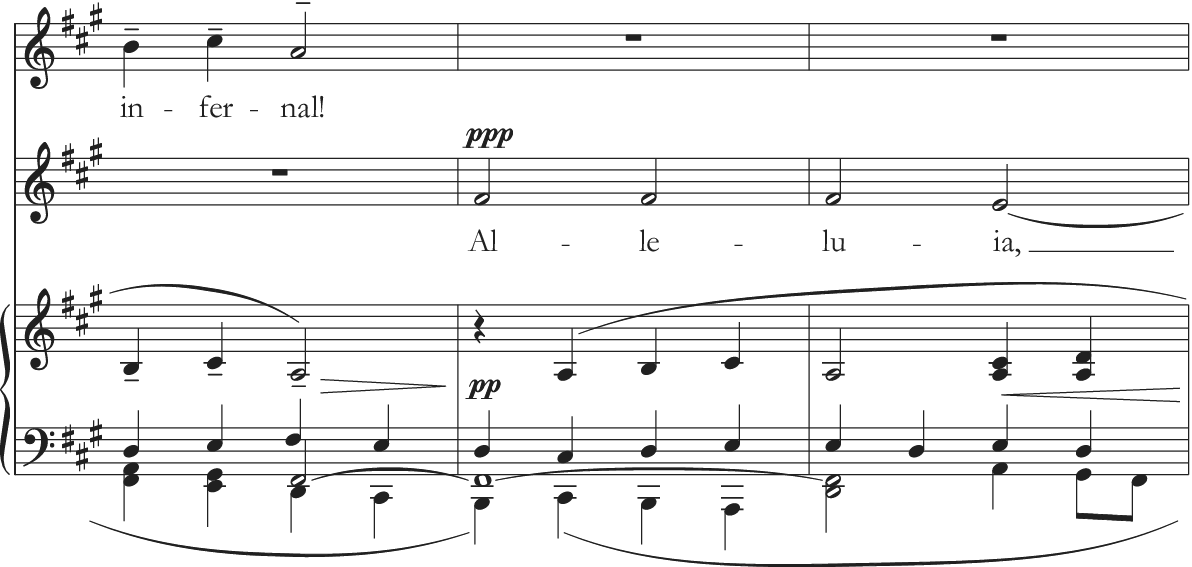
Bruneau’s quotations are particular in several ways, since they not only use original texts and melodies from the Christian repertory, but also treat them in a way that seems to imitate actual religious practices. The Ave verum corpus (Act 1, scene ii, pp. 68–71; see Example 1 and Figure 1) is accompanied by the organ in a style that is reminiscent of the diatonic chordal accompaniment made popular around the middle of the nineteenth century by Niedermeyer and d’Ortigue, as well as others.Footnote 74 It contrasts both with the synchronous lovers’ duet, which is more chromatic and expressive, and with the chanson populaire that immediately follows in a more animated 6/8 time. This musical contrast is a reflection of Angélique’s personal perception, in which her obsession with saints (triggered here by their depiction in the cathedral windows) blends with her idealization of Félicien. This blending of the sacred and profane, of idealized and real life, is represented by Bruneau’s combination of musical styles.
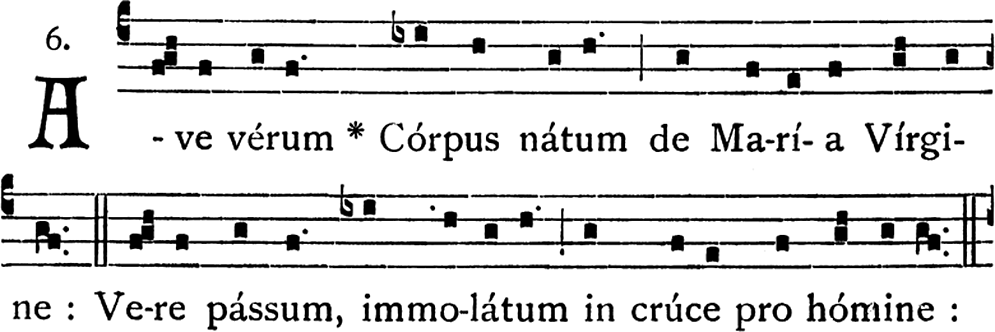
Figure 1: Ave verum corpus, from Liber usualis (Rome and Tournai: S. Joannis Evang., 1908), [51].
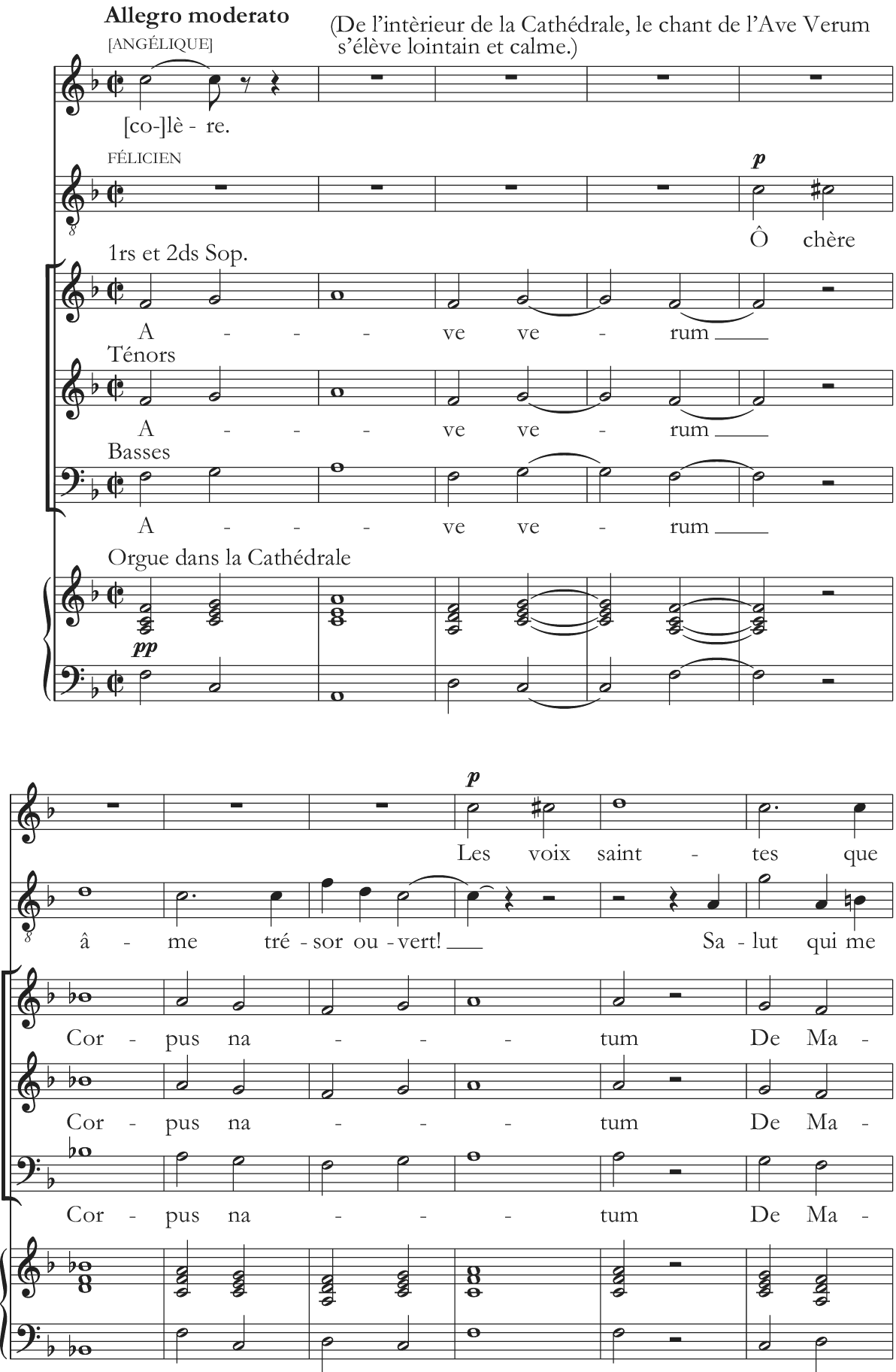
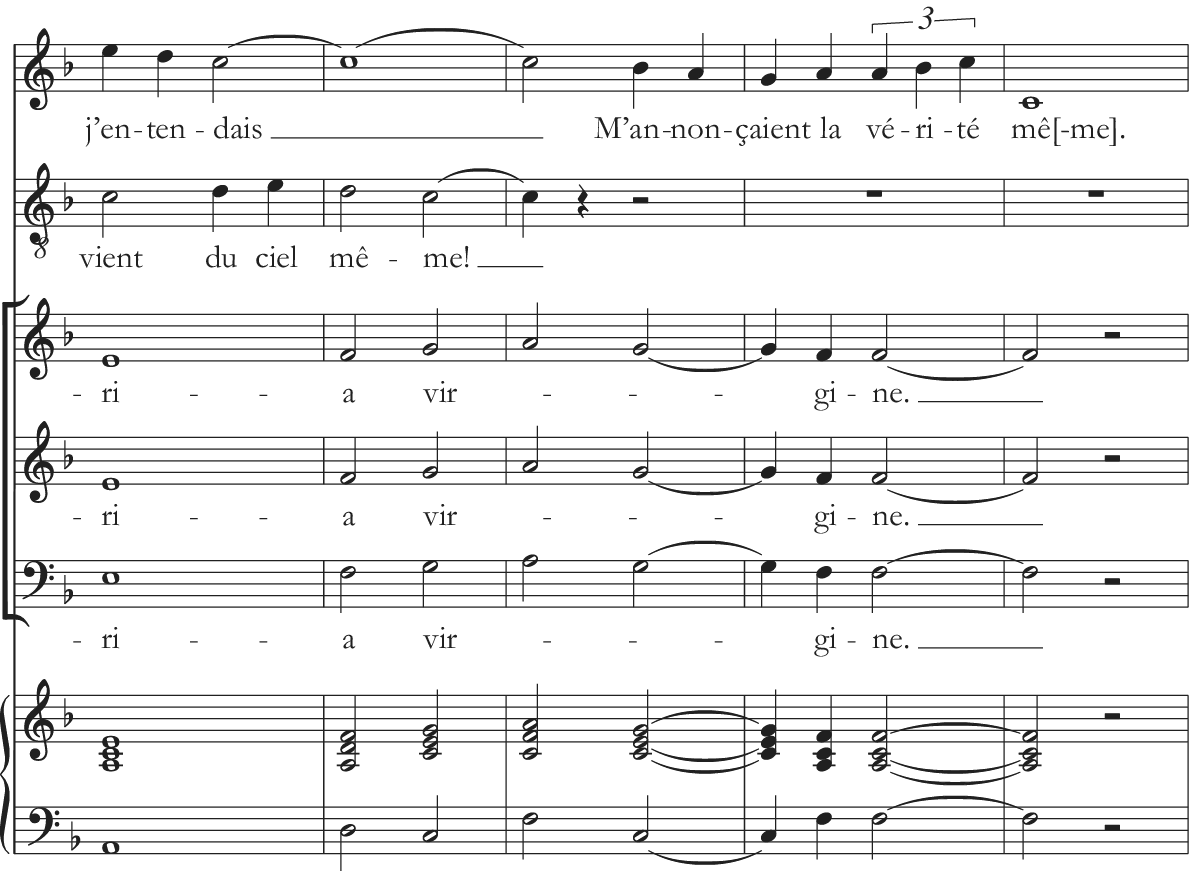
Example 1: Alfred Bruneau, Le rêve, extract from Act 1, scene ii, edited from the vocal score (Paris: Choudens, [1892]; A. C. 8428), p. 68.
More peculiar is the procession scene (Act 2, scene iii). Invisible choirs sing Pange lingua, the famous hymn for Corpus Christi, but also the French Christmas carol Les anges dans nos campagnes, which, strictly speaking, is liturgically inaccurate. Although this is a very opulent procession, we never actually see it on stage. The accuracy for which Bruneau seems to strive when depicting liturgical music is striking. Whereas the Christmas ‘cantique’ is heard in a simple three-voice setting for women, the Pange lingua is sung in unison by a men’s choir. Here Bruneau alludes to an old French practice: in the nineteenth century, it was common to accompany liturgical chant with the ophicleide.Footnote 75 The printed vocal score actually mentions the use of a backstage ophicleide (p. 100), whereas the manuscript as well as the printed full score employ the tuba,Footnote 76 the instrument that succeeded the ophicleide. A similar ‘correction’ appears at the beginning of the procession scene: Bruneau’s handwritten score had at first required the use of bells, but they were crossed out in the manuscript by a third handFootnote 77 and do not appear in any of the printed scores.
It is noteworthy that almost all of the quotations in this opera appear as invisible offstage music. Semiotically, stage music in opera is a complex phenomenon. Although it may at times clearly be identified as diegetic music, as something like a ‘sounding requisite’,Footnote 78 especially when instruments are visible on stage, its possible overlap with orchestral music from the pit allows a range of intermediate levels between diegetic and non-diegetic music.Footnote 79 This is particularly true when the sources of stage music are not visible, the instruments being located behind the scenes. Research on stage music has reflected on its distinctive aesthetic status and its affinity to quotation and couleur locale: Luca Zoppelli called a specific use of stage music ‘emblematic’ and mentioned Meyerbeer’s quotations as an example.Footnote 80 Carl Dahlhaus described stage music in general as comparable to the technique of quotation:
Emblematic stage music is one of the oldest traditions in theatrical history: trumpets proclaim the entry of princes or the start of a battle, muffled drums accompany a funeral cortège, horns denote hunting, trombones the underworld, a harp or a lute the declamation of an epic or the singing of a song. These musical conventions have a long tradition and are understood by everyone, but for that very reason they present a problem in opera: they stick out like quotations – intrusions from another world outside, it seems – in a context where music is the language of the drama’s entire world, presenting itself as natural and spontaneous, artificial and conventional though it be.Footnote 81
Although this description is equally adequate for the case of Bruneau’s Le rêve, stage music is also used here for a particular dramaturgical purpose. The voices heard by Angélique receive a treatment similar to the religious music; as stage music from behind the scenes, they obtain a form of audible, albeit invisible reality (p. 22 and elsewhere). As music that is partly heard by one character only, the voices present a very specific answer to the question, raised by Carolyn Abbate, of whether characters in opera do or do not hear the music around them. Abbate called ‘phenomenal’ those musical instances in opera that are clearly heard as music by the characters. She regards it as an exception to the rule that the characters in opera are ‘deaf’.Footnote 82 Le rêve in this respect follows a tradition in Romantic opera of using phenomenal song when referencing the supernatural.Footnote 83 From this point of view, Angélique’s inner voices would be a quite particular case: this is music that is (at first) heard only by one character, although it is treated just like the instances of quoted liturgical music which we can assume to be phenomenal stage music heard by everybody. However, the other music presented on stage – the mysterious voices heard only by Angélique – establishes in a certain way the least ‘real’ music in the whole opera, thus providing, one might argue, a sharp contrast to the tradition of stage music.
Another characteristic feature relevant to this combination of actual and imagined sacred music is the use of modality, which informs the musical style of the opera as a whole. This tendency is evident in the very first bars of the opera, where an important leitmotif, the bishop’s motto, is heard for the first time (p. 2). Furthermore, the parallel fifths and chords noticeable in the same example appear frequently throughout the opera. While this does not really have any historical precedence (with the possible exception of organum), it likewise seems to convey an image of early, even archaic, music. At the same time, it marks, of course, a rupture with traditional rules of composition that prohibit parallel fifths and octaves. From that point of view, Le rêve is a major step in the history of a specific cathedral style in French music, one that Jean-Jacques Eigeldinger has characterized as the ‘Gothic syntax’ of fin-de-siècle French music.Footnote 84 It became a musical topos to associate references to the sacred (and particularly to sacred buildings) with a chordal setting in a pseudo-chorale-like style that includes parallel chords. Among the most famous examples are Satie’s Ogives and Debussy’s La cathédrale engloutie. Footnote 85 This procedure is often combined with modality. The modality in this ‘modern’ manifestation, however, has less to do with historical restoration than with the creation of a new musical language. It may appear that the nineteenth-century French reception of early music was paradoxically a project with rather progressive consequences.Footnote 86
Bruneau’s music, at any rate, was widely perceived as modern, especially in terms of his approach to chordal progression and voice-leading, which was both criticized and praised.Footnote 87 Also for its use of other techniques such as the whole-tone scale, Le rêve gained a reputation for being an avant-garde piece, especially among younger composers such as Charles Koechlin and Maurice Emmanuel.Footnote 88 Paul Dukas even called the creation of Le rêve ‘the baptism of a new art’, while deploring some of Bruneau’s preferences, ‘such as the too frequent doubling of the bass and the upper part, the grouping of harmonies in the lower register and the monotony of certain minor cadences’.Footnote 89
And just as the use of modality goes beyond historicist reconstruction, the quotation of sacred music in Le rêve goes beyond couleur locale. It is not only the number of quotations and the mostly accurate (and arguably naturalistic) way in which they are presented, but particularly their connection to a type of music that is at once illusory and real. The close link created between actual church music and Angélique’s imagined inner voices of the saints is of crucial importance to the opera as a whole: this cathedral is a place always filled with ethereal music, existing somewhere between reality and imagination.
‘Message-opera’? Vincent d’Indy, L’étranger
It merits special attention that even Bruneau integrated Gregorian chant into French opera to such a large extent despite his relative lack of interest in church music. In Bruneau’s concept of music history (as Jane Fulcher has shown), French music is rooted not in plainchant, but rather in profane music, with Adam de la Halle as the starting point.Footnote 90 An ideological counterexample to Bruneau – and not only in the Dreyfus affair, in which Bruneau supported Zola in his struggle for Dreyfus – is provided by the anti-Semitic Catholic d’Indy, who signed the petition of the ‘antidreyfusard’ Ligue de la Patrie Française.Footnote 91 D’Indy used Gregorian chant even more frequently than Bruneau, starting with his ‘légende dramatique’ Le chant de la cloche and culminating in his ‘drame sacré’ La légende de Saint-Christophe (see Table 1).Footnote 92
TABLE 1 GREGORIAN CHANT IN NON-LITURGICAL WORKS BY VINCENT D’INDY
| Work title | Quoted chant | Liturgical function Footnote a | Possible reference |
|---|---|---|---|
| Le chant de la cloche (1886) | In paradisumFootnote b | Requiem | immortality (of the artist’s work)Footnote c |
| Fervaal (1895) | Pange lingua | Corpus Christi (Maundy Thursday) | holy loveFootnote d (the French nation?)Footnote e |
| L’étranger (1903) | Ubi caritas | Maundy Thursday | charity |
| Jour d’été à la montagne (1906) | Virgo prudentissima | Assumption Day | Christian idealization of nature?Footnote f |
| La légende de Saint-Christophe (1918) | Vexilla regis | Good Friday | crossFootnote g |
| Alleluia ‘Posuisti’ | Office of a martyr | prophecy | |
| Qui vult venire | Office of a martyr | prayer | |
| Haec dies | Easter | Easter/triumph | |
| Alleluia ‘Confitebuntur’ | Mass of a martyr | hymn to death | |
| Ubi caritas | Maundy Thursday | charity | |
| intonation of the Credo | Mass | faith |
a According to Liber usualis missae pro dominicis et festis duplicibus: Cum cantu gregoriano ad exemplar editionis typicae concinnatus et rhythmicis signis a solesmensibus monachis diligenter ornato (Rome and Tournai: S. Joannis Evang., 1908); Antiphonale sacrosanctae romanae ecclesiae pro diurnis horis [Antiphonale romanum] (Rome: Typis polyglottis Vaticanis, 1912).
b Not the well-known melody but another which, according to Fernand Biron, d’Indy took from a Parisian hymnal. Biron, Le chant grégorien, 122.
c Cf. Léon Vallas, Vincent d’Indy, 2 vols. (Paris: Michel, 1946–50), ii: La maturité; La vieillesse (1886–1931) (1950), 279.
d ‘The melody of Pangue lingua, chosen by the author to represent holy love’ (‘La mélodie du Pange lingua, choisie par l’auteur pour représenter le saint amour’). D’Indy, Cours de composition musicale, iii, 209. The third volume of Cours de composition musicale, edited posthumously by Guy de Lioncourt, was based on notes from d’Indy’s lectures. Cf. the editor’s ‘Avant-propos’, ibid., 5–7.
e D’Indy described the end of Fervaal as ‘the beginning of the French race’ (‘le commencement de la race française’). Cf. Steven Huebner, ‘“Le Hollandais fantôme”: Ideology and Dramaturgy in L’étranger’, Vincent d’Indy et son temps, ed. Schwartz, 263–81 (p. 263). James Ross sees three key elements at work in Fervaal: regionalism, Catholicism and nationalism. James Ross, ‘D’Indy’s “Fervaal”: Reconstructing French Identity at the “Fin de siècle”’, Music and Letters, 84 (2003), 209–40 (p. 226). Manuela Schwartz described the quotation’s function as ‘mediator of religious ideology’ (‘Vermittler einer religiösen Weltanschauung’). Schwartz, Wagner-Rezeption und französische Oper des Fin de siècle: Untersuchungen zu Vincent d’Indys Fervaal, Berliner Musik Studien, 18 (Sinzig: Studio, 1999), 209.
f Cf. Stefan Keym, ‘De la “Divine Bonté” à l’“Antéchrist”? Jour d’été à la montagne de Vincent d’Indy comparé à Eine Alpensinfonie de Richard Strauss’, Vincent d’Indy et son temps, ed. Schwartz, 195–210.
g Possible semantic explanations for the quotations in La légende de Saint-Christophe follow d’Indy, Cours de composition musicale, iii, 218–20.
Seen from this perspective, L’étranger can be considered as a work of transition. In his earlier examples of chant quotation, d’Indy quotes the melodies shortly before the end, ‘for the coronation of the work’, as he put it.Footnote 93 The original Latin text is sung only in the first such example, Le chant de la cloche, whereas the later works tend to use vocalises (as in Fervaal) or are purely instrumental (as in the orchestral work Jour d’été à la montagne). Beginning with Fervaal, d’Indy tends to introduce the quotation little by little before ‘quoting’ it in a clearly recognizable manner.Footnote 94 With L’étranger he starts, as I will show, to integrate the Gregorian melody into a leitmotif structure, a procedure later extended in his ‘drame anti-juif’ La légende de Saint-Christophe,Footnote 95 where it may be interpreted as a testimony to d’Indy’s ‘militant historicism’.Footnote 96
Even more than Bruneau’s work, d’Indy’s L’étranger has been discussed in relation to Wagner’s operas, especially Der fliegende Holländer. Footnote 97 In addition to the obvious references to Wagner, there are also connections to Henrik Ibsen’s dramas.Footnote 98 Furthermore, the opera has been likened to Debussy’s Pelléas et Mélisande. Footnote 99 Debussy himself attended the première at the Théâtre de la Monnaie in Brussels on 7 January 1903 and in a review lauded the opera as testimony to the composer’s growing distance from WagnerFootnote 100 – an acclaim that d’Indy (in a letter to his wife) described as amusing.Footnote 101 Despite its many differences from Le rêve, L’étranger has been interpreted in a similarly paradoxical way. Contemporary critics saw symbolist as well as – astonishing as it might seem – naturalist tendencies in the opera.Footnote 102
The libretto was written by d’Indy himself, and the plot takes place in a French fishing village. The eponymous ‘Stranger’ – a character that may exhibit autobiographical traitsFootnote 103 – is treated with scepticism and disrespect by the villagers. He possesses a relic that provides him with magical skills. Only a girl with the symbolically charged name of Vita shows him respect. Mutually growing affection even leads her to postpone her engagement to the fisherman André, but the Stranger refuses a relationship owing to their difference in age (Vita being 20 years old, the Stranger 42) – a gesture of renunciation and piety, since almost all of his actions are loaded with religious symbolism. The opera ends with a storm that threatens to sink a fishing boat. The Stranger and Vita are ultimately overcome by a tidal wave and drown as they try to save the fishermen in an act of heroic self-sacrifice.
D’Indy himself explained in his lectures, later published as the third volume of his Cours de composition musicale, that the melody Ubi caritas et amor is part of the leitmotivic design of the opera’s score. The analysis explains his intentions concerning the semantics of both the motifs and the keys used in the opera. According to his explication, Ubi caritas is extrapolated from theme C (used to express charity and devotion). What d’Indy calls theme B (expressing will/desire (volonté) and acts of good), however, is in fact closely related to C, as it also features upward melodic motion to the third of the scale (see Example 2 and Figure 2).Footnote 104

Figure 2: Ubi caritas et amor, from Liber usualis (Rome and Tournai: S. Joannis Evang., 1908), 274.
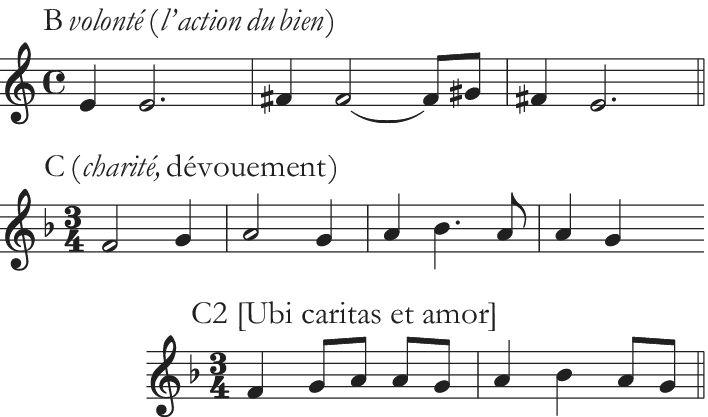
Example 2: Leitmotifs B, C and C2 in L’étranger, as shown in Vincent d’Indy, Cours de composition musicale, iii, 210–11.
The treatment of Gregorian chant could hardly be more different from that in Le rêve. The inclusion of Ubi caritas cannot be explained as a depiction of devotional practices, as there are nearly no religious rites in L’étranger. Footnote 105 In contrast to Bruneau’s work, the text of Ubi caritas is never uttered, the quotation remaining purely instrumental, so that the quotation can be recognized only by listeners who are familiar with the antiphon.Footnote 106 Yet recognition can take place only retrospectively, since a full presentation of the quotation does not occur until Act 2, scene ii, whereas allusions to related leitmotifs appear frequently throughout the whole opera. This is a further difference from Bruneau’s opera, where the chants appear only occasionally.
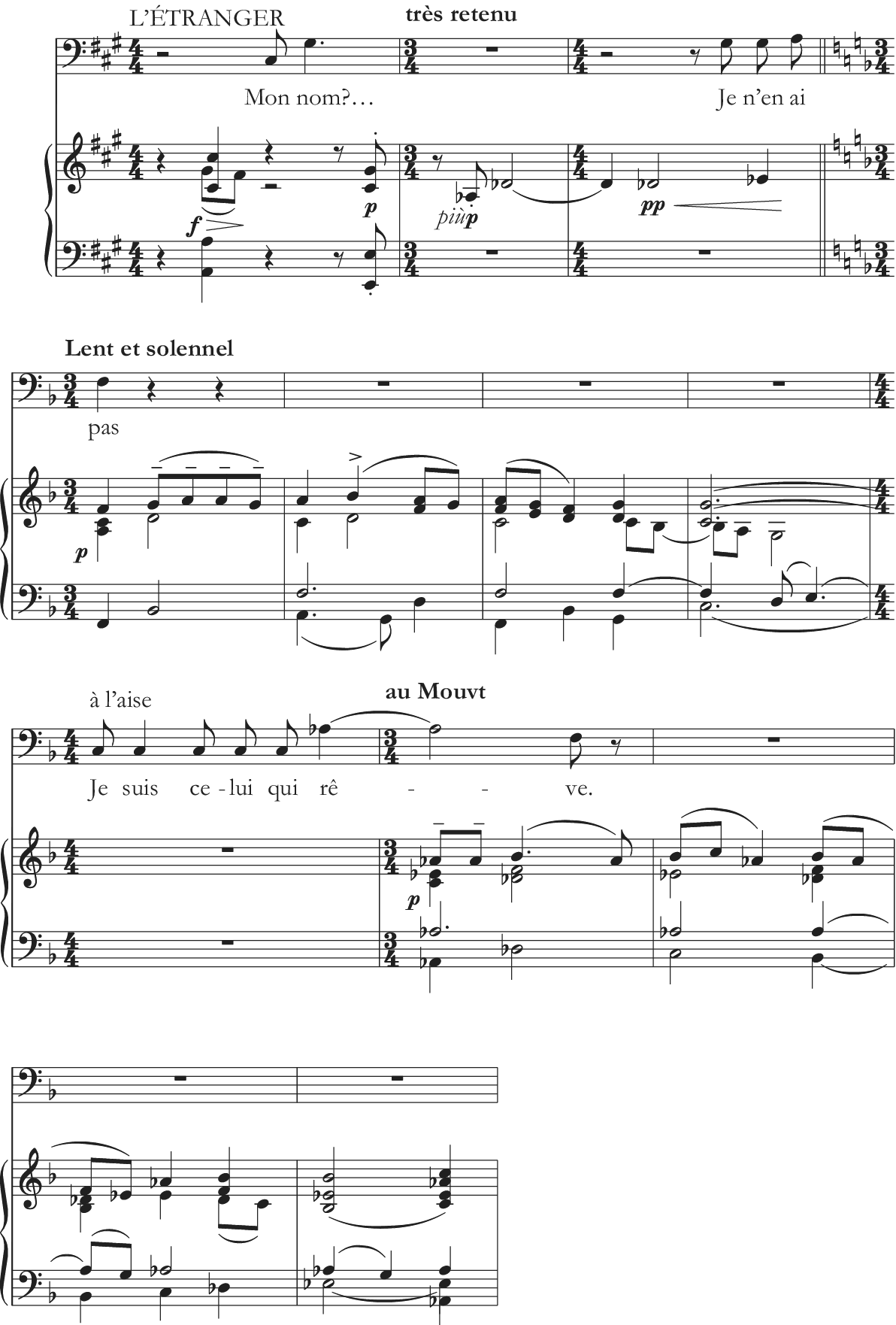
The second scene of Act 2, where the most explicit reference to Ubi caritas occurs, and where it is actually treated as a quotation, is a crucial scene for the opera as a whole. Vita asks for the Stranger’s name. He replies that he does not have one, saying that he is the one who dreams of happiness for all people, who loves the poor and the inconsolable. The motif is interpolated several times into his speech as a rather simple, diatonic accompaniment evoking contemporary plainchant accompaniments and versets. The theme is presented twice in the keys of F major and A♭ major, which, according to d’Indy, stand for charity and desire,Footnote 107 the main topics of the piece (pp. 119–20; see Example 3).Footnote 108 Subsequently, Ubi caritas is transposed to other keys and treated with methods of motivic-thematic work (pp. 120–2).
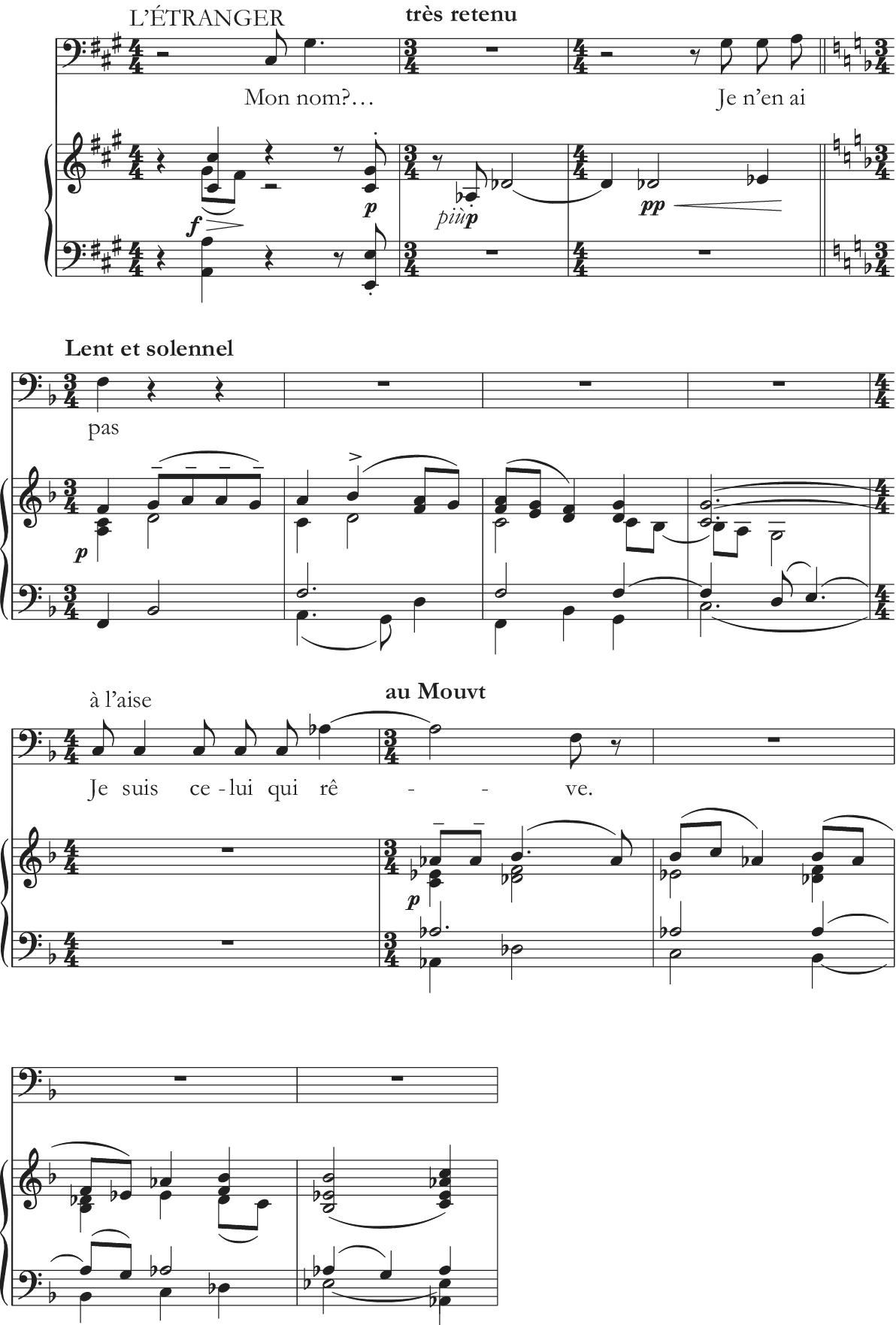
Example 3: Vincent d’Indy, L’étranger, extract from Act 2, scene ii, edited from the vocal score (Paris: Durand, 1902; D. &. F. 5981), pp. 119–20.
There is no indication that this music is something that may be heard on stage as phenomenal music in Abbate’s terms, nor is it technically stage music. It would be questionable, however, to underestimate the difference between this exposed quotation and the other orchestral music. By referencing pre-existing music, the quotation invites a distinct way of listening with a number of possible successive steps of association: the gesture of singing (as in, say, the finale of Brahms’ First Symphony); liturgical chant in general; and Ubi caritas in particular, including both its text and its religious message. This is a way of creating musical meaning comparable to the quotation of songs, chants or anthems in purely instrumental music. Furthermore, Ubi caritas is involved in d’Indy’s use of the leitmotif technique, a compositional procedure that in itself is a vehicle of semanticization in music. With knowledge of this scene, where the quotation is recognizable for a listener familiar with the antiphon, the beginning can be explained retrospectively. The leitmotif (B/C) appears for the first time in the overture or ‘introduction symphonique’, as d’Indy called it,Footnote 109 clearly highlighted by the use of woodwind and brass,Footnote 110 and in the same keys that will be used later, F major and A♭ major (pp. 4–5).
Later in the opera, it becomes clear that the motif complex described above is connected both to the Stranger and to his acts of charity. It appears again (in a variant in F minor) during his first conversation with Vita (p. 48), in which she compares the Stranger’s words to religious precepts read by the dean.Footnote 111 Shortly thereafter, the motif occurs again in F♯ major (d’Indy’s key of light and love)Footnote 112 after the Stranger explains his personal mission: ‘To help others, to serve others, that is my only joy, that is my only thought’ (p. 50).Footnote 113 In instances such as this, d’Indy refers to the antiphon’s text: ‘Ubi caritas et amor, Deus ibi est’ (‘Where charity and love are, there is God’).
Later, the motif is used in connection with the relic, a gem that allows the Stranger to control the wind and the sea and thus to save fishermen from danger. This association occurs, for example, during the Stranger’s encounter with Vita in Act 2, scene ii. Again, motivic-thematic work is used, and fragments of the motif are uttered in a contrapuntal episode in F minor, the symbolic key of immensity and fatality.Footnote 114 In this scene, the Stranger relates that the gem has become ineffective owing to the excitement caused by his love for Vita. This excitement may be symbolized by the chromatic modification of the motif (pp. 139–40; see Example 4). A little later, the first appearance of the motif is retrieved, but now with significant changes: F major is now clouded by the use of the minor subdominant (B♭ minor), and the key of A♭ minor appears instead of A♭ major (pp. 141–2).
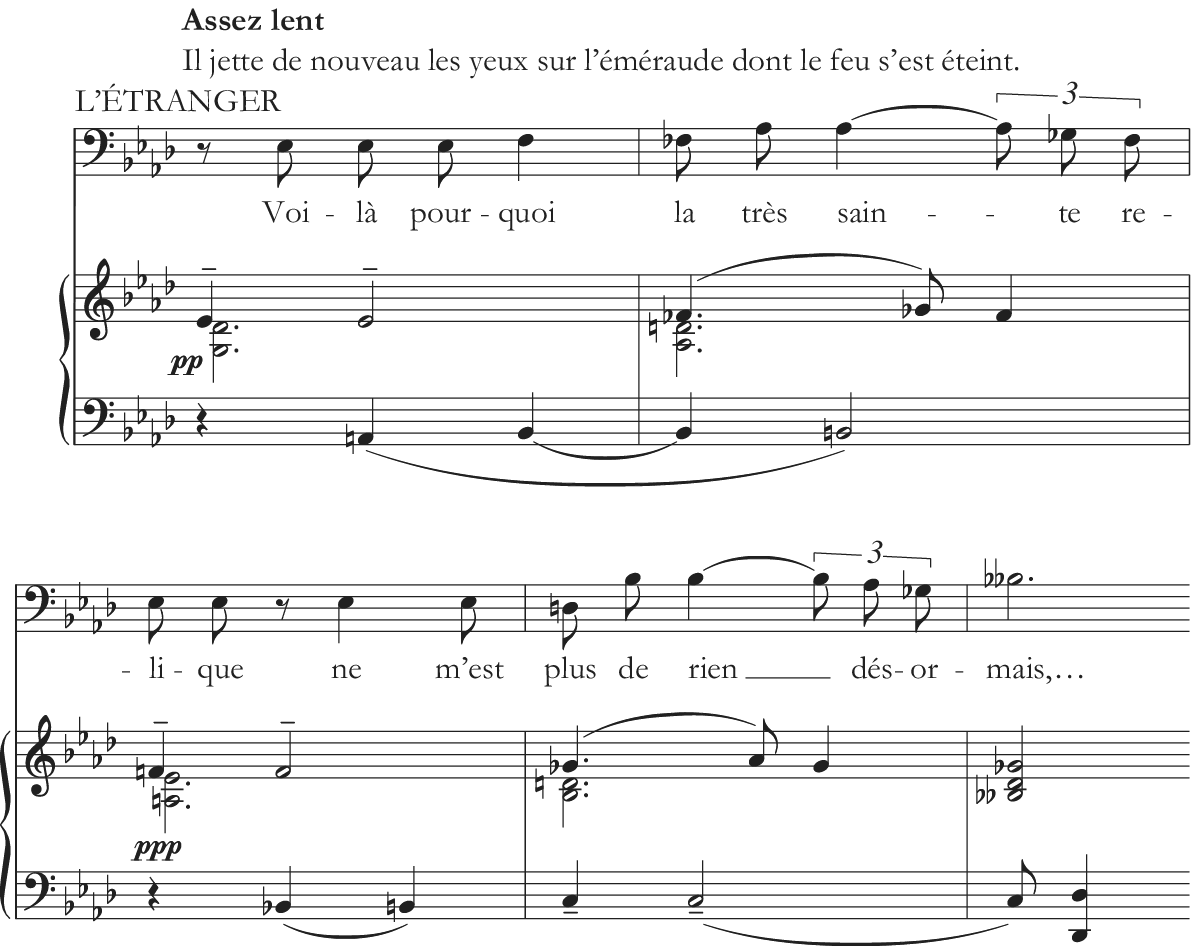
Example 4: Vincent d’Indy, L’étranger, extract from Act 2, scene ii, edited from the vocal score, (Paris: Durand, 1902; D. &. F. 5981), p. 139.
In summary, the leitmotif symbolizes the protagonist, his charity and the artefact which enables him to carry out acts of charity. The conflict between charity and amorous love is the key problem of the relationship between the Stranger and Vita and of the opera as a whole. It culminates in the two leitmotifs related to Ubi caritas, which d’Indy accordingly named ‘volonté’ and ‘charité’. Since this central theme of the opera is represented in Ubi caritas, it is not surprising that it reappears in the finale of the opera (which was considered too dark by some contemporaries).Footnote 115 Here, it emphasizes the altruistic decision of the Stranger to go out on the stormy sea (p. 184). Even at the very end, when the Stranger and Vita die, the orchestra alludes one last time to the motif (p. 200). Only by an act of renunciation, only in a Liebestod, does the synthesis of caritas and amor seem possible.Footnote 116 D’Indy uses Ubi caritas, the antiphon for Maundy Thursday, in a programmatic manner. Its text refers to the central conflict of the opera. This plainchant, traditionally sung during the washing of feet on Maundy Thursday,Footnote 117 serves as a reminder of an act of modesty and humility and is associated with a protagonist willing to renounce love for a greater good. Indirectly, the Stranger, who sacrifices himself and performs miracles, is associated with Jesus.
This dramaturgy might be linked to d’Indy’s aesthetic convictions. In his anti-Semitic narration of the history of opera, presented in the third volume of his Cours de composition musicale, he compared Jewish opera composers of the ‘Période judaïque’ (1825–67) and their equally reprehensible successors from the ‘Période éclectique’ (1850–80) with medieval artists who had, according to d’Indy, not worked in order to gain money or esteem, but to disseminate Christian values.Footnote 118 In sharp contrast to Bruneau, d’Indy was convinced that religious music was the origin (and the purpose) of French music.Footnote 119 From this point of view, L’étranger may appear as a ‘message-opera’, if one wants to adapt the term ‘message-symphony’ used by Brian Hart to describe French symphonies of the period by d’Indy and other composers,Footnote 120 even if this perspective may be somewhat reductive. In comparison with Bruneau, at any rate, d’Indy’s concept of quotation can be qualified even less as couleur locale. It does not have an illustrative function to purvey an image of a certain place, time or milieu, nor is it represented in the quasi-external manner that is often implied, especially when it is presented as stage music.
In this context, it is interesting to look at the reciprocal judgments of both composers about these pieces. Despite their political and aesthetic differences, it is difficult to find any criticism that lacks civility. D’Indy refers to Le rêve in his book on Wagner and his influence on French music (1930). He politely criticizes Bruneau’s leitmotifs but lauds the composition as a French adaption of Wagnerian principles. His portrayal of Bruneau’s naturalism, of which the use of sacred music is a key element, is an equally polite criticism:
There are, furthermore, in [Charpentier’s] Louise just as in Le rêve (the cortège of the procession), whole passages that one could describe as photographic tableaux, for these tableaux are nothing but the exact phonetic reproduction of scenes that anyone can attend in a street or under a roof without the music cooperating in any way and without the drama receiving any impulse whatsoever.Footnote 121
Bruneau refers briefly to L’étranger in a letter to his friend Étienne Destranges (who published studies on both Le rêve and L’étranger)Footnote 122 and takes issue with the religious dimension of d’Indy’s works:
What you say about L’étranger does not surprise me. When one is humanely wrong, one cannot be artistically right. With Le chant de la cloche and particularly Wallenstein, d’Indy made his most considerable effort. In my opinion, Fervaal clearly represented a standstill. I fear for him that he will now continue to diminish with every new work.Footnote 123
D’Indy’s use of Ubi caritas demonstrates a second method of incorporating Gregorian chant that draws on the Wagnerian technique of leitmotif. By integrating the plainchant melody into his symphonically organized score, d’Indy’s procedure only partly justifies the use of the term ‘quotation’. While d’Indy does use pre-existing material, the presentation of this material is only noticeably disclosed and detached from the remainder of the music in some instances (most clearly in Act 2, scene ii), whereas in other places the motivic material derived from Ubi caritas is woven into the score in a way that becomes difficult to define solely as quotation, ‘in a manner akin to quotation in speech or literature’.Footnote 124 Moreover, while this technique may be symptomatic of d’Indy’s aesthetical and ideological convictions, it is at the same time a typical feature of musical quotations, which are often only gradually separated from their new contextFootnote 125 and where the tension between ‘assimilation’ and ‘dissimilation’ is particularly relevant.Footnote 126
Allusion: Jules Massenet, Le jongleur de Notre-Dame
D’Indy would probably not have liked being likened to Massenet, since the older composer became something of a nemesis for him. D’Indy’s biographer Léon Vallas relates the well-known episode when d’Indy congratulated Massenet for his oratorio Marie-Magdeleine (1873), and Massenet candidly admitted that he did not believe in all of these ‘bondieuseries’ (sanctimonies, false pieties).Footnote 127 From that moment on, d’Indy criticized Massenet habitually. He was not the only one to see in Massenet ‘the quintessence of superficiality, officialdom, and routine’.Footnote 128 This is especially true of the discourse on Massenet in Germany, where Massenet has often, even in musicological writings, stood for superficial and inauthentic art, and even for Stilverfall (decline of style) and Trivialmusik (trivial music).Footnote 129 His stylistic eclecticism in works such as Le jongleur de Notre-Dame has been singled out for especially strong criticism.Footnote 130 One should therefore proceed with caution in examining the possible use of existing music and different styles in Massenet. Such a description may seem to have pejorative undertones, as it seemingly confirms the image of Massenet’s music as eclectic, as pastiche. In fact, compositional techniques of stylistic mixture and appropriation have been common in many eras and genres and do not necessarily degrade a composer or their work.Footnote 131
References to sacred music are numerous in Massenet’s operas; it is well known that he had a ‘fondness for religious scenes’.Footnote 132 The composer usually, however, avoids actual quotations. In the case of Le jongleur de Notre-Dame, even a contemporary reviewer spoke of the ‘pastiches of medieval vocalise’ which (positively!) characterized this ‘mystical operetta’.Footnote 133
The opera Le jongleur de Notre-Dame is based on the medieval ‘conte dévot’ Tombeor (or Tumbeor) Nostre Dame,Footnote 134 recounted in Anatole France’s L’étui de nacre (1892)Footnote 135 and adapted as a libretto by Maurice Léna.Footnote 136 Like d’Indy’s L’étranger, Massenet’s new opera premièred on foreign territory outside France, as the first in a series of operas by Massenet that were staged in Monte Carlo. The première on 18 February 1902 took place in the presence of Prince Albert I of Monaco, who later honoured the composer with the Grand-Croix of the Order of Saint-Charles.Footnote 137 According to Pierre Lalo, Massenet’s plan was to write ‘a piece, a legend, a tale in music, call it as you wish, where there is not one single female role!’Footnote 138 Since the action takes place in a medieval monastery, the opera’s cast is in fact exclusively male, with the sole exception of the Virgin Mary, a silent role. The title role of Jean the Jongleur was, however, later sung by the famous soprano Mary Garden in a production by Oscar Hammerstein I at the Manhattan Opera House in 1908.Footnote 139 Although quite popular in the first half of the twentieth century,Footnote 140 the opera is only rarely performed today. Nevertheless, it has been lauded by Massenet biographers as one of his masterpieces.Footnote 141
The plot of the opera is rather straightforward and entertaining. Outside Cluny Abbey, the jongleur Jean entertains the crowd and sings the ‘Alléluia du vin’. The prior of the abbey considers this behaviour offensive, but suggests that Jean might receive absolution if he enters the abbey. Jean decides to accept this proposition when he meets the abbey’s cook Boniface and understands what culinary pleasures monastic life could bring. Inside the abbey, Jean learns about the different ways in which the arts facilitate religious devotion. First, he witnesses a singing lesson in which he cannot participate as he does not speak Latin. A quarrel among the other monks then ensues regarding which of the arts best pleases Mary. Because of these experiences, Jean finally tries to contribute the art he knows best: profane, vernacular song accompanied on his vielle (a medieval fiddle). The dismayed monks soon discover his performance in a jongleur’s outfit in front of the statue of the Virgin, but before they can execute their vengeance (‘Mort à l’impie!’), the statue comes to life and greets the well-meaning jongleur. Jean ascends to heaven and even miraculously gains a qualification in Latin.
Even if many parts of the opera convey the impression that they use pre-existing material, it is in fact hard to trace any actual quotations. Massenet’s technique of approximation and transformation makes it difficult to identify the use of borrowed music, even though an impression of familiarity is generated throughout most of the work. He uses operatic techniques such as couleur locale and often employs music in a quotation-like manner, but none of the alleged quotations can be identified unequivocally.Footnote 142
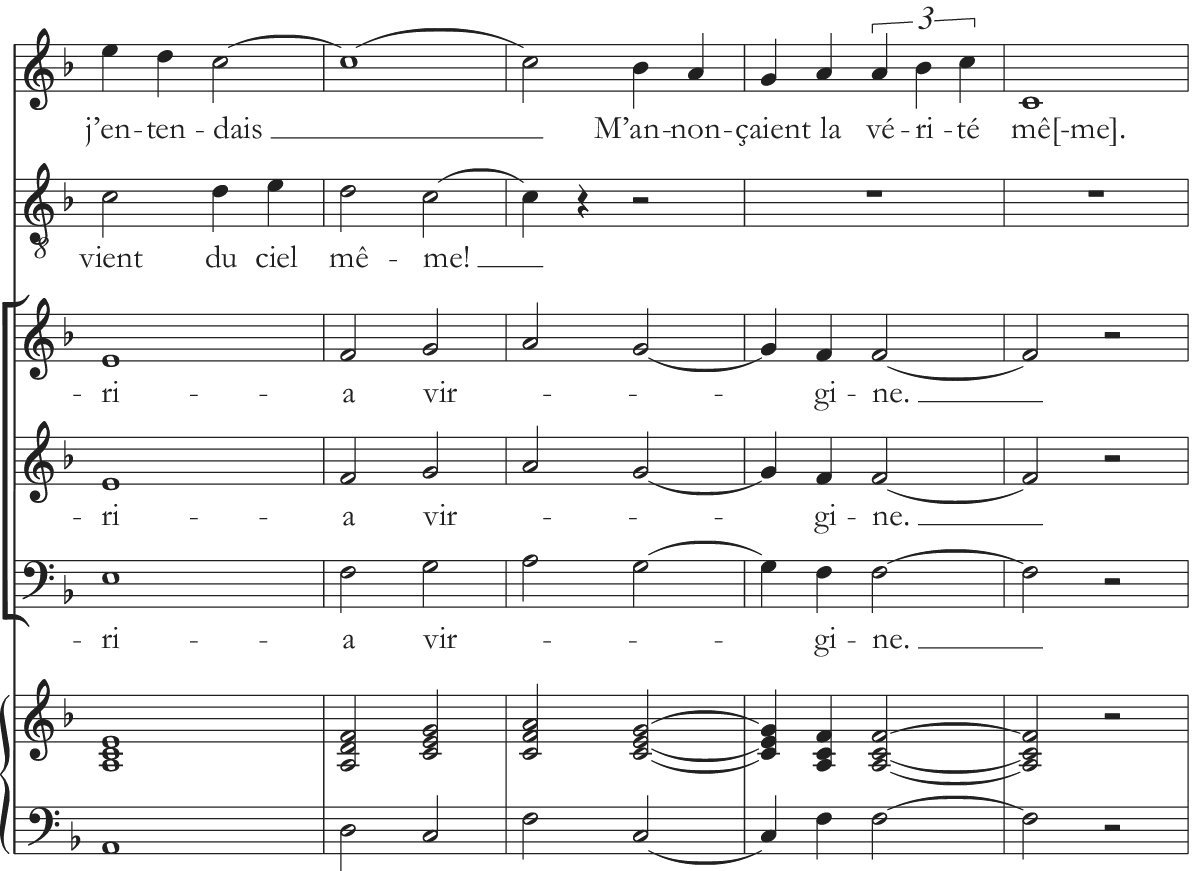
The simple melody of the ‘Alléluia du vin’, for instance, while hardly plainchant-like in itself, uses a short intonationFootnote 143 without accompaniment or a regularly accented beat which is repeated using different texts (‘Pater noster’, ‘Ave’, ‘Credo’, pp. 45, 47, 50).Footnote 144 While a comparison to Credo I in the Liber usualis seems possible,Footnote 145 the comparability results more from the gesture of intonation and of course from the fact that Jean actually sings the word ‘Credo’ the third time this melodic fragment occurs (see Example 5). The only significant melodic similarity, however, is the opening melodic motion of a second followed by a third. (Franz Liszt called this typically ‘Gregorian’ formula the ‘tonic symbol of the cross’.Footnote 146) Yet, on this general level, the jongleur’s intonation might also be related to other plainchants such as the Communion Posuisti Domine,Footnote 147 whose melodic beginning is identical to Massenet’s extract except for the very last note. Nevertheless, even if Massenet may have taken this or any other similar plainchant as a model, it is hardly a precisely identifiable ‘quotation’ of a well-known (and semantically charged) melody such as, for instance, the Dies irae, Pange lingua or Te Deum.
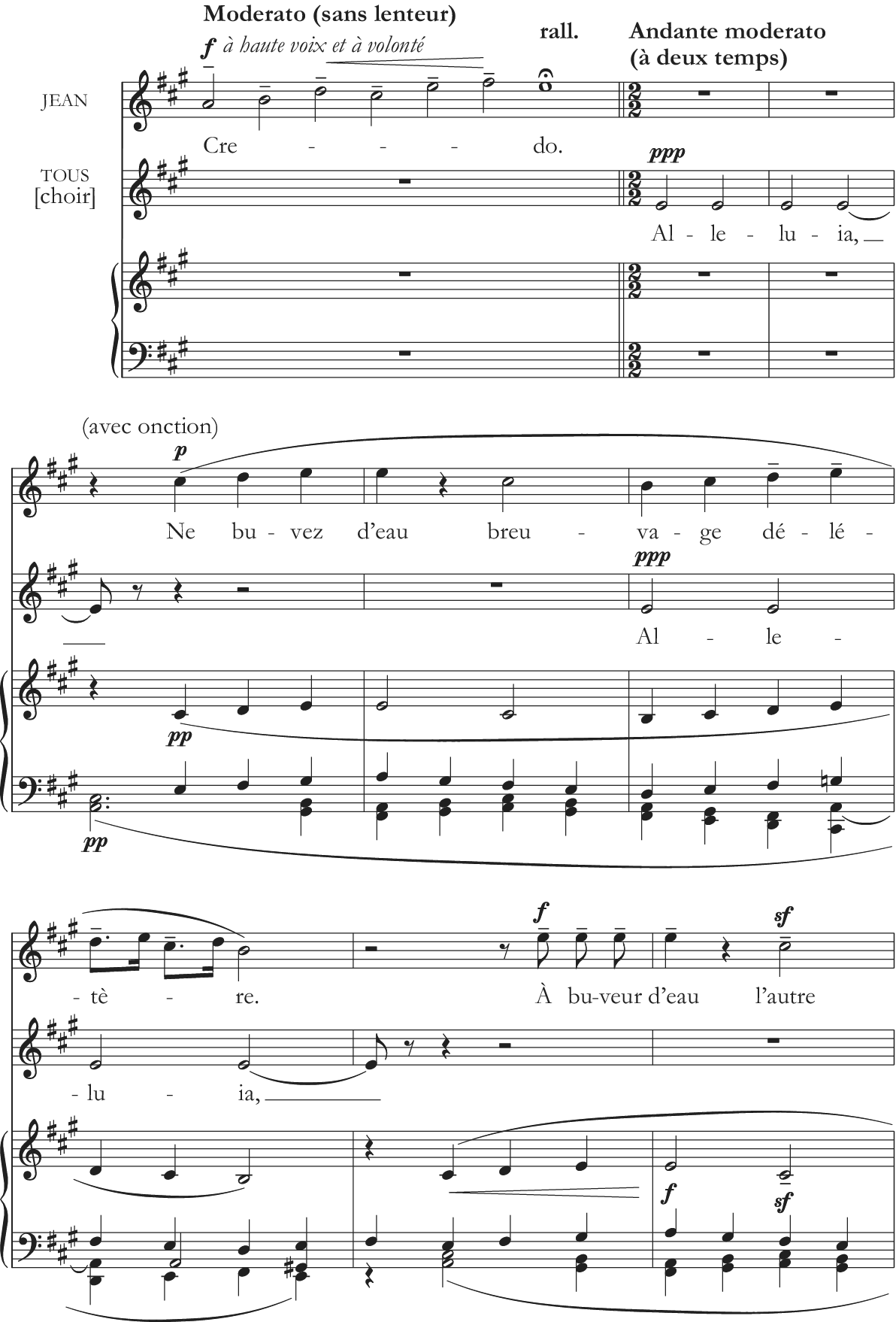
Example 5: Jules Massenet, Le jongleur de Notre-Dame, extract from Act 1, scene ii, edited from the vocal score (Paris: Heugel, 1902; H. et Cie. 20419), pp. 50–1.
Similar analyses can be made with regard to many other parts of the score that may be categorized as phenomenal (and I restrict my perspective to plainchant-like references in the broadest sense), especially when Massenet sets liturgical and pious acts to music. Another example is the Benedicite, when the monks say grace before their meal using a short Latin prayer that was commonly used, especially by French- and English-speaking Catholics (p. 86).Footnote 148 Here Massenet uses a recitation-like style, remaining on the pitch A for most of the time. The pitches G, F and (at the end) D hint at the first mode, but it would not seem sensible to identify this prayer (for which I was not able to trace any matching setting) with an existing melody. This prayer is also one of many instances where Massenet uses stage music in a way that is comparable to Bruneau’s: it is heard from inside the abbey, where it is accompanied by bells.Footnote 149 Another similarity to Bruneau is the use of instruments intentionally to convey an atmosphere of chronological distance, of music considered typically medieval, even though they are replaced by contemporary substitutes that are more common. Thus, Jean’s vielle is played by a viola d’amore – a more commonly available instrument, but still rather unusual in 1902.Footnote 150 In a similar way, a harmonium suggests the regal,Footnote 151 while the oboe simulates the chalumeau.Footnote 152
Stylistic imitation in this opera is by no means restricted to medieval monophony. The Ave coeleste lilium in Act 2 (p. 97) is an example where Massenet uses a melody resembling a Gregorian cantus firmus in a setting for several voices that in turn evokes fauxbourdon. Here I am focusing not on the setting but on the melody, which could be characterized, quite paradoxically, as a ‘quotation-like invention’. Massenet seems himself to have written the melody for the poem, which is by Bonaventure.Footnote 153 As with the other extracts discussed here, it seems improbable that a plainchant melody corresponding precisely to the Ave coeleste can be identified. The quasi-triadic beginning is rare but not non-existent in the Gregorian repertory.Footnote 154
Another exposed moment in the score shows that quotation-like passages do not necessarily have to include a vocal element. When the Musician Monk describes the celestial power of his art, a chorale-like section in a high register is heard in the flutes and the strings (p. 119).Footnote 155 The fact that this passage stands out places it on a similar footing to quotation, which is also usually clearly distinguishable from all that surrounds it. The rhetorical term noema has been used to describe this effect.Footnote 156 Again, the intervallic structure of a second followed by a third, symbolic of Gregorian chant, is used.
Another aspect that often hinders precise identification of the quotation-like moments in Massenet’s score is their brevity. This is especially true for the finale, where different prayers and chants are uttered, such as Hosanna (‘Hosanna! Gloire à Jean’, p. 184), a short extract from the Litany of LoretoFootnote 157 sung on one note (‘Kyrie, eleison, Christe exaudi nos, Sancta Maria, Ora pro nobis’, p. 193) and another Alleluia (p. 195). All these extracts are equally generic in their imitation of liturgical singing and, with the exception of the first, only two bars in length. At the end, the prior sings the short formula that Massenet put on the front page of the score as a motto: ‘Blessed are the simple, for they shall see God’ (‘Heureux les simples, car ils verront Dieu’), to which the other monks and the angels reply with ‘Amen’ (p. 200). The formula uses once again the succession of a second followed by a third, but now in inversion. Here again it does not seem appropriate to refer this short extract to one specific plainchant. I found the beginning (C–B–G–A–G) in a Benedicamus Domino Footnote 158 and, ironically, in a version of Ite missa est,Footnote 159 the chant that concludes the Mass.
The references to liturgical music described here are only part of Massenet’s strategy regarding the historicist imitation of musical styles as described by Jean-Pierre Bartoli. In addition to melodic references, this compositional approach – which needs only a brief summary here – includes archaisms such as the use of modality and diatonicism, open fifths and parallel fifths, counterpoint, fauxbourdon and so on. Bartoli summarizes: ‘In its entirety, the musical framework appears archaizing, but in strategic moments of great dramatic intensity musical episodes in modern language appear. One thus opens the score like one would open the imitation of an old codex.’Footnote 160
Massenet’s Le jongleur de Notre-Dame points to a problem in defining musical quotation. Given the extent of the liturgical chant repertory which in theory Massenet could have known, it is nearly impossible to prove that he did not quote some melody or other, however obscure, in his opera. On the surface, large parts of the score appear to be quotations in terms of their manner of presentation, even if the exact source might be difficult to identify and the possible modifications undertaken by Massenet might make it virtually impossible to correlate them to specific chants. It may in fact be that no exact quotation can be found,Footnote 161 even though a large portion of the music appears familiar, and much of it is presented as quotations in the French tradition of couleur locale and the more recent development of naturalism.Footnote 162
Overall, quotation does not appear to be the ideal term for Massenet’s procedure. A more flexible concept such as allusion better captures the specific approach of a composer who readily uses musical styles of various origins in his operas. A definition of allusion has been offered by Burkholder, who distinguishes it from quotation. Allusions are characterized by the fact that ‘material is not quoted directly, but a reference is made through some other similarity between the two works, such as gesture, melodic or rhythmic contour, timbre, texture or form’.Footnote 163 Using the term ‘allusion’, Annegret Fauser has suggested that Le jongleur de Notre-Dame was a turning point in Massenet’s aesthetic development:
With Le jongleur de Notre-Dame it becomes apparent for the first time where Massenet’s handling of style quotation would go: to montage. In Don Quichotte, but even more so in Panurge, Massenet’s musical language consists of vocabulary that he selects from the corpus of music-historical discussion of stage design. It is no longer quotation, which is recognized and interpreted as such in a context of ‘contemporary’ music (the gavotte in Manon, the Shema Yisrael in Hérodiade), but components of equal value in a composition.Footnote 164
From this point of view, allusion becomes a sort of principle that forms the basis of this work, a composition that to an unusually large extent is determined by phenomenal music, stage music, quotation-like presentation and historicist imitation of styles. Massenet’s musical procedure could be compared to the provenance of the score’s motto: ‘Heureux les simples, car ils verront Dieu.’ While sounding immediately familiar and supposedly identifiable as a passage from the Beatitudes (Matthew 5:3–12), it is actually heavily modified in such a way that, one could argue, it is no longer a strict quotation. In all the French translations of the Bible that I consulted, there are no occurrences of ‘simples’. Possibly this refers to the ‘pauvres en esprit’ (‘the poor in spirit’) found in Matthew 5:3. The concluding part of the saying, however, is from another verse, ‘Blessed are the pure in heart, for they shall see God’ (Matthew 5:8). In conclusion, this is a modified amalgamation of two verses. Hearing the phrase, however, a listener vaguely familiar with the Beatitudes would probably identify it as a biblical quotation.Footnote 165
The same ambiguity can be observed with regard to the message of this opera, which is far less explicit than, say, the plea for charity and self-sacrifice found in L’étranger. All in all, Le jongleur de Notre-Dame may appear as a very mild anti-clerical satire. The monks’ behaviour is characterized by rigour and a certain bigotry; with the exception of Boniface, they are always ready to punish Jean. At the end, they even briefly entertain the idea of a bloody revenge. The sympathy of the audience belongs to Jean, the oddly naive and only involuntarily blasphemous jongleur. Medieval Christianity is portrayed, albeit not without respect, as mostly picturesque and atavistic.
To understand this intention, it should be remembered that Anatole France (the author of the novel Thaïs)Footnote 166 already had a certain reputation for being a critic of Catholicism. Massenet, by contrast, was extremely prudent when it came to taking a stance in ideological matters, a caution that may have resulted from his ties to official institutions of the Third Republic.Footnote 167 In that respect as well, he is quite different from both Bruneau and d’Indy, who articulated their (contrary) political positions quite clearly. It may be assumed that Massenet held a relatively distant position from institutional Catholicism, a position that could be considered moderate mainstream in the Third Republic.Footnote 168 However, he was fascinated with religious motifs and themes, just as he liked the French cathedrals, ‘even though I live in a Republican country’, as he once wrote.Footnote 169
The same prudence can be observed with regard to Le jongleur de Notre-Dame. The opera, while potentially anti-clerical, remained acceptable to almost everyone by virtue of its comical lightness. This at least can be gathered from the review written by the Catholic critic BellaigueFootnote 170 for the Revue des deux mondes after the Paris production at the Opéra-Comique in 1904.Footnote 171 Observing that the opera, atypically for Massenet, does not contain a female role and consequently does not treat amorous love as a subject, Bellaigue praises its ‘religious tenderness first of all, religious with simplicity, with purity, that is to say with merits or virtues that are hardly common’.Footnote 172 He then continues to praise the religious piety of Massenet and his opera:
The work of Massenet is one of piety […], of a discreet yet cordial, and yet profound piety. One would say that love, rather than being banned from his preferred music, took, in order to remain in itself and still keep its charm for itself, its purest form, the form of compassion and charity.Footnote 173
This description (especially since it mentions charity) would seem rather better suited to d’Indy’s L’étranger, a work restaged in Paris the same year and, ironically, rejected by the anti-Wagnerian Bellaigue for not being sufficiently French.Footnote 174 It may have been these two operas, performed in Paris in 1904 after their foreign premières, that, among others, incited Bellaigue to publish his article, quoted at the beginning of this article, on ‘church music at the theatre’ shortly afterwards in the very same periodical.Footnote 175 (For the sake of completeness, it should be added that Bellaigue was quite critical towards Bruneau’s Le rêve, premièred more than 10 years earlier. Among the few things he appreciated, however, was Bruneau’s use of church music, especially the Ave verum corpus: ‘More than once, in this way the people’s chorus or hymns of the church soften the angles, smooth the edges of this spiky music.’Footnote 176)
Be that as it may, the three operas compared here reveal differences not just in their use of pre-existing material. Only Bruneau uses Gregorian chant as a proper quotation and refers to the topos of Gregorian chant as a counter-world, as conceived by d’Ortigue and others. In Le rêve, sacred music, whose traditions reach back into the past, magically enters a contemporary setting, where, together with Angélique’s inner voices, it occurs as stage music: ‘real’, diegetic music without any visible source. D’Indy integrates just one liturgical melody into the leitmotif structure of L’étranger. This use of the melody only partially justifies speaking of quotation, since the plainchant is only rarely perceptible as such, but is rather more often woven into the musical discourse as a whole, revealing how d’Indy, unlike Bruneau, wanted the entirety of his action musicale to convey a religious message of charity and love. In Massenet’s Le jongleur de Notre-Dame, the quotation of precisely identifiable plainchant is unlikely. An analysis of relevant extracts has shown that while apparent quotations may sound like real sacred music, it is virtually impossible to verify any specific origin. Therefore, Massenet’s procedure would be more accurately described as allusion, as one element in a flexible strategy of stylistic adaptation, which in a way parallels Massenet’s ambiguous stance towards Christianity.
The presence of Gregorian chant in these three works, a phenomenon rather common in French opera of this period,Footnote 177 may have been made possible by a more permissive, partly anti-clerical social context, and by the revival of Gregorian chant with all the lively discourses attached to it. Quotation, appropriation and allusion are very specific techniques, and only some of the consequences that these discourses may have had in French music. The fact that composers as different as these (both in ideological and in aesthetic matters) all refer to Gregorian chant in their operas may serve to illustrate the hypothesis that nineteenth-century plainchant ‘restoration’ and the discourses attached to it were more relevant to French music at the fin de siècle even outside the sacred domain than has hitherto been acknowledged. And this relevance is by no means restricted to ‘conservative’ or Catholic composers.Footnote 178 It might be argued, however, that the technique of quotation is essentially a feature of nineteenth-century couleur locale, which began to become somewhat outdated around 1900, and that consequently more subtle references to topics such as the Middle Ages, Catholicism and so on may have been made more appealing to other French composers such as Satie and Debussy.Footnote 179 The examination of references of a more literal nature, however, may provide a key to gaining an understanding of the diverse processes that adapt and create notions and meanings in fin-de-siècle French music with regard to ideas about Gregorian chant.






 Open access

