
Hostname: page-component-89b8bd64d-7zcd7 Total loading time: 0 Render date: 2026-05-08T03:57:19.322Z Has data issue: false hasContentIssue false

Modelling irrational numbers in analysis using elementary programming

Published online by Cambridge University Press:  01 August 2016

David Tall
Affiliation:
Mathematics Education Research Centre, University of Warwick, Coventry, CV4 7AL
John Mills
Affiliation:
Mathematics Education Research Centre, University of Warwick, Coventry, CV4 7AL
Get access

Extract

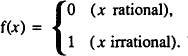
In recent years we have been teaching mathematical analysis using the computer to give experiences to help students understand the concepts [1]. It has proved to be a valuable aid in many ways, but the method depends on giving a suitably rich environment enabling students to experience the full range of possibilities. A great weakness of the use of regular computer languages is that they hold numbers in memory as a finite expansion in base two, so, effectively, all numbers in such a system are rational. This meant that we were unable to demonstrate any ideas that depend on the difference between rationals and irrationals; for instance, we could not plot graphs of the kind

Information

Type
Research Article
Copyright
Copyright © The Mathematical Association 1992

Access options

Get access to the full version of this content by using one of the access options below. (Log in options will check for institutional or personal access. Content may require purchase if you do not have access.)

Article purchase

Temporarily unavailable