




1. Introduction
Automatic paraphrase detection is the task of deciding whether two given text fragments have the same meaning or not (Wang et al., Reference Wang, Islam, Moh’d, Soto and Milios2021). Paraphrase detection has a number of applications, including question-answering (Noraset, Lowphansirikul, and Tuarob, Reference Noraset, Lowphansirikul and Tuarob2021), natural language generation (Paris, Swartout, and Mann, Reference Paris, Swartout and Mann2013; Zandie and Mahoor, Reference Zandie and Mahoor2022), and intelligent tutoring systems (Forsythe, Bernard, and Goldsmith, Reference Forsythe, Bernard and Goldsmith2006). In question-answering, multiple paraphrased answers could be considered as evidence for the correctness of an answer (Noraset et al., Reference Noraset, Lowphansirikul and Tuarob2021). For intelligent tutoring systems with natural language input (Forsythe et al., Reference Forsythe, Bernard and Goldsmith2006), paraphrase detection (Agarwal et al., Reference Agarwal, Ramampiaro, Langseth and Ruocco2018) is useful to assess the match between expected answers and the answers provided by the students. In addition to these uses, paraphrase detection is also important for information extraction (Ji et al., Reference Ji, Tao, Fei and Ren2020), machine translation (Farhan et al., Reference Farhan, Talafha, Abuammar, Jaikat, Al-Ayyoub, Tarakji and Toma2020), information retrieval (Ehsan and Shakery, Reference Ehsan and Shakery2016), automatic identification of copyright infringement (Clough et al., Reference Clough, Gaizauskas, Piao and Wilks2002; Jing, Liu, and Sugumaran, Reference Jing, Liu and Sugumaran2021), and text reuse and plagiarism detection. In recent years, the detection of paraphrased cases of plagiarism has also attracted the attention of the research community.
Text reuse can formally be defined as the conscious extraction of the selected text pieces from an existing text to produce a new one (Clough et al., Reference Clough, Gaizauskas, Piao and Wilks2002). Text reuse spectrum ranges from the simple scenarios of word-for-word (aka verbatim) copying, paraphrasing (insertion, deletion, substitution, and word reordering), and reusing of ideas, to the more complex scenario in which the same event is written independently by two different authors belonging to the same language and context (Clough et al., Reference Clough and Court2003).
Text plagiarism (aka the unacknowledged reuse of text) is a counterpart to text reuse. In text plagiarism, the author intentionally or unintentionally reuses the text from a single or multiple sources without acknowledgment of the original source (Barrón-Cedeno et al., Reference Barrón-Cedeno, Rosso, Agirre and Labaka2010, Barrón-Cedeno, Reference Barrón-Cedeno2013; Nawab, Reference Nawab2012). In plagiarism, the writer can often change the surface form to keep the source(s) hidden from the reader (Clough et al., Reference Clough, Gaizauskas, Piao and Wilks2002).
It is not easy to differentiate between plagiarism and various types of text reuse. However, from the perspective of computational linguistics and natural language processing (NLP), both plagiarism and text reuse are similar tasks (Barrón-Cedeno, Reference Barrón-Cedeno2013; Clough et al., Reference Clough and Court2003) because they share an almost identical authoring environment. For instance, in the journalism industry, an experienced plagiarizer is a person who is highly skilled in text editing. Eventually, nearly all types of re-writings (e.g., paraphrasing) in journalism and academia are quite similar (Barrón-Cedeno, Reference Barrón-Cedeno2012). Therefore, we will consider both tasks as equivalent and will hereafter use both terms interchangeably or in combined form as “text reuse and plagiarism.”
Paraphrasing is a linguistic technique that is employed in almost every text reuse and plagiarism case (Barrón-Cedeno, Reference Barrón-Cedeno2012; Barrón-Cedeno et al. Reference Barrón-Cedeno, Vila, Martí and Rosso2013). It occurs when someone generates new text from preexisting text while preserving its meaning (Burrows, Potthast, and Stein, Reference Burrows, Potthast and Stein2013). It is performed over text using different text altering operations, including deletion (e.g., of repeating contexts as a result of syntactic modifications), lexical substitutions (e.g., replacing words with their synonyms), structural changes (e.g., word reordering, switching between active and passive voice tenses), and summarizing (Clough and Gaizauskas, Reference Clough and Gaizauskas2009). Moreover, from the NLP perspective, researchers have also proposed various paraphrase typologies (Barrón-Cedeno, Reference Barrón-Cedeno2012; Muhammad, Reference Muhammad2020) to cover different types of text alteration mechanisms used by author(s) rephrase the source text.
Text plagiarism is becoming very common due to the free and ready availability of large amounts of text online, and this has become a cause of alarming for academics, publishers, and authors alike (Foltỳnek, Meuschke, and Gipp, Reference Foltỳnek, Meuschke and Gipp2019). Surveys in the past (Maurer, Kappe, and Zaka, Reference Maurer, Kappe and Zaka2006; Butakov and Scherbinin, Reference Butakov and Scherbinin2009) reported that a majority of students were involved in some form of plagiarism, and most of them committed plagiarism in their assignments. According to a report on Cyber Plagiarism,Footnote a 66% students out of a sample of 16,000, from 31 top-ranked US universities, admitted to cheating. In Germany, more than 200 academic plagiarism cases were found in a crowd-sourcing project (Foltỳnek et al., Reference Foltỳnek, Meuschke and Gipp2019). In Pakistan, 20 researchers from various Pakistani universities were blocklisted in 2015 by the Higher Education Commission (HEC) of Pakistan for their plagiarized work, while the number of reported cases are were even higher than this. It can reasonably be assumed that, if plagiarism and illegal reuse of text remain undiscovered, the outcomes will be even more severe, which may include artificial inflation in publications, distorted competence among students, and undue career advancements and research grants (Foltỳnek et al., Reference Foltỳnek, Meuschke and Gipp2019).
Various studies (Potthast et al., Reference Potthast, Stein, Barrón-Cedeño and Rosso2010, Reference Potthast, Hagen, Gollub, Tippmann, Kiesel, Rosso, Stamatatos and Stein2013; Barrón-Cedeno et al., Reference Barrón-Cedeno, Vila, Martí and Rosso2013; Franco-Salvador, Rosso, and Montes-y-Gómez, Reference Franco-Salvador, Rosso and Montes-y-Gómez2016) by the research community have shown that detecting paraphrased plagiarism presents major challenges. A hindrance to research in automatic paraphrase detection, especially for Urdu and other South Asian languages, is the lack of large-scale labeled paraphrased corpora. The majority of the available resources for paraphrase detection are developed either for English (Dolan and Brockett, Reference Dolan and Brockett2005; Alvi et al., Reference Alvi, El-Alfy, Al-Khatib and Abdel-Aal2012; Barrón-Cedeno et al., Reference Barrón-Cedeno, Vila, Martí and Rosso2013) or other resource-rich languages (Ganitkevitch, Van Durme, and Callison-Burch, Reference Ganitkevitch, Van Durme and Callison-Burch2013; Xu, Callison-Burch, and Dolan, Reference Xu, Callison-Burch and Dolan2015; Noraset et al., 2019). However, there is a dearth of such resources for South Asian languages including Urdu.
Urdu is a widely spoken language with around 231 million speakers worldwide (mostly in the Indian subcontinent).Footnote b It is a free word order language, derived from the Hindustani/Sanskrit language and influenced majorly by Turkish, Arabic, and Persian (Sharjeel, Nawab, and Rayson, Reference Sharjeel, Nawab and Rayson2017). Urdu is a highly inflected and morphologically rich language because gender, case, number, and forms of verbs are expressed by morphology. Additionally, there are numerous multi-word expressions in Urdu and letters whose shapes can vary depending on the context (Shafi et al., Reference Shafi, Iqbal, Nawab and Rayson2022). Over the last decade, the digital footprint of Urdu has increased exponentially. However, the language lacks severely in terms of computational tools and standard evaluation resources (Daud, Khan, and Che, Reference Daud, Khan and Che2017).
Recently, Sharjeel et al., developed the first-ever paraphrased corpus for Urdu at the document level, called the Urdu Paraphrase Plagiarism Corpus (Sharjeel, Rayson, and Nawab, Reference Sharjeel, Rayson and Nawab2016). Moreover, a handful of corpora have also been developed for the related task of text reuse and plagiarism detection (Sharjeel et al., Reference Sharjeel, Nawab and Rayson2017; Sameen et al., Reference Sameen, Sharjeel, Nawab, Rayson and Muneer2017; Haneef et al., Reference Haneef, Nawab, Muhammad, Munir and Bajwa2019; Muneer et al., Reference Muneer, Sharjeel, Iqbal, Nawab and Rayson2019) in Urdu. Furthermore, several state-of-the-art surface-level string-similarity-based approaches have been applied on these standard evaluation resources to show their usefulness in the task of text reuse and plagiarism detection in Urdu.
However, even these basic approaches have not been evaluated for the task of paraphrase detection in Urdu. These corpora have been created manually, which is both time-consuming and labor-intensive. Although they provide a good baseline to further explore Urdu text reuse and plagiarism detection tasks, their limited size is a major drawback for their utilization in mainstream data-driven and deep neural networks (DNN)-based approaches. As a result, the development of novel approaches for Urdu paraphrase detection and text reuse and plagiarism detection tasks has been constrained. This highlights the fact that to create large-scale standard evaluation resources for Urdu (and similar resource-poor languages), it is important to develop semi- or fully automatic corpus generation approaches.
Therefore, it can be deduced that there is currently no semi- or fully automatically generated sentence-level Urdu paraphrase corpus with examples of paraphrased and non-paraphrased sentence pairs. Moreover, there is no research study to compare various DNN-based architectures, including convolutional neural networks (CNNs) and long short-term memory (LSTMs), that use pretrained embedding models for paraphrase detection, and text reuse and plagiarism detection in Urdu texts.
This research work focuses on answering the following research questions: (i) how to create a semi- or fully automatically generated corpus for paraphrase detection in Urdu; (ii) whether it is possible to differentiate between different levels of Urdu paraphrasing using the mainstream DNN-based approaches; and (iii) whether the DNN-based approaches perform better than the traditional approaches that measure surface-level similarity between two sentences for Urdu paraphrase detection, and text reuse and plagiarism detection.
In this paper, we present a semi-automatically generated sentence-level paraphrased corpus for Urdu. The “Semi-automatic Urdu Sentential Paraphrase Corpus” (henceforth called SUSPC) contains a total of 3147 sentence pairs marked as either paraphrased (854) or non-paraphrased (2293). This is the first-ever semi-automatically created sentence-level paraphrased corpus developed for Urdu with manual annotations. The proposed corpus would benefit the Urdu NLP community in several ways: (i) it would reduce the scarcity of the publicly available corpora for Urdu paraphrased detection; (ii) it would present a less expensive and quick approach to creating a corpus for paraphrase detection; (iii) it would provide empirical evidence that an existing approach (Dolan and Brockett, Reference Dolan and Brockett2005) can be utilized to automatically generate a paraphrase corpus for Urdu; (iv) it would present an adequate number of semantically equivalent sentence pairs in natural Urdu; and (v) it would demonstrate using state-of-the-art supervised learning approaches for Urdu paraphrase detection.
As another contribution, we have proposed two DNN-based approaches: (i) a novel approach WENGO and (ii) a modified approach D-TRAPPD. Both approaches are evaluated on two related tasks: (i) Urdu paraphrase detection, and (ii) Urdu text reuse and plagiarism detection. Results show that the proposed D-TRAPPD approach has not only established a strong baseline for the paraphrase detection task in Urdu but also outperformed the state-of-the-art surface-level string similarity approaches (Sameen et al., Reference Sameen, Sharjeel, Nawab, Rayson and Muneer2017) for Urdu text reuse and plagiarism detection in both binary classification ( $F_1=78.5$
) and multi-classification (
$F_1=78.5$
) and multi-classification ( $F_1=88.90$
) tasks.
$F_1=88.90$
) tasks.
We have made our corpus, models, and implementation freely available for the research community.Footnote c We believe that the SUSPC corpus and DNN-based approaches presented in this research work will help (i) analyze and develop efficient paraphrase detection systems, specifically for Urdu; (ii) provide a detailed comparison of the DNN-based approaches on a variety of tasks and corpora; and (iii) further motivate research in Urdu paraphrase, and text reuse and plagiarism detection.
The rest of the article is organized as follows. Section 2 describes the related work. Section 3 presents the newly proposed corpus creation process, its statistics, and standardization. Section 4 describes the details of the approaches used to detect Urdu paraphrases. Section 5 explains the experimental setup, evaluation tasks, text prepossessing, and evaluation measures. Section 6 presents results and their analysis. Finally, Section 7 presents the conclusion.
2. Literature review
This section presents the details of the corpora and the approaches developed for the task of automatic paraphrase detection in the past.
2.1 Corpora
Developing a large-scale standard evaluation resource manually to investigate para-phrase detection is a difficult task since since it is time-consuming and labor-intensive. There have been efforts made in the past to develop benchmark corpora for paraphrase detection. Several benchmark corpora have been developed for English [e.g., Dolan and Brockett (Reference Dolan and Brockett2005); Alvi et al. (Reference Alvi, El-Alfy, Al-Khatib and Abdel-Aal2012); Barrón-Cedeno et al. (Reference Barrón-Cedeno, Vila, Martí and Rosso2013); Nighojkar and Licato (Reference Nighojkar and Licato2021); Kadotani et al. (Reference Kadotani, Kajiwara, Arase and Onizuka2021); Meng et al. (Reference Meng, Ao, He, Sun, Han, Wu, Fan and Li2021); Corbeil and Ghavidel (Reference Corbeil and Ghavidel2021)] along with other languages (Ganitkevitch et al., Reference Ganitkevitch, Van Durme and Callison-Burch2013; Xu et al., Reference Xu, Callison-Burch and Dolan2015; Al-Bataineh et al., Reference Al-Bataineh, Farhan, Mustafa, Seelawi and Al-Natsheh2019). An in-depth discussion of all these corpora are beyond the scope of this study. This research work focuses on some of the most prominent studies concerning the sentence-level corpora for English and Urdu.
Microsoft Research Paraphrase Corpus (MRPC) (Dolan and Brockett, Reference Dolan and Brockett2005) was one of the pioneering efforts to generate sentence-level paraphrased corpora using automatic corpus generation approaches. MRPC was developed to foster the research and the development of automatic paraphrase detection systems for English. It contained 5801 sentence pairs, each annotated manually as either paraphrased or non-paraphrased. Heuristic filters, along with a support vector machine (SVM) classifier, were used to extract likely paraphrased sentence pairs from 32,408 news clusters gathered from the internet over a period of 2 years. Three human annotators manually annotated the resulting sentence pairs to classify them as either paraphrased or non-paraphrased. Out of the 5801 extracted sentence pairs, 67% were classified as paraphrased while the other 33% were classified as non-paraphrased.
The PAN-PC corpora, an outcome of PAN (Plagiarism analysis, Authorship attribution, and Near-duplicate detection)Footnote d shared the different tasks (Sanchez-Perez, Sidorov, and Gelbukh, Reference Sanchez-Perez, Sidorov and Gelbukh2014) involved in plagiarism detection including paraphrased plagiarism detection. PAN-PC is a set of three benchmark corpora: PAN-PC-09 (Stein et al., Reference Stein, Rosso, Stamatatos, Koppel and Agirre2009), PAN-PC-10 (Potthast et al., Reference Potthast, Stein, Barrón-Cedeño and Rosso2010), and PAN-PC-11 (Potthast et al., Reference Potthast, Eiselt, Barrón Cedeno, Stein and Rosso2011). These corpora have various features, such as intrinsic and extrinsic plagiarism cases, translated cases of plagiarism from German and Spanish languages to English, and a variety of plagiarism types (verbatim, paraphrased, and independently written) created artificially and manually.
In a related study, Barrón-Cedeno et al. (Reference Barrón-Cedeno, Vila, Martí and Rosso2013) presented a P4P (Paraphrase for Plagiarism) corpus by extracting simulated paraphrasing plagiarism cases from the PAN-PC-10 corpus (Potthast et al., Reference Potthast, Stein, Barrón-Cedeño and Rosso2010). The P4P corpus was created by manually annotating a portion of the PAN-PC-10 corpus using a newly proposed paraphrasing typology and guidelines from MRPC. It contained 847 paraphrased sentence pairs, each containing a source and a plagiarized sentence, where the latter is created by applying different paraphrasing operations defined in the new paraphrasing typology. Moreover, each sentence contained 50 or fewer words in accordance with the guidelines from MRPC, which considers the average sentence to contain 28 words. Later, Alvis et al. (Reference Alvi, El-Alfy, Al-Khatib and Abdel-Aal2012) extracted another sentence-level paraphrased corpus from the P4P corpus.
The recent trends in automatic paraphrase generation are not over-reliant only on the lexical and syntactic properties of the text pairs. Instead, researchers have used various methods like formality transfer (Kadotani et al., Reference Kadotani, Kajiwara, Arase and Onizuka2021), adversarial paraphrasing (Nighojkar et al., Reference Nighojkar and Licato2021), Seq2Seq paraphrase generation (Meng et al., Reference Meng, Ao, He, Sun, Han, Wu, Fan and Li2021), transformer-based back translation (Corbeil and Ghavidel, Reference Corbeil and Ghavidel2021), etc., to produce high-quality paraphrased text pairs. Moreover, these corpora have been extensively evaluated under supervised and unsupervised experimental environments to show their effectiveness in paraphrase detection.
Literature shows that the paraphrased plagiarism corpora developed for English and other resource-rich languages is responsible for creating a significant stumbling block in the way of research and development of less resourced languages like Urdu. Although limited gold standard corpora (Sharjeel et al., Reference Sharjeel, Rayson and Nawab2016; Sharjeel et al., Reference Sharjeel, Nawab and Rayson2017; Sameen et al., Reference Sameen, Sharjeel, Nawab, Rayson and Muneer2017) are available for Urdu, which cover document and passage-level plagiarism, particularly paraphrased plagiarism, these have all been created manually.
We found only one Urdu corpus in the literature for the task of paraphrased plagiarism detection, and this was the “Urdu Paraphrase Plagiarism Corpus” (UPPC)Footnote e (Sharjeel et al., Reference Sharjeel, Rayson and Nawab2016). The UPPC corpus (Sharjeel et al., Reference Sharjeel, Rayson and Nawab2016) was the pioneering attempt to promote research in Urdu paraphrased plagiarism detection, complete with simulated cases of paraphrased plagiarism. It is a document-level corpus that contains 160 documents, among which 20 are the source, 75 are paraphrased plagiarized (PP), and 65 are non-plagiarized (NP). The corpus in total contains 2711 sentences, 46,729 words, and 6201 unique words. Wikipedia articles about 20 celebrities from different domains (historical, religious, and political) were used as source documents for this corpus. These were paraphrased by graduate-level university students to generate plagiarized documents. The plagiarized documents also contained typing mistakes (typos) to simulate real-world scenarios when plagiarists paraphrase texts. The NP documents were created by consulting books and essays as sources. Although UPPC is a useful resource for Urdu paraphrased plagiarism detection, it has a number of limitations. Since it is manually created, it contains only a small number of document pairs. In addition, the size of the plagiarized documents (between 200 and 300 words) is also short as compared to real academic essays. The documents also only contain text about celebrities. Lastly, since the simulated cases were generated in a controlled environment using crowd-sourcing approaches, they do not adequately demonstrate the practices followed by plagiarists in real-life scenarios.
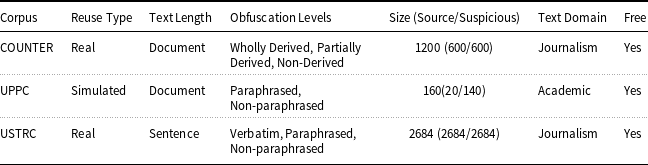
Although, this paper focuses on the task of paraphrase detection, it is worthwhile to also include two Urdu corpora developed for text reuse and plagiarism detection. The two corpora are as follows: (i) COrpus of Urdu News TExt Reuse (COUNTER)Footnote f (Sharjeel et al., Reference Sharjeel, Nawab and Rayson2017) and (ii) Urdu Short Text Reuse Corpus (USTRC)Footnote g (Sameen et al., Reference Sameen, Sharjeel, Nawab, Rayson and Muneer2017).
The COUNTER corpus (Sharjeel et al., Reference Sharjeel, Nawab and Rayson2017) is a remarkable effort for the detection of monolingual text reuse and plagiarism in Urdu text. It has been developed using the guidelines of the well known MEasuring TExt Reuse (METER) corpus (Gaizauskas et al., Reference Gaizauskas, Foster, Wilks, Arundel, Clough and Piao2001) of the English language. COUNTER is also a document-level corpus containing 600 document pairs that are manually annotated as Wholly Derived (WD, 135), Partially Derived (PD, 288), or Non-Derived (ND, 177). The corpus contains 10,841 sentences, 275,387 words, and 21,426 unique words. The largest source document contains 1377 words, while the largest derived document consists of 2481 words. The average length of a source document is 227 words, while for the derived documents the average length is 254 words. In this corpus, the source news articles have been collected from various news stories released by five Pakistani news agencies and included stories about business, showbiz, sports, and national and foreign affairs. The derived articles were taken from the same news stories published in nine different top Urdu newspapers. COUNTER is a useful benchmark resource to design and evaluate automatic monolingual text reuse and plagiarism detection systems for Urdu. However, the corpus contains only a small number of document pairs for each level of text reuse, since it is difficult to create a corpus with real examples of text reuse and plagiarism because of confidentiality issues (Clough et al., Reference Clough and Court2003).
Another benchmark resource that consists of real cases of sentence/passage-level text reuse and plagiarism for Urdu is USTRC (Sameen et al., Reference Sameen, Sharjeel, Nawab, Rayson and Muneer2017). It contains 2684 manually extracted short text pairs from 600 news document pairs (in which the news agency’s text is treated as source and the newspaper text is considered as reused text). The annotators manually classified these short text pairs into Verbatim (V, 496), Paraphrased (P, 1329), and Independently Written or Non-Paraphrased (I, 859). The source (news agency) texts were taken from the Associated Press of Pakistan (APPFootnote h ), while the derived texts were extracted from the top four newspapers in Pakistan. Both the source and the derived news texts were in Urdu and included stories from various news sections, including politics, sports, technology, business, entertainment, and foreign and national affairs. None-the-less, confidentiality constraints in getting real cases of plagiarism and the labor-intensive nature of USTRC became reasons why this too remained only a small-size corpus.
Table 1 presents the summarized view of the available corpora developed for Urdu text reuse and plagiarism detection and their characteristics. It can be observed that all of the available corpora consist of real and simulated cases of plagiarism from either journalism or academia. The number of cases included in each corpora is also limited because: (i) it is difficult to gather real cases of plagiarism from academia due to confidentiality and ethical issues, and (ii) the manual creation process itself is a labor-intensive and time-consuming task.
Existing corpora for Urdu paraphrase and text reuse and plagiarism detection. For document-level corpora, the size indicates the total number of documents, including both the source and the suspicious documents and is equal to the summation of source and suspicious. In the case of sentence-level corpora, the size indicates the number of pairs, where each pair consists of the source and the corresponding suspicious sentences
To sum up, there are only a few corpora available that can be used for mono-lingual paraphrase detection in Urdu. Moreover, they are much smaller in size as compared to the corpora that are available for other popular languages such as English, the major reason being that they have been created manually, thus requiring time and labor. Therefore, it is the need of the hour to either adopt existing or to develop semi- or fully automatic corpus generation approaches for quick production of Urdu corpora for paraphrase detection and similar tasks. This research study presents a novel semi-automatically generated Urdu sentence-level paraphrase corpus (SUSPC), which consists of 3147 semi-automatically extracted Urdu text pairs that are then manually tagged as either paraphrased (854) or non-paraphrased (2293). To the best of our knowledge, the proposed corpus is novel, unique, semi-automatically generated, and the largest sentence-level paraphrased corpus ever developed for Urdu.
2.2 Approaches
Over the years, various monolingual paraphrase detection approaches have been proposed. These can be classified into: (i) surface, (ii) fuzzy, (iii) semantics, and (iv) DNN-based approaches (Alzahrani, Salim, and Abraham, Reference Alzahrani, Salim and Abraham2011; Agarwal et al., Reference Agarwal, Ramampiaro, Langseth and Ruocco2018; El Desouki and Gomaa, Reference El Desouki and Gomaa2019; Muhammad, Reference Muhammad2020). This research work only presents the DNN-based approaches for monolingual paraphrase detection. DNN-based approaches can be subcategorized into (i) word/phrase/sentence embeddings, (ii) CNNs, (iii) recurrent neural networks(RNNs)/LSTM, and (iv) CNNs-RNNs/LSTM-based approaches.
Wieting et al. (Reference Wieting, Bansal, Gimpel and Karen2015) proposed an approach to learn the paraphrastic sentence embeddings by simply averaging the word embeddings learned from the Paraphrased Pair Database (PPDB) (Ganitkevitch et al., Reference Ganitkevitch, Van Durme and Callison-Burch2013). It has been observed that this does not perform well due to the crucial need for supervision from the PPDB dataset. In comparison, Arora, Liang, and Ma (Reference Arora, Liang and Ma2017) trained word embeddings in an unsupervised way on unlabeled texts from Wikipedia’s. The sentences were represented as weighted average vectors of all the words, leading to a 10% to 30% improvement in results. Wieting and Gimpel (Reference Wieting and Gimpel2017) also proposed gated recurrent averaging network (GRAN), under which, instead of training on phrase pairs, sentence pairs were used, and their states were averaged with an aggressive regularization for sequences representation. However, the results for the paraphrase detection task outperformed the approach proposed by Wieting et al. (Reference Wieting, Bansal, Gimpel and Karen2015).
The inclusion of context in word embeddings has been proven to be a watershed idea in NLP as exemplified by Embeddings from Language Model (ELMO) (Peters et al., Reference Peters, Neumann, Iyyer, Gardner, Clark, Lee and Zettlemoyer2018). Its embeddings are context-sensitive because ELMO considers the context of the words and how they are used in the running text. This indicates that ELMO embeddings contain more information and thus probably increase performance. For paraphrase detection tasks, ELMO has outperformed the periphrastic and other noncontextual static word embeddings-based approaches. Al-Bataineh et al. (Reference Al-Bataineh, Farhan, Mustafa, Seelawi and Al-Natsheh2019) who presented paraphrase detection based on deep contextualized embeddings for Modern Standard Arabic (MSA), trained their contextualized word embeddings using ELMOon a corpus containing MSA, and 24 other renowned Arabic dialects. In another study, Vrbanec and Meštrović (Reference Vrbanec and Meštrović2020) reported a performance comparison of eight different vector-based word representation models. Their findings showed that the word representation models based on deep learning outperformed the conventional state-of-the-art models for semantic level sentence similarity and paraphrase detection tasks.
Transformers, the new state-of-the-art models in NLP, particularly in paraphrase detection, have demonstrated that incorporating attention along with the context in word embeddings is revolutionary. Transformers use attention mechanism to decide at each step which parts of the input sequence are important. Generative Pre-Trained Transformers (GPT, GPT-2, and GPT-3) (Radford et al., Reference Radford, Narasimhan, Salimans and Sutskever2018) and (BERT) (Devlin et al., Reference Devlin, Chang, Lee and Toutanova2018) are two renowned transformers-based pretrained language models. OpenAI GPT is based on an idea similar to ELMO though it trains the language model in an unsupervised fashion and on a much larger collection of textual data. GPT differs from ELMO in two ways. Firstly, both models have different architectures. ELMO trains two independent LSTMs (left-to-right and right-to-left) and uses shallow concatenation to produce joint representation, while GPT, which is based on the renowned multilayer transformers (Vaswani et al., Reference Vaswani, Shazeer, Parmar, Uszkoreit, Jones, Gomez, Kaiser and Polosukhin2017), predicts the future only in one direction, that is, from left-to-right. Secondly, GPT and ELMO differ in their use of contextualized embeddings. GPT’s empirical evaluation has been conducted on various NLP tasks including semantic similarity and paraphrase detection (Radford et al., Reference Radford, Narasimhan, Salimans and Sutskever2018).
A contemporary of GPT is BERT, a language model trained on a huge collection of raw text and fine-tuned on specific tasks without customizing the underlying neural network. However, the bidirectional (left-to-right and right-to-left) training of BERT makes it different from GPT. BERT’s architecture consists of a multilayer bidirectional transformer encoder. It is trained with two tasks: (i) masked language model (MLM), which predicts the missing words in a sequence by randomly masking (i.e., replacing the selected tokens with placeholder [MASK]) 15% of its tokens, and (ii) next sentence prediction (NSP), which is a binary classification task to decide whether a sentence follows another sentence. BERT has been evaluated on various NLP downstream tasks including paraphrase detection (Wang, Yan, and Wu, Reference Wang, Yan and Wu2018; Arase and Tsujii, Reference Arase and Tsujii2021), and it has empirically shown that a representation that learns a context around a word rather than just after the word is better in capturing syntactic and semantic properties of the word (Devlin et al., Reference Devlin, Chang, Lee and Toutanova2018).
CNNs have established their worth in paraphrase detection and classification tasks with word embeddings representation (Kim, Reference Kim2014). In their work, Wang, Mi, and Ittycheriah (Reference Wang, Mi and Ittycheriah2016) have introduced a model that took into account both similarities and dissimilarities between a source-derived sentence pair. Similar and dissimilar components were computed for one sentence in relation with the other. These were fed to a single-layer CNN model (Kim, Reference Kim2014). The convolutional output gave feature representation for each input. This representation was absorbed by the similarity function, which gave a value for the prediction. This model produced outstanding results with respect to other state-of-the-art approaches. Yin et al. (Reference Yin, Schütze, Xiang and Zhou2016) reported paraphrase identification using attention-based convolutional neural networks (ABCNNs). They conducted experiments for various paraphrase identification tasks and showed that ABCNNs are much better than CNNs, which are without attention mechanisms.
Furthermore, LSTMs (a special kind of RNNs) (Hochreiter and Schmidhuber, Reference Hochreiter and Schmidhuber1997) have also been used widely for the task of paraphrase and textual semantic similarity detection. Mueller et al. (Reference Mueller and Thyagarajan2016) used a Siamese adaptation of the LSTM model to get the hidden representation for sentence pairs. The similarity is predicted by the difference in the final representation. The work establishes that using a simple LSTM for extracting feature vectors easily exceeds the performance achieved by models that use carefully crafted features (Marelli et al., Reference Marelli, Menini, Baroni, Bentivogli, Bernardi and Zamparelli2014b). Similarly, Kleenankandy and Nazeer (Reference Kleenankandy and Nazeer2020) reported a relational gated LSTM architecture to model the relationship between two input sentences by controlling the input. They also proposed the Type Dependency Tree-LSTM model to embed sentence semantics into a dense vector by using sentence dependency type and parse structure. The proposed model achieved comparable scores to the other state-of-the-art paraphrase detection approaches.
For semantic-level similarity and paraphrase detection tasks, CNNs have also been used with LSTMs. Kim et al. (Reference Kim, Jernite, Sontag and Rush2015) proposed a neural language model for sentence semantics matching that takes a character as input but makes predictions at the word level. Over the characters, they used CNNs and a highway network for feature extraction, which is given as an input to the LSTMs. The results show that the proposed model is able to encode both semantics and orthographic information with only the input of the character. In addition to these, Wang, Hamza, and Florian (Reference Wang, Hamza and Florian2017) also proposed a bilateral multi-perspective matching (BiMPM) model for two sentences. This model is based on Siamese-CNN, Multi-perspective CNN-LSTM, and BiLSTM. It encodes the two sentences in two directions and matches each time step of a sentence with all the time steps of the other sentence from multiple perspectives.
In another study, Agarwal et al. (Reference Agarwal, Ramampiaro, Langseth and Ruocco2018) reported a big neural architecture based on CNNs and LSTMs, along with surface-level string features to detect paraphrasing in clean and noisy text pairs. This CNN-LSTM-based model used CNNs to search local features, which were given as input to LSTMs to capture long-term dependencies. Moreover, a separate CNN that took a similarity matrix as input was also used. In addition to these, six different statistical features were also used that showed that the proposed approach outperformed the extant state-of-the-art approaches in terms of $F_1$
score for paraphrase detection. Finally, Shakeel, Karim, and Khan (Reference Shakeel, Karim and Khan2020) detected enhanced paraphrasing in texts by developing a multi-cascaded neural model with data augmentation. They made use of efficiently generated paraphrased and non-paraphrased texts for data augmentation by using graph theory. They employed CNN-LSTM-based supervised feature learners over these text pairs. These were provided to a discriminator network for classification with and without soft attention. Their results were at par with the state-of-the-art approaches.
$F_1$
score for paraphrase detection. Finally, Shakeel, Karim, and Khan (Reference Shakeel, Karim and Khan2020) detected enhanced paraphrasing in texts by developing a multi-cascaded neural model with data augmentation. They made use of efficiently generated paraphrased and non-paraphrased texts for data augmentation by using graph theory. They employed CNN-LSTM-based supervised feature learners over these text pairs. These were provided to a discriminator network for classification with and without soft attention. Their results were at par with the state-of-the-art approaches.
To conclude, the existing DNN-based approaches have been thoroughly explored for several languages but not for Urdu. The present research work proposes two DNN-based approaches, (i) WENGO and (ii) D-TRAPPD based on (Agarwal et al., Reference Agarwal, Ramampiaro, Langseth and Ruocco2018), for the detection of monolingual paraphrase text reuse and plagiarism in Urdu texts. To the best of our knowledge, the proposed DNN-based approaches have previously neither been developed for nor applied to Urdu for the task of detecting monolingual paraphrase text reuse and plagiarism.
3. Corpus generation process
This study presents the first semi-automatically generated Urdu paraphrased corpus at the sentence-level modeled on the original MRPC approach (Dolan and Brockett, Reference Dolan and Brockett2005). The proposed corpus (i.e., SUSPC) is created by following the MRPC’s approach (Dolan and Brockett, Reference Dolan and Brockett2005), with a few modifications to adapt it to Urdu, including the exclusion of a few rules, changes to the filter thresholds, and a few tweaks to the annotation guidelines.Footnote i The following sections describe the stages of construction and the components of the gold standard SUSPC, including domain selection, data source, manual evaluation process, corpus statistics, and standardization of the corpus.
3.1 Extracting sentence pairs
3.1.1 Domain selection
In order to develop SUSPC, we targeted the journalism industry. The choice of the journalism domain in SUSPC is motivated by the fact that it is comparatively easier to gather original and reproduced news stories from newspapers, since the majority of the newspapers are freely available in electronic form over the web. Moreover, it is straightforward to get real cases of paraphrasing, text reuse, and plagiarism, which is almost impossible in academia due to confidentiality issues. Further, it is a common practice in the newspaper industry to take the original text from news that is released by news agencies and to paraphrase it using different rewriting techniques (e.g., removing redundant words, changing word order, summarizing the text, and inserting synonyms, etc.) (Bell, Reference Bell1991; Fries, Reference Fries1997; Jing and McKeown, Reference Jing and McKeown1999). In addition, the majority of the previously available Urdu text reuse and plagiarism corpora (Sharjeel et al., Reference Sharjeel, Rayson and Nawab2016; Sameen et al., Reference Sameen, Sharjeel, Nawab, Rayson and Muneer2017) are based on newspapers, which is another reason why we chose newspapers for the construction of SUSPC.
3.1.2 Source data
To develop SUSPC, we used the COUNTER corpus (see Section 2.1) as a source. The motivation behind the selection of this source is the dire need for news clusters that consist of topically and temporally coherent news stories. The proposed SUSPC is modeled on the footsteps of MRPC, which is extracted from 32,408 news clusters that are coherent in topic and focus. These news clusters were collected from the internet over 2 years by the MRPC team (Dolan, Quirk, and Brockett, Reference Dolan, Quirk and Brockett2004; Dolan and Brockett, Reference Dolan and Brockett2005). Such news clusters were not readily available for Urdu news stories. Therefore, we used the COUNTER corpus in which each document pair is considered a cluster of sentences from related news.
COUNTER is a benchmark text reuse corpus that is publicly available, widely used, and frequently cited, containing text from newspapers. COUNTER contains 1200 documents, mainly categorized into source and derived documents. The average length of a source document is nine sentences, whereas the average length of a derived document is eight sentences. The derived documents are further annotated as: (1) wholly derived (WD, 135 documents), that is, most of the text in the document is a word-to-word copy of the text provided by the news agency, which is the only source of the news; (2) partially derived (PD, 288 documents), that is, most of the text is paraphrased from multiple news agencies with the addition of a few facts and figures by the journalist; and (3) non-derived (ND, 177 documents), that is, most of the text is new either because a news agency’s text was not used or the journalist heavily paraphrased the source news and/or incorporated new findings.
3.1.3 Candidate pairs search space reduction
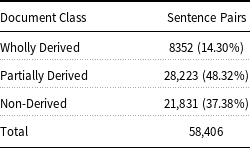
In the construction of SUSPC, each source/derived document pair was considered as one class. In each class, both source and derived documents were broken into sentences. Each sentence from the source document was paired with the corresponding sentence of the derived document (i.e., sentence-level cross product of the two documents was obtained). This resulted in 58,406 sentence pairs, of which 8352 (14.30%) belonged to WD, 28,223 (48.32%) to PD, and 21,831 (37.38%) to ND class. Table 2 shows the distribution of the initial sentence pairs‘ pool with respect to their classes in the source COUNTER corpus.
Distribution of the source sentence pairs w.r.t classes in the COUNTER corpus
To compute the string-level similarity between the two sentences, the word-based Levenshtein Edit Distance (LED) (Levenshtein, Reference Levenshtein1966) was used. Levenshtein Edit Distance is a textual similarity metric that examines the two words and returns a numerical value indicating their distance based on characters. Similarly, word-based LED (a variant of the original LED) compares the two sentences and provides a numerical value that shows how far apart they are from one another. In word-based LED, we can think of a sentence as a string (word) drawn from the English alphabet, where each character is a word (assuming that spaces mark the start and end of a character).
To ensure at least minimum divergence among the sentences, and to narrow down the initial candidate pairs space (58,406 pairs) for subsequent human evaluation, three heuristicFootnote j rules were applied (Dolan and Brockett, Reference Dolan and Brockett2005). The three rules are based on the common lexical properties and sentence positions in the document are as follows:
-
Rule 1 – The word-based LED of the two sentences must be in the range 1 $\lt$
LED
$\lt$
20, and the character-based length ratio between the two sentences must be greater than 66%. In addition, the first three sentences of the source and derived documents of each pair are also to be included in the candidate pair space, regardless of the sentences’ LED or length ratio.
$\lt$
LED
$\lt$
20, and the character-based length ratio between the two sentences must be greater than 66%. In addition, the first three sentences of the source and derived documents of each pair are also to be included in the candidate pair space, regardless of the sentences’ LED or length ratio. -
Rule 2 – In a sentence pair, the length
$n$
(number of words) of each sentence must be in the range
$5\leq n \leq 40$
. In other words, very short sentences (of length less than
$5$
words) and very long sentences (of length greater than
$40$
words) must be excluded. -
Rule 3 – The two sentences must share at least three words in common.


Rule 1 is based on string similarity computation and a heuristic for journalism. For the string similarity measurement, the source and derived sentences’ word-based LED and character-based sentence length ratios were used as features. LED was calculated using the minimum edit distance (insertion, deletion, and substitutions). Both sentences were split into words aka tokens, and dynamic programming was used to select a path with the minimum edit distance at each step to convert a sentence into another (Levenshtein, Reference Levenshtein1966). To ensure that there was no identical sentence pair in the resultant corpus, we used $LED\gt =1$
. Further, to rule out sentence pairs in which one was too long and the other one too short, the character-based length ratio of both the source and the derived sentences was calculated. Only the sentence pairs with less than 50% length difference were selected.
$LED\gt =1$
. Further, to rule out sentence pairs in which one was too long and the other one too short, the character-based length ratio of both the source and the derived sentences was calculated. Only the sentence pairs with less than 50% length difference were selected.
Another common practice in journalism, namely summarizing the whole article in two or three opening sentences was exploited (Dolan and Brockett, Reference Dolan and Brockett2005) during the creation of SUSPC. Journalists use the “inverted pyramid” structure to write news pieces. The most important information is placed at the top of the inverted pyramid, and the least important information is placed at the bottom.Footnote k , Footnote l Moreover, journalists also try to give the summarized information of the article in the first couple of sentences. Therefore, if both the source and derived documents are paraphrased, then the first couple of sentences from both articles would also most likely be paraphrased (Dolan et al., Reference Dolan, Quirk and Brockett2004).
As per Rule 2, sentences that are very short (of length less than $5$
wordsFootnote
m
) and very long (of length greater than
$5$
wordsFootnote
m
) and very long (of length greater than $40$
wordsFootnote
n
) are excluded on the basis of sentence length. Lastly, Rule 3 depends on the number of shared words between the two sentences.
$40$
wordsFootnote
n
) are excluded on the basis of sentence length. Lastly, Rule 3 depends on the number of shared words between the two sentences.
Figure 1 summarizes the process of semi-automatic extraction of the paraphrased sentence pairs. The process started by breaking up each document into sentences and then taking the sentence-level cross product of each document pair. This resulted in 58,406 sentence pairs. Then, Rule 1 was applied to filter sentence pairs based on string similarity and a heuristic rule, which resulted in 13,690 sentence pairs. These pairs were given as input to Rule 2 to exclude very short and very long sentences, which further reduced the number of sentence pairs to 10,679. Finally, Rule 3 was used to ensure that there were at least three common words in both the source and the derived sentences, which further reduced the search space to 3147 sentence pairs. Among these 3147 pairs, 774 (24.6%) sentence pairs belonged to WD, 1478 (46.96%) sentence pairs belonged to PD, and the remaining 895 (28.44%) sentence pairs belonged to ND class as per the COUNTER corpus (see Section 3.1.2).
Corpus generation process.

3.2 Human evaluation
The resultant 3147 semi-automatically extracted and likely to be paraphrased sentence pairs were then required to be examined by human beings.
3.2.1 Evaluation guidelines
The human evaluation, which followed the semi-automatic extraction of likely paraphrased sentence pairs, would classify the sentences as either paraphrased (P) or non-paraphrased (NP). The evaluation guidelines prepared for the task are described below:
-
Paraphrased (P): If both of the sentences share exactly the same news but with different wording or with minor changes in their text structure, or if they have an addition of related information or are rephrased (see Section 3.1.1) while keeping the semantics of the original text, they are marked as paraphrased (P).
-
Non-paraphrased (NP): If both sentences share the same general topic of the news but are written in the journalist’s own words and use her own findings, or if the two sentences have too few words in common, the pair is tagged as non-paraphrased (NP).
3.2.2 Evaluation process and inter-annotator agreement
The proposed SUSPC was manually evaluated by three judges (A, B, and C) over the course of 1 month. All three judges were Urdu speakers with a good understanding of the paraphrase detection task. They were graduate-level students of Computer Sciences at the Information Technology UniversityFootnote o and had prior experience in text tagging process. The judges were asked to tag a sentence pair into one of the two classes, that is, paraphrased or non-paraphrased. The complete evaluation was carried out in three phases: (i) training phase, (ii) annotations, and (iii) conflict resolution.
SUSPC human evaluation statistics

At the start, two judges (A and B) were given 30 randomly selected sentence pairs to tag. They were provided with the evaluation guidelines (see Section 3.2.1) and were trained. The training included lectures on rewriting operations and paraphrasing practices used by journalists, newspapers reading sessions, etc. After this process, a comprehensive meeting with both judges was organized to discuss the problems faced during the tagging process and to resolve the conflicting pairs. The results of these 30 sentence pairs were saved and both judges were asked to evaluate the remaining 3117 sentence pairs independently.
For all 3147 sentence pairs, both of the judges agreed with 2718 sentence pairs. In order to measure the degree of clarity and the judges’ comprehension of the annotation guidelines and the uniformity between annotators’ judgment, an inter-annotator agreement was computed. This was found to be 86.37%. Moreover, to further measure the reliability of the annotators to classify the sentence pairs, we used the Cohens Kappa Coefficient ( $k$
) (Cohen, Reference Cohen1960), which is a more robust measure than the accuracy and simple harmonic mean(
$k$
) (Cohen, Reference Cohen1960), which is a more robust measure than the accuracy and simple harmonic mean( $F_1$
), because the latter two measures do not consider the hypothetical probability of chance agreements. The value of
$F_1$
), because the latter two measures do not consider the hypothetical probability of chance agreements. The value of $k$
for SUSPC is 65.95%, which shows that the reliability of the agreement between the two annotators is substantial.
$k$
for SUSPC is 65.95%, which shows that the reliability of the agreement between the two annotators is substantial.
The rest of the 429 conflicts were resolved by a third judge (C) with a similar skill set. The most prominent conflict found was the amount of text used from the original sentence to generate a paraphrased sentence. We found that 854 (27.14 %) out of 3147 filtered sentence pairs were paraphrased. For test time evaluations, we have labeled the paraphrased class as true negative as described in details in Section 5.3.
In order to check the likelihood of plagiarized sentence pairs being rejected by the semi-automatic sentence pairs extraction approach, we selected 300 sentence pairs from the rejected pool of 55,559 sentence pairs at random. Out of the 300 rejected sentence pairs, only 8 were found to be plagiarized. This implies that only 2.66% of paraphrased sentence pairs were missed by the semi-automatic sentence pairs extraction approach. Table 3 shows the annotation statistics for the selected and rejected pools of sentence pairs.
3.3 Corpus statistics
SUSPC contains 3147 sentence pairs, 131,513 words (tokens), and 8033 unique words (types). More than half of the pairs belong to the non-paraphrased class (2293 sentence pairs, 96,057 tokens, and 7135 types) while the rest are paraphrased (854 sentence pairs, 35,456 tokens, and 4229 types). Table 4 shows the statistics of the proposed corpus.
SUSPC statistics

3.4 Distribution of sentence pairs
Table 5 presents a distribution of the resultant annotated sentence pairs in SUSPC plotted against the sentence pairs‘ initial classes in the source corpus, that is, COUNTER (Section 3.1.2). It can be seen that the SUSPC corpus contains 3147 sentence pairs, of which 854 are paraphrased while the rest (2293) are non-paraphrased. The paraphrased class comprises 387 WD, 370 PD, and 97 ND sentence pairs, whereas the non-paraphrased class includes 387 WD, 1108 PD, and 798 ND sentence pairs.
Distribution of the semi-automatically generated sentence pairs in SUSPC w.r.t. COUNTER corpus
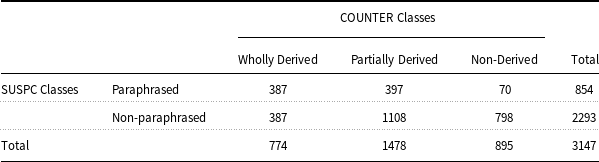
It can also be observed from Table 5 that the selected sentence pairs’ pool (i.e., 3147 sentence pairs) is 5.39% of the initial sentence pairs’ pool (i.e., 58,406 sentence pairs). This leads to the development of a hypothesis that the size of selected sentence pairs’ pool (i.e., SUSPC) has a relation of direct proportionality with the initially developed clusters and their size. Moreover, it can also be observed that the pattern of the classification of selected pairs to their respective classes has a relative proportion with the pattern of initial sentence pairs’ distribution (see Table 2). As can be seen, the PD sentence pairs’ class was the dominant class in the initial distribution (i.e., 48.32%), which is also the trend that can be seen in the resultant sentence pairs’ pool (i.e., 46.96% came from PD). Similarly, the contribution of sentence pairs of the ND class in the initial and filtered sentence pairs distributions was 37.38% and 28.44%, respectively. Finally, the WD category followed the trend with 14.30% in the initial sentence pairs pool and 24.60% in the resultant sentence pairs pool.
3.5 Examples from the corpus
Figure 2a shows a semi-automatically extracted sentence pair, manually tagged as paraphrased. The length of both sentences is quite similar, hence satisfying Rule 1. The word level edit distance between the two sentences is 8 – meaning that the news editor made eight word edits in the original news text – thus also satisfying Rule 2. Finally, both sentences share 13 words in common, thus satisfying Rule 3 as well. Consequently, the semi-automatic approach picked this sentence pair to be included in the initial data. Later on, the pair was tagged as paraphrased by the human judges because the two sentences shared the same news event, with slightly different wording and minor changes in the sentence structure, thus meeting the criteria for being marked as paraphrased as per the annotation guidelines (see Section 3.2.1).
Example sentence pairs from SUSPC: (a) paraphrased and (b) non-paraphrased.
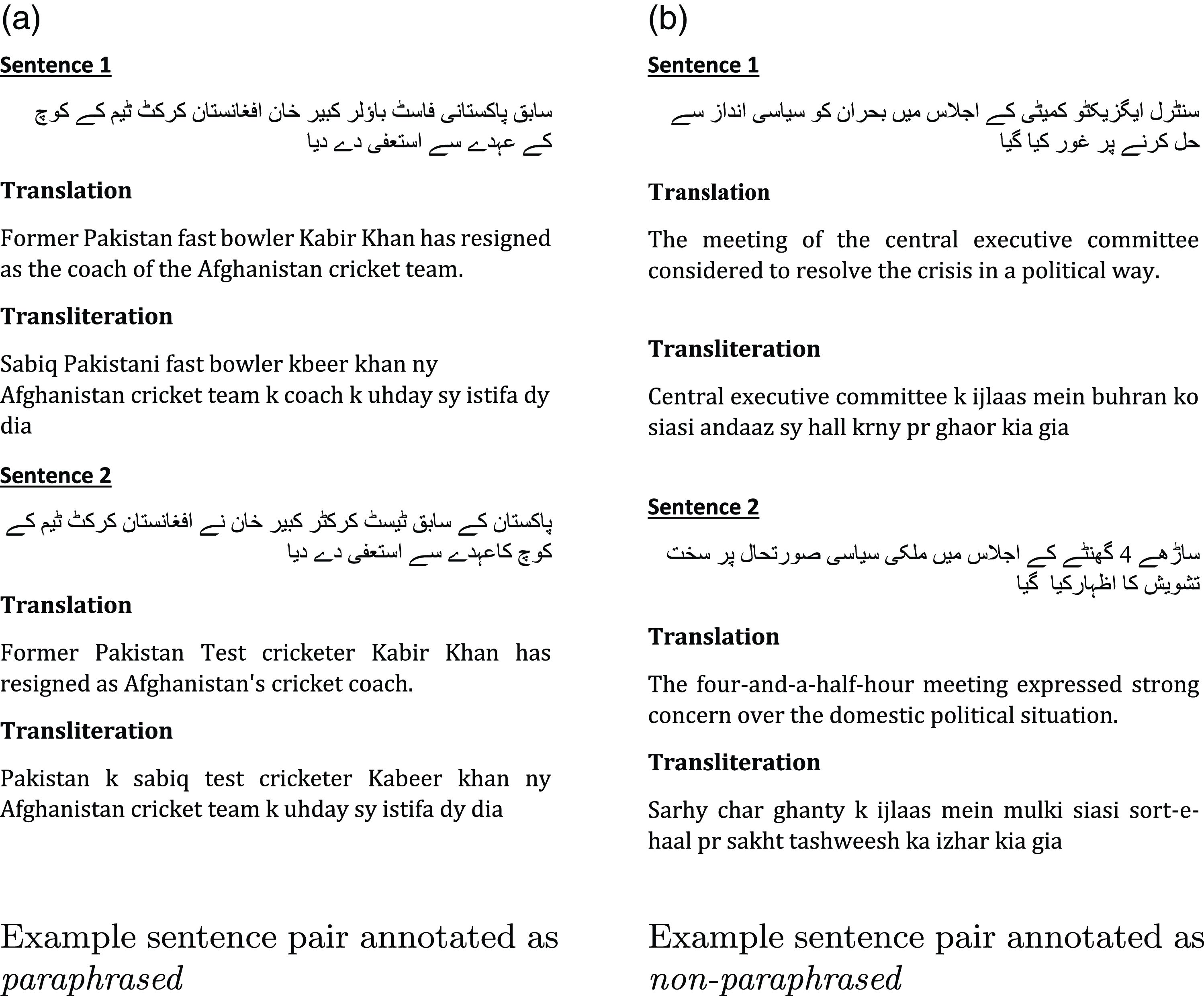
Figure 2b shows a sentence pair that is tagged as non-paraphrased. This pair also satisfies the three heuristic rules to be included in the initial data of selected pairs. The sentences’ length ratio is greater than 66%, there are 11 word level edits to convert the first sentence into the second, and they share five words in common. The judges marked this sentence pair as non-paraphrased because the information in both texts is not the same.
3.6 Corpus limitations
Although the proposed SUSPC corpus is the first-ever semi-automatically sentence-level paraphrased corpus in Urdu, it has some significant limitations:
-
The size of the proposed SUSPC corpus (3147 sentence pairs) is only a little larger than the size of the manually created USTRC corpus (2680 sentence pairs, see Section 2.1) corpus. The main reason could be the limited size of clusters in the source news data, as the average numbers of sentences in each cluster are 9 and 8 for the source and derived documents, respectively. Increasing the size of the source and derived documents could enhance the size of the SUSPC corpus. In other words, if the number of documents in the source corpus increased, the number of sentence pairs in the resultant corpus would also increase.
-
Another limitation of the SUSPC corpus is the imbalance between the assigned classes: where the number of paraphrased sentence pairs is only 854 (27%), the number of non-paraphrased sentence pairs is 2293 (72.26%). The lower count of the paraphrased class is entirely plausible because ND documents are independently written and have a lot of new text, as per the annotation guidelines of the COUNTER corpus (Sharjeel et al., Reference Sharjeel, Nawab and Rayson2017). Thus, the ND documents are bigger than the WD and PD documents. In addition, the strict filters in place for the reduction of the candidate pairs’ search space (see Section 3.1.3) could also have significantly reduced the number of paraphrased sentence pairs. For example, the filter
$LED\geq 1$
ensured that neither verbatim nor almost identical cases were included in SUSPC. -
The proposed corpus SUSPC contains only text examples from journalism. In the future, text examples from other fields, such as academics, Urdu literature, and history, can be added to increase the size of the SUSPC corpus.
-
Similarly, the vocabulary of SUSPC is limited to only five domains (national, foreign, business, sports, and showbiz), which can be expanded to further domains such as health, education, current affairs, and politics.

4. Paraphrase detection approaches
This section presents the two proposed DNN-based approaches to detect sentence-level paraphrasing in Urdu texts: (i) Word Embeddings n-gram Overlap (WENGO), and (ii) Deep Text Reuse and Paraphrase Plagiarism Detection (D-TRAPPD).
4.1 WENGO approach
WENGO is inspired by the popular but simple Word n-gram overlap approach (Alzahrani et al., Reference Alzahrani, Salim and Abraham2011), which is used to detect paraphrasing between two texts. In lieu of words, we used their respective pretrained word embedding vectors (using FastText pretrained word embeddings model, see Section 5.2). These vectors represent a word in a 300-dimensional vector space with a capability to capture semantic and syntactic properties of the text (Mikolov et al., Reference Mikolov, Sutskever, Chen, Corrado and Dean2013). These embedding vectors are the learned representations of words from a text where semantically similar words have similar representations (Goldberg and Hirst, Reference Goldberg and Hirst2017). For instance, the words “car” and “bus” are semantically similar, and their embedding vectors will have almost the same representation. These embedding vectors have shown impressive performance in a variety of NLP’s challenging problems like Sentiment Analysis (Yu et al., Reference Yu, Wang, Lai and Zhang2017), Machine Translation (Klein et al., Reference Klein, Kim, Deng, Senellart and Rush2017), Information Retrieval (Vulić and Moens, Reference Vulić and Moens2015; Ganguly et al., Reference Ganguly, Roy, Mitra and Jones2015), and Semantic Textual Similarity (Kenter and De Rijke, Reference Kenter and De Rijke2015) detection.
In order to detect the paraphrasing between sentence pairs, we used uni-gram, bi-gram, tri-gram, and four-gram word embeddings overlap for each sentence in a sentence pair. These embedding vectors were added together to make an average vector [see Equation (1)] for all words in a particular n-gram. The average vectors were concatenated together to make an average embedding matrix for each sentence in a sentence pair. Suppose, we have a sentence $s$
that contains
$s$
that contains $d$
words
$d$
words $\{w_1,w_2,w_3,\ldots,w_d\}$
, whose respective embedding vectors are
$\{w_1,w_2,w_3,\ldots,w_d\}$
, whose respective embedding vectors are $\{v_1,v_2,v_3,\ldots,v_d\}$
, and there will be a total of
$\{v_1,v_2,v_3,\ldots,v_d\}$
, and there will be a total of $(d-n+1)$
n-gram tuples, where
$(d-n+1)$
n-gram tuples, where $n$
is the length of an n-gram tuple. For example, let’s consider a sentence
$n$
is the length of an n-gram tuple. For example, let’s consider a sentence $s$
that contains five words (d = 5). If we make tri-gram (n = 3) tuples of
$s$
that contains five words (d = 5). If we make tri-gram (n = 3) tuples of $s$
, then there will be three tri-gram tuples. For each word in each tuple, the word embedding vector was extracted from a pretrained word embedding model. The average vector of all words in each tuple was generated by taking the average of all three embedding vectors [see Equation (1)]. Finally, an average embedding matrix (
$s$
, then there will be three tri-gram tuples. For each word in each tuple, the word embedding vector was extracted from a pretrained word embedding model. The average vector of all words in each tuple was generated by taking the average of all three embedding vectors [see Equation (1)]. Finally, an average embedding matrix ( $M$
) was generated for each sentence
$M$
) was generated for each sentence $s$
in a given sentence pair, and the cosine similarity score was computed for the two average embedding matrices for each text pair using Equation (2):
$s$
in a given sentence pair, and the cosine similarity score was computed for the two average embedding matrices for each text pair using Equation (2):
 \begin{equation}{\mathrm{EV}}_t=\frac1n\sum_{i=1}^nv_i\end{equation}
 \begin{equation} {Cos}(M_{s1}, M_{s2}) = \frac{\vec{M_{s1}} \cdot \vec{M_{s2}}}{|\vec{M_{s1}}||\vec{M_{s2}}|} \end{equation}
In Equation (1), $EV_{t}$
is the average embedding vector of an n-gram tuple
$EV_{t}$
is the average embedding vector of an n-gram tuple $t$
, and
$t$
, and $n$
is the length of the tuple, that is, uni-gram, bi-gram, tri-gram, or four-gram. In Equation (2),
$n$
is the length of the tuple, that is, uni-gram, bi-gram, tri-gram, or four-gram. In Equation (2), $M_{s1}$
and
$M_{s1}$
and $M_{s2}$
are the average embedding matrices of sentences
$M_{s2}$
are the average embedding matrices of sentences $s_{1}$
and
$s_{1}$
and $s_{2}$
, respectively, constructed from the average embedding vectors [see Equation (1)] of each n-gram tuple. These matrices are converted into a single flattened vector to compute their cosine similarity score.
$s_{2}$
, respectively, constructed from the average embedding vectors [see Equation (1)] of each n-gram tuple. These matrices are converted into a single flattened vector to compute their cosine similarity score.
The WENGO approach is computationally inexpensive. However, it is based on a bag-of-words model which causes it to lose the order of the n-grams, hence deteriorating the underlying text semantics. Secondly, it gives high weights to unrelated words when taking the average of all embedding vectors in an n-gram tuple making it difficult to differentiate among the word embedding vectors. Therefore, in this work, we use DNN-based approaches (i.e., CNNs and LSTMs). In most cases, these DNN-based approaches achieve state-of- the-art results compared to the WENGO approach. Particularly in text classification problems, these DNN-based approaches perform better than the traditional linear classifiers especially when working with pretrained word embedding representations (Zhang, Zhao, and LeCun, Reference Zhang, Zhao and LeCun2015; Goldberg, Reference Goldberg2016).
4.2 D-TRAPPD approach
Besides WENGO, we proposed another DNN-based approach D-TRAPPD for the task of Urdu paraphrase detection in monolingual settings. It is based on the work of Agarwal et al. (Reference Agarwal, Ramampiaro, Langseth and Ruocco2018) and consists of two major modules: (i) CNN and (ii) LSTM.
The CNN module is responsible for the extraction of meaningful and salient structures from the text, which is represented using word embedding vectors (Goldberg and Hirst, Reference Goldberg and Hirst2017). It is also noteworthy that certain word sequences are good indicators of the underlying semantics or topic of the text irrespective of their position (Goldberg, Reference Goldberg2016). In CNN, the convolutional layers in combination with the pooling layers are able to extract strong local features of words/phrases regardless of their position in the input text (Goldberg, Reference Goldberg2016). Although CNN is an important feature extraction neural network architecture, it shows better performance when integrated with a large neural network (Goldberg and Hirst, Reference Goldberg and Hirst2017). Therefore, we used it in combination with LSTMs, which are capable of learning long-term dependencies and are specifically designed to learn the temporal ordering of long input sequences (Hochreiter and Schmidhuber, Reference Hochreiter and Schmidhuber1997), which is exactly what we require for the problem under discussion.
Figure 3 shows the high-level architecture of our proposed D-TRAPPD approach for paraphrase detection in Urdu short text pairs. Firstly, Urdu word embedding vectors were extracted from a pretrained word embedding model (FastText (Grave et al., Reference Grave, Bojanowski, Gupta, Joulin and Mikolov2018); see Section 5.2) for both input sentences ( $s_1$
and
$s_1$
and $s_2$
) in a sentence pair to get a distributional vector representation matrix for each sentence. Secondly, these embedding matrices were provided as inputs to a Siamese CNN module (two replicas of the same CNN working on two different input vectors to produce comparable output vectors) (Chicco, Reference Chicco2021) to meaningful and salient structures from the text. The word-wise convolutions were performed on the input embedding matrices using kernels of two different sizes, that is, 2 (called bi-gram) and 3 (called tri-gram), 128 filters, and stride size 1 for all spatial dimensions. The convolutional layers were activated by ReLU [rectified linear unit (Nair and Hinton, Reference Nair and Hinton2010)] followed by a dropout layer (Srivastava et al., Reference Srivastava, Hinton, Krizhevsky, Sutskever and Salakhutdinov2014) to prevent the network from over-fitting. To summarize the resulting feature map, a max-pooling layer was added to the module. These condensed feature maps of both sizes (bi-gram and tri-gram) were concatenated to prepare the input for the next LSTM module with 64-dimensional output space and
$s_2$
) in a sentence pair to get a distributional vector representation matrix for each sentence. Secondly, these embedding matrices were provided as inputs to a Siamese CNN module (two replicas of the same CNN working on two different input vectors to produce comparable output vectors) (Chicco, Reference Chicco2021) to meaningful and salient structures from the text. The word-wise convolutions were performed on the input embedding matrices using kernels of two different sizes, that is, 2 (called bi-gram) and 3 (called tri-gram), 128 filters, and stride size 1 for all spatial dimensions. The convolutional layers were activated by ReLU [rectified linear unit (Nair and Hinton, Reference Nair and Hinton2010)] followed by a dropout layer (Srivastava et al., Reference Srivastava, Hinton, Krizhevsky, Sutskever and Salakhutdinov2014) to prevent the network from over-fitting. To summarize the resulting feature map, a max-pooling layer was added to the module. These condensed feature maps of both sizes (bi-gram and tri-gram) were concatenated to prepare the input for the next LSTM module with 64-dimensional output space and $L_2$
kernel regularizer.
$L_2$
kernel regularizer.
Proposed deep neural network architecture for paraphrased text reused detection.

The element-wise difference of the LSTM’s output vectors (for both sentences $s_1$
and
$s_1$
and $s_2$
) was taken using a lambda layer. The subsequent difference vector was the separating representative vector of the sentence pair that was utilized as a feature vector for learning the similarity between the two texts. It was used to classify the given sentence pair at the output layer, using two fully connected layers followed by their respective dropouts (Kingma and Ba, Reference Kingma and Ba2015) to regularize the proposed neural network. At the output layer, Sigmoid (Han and Moraga, Reference Han and Moraga1995) activation was used to perform binary classification (i.e., into paraphrased or non-paraphrased), and Softmax activation function (Goodfellow et al., Reference Goodfellow, Bengio, Courville and Bengio2016) was utilized for ternary classification (i.e., into verbatim, paraphrased, or non-paraphrased) tasks. Finally, the two separate models were trained for both binary and multi-classification.
$s_2$
) was taken using a lambda layer. The subsequent difference vector was the separating representative vector of the sentence pair that was utilized as a feature vector for learning the similarity between the two texts. It was used to classify the given sentence pair at the output layer, using two fully connected layers followed by their respective dropouts (Kingma and Ba, Reference Kingma and Ba2015) to regularize the proposed neural network. At the output layer, Sigmoid (Han and Moraga, Reference Han and Moraga1995) activation was used to perform binary classification (i.e., into paraphrased or non-paraphrased), and Softmax activation function (Goodfellow et al., Reference Goodfellow, Bengio, Courville and Bengio2016) was utilized for ternary classification (i.e., into verbatim, paraphrased, or non-paraphrased) tasks. Finally, the two separate models were trained for both binary and multi-classification.
5. Experimental setup
This section describes the experimental setup used along with the evaluation tasks and corpora, the text preprocessing and performance measures used for paraphrase detection, and other evaluation tasks in monolingual settings.
5.1 Evaluation tasks
We evaluated the proposed DNN-based approaches for two tasks: (i) paraphrase detection, and (ii) text reuse and plagiarism detection. The evaluation of multiple tasks allows us to report a fair generalization of the proposed approaches for the detection of textual similarity detection in Urdu texts.
5.1.1 Paraphrase detection
The paraphrase detection task was aimed at finding whether two sentences were paraphrased, based on their semantic similarity. We have selected UPPC (see Section 2.1) and SUSPC corpora (see Section 1) because both have been developed for the task of paraphrase detection. The task has been studied as a binary classification because text pairs in both corpora are either paraphrased or non-paraphrased. It is also worthwhile to note here that, for UPPC, we are the pioneers in evaluating the corpus for automatic paraphrased plagiarism detection tasks, particularly using the DNN-based approaches. Therefore, the results can serve as a baseline for future experiments on both corpora for Urdu paraphrase detection.
5.1.2 Text reuse and plagiarism detection
Text reuse is the act of borrowing and using text from a previously published text (i.e., source text). It could occur at the sentence, passage, or document level. The text could be reused verbatim (word-for-word) or paraphrased by changing the word order, exchanging words with appropriate synonyms, compressing or expanding the text, etc. The counterpart of text reuse is plagiarism, which is the unacknowledged reuse of text.
For the text reuse and plagiarism detection task, we selected the USTRC (see Section 2.1) corpus. USTRC has been developed for the detection of text reuse and plagiarism and considers three types of text reuse and plagiarism cases (i.e., verbatim, paraphrased, and independently written/non-paraphrased). We conducted our study for both binary classification and multi-classification tasks. For binary classification, we used USTRC by merging verbatim and paraphrased classes to make a single class called paraphrased (i.e., verbatim $+$
paraphrased
$+$
paraphrased $=$
paraphrased), while using the non-paraphrased class as it was. For multi-classification, we considered all of the three classes (i.e., verbatim, paraphrased, and independently written/non-paraphrased). As a baseline for text reuse and plagiarism detection, we used the work of Sameen et.al (Sameen et al., Reference Sameen, Sharjeel, Nawab, Rayson and Muneer2017) on USTRC.
$=$
paraphrased), while using the non-paraphrased class as it was. For multi-classification, we considered all of the three classes (i.e., verbatim, paraphrased, and independently written/non-paraphrased). As a baseline for text reuse and plagiarism detection, we used the work of Sameen et.al (Sameen et al., Reference Sameen, Sharjeel, Nawab, Rayson and Muneer2017) on USTRC.
5.2 Text preprocessing and word embeddings extraction
The essays (in UPPC) and long passages (in USTRC) were converted into a single sentence by removing all sentence separators, and each sentence was preprocessed by removing all of its numbers, punctuation, more than one white space, line breaks, and all other characters other than Urdu letters (Sharjeel et al., Reference Sharjeel, Nawab and Rayson2017; Amjad, Sidorov, and Zhila, Reference Amjad, Sidorov and Zhila2020a; Amjad et al., Reference Amjad, Sidorov, Zhila, Gómez-Adorno, Voronkov and Gelbukh2020b). Furthermore, each sentence was tokenized on a single white space. For each token, its respective word embedding vector was extracted from a pretrained word embedding model for Urdu [i.e., FastText (Grave et al., Reference Grave, Bojanowski, Gupta, Joulin and Mikolov2018)].
Although several word embedding models [e.g., Word2Vec (Mikolov et al., Reference Mikolov, Sutskever, Chen, Corrado and Dean2013; Qasmi et al., Reference Qasmi, Zia, Athar and Raza2020), Glove (Pennington, Socher, and Manning, Reference Pennington, Socher and Manning2014), FastText (Grave et al., Reference Grave, Bojanowski, Gupta, Joulin and Mikolov2018), ELMO (Peters et al., Reference Peters, Neumann, Iyyer, Gardner, Clark, Lee and Zettlemoyer2018), BERT (Devlin et al., Reference Devlin, Chang, Lee and Toutanova2018), and RoBERTA (Liu et al., Reference Liu, Ott, Goyal, Du, Joshi, Chen, Levy, Lewis, Zettlemoyer and Stoyanov2019)] were available, the largest pretrained word embedding model available for Urdu (at the time of experimentation) was FastText. FastText are pretrained distributed word vectors (extracted by using FastText APIFootnote p ), trained on Wikipedia and Common CrawlFootnote q using continuous bag-of-word (BOW) with position-weights, character 5-g, in 300 dimensions.
5.3 Evaluation methodology and measures
The main objectives of the experiments performed for this study were twofold. Firstly, we explored whether it is possible to differentiate between the different levels of Urdu paraphrasing using the proposed DNN-based approaches. Secondly, we evaluated whether the proposed DNN-based approaches perform better than the traditional surface-level similarity measurement-based approaches for Urdu text reuse and plagiarism detection task in monolingual settings.
To achieve these objectives, we applied various conventional machine learning (ML) classifiers to report a comparison between the extant state-of-the-art approaches and our proposed approaches. Thus, we studied the problem as a classification task and used 10 different classifiers: (i) Nearest Neighbors (NN), (ii) Logistic Regression (LR), (iii) Linear Support Vector Machines (LSVM), (iv) SVM with Radial Basis Function (RBF-SVM), (v) Decision Tree (DT), (vi) Random Forest (RF), (vii) Multi-Layer Perceptron (MLP), (Viii) AdaBoost (AB), (ix) Naive Bayes (NB), and (x) Quadratic Discriminant Analysis (QDA).
We used the standard evaluation measures used in previous studies (Sharjeel et al., Reference Sharjeel, Nawab and Rayson2017; Sameen et al., Reference Sameen, Sharjeel, Nawab, Rayson and Muneer2017) for Urdu text reuse and plagiarism detection tasks. These measures are precision [see Equation (3)], recall [see Equation (4)], and $F_1$
scores [see Equation (5)]. In the context of classification, we have defined True Positives (TP) as the relevant text pairs correctly classified as non-paraphrased class and True Negatives (TN) as the text pairs correctly classified as paraphrased:
$F_1$
scores [see Equation (5)]. In the context of classification, we have defined True Positives (TP) as the relevant text pairs correctly classified as non-paraphrased class and True Negatives (TN) as the text pairs correctly classified as paraphrased:
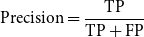 \begin{equation}\mathrm{Precision}=\frac{\mathrm{TP}}{\mathrm{TP}+\mathrm{FP}}\end{equation}
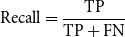 \begin{equation}\mathrm{Recall}=\frac{\mathrm{TP}}{\mathrm{TP}+\mathrm{FN}}\end{equation}
The value of precision and recall ranges between $0$
and
$0$
and $1$
, demonstrating the lowest performance and the best performance, respectively. Normally, there is a trade-off between precision and recall, that is, a high value of precision with high value shows that the system correctly identified all the relevant text pairs, but the corresponding recall will be low. Similarly, a high recall will result in low precision. To balance the effect of precision and recall trade-off, a harmonic mean is computed by combining the precision and recall values, known as F-measure (Baeza-Yates et al., Reference Baeza-Yates and Ribeiro-Neto1999) or
$1$
, demonstrating the lowest performance and the best performance, respectively. Normally, there is a trade-off between precision and recall, that is, a high value of precision with high value shows that the system correctly identified all the relevant text pairs, but the corresponding recall will be low. Similarly, a high recall will result in low precision. To balance the effect of precision and recall trade-off, a harmonic mean is computed by combining the precision and recall values, known as F-measure (Baeza-Yates et al., Reference Baeza-Yates and Ribeiro-Neto1999) or $F_1$
-measure
Footnote
r
[see Equation (5)]. The value of
$F_1$
-measure
Footnote
r
[see Equation (5)]. The value of $F_1$
also varies between
$F_1$
also varies between $0$
(worst) and
$0$
(worst) and $1$
(perfect).
$1$
(perfect). $F_1$
is generally used for corpora with imbalanced classes:
$F_1$
is generally used for corpora with imbalanced classes:
 \begin{equation}F_1=2\times\frac{\mathrm{Precision}\times\mathrm{Recall}}{\mathrm{Precision}+\mathrm{Recall}}\end{equation}
5.4 Model hyperparameters setting
The proposed approaches were implemented using Keras,Footnote
s
a renowned deep learning API written in Python. We tried various combinations of the hyperparameters and retained those with better performance. Since experiments have been performed on three different corpora for two similar tasks (see Section 5.1), most of the hyperparameter settings were common, such as (i) dropout rate (Srivastava et al., Reference Srivastava, Hinton, Krizhevsky, Sutskever and Salakhutdinov2014) (0.5), (ii) optimizer (adam (Kingma and Ba, Reference Kingma and Ba2015)), (iii) kernel regularizer ( $L_2$
), (iv) learning rate (
$L_2$
), (iv) learning rate ( $1.0$
), and (v) epochs (10, 25, 50, 125, 250, 500, 1000, 2000). Similarly, various sequence lengths were tried for each of the three corpora, and the lengths with the best results were selected. For sentence-level corpora (USTRC and SUSPC), the appropriate sequence length is 30 words, while for document-level corpora (UPPC), a sequence length of 250 words performed better. For sequences shorter than the maximum length, zero-padding was used.
$1.0$
), and (v) epochs (10, 25, 50, 125, 250, 500, 1000, 2000). Similarly, various sequence lengths were tried for each of the three corpora, and the lengths with the best results were selected. For sentence-level corpora (USTRC and SUSPC), the appropriate sequence length is 30 words, while for document-level corpora (UPPC), a sequence length of 250 words performed better. For sequences shorter than the maximum length, zero-padding was used.
Different batch sizes were used for the USTRC and SUSPC corpora (64, 128, 256, and 512) on the one hand, and the UPPC corpus (8, 16, 32, 64, and 128) on the other hand. Smaller batch sizes were used for UPPC since it has a smaller number of paraphrased plagiarism cases. For the binary classification task, “binary cross-entropy” was considered as loss, whereas for the multi-classification task, “categorical cross-entropy” was considered as loss.
To prevent our trained model from overfitting and to perform an effective unbiased evaluation, we used stratified 10-fold cross-validation along with validation split (0.1). At first, input data were randomly divided into 10 equal subsets where 9 subsets were used for training and the remaining one subset was used for testing. Further, 10% of the training dataset was used to make a validation dataset for an unbiased evaluation of the model fitted on the training dataset and to tune the model hyperparameters. Finally, the trained model was tested on the test dataset to assess how well our model is generalized and how well it performs in the production environment.
6. Results and discussion
This section discusses the results of the two evaluation tasks described in Section 5.1.
6.1 Paraphrase detection task results
6.1.1 Results and discussion on UPPC
Table 6 shows the results (only the best ones of each approach) of the paraphrase detection task for UPPC. The “Approach” column lists all the approaches applied for the paraphrase detection task, while “Classifier” logs the ML algorithms that produced the best $F_1$
score for binary classification. It is important to note that the following tables list only those classifiers that show the highest
$F_1$
score for binary classification. It is important to note that the following tables list only those classifiers that show the highest $F_1$
scores together with their respective precision and recall values.
$F_1$
scores together with their respective precision and recall values.
Result comparison of the proposed approaches on UPPC
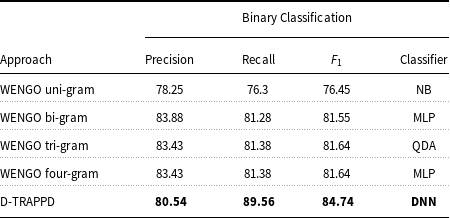
Overall, the proposed D-TRAPPD approach performed better than all other approaches ( $F_1=84.74$
), whereas among the WENGO-based approaches, WENGO tri-gram and four-gram (using QDA and MLP classifiers, respectively) produced the highest
$F_1=84.74$
), whereas among the WENGO-based approaches, WENGO tri-gram and four-gram (using QDA and MLP classifiers, respectively) produced the highest $F_1$
scores. It can be noted that the performance of WENGO-based approaches increased with an increasing value of
$F_1$
scores. It can be noted that the performance of WENGO-based approaches increased with an increasing value of $n$
. One possible reason could be that the lengths of the source and the rephrased texts (i.e., between 200 and 300 words) increased the number of n-grams containing semantically similar words in the source and paraphrased sentences. Another reason could be that the simulated text generation process of UPPC as students were permitted to look into the provided material – increased the chances of several phrases being simply copied and pasted from the helping material, resulting in more common or semantically similar words in the n-gram tuples.
$n$
. One possible reason could be that the lengths of the source and the rephrased texts (i.e., between 200 and 300 words) increased the number of n-grams containing semantically similar words in the source and paraphrased sentences. Another reason could be that the simulated text generation process of UPPC as students were permitted to look into the provided material – increased the chances of several phrases being simply copied and pasted from the helping material, resulting in more common or semantically similar words in the n-gram tuples.
6.1.2 Results and discussion on SUSPC
Table 7 demonstrates the results of the experiments performed on SUSPC (see Section 3). These are only the best results from the application of each approach. Overall, our proposed D-TRAPPD approach outperformed ( $F_1=96.80$
) all other approaches applied for the binary classification task on SUSPC.
$F_1=96.80$
) all other approaches applied for the binary classification task on SUSPC.
Result comparison of the proposed approaches on SUSPC

Among the rest of the approaches, the WENGO four-gram approach produced the highest scores ( $F_1=57.28$
). A clear pattern can be observed among
$F_1=57.28$
). A clear pattern can be observed among $F_1$
scores of the WENGO-based approaches, that is, the
$F_1$
scores of the WENGO-based approaches, that is, the $F_1$
score keeps on increasing as the value of
$F_1$
score keeps on increasing as the value of $n$
increases. The heuristic filters (see Section 3.1), particularly Rule 3 (“both sentences must have at least 3 words in common”), could be the possible reason for the observed pattern in the output. Since words are represented by their respective embedding vectors, semantically equivalent vectors have similar representation vectors.
$n$
increases. The heuristic filters (see Section 3.1), particularly Rule 3 (“both sentences must have at least 3 words in common”), could be the possible reason for the observed pattern in the output. Since words are represented by their respective embedding vectors, semantically equivalent vectors have similar representation vectors.
6.2 Text reuse and plagiarism detection task results
6.2.1 Results and discussion on USTRC
Table 8 shows the results for both binary and multi-classification for text reuse and plagiarism detection task on USTRC. It is important to note that Table 8 only lists those classifiers that show the highest $F_1$
scores together with their respective precision and recall scores.
$F_1$
scores together with their respective precision and recall scores.
Result comparison of the proposed approaches on USTRC

The highest $F_1$
scores for both binary and ternary classification tasks are produced by the proposed D-TRAPPD approach. Among these, the results for the binary classification task are slightly lower (
$F_1$
scores for both binary and ternary classification tasks are produced by the proposed D-TRAPPD approach. Among these, the results for the binary classification task are slightly lower ( $F_1=87.85$
) than the ternary classification (
$F_1=87.85$
) than the ternary classification ( $F_1=88.90$
). A clear reason is the difference between the precision and recall scores, which are greater in the case of binary classification than that of the multi-classification task. In binary classification, the recall score (
$F_1=88.90$
). A clear reason is the difference between the precision and recall scores, which are greater in the case of binary classification than that of the multi-classification task. In binary classification, the recall score ( $83.64$
) is quite low as compared to the recall score (
$83.64$
) is quite low as compared to the recall score ( $87.98$
) of multi-classification. This shows that the data in verbatim and paraphrased classes do not belong to the same distribution, as can be seen in the ternary classification models. In other words, it shows substantial difference between the means of all three classes, particularly for verbatim and paraphrased classes. Moreover, in binary classification, we are forcing the model to classify sentence pairs into two classes. This confuses the model with respect to the first class (Verbatim+Paraphrased) and leads to some of its instances being turned to the other class, resulting in a high number of false negatives and a dropp in the model’s recall score. This pattern can also be observed in the results of the WENGO bi-gram, tri-gram, and four-gram approaches. Only in the case of the WENGO uni-gram approach, the binary classification is seen to be easier than the multi-classification task.
$87.98$
) of multi-classification. This shows that the data in verbatim and paraphrased classes do not belong to the same distribution, as can be seen in the ternary classification models. In other words, it shows substantial difference between the means of all three classes, particularly for verbatim and paraphrased classes. Moreover, in binary classification, we are forcing the model to classify sentence pairs into two classes. This confuses the model with respect to the first class (Verbatim+Paraphrased) and leads to some of its instances being turned to the other class, resulting in a high number of false negatives and a dropp in the model’s recall score. This pattern can also be observed in the results of the WENGO bi-gram, tri-gram, and four-gram approaches. Only in the case of the WENGO uni-gram approach, the binary classification is seen to be easier than the multi-classification task.
For the WENGO-based approaches, the highest scores ( $F_1=61.08$
) for binary classification are produced by the WENGO uni-gram approach, whereas for multi-classification, the WENGO four-gram (
$F_1=61.08$
) for binary classification are produced by the WENGO uni-gram approach, whereas for multi-classification, the WENGO four-gram ( $F_1=61.19$
) approach performed better than all other WENGO-based approaches. Since we cannot observe a pattern in performance variation of WENGO-based approaches when the length of
$F_1=61.19$
) approach performed better than all other WENGO-based approaches. Since we cannot observe a pattern in performance variation of WENGO-based approaches when the length of $n$
is increased, we can conclude from the competitive results that the variation in length of
$n$
is increased, we can conclude from the competitive results that the variation in length of $n$
is not a good discriminator to detect text reuse of the source text. Overall, WENGO-based approaches by themselves are not suitable for text reuse and plagiarism detection for the corpus in Urdu of short text pairs derived from real news (i.e., USTRC). However, when these word embeddings are used with some neural network architectures, such as CNN or LSTM (like in the proposed D-TRAPPD approach), they produce better results than the state-of-the-art approaches.
$n$
is not a good discriminator to detect text reuse of the source text. Overall, WENGO-based approaches by themselves are not suitable for text reuse and plagiarism detection for the corpus in Urdu of short text pairs derived from real news (i.e., USTRC). However, when these word embeddings are used with some neural network architectures, such as CNN or LSTM (like in the proposed D-TRAPPD approach), they produce better results than the state-of-the-art approaches.
6.3 Best results comparison for both tasks
Table 9 shows the best results for both the tasks of paraphrase detection (see Section 5.1.1) and text reuse and plagiarism detection (see Section 5.1.2) tasks. It can be seen that the proposed D-TRAPPD approach (see Section 4.2) outperformed all the other approaches applied on the two tasks for both binary classification and multi-classification (where applicable). The apparent reason for this significant difference in results is the application of additional layers (over the pretrained embedding models) of the complex and computationally expensive deep neural architectures (CNNs and LSTMs). Looking at the two proposed approaches, we find that the WENGO-based approaches only considered the pretrained embedding vectors in an n-gram overlapping fashion. In comparison, CNNs, on which the D-TRAPPD approach is based, considered not only the pretrained embedding vectors but also combined the convolutional layers with the 765 pooling layers to extract the robust local features of the sentence pairs. It did this regardless of the positioning of the words in the input text (see Section 4.2). Moreover, CNNs, in combination with LSTM, also captured the long-term dependencies, specifically the temporal ordering of long input sequences, which was not possible under the WENGO-based approaches.
Comparison of the best results for: (i) paraphrase detection task, and (ii) text reuse and plagiarism detection task
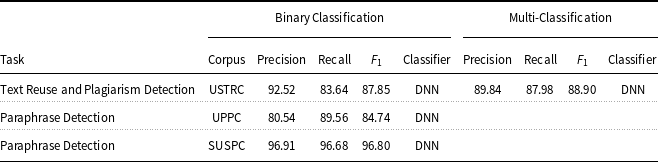
These results (Table 9) suggest that for the detection of text reuse and paraphrased plagiarism in Urdu, it is much better to use the D-TRAPPD approaches than the pretrained embedding models that only consider embedding vectors. Moreover, it can also be clearly observed from the best results of all the corpora that the proposed approach produced lower scores on UPPC (simulated cases of text reuse and plagiarism) than it did on SUSPC (semi-automatically generated cases of paraphrasing). This implies that simulated cases of paraphrased plagiarism are more difficult to detect than both real cases and semi-automatically generated cases of text reuse and paraphrasing.
It can also be observed that the scores of the proposed D-TRAPPD approach on both USTRC and UPPC are comparable, whereas the scores of D-TRAPPD on SUSPC are quite high. The possible reason of similarity in the former two could be the slight commonalities between the paraphrased text pairs’ generation process and the annotation guidelines of the two corpora. These commonalities can be explained by the fact that USTRC contains texts from the journalism domain, and it is a common practice among journalists to obfuscate the text of new reports using different rewriting operations like synonym replacement, changing word order, etc. (Bell, Reference Bell1991; Fries, Reference Fries1997; Jing and McKeown, Reference Jing and McKeown1999). Similarly, during the simulated texts generation process in UPPC, students were allowed to look at the provided material, which increased the likelihood of their simply copy-pasting phrases from the helping material, resulting in common or semantically similar words. On the other hand, the higher scores observed in the SUSPC output may be due to the rules that were followed in the text pairs’ generation process that ensured that there were at least three words in common among the members of each pair. Since words are represented by their respective embedding vectors, semantically equivalent vectors have similar representation vectors.
Figures 4 and 5 show the effects of the different number of epochs (see Section 5.4) used in D-TRAPPD for both tasks (paraphrase detection and text reuse and plagiarism detection) on all three corpora (UPPC, SUSPC, and USTRC) for both binary and multi-classification (where applicable). Overall, for both evaluation tasks (see Section 5.1), the scores of all of the three evaluation measures (i.e., precision, recall, and $F_1$
; see Section 5.3) increased as the number of epochs increased. For the paraphrase detection task on UPPC (see Fig. 4a), a significant increase (
$F_1$
; see Section 5.3) increased as the number of epochs increased. For the paraphrase detection task on UPPC (see Fig. 4a), a significant increase ( $F_1=56.21$
to
$F_1=56.21$
to $F_1=84.74$
) can be observed in the scores with the increments in epochs, whereas on SUSPC (see Fig. 4b), this increase (
$F_1=84.74$
) can be observed in the scores with the increments in epochs, whereas on SUSPC (see Fig. 4b), this increase ( $F_1=84.91$
to
$F_1=84.91$
to $F_1=96.80$
) is not too striking. This leads to the conclusion that the textual or semantic variation in simulated paraphrased cases is higher than in the semi-automatically generated cases. For the text reuse and plagiarism detection task, a noteworthy improvement in
$F_1=96.80$
) is not too striking. This leads to the conclusion that the textual or semantic variation in simulated paraphrased cases is higher than in the semi-automatically generated cases. For the text reuse and plagiarism detection task, a noteworthy improvement in $F_1$
scores (
$F_1$
scores ( $F_1=17.74$
to
$F_1=17.74$
to $F_1=87.85$
) for binary classification (see Fig. 5a) on USTRC can be observed. Finally, for multi-classification (see Fig. 5b), this increase (
$F_1=87.85$
) for binary classification (see Fig. 5a) on USTRC can be observed. Finally, for multi-classification (see Fig. 5b), this increase ( $F_1=34.66$
to
$F_1=34.66$
to $F_1=88.90$
) is obvious, yet not as remarkable as that of the binary classification task. This shows that, with increasing epochs, the proposed DNN-based models can easily differentiate between the three classes of text reuse as compared to the two classes of USTRC.
$F_1=88.90$
) is obvious, yet not as remarkable as that of the binary classification task. This shows that, with increasing epochs, the proposed DNN-based models can easily differentiate between the three classes of text reuse as compared to the two classes of USTRC.
Effect of epochs on precision, recall, and $F_1$
for paraphrase detection task (Section 5.1.1) on: (a) UPPC and (b) SUSPC.
$F_1$
for paraphrase detection task (Section 5.1.1) on: (a) UPPC and (b) SUSPC.
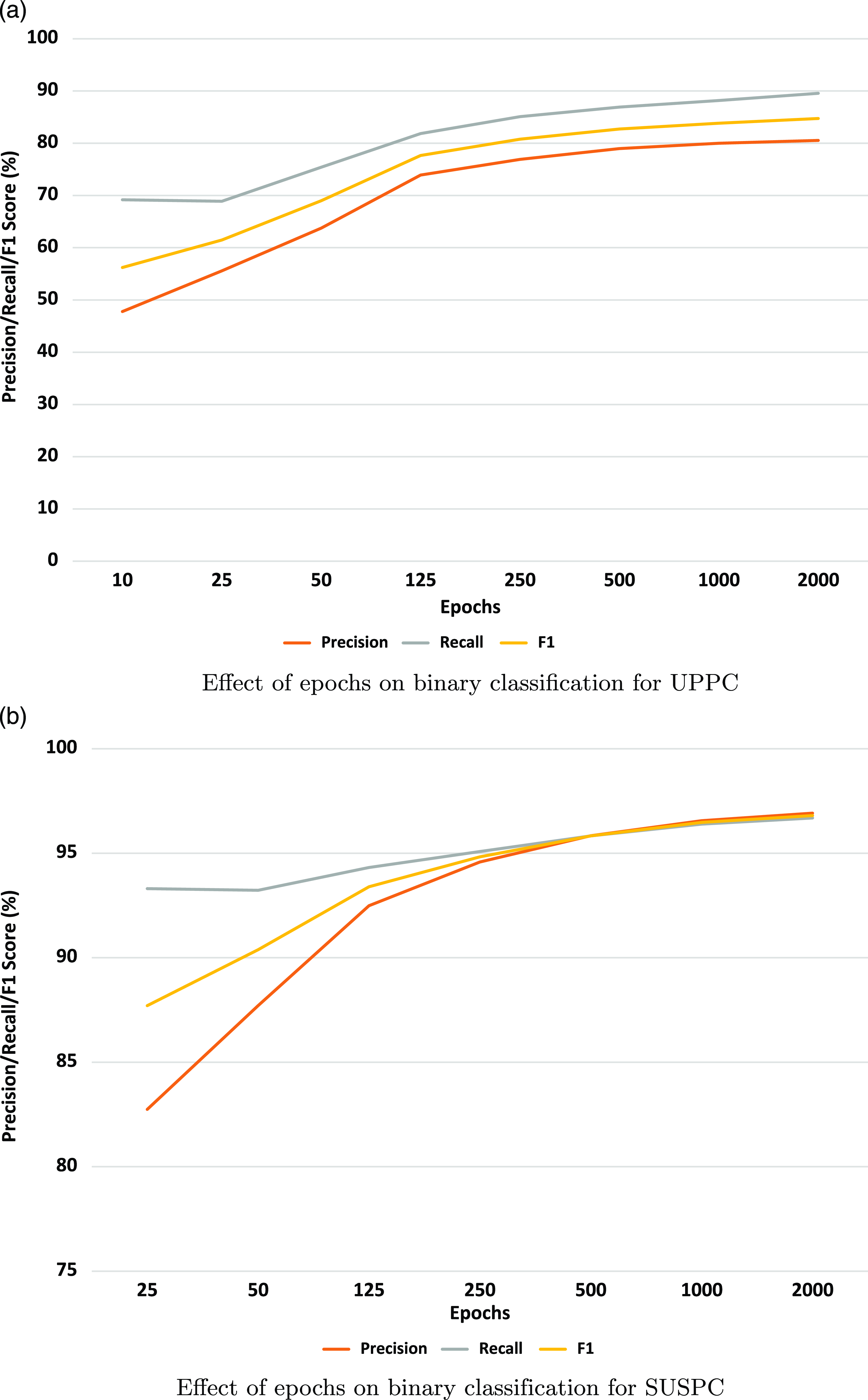
Effect of epochs on precision, recall, and $F_1$
for text reuse and plagiarism detection task (Section 5.1.2) on USTRC for: (c) binary classification, and (d) multi-classification.
$F_1$
for text reuse and plagiarism detection task (Section 5.1.2) on USTRC for: (c) binary classification, and (d) multi-classification.

6.4 Comparing results with the baseline approaches
For the paraphrase detection task (see Section 5.1.1), there are no baseline approaches and reported results in the past. This implies that we are the first ones to apply any type of paraphrase detection approach(es) on the UPPC. The reported results from both UPPC and SUSPC can serve as a baseline for the task of paraphrase detection in Urdu. In contrast, for the task of text reuse and plagiarism detection (see Section 5.1.2), we considered the works of Sameen et.al (Sameen et al., Reference Sameen, Sharjeel, Nawab, Rayson and Muneer2017), including USTRC, as the the baseline and state-of-the-art approach for text reuse and plagiarism detection for Urdu in monolingual settings.
Table 10 presents the comparison of the proposed D-TRAPPD approach for text reuse and plagiarism detection on USTRC with the state-of-the-art approach (Sameen et al., Reference Sameen, Sharjeel, Nawab, Rayson and Muneer2017) for both binary and multi-classification tasks. A “blank field” shows that the author(s) did not report this evaluation measure. The “Structural (Baseline)” approach refers to the character n-gram overlap (CNG) approach to measure the similarity between two texts. Sameen et.al (Sameen et al., Reference Sameen, Sharjeel, Nawab, Rayson and Muneer2017) achieved the best results for binary classification ( $F_1=77.50$
using character 5-gram, character 6-gram, and J48 classifier) and multi-classification (
$F_1=77.50$
using character 5-gram, character 6-gram, and J48 classifier) and multi-classification ( $F_1=70.40$
using character 3-gram, and J48 classifier) tasks. Our proposed D-TRAPPD approach outperformed the state-of-the-art approach in both binary classification (
$F_1=70.40$
using character 3-gram, and J48 classifier) tasks. Our proposed D-TRAPPD approach outperformed the state-of-the-art approach in both binary classification ( $F_1=87.85$
) and multi-classification (
$F_1=87.85$
) and multi-classification ( $F_1=88.90$
) tasks. In addition, our results also included the precision and recall measures to provide a better insight into the results.
$F_1=88.90$
) tasks. In addition, our results also included the precision and recall measures to provide a better insight into the results.
Comparison with the state-of-the-art approaches on Urdu Short Text Reuse Corpus
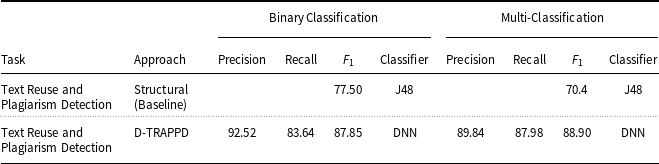
This comparison clearly demonstrates that the proposed D-TRAPPD approach performed better than the structural approaches on the same corpus (i.e., USTRC), particularly for the multi-classification task, which is harder to detect. Moreover, the baseline approaches achieved higher results for binary classification than the multi-classification task, whereas the proposed D-TRAPPD approach obtained better results for multi-classification than the binary classification task. This implies that the proposed semantic-based D-TRAPPD approach has a deeper understanding of the distribution of classes as compared to the surface-level structural approaches.
7. Conclusion
This research work focuses on answering the following research questions: (i) how to create a semi- or fully automatically generated corpus for paraphrase detection in Urdu; (ii) whether it is possible to differentiate between different levels of Urdu paraphrasing using the mainstream DNN-based approaches; and (iii) whether the DNN-based approaches perform better than the traditional approaches that measure surface-level similarity between two sentences for Urdu paraphrase detection and text reuse and plagiarism detection.
The first question has been answered by presenting the first-ever semi-automatically generated sentence-level corpus to develop and evaluate Urdu paraphrased detection systems (see Section 3). This corpus was developed in the footsteps of MRPC by using standard procedures, annotation guidelines, and XML encoding format. This corpus has also been made publicly available to foster research and development in Urdu paraphrased detection and text reuse and plagiarism detection. However, the proposed corpus has some limitations, including its limited size in terms of domain coverage, vocabulary, number of sentence pairs, etc. In the future, we will explore the recently published paraphrased text generation approaches to increase the size of the proposed SUSPC corpus.
The second question has been answered by presenting the two mainstream DNN-based approaches, that is, WENGO (see Section 4.1) and D-TRAPPD (see Section 4.2). WENGO extracts embeddings from pretrained monolingual word embedding models (i.e., FastText) and computes the cosine similarity score between the input text pairs. Conventional ML classifiers (e.g., SVM, NB, etc.) were used to differentiate between paraphrased and non-paraphrased text pairs. Moreover, D-TRAPPD, a computationally expensive approach, is presented and fine-tuned to detect paraphrasing in Urdu text pairs. Mainstream CNNs and LSTM architectures were used to capture the input text pairs’ salient features and long-term dependencies.
Finally, the third question has been answered by presenting two types of comparisons. Firstly, a comparison was conducted between all the newly proposed (i.e., WENGO and D-TRAPPD) approaches. It was found that D-TRAPPD has outperformed the WENGO-based approaches for both evaluation tasks (see Section 5.5). Secondly, D-TRAPPD was compared with the existing surface-level approaches for Urdu text reuse and plagiarism detection. Experimental results showed that D-TRAPPD performed better than WENGO and the existing surface-level similarity assessment approaches for paraphrase detection and text reuse and plagiarism detection in Urdu texts. All the evaluations performed on SUSPC were external, meaning that we did not perform any Urdu-specific modifications (e.g., stemming, lemmatization, etc.) to evaluate the newly generated SUSPC corpus.
In the future, we aim to further explore the D-TRAPPD approach by focusing on Urdu language-specific modifications such as orthograph, syntax, and semantics. Further, we will explore more recent approaches (as mentioned in Section 2), including deep learning (GRU, Bi-LSTM, Multi-perspective LSTMs, etc.), and transformers-based approaches for automatic paraphrase generation and detection and other related tasks. We will explore language agnostic (e.g., LaBERT) and multilingual models (e.g., mBERT, XLM-RoBERTa) to detect paraphrasing in Urdu text reuse and plagiarism cases.
Acknowledgments
This work is funded by the Higher Education Commission (HEC) of Pakistan under the National Research Program for Universities (NRPU) grant, and the Information Technology University, Lahore, Pakistan.


 Open access

