





1. Introduction
Roe algebras are  $C^*$-algebras associated to metric spaces, which encode the coarse geometry of the underlying spaces. They were introduced by Roe in his pioneering work on higher index theory [Reference Roe41, Reference Roe42], where he discovered that the $K$-theory of Roe algebras serves as a receptacle for higher indices of elliptic differential operators on open manifolds. Hence, the computation for the $K$-theory of Roe algebras becomes crucial in the study of higher index theory, and a pragmatic and practical approach is to consult the Baum–Connes type conjectures [Reference Baum and Connes4, Reference Baum, Connes and Higson5, Reference Higson and Roe23]. There is also a uniform version of the Roe algebra, which equally plays a key role in higher index theory (see [Reference Špakula27, Reference Skandalis, Tu and Yu49]). Over the last four decades, there have been a number of excellent works around this topic (e.g., [Reference Chen, Wang and Yu17, Reference Higson, Lafforgue and Skandalis22, Reference Willett and Yu52, Reference Yu53]), which have lead to significant progress in topology, geometry, and analysis (see, e.g., [Reference Roe42, Reference Roe43]).
On the other hand, the analytic structure of (uniform) Roe algebras reflects the coarse geometry of the underlying spaces, and the rigidity problem asks whether the coarse geometry of a metric space can be fully determined by the associated (uniform) Roe algebra. This problem was initially studied by Špakula and Willett in [Reference Špakula and Willett28], followed by a series of works in the last decade (e.g., [Reference Braga, Chung and Li6, Reference Braga and Farah7, Reference Jiang and Zhang30, Reference Li, Špakula and Zhang32]). Recently, this problem has been completely solved by the profound works [Reference Baudier, Braga, Farah, Khukhro, Vignati and Willett3] and [Reference Martínez and Vigolo33]. Meanwhile, uniform Roe algebras have also attained rapidly-growing interest from researchers in mathematical physics, especially in the theory of topological materials and topological insulators (see, e.g., [Reference Ewert and Meyer18] and the references therein).
Due to the importance of (uniform) Roe algebras, Chen and the first-named author initiated the study of their ideal structure [Reference Chen and Wang11–Reference Chen and Wang15, Reference Wang51]. They succeeded in obtaining a full description for the ideal structure of the uniform Roe algebra when the underlying space has Yu’s Property A [Reference Chen and Wang12, Reference Chen and Wang14]. Over the last two decades, there has been no essential progress on the ideal structures of uniform Roe algebras beyond the scope of Property A, and the general picture is far from clear.
When the underlying space comes from a discrete group  $\Gamma$ equipped with a word length metric, then the uniform Roe algebra is the crossed product $\ell^\infty(\Gamma) \rtimes \Gamma$ ([Reference Higson and Roe24, Reference Ozawa36]). Crossed products play an important role in dynamical systems, and their ideal structures have also been extensively studied (see, e.g., [Reference Kennedy and Schafhauser31, Reference Renault39, Reference Sierakowski47]). It is known that general uniform Roe algebras can be realized as reduced groupoid $C^*$-algebras, and recently, rapidly-growing interest has arisen in the study of ideal structures for groupoid $C^*$-algebras (see, e.g., [Reference Bönicke and Li2, Reference Brix, Carlsen and Sims8]).
In this paper, we investigate the ideal structure of uniform Roe algebras beyond the scope of Property A. Let us outline our results into several parts.
1.1. Ideal structure: within Property A
Let us start with some notions. Let  $(X,d)$ be a discrete metric space of bounded geometry. Thinking of operators on $\ell^2(X)$ as $X$-by- $X$ matrices, we say that such an operator has finite propagation if the non-zero entries appear only in an entourage of finite width (measured by the metric on $X$) around the main diagonal (see Section 2.3). The set of all finite propagation operators forms a $\ast$-subalgebra of $\mathfrak{B}(\ell^2(X))$, and its norm closure is called the uniform Roe algebra of $X$ and denoted by $C^*_u(X)$.
A natural class of ideals in the uniform Roe algebra arises from subspaces. An operator  $T\in \mathfrak{B}(\ell^2(X))$ is called near a subspace $A \subseteq X$ if the non-zero entries of $T$ sit in the product of some $R$-neighbourhood of $A$. The set of all finite propagation operators near $A$ forms a $\ast$-subalgebra of $\mathfrak{B}(\ell^2(X))$, whose norm closure is called the spatial ideal of $A$. These ideals play a key role when we calculate the $K$-theory of the uniform Roe algebra using the Mayer–Vietoris sequence argument from [Reference Higson, Roe and Yu25].
More generally, we consider the ‘spatial’ ideal associated with a family of subspaces  $\{A_\lambda\}_{\lambda \in \Lambda}$ in $X$, i.e., the norm closure of all finite propagation operators near some $A_\lambda$. These ideals reflect the geometry of the underlying subspaces, and have a nice analytic characterization from [Reference Chen and Wang12] that finite propagation operators therein are dense. Based on this, the following was introduced in [Reference Wang51, Definition 1.4]:
Definition A (Definition 3.2)
An ideal  $I$ in the uniform Roe algebra $C^*_u(X)$ is called geometric if the set of all finite propagation operators in $I$ is dense in $I$.
$I$.
The class of geometric ideals can also be described using the coarse groupoid. Recall from [Reference Skandalis, Tu and Yu49] that Skandalis, Tu and Yu introduced a notion of coarse groupoid  $G(X)$ associated to a discrete metric space $X$, which is a locally compact, Hausdorff, étale and principal groupoid (see Section 2.3) with the unit space being the Stone–Čech compactification $\beta X$ of $X$. Moreover, the uniform Roe algebra $C^*_u(X)$ can be interpreted as the reduced groupoid $C^*$-algebra of $G(X)$ (see [Reference Roe44, Chapter 10]).
A subset  $U \subseteq \beta X$ is invariant if any element $\gamma$ in $G(X)$ with source in $U$ also has its range in $U$. As shown in [Reference Chen and Wang12], for any ideal $I$ in $C^*_u(X)$ one can associate an invariant open subset $U(I)$ of $\beta X$ (see (3.1) below), and conversely, for any invariant open subset $U \subseteq \beta X$ one can associate an ideal $I(U):=C^*_r(G(X)_U)$ in $C^*_u(X)$ (see Definition 3.4 and Lemma 3.5). Furthermore, these two procedures provide a one-to-one correspondence between invariant open subsets of $\beta X$ and geometric ideals in $C^*_u(X)$. Therefore, geometric ideals in $C^*_u(X)$ are easy to handle since they have the form of $I(U)$ for some invariant open $U \subseteq \beta X$, called the geometric ideal associated to $U$. Moreover, [Reference Chen and Wang14, Theorem 4.4] shows that all ideals in $C^*_u(X)$ are geometric when $X$ has Yu’s Property A. Therefore, the picture of ideal structures for uniform Roe algebras is clear within the context of Property A.
1.2. Ideal structure: beyond Property A
Things get complicated beyond the context of Property A. As shown in [Reference Roe and Willett45, Theorem 1.3] (also noticed in [Reference Chen and Wang12, Remark 6.5]), when  $X$ does not have Property A (e.g., if $X$ comes from a sequence of expander graphs) then the ideal $I_G$ consisting of all ghost operators are not geometric (see also [Reference Higson, Lafforgue and Skandalis22]). Recall that $T \in \mathfrak{B}(\ell^2(X))$ is a ghost if $T \in C_0(X \times X)$ when regarded as a function on $X \times X$. Ghost operators are introduced by Yu, and they are crucial to provide counterexamples to the coarse Baum–Connes conjecture [Reference Higson, Lafforgue and Skandalis22].
Direct calculations show that the associated invariant open subsets for  $I_G$ and for the ideal of compact operators in $\mathfrak{B}(\ell^2(X))$ are the same, both of which equal $X$ (see Example 3.6 and 4.5). Hence, for a general metric space $X$ and an invariant open subset $U \subseteq \beta X$, there might be more than one ideal $I$ in the uniform Roe algebra $C^*_u(X)$ satisfying $U(I)=U$. Therefore, we cannot describe ideal structures merely using invariant open subsets in $\beta X$, which is a key obstruction.
One of the main contributions of this paper is to provide a fibred description for the ideal structures of uniform Roe algebras beyond the context of Property A. Following the discussions in the context of Property A, we observe that the study of the ideal structure for  $C^*_u(X)$ can be reduced to analyze the lattice (where the order is given by inclusion)
 \begin{equation}
\mathfrak{I}_U:=\{I \text{~is~an~ideal~in~} C^*_u(X): U(I)=U\}
\end{equation}
\begin{equation}
\mathfrak{I}_U:=\{I \text{~is~an~ideal~in~} C^*_u(X): U(I)=U\}
\end{equation} for each invariant open subset  $U \subseteq \beta X$. It is easy to see that $I(U(I)) \subseteq I$ for any ideal $I$ in $C^*_u(X)$, which implies that the geometric ideal $I(U)$ is the smallest element in $\mathfrak{I}_U$ (see Proposition 3.8). To explore the largest element in $\mathfrak{I}_U$, we introduce the following notion of ghostly ideals:
Definition B (Definition 4.1)
Let  $(X, d)$ be a discrete metric space of bounded geometry and $U$ be an invariant open subset of $\beta X$. The ghostly ideal associated to $U$ is defined to be
 \begin{equation*}
\tilde{I}(U):=\{T \in C^*_u(X): \overline{\mathrm{r}(\mathrm{supp}_\varepsilon(T))} \subseteq U \text{~for~any~}\varepsilon \gt 0\},
\end{equation*}
\begin{equation*}
\tilde{I}(U):=\{T \in C^*_u(X): \overline{\mathrm{r}(\mathrm{supp}_\varepsilon(T))} \subseteq U \text{~for~any~}\varepsilon \gt 0\},
\end{equation*} where  $\mathrm{supp}_\varepsilon(T):=\{(x,y)\in X \times X: |T(x,y)| \geq \varepsilon\}$ and $\mathrm{r}: X \times X \to X$ is the projection onto the first coordinate.
We show that  $\tilde{I}(U)$ is indeed an ideal in the uniform Roe algebra $C^*_u(X)$ (see Lemma 4.2) and moreover, we obtain the following structure result:
Theorem C (Theorem 4.4)
Let  $(X,d)$ be a discrete metric space of bounded geometry and $U$ be an invariant open subset of $\beta X$. Then any ideal $I$ in $C^*_u(X)$ with $U(I)=U$ sits between $I(U)$ and $\tilde{I}(U)$. More precisely, the geometric ideal $I(U)$ is the smallest element while the ghostly ideal $\tilde{I}(U)$ is the largest element in the lattice $\mathfrak{I}_U$ in (1.1).
Theorem C draws the border of the lattice  $\mathfrak{I}_U$ in (1.1), as the first and an important step to study the ideal structure of uniform Roe algebras beyond Property A. More precisely, if we can describe every ideal between $I(U)$ and $\tilde{I}(U)$ for each invariant open subset $U \subseteq \beta X$, then we will obtain a full description for the ideal structure of the uniform Roe algebra $C^*_u(X)$. We also remark that in a recent work [Reference Jiang and Zhang30], the rigidity problem for geometric ideals is completely solved.
Meanwhile, we characterize the ghostly ideal in terms of limit operators from [Reference Špakula and Willett29], showing that  $\tilde{I}(U)$ consists of operators vanishing in the $(\beta X \setminus U)$-direction (see Proposition 4.6). Since ghost operators vanish in all directions, operators in $\tilde{I}(U)$ can be regarded as ‘partial’ ghosts, which clarifies their terminology. Thanks to this viewpoint, we discover the deep reason behind the counterexample to the conjecture in [Reference Chen and Wang12], discovered in [Reference Wang51, Section 3] (see Example 4.10).
1.3. The coarse Baum–Connes conjecture and partial Property A
Recall from [Reference Baum and Connes4, Reference Baum, Connes and Higson5, Reference Higson and Roe23] that the coarse Baum–Connes conjecture asserts that for a discrete metric space of bounded geometry, the assembly map
 \begin{equation*}
\mu: KX_\ast(X) \longrightarrow K_*(C^*(X))
\end{equation*}
\begin{equation*}
\mu: KX_\ast(X) \longrightarrow K_*(C^*(X))
\end{equation*} is an isomorphism, where  $KX_\ast(X)$ is the coarse $K$-homology group and $K_*(C^*(X))$ is the $K$-theory of the Roe algebra $C^*(X)$. This conjecture and its various forms (including a uniform version) are central in higher index theory, and have fruitful applications in topology, geometry, and analysis.
It is shown in [Reference Higson, Lafforgue and Skandalis22] that the coarse Baum–Connes conjecture fails in general (e.g., for expanders). Finn-Sell discovered in [Reference Finn-Sell19, Corollary 36] that for certain spaces, this failure is closely related to the fact that the ideals of ghost operators and compact operators have different  $K$-theories. More generally, it is natural to ask when geometric ideals and ghostly ideals have the same $K$-theory.
We study this question and provide a comprehensive understanding of counterexamples to the coarse Baum–Connes conjectures on the level of ideals. More precisely, we obtain the following:
Theorem D (Theorem 5.4)
Let  $X$ be a discrete metric space of bounded geometry that can be coarsely embedded into some Hilbert space. Then for any invariant open subset $U \subseteq \beta X$, we have an isomorphism
 \begin{equation*}
(\iota_U)_\ast: K_\ast(I(U)) \longrightarrow K_\ast(\tilde{I}(U))
\end{equation*}
\begin{equation*}
(\iota_U)_\ast: K_\ast(I(U)) \longrightarrow K_\ast(\tilde{I}(U))
\end{equation*} for  $\ast =0,1$, where $\iota_U$ is the inclusion map.
Applying Theorem D to  $U=X$, we recover [Reference Finn-Sell19, Corollary 36]. This is crucial in the constructions of counterexamples to the Baum–Connes conjectures (see [Reference Skandalis, Tu and Yu49] for the coarse version and [Reference Finn-Sell and Wright20, Section 5] for the boundary version, the latter of which is based on the example considered in [Reference Wang51, Section 3]). Hence, presumably Theorem D will find further applications in higher index theory.
Furthermore, it is important to learn when the geometric ideal  $I(U)$ coincides with the ghostly ideal $\tilde{I}(U)$, which is more difficult than only considering their $K$-theories as in Theorem D. As a consequence of Theorem C, $\mathfrak{I}_U$ has only a single element when $I(U) = \tilde{I}(U)$ and hence, the ideal structure will become clear.
To study this issue, we start with an extra picture for ghostly ideals using the groupoid  $C^*$-algebras (see Proposition 4.9) and show that the amenability of the restriction $G(X)_{\beta X \setminus U}$ ensures that $I(U) = \tilde{I}(U)$ (see Proposition 5.2). Conversely, [Reference Roe and Willett45, Theorem 1.3] implies that $I(X) = \tilde{I}(X)$ if and only if $X$ has Property A, which is also equivalent to the amenability of $G(X)$ thanks to [Reference Skandalis, Tu and Yu49, Theorem 5.3]. Inspired by these works, we introduce the following partial version of Property A:
Definition E (Definition 6.1)
Let  $(X,d)$ be a discrete metric space of bounded geometry and $U \subseteq \beta X$ be an invariant open subset. We say that $X$ has partial Property A relative to $U$ if $G(X)_{\beta X \setminus U}$ is amenable.
Finally, we reach the following, which recovers [Reference Roe and Willett45, Theorem 1.3] when  $U=X$:
Theorem F (Theorem 6.19)
Let  $(X,d)$ be a strongly discrete metric space of bounded geometry and $U \subseteq \beta X$ be a countably generated invariant open subset. Then the following are equivalent:
(1) $X$ has partial Property A relative to
$U$;
$X$ has partial Property A relative to
$U$;(2)
$\tilde{I}(U) = I(U)$;(3) the ideal
$I_G$ of all ghost operators is contained in
$I(U)$.


Note that Theorem F requires a technical condition of being countably generated (see Definition 6.13), which holds for a number of examples (see Example 6.14), including  $X$ itself. However, as shown in Example 6.17, there does exist an invariant open subset which is not countably generated.
The proof of Theorem F follows the outline of the case that  $U=X$ (cf. [Reference Roe and Willett45, Theorem 1.3]), and is divided into several steps. Firstly, we unpack the groupoid language of Definition E and provide a concrete geometric description similar to the definition of Property A (see Proposition 6.2). Then we introduce a notion of partial operator norm localization property (Definition 6.7), which is a partial version of the operator norm localization property (ONL) introduced in [Reference Chen, Tessera, Wang and Yu10]. Parallel to Sako’s result that Property A is equivalent to ONL [Reference Sako46], we show that partial Property A is equivalent to partial ONL (see Proposition 6.9). Finally, thanks to the assumption of being countably generated, we conclude Theorem F.
1.4. Maximal ideals in uniform Roe algebras
Using ghostly ideals developed above, we manage to provide a full description of maximal ideals in uniform Roe algebras. Note that it follows directly from Theorem C that maximal ideals correspond to minimal invariant closed subsets of the Stone–Čech boundary  $\partial_\beta X:=\beta X \setminus X$. Moreover, we prove the following:
Theorem G (Proposition 7.2, Corollary 7.3 and Lemma 7.5)
Let  $(X,d)$ be a strongly discrete metric space of bounded geometry and $I$ be a maximal ideal in $C^*_u(X)$. Then there exists $\omega \in \partial_\beta X$ such that $I=\tilde{I}(\beta X \setminus \overline{X(\omega)})$, where $X(\omega)$ is the limit space of $\omega$.
A point  $\omega \in \partial_\beta X$ satisfying the condition in Theorem G is called a minimal point (see Definition 7.4). The following result is well-known, showing that there exist a number of non-minimal points even for $X=\mathbb{Z}$.
Proposition H (Proposition 7.6)
For the integer group  $\mathbb{Z}$ with the usual metric, there exist non-minimal points in the boundary $\partial_\beta \mathbb{Z}$. More precisely, for any sequence $\{h_n\}_{n\in \mathbb{N}}$ in $\mathbb{Z}$ tending to infinity such that $|h_n -h_m| \to +\infty$ when $n+m \to \infty$ and $n\neq m$, and any $\omega \in \partial_\beta \mathbb{Z}$ with $\omega(\{h_n\}_{n\in \mathbb{N}})=1$, then $\omega$ is not a minimal point.
We provide two direct proofs of Proposition H for the convenience of readers. One is topological, which makes use of several constructions and properties of ultrafilters. The other is  $C^*$-algebraic, relying on a description of maximal ideals in terms of limit operators (see Lemma 7.13) together with a recent result [Reference Roch40].
1.5. Organization
In Section 2, we recall background knowledge in coarse geometry, groupoids, and limit operator theory. Section 3 is devoted to the notion of geometric ideals (Definition A) studied in [Reference Chen and Wang12, Reference Wang51], and we also discuss their minimality in the lattice of ideals  $\mathfrak{I}_U$ from (1.1). We introduce the key notion of ghostly ideals (Definition B) in Section 4, prove Theorem C and several characterizations. In Section 5, we study the problem when the geometric ideal coincides with the ghostly ideal, discuss their $K$-theories, and prove Theorem D. Then in Section 6, we introduce the notion of partial Property A (Definition E) and prove Theorem F. In Section 7, we discuss maximal ideals in uniform Roe algebras, and prove Theorem G and Proposition H. Finally, we list some open questions in Section 8.
2. Preliminaries
2.1. Basic notation
Here, we collect the notation used throughout the paper.
For a set  $X$, denote by $|X|$ the cardinality of $X$. For a subset $A \subseteq X$, denote by $\chi_{A}$ the characteristic function of $A$, and set $\delta_x:=\chi_{\{x\}}$ for $x\in X$.
When  $X$ is a locally compact Hausdorff space, denote $C(X)$ the set of complex-valued continuous functions on $X$, and $C_b(X)$ the subset of bounded continuous functions on $X$. The support of $f\in C(X)$ is the closure of $\{x\in X: f(x)\neq 0\}$, written as $\mathrm{supp}(f)$, and denote $C_c(X)$ the set of continuous functions with compact support. We also denote by $C_0(X)$ the set of continuous functions vanishing at infinity with the supremum norm $\|f\|_\infty:=\sup\{|f(x)|: x\in X\}$.
When  $X$ is discrete, denote $\ell^\infty(X):=C_b(X)$ and $\ell^2(X)$ the Hilbert space of complex-valued square-summable functions on $X$. Denote $\mathfrak{B}(\ell^2(X))$ the $C^*$-algebra of all bounded linear operators on $\ell^2(X)$, and $\mathfrak{K}(\ell^2(X))$ the $C^*$-subalgebra of all compact operators on $\ell^2(X)$.
For a discrete space  $X$, denote $\beta X$ its Stone–Čech compactification and $\partial_\beta X:=\beta X \setminus X$ the Stone–Čech boundary.
For a discrete metric space  $(X,d)$, denote $B_{X}(x,r):=\{y\in X: d(x,y)\leq r\}$ for $x\in X$ and $r\geq 0$. For a subset $A\subseteq X$ and $r \gt 0$, denote $\mathcal{N}_r(A):=\{x\in X: d_X(x,A) \leq r\}$. For $R \gt 0$, denote the $R$-entourage by $E_R :=\{(x,y) \in X \times X: d(x,y) \leq R\}$. We say that $(X,d)$ has bounded geometry if for any $r \gt 0$, $\sup_{x\in X} |B_{X}(x,r)| \lt \infty$. Also, say that $(X,d)$ is strongly discrete if the set $\{d(x,y): x,y \in X\}$ is a discrete subset of $\mathbb{R}$.
Convention. We say that ‘ $X$ is a space’ as shorthand for ‘ $X$ is a strongly discrete metric space of bounded geometry’ (as in [Reference Špakula and Willett29]) throughout the rest of this paper.
We remark that although our results hold without the assumption of strong discreteness, we choose to add it so as to simplify the proofs. As discussed in [Reference Špakula and Willett29, Section 2], this will not lose any generality.
Definition 2.1 ([Reference Yu53])
A space  $(X,d)$ is said to have Property A if for any $\varepsilon, R \gt 0$ there exist an $S \gt 0$ and a function $f: X \times X \to [0,+\infty)$ satisfying:
(1)
$\mathrm{supp}(f) \subseteq E_S$;(2) for any
$x\in X$, we have
$\sum_{z\in X} f(z,x) =1$;(3) for any
$x,y\in X$ with
$d(x,y) \leq R$, then
$\sum_{z\in X} |f(z,x) - f(z,y)| \leq \varepsilon$.


Definition 2.2. Let  $(X,d_X)$ and $(Y,d_Y)$ be metric spaces and $f: X \to Y$ be a map. We say that $f$ is a coarse embedding if there exist functions $\rho_{\pm}: [0,\infty) \to [0,\infty)$ with $\lim_{t\to +\infty}\rho_{\pm}(t) = +\infty$ such that for any $x,y\in X$ we have
 \begin{equation*}
\rho_-(d_X(x,y)) \leq d_Y(f(x),f(y)) \leq \rho_+(d_X(x,y)).
\end{equation*}
\begin{equation*}
\rho_-(d_X(x,y)) \leq d_Y(f(x),f(y)) \leq \rho_+(d_X(x,y)).
\end{equation*} If additionally there exists  $C \gt 0$ such that $Y=\mathcal{N}_C(f(X))$, then we say that $f$ is a coarse equivalence and $(X,d_X), (Y,d_Y)$ are coarsely equivalent.
2.2. Groupoids and
$C^*$-algebras

Here, we collect some basic notions and terminology on groupoids. Details can be found in [Reference Renault38], or [Reference Sims48] in the étale case.
A groupoid is a small category in which every morphism is invertible. More precisely, a groupoid consists of a set  $\mathcal{G}$, a subset $\mathcal{G}^{(0)}$ called the unit space, two maps $\mathrm{s},\mathrm{r}: \mathcal{G} \to \mathcal{G}^{(0)}$ called the source and range maps, a composition law:
 \begin{equation*}
\mathcal{G}^{(2)}:=\{(\gamma_1,\gamma_2) \in \mathcal{G} \times \mathcal{G}: \mathrm{s}(\gamma_1)=\mathrm{r}(\gamma_2)\}\ni(\gamma_1,\gamma_2) \mapsto \gamma_1\gamma_2 \in \mathcal{G},
\end{equation*}
\begin{equation*}
\mathcal{G}^{(2)}:=\{(\gamma_1,\gamma_2) \in \mathcal{G} \times \mathcal{G}: \mathrm{s}(\gamma_1)=\mathrm{r}(\gamma_2)\}\ni(\gamma_1,\gamma_2) \mapsto \gamma_1\gamma_2 \in \mathcal{G},
\end{equation*} and an inverse map  $\gamma \mapsto \gamma^{-1}$, which satisfy a couple of axioms.
For  $x \in \mathcal{G}^{(0)}$, denote $\mathcal{G}^x:=\mathrm{r}^{-1}(x)$ and $\mathcal{G}_x:=\mathrm{s}^{-1}(x)$. A subset $Y\subseteq \mathcal{G}^{(0)}$ is called invariant if $\mathrm{r}^{-1}(Y)=\mathrm{s}^{-1}(Y)$, and denote $\mathcal{G}_Y:=\mathrm{r}^{-1}(Y)$.
A locally compact Hausdorff groupoid is a groupoid with a locally compact Hausdorff topology such that the structure maps are continuous. Such a groupoid is called étale if the range map is a local homeomorphism.
Example 2.3. Let  $X$ be a set. The pair groupoid of $X$ is $X \times X$ as a set, whose unit space is $\{(x,x) \in X \times X: x\in X\}$ and identified with $X$ for simplicity. The source and range maps are the projections onto the second and the first coordinate, respectively. The composition is given by $(x,y) \cdot (y,z)=(x,z)$ for $x,y,z \in X$.
Now we recall the groupoid  $C^*$-algebras. Let $\mathcal{G}$ be a locally compact, Hausdorff and étale groupoid with unit space $\mathcal{G}^{(0)}$. The space $C_c(\mathcal{G})$ is a $\ast$-involutive algebra with respect to the following operations: for $f,g \in C_c(\mathcal{G})$,
 \begin{eqnarray*}
(f \ast g)(\gamma) &=& \sum_{\alpha \in \mathcal{G}_{\mathrm{s}(\gamma)}} f(\gamma \alpha^{-1}) g(\alpha), \\
f^*(\gamma) &=& \overline{f(\gamma^{-1})}.
\end{eqnarray*}
\begin{eqnarray*}
(f \ast g)(\gamma) &=& \sum_{\alpha \in \mathcal{G}_{\mathrm{s}(\gamma)}} f(\gamma \alpha^{-1}) g(\alpha), \\
f^*(\gamma) &=& \overline{f(\gamma^{-1})}.
\end{eqnarray*} The maximal (full) groupoid  $C^*$-algebra $C^*_{\mathrm{max}}(\mathcal{G})$ is the completion of $C_c(\mathcal{G})$ with respect to the norm $\|f\|_{\mathrm{max}}:=\sup \|\pi(f)\|$, where the supremum is taken over all $\ast$-representations $\pi$ of $C_c(\mathcal{G})$. The regular representation at $x \in \mathcal{G}^{(0)}$, denoted by $\lambda_x: C_c(\mathcal{G}) \to \mathfrak{B}(\ell^2(\mathcal{G}_x))$, is defined by:
 \begin{equation}
\big(\lambda_x(f)\xi\big)(\gamma):=\sum_{\alpha \in \mathcal{G}_x} f(\gamma \alpha^{-1})\xi(\alpha), \quad \text{where}~ f \in C_c(\mathcal{G})\text{~and~}\xi \in \ell^2(\mathcal{G}_x).
\end{equation}
\begin{equation}
\big(\lambda_x(f)\xi\big)(\gamma):=\sum_{\alpha \in \mathcal{G}_x} f(\gamma \alpha^{-1})\xi(\alpha), \quad \text{where}~ f \in C_c(\mathcal{G})\text{~and~}\xi \in \ell^2(\mathcal{G}_x).
\end{equation} The reduced norm on  $C_c(\mathcal{G})$ is $\|f\|_r:=\sup_{x \in \mathcal{G}^{(0)}} \|\lambda_x(f)\|$, and the reduced groupoid $C^*$-algebra $C^*_r(\mathcal{G})$ is the completion of the $\ast$-algebra $C_c(\mathcal{G})$ with respect to this norm. Then each $\lambda_x$ can be extended to a homomorphism $\lambda_x: C^*_r(\mathcal{G}) \to \mathfrak{B}(\ell^2(\mathcal{G}_x))$.
2.3. Uniform Roe algebras and the coarse groupoid
Let  $(X,d)$ be a discrete metric space. Each $T \in \mathfrak{B}(\ell^2(X))$ can be written in the matrix form $T=(T(x,y))_{x,y\in X}$, where $T(x,y)=\langle T \delta_y, \delta_x \rangle \in \mathbb{C}$. Hence, $T \in \mathfrak{B}(\ell^2(X))$ can be regarded as an element in $\ell^\infty(X \times X)$. Denote by $\|T\|$ the operator norm of $T$ in $\mathfrak{B}(\ell^2(X))$, and $\|T\|_\infty$ the supremum norm when regarding $T$ as a function in $\ell^\infty(X \times X)$.
Given an operator  $T \in \mathfrak{B}(\ell^2(X))$, we define the support of $T$ to be
 \begin{equation*}
\mathrm{supp}(T):=\{(x,y) \in X \times X: T(x,y) \neq 0\},
\end{equation*}
\begin{equation*}
\mathrm{supp}(T):=\{(x,y) \in X \times X: T(x,y) \neq 0\},
\end{equation*} and the propagation of  $T$ to be
 \begin{equation*}
\mathrm{prop}(T):= \sup\{d(x,y): (x,y) \in \mathrm{supp}(T)\}.
\end{equation*}
\begin{equation*}
\mathrm{prop}(T):= \sup\{d(x,y): (x,y) \in \mathrm{supp}(T)\}.
\end{equation*}Definition 2.4. Let  $(X,d)$ be a space.
(1) The set of all finite propagation operators in
$\mathfrak{B}(\ell^2(X))$ forms a
$\ast$-algebra, called the algebraic uniform Roe algebra of
$X$ and denoted by
$\mathbb{C}_u[X]$. For each
$R\geq 0$, denote
$\mathbb{C}_u^R[X]:=\{T\in \mathfrak{B}(\ell^2(X)): \mathrm{prop}(T) \leq R\}$.(2) The uniform Roe algebra of
$X$ is defined to be the operator norm closure of
$\mathbb{C}_u[X]$ in
$\mathfrak{B}(\ell^2(X))$, which forms a
$C^*$-algebra and is denoted by
$C^*_u(X)$.


Definition 2.5 (Yu)
An operator  $T \in C^*_u(X)$ is called a ghost if $T \in C_0(X \times X)$ when regarding $T$ as a function in $\ell^\infty(X \times X)$. All the ghost operators in $C^*_u(X)$ form an ideal in $C^*_u(X)$, denoted by $I_G$.
Now we recall the notion of coarse groupoid from [Reference Skandalis, Tu and Yu49]. For a space  $(X,d)$, the coarse groupoid $G(X)$ is defined (as a topological space) by:
 \begin{equation*}
G(X):=\bigcup_{r \gt 0}{\overline{E_r}}^{\beta (X \times X)} \subseteq \beta (X \times X).
\end{equation*}
\begin{equation*}
G(X):=\bigcup_{r \gt 0}{\overline{E_r}}^{\beta (X \times X)} \subseteq \beta (X \times X).
\end{equation*} The projection maps  $\mathrm{r}, \mathrm{s}: X \times X \to X$ onto the first and second coordinate can be extended to maps $G(X) \to \beta X$, still denoted by $\mathrm{r}$ and $\mathrm{s}$. It was shown in [Reference Skandalis, Tu and Yu49, Lemma 2.7] that the map $(\mathrm{r},\mathrm{s}): G(X) \to \beta X \times \beta X$ is injective, and hence $G(X)$ can be regarded as a subset of $\beta X \times \beta X$ and then endowed with the groupoid structure from Example 2.3, called the coarse groupoid of $X$. It was shown in [Reference Skandalis, Tu and Yu49, Proposition 3.2] that the coarse groupoid $G(X)$ is locally compact, Hausdorff, étale and principal. Clearly, the unit space of $G(X)$ can be identified with $\beta X$.
Given  $f \in C_c(G(X))$, we define an operator $\theta(f)$ on $\ell^2(X)$ by setting its matrix coefficients to be $\theta(f)(x,y):=f(x,y)$ for $x,y\in X$. We have:
Proposition 2.6 ([Reference Roe44, Proposition 10.29])
The map  $\theta$ provides a $\ast$-isomorphism from $C_c(G(X))$ to $\mathbb{C}_u[X]$, and extends to a $C^*$-isomorphism $\Theta: C^*_r(G(X)) \to C^*_u(X)$.
Regarding  $T \in \mathfrak{B}(\ell^2(X))$ as an element in $\ell^\infty(X \times X)$, we denote by $\overline{T}$ the continuous extension of $T$ on $\beta(X \times X)$. Then $\mathrm{supp}(\overline{T}) = \overline{\mathrm{supp}(T)}$ and we have:
Lemma 2.7. For  $T \in \mathbb{C}_u[X]$, we have $\overline{T} \in C_c(G(X))$ and $\theta(\overline{T})=T$. For $T \in C^*_u(X)$, we have $\overline{T} \in C_0(G(X))$ and $\Theta(\overline{T}) = T$.
Furthermore, Property A and coarse embeddability for  $(X,d)$ can also be described using the coarse groupoid $G(X)$. Let us recall the following:
Definition 2.8 ([Reference Anantharaman-Delaroche and Renault1])
A locally compact, Hausdorff and étale groupoid  $\mathcal{G}$ is said to be (topologically) amenable if for any $\varepsilon \gt 0$ and compact $K \subseteq \mathcal{G}$, there exists $f \in C_c(\mathcal{G})$ with range in $[0,+\infty)$ such that for any $\gamma \in K$ we have
 \begin{equation*}
\big| \sum_{\alpha \in \mathcal{G}_{\mathrm{r}(\gamma)}} f(\alpha) - 1 \big| \lt \varepsilon \quad \text{and} \quad \sum_{\alpha \in \mathcal{G}_{\mathrm{r}(\gamma)}} |f(\alpha) - f(\alpha\gamma)| \lt \varepsilon.
\end{equation*}
\begin{equation*}
\big| \sum_{\alpha \in \mathcal{G}_{\mathrm{r}(\gamma)}} f(\alpha) - 1 \big| \lt \varepsilon \quad \text{and} \quad \sum_{\alpha \in \mathcal{G}_{\mathrm{r}(\gamma)}} |f(\alpha) - f(\alpha\gamma)| \lt \varepsilon.
\end{equation*}Recall that open or closed subgroupoids of amenable étale groupoids are amenable, and amenability is preserved under taking groupoid extensions. See [Reference Anantharaman-Delaroche and Renault1, Section 5] for details. Also, recall the following:
Proposition 2.9 ([Reference Brown and Ozawa9, Corollary 5.6.17])
Let  $\mathcal{G}$ be a locally compact, Hausdorff, étale and amenable groupoid. Then the natural quotient $C^*_{\mathrm{max}}(\mathcal{G}) \to C^*_r(\mathcal{G})$ is an isomorphism.
Tu introduced the notion of a-T-menability for groupoids (see [Reference Tu50] for a precise definition). Here, we only need the following significant result by Tu:
Proposition 2.10 ([Reference Tu50, Théorème 0.1])
Let  $\mathcal{G}$ be a locally compact, $\sigma$-compact, Hausdorff, étale and a-T-menable groupoid. Then $\mathcal{G}$ is $K$-amenable. In particular, the quotient map induces an isomorphism $K_\ast(C^*_{\mathrm{max}}(\mathcal{G})) \to K_\ast(C^*_r(\mathcal{G}))$ for $\ast=0,1$.
Finally, we record the following result for coarse groupoids:
Proposition 2.11 ([Reference Skandalis, Tu and Yu49, Theorem 5.3 and 5.4])
For a space  $(X,d)$, we have:
(1)
$X$ has Property A if and only if
$G(X)$ is amenable;(2)
$X$ can be coarsely embedded into Hilbert space if and only if
$G(X)$ is a-T-menable.


2.4. Limit spaces and limit operators
Here, we recall the limit operator theory for metric spaces developed in [Reference Špakula and Willett29]. We will freely use the notion of ultrafilters, and related materials can be found in [Reference Brown and Ozawa9, Appendix A] and [Reference Roe44, Chapter 7.4].
Recall that  $t: D \to R$ with $D,R \subseteq X$ is a partial translation if $t$ is a bijection from $D$ to $R$, and $\sup_{x\in X}d(x,t(x))$ is finite.
Definition 2.12 ([Reference Špakula and Willett29, Definition 3.2 and 3.6])
A partial translation  $t:D \to R$ on $X$ is compatible with an ultrafilter $\omega \in \beta X$ if $\omega(D)=1$, and define $t(\omega):=\lim_\omega t \in \beta X$. An ultrafilter $\alpha \in \beta X$ is compatible with $\omega$ if there exists a partial translation $t$ compatible with $\omega$ and $t(\omega)=\alpha$.
Denote by  $X(\omega)$ all ultrafilters on $X$ compatible with $\omega$. A compatible family for $\omega$ is a collection of partial translations $\{t_\alpha\}_{\alpha \in X(\omega)}$ such that each $t_\alpha$ is compatible with $\omega$ and $t_\alpha(\omega)=\alpha$. Define a function $d_{\omega}: X(\omega) \times X(\omega) \to [0,\infty)$ by
 \begin{equation*}d_{\omega}(\alpha, \beta):=\lim_{x\to \omega}d(t_\alpha(x),t_\beta(x)).\end{equation*}
 It is shown in [Reference Špakula and Willett29, Proposition 3.7] that  $d_\omega$ is a uniformly discrete metric of bounded geometry on $X(\omega)$, independent of the choice of $\{t_{\alpha}\}$. This leads to the following:
Definition 2.13 ([Reference Špakula and Willett29, Definition 3.8])
For each non-principal ultrafilter  $\omega$ on $X$, the metric space $(X(\omega), d_\omega)$ is called the limit space of $X$ at $\omega$.
Limit spaces can be described in terms of the coarse groupoid  $G(X)$:
Lemma 2.14 ([Reference Špakula and Willett29, Lemma C.3])
Given a non-principal ultrafilter  $ \omega \in \beta X$, the map
 \begin{equation*}F : X(\omega) \rightarrow G(X)_\omega ~, \quad \alpha \mapsto (\alpha, \omega)\end{equation*}
 is a bijection. Hence,  $X(\omega)$ is the smallest invariant subset of $\beta X$ containing $\omega$.
We record the following observation, whose proof is straightforward and almost identical to that of Lemma 2.14 (originally from [Reference Roe44, discussion in 10.18-10.24]):
Lemma 2.15. Let  $t: D \to R$ be a partial translation on $X$. Then we have:
 \begin{equation*}
\overline{\mathrm{gr}(t)}^{\beta X \times \beta X} = \mathrm{gr}(t) \sqcup \bigcup_{\omega \in \partial_\beta X} \big\{(\alpha, \omega): \omega (D) =1 \text{and } \alpha = t(\omega)\big\}.
\end{equation*}
\begin{equation*}
\overline{\mathrm{gr}(t)}^{\beta X \times \beta X} = \mathrm{gr}(t) \sqcup \bigcup_{\omega \in \partial_\beta X} \big\{(\alpha, \omega): \omega (D) =1 \text{and } \alpha = t(\omega)\big\}.
\end{equation*} Here, we write  $\mathrm{gr}(t)$ for the graph of $t$.
$t$.
Consequently, we have the following:
Lemma 2.16. For any  $S\geq 0$, we have:
 \begin{equation*}
\overline{E_S}^{\beta X \times \beta X} = E_S \sqcup \bigcup_{\omega \in \partial_\beta X} \big\{(\alpha, \gamma)\in X(\omega) \times X(\omega): d_\omega(\alpha, \gamma) \leq S \big\}.
\end{equation*}
\begin{equation*}
\overline{E_S}^{\beta X \times \beta X} = E_S \sqcup \bigcup_{\omega \in \partial_\beta X} \big\{(\alpha, \gamma)\in X(\omega) \times X(\omega): d_\omega(\alpha, \gamma) \leq S \big\}.
\end{equation*}Proof. Since  $(X,d)$ has bounded geometry, we decompose
 \begin{equation*}
E_S= \mathrm{gr}(t_1) \sqcup \cdots \sqcup \mathrm{gr}(t_N)
\end{equation*}
\begin{equation*}
E_S= \mathrm{gr}(t_1) \sqcup \cdots \sqcup \mathrm{gr}(t_N)
\end{equation*} where each  $t_i: D_i \to R_i$ is a partial translation. Hence, we have
 \begin{equation*}
\overline{E_S} = \overline{\mathrm{gr}(t_1)} \cup \cdots \cup \overline{\mathrm{gr}(t_N)}.
\end{equation*}
\begin{equation*}
\overline{E_S} = \overline{\mathrm{gr}(t_1)} \cup \cdots \cup \overline{\mathrm{gr}(t_N)}.
\end{equation*} Applying Lemma 2.15,  $\overline{E_S}$ is contained in the right-hand side of the statement.
Conversely, given  $\omega \in \partial_\beta X$ and $\alpha, \gamma \in X(\omega)$ with $d_\omega(\alpha, \gamma) \leq S$, we have $(X(\omega), d_\omega) = (X(\gamma),d_\gamma)$. Take a partial translation $t: D \to R$ such that $\gamma(D) =1$ and $\alpha = t(\gamma)$. Note that
 \begin{equation*}
d_\gamma(\alpha, \gamma) = \lim_{x \to \gamma} d(t(x),x) \leq S.
\end{equation*}
\begin{equation*}
d_\gamma(\alpha, \gamma) = \lim_{x \to \gamma} d(t(x),x) \leq S.
\end{equation*} Hence, for  $D':=\{x\in D: d(t(x),x) \leq S\}$, we have $\gamma(D')=1$. Consider the restriction of $t$ on $D^{\prime}$, denoted by $t^{\prime}$. Then $t^{\prime}$ is also a partial translation and $\alpha = t'(\gamma)$. By Lemma 2.15, we obtain that $(\alpha, \gamma) \in \overline{\mathrm{gr}(t')}$, which is contained in $\overline{E_S}$ as desired.
Now we recall the notion of limit operators for metric spaces:
Definition 2.17 ([Reference Špakula and Willett29, Definition 4.4])
For a non-principal ultrafilter  $\omega$ on $X$, fix a compatible family $\{t_\alpha\}_{\alpha \in X(\omega)}$ for $\omega$ and let $T \in C^*_u(X)$. The limit operator of $T$ at $\omega$, denoted by $\Phi_\omega(T)$, is an $X(\omega)$-by- $X(\omega)$ indexed matrix defined by
 \begin{equation*}
\Phi_\omega(T)_{\alpha\gamma}:=\lim_{x \to \omega}T_{t_{\alpha}(x)t_{\gamma}(x)} \quad \text{for} \quad \alpha, \gamma \in X(\omega).
\end{equation*}
\begin{equation*}
\Phi_\omega(T)_{\alpha\gamma}:=\lim_{x \to \omega}T_{t_{\alpha}(x)t_{\gamma}(x)} \quad \text{for} \quad \alpha, \gamma \in X(\omega).
\end{equation*} It is shown in [Reference Špakula and Willett29, Chapter 4] that the above definition does not depend on the choice of the compatible family  $\{t_\alpha\}_{\alpha \in X(\omega)}$. Furthermore, the limit operator $\Phi_\omega(T)$ is indeed a bounded operator on $\ell^2(X(\omega))$ and moreover, $\Phi_\omega(T) \in C^*_u(X(\omega))$.
The following is implicitly mentioned in the proof of [Reference Špakula and Willett29, Lemma C.3]:
Lemma 2.18. For a non-principal ultrafilter  $\omega$ on $X$ and $T \in C^*_u(X)$, we have
 \begin{equation*}
\Phi_\omega(T)_{\alpha\gamma} = \overline{T}(\alpha, \gamma) \quad \text{for} \quad \alpha, \gamma \in X(\omega).
\end{equation*}
\begin{equation*}
\Phi_\omega(T)_{\alpha\gamma} = \overline{T}(\alpha, \gamma) \quad \text{for} \quad \alpha, \gamma \in X(\omega).
\end{equation*} Since the limit operator  $\Phi_\omega(T)$ contains the information of the asymptotic behaviour of $T$ ‘in the $\omega$-direction’, we introduce the following:
Definition 2.19. For an  $\omega\in \partial_\beta X$, we say that an operator $T \in C^*_u(X)$ is locally invisible (or vanishes) in the $\omega$-direction if $\Phi_\omega(T)=0$. For a subset $V \subseteq \partial_\beta X$, we say that $T$ is locally invisible (or vanishes) in the $V$-direction if $\Phi_\omega(T)=0$ for any $\omega \in V$.
3. Geometric ideals
In this section, we recall the notion of geometric ideals, which was originally introduced in [Reference Wang51] (see also [Reference Chen and Wang12]). For a space  $(X,d)$, an operator $T \in C^*_u(X)$ and $\varepsilon \gt 0$, recall that the $\varepsilon$-support of $T$ is defined to be
 \begin{equation*}
\mathrm{supp}_\varepsilon(T):=\{(x,y)\in X \times X: |T(x,y)| \geq \varepsilon\}.
\end{equation*}
\begin{equation*}
\mathrm{supp}_\varepsilon(T):=\{(x,y)\in X \times X: |T(x,y)| \geq \varepsilon\}.
\end{equation*} Also define the  $\varepsilon$-truncation of $T$ to be
 \begin{equation*}
T_\varepsilon(x,y):=
\begin{cases}
~T(x,y), & \text{if~} |T(x,y)| \geq \varepsilon; \\
~0, & \text{otherwise}.
\end{cases}
\end{equation*}
\begin{equation*}
T_\varepsilon(x,y):=
\begin{cases}
~T(x,y), & \text{if~} |T(x,y)| \geq \varepsilon; \\
~0, & \text{otherwise}.
\end{cases}
\end{equation*} It is clear that  $\mathrm{supp}(T_\varepsilon) = \mathrm{supp}_\varepsilon(T)$. We also record the following elementary result for later use. The proof is straightforward, hence omitted.
Lemma 3.1. Given  $T \in C^*_u(X)$ and $\varepsilon \gt 0$, we have
 \begin{equation*}
\overline{\mathrm{supp}(T_\varepsilon)} \subseteq \{\tilde{\omega} \in \beta(X \times X): |\overline{T}(\tilde{\omega})| \geq \varepsilon\} \subseteq \overline{\mathrm{supp}(T_{\varepsilon/2})}.
\end{equation*}
\begin{equation*}
\overline{\mathrm{supp}(T_\varepsilon)} \subseteq \{\tilde{\omega} \in \beta(X \times X): |\overline{T}(\tilde{\omega})| \geq \varepsilon\} \subseteq \overline{\mathrm{supp}(T_{\varepsilon/2})}.
\end{equation*}Now we recall the notion of geometric ideals from [Reference Wang51]:
Definition 3.2 ([Reference Wang51])
An ideal  $I$ in the uniform Roe algebra $C^*_u(X)$ is called geometric if $I \cap \mathbb{C}_u[X]$ is dense in $I$.
$I$.
In [Reference Chen and Wang12], a full description of geometric ideals in  $C^*_u(X)$ was provided in terms of invariant open subsets of $G(X)^{(0)}=\beta X$. To start, let us record the following:
Lemma 3.3. Let  $U$ be a non-empty invariant open subset of $\beta X$, then $X \subseteq U$.
Given an invariant open subset  $U \subseteq \beta X$, denote $G(X)_U:=G(X) \cap s^{-1}(U)$. Following [Reference Chen and Wang12], we define
 \begin{align*}
I_c(U)=&\{f\in C_c(G(X)): f(\tilde{\omega})=0 \text{~for~every~} \tilde{\omega} \notin G(X)_U\}\\
= &\{T \in \mathbb{C}_u[X]: \overline{T}(\tilde{\omega})=0 \text{~for~every~} \tilde{\omega} \notin G(X)_U\},
\end{align*}
\begin{align*}
I_c(U)=&\{f\in C_c(G(X)): f(\tilde{\omega})=0 \text{~for~every~} \tilde{\omega} \notin G(X)_U\}\\
= &\{T \in \mathbb{C}_u[X]: \overline{T}(\tilde{\omega})=0 \text{~for~every~} \tilde{\omega} \notin G(X)_U\},
\end{align*} where the second equality comes from the identification  $\Theta$ in Proposition 2.6. Denote its closure in $C^*_r(G(X))$ by $I(U)$, which is a geometric ideal in $C^*_r(G(X)) \cong C^*_u(X)$. This leads to the following:
Definition 3.4. For an invariant open subset  $U \subseteq \beta X$, the ideal $I(U)$ is called the geometric ideal associated to $U$.
$U$.
We also record the following, whose proof is implicitly contained in the proof of [Reference Chen and Wang12, Proposition 5.5] and hence omitted.
Lemma 3.5. Let  $U$ be an invariant open subset of $\beta X$. Then the ideal $I(U)$ is isomorphic to the reduced groupoid $C^*$-algebra $C^*_r(G(X)_U)$.
Example 3.6. For  $U=X$, it is clear that $G(X)_X = X \times X$. Hence, combining Proposition 2.6 and Lemma 3.5, we obtain that the geometric ideal associated to $X$ is $I(X)=\mathfrak{K}(\ell^2(X))$. On the other hand, for $U=\beta X$ it is clear that $I(\beta X) = C^*_u(X)$.
Conversely, following [Reference Chen and Wang12, Section 4 and 5], we can associate an invariant open subset of  $\beta X$ to any ideal in the uniform Roe algebra. More precisely, let $I$ be an ideal in the uniform Roe algebra $C^*_u(X)$. Define:
 \begin{equation}
U(I) :=\bigcup_{T \in I, \varepsilon \gt 0} \overline{\mathrm{r}(\mathrm{supp}_\varepsilon(T))} = \bigcup_{T \in I \cap \mathbb{C}_u[X], \varepsilon \gt 0} \overline{\mathrm{r}(\mathrm{supp}_\varepsilon(T))},
\end{equation}
\begin{equation}
U(I) :=\bigcup_{T \in I, \varepsilon \gt 0} \overline{\mathrm{r}(\mathrm{supp}_\varepsilon(T))} = \bigcup_{T \in I \cap \mathbb{C}_u[X], \varepsilon \gt 0} \overline{\mathrm{r}(\mathrm{supp}_\varepsilon(T))},
\end{equation} where the second equality comes from [Reference Chen and Wang12, Theorem 3.5]. Also [Reference Chen and Wang12, Lemma 5.2] implies that  $U(I)$ is an invariant open subset of $\beta X$. Furthermore, as a special case of [Reference Chen and Wang12, Theorem 6.3], we have the following:
Proposition 3.7. For a space  $(X,d)$, the map $I \mapsto U(I)$ provides an isomorphism between the lattice of all geometric ideals in $C^*_u(X)$ and the lattice of all invariant open subsets of $\beta X$, with the inverse map given by $U \mapsto I(U)$.
Therefore, geometric ideals in  $C^*_u(X)$ can be fully determined by invariant open subsets of $\beta X$. In contrast, general ideals in $C^*_u(X)$ cannot be characterized merely by the associated subsets of $\beta X$. For example, direct calculations show that the associated invariant open subsets for the ideal $I_G$ defined in Section 2.3 and the one of compact operators $\mathfrak{K}(\ell^2(X))$ are the same, both of which equal $X$.
$X$.
Hence, the study of the ideal structure for the uniform Roe algebra can be reduced to analyzing the lattice (where the order is given by inclusion)
 \begin{equation*}
\mathfrak{I}_U=\{I \text{~is~an~ideal~in~} C^*_u(X): U(I)=U\}
\end{equation*}
\begin{equation*}
\mathfrak{I}_U=\{I \text{~is~an~ideal~in~} C^*_u(X): U(I)=U\}
\end{equation*} for each invariant open subset  $U \subseteq \beta X$. The following result describes the smallest element in $\mathfrak{I}_U$:
Proposition 3.8. Let  $U$ be an invariant open subset of $\beta X$. Then the geometric ideal $I(U)$ is the smallest element in the lattice $\mathfrak{I}_U$ in (1.1).
The proof of Proposition 3.8 follows directly from the following lemma:
Lemma 3.9. Let  $(X,d)$ be a space and $I$ an ideal in $C^*_u(X)$. Then we have
 \begin{equation*}
I(U(I)) = \overline{I \cap \mathbb{C}_u[X]},
\end{equation*}
\begin{equation*}
I(U(I)) = \overline{I \cap \mathbb{C}_u[X]},
\end{equation*} where the closure is taken in  $C^*_u(X)$. Hence, we have $I(U(I)) \subseteq I$.
Proof. Denoting  $\mathring{I}:=\overline{I \cap \mathbb{C}_u[X]}$, it is clear that $\mathring{I} \cap \mathbb{C}_u[X] = I \cap \mathbb{C}_u[X]$. This implies that $\mathring{I}$ is a geometric ideal, and hence $\mathring{I} = I(U(\mathring{I}))$ by Proposition 3.7. Then
 \begin{equation*}
U(\mathring{I}) = \bigcup_{T \in \mathring{I} \cap \mathbb{C}_u[X], \varepsilon \gt 0} \overline{\mathrm{r}(\mathrm{supp}_\varepsilon(T))} = \bigcup_{T \in I \cap \mathbb{C}_u[X], \varepsilon \gt 0} \overline{\mathrm{r}(\mathrm{supp}_\varepsilon(T))} = U(I).
\end{equation*}
\begin{equation*}
U(\mathring{I}) = \bigcup_{T \in \mathring{I} \cap \mathbb{C}_u[X], \varepsilon \gt 0} \overline{\mathrm{r}(\mathrm{supp}_\varepsilon(T))} = \bigcup_{T \in I \cap \mathbb{C}_u[X], \varepsilon \gt 0} \overline{\mathrm{r}(\mathrm{supp}_\varepsilon(T))} = U(I).
\end{equation*} Therefore, we obtain that  $I(U(I)) = I(U(\mathring{I})) = \mathring{I}=\overline{I \cap \mathbb{C}_u[X]}$ as required.
Now we recall another description for geometric ideals.
Definition 3.10 ([Reference Chen and Wang12, Definition 6.1])
An ideal in a space  $(X,d)$ is a collection $\textbf{L}$ of subsets of $X$ satisfying the following:
(1) if
$Y \in \textbf{L}$ and
$Z \subseteq Y$, then
$Z \in \textbf{L}$;(2) if
$R\geq 0$ and
$Y \in \textbf{L}$, then
$\mathcal{N}_R(Y) \in \textbf{L}$;(3) if
$Y,Z \in \textbf{L}$, then
$Y \cup Z \in \textbf{L}$.


For an ideal  $\textbf{L}$ in $X$, we define
 \begin{equation*}
U(\textbf{L}):= \bigcup_{Y \in \textbf{L}} \overline{Y}^{\beta X}.
\end{equation*}
\begin{equation*}
U(\textbf{L}):= \bigcup_{Y \in \textbf{L}} \overline{Y}^{\beta X}.
\end{equation*} Conversely, given an invariant open subset  $U$ of $\beta X$, we define
 \begin{equation*}
\textbf{L}(U):=\{Y \subseteq X: \overline{Y}^{\beta X} \subseteq U\}.
\end{equation*}
\begin{equation*}
\textbf{L}(U):=\{Y \subseteq X: \overline{Y}^{\beta X} \subseteq U\}.
\end{equation*}As a special case of [Reference Chen and Wang12, Theorem 6.3], we have the following:
Proposition 3.11. For a space  $(X,d)$, the map $\textbf{L} \mapsto U(\textbf{L})$ provides an isomorphism between the lattice of all ideals in $X$ and the lattice of all invariant open subsets of $\beta X$, with the inverse map given by $U \mapsto \textbf{L}(U)$.
Combining Proposition 3.7 and 3.11, we obtain an isomorphism between the lattice of all ideals in  $X$ and the lattice of all geometric ideals in $C^*_u(X)$. Direct calculations show (see also [Reference Chen and Wang12, Theorem 6.4]):
 \begin{equation}
I(U(\textbf{L}))=\overline{\{T \in \mathbb{C}_u[X]: \mathrm{supp}(T) \subseteq Y \times Y \text{~for~some~}Y \in \textbf{L}\}}.
\end{equation}
\begin{equation}
I(U(\textbf{L}))=\overline{\{T \in \mathbb{C}_u[X]: \mathrm{supp}(T) \subseteq Y \times Y \text{~for~some~}Y \in \textbf{L}\}}.
\end{equation} Now we consider geometric ideals from subspaces. Given  $A \subseteq X$, recall that $T \in \mathfrak{B}(\ell^2(X))$ is near $A$ if there exists $R \gt 0$ such that $\mathrm{supp}(T) \subseteq \mathcal{N}_R(A) \times \mathcal{N}_R(A)$, and the ideal $I_A$ is defined to be the norm closure of all operators in $\mathbb{C}_u[X]$ near $A$. This ideal was introduced in [Reference Higson, Roe and Yu25, Section 5], also called spatial in [Reference Chen and Wang13].
To show that spatial ideals are geometric, we observe that the smallest ideal in  $X$ containing $A$ is $\textbf{L}_A:=\{Z \subseteq \mathcal{N}_R(A): R \gt 0\}$. Hence, applying Proposition 3.11, we immediately obtain the following:
Lemma 3.12. For  $A\subseteq X$, the following is an invariant open subset of $\beta X$:
 \begin{equation}
U_A:=U(\textbf{L}_A) = \bigcup_{R \gt 0} \overline{\mathcal{N}_R(A)}.
\end{equation}
\begin{equation}
U_A:=U(\textbf{L}_A) = \bigcup_{R \gt 0} \overline{\mathcal{N}_R(A)}.
\end{equation}Combining with (3.2), we reach the following:
Corollary 3.13. For  $A\subseteq X$, we have $I(U_A)=I_A$. Hence, the spatial ideal $I_A$ is geometric.
For later use, we record the following result for  $U_A$. Note that for a subset $Z \subseteq X$, the closure $\overline{Z}$ in $\beta X$ is homeomorphic to $\beta Z$.
Lemma 3.14. For  $A\subseteq X$, we have
  $
G(X)_{U_A} = \bigcup_{R \gt 0} G(\mathcal{N}_R(A)).
$
$
G(X)_{U_A} = \bigcup_{R \gt 0} G(\mathcal{N}_R(A)).
$
Proof. By definition,  $G(X)_{U_A} = \bigcup_{R \gt 0} G(X)_{\overline{\mathcal{N}_R(A)}}$. For each $R \gt 0$ and $(\alpha, \omega) \in G(X)_{\overline{\mathcal{N}_R(A)}}$, we have $\omega \in \overline{\mathcal{N}_R(A)}$ and there exists $S \gt 0$ such that $(\alpha, \omega) \in \overline{E_S}$ by Lemma 2.16. Hence, $(\alpha, \omega) \in G(\mathcal{N}_{R+S}(A))$, which concludes the proof.
To end this section, we calculate associated open subsets for principal ideals:
Lemma 3.15. Let  $I=\langle T \rangle$ be the principal ideal in $C^*_u(X)$ generated by $T \in C^*_u(X)$. Denote
 \begin{equation*}
U:= \bigcup_{\varepsilon \gt 0, R \gt 0} \overline{\mathcal{N}_R(\mathrm{r}(\mathrm{supp}_\varepsilon(T)))}.
\end{equation*}
\begin{equation*}
U:= \bigcup_{\varepsilon \gt 0, R \gt 0} \overline{\mathcal{N}_R(\mathrm{r}(\mathrm{supp}_\varepsilon(T)))}.
\end{equation*} Then  $U$ is an invariant open subset of $\beta X$, and we have $U(I)=U$.
Proof. By Lemma 3.12 and (3.1),  $U$ is invariant and contained in $U(I)$. Conversely, consider $S=\sum_{i=1}^n a_iTb_i$ where $a_i, b_i$ are non-zero with supports being partial translations contained in $E_R$ for some $R \gt 0$. Hence, for any $\varepsilon \gt 0$, we have
 \begin{equation*}
\mathrm{r}\left(\mathrm{supp}_\varepsilon(S)\right) \subseteq \bigcup_{i=1}^n \mathrm{r}\left(\mathrm{supp}_{\frac{\varepsilon}{n}}(a_iTb_i)\right) \subseteq \bigcup_{i=1}^n \mathcal{N}_R\left(\mathrm{r}\left(\mathrm{supp}_{\frac{\varepsilon}{n\|a_i\|\cdot\|b_i\|}}(T)\right)\right),
\end{equation*}
\begin{equation*}
\mathrm{r}\left(\mathrm{supp}_\varepsilon(S)\right) \subseteq \bigcup_{i=1}^n \mathrm{r}\left(\mathrm{supp}_{\frac{\varepsilon}{n}}(a_iTb_i)\right) \subseteq \bigcup_{i=1}^n \mathcal{N}_R\left(\mathrm{r}\left(\mathrm{supp}_{\frac{\varepsilon}{n\|a_i\|\cdot\|b_i\|}}(T)\right)\right),
\end{equation*} which implies that  $\overline{\mathrm{r}\left(\mathrm{supp}_\varepsilon(S)\right)} \subseteq U$. For any $\tilde{S} \in I$ and $\varepsilon \gt 0$, there exists $S=\sum_{i=1}^n a_iTb_i$ where $a_i, b_i$ are non-zero with supports being partial translations such that $\|\tilde{S} - S\| \lt \varepsilon/2$. Hence, $\mathrm{supp}_{\varepsilon}(\tilde{S}) \subseteq \mathrm{supp}_{\varepsilon/2}(S)$, which finishes the proof.
4. Ghostly ideals
In the previous section, we observed that for an invariant open subset  $U$ of $\beta X$, the associated geometric ideal $I(U)$ is the smallest element in the lattice
 \begin{equation*}
\mathfrak{I}_U=\{I \text{~is~an~ideal~in~} C^*_u(X): U(I)=U\}.
\end{equation*}
\begin{equation*}
\mathfrak{I}_U=\{I \text{~is~an~ideal~in~} C^*_u(X): U(I)=U\}.
\end{equation*} Here, we explore the largest element in  $\mathfrak{I}_U$. A natural idea is to include all operators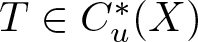 $T \in C^*_u(X)$ sitting in some ideal $I$ with $U(I)=U$, which leads to the following:
Definition 4.1. For a space  $(X,d)$ and an invariant open subset $U$ of $\beta X$, denote
 \begin{equation*}
\tilde{I}(U):=\{T \in C^*_u(X): \overline{\mathrm{r}(\mathrm{supp}_\varepsilon(T))} \subseteq U \text{~for~every~}\varepsilon \gt 0\}.
\end{equation*}
\begin{equation*}
\tilde{I}(U):=\{T \in C^*_u(X): \overline{\mathrm{r}(\mathrm{supp}_\varepsilon(T))} \subseteq U \text{~for~every~}\varepsilon \gt 0\}.
\end{equation*} We call  $\tilde{I}(U)$ the ghostly ideal associated to $U$.
$U$.
The terminology will become clear later (see Proposition 4.6 and Remark 4.8 below). Firstly, let us verify that  $\tilde{I}(U)$ is indeed an ideal in $C^*_u(X)$.
Lemma 4.2. For an invariant open subset  $U$ of $\beta X$, $\tilde{I}(U)$ is an ideal in $C^*_u(X)$.
Proof. It is clear that  $\tilde{I}(U)$ is a closed $\ast$-linear space. Given $T \in \tilde{I}(U)$ and $S \in C^*_u(X)$, we need show $TS \in \tilde{I}(U)$. Since $\tilde{I}(U)$ is closed in $C^*_u(X)$, we only consider $S \in \mathbb{C}_u[X]$. Moreover, we can assume that $\mathrm{supp}(S)$ is a partial translation. In this case, $\mathrm{r}(\mathrm{supp}_\varepsilon(TS)) \subseteq \mathrm{r}(\mathrm{supp}_{\varepsilon/\|S\|}(T))$ for any $\varepsilon \gt 0$, which finishes the proof.
The following shows that  $\tilde{I}(U)$ is indeed the largest element in the lattice $\mathfrak{I}_U$:
Lemma 4.3. Given an invariant open subset  $U$ of $\beta X$, we have the following:
(1) for an ideal
$I$ in
$C^*_u(X)$ with
$U(I)=U$, then
$I \subseteq \tilde{I}(U)$.(2)
$U(\tilde{I}(U))=U$.


Proof. (1). Given  $T \in I$, the condition $U(I)=U$ implies that $\overline{\mathrm{r}(\mathrm{supp}_\varepsilon(T))} \subseteq U$ for each $\varepsilon \gt 0$. Hence, by definition, we have $T \in \tilde{I}(U)$.
(2). Note that
 \begin{equation*}
U(\tilde{I}(U)) = \bigcup_{T \in \tilde{I}(U), \varepsilon \gt 0} \overline{\mathrm{r}(\mathrm{supp}_\varepsilon(T))} \subseteq U.
\end{equation*}
\begin{equation*}
U(\tilde{I}(U)) = \bigcup_{T \in \tilde{I}(U), \varepsilon \gt 0} \overline{\mathrm{r}(\mathrm{supp}_\varepsilon(T))} \subseteq U.
\end{equation*} Proposition 3.7 shows that  $U(I(U))=U$, which implies that $\tilde{I}(U) \supseteq I(U)$ thanks to (1). Hence, we have $U(\tilde{I}(U)) \supseteq U(I(U)) =U$ again by Proposition 3.7.
Combining with Proposition 3.8, we reach the following:
Theorem 4.4 Let  $(X,d)$ be a space and $U \subseteq \beta X$ be invariant and open. Then any ideal $I$ in $C^*_u(X)$ with $U(I)=U$ sits between $I(U)$ and $\tilde{I}(U)$. Hence, the geometric ideal $I(U)$ is the smallest element while the ghostly ideal $\tilde{I}(U)$ is the largest one in the lattice $\mathfrak{I}_U$ in (1.1).
Theorem 4.4 draws the border of the lattice  $\mathfrak{I}_U$. Therefore, if we can describe every ideal between $I(U)$ and $\tilde{I}(U)$ for each invariant open subset $U \subseteq \beta X$, then we will obtain a full description for the ideal structure of the uniform Roe algebra $C^*_u(X)$ (see Question 8.1).
Now we aim to provide a geometric description for ghostly ideals, which will explain the terminology. Let us start with an easy example.
Example 4.5. Taking  $U=X$, then $\tilde{I}(X)$ is the ideal $I_G$ defined in Section 2.3. Indeed, $T \in \tilde{I}(X)$ if and only if for any $\varepsilon \gt 0$, $\mathrm{r}(\mathrm{supp}_\varepsilon(T))$ is finite. This is equivalent to that $T \in C_0(X \times X)$ since $T \in C^*_u(X)$. On the other hand, it is clear that $\tilde{I}(\beta X) = C^*_u(X)$.
More generally, we have the following:
Proposition 4.6. For an invariant open subset  $U \subseteq \beta X$ and $T \in C^*_u(X)$, the following are equivalent:
(1)
$T \in \tilde{I}(U)$;(2)
$\overline{T} \in C_0(G(X)_U)$;(3)
$\overline{T} \in \overline{I_c(U)}^{\|\cdot\|_\infty}$;(4)
$T$ vanishes in the
$(\beta X \setminus U)$-direction, i.e.,
$\Phi_\omega(T) = 0$ for any
$\omega \in \beta X \setminus U$.


Proof. ‘(1)  $\Rightarrow$ (2)’: By definition, for any $\varepsilon \gt 0$ we have
 \begin{equation*}
\mathrm{r}(\mathrm{supp}(\overline{T_\varepsilon})) = \mathrm{r}(\overline{\mathrm{supp}(T_\varepsilon)}) = \overline{\mathrm{r}(\mathrm{supp}_\varepsilon(T))} \subseteq U.
\end{equation*}
\begin{equation*}
\mathrm{r}(\mathrm{supp}(\overline{T_\varepsilon})) = \mathrm{r}(\overline{\mathrm{supp}(T_\varepsilon)}) = \overline{\mathrm{r}(\mathrm{supp}_\varepsilon(T))} \subseteq U.
\end{equation*} Consider the compact set  $K:=\{\tilde{\omega} \in \beta(X \times X): |\overline{T}(\tilde{\omega})| \geq 2\varepsilon\}$. By Lemma 3.1, we have $\mathrm{r}(K) \subseteq \mathrm{r}(\mathrm{supp}(\overline{T_\varepsilon})) \subseteq U$, which implies that $K\subseteq G(X)_U$. Moreover, we have $|\overline{T}(\tilde{\omega})| \lt 2\varepsilon$ for any $\tilde{\omega} \in \beta(X \times X) \setminus K$, which concludes that $\overline{T} \in C_0(G(X)_U)$.
‘(2)  $\Rightarrow$ (1)’: Assume that $\overline{T} \in C_0(G(X)_U) \subseteq C(\beta(X \times X))$. Then for any $\varepsilon \gt 0$ there exists a compact subset $K \subseteq G(X)_U$ such that for any $\tilde{\omega} \in \beta(X \times X) \setminus K$, we have $|\overline{T}(\tilde{\omega})| \lt \varepsilon$. This implies that $\{\tilde{\omega} \in \beta(X \times X): |\overline{T}(\tilde{\omega})| \geq \varepsilon\} \subseteq K$. Using Lemma 3.1, we obtain that $\overline{\mathrm{supp}(T_\varepsilon)} \subseteq K$, which implies that $\overline{\mathrm{r}(\mathrm{supp}_\varepsilon(T))} \subseteq U$. Hence, $T \in \tilde{I}(U)$.
‘(2)  $\Leftrightarrow$ (3)’ is due to $\overline{I_c(U)}^{\|\cdot\|_\infty} = \{f \in C_0(G(X)): f(\tilde{\omega})=0 \text{for } \tilde{\omega} \notin G(X)_U\}$.
‘(3)  $\Leftrightarrow$ (4)’: By Lemma 2.18, (4) holds if and only if $\overline{T}(\alpha, \gamma) = 0$ for any $\alpha, \gamma \in X(\omega)$ and $\omega \in \beta X \setminus U$. Applying Lemma 2.7 and Lemma 2.14, this holds if and only if $\overline{T}(\tilde{\omega}) = 0$ whenever $\tilde{\omega} \notin G(X)_U$, which describes elements in $\overline{I_c(U)}^{\|\cdot\|_\infty}$.
As a corollary, we recover the following characterization for ghost operators:
Corollary 4.7 ([Reference Špakula and Willett29, Proposition 8.2])
An operator  $T \in C^*_u(X)$ is a ghost if and only if $\Phi_\omega(T)=0$ for any non-principal ultrafilter $\omega$ on $X$.
$X$.
Remark 4.8. Corollary 4.7 shows that a ghost in  $C^*_u(X)$ is locally invisible in all directions. This suggests we consider operators in $\tilde{I}(U)$ as ‘partial’ ghosts, which clarifies the terminology of ‘ghostly ideals’.
We now provide another description for ghostly ideals using operator algebras. Let us start with the short exact sequences from [Reference Higson, Lafforgue and Skandalis22] (see also [Reference Finn-Sell and Wright20, Section 2]).
Given an invariant open subset  $U \subseteq \beta X$, notice that $U^c=\beta X \setminus U$ is also invariant. Denote by $G(X)_{U^c}:=G(X) \cap \mathrm{s}^{-1}(U^c)$ and clearly, we have a decomposition:
 \begin{equation*}
G(X) = G(X)_U \sqcup G(X)_{U^c}.
\end{equation*}
\begin{equation*}
G(X) = G(X)_U \sqcup G(X)_{U^c}.
\end{equation*} Since  $G(X)_U$ is open in $G(X)$, the above induces a short exact sequence of $\ast$-algebras:
 \begin{equation}
0 \longrightarrow C_c(G(X)_U) \longrightarrow C_c(G(X)) \longrightarrow C_c(G(X)_{U^c}) \longrightarrow 0,
\end{equation}
\begin{equation}
0 \longrightarrow C_c(G(X)_U) \longrightarrow C_c(G(X)) \longrightarrow C_c(G(X)_{U^c}) \longrightarrow 0,
\end{equation} where  $C_c(G(X)_U) \longrightarrow C_c(G(X))$ is the inclusion and $C_c(G(X)) \longrightarrow C_c(G(X)_{U^c})$ is the restriction.
We may complete the sequence (4.1) with respect to the maximal norms and obtain the following sequence:
 \begin{equation}
0 \longrightarrow C^*_{\rm max}(G(X)_U) \longrightarrow C^*_{\rm max}(G(X)) \longrightarrow C^*_{\rm max}(G(X)_{U^c}) \longrightarrow 0,
\end{equation}
\begin{equation}
0 \longrightarrow C^*_{\rm max}(G(X)_U) \longrightarrow C^*_{\rm max}(G(X)) \longrightarrow C^*_{\rm max}(G(X)_{U^c}) \longrightarrow 0,
\end{equation}which is automatically exact (see, e.g., [Reference Muhly, Renault and Williams34, Lemma 2.10]). We may also complete (4.1) with respect to the reduced norms and obtain the following sequence:
 \begin{equation}
0 \longrightarrow C^*_r(G(X)_U) \stackrel{i_U}{\longrightarrow} C^*_r(G(X)) \stackrel{q_U}{\longrightarrow} C^*_r(G(X)_{U^c}) \longrightarrow 0.
\end{equation}
\begin{equation}
0 \longrightarrow C^*_r(G(X)_U) \stackrel{i_U}{\longrightarrow} C^*_r(G(X)) \stackrel{q_U}{\longrightarrow} C^*_r(G(X)_{U^c}) \longrightarrow 0.
\end{equation} By construction,  $i_U$ is injective, $q_U$ is surjective and $q_U \circ i_U =0$. Also, recall from Lemma 3.5 that $i_U(C^*_r(G(X)_U)) = I(U)$, the geometric ideal associated to $U$. However, in general, (4.3) fails to be exact at the middle item. This is crucial in [Reference Higson, Lafforgue and Skandalis22] to provide a counterexample to the Baum–Connes conjecture with coefficients.
For  $U=X$, it was proved in [Reference Finn-Sell and Wright20, Proposition 4.4] that ${\rm Ker}(q_X)=I_G$. Hence, from Example 3.6 and 4.5, the sequence (4.3) is exact for $U=X$ if and only if $I(X) = \tilde{I}(X)$. More generally, we have the following:
Proposition 4.9. Given an invariant open subset  $U \subseteq \beta X$, the kernel of $q_U$ in (4.3) coincides with the ghostly ideal $\tilde{I}(U)$. Hence, (4.3) is exact if and only if $I(U) = \tilde{I}(U)$.
Proof. It is easy to see that an operator  $T \in C^*_u(X) \cong C^*_r(G(X))$ belongs to the kernel of $q_U$ if and only if $\lambda_\omega(T)=0$ for any $\omega \in \beta X \setminus U$, where $\lambda_\omega$ is the left regular representation from (2.1). Now [Reference Špakula and Willett29, Lemma C.3] implies that $\Phi_\omega(T) = 0$ for any $\omega \in \beta X \setminus U$. Finally, we conclude the proof thanks to Proposition 4.6.
We end this section with an illuminating example from [Reference Wang51, Section 3] (see also [Reference Finn-Sell and Wright20, Section 5]), which is important to construct counterexamples to coarse Baum–Connes conjectures:
Example 4.10. Let  $\{X_i\}_{i\in \mathbb{N}}$ be a sequence of expander graphs or perturbed expander graphs (see [Reference Wang51] for the precise definition). Let $Y_{i,j}=X_i$ for all $j\in \mathbb{N}$ and set $Y:=\bigsqcup_{i,j} Y_{i,j}$. We endow $Y$ with a metric $d$ such that it is the graph metric on each $Y_{i,j}$ and satisfies $d(Y_{i,j}, Y_{k,l}) \to \infty$ as $i+j+k+l \to \infty$. Let $P_{i,j} \in \mathfrak{B}(\ell^2(Y_{i,j}))$ be the orthogonal projection onto constant functions on $Y_{i,j}$, and $P$ be the direct sum of $P_{i,j}$ in the strong operator topology. It is clear that $P \in C^*_u(Y)$, and was explained in [Reference Wang51, Section 3] that $P$ is not a ghost, i.e., $P \notin \tilde{I}(X)$. However, intuitively, $P$ should vanish ‘in the $i$-direction’. We will make it more precise in the following.
Recall from [Reference Finn-Sell and Wright20, Section 5.1] that we have a surjective map  $\beta Y \to \beta X \times \beta \mathbb{N}$ induced by the bijection of $Y$ with $X \times \mathbb{N}$ and the universal property of $\beta Y$. Define:
 \begin{equation*}
f: \beta Y \longrightarrow \beta X \times \beta \mathbb{N} \longrightarrow \beta X
\end{equation*}
\begin{equation*}
f: \beta Y \longrightarrow \beta X \times \beta \mathbb{N} \longrightarrow \beta X
\end{equation*} where the second map is just the projection onto the first coordinate. Denote  $U=f^{-1}(X)$, which is open in $\beta Y$. Note that $U=\bigsqcup_i f^{-1}(X_i)$, where each $f^{-1}(X_i)$ is homeomorphic to $X_i \times \beta \mathbb{N}$. On the other hand, note that
 \begin{equation*}
U= \bigsqcup_i f^{-1}(X_i) = \bigcup_i \overline{\bigsqcup_j Y_{i,j}} = \bigcup_{\varepsilon \gt 0} \overline{\mathrm{r}(\mathrm{supp}_\varepsilon(P))} = \bigcup_{\varepsilon \gt 0, R \gt 0} \overline{\mathcal{N}_R(\mathrm{r}(\mathrm{supp}_\varepsilon(P)))}.
\end{equation*}
\begin{equation*}
U= \bigsqcup_i f^{-1}(X_i) = \bigcup_i \overline{\bigsqcup_j Y_{i,j}} = \bigcup_{\varepsilon \gt 0} \overline{\mathrm{r}(\mathrm{supp}_\varepsilon(P))} = \bigcup_{\varepsilon \gt 0, R \gt 0} \overline{\mathcal{N}_R(\mathrm{r}(\mathrm{supp}_\varepsilon(P)))}.
\end{equation*} Hence, Lemma 3.15 implies that  $U$ is invariant and $U(\langle P \rangle) = U$. (Note that $P \in \tilde{I}(U)$ was already implicitly proved in [Reference Finn-Sell and Wright20, Theorem 5.5], thanks to Proposition 4.9.) Since $U$ contains $Y$ as a proper subset, we reprove that $P$ is not a ghost.
Moreover, it follows from Proposition 4.6 that  $P$ vanishes in the $(\partial_\beta Y \setminus U)$-direction. In particular, fixing an index $j_0 \in \mathbb{N}$ and taking a sequence $\{x_i \in Y_{i,j_0}\}_{i\in \mathbb{N}}$, we choose a cluster point $\omega \in \overline{\{x_i\}_i}$. It is clear that $\omega \notin U$. Intuitively speaking, this means that $P$ vanishes ‘in the $i$-direction’.
We remark that it was proved in [Reference Wang51, Section 3] that the principal ideal  $\langle P \rangle$ cannot be decomposed into $I(U) + (I_G\cap \langle P \rangle)$, which provided a counterexample to the conjecture at the end of [Reference Chen and Wang12]. Our explanation above reveals that the reason behind this counterexample is that the ghostly part of $\langle P \rangle$ could not be ‘exhausted’ merely by ghostly elements associated with $X$ (rather than $U$). Finally, we remark that $G(Y)_U$ above also plays a key role in constructing a counterexample to the boundary coarse Baum–Connes conjecture introduced in [Reference Finn-Sell and Wright20].
5. Geometric ideals vs ghostly ideals
In this section, our main focus is when  $I(U)=\tilde{I}(U)$ or equivalently, when $\mathfrak{I}_U$ consists of a single element by Theorem 4.4. Moreover, we will discuss their $K$-theories and provide a sufficient condition to ensure $K_\ast(I(U))=K_\ast(\tilde{I}(U))$.
Let us start with the case that  $U=X$. Combining [Reference Chen and Wang14, Theorem 4.4] and [Reference Roe and Willett45, Theorem 1.3], we have the following:
Proposition 5.1. For a space  $(X,d)$, the following are equivalent:
(1)
$X$ has Property A;(2)
$G(X)$ is amenable;(3)
$G(X)_{\partial_\beta X}$ is amenable;(4)
$I(U)=\tilde{I}(U)$ for any invariant open subset
$U \subseteq \beta X$;(5)
$I(X) = \tilde{I}(X)$.


We remark that ‘(1)  $\Rightarrow$ (4)’ was originally proved in [Reference Chen and Wang14] using approximations by kernels. For the convenience of readers, here we provide a complete proof.
Proof of Proposition 5.1
‘(1)  $\Leftrightarrow$ (2)’ was proved in [Reference Skandalis, Tu and Yu49, Theorem 5.3]. ‘(2) $\Leftrightarrow$ (3)’ is due to the permanence properties of amenability. ‘(4) $\Rightarrow$ (5)’ holds trivially. ‘(5) $\Rightarrow$ (1)’ comes from [Reference Roe and Willett45, Theorem 1.3] together with Example 3.6 and 4.5.
‘(2)  $\Rightarrow$ (4)’: Let $U \subseteq \beta X$ be an invariant open subset. As open/closed subgroupoids, both $G(X)_U$ and $G(X)_{U^c}$ are amenable as well. Consider the following commutative diagram coming from (4.2) and (4.3):

By Proposition 2.9, all three vertical lines are isomorphisms. Hence, the exactness of the first row implies that the second row is exact. Hence, we conclude (4) by Proposition 4.9.
Proposition 5.1 provides a coarse geometric characterization for  $I(X) = \tilde{I}(X)$ using Property A. However, we notice that assuming Property A is often too strong to ensure that $I(U) = \tilde{I}(U)$ for merely a specific invariant open subset $U \subseteq \beta X$. A trivial example is that $I(\beta X) = \tilde{I}(\beta X)$ holds for any space $X$. This suggests us to explore a weaker criterion for $I(U) = \tilde{I}(U)$, and we reach the following:
Proposition 5.2. Let  $(X,d)$ be a space and $U$ be an invariant open subset of $\beta X$. If the canonical quotient map $C^*_{{\rm max}}(G(X)_{U^c}) \to C^*_r(G(X)_{U^c})$ is an isomorphism, then $I(U)=\tilde{I}(U)$. In particular, if the groupoid $G(X)_{U^c}$ is amenable then $I(U)=\tilde{I}(U)$.
Proof. We consider the following commutative diagram:

Here the map  $\pi_U$ is the composition:
 \begin{equation}
C^*_{{\rm max}}(G(X)_U) \to C^*_r(G(X)_U) \cong I(U) \hookrightarrow \tilde{I}(U),
\end{equation}
\begin{equation}
C^*_{{\rm max}}(G(X)_U) \to C^*_r(G(X)_U) \cong I(U) \hookrightarrow \tilde{I}(U),
\end{equation} where the middle isomorphism comes from Lemma 3.5. The top horizontal line is automatically exact, while the bottom one is also exact by Proposition 4.9. The middle vertical map is always surjective, and by assumption, the right vertical map is an isomorphism. Hence, via a diagram chasing argument, we obtain that the left vertical map is surjective. This concludes that  $I(U)=\tilde{I}(U)$ thanks to (5.2).
Remark 5.3. When  $U=X$, Proposition 5.2 recovers ‘(3) $\Rightarrow$ (5)’ in Proposition 5.1. Readers might wonder whether the converse of Proposition 5.2 holds as in the case of $U=X$. We manage to provide a partial answer in Section 6.4.
Now we move to discuss the  $K$-theories of geometric and ghostly ideals:
Theorem 5.4. Let  $X$ be a space that can be coarsely embedded into some Hilbert space. Then for any invariant open subset $U \subseteq \beta X$, we have an isomorphism
 \begin{equation*}
(\iota_U)_\ast: K_\ast(I(U)) \longrightarrow K_\ast(\tilde{I}(U))
\end{equation*}
\begin{equation*}
(\iota_U)_\ast: K_\ast(I(U)) \longrightarrow K_\ast(\tilde{I}(U))
\end{equation*} for  $\ast =0,1$, where $\iota_U$ is the inclusion map. Therefore, for any ideal $I$ in $C^*_u(X)$, we have an injective homomorphism
 \begin{equation*}
(\iota_I)_\ast: K_\ast(\overline{I \cap \mathbb{C}_u[X]}) \longrightarrow K_\ast(I)
\end{equation*}
\begin{equation*}
(\iota_I)_\ast: K_\ast(\overline{I \cap \mathbb{C}_u[X]}) \longrightarrow K_\ast(I)
\end{equation*} for  $\ast =0,1$, where $\iota_I$ is the inclusion map.
Proof. Fixing such a  $U\subseteq \beta X$, we consider the commutative diagram (5.1) from the proof of Proposition 5.2, where both of the horizontal lines are exact. This implies the following commutative diagram in $K$-theories:

where both horizontal lines are exact. Recall from [Reference Skandalis, Tu and Yu49, Theorem 5.4] that  $X$ is coarsely embeddable if and only if $G(X)$ is a-T-menable and hence, both $G(X)_U$ and $G(X)_{U^c}$ are a-T-menable. Moreover, $G(X)_{U^c}$ is $\sigma$-compact (In general, G(X)U is not σ-compact. In fact, this is true if and only if U is σ-compact. Moreover, compact open subsets of βX are the same thing as sets of the form A for A ⊆ X. Hence U is σ-compact if and only if L(U) is countably generated, which is false in general by Example 6.14). Proposition 2.10 implies that $G(X)$ and $G(X)_{U^c}$ are $K$-amenable. Hence, the middle two vertical maps above are isomorphisms, which implies that $(\pi_U)_\ast$ is an isomorphism by the Five Lemma. Therefore, from (5.2), we obtain that the composition
 \begin{equation*}
K_\ast(C^*_{{\rm max}}(G(X)_U)) \longrightarrow K_\ast(C^*_r(G(X)_U)) \cong K_\ast(I(U)) \stackrel{(\iota_U)_\ast}{\longrightarrow} K_\ast(\tilde{I}(U))
\end{equation*}
\begin{equation*}
K_\ast(C^*_{{\rm max}}(G(X)_U)) \longrightarrow K_\ast(C^*_r(G(X)_U)) \cong K_\ast(I(U)) \stackrel{(\iota_U)_\ast}{\longrightarrow} K_\ast(\tilde{I}(U))
\end{equation*} is an isomorphism for  $\ast=0,1$.
On the other hand, we claim that  $K_\ast(C^*_{{\rm max}}(G(X)_U)) \longrightarrow K_\ast(C^*_r(G(X)_U))$ is an isomorphism and hence the map $(\iota_U)_\ast$ is an isomorphism for $\ast=0,1$. Indeed, recall from [Reference Skandalis, Tu and Yu49, Lemma 3.3] that there is a locally compact, second countable, ample and étale groupoid $\mathcal{G}^{\prime}$ such that $G(X) = \beta X \rtimes \mathcal{G}^{\prime}$, which implies $G(X)_U = U \rtimes \mathcal{G}^{\prime}$. Hence, $C^*_{{\rm max}}(G(X)_U) \cong C_0(U) \rtimes_{{\rm max}} \mathcal{G}^{\prime}$ and $C^*_r(G(X)_U) \cong C_0(U) \rtimes_{r} \mathcal{G}^{\prime}$. Note that the $\mathcal{G}^{\prime}$- $C^*$-algebra $C_0(U)$ can be written as an inductive limit $\varinjlim_{i\in I} (A_i, \phi_i)$ of separable $\mathcal{G}^{\prime}$- $C^*$-algebras. Moreover, [Reference Skandalis, Tu and Yu49, Theorem 5.4] implies that $\mathcal{G}^{\prime}$ is a-T-menable since $G(X)$ is a-T-menable, and hence $\mathcal{G}^{\prime}$ is $K$-amenable by Proposition 2.10. It follows from [Reference Tu50, Proposition 4.12] that the canonical map $K_\ast(A_i \rtimes_{{\rm max}} \mathcal{G}') \rightarrow K_\ast(A_i \rtimes_{r} \mathcal{G}')$ is an isomorphism for each $i \in I$. Taking limits, we obtain that $K_\ast(C_0(U) \rtimes_{{\rm max}} \mathcal{G}') \rightarrow K_\ast(C_0(U) \rtimes_{r} \mathcal{G}')$ is also an isomorphism, which concludes the claim.
For the last statement, assume  $U=U(I)$. By Lemma 3.9, $\overline{I \cap \mathbb{C}_u[X]} = I(U)$. Also, Lemma 4.3(1) shows that $I \subseteq \tilde{I}(U)$. Hence, $\iota_U$ can be decomposed as follows:
 \begin{equation*}
I(U) = \overline{I \cap \mathbb{C}_u[X]} \stackrel{\iota_I}{\hookrightarrow} I \hookrightarrow \tilde{I}(U).
\end{equation*}
\begin{equation*}
I(U) = \overline{I \cap \mathbb{C}_u[X]} \stackrel{\iota_I}{\hookrightarrow} I \hookrightarrow \tilde{I}(U).
\end{equation*} Therefore,  $(\iota_U)_\ast$ being an isomorphism implies that $(\iota_I)_\ast$ is injective for $\ast=0,1$.
Applying Theorem 5.4 to the case of  $U=X$, we partially recover the following result by Finn-Sell (see [Reference Finn-Sell19, Corollary 36]):
Corollary 5.5. Let  $X$ be a space that can be coarsely embedded into some Hilbert space. Then the inclusion of $\mathfrak{K}(\ell^2(X))$ into $I_G$ induces an isomorphism on the $K$-theory level.
6. Partial Property A and partial operator norm localization property
Here, we study the converse to Proposition 5.2 and show that this is indeed an equivalent condition under an extra assumption. Our strategy is to follow the outline of the case that  $U=X$.
6.1. Partial Property A
Recall from Proposition 5.1 that a space  $X$ has Property A if and only if the groupoid $G(X)_{\partial_\beta X}$ is amenable, which characterizes $I(X) = \tilde{I}(X)$. Together with Proposition 5.2, this inspires us to introduce the following:
Definition 6.1. Let  $(X,d)$ be a space and $U \subseteq \beta X$ be invariant (not necessarily open). We say that $X$ has partial Property A relative to $U$ if $G(X)_{\partial_\beta X \setminus U}$ is amenable.
It is clear from the definition that  $X$ has Property A if and only if it has partial Property A relative to $X$. On the other hand, it follows from Proposition 5.2 that if $X$ has partial Property A relative to some invariant open $U$, then we have $I(U) = \tilde{I}(U)$. The rest of this section is devoted to studying the converse.
Firstly, we aim to unpack the groupoid language and provide a concrete geometric description for partial Property A, which resembles the definition of Property A (see Definition 2.1). The following is the main result:
Proposition 6.2. Let  $(X,d)$ be a space and $U \subseteq \beta X$ an invariant open subset. Then $X$ has partial Property A relative to $U$ if and only if for any $\varepsilon, R \gt 0$, there exist $S \gt 0$, a subset $D \subseteq X$ with $\overline{D} \supseteq U^c$ and a function $f: X \times X \to [0,1]$ satisfying:
(1)
$\mathrm{supp}(f) \subseteq E_S$;(2) for any
$x\in D$, we have
$\sum_{z\in X} f(z,x) =1$;(3) for any
$x, y\in D$ with
$d(x,y) \leq R$, we have
$\sum_{z\in X} |f(z,x) - f(z,y)| \leq \varepsilon$.


To prove Proposition 6.2, we start with the following lemma:
Lemma 6.3. With the same notation as above,  $X$ has partial Property A relative to $U$ if and only if for any $\varepsilon, R \gt 0$, there exist $S \gt 0$ and $f: X \times X \to [0,1]$ satisfying:
(1)
$\mathrm{supp}(f) \subseteq E_S$;(2) for any
$\omega\in U^c$, we have
$\sum_{\alpha \in X(\omega)} \overline{f}(\alpha, \omega) =1$;(3) for
$\omega\in U^c$ and
$\alpha \in X(\omega)$ with
$d_\omega(\alpha, \omega) \leq R$, then
$\sum_{\gamma\in X(\omega)} |\overline{f}(\gamma, \alpha) - \overline{f}(\gamma, \omega)| \leq \varepsilon$,


where  $\overline{f} \in C_0(G(X))$ is the continuous extension from Lemma 2.7.
Proof. By definition,  $X$ has partial Property A relative to $U$ if and only if for any $\varepsilon \gt 0$ and compact $K \subseteq G(X)_{U^c}$, there exists $g \in C_c(G(X)_{U^c})$ with range in $[0,1]$ such that for any $\gamma \in K$ we have
 \begin{equation*}
\sum_{\alpha \in \mathcal{G}_{\mathrm{r}(\gamma)}} g(\alpha) =1 \quad \text{and} \quad \sum_{\alpha \in \mathcal{G}_{\mathrm{r}(\gamma)}} |g(\alpha) - g(\alpha\gamma)| \lt \varepsilon.
\end{equation*}
\begin{equation*}
\sum_{\alpha \in \mathcal{G}_{\mathrm{r}(\gamma)}} g(\alpha) =1 \quad \text{and} \quad \sum_{\alpha \in \mathcal{G}_{\mathrm{r}(\gamma)}} |g(\alpha) - g(\alpha\gamma)| \lt \varepsilon.
\end{equation*} Since the restriction map  $C_c(G(X)) \to C_c(G(X)_{U^c})$ is surjective, $g$ can be regarded as a function in $C_c(G(X))$. Taking $f$ to be the restriction of $g$ on $X \times X$, then $f \in \ell^\infty(X \times X)$ and there exists $S \gt 0$ such that $\mathrm{supp}(f) \subseteq E_S$ for some $S \gt 0$. Moreover, $g = \overline{f}$. Note that $G(X)_{U^c} = \bigcup_{R \gt 0} (\overline{E_R} \cap G(X)_{U^c})$, and hence $K \subseteq \overline{E_R} \cap G(X)_{U^c}$ for some $R \gt 0$. By Lemma 2.14 and Lemma 2.16, we conclude the proof.
Proof of Proposition 6.2
Sufficiency: For any  $\varepsilon, R \gt 0$, choose $S \gt 0$, $D \subseteq X$ and $g: X \times X \to [0,1]$ satisfying the conditions (1)-(3) for $\varepsilon$ and $3R$. Take a map $p: \mathcal{N}_R(D) \to D$ such that $p|_D = \mathrm{Id}_D$ and $d(p(x), x) \leq R$. Now we define:
 \begin{equation*}
f(x,y) =
\begin{cases}
~g(x,p(y)), & y\in \mathcal{N}_R(D); \\
~g(x,y), & \text{otherwise}.
\end{cases}
\end{equation*}
\begin{equation*}
f(x,y) =
\begin{cases}
~g(x,p(y)), & y\in \mathcal{N}_R(D); \\
~g(x,y), & \text{otherwise}.
\end{cases}
\end{equation*} It is clear that  $\mathrm{supp}(f) \subseteq E_{R+S}$. Moreover, for any $y_1, y_2 \in \mathcal{N}_R(D)$ with $d(y_1, y_2) \leq R$, we have $d(p(y_1),p(y_2)) \leq 3R$ and hence
 \begin{equation*}
\sum_{x\in X} |f(x,y_1) - f(x,y_2)| = \sum_{x\in X} |g(x,p(y_1)) - g(x,p(y_2))| \leq \varepsilon.
\end{equation*}
\begin{equation*}
\sum_{x\in X} |f(x,y_1) - f(x,y_2)| = \sum_{x\in X} |g(x,p(y_1)) - g(x,p(y_2))| \leq \varepsilon.
\end{equation*} Therefore, (enlarging  $S$ to $S+R$), we obtain that for any $\varepsilon, R \gt 0$, there exist $S \gt 0$, a subset $D \subseteq X$ with $\overline{D} \supseteq U^c$ and a function $f: X \times X \to [0,1]$ satisfying:
(1)
$\mathrm{supp}(f) \subseteq E_S$;(2) for any
$x\in D$, we have
$\sum_{z\in X} f(z,x) =1$;(3) for any
$x\in D$ and
$y\in X$ with
$d(x,y) \leq R$, we have
$\sum_{z\in X} |f(z,x) - f(z,y)| \leq \varepsilon$.


Now we fix  $\varepsilon, R \gt 0$ and take such $S, D$ and function $f$.
$f$.
Given  $\omega \in U^c$, we have $\omega(D)=1$. Choose $\{t_\alpha:D_\alpha \to R_\alpha\}$ to be a compatible family for $\omega$. Applying [Reference Špakula and Willett29, Proposition 3.10], there exists $Y_\omega \subseteq X$ with $\omega(Y)=1$ and a local coordinate system $\{h_y: B(\omega, R+S) \to B(y,R+S)\}_{y\in Y_\omega}$ such that the map
 \begin{equation*}
h_y: B(\omega, R+S) \to B(y,R+S), \quad \alpha \mapsto t_\alpha(y)
\end{equation*}
\begin{equation*}
h_y: B(\omega, R+S) \to B(y,R+S), \quad \alpha \mapsto t_\alpha(y)
\end{equation*} is a surjective isometry for each  $y\in Y_\omega$. Replacing $Y$ by $Y_\omega \cap D$, we assume that $Y_\omega \subseteq D$. Note that $\mathrm{supp}(f) \subseteq E_S$, and hence applying Lemma 2.16 we have
 \begin{align}
\sum_{\alpha \in X(\omega)} \overline{f}(\alpha, \omega) & = \sum_{\alpha \in B(\omega, S)} \overline{f}(\alpha, \omega) = \sum_{\alpha \in B(\omega, S)} \lim_{x\to \omega} f(t_\alpha(x),x)\nonumber\\ &= \lim_{x\to \omega, x\in Y_\omega} \sum_{\alpha \in B(\omega, S)} f(t_\alpha(x),x) \nonumber \\
&= \lim_{x\to \omega, x\in Y_\omega} \sum_{z\in B(x,S)} f(z,x) = \lim_{x\to \omega, x\in Y_\omega} \sum_{z\in X} f(z,x),
\end{align}
\begin{align}
\sum_{\alpha \in X(\omega)} \overline{f}(\alpha, \omega) & = \sum_{\alpha \in B(\omega, S)} \overline{f}(\alpha, \omega) = \sum_{\alpha \in B(\omega, S)} \lim_{x\to \omega} f(t_\alpha(x),x)\nonumber\\ &= \lim_{x\to \omega, x\in Y_\omega} \sum_{\alpha \in B(\omega, S)} f(t_\alpha(x),x) \nonumber \\
&= \lim_{x\to \omega, x\in Y_\omega} \sum_{z\in B(x,S)} f(z,x) = \lim_{x\to \omega, x\in Y_\omega} \sum_{z\in X} f(z,x),
\end{align} where the last item equals  $1$ thanks to the assumption.
On the other hand, for any  $\alpha \in B(\omega, R)$ we have $\lim_{x\to \omega} d(t_\alpha(x),x) \leq R$. Hence, shrinking $Y_\omega$ if necessary, we can assume $d(t_\alpha(x),x) \leq R$ for any $x\in Y_\omega$. Hence
 \begin{equation}
\sum_{\gamma\in X(\omega)} |\overline{f}(\gamma, \alpha) - \overline{f}(\gamma, \omega)| = \sum_{\gamma\in B(\omega, R+S)} |\overline{f}(\gamma, \alpha) - \overline{f}(\gamma, \omega)|\qquad\qquad\qquad\qquad \end{equation}
\begin{equation}
\sum_{\gamma\in X(\omega)} |\overline{f}(\gamma, \alpha) - \overline{f}(\gamma, \omega)| = \sum_{\gamma\in B(\omega, R+S)} |\overline{f}(\gamma, \alpha) - \overline{f}(\gamma, \omega)|\qquad\qquad\qquad\qquad \end{equation} \begin{align*} &\qquad\qquad\qquad\qquad\qquad\! = \lim_{x\to \omega, x\in Y_\omega}\sum_{\gamma\in B(\omega, R+S)} |f(t_\gamma(x), t_\alpha(x)) - f(t_\gamma(x), x)|\\
&\qquad\qquad\qquad\qquad\qquad\! = \lim_{x\to \omega, x\in Y_\omega}\sum_{z\in B(x, R+S)} |f(z, t_\alpha(x)) - f(z, x)| \\
&\qquad\qquad\qquad\qquad\qquad\! = \lim_{x\to \omega, x\in Y_\omega}\sum_{z\in X} |f(z, t_\alpha(x)) - f(z, x)| \leq \varepsilon.
\end{align*}
\begin{align*} &\qquad\qquad\qquad\qquad\qquad\! = \lim_{x\to \omega, x\in Y_\omega}\sum_{\gamma\in B(\omega, R+S)} |f(t_\gamma(x), t_\alpha(x)) - f(t_\gamma(x), x)|\\
&\qquad\qquad\qquad\qquad\qquad\! = \lim_{x\to \omega, x\in Y_\omega}\sum_{z\in B(x, R+S)} |f(z, t_\alpha(x)) - f(z, x)| \\
&\qquad\qquad\qquad\qquad\qquad\! = \lim_{x\to \omega, x\in Y_\omega}\sum_{z\in X} |f(z, t_\alpha(x)) - f(z, x)| \leq \varepsilon.
\end{align*}Therefore, applying Lemma 6.3, we conclude the sufficiency.
Necessity: Given  $\varepsilon, R \gt 0$, Lemma 6.3 provides $S \gt 0$ and $f: X \times X \to [0,1]$ satisfying the conditions (1)-(3) therein. For $\omega \in U^c$, choose a compatible family $\{t_\alpha:D_\alpha \to R_\alpha\}$. Applying [Reference Špakula and Willett29, Proposition 3.10], there exists $Y_\omega \subseteq X$ with $\omega(Y)=1$ and a local coordinate system $\{h_y: B(\omega, R+S) \to B(y,R+S)\}_{y\in Y_\omega}$ such that
 \begin{equation*}
h_y: B(\omega, R+S) \to B(y,R+S), \quad \alpha \mapsto t_\alpha(y)
\end{equation*}
\begin{equation*}
h_y: B(\omega, R+S) \to B(y,R+S), \quad \alpha \mapsto t_\alpha(y)
\end{equation*} is a surjective isometry for each  $y\in Y_\omega$. By the calculations in (6.1), we obtain that
 \begin{equation*}
\lim_{x\to \omega, x\in Y_\omega} \sum_{z\in X} f(z,x) =1.
\end{equation*}
\begin{equation*}
\lim_{x\to \omega, x\in Y_\omega} \sum_{z\in X} f(z,x) =1.
\end{equation*} Hence, for the given  $\varepsilon$, there exists $Y'_\omega \subseteq Y_\omega$ with $\omega(Y'_\omega)=1$ such that
 \begin{equation*}
\sum_{z\in X} f(z,x) \in (1-\varepsilon, 1+\varepsilon), \quad \forall x\in Y'_\omega.
\end{equation*}
\begin{equation*}
\sum_{z\in X} f(z,x) \in (1-\varepsilon, 1+\varepsilon), \quad \forall x\in Y'_\omega.
\end{equation*} On the other hand, for any  $\alpha \in B(\omega, R)$ the calculations in (6.2) show that
 \begin{equation*}
\lim_{x\to \omega, x\in Y'_\omega}\sum_{z\in X} |f(z, t_\alpha(x)) - f(z, x)| = \sum_{\gamma\in X(\omega)} |\overline{f}(\gamma, \alpha) - \overline{f}(\gamma, \omega)| \leq \varepsilon.
\end{equation*}
\begin{equation*}
\lim_{x\to \omega, x\in Y'_\omega}\sum_{z\in X} |f(z, t_\alpha(x)) - f(z, x)| = \sum_{\gamma\in X(\omega)} |\overline{f}(\gamma, \alpha) - \overline{f}(\gamma, \omega)| \leq \varepsilon.
\end{equation*} For  $x\in Y'_\omega$, [Reference Špakula and Willett29, Proposition 3.10] implies that $\{t_\alpha(x): \alpha \in B(\omega, R)\} = B(x,R)$. Hence, there exists $Y^{\prime\prime}_\omega \subseteq Y'_\omega$ with $\omega(Y^{\prime\prime}_\omega)=1$ such that for any $x \in Y^{\prime\prime}_\omega$ and $y\in B(x,R)$, we have
 \begin{equation*}
\sum_{z\in X} |f(z, y) - f(z, x)| \lt 2\varepsilon.
\end{equation*}
\begin{equation*}
\sum_{z\in X} |f(z, y) - f(z, x)| \lt 2\varepsilon.
\end{equation*} Taking  $D:=\bigcup_{\omega \in U^c} Y^{\prime\prime}_\omega$, clearly $\overline{D} \supseteq U^c$. Moreover, the analysis above shows that:
• for any
$x\in D$ we have
$\sum_{z\in X} f(z,x) \in (1-\varepsilon, 1+\varepsilon)$;• for any
$x\in D$ and
$y\in B(x,R)$, we have
$\sum_{z\in X} |f(z, y) - f(z, x)| \lt 2\varepsilon$.


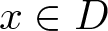


Finally, using a standard normalization argument, we conclude the proof.
Setting  $\xi_y(x):=f(x,y)$ for the function $f$ in Proposition 6.2, we can rewrite Proposition 6.2 as follows:
Proposition 6.2. Let  $(X,d)$ be a space and $U \subseteq \beta X$ be an invariant open subset. Then $X$ has partial Property A relative to $U$ if and only if for any $\varepsilon, R \gt 0$, there exist $S \gt 0$, a subset $D \subseteq X$ with $\overline{D} \supseteq U^c$ and a function $\xi: D \to \ell^1(X)_{1,+}, x \mapsto \xi_x$ satisfying:
(1)
$\mathrm{supp}(\xi_x) \subseteq B(x,S)$ for any
$x\in D$;(2) for any
$x, y\in D$ with
$d(x,y) \leq R$, we have
$\|\xi_x - \xi_y\|_1 \leq \varepsilon$.


Remark 6.4. The function  $\xi$ in Proposition 6.2 can be made such that $\xi_x \in \ell^1(D)_{1,+}$. In fact, this is the same trick as in the case of Property A (see, e.g., [Reference Nowak and Yu35, Proposition 4.2.5]). We can further replace $\ell^1(D)_{1,+}$ by $\ell^2(D)_{1,+}$ using the Mazur map.
Now we provide an alternative picture for partial Property A using the notion of ideals in spaces (see Definition 3.10). Recall that for an ideal  $\textbf{L}$ in $X$, we denote $U(\textbf{L}):= \bigcup_{Y \in \textbf{L}} \overline{Y}$. The following lemma is easy, and the proof is left to the readers.
Lemma 6.5. Let  $\textbf{L}$ be an ideal in $X$ and $D \subseteq X$. Then $\overline{D} \supseteq U(\textbf{L})^c$ if and only if there exists $Y \in \textbf{L}$ such that $D \supseteq Y^c$.
Thanks to Lemma 6.5, we can rewrite Proposition 6.2:
Corollary 6.6. Let  $(X,d)$ be a space and $U \subseteq \beta X$ an invariant open subset. Then $X$ has partial Property A relative to $U$ if and only if for any $R \gt 0$ and $\varepsilon \gt 0$, there exist $S \gt 0$, $Y \in \textbf{L}(U)$ and a kernel $k: Y^c \times Y^c \to \mathbb{R}$ of positive type satisfying:
(1) for
$x,y\in Y^c$, we have
$k(x,y)=k(y,x)$ and
$k(x,x) =1$;(2) for
$x,y\in Y^c$ with
$d(x,y) \geq S$, we have
$k(x,y)=0$;(3) for
$x,y\in Y^c$ with
$d(x,y) \leq R$, we have
$|1-k(x,y)| \leq \varepsilon$.


6.2. Partial operator norm localization property
Let  $\nu$ be a positive locally finite Borel measure on $X$ and $\mathcal{H}$ be a separable infinite-dimensional Hilbert space. For an operator $T \in \mathfrak{B}(L^2(X,\nu) \otimes \mathcal{H})$, we can also define its propagation as in Section 2.3. We introduce the following:
Definition 6.7. Let  $(X,d)$ be a space and $U \subseteq \beta X$ an invariant open subset. We say that $X$ has partial operator norm localization property (partial ONL) relative to $U$ if there exists $c \in (0,1]$ such that for any $R \gt 0$ there exist $S \gt 0$ and $D \subseteq X$ with $\overline{D} \supseteq U^c$ satisfying the following: for any positive locally finite Borel measure $\nu$ on $X$ with $\mathrm{supp}(\nu) \subseteq D$ and any $a \in \mathfrak{B}(L^2(X,\nu) \otimes \mathcal{H})$ with propagation at most $R$, there exists a non-zero $\zeta \in L^2(X,\nu) \otimes \mathcal{H}$ with $\mathrm{diam}(\mathrm{supp}(\zeta)) \leq S$ such that $c\|a\| \cdot \|\zeta\| \leq \|a \zeta\|$.
Using a similar argument as for [Reference Sako46, Proposition 3.1] together with Lemma 6.5, we have the following. We leave the details to the readers.
Lemma 6.8. Let  $(X,d)$ be a space, $U \subseteq \beta X$ an invariant open subset, and $\textbf{L}=\textbf{L}(U)$ the associated ideal in $X$. Then $X$ has partial ONL relative to $U$ if and only if for any $c \in (0,1)$ and $R \gt 0$ there exist $S \gt 0$ and $Y \in \textbf{L}(U)$ satisfying the following: for any $a \in \mathbb{C}^R_u[Y^c]$ there exists a non-zero $\xi \in \ell^2(X)$ with $\mathrm{diam}(\mathrm{supp}(\xi)) \leq S$ and $c\|a\| \cdot \|\xi\| \leq \|a \xi\|$.
Now we can mimic the proof of [Reference Sako46, Theorem 4.1] using Proposition 6.2, Remark 6.4, Corollary 6.6 together with an analogue of [Reference Sako46, Proposition 3.1], and reach the following. The proof is almost identical, and hence the details are left to the readers.
Proposition 6.9. Let  $(X,d)$ be a space and $U \subseteq \beta X$ be an invariant open subset. Then $X$ has partial Property A relative to $U$ if and only if $X$ has partial ONL relative to $U$.
$U$.
Now we study a permanence property of partial ONL. Let  $X$ be a space and $\textbf{L}$ an ideal in $X$. Assume that $X= X_1 \cup X_2$. Consider
 \begin{equation}
\textbf{L}_i:=\{Y \cap X_i: Y \in \textbf{L}\} \quad \text{for} \quad i=1,2.
\end{equation}
\begin{equation}
\textbf{L}_i:=\{Y \cap X_i: Y \in \textbf{L}\} \quad \text{for} \quad i=1,2.
\end{equation} Then it is routine to check that  $\textbf{L}_i$ is an ideal in $X_i$ for $i=1,2$, and
 \begin{equation*}
\textbf{L}=\{Y_1 \cup Y_2: Y_i \in \textbf{L}_i, i=1,2\}.
\end{equation*}
\begin{equation*}
\textbf{L}=\{Y_1 \cup Y_2: Y_i \in \textbf{L}_i, i=1,2\}.
\end{equation*}Proposition 6.10. With the notation as above, assume that  $X_i$ has partial ONL relative to $U(\textbf{L}_i)$ for $i=1,2$. Then $X$ has partial ONL relative to $U(\textbf{L})$.
One way to prove Proposition 6.10 is to follow the proof of [Reference Chen, Wang and Wang16, Lemma 3.3] with minor changes. Here, we choose another approach using Proposition 6.9. Firstly, we have the following (the proof is straightforward, hence omitted):
Lemma 6.11. Let  $X = X_1 \cup X_2$, $\textbf{L}$ be an ideal in $X$ and $U = U(\textbf{L})$. Then $U \cap \overline{X_i}$ is an invariant open subset of $\overline{X_i} = \beta X_i$, corresponding to the ideal $\textbf{L}_i$ in (6.3) for $i=1,2$.
Although  $U \cap \overline{X_i}$ is invariant in $\beta X_i$, generally it is not invariant in $\beta X$. This coincides with the fact that $\chi_{X_i} C^*_u(X) \chi_{X_i} \cong C^*_u(X_i)$ is just a subalgebra in $C^*_u(X)$ rather than an ideal. Instead, we consider the spatial ideal $I_{X_i}$, and prove the following permanence property for partial Property A:
Lemma 6.12. Let  $X = X_1 \cup X_2$, $U \subseteq \beta X$ be an invariant open subset and $U_i=U \cap \overline{X_i}$ for $i=1,2$. If $X_i$ has partial Property A relative to $U_i$ for $i=1,2$, then $X$ has partial Property A relative to $U$.
$U$.
Proof. For any  $R \gt 0$ and $i=1,2$, set $U_i(R):=\overline{\bigcup_{Y \in \textbf{L}(U_i)} \mathcal{N}_R(Y)}$, which is an invariant open subset of $\overline{\mathcal{N}_R(X_i)} = \beta (\mathcal{N}_R(X_i))$. Proposition 6.2 implies that $\mathcal{N}_R(X_i)$ has partial Property A relative to $U_i(R)$, i.e., $G(\mathcal{N}_R(X_i))_{\overline{\mathcal{N}_R(X_i)} \setminus U_i(R)}$ is amenable. Hence, as a subgroupoid, $G(\mathcal{N}_R(X_i))_{\overline{\mathcal{N}_R(X_i)} \setminus U}$ is amenable, which further implies that the groupoid $\bigcup_{R \gt 0}G(\mathcal{N}_R(X_i))_{\overline{\mathcal{N}_R(X_i)} \setminus U}$ is amenable.
By Lemma 3.12,  $\bigcup_R \overline{\mathcal{N}_R(X_i)}\setminus U$ is invariant in $\beta X$. Lemma 3.14 implies that
 \begin{equation*}
G(X)_{\bigcup_R \overline{\mathcal{N}_R(X_i)}\setminus U} = \bigcup_{R \gt 0} G(\mathcal{N}_R(X_i))_{\overline{\mathcal{N}_R(X_i)} \setminus U},
\end{equation*}
\begin{equation*}
G(X)_{\bigcup_R \overline{\mathcal{N}_R(X_i)}\setminus U} = \bigcup_{R \gt 0} G(\mathcal{N}_R(X_i))_{\overline{\mathcal{N}_R(X_i)} \setminus U},
\end{equation*} which is, hence, amenable. Note that  $\bigcup_R \overline{\mathcal{N}_R(X_1)} \cup \bigcup_R \overline{\mathcal{N}_R(X_2)} = \beta X$, and hence
 \begin{equation*}
G(X)_{\beta X \setminus U} = G(X)_{\bigcup_R \overline{\mathcal{N}_R(X_1)}\setminus U} \cup G(X)_{\bigcup_R \overline{\mathcal{N}_R(X_2)}\setminus U}
\end{equation*}
\begin{equation*}
G(X)_{\beta X \setminus U} = G(X)_{\bigcup_R \overline{\mathcal{N}_R(X_1)}\setminus U} \cup G(X)_{\bigcup_R \overline{\mathcal{N}_R(X_2)}\setminus U}
\end{equation*}is amenable as required.
Combining Proposition 6.9 and Lemma 6.12, we conclude Proposition 6.10.
6.3. Countable generatedness
Here, we introduce the extra assumption we need to characterize  $\tilde{I}(U) = I(U)$.
Definition 6.13. For a set  $\mathcal{S}$ of subsets of $X$, denote $\textbf{L}(\mathcal{S})$ the smallest ideal in $X$ containing $\mathcal{S}$, and we say that $\textbf{L}(\mathcal{S})$ is generated by $\mathcal{S}$. An ideal $\textbf{L}$ in $X$ is called countably generated if there exists a countable set $\mathcal{S}$ such that $\textbf{L}=\textbf{L}(\mathcal{S})$. An invariant open subset $U \subseteq \beta X$ is called countably generated if $\textbf{L}(U)$ is countably generated.
Example 6.14. For a space  $X$ and $A \subseteq X$, it follows from Lemma 3.12 that the spatial ideal $I_A$ is countably generated. On the other hand, it follows from Lemma 3.15 that principal ideals are always countably generated. In particular, the ideal $\langle P \rangle$ considered in [Reference Wang51, Section 3] (see also Example 4.10) is countably generated.
The property of being countably generated leads to the following:
Lemma 6.15. Let  $\textbf{L}$ be a countably generated ideal in $X$. Then there exists a countable subset $\{Y_1, Y_2, \cdots, Y_n, \cdots\}$ in $\textbf{L}$ such that
 \begin{equation*}
\textbf{L}=\{Z\subseteq X: ~\exists~n\in \mathbb{N} \text{such that } Z \subseteq Y_n\}.
\end{equation*}
\begin{equation*}
\textbf{L}=\{Z\subseteq X: ~\exists~n\in \mathbb{N} \text{such that } Z \subseteq Y_n\}.
\end{equation*} To prove Lemma 6.15, we need an auxiliary result on the structure of  $\textbf{L}(\mathcal{S})$. The proof is straightforward, hence omitted.
Lemma 6.16. For a set  $\mathcal{S}$ of subsets of $X$, denote $\mathcal{S}^{(1)}:=\{A_1 \cup \cdots \cup A_n: A_i \in \mathcal{S}, n\in \mathbb{N}\}$ and $\mathcal{S}^{(2)}:=\{\mathcal{N}_k(\tilde{A}): \tilde{A} \in \mathcal{S}^{(1)}, k \in \mathbb{N}\}$. Then we have:
 \begin{equation*}
\textbf{L}(\mathcal{S}) = \{Z: \exists~Y \in \mathcal{S}^{(2)} \text{such that } Z \subseteq Y\}.
\end{equation*}
\begin{equation*}
\textbf{L}(\mathcal{S}) = \{Z: \exists~Y \in \mathcal{S}^{(2)} \text{such that } Z \subseteq Y\}.
\end{equation*}Proof of Lemma 6.15
By assumption, there exists a countable  $\mathcal{S}$ such that $\textbf{L}= \textbf{L}(\mathcal{S})$. Using the notation of Lemma 6.16, the set $\mathcal{S}^{(2)}$ is countable as well. Hence, the statement follows directly from Lemma 6.16.
The following example shows that not every ideal is countably generated.
Example 6.17. Let  $X = \mathbb{N} \times \mathbb{N}$, equipped with the metric induced from the Euclidean metric $d_E$ on $\mathbb{R}^2$. For each $\theta \in [0, \frac{\pi}{2}]$ and $k\in \mathbb{N}$, we define
 \begin{equation*}
\ell_\theta:=\{(x,y) \in \mathbb{R} \times \mathbb{R}: y=\tan(\theta)x\}
\end{equation*}
\begin{equation*}
\ell_\theta:=\{(x,y) \in \mathbb{R} \times \mathbb{R}: y=\tan(\theta)x\}
\end{equation*}and
 \begin{equation*}
S_{\theta,k}:=\{(x,y) \in X: d_E((x,y), \ell_\theta) \leq k\} = \mathcal{N}_k(\ell_\theta) \cap X.
\end{equation*}
\begin{equation*}
S_{\theta,k}:=\{(x,y) \in X: d_E((x,y), \ell_\theta) \leq k\} = \mathcal{N}_k(\ell_\theta) \cap X.
\end{equation*} Consider  $\mathcal{S}:=\{S_{\theta,k}: \theta \in [0, \frac{\pi}{2}], k\in \mathbb{N}\}$ and set $\mathcal{S}^{(1)}$ as in Lemma 6.16. For any $R \gt 0$ and $A= A_1 \cup \cdots \cup A_n\in \mathcal{S}^{(1)}$ where $A_i \in \mathcal{S}$, we have $\mathcal{N}_R(A) = \mathcal{N}_R(A_1) \cup \cdots \cup \mathcal{N}_R(A_n)$, contained in some element in $\mathcal{S}$. Hence, applying Lemma 6.16, the ideal $\textbf{L}(\mathcal{S})$ generated by $\mathcal{S}$ is:
 \begin{equation}
\textbf{L}(\mathcal{S})= \{Z: \exists~Y \in \mathcal{S}^{(1)} \text{such that } Z \subseteq Y\}.
\end{equation}
\begin{equation}
\textbf{L}(\mathcal{S})= \{Z: \exists~Y \in \mathcal{S}^{(1)} \text{such that } Z \subseteq Y\}.
\end{equation} We claim that  $\textbf{L}(\mathcal{S})$ is not countably generated. Otherwise, there exists a countable subset $\mathcal{S}^{\prime}$ generating $\textbf{L}(\mathcal{S})$. Moreover, according to (6.4) we can assume that
 \begin{equation*}
\mathcal{S}' = \{Y_n: n\in \mathbb{N}\} \quad \text{where} \quad Y_n=S_{\theta_{n,1}, k_n} \cup \cdots \cup S_{\theta_{n,p_n}, k_{n}} \in \mathcal{S}^{(1)}.
\end{equation*}
\begin{equation*}
\mathcal{S}' = \{Y_n: n\in \mathbb{N}\} \quad \text{where} \quad Y_n=S_{\theta_{n,1}, k_n} \cup \cdots \cup S_{\theta_{n,p_n}, k_{n}} \in \mathcal{S}^{(1)}.
\end{equation*} Choose  $\theta \in [0,\frac{\pi}{2}] \setminus \{\theta_{n,i}: i=1,2,\cdots, p_n; n\in \mathbb{N}\}$, and set $Y=S_{\theta,1}$. Since $\mathcal{S}^{\prime}$ generates $\textbf{L}(\mathcal{S})$, Lemma 6.16 implies that there exist $R \gt 0$ and $Y_{m_1}, \cdots, Y_{m_l} \in \mathcal{S}^{\prime}$ such that
 \begin{equation*}
S_{\theta,1} =Y \subseteq \mathcal{N}_R(Y_{m_1}\cup \cdots\cup Y_{m_l}).
\end{equation*}
\begin{equation*}
S_{\theta,1} =Y \subseteq \mathcal{N}_R(Y_{m_1}\cup \cdots\cup Y_{m_l}).
\end{equation*} The right-hand side is contained in a finite union of some  $R^{\prime}$-neighbourhood of lines (in $\mathbb{R}^2$ crossing the origin) with slopes in the set
 \begin{equation*}
\big\{\tan(\theta_{n,i}): i=1,2,\cdots, p_n; n\in \mathbb{N}\big\}.
\end{equation*}
\begin{equation*}
\big\{\tan(\theta_{n,i}): i=1,2,\cdots, p_n; n\in \mathbb{N}\big\}.
\end{equation*} This leads to a contradiction due to the choice of  $\theta$.
Remark 6.18. In fact, there are a lot of ideals which are not countably generated. For example, let  $X=\mathbb{Z}$. Then there are $2^{\aleph_0}$ countably generated ideals in $X$ by standard counting arguments. However, there are $2^{2^{\aleph_0}}$ ideals in general, which follows from [Reference Hindman and Strauss26, Theorem 6.9 and Lemma 19.6].
6.4. Characterization for
$I(U) = \tilde{I}(U)$

Now we present the main result:
Theorem 6.19 Let  $(X,d)$ be a space and $U \subseteq \beta X$ be a countably generated invariant open subset. Then the following are equivalent:
(1)
$X$ has partial Property A relative to
$U$;(2)
$\tilde{I}(U) = I(U)$;(3) the ideal
$I_G$ of all ghost operators is contained in
$I(U)$.


Note that  $U=X$ is countably generated, and hence Theorem 6.19 recovers [Reference Roe and Willett45, Theorem 1.3].
We follow the outline of the proof for [Reference Roe and Willett45, Theorem 1.3]. Firstly, we need a modified version of [Reference Roe and Willett45, Lemma 4.2]:
Lemma 6.20. Let  $(X,d)$ be a space, $U \subseteq \beta X$ be a countably generated invariant open subset and $\textbf{L}=\textbf{L}(U)$ the associated ideal in $X$. Assume that $X$ does not have partial ONL relative to $U$. Then there exist $\kappa \in (0,1)$, $R \gt 0$, a sequence $(T_n)$ in $\mathbb{C}_u[X]$, a sequence $(B_n)$ of finite subsets of $X$ and a sequence $(S_n)$ of positive real numbers such that:
(a)
$(S_n)$ is an increasing sequence tending to infinity as
$n \to \infty$;(b) each
$T_n$ is positive and has norm
$1$;(c) for
$n\neq m$, then
$B_n \cap B_m = \emptyset$;(d) each
$T_n$ is supported in
$B_n \times B_n$;(e) for each
$n$ and
$\xi \in \ell^2(X)$ with
$\|\xi\|=1$ and
$\mathrm{diam}(\mathrm{supp} \xi) \leq S_n$, then
$\|T_n \xi\| \leq \kappa$;(f) for each
$Y \in \textbf{L}(U)$, there exists
$n$ such that
$B_n \cap Y = \emptyset$.


Proof. Fixing a basepoint  $x_0 \in X$, consider the decomposition $X = X^{(1)} \cup X^{(2)}$ with
 \begin{equation*}
X^{(1)}:= \bigsqcup_{m \text{even}} \{x\in X: m^2 \leq d(x, x_0) \lt (m+1)^2\}\end{equation*}
\begin{equation*}
X^{(1)}:= \bigsqcup_{m \text{even}} \{x\in X: m^2 \leq d(x, x_0) \lt (m+1)^2\}\end{equation*}and
 \begin{equation*}
X^{(2)}:= \bigsqcup_{m \text{odd}} \{x\in X: m^2 \leq d(x, x_0) \lt (m+1)^2\}.
\end{equation*}
\begin{equation*}
X^{(2)}:= \bigsqcup_{m \text{odd}} \{x\in X: m^2 \leq d(x, x_0) \lt (m+1)^2\}.
\end{equation*} Set  $\textbf{L}_i:=\{Y \cap X^{(i)}: Y \in \textbf{L}\}$ for $i=1,2$. By assumption and Proposition 6.10, we can assume (without loss of generality) that $X^{(1)}$ does not have partial Property A relative to $U(\textbf{L}_1)$. It is clear that $\textbf{L}_1$ is also countably generated, and hence according to Lemma 6.15 there exists $\{Y_1, Y_2, \cdots, Y_n, \cdots\} \subseteq \textbf{L}_1$ such that
 \begin{equation*}
\textbf{L}_1=\{Z\subseteq X^{(1)}: ~\exists~n\in \mathbb{N} \text{such that } Z \subseteq Y_n\}.
\end{equation*}
\begin{equation*}
\textbf{L}_1=\{Z\subseteq X^{(1)}: ~\exists~n\in \mathbb{N} \text{such that } Z \subseteq Y_n\}.
\end{equation*} In the sequel, we fix such a sequence  $\{Y_1, Y_2, \cdots, Y_n, \cdots\}$.
Due to Lemma 6.8, there exist  $c\in (0,1)$ and $R \gt 0$ such that for any $Y \in \textbf{L}_1$ and $S \gt 0$, there exists $T \in \mathbb{C}^R_u[X^{(1)} \setminus Y]$ with $\|T\|=1$ satisfying: for any $\xi \in \ell^2(X^{(1)})$ with $\mathrm{diam}(\mathrm{supp} \xi) \leq S$ and $\|\xi\|=1$, then $\|T \xi\| \lt c$. We call such an operator $(R,c,S,Y)$-localized. Replacing $T$ by $T^*T$ (and $R$ by $2R$ and $c$ by $\sqrt{c}$), there exist $c\in (0,1)$ and $R \gt 0$ such that for any $Y \in \textbf{L}_1$ and $S \gt 0$, there exists a positive $(R,c,S,Y)$-localized operator of norm one. Fix such $c$ and $R$ and set $\kappa:=\frac{2c}{1+c} \lt 1$.
Note that  $X^{(1)}$ can be decomposed into:
 \begin{equation*}
X^{(1)}:= \bigsqcup_{m\in \mathbb{N}} X_m
\end{equation*}
\begin{equation*}
X^{(1)}:= \bigsqcup_{m\in \mathbb{N}} X_m
\end{equation*} where each  $X_m$ is finite and $d(X_m, X_n) \gt R$ for any $n \neq m$. Hence, each $T \in \mathbb{C}^R_u[X^{(1)}]$ splits as a block diagonal sum of finite rank operators $T = \bigoplus_m T^{(m)}$ where $T^{(m)} \in \mathfrak{B}(\ell^2(X_m))$, with respect to this decomposition.
Take  $S_1=1$. By assumption, there exists a positive $(R,c,S_1,Y_1)$-localized operator $T \in \mathbb{C}^R_u[X^{(1)} \setminus Y_1]$ with norm $1$. Note that $\|T\| = \sup_m \|T^{(m)}\|$, and then there exists $m_1 \in \mathbb{N}$ such that $\|T^{(m_1)}\| \gt \frac{1+c}{2}$. Set $T_1 := T^{(m_1)} / \|T^{(m_1)}\|$ and denote $B_1:=X_{m_1} \cap (X^{(1)} \setminus Y_1)$, which is nonempty since $\mathrm{supp}(T) \subseteq B_1 \times B_1$ by assumption. Then for any $\xi \in \ell^2(X^{(1)})$ with $\|\xi\|=1$ and $\mathrm{diam}(\mathrm{supp}(\xi)) \leq S_1$, we have
 \begin{equation*}
\|T_1 \xi\| \leq \frac{2c}{1+c} = \kappa \lt 1.
\end{equation*}
\begin{equation*}
\|T_1 \xi\| \leq \frac{2c}{1+c} = \kappa \lt 1.
\end{equation*} Now take  $S_2 \gt \mathrm{max}\big\{\mathrm{diam}\big( \bigsqcup_{k \leq m_1} X_k \big), 2\big\}$. By assumption, there exists a positive $(R,c,S_2,Y_2)$-localized operator $T \in \mathbb{C}^R_u[X^{(1)} \setminus Y_2]$ with norm $1$. Again there exists $m_2$ such that $\|T^{(m_2)}\| \gt \frac{1+c}{2}$, which forces $m_2 \gt m_1$. We set $T_2 := T^{(m_2)} / \|T^{(m_2)}\|$ and denote $B_2:=X_{m_2} \cap (X^{(1)} \setminus Y_2)$, which is nonempty since $\mathrm{supp}(T) \subseteq B_2 \times B_2$. Similarly for any $\xi \in \ell^2(X^{(1)})$ with $\|\xi\|=1$ and $\mathrm{diam}(\mathrm{supp}(\xi)) \leq S_2$, we have $\|T_2 \xi\| \leq \kappa$.
Inductively, we obtain a sequence  $(T_n)$ in $\mathbb{C}_u[X^{(1)}] \subseteq \mathbb{C}_u[X]$, a sequence $(B_n)$ of finite subsets of $X^{(1)} \subseteq X$ and a sequence $(S_n)$ of positive real numbers satisfying condition (a)-(e) in the statement. Furthermore for each $Z \in \textbf{L}(U)$, there exists $Y_n$ containing $Z \cap X^{(1)}$ for some $n$. By construction, $B_n\cap Y_n = \emptyset$ and $B_n \subseteq X^{(1)}$. Hence
 \begin{equation*}
B_n \cap Z = B_n \cap X^{(1)} \cap Z \subseteq B_n \cap Y_n = \emptyset,
\end{equation*}
\begin{equation*}
B_n \cap Z = B_n \cap X^{(1)} \cap Z \subseteq B_n \cap Y_n = \emptyset,
\end{equation*}which provides condition (f) and concludes the proof.
Proof of Theorem 6.19
‘(1)  $\Rightarrow$ (2)’ is contained in Proposition 5.2, and ‘(2) $\Rightarrow$ (3)’ holds trivially since $I_G = \tilde{I}(X) \subseteq \tilde{I}(U)$. Hence, it suffices to show ‘(3) $\Rightarrow$ (1)’, and we follow the outline of the proof for [Reference Roe and Willett45, Theorem 1.3].
Assume that  $X$ does not have partial Property A relative to $U$, then Proposition 6.9 implies that $X$ does not have partial ONL relative to $U$. By Lemma 6.20, there exist $\kappa \in (0,1)$, $R \gt 0$, a sequence $(T_n)$ in $\mathbb{C}_u[X]$, a sequence $(B_n)$ of finite subsets of $X$ and a sequence $(S_n)$ of positive real numbers satisfying condition (a)-(f) therein. Now we consider the operator
 \begin{equation*}
T :=\bigoplus_n T_n,
\end{equation*}
\begin{equation*}
T :=\bigoplus_n T_n,
\end{equation*} which is a positive operator in  $\mathbb{C}_u[X]$ of norm one.
Take a continuous function  $f: [0,1] \to [0,1]$ such that $\mathrm{supp} f \subseteq [\frac{1+\kappa}{2},1]$ and $f(1)=1$. Consider $f(T) \in C^*_u(X)$, which is positive, norm one, and
 \begin{equation*}
f(T) = \bigoplus_n f(T_n),
\end{equation*}
\begin{equation*}
f(T) = \bigoplus_n f(T_n),
\end{equation*} where each  $f(T_n) \in \mathfrak{B}(\ell^2(B_n))$. We will show that $f(T) \in \tilde{I}(X)\setminus I(U)$, and hence conclude a contradiction.
Recall from (3.2) that  $I(U)=\overline{\left\{T' \in \mathbb{C}_u[X]: \mathrm{supp}(T') \subseteq Y \times Y \text{~for~some}\right.}$ $\overline{\left.Y \in \textbf{L}(U)\right\}}$. For any $T' \in \mathbb{C}_u[X]$ with $\mathrm{supp}(T') \subseteq Y \times Y$ for some $Y \in \textbf{L}(U)$, condition (f) in Lemma 6.20 implies that there exists $n$ such that $B_n \cap Y = \emptyset$. Hence, we have:
 \begin{equation*}
\|f(T) - T'\| \geq \|\chi_{B_n} f(T) \chi_{B_n} - \chi_{B_n} T' \chi_{B_n}\| = \|f(T_n) - 0\| =1,
\end{equation*}
\begin{equation*}
\|f(T) - T'\| \geq \|\chi_{B_n} f(T) \chi_{B_n} - \chi_{B_n} T' \chi_{B_n}\| = \|f(T_n) - 0\| =1,
\end{equation*} which implies that  $f(T) \notin I(U)$. On the other hand, using the same argument as for [Reference Roe and Willett45, Theorem 1.3], we obtain that $f(T)$ is a ghost operator.
7. Maximal ideals
In this section, we study maximal ideals in uniform Roe algebras using the tools of ghostly ideals developed above. Throughout this section, let  $(X,d)$ be a space.
7.1. Minimal points in the boundary
Since ideals are closely related to invariant open subsets of the unit space  $\beta X$, we introduce the following:
Definition 7.1. An invariant open subset  $U \subseteq \beta X$ is called maximal if $U \neq \beta X$ and $U$ is not properly contained in any proper invariant open subset of $\beta X$. Similarly, an invariant closed subset $K \subseteq \beta X$ is called minimal if $K \neq \emptyset$ and $K$ does not properly contain any non-empty invariant closed subset of $\beta X$.
Proposition 7.2. For any maximal invariant open subset  $U \subset \beta X$, the ghostly ideal $\tilde{I}(U)$ is a maximal ideal in the uniform Roe algebra $C^*_u(X)$. Conversely, for any maximal ideal $I$ in $C^*_u(X)$, the associated invariant open subset $U(I)$ is maximal and we have $I=\tilde{I}(U(I))$.
Proof. For any ideal  $J$ in $C^*_u(X)$ containing $\tilde{I}(U)$, we have $U(J) \supseteq U(\tilde{I}(U)) = U$ by Lemma 4.3(2). Since $U$ is maximal, then either $U(J) = \beta X$ or $U(J) = U$. If $U(J)= \beta X$, then $J=C^*_u(X)$. If $U(J) = U$, then Lemma 4.3(1) shows that $J \subseteq \tilde{I}(U(J)) = \tilde{I}(U)$, which implies that $J=\tilde{I}(U)$. This concludes that $\tilde{I}(U)$ is maximal.
Conversely, for any maximal ideal  $I$ in $C^*_u(X)$, we have $U(I) \neq \beta X$. For any open invariant subset $V \neq \beta X$ containing $U$, we have $I \subseteq \tilde{I}(U) \subseteq \tilde{I}(V)$ by Theorem 4.4, and $\tilde{I}(V) \neq C^*_u(X)$. Hence, due to the maximality of $I$, we obtain that $I = \tilde{I}(U) = \tilde{I}(V)$. This implies that $U=V$ and also $I = \tilde{I}(U)$ as required.
Corollary 7.3. For any minimal invariant closed  $K \subseteq \beta X$, the ghostly ideal $\tilde{I}(\beta X \setminus K)$ is a maximal ideal in $C^*_u(X)$. Moreover, every maximal ideal in $C^*_u(X)$ arises in this form.
Therefore, in order to describe maximal ideals in the uniform Roe algebra, it suffices to study minimal invariant closed subsets of  $\beta X$. Recall from Lemma 2.14 that for each $\omega \in \partial_\beta X$, the limit space $X(\omega)$ is the smallest invariant subset of $\beta X$ containing $\omega$. However, note that $X(\omega)$ might not be closed in general.
Definition 7.4. A point  $\omega \in \partial_\beta X$ is called minimal if the closure of the limit space $X(\omega)$ in $\beta X$ is minimal in the sense of Definition 7.1.
The following result is straightforward; hence, we omit the proof.
Lemma 7.5. For a minimal invariant closed subset  $K \subseteq \beta X$, there exists a minimal point $\omega \in \partial_\beta X$ with $K= \overline{X(\omega)}$. Conversely, for any minimal point $\omega \in \partial_\beta X$, $\overline{X(\omega)}$ is minimal.
Unfortunately, not every point in the boundary is minimal:
Proposition 7.6. For the integer group  $\mathbb{Z}$ with the usual metric, there exist non-minimal points in the boundary $\partial_\beta \mathbb{Z}$. More precisely, for any sequence $\{h_n\}_{n\in \mathbb{N}}$ in $\mathbb{Z}$ tending to infinity such that $|h_n -h_m| \to +\infty$ when $n+m \to \infty$ and $n\neq m$, and any $\omega \in \partial_\beta \mathbb{Z}$ with $\omega(\{h_n\}_{n\in \mathbb{N}})=1$, then $\omega$ is not a minimal point.
We need the following. The proof is elementary, and hence omitted.
Lemma 7.7. For a group  $\Gamma$ and $\omega, \alpha \in \partial_\beta \Gamma$, then $\alpha \in \overline{\Gamma(\omega)}$ if and only if for any $S \subseteq \Gamma$ with $\alpha(S)=1$, there exists $g_S \in \Gamma$ such that $\omega(S \cdot g_S^{-1}) =1$.
Proof of Proposition 7.6
Fix a subset  $H=\{h_n\}_{n\in \mathbb{N}} \subseteq \mathbb{Z}$ tending to infinity such that $|h_n -h_m| \to +\infty$ when $n+m \to \infty$ and $n\neq m$. For $g \neq 0$ in $\mathbb{Z}$, note that $h\in (g+H) \cap H$ if and only if there exists $h' \in H$ such that $h-h'=g$. Hence, $(g+H) \cap H$ is finite, which implies that $(g_1+H) \cap (g_2 + H)$ is finite for $g_1 \neq g_2$ in $\mathbb{Z}$.
Given a non-principal ultrafilter  $\omega \in \partial_\beta \mathbb{Z}$ with $\omega(H)=1$, denote
 \begin{equation*}
\mathcal{U}:=\{B \subseteq H: \omega(B)=1\}.
\end{equation*}
\begin{equation*}
\mathcal{U}:=\{B \subseteq H: \omega(B)=1\}.
\end{equation*} We claim that for each  $n\in \mathbb{N}$, there exists $g_n \in \mathbb{Z}$ and $B_n \in \mathcal{U}$ such that $\{B_n+g_n\}_{n\in \mathbb{N}}$ are mutually disjoint. Indeed, we take $g_0=0$ and $B_0 = H$. Set $g_1=1$ and $B_1:=H \setminus (H-g_1)$. Since $H \cap (H-g_1)$ is finite by the previous paragraph, then $\omega(B_1)=1$, i.e., $B_1 \in \mathcal{U}$. Similarly for each $n \in \mathbb{N}$, we take $g_n=n$ and $B_n:=H \setminus \big( (H-g_1) \cup (H-g_2) \cup \cdots \cup (H-g_{n}) \big)$, which concludes the claim.
Let  $\widetilde{H}:=\bigsqcup_{n\in \mathbb{N}} (B_n + g_n)$ and $\mathcal{U}_n:=\{B \subseteq B_n: \omega(B)=1\}$ for each $n\in \mathbb{N}$, which is an ultrafilter on $B_n$. Fix a non-principal ultrafilter $\omega_0$ on $\mathbb{N}$ and set:
 \begin{align*}
\widetilde{\mathcal{U}}&:=\big\{\bigsqcup_{n\in \mathbb{N}} (A_n + g_n) \subseteq \bigsqcup_{n\in \mathbb{N}} (B_n + g_n) = \widetilde{H}: \exists~J \subseteq \mathbb{N}\, \text{with } \omega_0(J)=1 \text{ s.t. }\\ &\qquad\qquad\qquad\qquad\qquad\qquad\qquad\qquad\qquad\qquad\qquad \forall n\in J, A_n \in \mathcal{U}_n \big\}.
\end{align*}
\begin{align*}
\widetilde{\mathcal{U}}&:=\big\{\bigsqcup_{n\in \mathbb{N}} (A_n + g_n) \subseteq \bigsqcup_{n\in \mathbb{N}} (B_n + g_n) = \widetilde{H}: \exists~J \subseteq \mathbb{N}\, \text{with } \omega_0(J)=1 \text{ s.t. }\\ &\qquad\qquad\qquad\qquad\qquad\qquad\qquad\qquad\qquad\qquad\qquad \forall n\in J, A_n \in \mathcal{U}_n \big\}.
\end{align*} Then  $\widetilde{\mathcal{U}}$ is an ultrafilter on $\widetilde{H}$. Define $\alpha: \mathcal{P}(\mathbb{Z}) \to \{0,1\}$ by $\alpha(S)=1$ if and only if $S \cap \widetilde{H} \in \widetilde{\mathcal{U}}$, which is an ultrafilter on $\mathbb{Z}$. Then $\alpha$ is non-principal and $\alpha(\widetilde{H})=1$.
Now we show that  $\alpha \in \overline{\mathbb{Z}(\omega)}$ while $\omega \notin \overline{\mathbb{Z}(\alpha)}$, and hence conclude the proof. For any $S \subseteq \mathbb{Z}$ with $\alpha(S)=1$, we have $S \cap \widetilde{H} \in \widetilde{\mathcal{U}}$. Writing $S \cap \widetilde{H} = \bigsqcup_{n\in \mathbb{N}}(A_n + g_n)$ with $A_n \subseteq B_n$, there exists $J \in \omega_0$ such that for any $n\in J$ we have $A_n \in \mathcal{U}_n$. Hence, for any $n \in J$, we have $S \supseteq S \cap \widetilde{H} \supseteq A_n + g_n$ and $\omega(A_n)=1$, which implies that $\omega(S - g_n)=1$. Applying Lemma 7.7, we conclude that $\alpha \in \overline{\mathbb{Z}(\omega)}$.
Now assume  $\omega \in \overline{\mathbb{Z}(\alpha)}$. Lemma 7.7 implies that there exists $g\in \mathbb{Z}$ and $\widetilde{B} \subseteq \widetilde{H}$ with $\alpha(\widetilde{B})=1$ such that $H \supseteq \widetilde{B} - g$. Writing $\widetilde{B} = \bigsqcup_{n\in \mathbb{N}} (A_n + g_n)$ with $A_n \subseteq B_n$, then there exists $J \in \omega_0$ such that for any $n\in J$, $\omega(A_n) = 1$. This implies that
 \begin{equation*}
H + g \supseteq \widetilde{B} \supseteq \bigsqcup_{n\in J} (A_n + g_n) \supseteq A_{n_0} + g_{n_0}
\end{equation*}
\begin{equation*}
H + g \supseteq \widetilde{B} \supseteq \bigsqcup_{n\in J} (A_n + g_n) \supseteq A_{n_0} + g_{n_0}
\end{equation*} for some  $n_0 \in J$ with $g_{n_0} \neq g$ (this can be achieved since $J$ is infinite). However, it follows from the first paragraph that $(H + g) \cap (H + g_{n_0})$ is finite. While this intersection contains $A_{n_0} + g_{n_0}$, which is infinite since $\omega(A_{n_0}) =1$. Therefore, we reach a contradiction and conclude the proof.
Remark 7.8. Using the same proof as above, it follows that all wandering points in  $\beta \mathbb{Z}$ are not minimal (see, e.g., [Reference Hindman and Strauss26] for the definition). Moreover, it follows from [Reference Paulsen37, Section 3] that all rare points are wandering, and hence not minimal.
Remark 7.9. Note that if  $F$ is a minimal closed invariant subset of $\partial_\beta X$, then $\textbf{L}(\beta X \setminus F)$ cannot be countably generated. In fact, if $\textbf{L}(\beta X \setminus F)$ were countably generated, then $F$ would be a $G_\delta$ set in $\partial_\beta X$. According to [Reference Hindman and Strauss26, Theorems 3.23 and 3.36], $F$ would contain a non-trivial set of the form $\overline A \setminus A$ for some infinite set $A \subseteq X$. It is not difficult to see that this contradicts minimality.
7.2. Maximal ideals via limit operators
As shown above, maximal ideals in the uniform Roe algebra are related to minimal points in the Stone–Čech boundary of the underlying space. We also used topological methods and showed the existence of non-minimal points. Now we turn to a  $C^*$-algebraic viewpoint and use the tool of limit operators to provide an alternative description for these ideals.
First recall from Corollary 7.3 and Lemma 7.5 that any maximal ideal in  $C^*_u(X)$ have the form $\tilde{I}(\beta X \setminus \overline{X(\omega)})$ for some boundary point $\omega \in \partial_\beta X$. According to Proposition 4.9, $\tilde{I}(\beta X \setminus \overline{X(\omega)})$ is the kernel of the following surjective homomorphism:
 \begin{equation*}
q_{\beta X \setminus \overline{X(\omega)}}: C^*_r(G(X)) \longrightarrow C^*_r(G(X)_{\overline{X(\omega)}}).
\end{equation*}
\begin{equation*}
q_{\beta X \setminus \overline{X(\omega)}}: C^*_r(G(X)) \longrightarrow C^*_r(G(X)_{\overline{X(\omega)}}).
\end{equation*}Hence, we obtain the following:
Corollary 7.10. A point  $\omega \in \partial_\beta X$ is minimal if and only if $C^*_r(G(X)_{\overline{X(\omega)}})$ is simple.
Example 7.11. Consider the case of a countable discrete group  $\Gamma$. For a point $\omega \in \partial_\beta \Gamma$, it follows from [Reference Špakula and Willett29, Lemma B.1] that the limit space $\Gamma(\omega)$ is identical to $\omega\Gamma$, and hence $C^*_r(G(\Gamma)_{\overline{\Gamma(\omega)}})$ is $C^*$-isomorphic to the reduced crossed product $C(\overline{\omega\Gamma}) \rtimes_r \Gamma$. Thanks to Corollary 7.10, we obtain that $\omega$ is minimal if and only if $C(\overline{\omega\Gamma}) \rtimes_r \Gamma$ is simple. Moreover, note that the action of $\Gamma$ on $\beta \Gamma$ is free. Hence, it follows from [Reference Renault39, Corollary 4.6] that $C(\overline{\omega\Gamma}) \rtimes_r \Gamma$ is simple if and only if the action of $\Gamma$ on $\overline{\omega\Gamma}$ is minimal. Hence, we recover the following:
Corollary 7.12. In the case of a countable discrete group  $\Gamma$, a point $\omega \in \partial_\beta \Gamma$ is minimal if and only if the action of $\Gamma$ on $\overline{\omega\Gamma}$ is minimal.
On the other hand, Proposition 4.6 shows that an operator 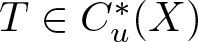 $T\in C^*_u(X)$ belongs to $\tilde{I}(\beta X \setminus \overline{X(\omega)})$ if it vanishes in the $\overline{X(\omega)}$-direction. This can be simplified as follows:
Lemma 7.13. For  $\omega \in \partial_\beta X$, an operator $T\in C^*_u(X)$ belongs to the ideal $\tilde{I}(\beta X \setminus \overline{X(\omega)})$ if and only if $T$ vanishes in the $\omega$-direction, i.e., $\Phi_\omega(T)=0$.
Proof. We assume that  $\Phi_\omega(T)=0$, and it suffices to show that $\Phi_\alpha(T)=0$ for any $\alpha \in \overline{X(\omega)}$. Fixing such an $\alpha$, we take a net $\{\omega_\lambda\}_{\lambda \in \Lambda}$ in $X(\omega)$ such that $\omega_\lambda \to \alpha$ and it follows that $\Phi_{\omega_\lambda}(T)=0$. For any $\gamma_1, \gamma_2 \in X(\alpha)$, Lemma 2.14 implies that there exist $\gamma_{1,\lambda}$ and $\gamma_{2,\lambda}$ in $X(\omega_\lambda)$ for each $\lambda \in \Lambda$ such that $\gamma_{1,\lambda} \to \gamma_1$ and $\gamma_{2,\lambda} \to \gamma_2$. Now Lemma 2.18 implies that
 \begin{equation*}
\Phi_\alpha(T)_{\gamma_1\gamma_2} = \overline{T}((\gamma_1,\gamma_2)) = \lim_{\lambda \in \Lambda} \overline{T}((\gamma_{1,\lambda},\gamma_{2,\lambda})) = \lim_{\lambda \in \Lambda} \Phi_{\omega_\lambda}(T)_{\gamma_{1,\lambda}\gamma_{2,\lambda}} = 0,
\end{equation*}
\begin{equation*}
\Phi_\alpha(T)_{\gamma_1\gamma_2} = \overline{T}((\gamma_1,\gamma_2)) = \lim_{\lambda \in \Lambda} \overline{T}((\gamma_{1,\lambda},\gamma_{2,\lambda})) = \lim_{\lambda \in \Lambda} \Phi_{\omega_\lambda}(T)_{\gamma_{1,\lambda}\gamma_{2,\lambda}} = 0,
\end{equation*}which concludes the proof.
Hence, for  $\omega \in \partial_\beta X$, Lemma 7.13 implies that $\tilde{I}(\beta X \setminus \overline{X(\omega)})$ coincides with the kernel of the limit operator homomorphism (see also [Reference Špakula and Willett29, Theorem 4.10]):
 \begin{equation}
\Phi_\omega: C^*_u(X) \longrightarrow C^*_u(X(\omega)), \quad T \mapsto \Phi_\omega(T).
\end{equation}
\begin{equation}
\Phi_\omega: C^*_u(X) \longrightarrow C^*_u(X(\omega)), \quad T \mapsto \Phi_\omega(T).
\end{equation}Consequently, we reach the following:
Corollary 7.14. A point  $\omega \in \partial_\beta X$ is minimal if and only if the image $\mathrm{Im}(\Phi_\omega)$ is simple. Hence, when $X(\omega)$ is infinite and $\Phi_\omega$ is surjective, the point $\omega$ cannot be minimal.
Remark 7.15. Note that ideals of the form  $\tilde{I}(\beta \setminus \overline{X(\omega)})$ already appeared in [Reference Georgescu21] (with the notation $\mathscr{G}_\omega(X)$) to study the limit operator theory on general metric spaces.
Thanks to Corollary 7.14, a special case of Proposition 7.6 can also be deduced from a recent work by Roch [Reference Roch40]. More precisely, combining [Reference Špakula and Willett29, Proposition B.6] with [Reference Roch40, Lemma 2.1], we have the following:
Proposition 7.16. Let  $\{h_n\}_{n\in \mathbb{N}}$ be a sequence in $\mathbb{Z}^N$ tending to infinity such that
 \begin{equation*}
\|h_n - h_k\|_\infty \geq 3k \quad \text{for any} \quad k \gt n.
\end{equation*}
\begin{equation*}
\|h_n - h_k\|_\infty \geq 3k \quad \text{for any} \quad k \gt n.
\end{equation*} Then for any  $\omega \in \partial_\beta \mathbb{Z}^N$ with $\omega(\{h_n\}_{n\in \mathbb{N}}) =1$, $\Phi_\omega: C^*_u(\mathbb{Z}^N) \longrightarrow C^*_u(\mathbb{Z}^N(\omega))$ is surjective.
Note that the limit space  $\mathbb{Z}^N(\omega)$ is bijective to $\mathbb{Z}^N$ by [Reference Špakula and Willett29, Lemma B.1], and hence infinite. Therefore, applying Corollary 7.14, we obtain the following (when $N=1$, it partially recovers Proposition 7.6).
Corollary 7.17. For any sequence  $\{h_n\}_{n\in \mathbb{N}}$ in $\mathbb{Z}^N$ tending to infinity such that $\|h_n - h_k\|_\infty \geq 3k$ for any $k \gt n$, and any $\omega \in \partial_\beta \mathbb{Z}^N$ with $\omega(\{h_n\}_{n\in \mathbb{N}})=1$, then $\omega$ is not a minimal point.
8. Open questions
Here, we collect several open questions around this topic.
Recall from Theorem 4.4 that for a space  $(X,d)$, any ideal $I$ in $C^*_u(X)$ must lie between $I(U)$ and $\tilde{I}(U)$ for $U=U(I)$. However, the structure of the lattice
 \begin{equation*}
\mathfrak{I}_{U}=\{I \text{~is~an~ideal~in~} C^*_u(X): U(I)=U\}
\end{equation*}
\begin{equation*}
\mathfrak{I}_{U}=\{I \text{~is~an~ideal~in~} C^*_u(X): U(I)=U\}
\end{equation*} in (1.1) is still unclear. Note that for any invariant open subset  $V \supseteq U$ of $\beta X$, the ideal $I(V) \cap \tilde{I}(U)$ belongs to the lattice $\mathfrak{I}_{U}$. Unfortunately, we do not know whether these ideals describe every element in $\mathfrak{I}_{U}$. Hence, we pose the following:
Question 8.1. Let  $(X,d)$ be a space and $U \subseteq \beta X$ be an invariant open subset. Can we describe elements in the lattice $\mathfrak{I}_{U}=\{I \text{~is~an~ideal~in~} C^*_u(X): U(I)=U\}$ in details? For $I \in \mathfrak{I}_{U}$, can we find an invariant open subset $V \supseteq U$ such that $I = I(V) \cap \tilde{I}(U)$?
Note that an answer to the above question, together with Theorem 4.4, will provide a full description of the ideal structure of the uniform Roe algebra.
The next question concerns the discussion on  $K$-theory in Section 5. Recall that in Theorem 5.4, we prove that for an ideal $I$ in $C^*_u(X)$, $(\iota_I)_\ast: K_\ast(\overline{I \cap \mathbb{C}_u[X]}) \longrightarrow K_\ast(I)$ is injective when $X$ is coarsely embeddable. Hence, we pose the following:
Question 8.2. For an ideal  $I$ in $C^*_u(X)$ with $X$ coarsely embeddable, is the map $(\iota_I)_\ast: K_\ast(\overline{I \cap \mathbb{C}_u[X]}) \longrightarrow K_\ast(I)$ surjective for $\ast =0,1$?
Recall that the assumption of countably generatedness plays an important role in Lemma 6.20, which is in turn crucial in the proof of Theorem 6.19. We wonder whether this assumption is necessary, and ask the following:
Question 8.3. Let  $(X,d)$ be a space and $U \subseteq \beta X$ be an invariant open subset. If $\tilde{I}(U) = I(U)$, can we deduce that $X$ has partial Property A relative to $U$ without the assumption of $U$ being countably generated?
The final question concerns minimal points discussed in Section 7.1. Recall that minimal points in the Stone–Čech boundary correspond to maximal ideals in the uniform Roe algebra. Hence, we pose the following:
Question 8.4. Given a space  $(X,d)$ and a point $\omega$ in the Stone–Čech boundary $\partial_\beta X$, how can we tell whether $\omega$ is a minimal point?
We provide some observations that might be helpful. When  $X$ is a countable discrete group, it follows from [Reference Hindman and Strauss26, Theorem 6.9 and Lemma 19.6] that there are exactly $2^{2^{\aleph_0}}$ minimal closed invariant subsets of $\beta X$ (which are necessarily disjoint), while all the quotients are $\ast$-isomorphic thanks to [Reference Hindman and Strauss26, Theorem 19.10]. The latter does not hold for general spaces.
Acknowledgements
We thank Kang Li for reading an early draft of this paper and pointing out that the assumption of being countably generated is redundant for Theorem D. We also thank Baojie Jiang and Ján Špakula for helpful discussions.
Funding
QW is partially supported by NSFC (No. 12571135, 12171156), Key Laboratory of MEA (Ministry of Education), the Science and Technology Commission of Shanghai (No. 22DZ2229014), and Shanghai Key Laboratory of PMMP, East China Normal University. JZ was partly supported by National Key R&D Program of China 2022YFA100700 and NSFC (No. 12422107).


 Open access

