


Introduction
Individuals with bipolar disorder (BD) cycle through episodes of mania, depression and euthymia, demonstrating dramatic fluctuations in energy, social behaviour, mood and cognitive functioning. However, few theoretical proposals have attempted to account for the variation in affective processing across depressed, euthymic and manic states. Cognitive models based on Beck's model of affective disorder (Beck, Reference Beck1976, Reference Beck, Clayton and Barrett1983) have been proposed that attempt to take account of the complex interaction of biological, psychological and social elements that characterize BD. However, difficulties with what may be termed ‘single level theories of emotion’ have been described both clinically and conceptually (e.g. Power & Dalgleish, Reference Power and Dalgleish1997). To answer concerns about the limitations of such models, multi-level theories have been devised to provide a framework through which to formulate the relationship between cognition and emotion.
The Interacting Cognitive Subsystems (ICS; Teasdale & Barnard, Reference Teasdale and Barnard1993) is an example of a multi-level theory that was initially developed to account for cognitive processing identified in individuals with depression. Unlike in models of cognitive therapy, the emphasis in this model is on the mode of processing rather than the content of the structures. In brief, the ICS provides a framework that addresses all aspects of information processing by defining a complete cognitive system composed of nine different subsystems. Two of the levels considered central to many activities, including the maintenance and moderation of emotional states, are the implicational and propositional levels. It is hypothesized that specific meanings are represented in patterns of propositional code. Meanings at this level are explicit, correspond to the kind of meaning conveyed by a single sentence, and are not difficult to grasp. By contrast, patterns of implicational code represent higher order implicit meanings, or schematic mental models, of experience. The meaning from these models cannot be easily conveyed, and the knowledge is implicit, rather than explicit. Within the ICS, higher order implicational meanings are the only level of representation that can directly produce emotion. It follows that modification of emotional response, as in emotional processing, necessarily involves changes in affect-related schematic models. Teasdale & Barnard (Reference Teasdale and Barnard1993) proposed that implicational representations are generic schematic models that integrate the products of processing propositional meaning with the immediate products of processing sensory information, including activated or lowered body states. Thus, in depressed states it is suggested that the processing of propositions more or less continually regenerates negative self-models encoded as generic, implicational meanings. These, in turn, regenerate further negative propositions about the self in cycles that are reinforced by inputs to the schematic models from lowered bodily states. These exchanges become interlocked in a negative feedback loop.
Palmer & Barnard (Reference Palmer and Barnard2003) suggest that the mode of processing may be entirely different in mania to that observed in depression. In depression, the idea that negative schematic models of self are continually regenerated implies a low rate of change in the content of the implicational image, hence most attention is paid to moment-to-moment changes in the contents of the propositional image. It is a mode linked to ruminative thought, and less attention consequently assigned to processing inter-relationships between schematic models (Teasdale, Reference Teasdale1999). By contrast, the manic state is hypothesized to be associated with high rates of change in the contents of the implicational image and the schematic models represented in it. Therefore, correspondingly less attention is paid to evaluating inter-relationships between specific propositions, and discrepancies may not be explicitly evaluated.
Using the Question–Answer task, Palmer & Barnard (Reference Palmer and Barnard2003) tested the specific hypothesis that the modes adopted when processing meaning might differ in depression and mania in a manner that can be directly linked to symptomatology. In normal cognition, there are circumstances where discrepant meanings remain unevaluated. The authors give the example that, when asked the question ‘How many animals of each kind did Moses take into the ark?’ people frequently answer ‘two’, not noticing that the biblical story referred to Noah, not Moses. This task works because Moses fits the same generic schema as Noah, and so the difference between them is overlooked. Using this phenomenon, the authors devised a task that allowed them a means of testing the relative amount of attention being devoted to referentially specific as opposed to schematic meanings.
The task devised by Palmer & Barnard (Reference Palmer and Barnard2003) asked individuals in manic and depressed states to answer questions about the content of simple statements. Test questions referenced a plausible inference based on natural schemas for everyday events and were designed to assess the extent to which discrepant meanings were being actively scrutinized. For example, the statement ‘Graham knew that Sue had brought the flowers in from the garden’ is compatible with a schema-based inference that Sue had picked the flowers. When asked the question ‘Did Sue pick the flowers?’, it is hypothesized that the attention of individuals in a depressive state is likely to be focused on the discrepancy between the two referentially specific propositions ‘Sue brought flowers in’ and ‘Sue picked flowers’. In consequence they should be able to answer, ‘I don't know if she picked the flowers or not, I only know that she brought them in’. However, if attention is being preferentially directed in a manic phase at implicational meanings, then the discrepancy should be more likely to pass unnoticed in the flow of ideation because both statement and question content fit a broad generic model. Using this measure, the authors found that individuals with BD were more likely to detect discrepant meanings in the test questions when depressed than when manic; and conversely, they were more likely to answer questions consistent with a schema-based inference when manic than when depressed. This provides support for the hypothesis that the different affective states are associated with different forms of processing as described by the ICS.
The aims of the present study were to replicate this experiment in laboratory conditions using a group of individuals in remission from BD and a group of individuals with no history of affective disorder. Until recently it was assumed that individuals with bipolar disorder showed few symptoms in between episodes. However, systematic, longitudinal studies have now shown that periods of remission are characterized by substantial subclinical symptoms of hypomania and depression (Judd et al. Reference Judd, Akiskal, Schlettler, Endicott, Maser, Solomon, Rice and Keller2002, Reference Judd, Akiskal, Schettler, Coryell, Endicott, Maser, Solomon, Leon and Keller2003; Paykel et al. Reference Paykel, Morris, Hayhurst and Scott2006). Therefore, participants in this study were not excluded if they exhibited subclinical symptoms. Participants were tested in the euthymic state, and then in an induced positive mood. This study investigated the hypothesis that the modes adopted when processing meaning might differ in different affective states, with more attention being paid to schema-based (or implicational) meaning in high mood states than in the normal or euthymic state. We hypothesized that in the euthymic state, there would be no difference in responding between the BD and the control groups. However, it is hypothesized that positive mood induction in the bipolar group would encourage an implicational rather than a propositional level of processing, which would influence performance on the Question–Answer task. We therefore proposed that the BD group would be impaired at noticing discrepancies in schemas and would be more likely to answer questions consistent with a schema-based inference than the control group.
Method
Participants
Participants included 30 individuals with a diagnosis of BD and 30 individuals with no history of affective disorder, comprising a non-clinical control group. Most of those in the BD group were either referred by a consultant psychiatrist or were recruited for this study through advertisement. All diagnoses were made using the Structured Clinical Interview for DSM-IV (SCID-IV; First et al. Reference First, Spitzer, Gibbon and Williams1996). To check the validity of the SCID diagnostic scores, an inter-rater reliability study was carried out by comparing the results with those collected by another investigator. Five recorded interviews from each rater were chosen at random and scored by the other rater on diagnosis of bipolar 1 disorder and on depression and mania symptoms. We found 100% agreement for the bipolar diagnosis. The unweighted κ was 0.63 [standard error (s.e.)=0.21, 95% confidence interval (CI) 0.22–1.03] for mania symptom scores and 0.71 (s.e.=0.18, 95% CI 0.36–1.06) for depression symptom scores. Exclusion criteria included being actively suicidal [score 3 on the Beck Depression Inventory (BDI) suicide item] and currently fulfilling criteria for substance use disorders. At least 6 months had passed since participants had experienced an episode of mania or depression. In terms of medication, four individuals were not taking any medication at the time of the study, 13 were taking only one type of medication, and 13 were taking several medications. Of these medications, eight were antidepressants and 32 were mood stabilizers.
For the control group, exclusion criteria included fulfilling DSM-IV criteria for any lifetime psychiatric disorder, BDI scores >16 and Mania Rating Scale (MRS; Bech et al. Reference Bech, Rafaelsen, Kramp and Bolwig1978) scores >9. All participants were aged between 18 and 70 years.
Measures
The MRS (Bech et al. Reference Bech, Rafaelsen, Kramp and Bolwig1978)
The MRS consists of 11 items that map into the patient's motor activity, visual activity, flight of thoughts, voice/noise level, hostility/destructiveness, mood level (feeling of well-being), self-esteem, contact (intrusiveness), sleep (average of past three nights), sexual interest and decreased work ability. Each item is rated on a five-point scale from 0 (not present) to 4 (severe or extreme). The scale has good inter-rater reliability and construct validity and has accumulated good evidence of validity (Double, Reference Double1990).
Short version of the Dysfunctional Attitudes Scale for Bipolar Disorder (DAS: BD; Lam et al. Reference Lam, Watkins, Hayward, Bright, Wright, Kerr, Perr-Davis and Sham2003)
The DAS: BD consists of 24 items with high scores corresponding to endorsement of dysfunctional attitudes. This version of the DAS was developed through principal components analysis of data from 140 individuals with remitted bipolar I disorder who completed the Power et al. (Reference Power, Katz, McGuffin, Duggan, Lam and Beck1994) DAS-24 version. Three subscales were generated: Achievement, Goal attainment, and Dependent relationships with others. This measure was selected for use within this study as its subscales were thought to more accurately reflect the dysfunctional cognitions that may become elevated in BD (Lam et al. Reference Lam, Wright and Smith2004). Participants indicated their agreement with the beliefs expressed by the item statements using a seven-point scale, ranging from Totally agree to Totally disagree.
The BDI (Beck et al. Reference Beck, Ward, Mendelsohn, Mock and Erbaugh1961)
This is a well-known 21-item inventory designed to measure the severity of depression in adults and adolescents. It enquires into the somatic, cognitive and behavioural aspects of depression in the past week, and each item is scored on a four-point scale.
The Positive and Negative Affect Scale (PANAS; Watson et al. Reference Watson, Clark and Tellegen1988)
The PANAS is a 20-item self-report measure of positive and negative affect, reflecting different dispositional dimensions. In brief, positive affect reflects the extent to which a person is enthusiastic, active and alert, and negative affect is a dimension of subjective distress and unpleasurable engagement that subsumes a variety of aversive mood states, including anger, guilt, fear and nervousness. The sum of the ratings for 10 of the adjectives provides an index of Positive Affect (PA) and the sum of the ratings for the other 10 items serve as a measure of Negative Affect (NA). Each item is rated on a scale from 1 to 5 (with responses ranging from not at all to very much). It has been shown to have good reliability and validity (Crawford & Henry, Reference Crawford and Henry2004).
The Visual Analogue Scale (VAS) of 100 mm
Momentary mood state was measured using a VAS, measuring 10 cm, labelled ‘extremely low’ on the left side and ‘extremely high’ on the other, with a mark at the central point labelled ‘neutral’. Participants were asked to place a cross at the point that best described their mood as it was at that moment. This technique of ascertaining current mood level has been used in previous studies (e.g. Teasdale & Russell, Reference Teasdale and Russell1983; Clark & Teasdale, Reference Clark and Teasdale1985).
The Question–Answer task (Palmer & Barnard, Reference Palmer and Barnard2003)
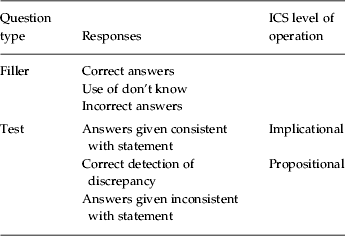
As described previously, this task involves answering questions about the content of simple statements to assess the extent to which discrepant meanings are actively being scrutinized. There were 12 filler questions and 12 test questions that were randomly intermixed. Both sets of questions were devised in the same form and referenced a plausible inference based on natural schemas for everyday events. The filler statements were all phrased with a main and subsidiary clause, for example: ‘Harry thanked Anne for cooking the lovely meal’. Filler questions mentioned only one of the agents and always referenced the exact action referred to in the subsidiary clause. For example: ‘Did Anne cook the meal?’ These questions are unambiguously querying the agent of the action mentioned in the subsidiary clause and hence can always be correctly answered with a simple ‘yes’ or ‘no’. Statements in the test set were of the same form as fillers. However, each test item allowed a pragmatic inference to be questioned. The test questions differed from the filler set in that the verb now carried a pragmatic implication rather than the exact action mentioned in the statement. For example, ‘John saw Carol drop the plate on the kitchen floor’ supports an inference that the plate probably broke. The test questions are therefore technically ambiguous, for example ‘Did Carol break the plate?’ should be answered ‘I don't know’. Such a detection of the discrepancy in meaning between statements and questions is consistent with use of a mode in which internal attention is preferentially focused on processing the relationships among recently experienced adjacent ‘propositional’ meanings, which would be termed as working at the propositional level according to the ICS analysis. Alternatively, an answer of ‘yes’ would mean that the discrepancies in propositional meaning, be they positive, negative or neutral, have passed unnoticed in the flow of ideation, and the individual is operating at the implicational level according to the ICS model. Table 1 indicates the range of options for the item responses.
Range of options for the item responses on the Question–Answer task
ICS, Interacting Cognitive Subsystems.
The questions were presented in the centre of a computer screen for 3.5 s, followed by a 500-ms blank screen. Participants were then asked questions about the preceding statement and were asked to respond with ‘yes’, ‘no’ or ‘don't know’ by pressing labelled keys on the keypad. Before the test started, six practice trials took place, and the participants were provided with feedback. If they responded ‘yes’ or ‘no’ to a practice question based on a false presupposition, direct feedback was given about why a ‘don't know’ response should have been given. At the end of the practice, the main block of 24 trials was presented with no further feedback given. There were two variations of this task (A and B) because participants carried out the task before and after mood induction. Participants were therefore allocated randomly to one of two groups, which changed the order of the tasks (i.e. AB or BA) (see Appendix).
Procedure
Participants were assessed with the SCID-IV (First et al. Reference First, Spitzer, Gibbon and Williams1996) and the MRS (Bech et al. Reference Bech, Rafaelsen, Kramp and Bolwig1978). They were then asked to complete the following baseline measures: the DAS: BD (Lam et al. Reference Lam, Watkins, Hayward, Bright, Wright, Kerr, Perr-Davis and Sham2003), the BDI (Beck et al. Reference Beck, Ward, Mendelsohn, Mock and Erbaugh1961), the PANAS (Watson et al. Reference Watson, Clark and Tellegen1988) and a VAS of 100 mm. They then carried out four experimental tasks, one of which was the Question–Answer task (Palmer & Barnard, Reference Palmer and Barnard2003).
Participants were then exposed to positive mood induction material, which consisted of three film/television clips lasting approximately 6 min. Presentation of visual material has been used by several groups of researchers to elicit high and low mood change (e.g. Miranda & Persons, Reference Miranda and Persons1988) and has been found to be a reliable way to elicit high mood change (Martin, Reference Martin1990). Participants were then asked to again complete the PANAS and the VAS. To confirm that the mood induction procedure was successful in producing a positive shift in mood, the VAS mood measures were examined. Data from three participants whose mood had not changed were excluded from subsequent analysis. Participants then undertook the experimental task again. Between the tasks, participants were asked to complete a VAS again, and, where necessary, the mood induction procedure was repeated as a ‘top-up’ to ensure the mood state was maintained. This consisted of watching an additional film clip.
Results
Demographic and baseline measure scores of the groups
No significant differences were identified between the groups in terms of age (t=1.081, p=0.077) or gender (χ=0.659, p=0.417) (Table 2). The bipolar group reported significantly higher levels of depression (U=255.0, Z=−2.935, p=0.003) and dysfunctional assumptions (t=2.595, df=58, p=0.012). Specifically, they reported significantly higher levels of dysfunctional attitudes related to dependency (t=3.288, df=58, p=0.002) and achievement (t=2.630, df=58, p=0.011) factors, whereas no significant differences were identified between the groups for the goal attainment and anti-dependency factors.
Demographic and baseline measures for the groups

s.d., Standard deviation; BDI, Beck Depression Inventory.
Values are mean (s.d.).
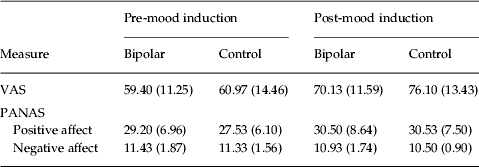
There were no significant differences between the groups for the measures of momentary mood either before or after mood induction (Table 3). However, for both groups the mood measures indicated that there was a significant increase in mood following the mood induction in the predicted direction. For the bipolar group, change on the VAS (t=−3.640, df=58, p=0.001) and the PANAS positive (t=13.503, df=58, p=0.001) indicated significant increases in positive mood and the PANAS negative (t=12.158, df=58, p=0.001) indicated decrease in negative mood. These changes were also identified in the control group, with change on the VAS (t=−4.200, df=58, p=0.000) and the PANAS positive (t=14.290, df=58, p=0.000) indicating significant increase in positive mood and the PANAS negative (t=14.534, df=58, p=0.000) indicated significant decrease in negative mood.
Momentary mood measure scores pre- and post-mood induction for the groups
VAS, Visual Analogue Scale; PANAS, Positive and Negative Affect Scale.
Values are given as mean (standard deviation).
Repeated-measures analyses of variance (ANOVAs) were also carried out to determine whether the bipolar and control groups differed significantly in the extent to which reported mood changed following the induction procedure. We found a statistically significant interaction between time×group for VAS change, which indicated that one of the groups changed more significantly following the mood induction procedure (F=4.855, df=1, 58, p=0.032). Inspection of the mean scores indicated that the VAS score of the control group increased more than that of the bipolar group, indicating that they showed a greater response to the mood induction procedure.
Group differences at pre- and post-mood induction for the Question–Answer task
Table 4 summarizes the mean scores for the groups for the Question–Answer task measures pre- and post-mood induction. For the test items, there were no statistically significant differences between the groups in the detection of the discrepancy between the statement and the response, either before or after mood induction. Pre-mood induction, the bipolar group provided significantly more responses that were consistent with the implication (t=2.980, df=58, p=0.004) than the control group. Although the same pattern of responses was also evident following the mood induction procedure, the statistical significance of the difference was reduced (t=2.160, df=58, p=0.035). For the filler items, at baseline the control group answered significantly more correctly than did the bipolar group (U=292.5, Z=−2.356, p=0.018). Mood induction had no effect on performance for the filler items.
Mean scores of Question–Answer task responses for groups pre- and post-mood induction

Values are given as mean (standard deviation).
Group differences for Question–Answer task responses following mood induction with mood measures controlled for
Repeated-measures ANOVA models were used to test the ability of the between-subjects factor of group to predict the within-subject factors of Question–Answer measures pre- and post-mood induction with the inclusion of variables to control for mood at baseline and change in mood. The covariates included in the analysis were the measures of mood that the groups significantly differed on, which were baseline depression (BDI), dysfunctional attitudes (DAS) and mood change (VAS change).
For the answers that correctly detected the discrepancy, there was a significant interaction for time×VAS change for the bipolar group [F(1, 54)=5.191, p=0.027] but not for the control group [F(1, 54)=0.015, p=0.902]. For answers that were consistent with the implication, a similar relationship was found for time×VAS change for the bipolar group [F(1, 54)=4.362, p=0.041] for the control group [F(1, 54)=0.153, p=0.697]. These findings indicate that there is a relationship between mood change (VAS) and scores on the Question–Answer task for the bipolar group but not for the control group. For the bipolar group, an increase in mood was robustly related to increased ability to correctly detect the discrepancy between statement and answer, and inversely a decreased tendency to provide answers that were consistent with the statement.
Conclusions
The Question–Answer task was designed to allow a method of investigating the different modes of processing that are hypothesized to take place in multi-level models of cognition. The test questions were devised to require the propositional meaning of sentences to be scrutinized, and also to enable schema-based knowledge of properties associated with everyday events to come into play. Palmer & Barnard (Reference Palmer and Barnard2003) found that, during mania, a BD group was less able to detect discrepancies between the statement and question, and more likely to provide responses that were consistent with the statement than during depression, suggesting that they had moved to a more implicational form of processing. In the present study we hypothesized that positive mood induction in a euthymic BD group would have the effect of altering the mode of processing to that of an implicational one. However, this study did not, as hypothesized, find that mood induction had the effect of altering performance or that the groups differed in their ability to detect discrepancies between the statements.
Nevertheless, an important aspect of Palmer & Barnard's study was replicated in the present study. We found that the BD group was more likely than the control group to answer questions that were consistent with the implicational schema, both before and after mood induction. This indicates that they were paying attention to more abstract schema, or generic schematic models, and were more likely to go along with the implication, or sense, of the question. This finding may reflect a general cognitive bias, that individuals with BD in euthymia have a tendency to think in an implicational way at a more abstract level of representation. A more extreme change of mood (such as that triggered by mania) may consequently mean that the shift in processing becomes more marked, and that this is then characterized by a corresponding failure to notice more marked discrepancies. Low levels of mood change such as that elicited in the present study may have been insufficient to result in a move to an implicational level of processing, and therefore was not extreme enough to mean that participants were unable to notice discrepancies in the tasks.
It may be hypothesized that a tendency to work at an implicational level of processing would have relevance to a range of everyday situations in the euthymic state for the BD individual. The ICS account suggests that individuals processing at a more abstract, higher schematic level prefer to allow details to be incorporated into the prevailing schema, rather than detect and act on dissonance. Clinically, for example, there may be evidence regarding an individual's mood from different sources (such as from friends, thoughts or behaviour), and it may be that reconciling potentially contradictory information is more difficult because of this processing bias. This could explain why some individuals with BD have difficulties in detecting and reconciling discrepant prodromal evidence and incorporating it into their daily lives. Potentially, a cognitive remedial training programme aiming to teach compensatory strategies for this deficit may be helpful.
Alternative explanations are that these findings reflect deficits in executive function or in depleted cognitive resources. Numerous studies have observed a broad pattern of cognitive impairments in individuals with BD (see Bearden et al. Reference Bearden, Hoffman and Cannon2001 for review), and such persistent cognitive deficits within the BD population at all affective states may therefore provide an alternative explanation for the results of the present study. For example, in the present study we found that the BD group was less accurate than the control group at answering the filler questions, indicative of at least some problems with immediate retention. It is hypothesized that as the filler questions did not require much processing of semantic relationships, a general decrement would be consistent with a problem in coordinating access to, and use of, executive short-term storage systems. However, it is less clear that such an explanation would account for the pattern of responses for the experimental items. If deficits in attention and changing sets were able to account for differences between the groups on responses that were consistent with the schema, it would also be expected to be identified on the groups' abilities to correctly detect discrepancies; however, no such difference was identified. Further tentative evidence that performance on the test items is unrelated to executive deficits was indicated by the finding that mood change was related to change in performance on this task for the bipolar group but not for the control group.
There are a number of conceptual and methodological limitations to this study. The mood induction procedure was designed to elicit affective change according to a broad definition of positive mood, such that can be obtained in daily life following watching television comedy. However, a more comprehensive activation of affect, which may have cognitive and physical components, may not have been achieved through the mood induction procedure. Furthermore, as the changes in mood elicited in this study were small, the likely amount of change in cognitive processing that took place was also probably relatively small. This limits the conclusions that can be drawn from such findings. It may also be that the VAS, which was used as a brief measure of mood, was capturing a mood dimension, such as well-being. There are also concerns regarding the use of subjective measures of mood rating, in that it is very difficult to know whether participants did in fact experience the reported change in mood. Other issues to be taken into account when considering the use of the procedure include experimenter demand characteristics that may have affected self-report measures of mood. Finally, without the use of a low mood induction procedure, the impacts of mood change in implicational and propositional processing is not complete. Further research using such a mood induction procedure is required.
Acknowledgements
Philip Barnard's involvement was funded under MRC project code U.1055.02.003.00001.01.
Declaration of Interest
None.
Appendix
Version A of the Question–Answer task

Version B of the Question–Answer task


 Open access

