






INTRODUCTION
Early Bronze Age Levantine society experienced a particularly dramatic transformation through the mid- and latter portions of the third millennium BCE. Following the construction of fortified settlements in Early Bronze II and III, southern Levantine society witnessed the pervasive abandonment of these communities across the region by the end of Early Bronze III and during Early Bronze IV (known alternatively as the Intermediate Bronze Age or Intermediate EB-MB) (D’Andrea Reference D’Andrea2014a, Reference D’Andrea and Richard2020; de Miroschedji Reference de Miroschedji, Steiner and Killebrew2014; Prag Reference Prag, Steiner and Killebrew2014; Greenberg Reference Greenberg2019; Richard Reference Richard and Richard2020). The prevailing archaeological narrative has emphasized a drastic shift from EB II-III agrarian town life to EB IV mobile pastoralism, influenced especially by Dever’s model of EB IV seasonal transhumance between lowland winter encampments and upland summer settlements and cemeteries (Dever Reference Dever1980, Reference Dever and Levy1995, Reference Dever2014). Traditionally, the timing and explanation of Levantine EB III town abandonment was attributed to the collapse of the Egyptian Old Kingdom, which was followed by fragmented political authority during the First Intermediate Period between about 2300/2200 and 2000 BCE (see discussion in Sharon Reference Sharon, Steiner and Killebrew2014). A reevaluation of EB IV society has stemmed from several related lines of investigation during the past three decades. The importance of EB IV sedentary agrarian communities has been illuminated through the reevaluation of regional survey data (e.g., Palumbo Reference Palumbo1991, Reference Palumbo and Adams2008) and excavations at a growing number of sedentary settlements (Figure 1). These excavations document EB IV villages at Tell Abu en-Ni‘aj (Falconer and Fall Reference Falconer and Fall2019), Tell Um Hammad (Helms Reference Helms1986; Kennedy Reference Kennedy2015), Khirbet al-Batrawy (Nigro Reference Nigro2006), Tell Iktanu (Prag Reference Prag, Chesson, Aufrecht and Kuijt2011), Sha’ar Ha-Golan (Eisenberg Reference Eisenberg2012), Kfar Vradim (Covello-Paran Reference Covello-Paran and Richard2020), and Horbat Qishron (Smithline Reference Smithline and Gal2002), including walled settlements at Dhahret Umm el-Marar (Falconer and Fall Reference Falconer and Fall2019), Khirbet Um al-Ghozlan (Fraser Reference Fraser2017) and Khirbet el-Meiyiteh (Bar et al. Reference Bar, Cohen and Zertal2013). Evidence elsewhere shows that EB III settlement was followed by EB IV reoccupation at Hazor (Bechar Reference Bechar, Ben-Tor, Zuckerman, Bechar and Sandhaus2017), Beth Shean (Mazar Reference Mazar, Gitin, Wright and Dessel2006), Jericho (Nigro Reference Nigro2003), Bab edh-Dhra‘ (Rast and Schaub Reference Rast and Schaub2003), possibly Megiddo (Adams Reference Adams and Höflmayer2017) and, most notably for this study, at Khirbat Iskandar in central Jordan (Richard et al. Reference Richard, Long, Holdorf and Peterman2010; Richard Reference Richard and Richard2020). Khirbat Iskandar has been a key site for the ongoing re-evaluation of EB IV settlement, based on its stratified evidence from EB III and IV, including the apparent re-use of EB III fortifications (Richard and Long Reference Richard, Long and al-Khraysheh2007a, Reference Richard, Long, Levy, Daviau, Younker and Shaer2007b, Reference Richard, Long and Parr2009; Richard et al. Reference Richard, Long, Holdorf and Peterman2010, Reference Richard, Long, D’Andrea and Wulff-Krabbenhöft2018; Richard Reference Richard and Richard2020) and possible construction of fortifications in EB IV (Richard Reference Richard, Stucky, Kaelin and Mathys2016; D’Andrea et al. Reference D’Andrea, Richard and Long2020).
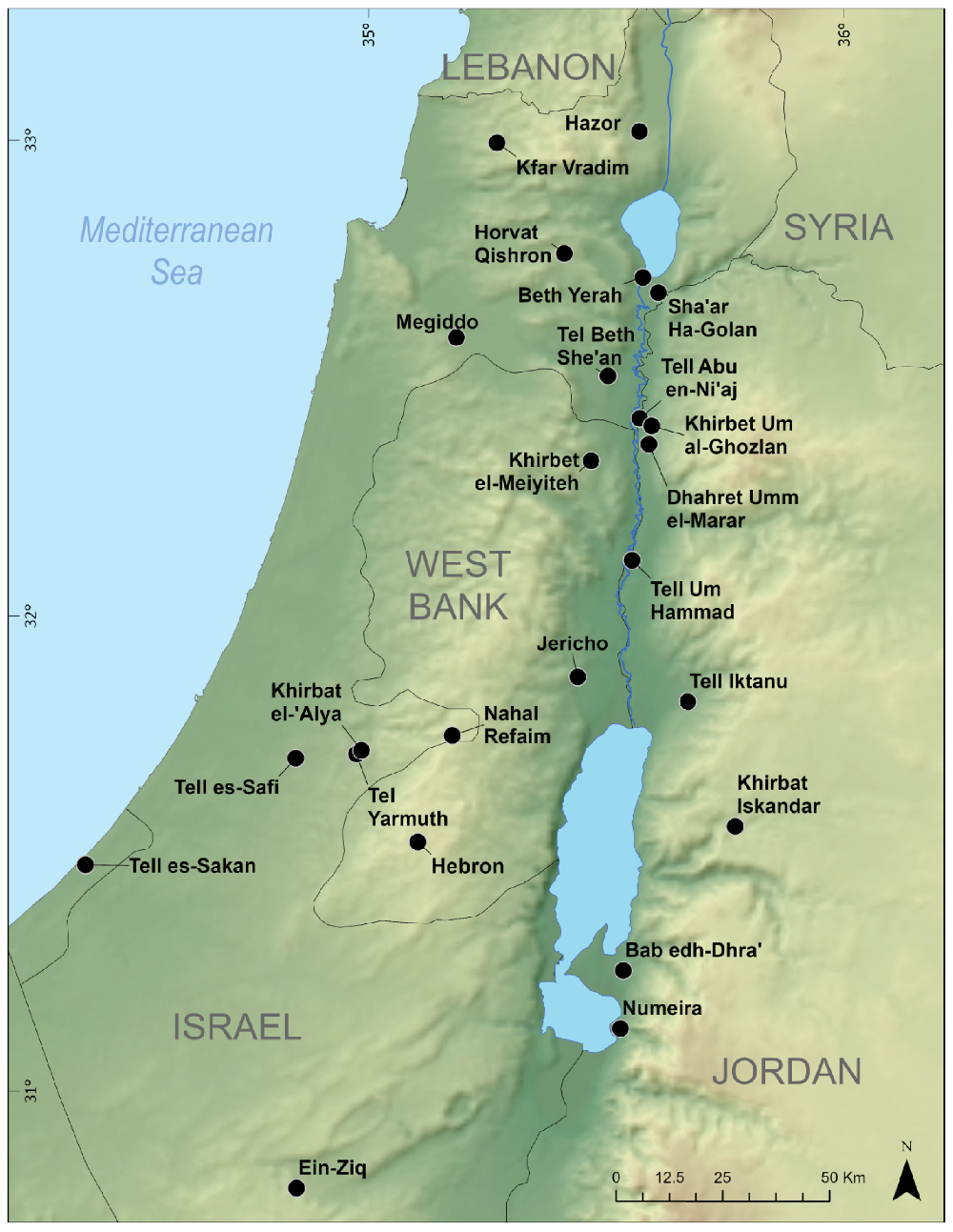
Figure 1 Map of the Southern Levant showing EB III and EB IV archaeological sites discussed in text.
Over roughly the last two decades, Early Bronze Age chronology has been revised drastically through site-specific and regional Bayesian radiocarbon modeling (Bronk Ramsey Reference Bronk Ramsey2009a). This comprehensive revision shifts the constituent Early Bronze Age subperiods earlier, thereby disarticulating them from their previous historically-based conventions. Highlights of this high chronology include a start date for EB I well before 3500 cal BCE, a compressed one-century time span for EB II, and an earlier transition from EB II to III (2900 cal BCE) (Table 1) (e.g., Bruins and van der Plicht Reference Bruins and van der Plicht2001; Golani and Segal Reference Golani, Segal, van den Brink and Yannai2002; Bourke et al. Reference Bourke, Zoppi, Hua, Meadows and Gibbins2009; Regev et al. Reference Regev, de Miroschedji, Greenberg, Braun, Greenhut and Boaretto2012a, Reference Regev, Finkelstein, Adams and Boaretto2014, Reference Regev, Regev, Mintz and Boaretto2017; cf. Nigro et al. Reference Nigro, Calcagnile, Yasin, Gallo and Quarta2019). These changes set the stage for the elucidation of the EB III/IV interface, which is being shifted 200–300 years earlier, based especially on analytically robust Bayesian models for the end of EB III occupation at Numeira, Khirbet Yarmouk/Tel Yarmuth, Tell el-Mutesellim/Megiddo, Khirbet Kerak/Beth Yerah and Tell es-Safi/Gath (Regev et al. Reference Regev, de Miroschedji and Boaretto2012b, Reference Regev, Finkelstein, Adams and Boaretto2014, Reference Regev, Paz, Greenberg and Boaretto2019; Shai et al. Reference Shai, Greenfield, Regev, Boaretto, Eliyahu-Behar and Maeir2014) and for the founding of the EB IV village at Tell Abu en-Ni‘aj (Falconer and Fall Reference Falconer and Fall2019; Fall et al. Reference Fall, Falconer and Höflmayer2021).
Table 1 Traditional and revised Early Bronze IV chronologies for the southern Levant. Traditional chronology based on Levy (Reference Levy and Levy1995: fig. 3); revised chronology based on Regev et al. (Reference Regev, de Miroschedji, Greenberg, Braun, Greenhut and Boaretto2012a).

A major challenge of EB III/IV chronology building lies in the paucity of sites that offer both stratified occupations spanning the EB III/IV transition and AMS datasets suitable for chronological modeling. At the time of their influential revision of Early Bronze Age chronology, Regev et al. noted that “no sites currently exist where both EB III and EB IV/IBA have been 14C dated” (Reference Regev, de Miroschedji, Greenberg, Braun, Greenhut and Boaretto2012a: 559). This study addresses this challenge by presenting Bayesian modeling of a suite of 12 calibrated AMS ages from stratified EB III and EB IV levels in Area C at Khirbat Iskandar, Jordan. Our modeling solidifies the EB III/IV transition date as a key component of the emerging Early Bronze Age chronology, which disarticulates Levantine and Egyptian chronologies (e.g., Kutschera et al. Reference Kutschera, Bietak, Wild, Bronk Ramsey, Dee, Golser, Kopetsky, Stadler, Steier, Thanheiser and Weninger2012), and opens the door for independent assessment of Levantine EB III/IV settlement and societal dynamics.
EXCAVATIONS AT KHIRBAT ISKANDAR
The 2.7 ha tell of Khirbat Iskandar, Jordan lies in the lower reaches of the Wadi Wala, which drains west to the Dead Sea (Figure 2). Two initial trenches on the northeastern edge of the site were excavated in 1955 by Parr (Reference Parr1960). Subsequently, 15 seasons of field work, research and restoration between 1981 and 2019 have been directed by Richard and co-directors Long (since 1994) and D’Andrea (since 2015). Excavations in 32 5 × 5 m squares distributed in three locations on the tell (Areas A, B, and C) reveal stratified evidence of a permanently settled Early Bronze Age fortified community. The most recent excavations in 2019 investigated Areas B and C. The Area C excavations produced evidence from EB IV (Phases 1–3, from earliest to latest), which was stratified immediately above deposition from EB III (in four phases labeled Pre-Phase 1D, Pre-Phase 1C, Pre-Phase 1B, and Pre-Phase 1A, from earliest to latest) (D’Andrea et al. Reference D’Andrea, Richard and Long2020). Pre-Phase 1D includes a burned layer that appears to correlate with a destruction layer overlying the latest EB III occupation identified thus far in Area B. This stratigraphic correlation situates the Pre-Phase 1 deposits in Area C in the latter portion of EB III. The Phase 1 ceramics include transitional EB III-IV vessel forms that place this phase very early in EB IV (Long Reference Long, Richard, Long, Holdorf and Peterman2010: 37; Richard Reference Richard, Richard, Long, Holdorf and Peterman2010: 69–111, 272–273; D’Andrea Reference D’Andrea2014a: 133, Reference D’Andrea, Kaelin and Mathys2016: 545, Reference D’Andrea and Gallo2019: 66, Reference D’Andrea and Richard2020: 400), while the Phase 2 and 3 vessels incorporate attributes found typically at EB IV sites along the southern Jordan Rift (Long Reference Long, Richard, Long, Holdorf and Peterman2010: 63; Richard Reference Richard, Richard, Long, Holdorf and Peterman2010: 69–111), including forms suggestive of later EB IV, especially in Phase 3, which is the latest EB IV phase at Khirbat Iskandar (D’Andrea Reference D’Andrea, Bieliński, Gawlikowski, Koliński, Ławecka, Sołtysiak and Wygnańska2014b: 157, fig. 9; Reference D’Andrea and Gallo2019: 70–72, fig. 4; Reference D’Andrea and Richard2020: 409, fig. 22.4: 1, 3–5, 16, 17). Phase 3 architecture features a gateway to the settlement (Long Reference Long, Richard, Long, Holdorf and Peterman2010: 64-65), while the earlier phases reveal domestic areas that include broad- and long-room houses with associated domestic features. Most importantly for this study, the 2019 excavations show that the Area C stratigraphic sequence spans the EB III/IV interface at Khirbat Iskandar. Thus, chronometric evidence from the stratified occupational evidence in Area C at Khirbat Iskandar is particularly well-positioned to provide a high-precision determination of the timing of the EB III/IV transition based on modeling of AMS ages from a sequence of samples from contiguous EB III and EB IV strata.

Figure 2 Topographic map of Khirbat Iskandar showing Excavation Areas A, B, and C. Modern buildings shown in gray. Figure courtesy of the Khirbat Iskandar Expedition.
MATERIALS AND METHODS
The context for all materials excavated at Khirbat Iskandar is identified according to Area (A, B or C), Square (numbered according to the grid of squares in each Area), Pail (numbered according to soil layers) and Locus (numbered in reference to three-dimensional features). During the 2019 Khirbat Iskandar excavations, archaeological sediments from contexts such as floors, ovens, pits, and mudbrick layers were processed by water flotation to recover plant macroremains. This study incorporates 10 new AMS ages along with two AMS ages from charcoal samples excavated previously from Area C, Square 2 (Long Reference Long, Richard, Long, Holdorf and Peterman2010: 43; Holdorf Reference Holdorf, Richard, Long, Holdorf and Peterman2010: 267), which were analyzed at the University of Arizona Accelerator Mass Spectrometry Laboratory (AA-50178) and the University of Tubingen (lab number unreported).
We submitted 10 seed samples recovered in the 2019 excavations through flotation of sediment from Area C, Squares 6 and 8 for AMS 14C analysis at the University of Georgia. These samples were pretreated using the standard laboratory methods of the Center for Applied Isotope Studies at the University of Georgia. Seeds were inspected under microscope and manually cleaned to remove superficial contaminants, followed by acid/alkali/acid (AAA) pretreatment as follows. Subsamples were treated in 1N HCl at 80°C, decanted, and rinsed with MilliQ water, then treated with 0.1 M NaOH at room temperature and rinsed to neutral with MilliQ water. The samples were treated with HCl a second time at 80°C for 15 min, rinsed repeatedly with MilliQ water, and dried at 105°C. Approximately 2–3-mg subsamples were encapsulated in tin, and the elemental concentrations (%C and %N) and stable isotope ratios (δ13C and δ15N) were measured using an elemental analyzer isotope ratio mass spectrometer (EA-IRMS). Values are expressed as δ13C with respect to VPDB and δ15N with respect to AIR.
Each 2–3-mg subsample of pretreated material was combusted at 900°C in an evacuated and sealed quartz tube in the presence of CuO to produce CO2. The CO2 samples were cryogenically purified from the other reaction products and catalytically converted to graphite using the method of Vogel et al. (Reference Vogel, Southon, Nelson and Brown1984). Graphite14C/13C ratios were measured using the CAIS 0.5 MeV AMS. Sample ratios were compared to the ratio measured from the Oxalic Acid I standard (NBS SRM 4990), and the results are presented as percent Modern Carbon (pMC). The quoted uncalibrated date is given in radiocarbon years before 1950 (years BP), using the 14C half-life of 5568 years. The error is quoted as one standard deviation and reflects both statistical and experimental errors. The dates have been corrected for isotope fractionation using the δ13C value.
All 14C ages in this study were calibrated using OxCal v 4.4.4 (Bronk Ramsey Reference Bronk Ramsey2009a) and the IntCal20 atmospheric curve (Reimer et al. Reference Reimer, Austin, Bard, Bayliss, Blackwell, Bronk Ramsey, Butzin, Cheng, Edwards, Friedrich, Grootes, Guilderson, Hajdas, Heaton, Hogg, Hughen, Kromer, Manning, Muscheler, Palmer, Pearson, van der Plicht, Reimer, Richards, Scott, Southon, Turney, Wacker, Adolphi, Buntgen, Capano, Fahrni, Fogtmann-Schulz, Friedrich, Köhler, Kudsk, Miyake, Olsen, Reinig, Sookdeo and Talamo2020; van der Plicht et al. Reference van der Plicht, Bronk Ramsey, Heaton, Scott and Talamo2020). The analytical tools in OxCal 4.4.4 were used for Bayesian modeling of the calibrated dates. Bayesian analysis permits probabilistic modeling of calibrated 14C determinations using prior stratigraphic information, and can accommodate the non-normally distributed probabilities of calibrated 14C ages (Bronk Ramsey Reference Bronk Ramsey2009a). The radiocarbon ages from Khirbat Iskandar were organized for modeling according to stratigraphic phases and in chronological order within phases, based on their uncalibrated AMS determinations. OxCal Agreement values (A, Amodel) provide a means of assessing the reliability of the individual calibrated ages in Bayesian models and the quality of overall models. Values of A calculate the overlap of the non-modeled distribution for each calibrated age with its Bayesian modeled distribution, such that A > 60 approximates a value of p < 0.05 for a χ2 significance test (Manning Reference Manning, Knapp, Webb and McCarthy2013: 496, fig. A5). Accordingly, values of Amodel > 60 are used to identify statistically robust Bayesian models, and calibrated ages with A ≤ 60 would be treated as statistical outliers and would not be incorporated in our Bayesian modeling (Bronk Ramsey Reference Bronk Ramsey2009b).
RESULTS
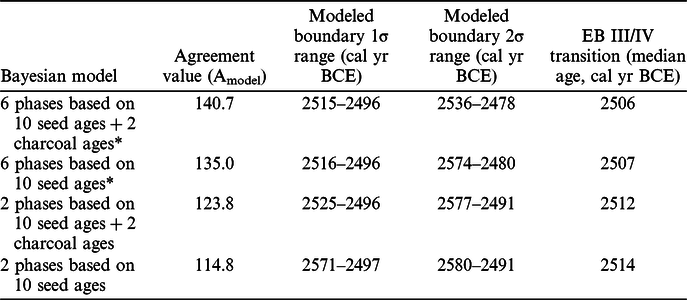
Khirbat Iskandar provides a sequence of 12 AMS 14C ages from six stratigraphic phases designated as EB III or EB IV on the basis of Area C stratigraphy and ceramic chronology (Table 2). These ages are reported in radiocarbon years BP (Before Present, with the present defined as 1950 CE) following international convention (Stuiver and Polach Reference Stuiver and Polach1977). We modeled these ages in a chronological sequence of six stratigraphic phases: Pre-Phase 1D, 1B, and 1A (EB III strata), and Phases 1, 2, and 3 (EB IV strata), from earliest to latest, respectively. Modeled ages are presented in Table 3. Our optimal Bayesian model for Khirbat Iskandar (Figure 3; Amodel=140.7) begins between 2600 and 2500 cal BCE (starting boundary 1σ range: 2585–2504 cal BCE; median = 2533 cal BCE) and ends around 2460 cal BCE (ending boundary 1σ range: 2469–2453 cal BCE; median = 2460 cal BCE). This model places the EB III/IV transition in Area C at or slightly before 2500 cal BCE (1σ range: 2515–2496 cal BCE; median = 2506 cal BCE).
Table 2 AMS radiocarbon results for seed samples (except when noted as charcoal) from Area C at Khirbat Iskandar, Jordan. Calibration based on OxCal 4.4.4 (Bronk Ramsey Reference Bronk Ramsey2009a, Reference Bronk Ramsey2017) using the IntCal20 atmospheric curve (Reimer et al. Reference Reimer, Austin, Bard, Bayliss, Blackwell, Bronk Ramsey, Butzin, Cheng, Edwards, Friedrich, Grootes, Guilderson, Hajdas, Heaton, Hogg, Hughen, Kromer, Manning, Muscheler, Palmer, Pearson, van der Plicht, Reimer, Richards, Scott, Southon, Turney, Wacker, Adolphi, Buntgen, Capano, Fahrni, Fogtmann-Schulz, Friedrich, Köhler, Kudsk, Miyake, Olsen, Reinig, Sookdeo and Talamo2020). Stratigraphic phases in Area C at Khirbat Iskandar start with Pre-Phase 1D (the earliest, lowermost stratum) and end with Phase 3 (the latest, uppermost stratum). Samples are tabulated by phase and ordered chronologically according to conventional 14C age within each phase. Context is indicated according to Square, Pail and Locus (e.g., Square 8N, Pail 167N, Locus 162N).
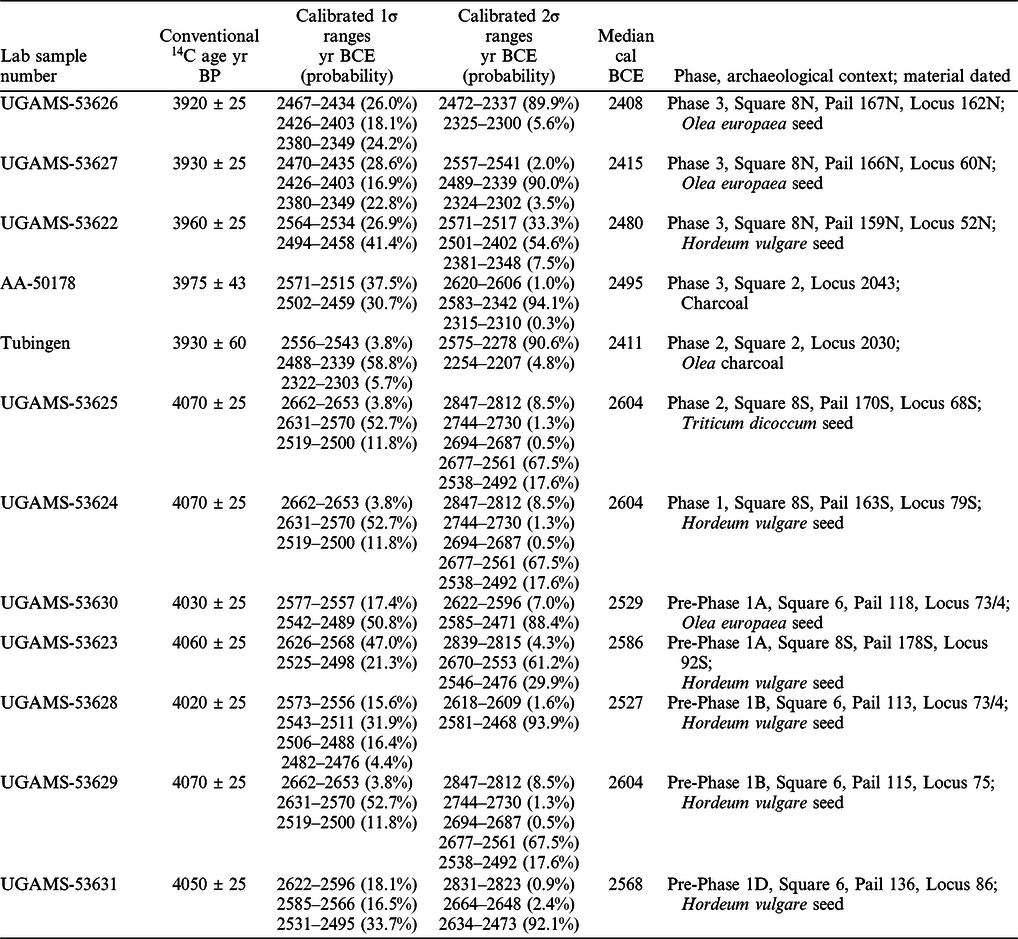
Table 3 Bayesian modeled (calibrated) ages, stable isotope concentrations (δ13C, δ15N) and percent modern carbon (pMC) for samples from Area C at Khirbat Iskandar, Jordan. Modeled ages listed in stratigraphic order. Calibration and modeling based on OxCal 4.4.4 (Bronk Ramsey Reference Bronk Ramsey2009a, Reference Bronk Ramsey2017) using the IntCal20 atmospheric curve (Reimer et al. Reference Reimer, Austin, Bard, Bayliss, Blackwell, Bronk Ramsey, Butzin, Cheng, Edwards, Friedrich, Grootes, Guilderson, Hajdas, Heaton, Hogg, Hughen, Kromer, Manning, Muscheler, Palmer, Pearson, van der Plicht, Reimer, Richards, Scott, Southon, Turney, Wacker, Adolphi, Buntgen, Capano, Fahrni, Fogtmann-Schulz, Friedrich, Köhler, Kudsk, Miyake, Olsen, Reinig, Sookdeo and Talamo2020). ND = not determined. NA = not available. *Statistical outlier not included in six-phase Bayesian models.


Figure 3 Bayesian model of AMS 14C ages for seed and charcoal samples from Area C at Khirbat Iskandar, Jordan. Light gray curves indicate single-sample calibration distributions; dark curves indicate modeled calibration distributions. Calibration and Bayesian modeling based on OxCal v 4.4.4 (Bronk Ramsey Reference Bronk Ramsey2009a) using the IntCal20 atmospheric curve (Reimer et al. Reference Reimer, Austin, Bard, Bayliss, Blackwell, Bronk Ramsey, Butzin, Cheng, Edwards, Friedrich, Grootes, Guilderson, Hajdas, Heaton, Hogg, Hughen, Kromer, Manning, Muscheler, Palmer, Pearson, van der Plicht, Reimer, Richards, Scott, Southon, Turney, Wacker, Adolphi, Buntgen, Capano, Fahrni, Fogtmann-Schulz, Friedrich, Köhler, Kudsk, Miyake, Olsen, Reinig, Sookdeo and Talamo2020; van der Plicht et al. Reference van der Plicht, Bronk Ramsey, Heaton, Scott and Talamo2020). Amodel=138.1; one statistical outlier: UGAMS-53625.
We also modeled the calibrated seed and charcoal from Khirbat Iskandar as two contiguous phases in which the earlier Oxcal phase includes the five ages from the EB III strata (Pre-Phase 1D, 1B, and 1A), and the later Oxcal phase includes the seven ages from the EB IV strata (Phases 1–3.) Ages within each Oxcal phase were ordered stratigraphically. This two-phase model once again estimates the EB III/IV boundary at or slightly before 2500 cal BCE (Table 4). As a further consideration, we assessed the modeling influences of the two charcoal ages from Phases 2 and 3, which model well with the other five EB IV dates in the two-phase model noted above. The individual calibration distributions for these two samples provide no indication of an “old wood” effect of inbuilt age (Dee and Bronk Ramsey Reference Dee and Bronk Ramsey2014). All four models produce strikingly consistent determinations of the EB III/IV transition at Khirbat Iskandar at or slightly before 2500 cal BCE (see Table 4).
Table 4 Bayesian modeling of the EB III/IV transition in Area C at Khirbat Iskandar, Jordan. Calibration and modeling based on OxCal 4.4.4 (Bronk Ramsey Reference Bronk Ramsey2009a, Reference Bronk Ramsey2017) using the IntCal20 atmospheric curve (Reimer et al. Reference Reimer, Austin, Bard, Bayliss, Blackwell, Bronk Ramsey, Butzin, Cheng, Edwards, Friedrich, Grootes, Guilderson, Hajdas, Heaton, Hogg, Hughen, Kromer, Manning, Muscheler, Palmer, Pearson, van der Plicht, Reimer, Richards, Scott, Southon, Turney, Wacker, Adolphi, Buntgen, Capano, Fahrni, Fogtmann-Schulz, Friedrich, Köhler, Kudsk, Miyake, Olsen, Reinig, Sookdeo and Talamo2020); *1 outlier: UGAMS 53625.
DISCUSSION
Bayesian modeling of the Pre-Phase 1 seed ages from Khirbat Iskandar correlates the lower strata in Area C with the tail end of Early Bronze III occupations at the best radiocarbon dated sites across the Levant. For example, seven seed ages from Tell es-Safi/Gath, in the Hebron region, model the end of its EB III occupation between 2680 and 2580 cal BCE (Shai et al. Reference Shai, Greenfield, Regev, Boaretto, Eliyahu-Behar and Maeir2014), while a model of 17 AMS ages from Tel Yarmuth/Khirbet Yarmuk, in the foothills of the Shephelah, ends its EB III occupation about 2500 cal BCE (Regev et al. Reference Regev, de Miroschedji and Boaretto2012b). Models that include further AMS ages from Numeira, Bab edh-Dhra‘, Tell es-Sakan, Hebron and Khirbet Kerak/Beth Yerah (Rast and Schaub Reference Rast and Schaub1980; Weinstein Reference Weinstein1984, Reference Weinstein, Rast and Schaub2003; Regev et al. Reference Regev, de Miroschedji, Greenberg, Braun, Greenhut and Boaretto2012a; Regev et al. Reference Regev, Paz, Greenberg and Boaretto2019) also terminate EB III at each of these sites about 2500 cal BCE (Regev et al. Reference Regev, de Miroschedji, Greenberg, Braun, Greenhut and Boaretto2012a). This substantial body of data represents a growing consensus that “… EB III ended at the latest ∼2450, perhaps before 2500 BC” (Regev et al. Reference Regev, de Miroschedji and Boaretto2012b: 505, emphasis original). Our modeling positions the Pre-Phase 1 ages from Khirbat Iskandar Area C at the very end of EB III, prior to 2500 cal BCE, in chronological accordance with this consensus derived from this wide variety of AMS-dated Levantine sites.
For comparative purposes, well-dated evidence for the beginning of EB IV in the Southern Levant features the seven-phase modeled sequence of 25 seed ages for Tell Abu en-Ni‘aj (Fall et al. Reference Fall, Falconer and Höflmayer2021), but is otherwise limited to three AMS seed ages from Khirbet el-‘Alya (Bar et al. Reference Bar, Cohen and Zertal2013; Lev et al. Reference Lev, Shalev, Regev, Paz and Boaretto2020), the two earliest of four charcoal dates from Ein-Ziq (Avner and Carmi Reference Avner and Carmi2001; see also Dunseth et al. Reference Dunseth, Junge, Fuchs, Finkelstein and Shahack-Gross2016) and the earliest one of three charcoal ages from Nahal Refaim (Segal and Carmi Reference Segal and Carmi1996). Another noteworthy site, Bab edh-Dhra‘, has five ages that correlate with Phases 2 and 1 at Tell Abu en-Ni‘aj, late in EB IV after about 2350 cal BCE (Falconer and Fall Reference Falconer, Fall, Long and Dever2021). In contrast, our modeling incorporates seven ages from a single area at Khirbat Iskandar that fit squarely within the modeled intervals for Phases 7 and 6, very early in EB IV at the outset of the Tell Abu en-Ni‘aj sequence (Falconer and Fall Reference Falconer, Fall, Long and Dever2021; Fall et al. Reference Fall, Falconer and Höflmayer2021). These ages parallel the calibrated distributions for the early EB IV dates from Khirbet el-‘Alya, Ein-Ziq and Nahal Refaim. Thus, Bayesian modeling of AMS ages from Khirbat Iskandar Phases 1–3 places the beginning of EB IV occupation in Area C at 2500 cal BCE, in keeping with the best-dated evidence for early EB IV occupations elsewhere in the Southern Levant.
Among the sites with deposition from both EB III and EB IV, chronological gaps have been inferred between these periods at Beth Shean/Tell el-Hosn based on ceramic chronology (Mazar Reference Mazar and Mazar2012: 28) and at Hazor/Tell el-Waqqas and Jericho/Tell es-Sultan based on stratigraphy (Nigro Reference Nigro2003: 131, 138; Lev et al. Reference Lev, Bechar and Boaretto2021). Modeling of AMS ages from Hazor estimates the end of its EB III occupation by 2580 cal BCE, followed by “many decades of abandonment” prior to resettlement in EB IV (Lev et al. Reference Lev, Bechar and Boaretto2021). Six AMS ages support a model of subsequent EB IV occupation beginning after 2400 cal BCE and ending by 2200 cal BCE, based on 1σ boundary ranges (Lev et al. Reference Lev, Bechar and Boaretto2021: fig. 13). Thus, the evidence from Hazor leads to an estimate of the intervening EBIII/IV transition at this site between about 2600 and 2400 cal BCE, in general agreement with the high Early Bronze Age chronology. In this context, the new evidence of a radiocarbon-dated EB III/IV stratigraphic sequence at Khirbat Iskandar underscores the importance of sites with EB III and EB IV occupations that potentially document local continuity over the transition from late EB III into early EB IV (D’Andrea et al. Reference D’Andrea, Richard and Long2020; D’Andrea Reference D’Andrea, Bietak and Prell2021).
An alternative interpretation is offered by Nigro et al. (Reference Nigro, Calcagnile, Yasin, Gallo and Quarta2019), who suggest a conventional end date for EB III about 2300 cal BCE, based on three charcoal ages from two excavation areas that model the end of EB IIIB occupation in Sultan Phase IIIc2 at or shortly after 2500 cal BCE (Nigro et al. Reference Nigro, Calcagnile, Yasin, Gallo and Quarta2019: table 7, fig. 12). They report no radiocarbon ages from the earliest EB IV stratum (Sultan Phase IIId1; Nigro et al. Reference Nigro, Calcagnile, Yasin, Gallo and Quarta2019: 235), and the two 14C ages for charcoal samples from the latest EB IV stratum at Jericho (Sultan Phase IIId2; Nigro et al. Reference Nigro, Calcagnile, Yasin, Gallo and Quarta2019: table 8) were excavated in separate trenches by Kenyon (Reference Kenyon1981: 167, 214). The modeled 1σ distributions for these ages lie between about 2400 and 2250 cal BCE (Nigro et al. Reference Nigro, Calcagnile, Yasin, Gallo and Quarta2019: fig. 12), correlate with mid-EB IV Phases 4-1 at Tell Abu en-Ni‘aj (Fall et al. Reference Fall, Falconer and Höflmayer2021), and accord with a beginning date for EB IV about 2500 cal BCE, as attested increasingly at other Levantine sites.
In overview, the majority of comparative radiocarbon-dated evidence from Early Bronze Age sites in the Southern Levant stems from settlements with occupations that either end in late EB III or begin in early EB IV. Bayesian modeling of growing AMS datasets has narrowed the time frame for the EB III-IV transition to the mid-third millennium BCE. Khirbat Iskandar now offers a unique stratigraphically continuous sequence of 12 AMS ages from a single excavation area that spans the end of EB III and the beginning of EB IV, and provides a focused model of the EB III/IV transition about 2500 cal BCE. As Regev et al. point out, fixing this interface “at ca. 2500 cal BC forces reconsideration of the synchronism between Egypt and the Southern Levant that has far reaching implications for the history and chronology of both regions” (2014: 260). In particular, it “disconnect[s] the end of the Early Bronze III period from the end of the Egyptian Old Kingdom” (Höflmayer et al. Reference Höflmayer, Dee, Genz and Riehl2014: 540), and no longer supports a direct correlation of Egyptian political dissolution and Levantine town abandonment (see Regev et al. Reference Regev, Finkelstein, Adams and Boaretto2014).
CONCLUSIONS
Bayesian modeling of 10 new AMS seed ages plus two previous AMS charcoal dates from Khirbat Iskandar provides a new stratigraphically-based calculation of the EB III/IV transition in the Southern Levant. Our modeling is the first to be based on samples from a continuous stratigraphic sequence in a single excavation area from the end of EB III to the beginning of EB IV. We model the EB III/IV transition at about or slightly before 2500 cal BCE, which is 200–300 years earlier than assumed traditionally. These data contribute strategically to the continuing corroboration of a high chronology for the Early Bronze Age in the Southern Levant. The evidence from Khirbat Iskandar also emphasizes the importance of sedentary settlements in EB IV society, which hold the greatest promise of providing stratified seed samples for continued AMS dating and rigorous chronological modeling of this enigmatic period in Levantine prehistory. On a larger scale, further chronological revision will contribute to the ongoing “audit of the synchronisms between Egyptian and Levantine chronologies” (Regev et al. Reference Regev, Finkelstein, Adams and Boaretto2014: 261) and a correspondingly revised interpretation of Levantine social dynamics in the third millennium BCE.
ACKNOWLEDGMENTS
Excavations at Khirbat Iskandar were conducted under permits from the Department of Antiquities, Hashemite Kingdom of Jordan. Funding source: the new AMS analyses of 10 seed samples from Khirbat Iskandar Area C were supported as part of a grant to SEF, PLF, SEPB, and ER from the National Science Foundation (#1850259).


 Open access

