

Callous-unemotional (CU) traits are characterized by lack of empathy, lack of guilt, shallow emotional expression, and lack of concern about performance and describe a subgroup of children who are at more risk for conduct problems and antisocial behavior along development (Frick et al., Reference Frick, Ray, Thornton and Kahn2014). Considering the severity and associated risk factors of CU traits, the Diagnostic and Statistical Manual of Mental Disorders (5th Ed.; DSM–5; American Psychiatric Association, 2013) has included CU traits as a “Limited Prosocial Emotions” specifier for conduct disorder (CD) (Frick & Myers, Reference Frick, Myers, Lochman and Matthys2018), and the International Classification of Diseases (11th Rev.; ICD–11; World Health Organization, 2018) has adopted this specifier for the diagnosis of oppositional defiant disorder (ODD) and CD (Evans et al., Reference Evans, Burke, Roberts, Fite, Lochman and la Peña2017).
CU traits are often interpreted as the affective dimension of adult psychopathy (Salekin, Reference Salekin2016), sharing core features such as low interpersonal emotional sensitivity, poor emotion recognition, deficits in prosociality and fearlessness (Waller & Hyde, Reference Waller and Hyde2018). Research has also found that high CU traits in childhood increase the risk for developing psychopathy in adulthood (Hawes et al., Reference Hawes, Byrd, Waller, Lynam and Pardini2017). Thus, CU traits are strongly associated with antisocial behavior such as aggression and rule-breaking (Frick et al., Reference Frick, Ray, Thornton and Kahn2014; Muñoz & Frick, Reference Muñoz and Frick2012), which have been linked with the behavioral dimension of adult psychopathy. More specifically, CU traits are associated with violence, delinquency, and criminality (Kahn, Byrd, et al., Reference Kahn, Byrd and Pardini2013; Robertson et al., Reference Robertson, Frick, Walker, Kemp, Ray, Thornton, Wall Myers, Steinberg and Cauffman2020), aggressive behavior such as bullying (Catone et al., Reference Catone, Almerico, Pezzella, Riccio, Bravaccio, Bernardo, Muratori, Pascotto, Pisano and Senese2021) and substance abuse (Donohue et al., Reference Donohue, Hoyniak, Tillman, Barch and Luby2021). Children with CU traits also show a more stable pattern of CD and antisocial behavior (Frick et al., Reference Frick, Ray, Thornton and Kahn2014), which may explain the poor treatment outcomes that characterizes this subgroup of children (Hawes et al., Reference Hawes, Price and Dadds2014).
While the construct of psychopathy is only applied to adults, CU traits can already be observed from early childhood on (Kimonis et al., Reference Kimonis, Fanti, Anastassiou-Hadjicharalambous, Mertan, Goulter and Katsimicha2016) and there is evidence that CU traits in early childhood co-occur with psychopathic traits and can therefore be considered the precursors to adult psychopathy (Klingzel et al., 2016). Moreover, early onset CU traits have been linked with fearlessness, aggressive behavior, and rule-breaking (Waller & Hyde, Reference Waller and Hyde2018) and are considered a risk factor for severe conduct problems (Donohue et al., Reference Donohue, Hoyniak, Tillman, Barch and Luby2021) and low socio-emotional competencies (Zumbach et al., Reference Zumbach, Rademacher and Koglin2021). Early childhood CU traits also predict externalizing behavior (Song et al., Reference Song, Waller, Hyde and Olson2016) and severe and persistent antisocial behavior over time (Willoughby et al., Reference Willoughby, Mills‐Koonce, Gottfredson and Wagner2014).
Genetic and environmental influences on the etiology of CU have been vastly studied. Genetic studies have shown that the heritability of CU traits accounts for between 36% and 67% of the variation of CU traits (Moore et al., Reference Moore, Blair, Hettema and Roberson-Nay2019). Interestingly, sex-differences in CU trait heritability have also been observed and indicate that boys might be under greater genetic influence on CU traits than girls. Thus, CU traits are more prevalent in boys than in girls (Ueno et al., Reference Ueno, Ackermann, Freitag and Schwenck2021) and sex differences have been found in the severity, the stability, and the associated difficulties of CU traits (Euler et al., Reference Euler, Jenkel, Stadler, Schmeck, Fegert, Kölch and Schmid2015). For example, boys score higher on CU traits and show more externalizing problems such as antisocial behavior and impulsivity, whereas girls high on CU traits exhibit better affective empathy and more internalizing problems such as anxiety and depression (Cardinale & Marsh, Reference Cardinale and Marsh2020).
Studies on environmental influences have identified negative stressful life events (SLE) as risk factors in the development of CU traits (Kimonis et al., Reference Kimonis, Centifanti, Allen and Frick2014). The most common studied SLE associated with CU trait development have been maltreatment or neglect (Dackis et al., Reference Dackis, Rogosch and Cicchetti2015), experiencing high levels of chaos at home (Fontaine et al., Reference Fontaine, McCrory, Boivin, Moffitt and Viding2011; Mills-Koonce et al., Reference Mills-Koonce, Willoughby, Garrett-Peters, Wagner and Vernon-Feagans2016), or harsh parenting (Waller & Hyde, Reference Waller and Hyde2018). Even a bidirectional effect of these SLE and CU traits has been described by Kimonis et al. (Reference Kimonis, Centifanti, Allen and Frick2014), suggesting that children with CU traits might evoke SLE from their environment by their characteristics or their predisposition to risky behavior. These SLE often have a deep psychological impact in the life of individuals because they change their life circumstances and their coping and adaptation strategies, which might lead to psychological distress (Johnson, Reference Johnson, Lahey and Kazdin1982). Especially during early childhood, SLE have been found to have an impact on childhood development, contributing to mental health outcomes such as conduct problems, posttraumatic stress disorder and attention-deficit/hyperactivity disorder (ADHD) and anxiety (Humphreys & Zeanah, Reference Humphreys and Zeanah2015).
Related to SLE, the socioeconomic status (SES) of the family is a stressful risk factor for children’s development and evidence shows that children who live in low SES contexts show more psychopathology (Peveril et al., Reference Peverill, Dirks, Narvaja, Herts, Comer and McLaughlin2021). Similarly, Piotrowska et al. (Reference Piotrowska, Stride, Croft and Rowe2015) reported in a meta-analysis that lower SES was associated with CU traits and antisocial behavior. The relationship between SES and externalizing behavior in children can be described through the family stress model, which suggests that low SES families might experience greater household chaos and lower family income, so that the parents face more personal difficulties. Thus, parents in low SES contexts are at higher risk of developing mental disorders (Reiss et al., Reference Reiss, Meyrose, Otto, Lampert, Klasen and Ravens-Sieberer2019), which can impact their parenting style. For example, when mothers suffer from depression or anxiety, they seem to have more difficulties with parenting and might face their children’s CU traits with less discipline and less involvement (Hawes et al., Reference Hawes, Dadds, Frost and Hasking2011). Also, when mothers show antisocial behavior or psychotic traits they might engage in more impulsive reactions towards their children or act with more irresponsibility, so these maternal externalizing problems predict child mental health problems such as CD, ODD or depressive symptoms (Fanti & Lordos, Reference Fanti and Lordos2021). In fact, studies have observed a positive relationship between child CU traits and maternal psychopathological traits (Barker et al., Reference Barker, Oliver, Viding, Salekin and Maughan2011), maternal antisocial behavior (Hyde et al., Reference Hyde, Waller, Trentacosta, Shaw, Neiderhiser, Ganiban, Reiss and Leve2016) and maternal psychopathic traits (Zhong et al., Reference Zhong, Wang, Shou, Zhang and Deng2020).
The role of SLE and associated contextual risk factors in the etiology of CU traits seems to be crucial considering Karpman’s (Reference Karpman1946) theoretical model on primary and secondary variants of psychopathy, which show similar psychopathic traits, but differ in emotional reactivity and etiology. The primary variant is described as the traditional or idiopathic subtype with low levels of anxiety, whereas the secondary variant is considered the distressed subtype with high levels of anxiety and exposure to traumatic or stressful events (Craig et al., Reference Craig, Goulter and Moretti2021).
Building upon this theory, studies have started to investigate primary and secondary variants on CU traits but have focused mostly on justice-involved male youth samples (Craig et al., Reference Craig, Goulter and Moretti2021). This stream of research was able to identify a subgroup of adolescents with high CU traits and high levels of anxiety, who had also experienced severe traumatic events or SLE. While this high CU/high anxiety group is described as a secondary variant of CU traits, the primary variant has been identified as a group of adolescents with high CU traits, no exposure to SLE and low anxiety. Although both variants involve similar phenotypic CU traits, they differ in specific outcomes derived from them. For example, in a community sample of socially deprived youths (age 18), the secondary variants of CU traits experienced more psychological distress and ADHD and engaged in more behavioral risks such as substance use, suicidal ideation and unsafe sex (Cecil et al., Reference Cecil, Mccrory, Barker, Guiney and Viding2018) than the primary variant. Similarly, in a sample of adolescents (age 11–18), that were recruited from a mental health care center, the secondary variant showed more impulsivity, externalizing behaviors and aggression than the primary variant (Kahn, Frick, et al., Reference Kahn, Frick, Youngstrom, Kogos Youngstrom, Feeny and Findling2013). Meehan et al. (Reference Meehan, Maughan, Cecil and Barker2017) also identified that among the secondary variant, youth faced more prenatal and postnatal levels of family adversity and maternal psychopathology, more psychopathology such as ADHD, CD or ODD, and more emotional and academic difficulties than the primary variant.
The few studies conducted on young children highlight similar results than those on adolescents, and suggest that the secondary variant, in comparison to the primary variant, occurs with more psychosocial difficulties (Ezpeleta et al., Reference Ezpeleta, Granero, la Osa and Doménech2017) and mental health problems such as depression or CD (Goulter et al., Reference Goulter, Kimonis, Hawes, Stepp and Hipwell2017; Huang et al., Reference Huang, Fan, Lin and Wang2020), more peer problems and antisocial behavior (Humayun et al., Reference Humayun, Kahn, Frick and Viding2014), more deficits in self-regulation and cognitive functioning (Fanti & Kimonis, Reference Fanti and Kimonis2017) and more exposure to trauma or SLE (Cecil et al., Reference Cecil, Lysenko, Jaffee, Pingault, Smith, Relton, Woodward, Mcardle, Mill and Barker2014). On the other hand, the primary variant, in comparison to the secondary variant, occurs with low anxiety, low levels of SLE and more emotional deficits in responding to others (Dadds et al., Reference Dadds, Kimonis, Schollar-Root, Moul and Hawes2018).
The previous results seem to suggest that the secondary, distressed, variant of CU traits is associated with impaired executive functioning, which includes difficulties in behavior inhibition and emotion control. Neurobiological studies have shown that chronic stress alters brain structures and functions of the prefrontal cortex, which is the brain region responsible for executive functioning (Girotti et al., Reference Girotti, Adler, Bulin, Fucich, Paredes and Morilak2018). Therefore, exposition to severe SLE could have a negative impact on neural development, resulting in self-regulation problems and a deficient impulse control. In combination with CU traits, these executive functioning deficits can lead to more peer problems and aggressive behavior (Waller et al., Reference Waller, Hyde, Baskin-Sommers and Olson2016). A systematic understanding of how executive functioning contributes to secondary variants of CU traits is still lacking and needs to be further addressed.
Besides research on primary and secondary variants of CU traits, longitudinal intrapersonal studies on CU traits have found variations of CU traits along development, with groups of children presenting low, unstable (increasing and decreasing) or stable high CU traits. Evidence suggests that children (7–12 years) in the stable high CU trait group often experience more SLE and show more severe mental health outcomes, such as conduct problems and hyperactivity when compared to children in the other groups (Fontaine et al., Reference Fontaine, Rijsdijk, McCrory and Viding2010). Similarly, Byrd et al. (Reference Byrd, Hawes, Loeber and Pardini2016) conducted a longitudinal study on a community sample of boys between 7 to 15 years old and found the stable high CU trait group to be associated with more psychosocial adversity and maltreatment, as well as with child characteristics such as fearlessness and difficulties in anger-management, and with externalizing problems such as conduct problems and ADHD. Stable high CU traits are also associated with low SES (Fontaine et al., Reference Fontaine, Hanscombe, Berg, McCrory and Viding2018), which is a strong predictor for SLE (Kimonis et al., Reference Kimonis, Centifanti, Allen and Frick2014). Most of these studies have predominantly focused on middle childhood (5–11 years) or youth (12–18 years), but less is known about CU trait development, contextual risk factors, personal factors (executive functioning) and mental health outcomes in early childhood, comprising the preschool period (3–5 years) (Fanti & Kimonis, Reference Fanti and Kimonis2017).
All in all, SLE might influence the development of CU traits along childhood, but the extant literature has not examined yet how joint CU traits and SLE trajectories might be associated with different contextual risk factors such as gender, economic problems, low educational backgrounds of parents, as well as maternal psychopathology. Therefore, the objective of this study was to analyze contextual risk factors (i.e., economic problems, family disadvantages and maternal mental illness) and personal factors (executive functioning) in early childhood (at the age of 3), as well as their mental health outcomes at the age of 10, depending on different CU traits and SLE trajectories. Because the period between 3 and 10 years is a sensitive window to the development of social and emotional behavior, the impact of joint CU trait and SLE might have negative consequences for child’s psychosocial adjustment (Humphreys & Zeanah, Reference Humphreys and Zeanah2015). Based on the existing literature (Craig et al., Reference Craig, Goulter and Moretti2021), we hypothesized that children with high CU traits and high levels of SLE would face more contextual risk factors, more executive functioning difficulties and more mental health problems than children with increasing CU traits and low levels of SLE or children who showed neither CU traits nor SLE.
Identifying the contextual and individual characteristics of children with CU traits in early childhood might be important in the light of the poor treatment outcomes that have been found among those children with higher CU traits (Hawes et al., Reference Hawes, Price and Dadds2014). Therefore, focusing on their distinct SLE trajectories could be crucial to detecting at-risk groups of children and tailoring more personalized interventions that may change negative developmental CU trait courses. Also, gaining knowledge on the trajectories towards mental health problems is important for realizing how the early risk factors and later outcomes associated with CU traits could be prevented.
Method
Participants
The sample comes from a longitudinal study of behavioral problems starting at the age of 3 (Ezpeleta et al., Reference Ezpeleta, de la Osa and Doménech2014). A double phase sampling design as summarized in Figure 1 was employed. The first phase started with a random sample of 2,283 children selected from the census of early childhood schools in Barcelona. From these, 1,341 families (58.7%) agreed to participate (50.9% boys; 33.6% high socioeconomic status (SES), 43.1% middle-high/middle SES and 23.3% middle-low/low SES). In the second phase of the sampling, a parent-rating of ODD symptoms (8 items) based on the four items of the conduct problems scale of the Strengths and Difficulties Questionnaire (SDQ) plus four additional ODD items to complete the Diagnostic and Statistical Manual of Mental Disorders (4th Ed.; DSM–IV; American Psychiatric Association, 2000) description was used to screen children with possible psychological problems. Exclusion criteria were showing autism spectrum disorder or intellectual disability, planning to live abroad the next year and limited understanding of Spanish language. Two groups were considered: The screen–positive group included all the children with scores above the cut-off point (90th percentile) of the SDQ or with a positive response for any of the eight ODD symptoms (n = 417; 49.0% boys); and the second group, considered screen-negative, was a random selection of 28% of the children who did not reach the positive criteria (n = 205; 51.2% boys). The number of children in the screening-positive group was higher than those from the screening-negative group to increase the number of participants with potentially psychological problems, as it was assumed that the occurrence of psychological problems in a community sample is lower.

Figure 1. Two-Phase Sampling Design and Study Follow-ups
The follow-up study, consisting of a yearly evaluation from the age of 3 to 10 years old (8 assessment points), started with a sample of 622 children. The mean and standard deviation (SD) of the age at the different follow-ups that provided data for the risk factors and outcomes was: 3.77 (0.34) at baseline (age 3) and 9.65 (0.35) at the last follow-up (age 10).
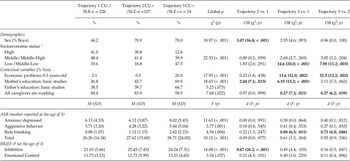
In a previous study of Ezpeleta et al. (Reference Ezpeleta, Penelo, de la Osa, Blas Navarro, Fañanás and Fatjó-Vilas2019), Latent Class Growth Analysis (LCGA) for two parallel processes (CU traits and the number of SLE experienced each year) was used on follow-up data from age 3 to 9. The analyzed sample consisted of the 377 children who completed at least 4 of 7 follow-up assessments (see Table 1 for a description).
Table 1. Description of Sociodemographic and Clinical Variables at Ages 3 and 10 Years-Old

Note. ASR = Adult Self-Report; BRIEF-P = The Behavior Rating Inventory of Executive Function-Preschool; SDQ = Strengths and Difficulties Questionnaire.
To select the optimal solution, models with one to five latent classes of growth patterns (trajectories) were compared using statistical criteria (AIC, BIC, adjusted BIC, average posterior probabilities, entropy values and a minimum of 20 participants in each trajectory) and clinical interpretability. The 3-trajectory solution showed the highest entropy (.859), high posterior probabilities of class membership (.951, .925 and .884 for diagonal values), a sample size above 20 for each trajectory and was clinically interpretable. These three trajectories defined the three groups of participants used for the present study: Trajectory 1 (226; 59.9%) is the reference group and describes a group of children with a low and stable profile for both CU scores and the number of SLE (CU-/SLE-); Trajectory 2 (127; 33.7%) includes children with increasing high CU scores and a low and stable number of SLE (CU+/SLE-); and Trajectory 3 (24; 6.4%) refers to children with both stable high CU scores and a stable high number of SLE (CU+/SLE+) (Figure 2). The available data at age 10 (n = 320) was used to study the mental health outcomes (see Table 1 for a description).

Figure 2. Trajectories of Callous-Unemotional Scores and Number of Stressful Life Events by Classes (N weighted) Combining both Measures.
Source: From Ezpeleta, L., Penelo, E., de la Osa, N., Navarro, J. B., Fañanás, L., & Fatjó-Vilas, M. (Reference Ezpeleta, Penelo, de la Osa, Blas Navarro, Fañanás and Fatjó-Vilas2019). Association of OXTR rs53576 with developmental trajectories of callous-unemotional traits and life events from 3 to 9 year-old community children. Journal of Abnormal Child Psychology, 47, 1651-1662. https://doi.org/10.1007/s10802-019-00548-z Printed with permission.
Measures
Developmental Trajectories
The Inventory of Callous-Unemotional Traits (ICU; Frick, Reference Frick2004) includes 24 items which can be grouped into three subscales (Uncaring, Callousness and Unemotional) to identify children with CU traits. Psychometric research on the ICU has presented evidence for high internal consistency, convergent and criterion validity of the total ICU score (range 0–72) across different samples, especially for the parent- and teacher-report versions (Cardinale & Marsh, Reference Cardinale and Marsh2020). While most of the research on the ICU has focused on self- and parent-report, preliminary studies on the teacher-report version of the ICU have found that teachers seem to be more reliable as informants for CU traits than the child or adolescents themselves (Docherty et al., Reference Docherty, Boxer, Huesmann, O’Brien and Bushman2017; Ueno et al., Reference Ueno, Ackermann, Freitag and Schwenck2021). Teachers may be more aware of certain CU traits such as indifference about performance or socioemotional problems that may become more salient in school settings than in a more familiar context (Ueno et al., Reference Ueno, Ackermann, Freitag and Schwenck2021). The teachers of our study responded using a 4-point Likert-type scale from 0 (not at all true) to 3 (definitely true). The specific validation for the ICU that was used in this study can be found in Ezpeleta, de la Osa, et al. (Reference Ezpeleta, la Osa, Granero, Penelo and Domènech2013). The total score was used for obtaining the developmental trajectories. Cronbach’s alpha for the total score through follow-ups in the present sample ranged from .88 to .93.
SLE were registered through the Life Events Checklist (Johnson & McCutcheon, Reference Johnson, McCutcheon, Saranson and Spielberger1980) that includes 25 SLE which were reported by the mother or caregiver. These events include moving to a new house or school, a new brother/sister, parents’ fights, separation/divorce, a new father/mother, death of a family member, child abuse, among others. In each follow-up, a life event was registered as present if the child was exposed to it at least once during the previous year (the year between assessments). The total number of SLE (range 0–25) at each age was combined with the ICU total score to obtain the developmental trajectories.
Risk Factors at the Age of 3
Demographic and contextual variables were assessed through dichotomic questions about economic problems in early infancy, achieved level of studies of the parents and employment of the main caregiver. Moreover, SES was assessed according to the Hollingshead Four-Factor Index of Social Status (Hollingshead, Reference Hollingshead1975). This index includes weighted scaled scores of the occupation and educational attainment of the mother and father, which were categorized in 3 groups: Low/middle-low, middle/middle-high and high SES.
Parental Mental Health: Adult Self-Report (ASR; Achenbach & Rescorla, Reference Achenbach and Rescorla2003) assesses dimensional psychopathology in adults between ages 18 and 59. It contains 126 items with 3 response options from 0 (not true) to 2 (very true/often true). The internal consistency of the original ASR version shows alpha values of .82 to .95 and can be considered good (Guerrero, et al., Reference Guerrero, Hoffmann and Pulkki-Råback2020). Mothers reported on their mental health status when children were 3 years old. The current study considered the scale scores for anxious/depressed (18 items, range 0–36), aggressive behavior (15 items, range 0–30), rule-breaking (14 items, range 0–28) and the total score (120 items, range 0–240). Ordinal alpha values in the present sample were .92, .89, .68 and .91, respectively.
Personal Factors at the Age of 3
Executive Functions: The Behavior Rating Inventory of Executive Function preschool version (BRIEF-P; Isquith et al., Reference Isquith and Gioia2003) assesses behaviors reflecting the executive functions in daily life in preschool children. The questionnaire has shown good internal consistency reliability with Cronbach’s alpha coefficients ranging between .86 and .95 when applied to normative samples of 2 to 5-year-old children (Isquith et al., Reference Isquith and Gioia2003). Teachers completed the inventory when children were 3 years old. The instrument consists of 63 items on a 3-point ordered scale from 1 (never) to 3 (often). Two dimensions of executive functioning, inhibitory control (the ability to suppress thoughts or actions that are irrelevant to the task) (16 items, range 16–48) and emotional control (9 items, range 9–27), were used. Higher scores show higher difficulties in executive functioning. Ordinal alpha values in the present sample were .96 and .94 respectively. The specific validation for the BRIEF-P that was used in this study can be found in Ezpeleta et al. (Reference Ezpeleta, Granero, Penelo, de la Osa and Domènech2015).
Mental Health Outcomes at the Age of 10
The Strengths and Difficulties Questionnaire (SDQ) (Goodman, Reference Goodman1997) is a brief screening questionnaire for the mental health of children which comprises five scales of five items each (0: Not true to 2: Certainly true). A meta-analysis of the psychometric properties of the SDQ has found strong internal consistency for both the parent- and the teacher-report version (Stone et al., Reference Stone, Otten, Engels, Vermulst and Janssens2010). Only a few studies have evaluated the psychometric properties of the SDQ applied in young children (age 3 and 4), but the preliminary results show that the parent-report version of the SDQ is a valid instrument with an internal consistency for its subscales between .66 and .83 (Croft et al., Reference Croft, Stride, Maughan and Rowe2015). The specific validation for the SDQ at the age of 3 that was used in this study can be found in Ezpeleta, Granero, et al. (Reference Ezpeleta, Granero, la Osa, Penelo and Domènech2013). The SDQ was completed by parents and teachers when children were 3 and 10 years old. The total difficulties score (20 items, range 0–40) and the scale scores of emotional problems (5 items, range 0–10), conduct problems (5 items, range 0–10), hyperactivity (5 items, range 0–10) and peer problems (5 items, range 0–10) were used. Ordinal alpha values in the present sample ranged from .79 to .93 for parents and from .79 to .92 for teacher ratings.
Procedure
The project was approved by the Ethics Committee on Animal and Human Experimentation of the Autonomous University of Barcelona that follows the ethical standards laid down in the 1964 Declaration of Helsinki and its later amendments. The recruitment of the families took place at the schools whose heads and parents were provided with a description of the study’s aims and procedures. Participating families gave written consent prior to their inclusion in the study and were invited to answer the screening questionnaire SDQ3–4. The questionnaire was completed at home and returned to the schools. Families who met screening criteria were contacted by telephone and were interviewed at the school by previously trained psychologists or psychology students who were supervised. The interview consisted of a semi-structured diagnostic interview and other psychological assessment instruments. All interviewers were blind to the screening group and all interviews were recorded. Then parents answered the questionnaires on demographic variables, child characteristics and mental health and, at the schools, the teachers were asked to answer the questionnaires on child characteristics.
For the annual follow-up, parents and teachers were assessed each year at the school by the team of interviewers. To obtain the information from the parents, both father and mother were called. Most of the time only mothers attended the appointment, in other occasions it was only fathers and in other occasions both attended. There were no statistically significant differences in the score of the questionnaires between mothers, fathers or both as informants. All participants gave their informed consent prior to their inclusion in the study. The Spanish law on protection of personal data (3/2018, from 5th of December) was followed.
Data Analysis
The statistical analysis was carried out using Stata 16. Given the multistage sampling procedure used, the analyses were weighted by the inverse probability of selection in the second phase of sampling, to reestablish the proportionality between the sample and the population. Different demographic and psychological measurements obtained at the age of 3 and 10 were compared between trajectories using multiple post-hoc comparisons. Linear regression models for continuous, logistic models for binary and multinomial logistic models for polytomous measures were estimated. In the analysis of outcomes at the age of 10, the SDQ scores at the age of 3 were included as covariates. The risk of type I error was corrected by Šidák’s (Reference Šidák1967) approach. Cohens’ d effect size was calculated for each contrast. According to Cohen (Reference Cohen1992) absolute values of d were interpreted as follows: null effect for values < 0.20, small effect for values 0.20–0.50, medium effect for values 0.50–0.80 and large effect for values > 0.80.
Results
Comparison of the Trajectories in Early Childhood (Risk Factors and Personal Factors) at the Age of 3
Table 2 provides the comparison between trajectories of demographic characteristics, contextual risk factors, maternal psychopathology and personal factors (executive functioning) at baseline (age 3). CU+/SLE- children (Trajectory 2), in comparison with CU-/SLE- children (Trajectory 1- reference group), were mostly males, had a higher percentage of mothers with lower educational level and showed more inhibition problems at the age of 3. The effect size for these comparisons was medium (d ≥ 0.67). Children with CU+/SLE+ (Trajectory 3) compared with the reference group, were more likely to grow up in families with low/middle-low SES, with caregivers that were less often employed and had early economic problems when the children were between 0–3 years old. In addition, their mothers had lower educational level and scored higher in rule-breaking behavior. The effect size for these comparisons was large (d ≥ 0.88). The CU+/SLE+ group (Trajectory 3) in comparison with the CU+/SLE group (Trajectory 2) pertained more frequently to low/middle-low SES, had early economic problems, had more unemployed caregivers and their mothers engaged in more rule-breaking behavior. The effect size for these comparisons was medium (d ≥ 0.73).
Table 2. Differences on Trajectories Depending on Sociodemographic and Contextual Factors, Maternal Mental Illness and Executive Function

Note. Trajectory 1 = Children showing low CU traits and experiencing low stressful life events; Trajectory 2 = Children showing increasing high CU traits and experiencing low stressful life events; Trajectory 3 = Children showing high CU traits and experiencing high stressful life events. Trajectories comparison p-values are corrected for multiple comparison using Sidak’s approach; in bold significant comparison; d: Cohen’s d effect size.
a Comparison of OR between trajectories related to High SES as reference category; ASR = Adult Self-Report; BRIEF-P = The Behavior Rating Inventory of Executive Function-Preschool.
Comparison of the Trajectories on Mental Health Outcomes at the Age of 10
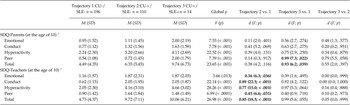
Table 3 presents the descriptive data obtained on mental health scores for each trajectory and their comparisons. Children in the CU+/SLE- group (Trajectory 2), in comparison to CU-/SLE- children (Trajectory 1- reference group), scored higher on all the teacher-reported mental health problems, but no differences were found when the informants were parents. The effect sizes for emotional and peer problems were small (d ≤ 0.45), whereas for hyperactivity the effect size reached medium value (d = 0.77). Conduct and total problems had large effect sizes (d ≥ 0.85). Children in the CU+/SLE+ group (Trajectory 3), compared with CU-/SLE- children (Trajectory 1- reference group), scored higher on parent-reported problems with peers and overall problems, showing large effect sizes for both outcomes (d ≥ 0.93). No differences were found for teacher-reported mental problems. No differences were observed in the mental health outcomes between CU+/SLE- (Trajectory 2) and CU+/SLE+ (Trajectory 3) children.
Table 3. Comparison of the Trajectories on Mental Health Outcomes at the Age of 10

Note. Trajectory 1 = Children showing low CU traits and experiencing low stressful life events; Trajectory 2 = Children showing increasing high CU traits and experiencing low stressful life events; Trajectory 3 = Children showing high CU traits and experiencing high stressful life events. Trajectories comparison p-values are corrected for multiple comparison using Sidak’s approach. In bold significant comparison; d = Cohen’s d effect size.
a Adjusted by the same measure at baseline; SDQ = Strengths and Difficulties Questionnaire
Discussion
The current study analyses contextual risk factors, maternal psychopathology, personal factors (executive functioning) and mental health outcomes of co-occurring CU traits and SLE trajectories along childhood, between the ages of 3 and 10 years. The aim was to examine if children with high CU traits, who were also sustainably exposed to high levels of stressors (CU+/SLE+), would face more contextual risk factors (including socioeconomic problems and maternal psychopathology), lower executive functioning and more mental health problems in comparison to children with increasing high CU traits and low stress (CU+/SLE-) or children with low CU traits and low stress (CU-/SLE-; reference group).
The results only support our hypothesis partially. CU+/SLE+ children were more likely to face early contextual adversity in forms of low SES, unemployment, early economic problems, and maternal psychopathology than the children from the other two trajectories. The CU+/SLE+ trajectory was the smallest group in our sample (only 24 participants), but also the one which experienced the highest early risk environments. The highest scores on mental health problems were also found in this CU+/SLE+ trajectory, but the comparison between the other two trajectories (reference group and CU+/SLE-) did not reach statistical significance. Contrary to our hypothesis, we found neither poorer executive functioning among CU+/SLE+ children at the age of 3, nor differences on mental health outcomes reported by teachers and parents at the age of 10 in comparison to CU+/SLE- children. This suggests that children with CU traits and different levels of SLE show similar executive functioning and mental health outcomes, but different contextual risk factors. Worse outcomes in peer relations and higher psychopathology symptoms reported by parents were only observed when comparing CU+/SLE+ children to the reference group.
When analyzing the different contextual risk factors of CU+/SLE+ children in comparison to the other two trajectories, our results are in line with previous research, which has revealed that children with high CU traits also suffered from more contextual risk factors such as parental mental health problems, that are related to socioeconomic difficulties (Piotrowska et al., Reference Piotrowska, Stride, Croft and Rowe2015). Low SES and its associated risk factors (unemployment and lower educational backgrounds) might increase the parental vulnerability to develop mental health problems (Vukojević et al., Reference Vukojević, Zovko, Talić, Tanović, Rešić, Vrdoljak and Splavski2017), resulting in more deficient parent-child relationships and problematic parenting styles (Schneider & Schenk-Fontaine, Reference Schneider and Schenk-Fontaine2021). Similar results were observed in our study, as the CU+/SLE+ trajectory was socioeconomically more disadvantaged (lower SES, higher early economic problems and unemployment) and lived with mothers who engage in higher rule breaking behavior when comparing these variables to the other two trajectories. These results are not surprising, because parents who show antisocial behavior might also engage in more authoritarian parenting styles (Zhong et al., Reference Zhong, Wang, Shou, Zhang and Deng2020). Thus, harsh parenting styles are a predictor of children’s CU traits (Waller et al., Reference Waller, Shaw, Neiderhiser, Ganiban, Natsuaki, Reiss, Trentacosta, Leve and Hyde2017) and parental psychopathology has been associated with higher CU traits (Cecil et al., Reference Cecil, Lysenko, Jaffee, Pingault, Smith, Relton, Woodward, Mcardle, Mill and Barker2014). Possible psychopathological conditions of the mothers should be considered as an additional risk factor when analyzing developing pathways of CU traits among children.
Another factor that should be further examined is the role of sex differences in CU trait development. In our study, we observed more boys in the CU+/SLE- and CU+/SLE+ trajectories than in the reference group. This finding is consistent with previous research indicating that CU traits in boys are higher and more prevalent than in girls (Pihet et al., Reference Pihet, Etter, Schmid and Kimonis2015). Thus, boys have found to be more vulnerable towards biological factors (Moore et al., Reference Moore, Blair, Hettema and Roberson-Nay2019) and seem to be more prevalent in the primary variant of CU traits (Docherty et al., Reference Docherty, Boxer, Huesmann, O’Brien and Bushman2016), while girls are more vulnerable towards environmental factors and are more likely to be found among the secondary variant of CU traits. However, our results did not show any sex-differences between the CU+/SLE- and the CU+/SLE+ trajectories. Future research that examines the developmental pathways on CU traits for boys and girls separately is needed.
Furthermore, the children in the CU+/SLE- seem to show distinct personal factors that might predisposition them towards CU behavior, such as inhibitory control deficits. The role of early inhibition problems is especially important, as CU traits together with low executive function work as comorbid risk markers for poor psychosocial adjustment, more peer rejection and more aggressive behavior than children with CU traits, but intact executive functioning (Waller et al., Reference Waller, Hyde, Baskin-Sommers and Olson2016). Previous research has observed that increasing CU traits are associated with ADHD, suggesting that early childhood CU traits in combination with executive function deficits could describe a distinct developmental pattern (Byrd et al., Reference Byrd, Hawes, Loeber and Pardini2016; Squillaci & Benoit, Reference Squillaci and Benoit2021). Our study would support this finding, as the CU+/SLE- trajectory has a higher presence of psychopathology in comparison to the reference group regarding all domains (emotional, behavioral, hyperactivity, social) reported by teachers at the age of 10. Surprisingly, parents did not describe any mental health issues for this group of children. A possible reason for this is that parents and teachers experience and interact with children in different settings. Therefore, teachers could be more sensitive towards impulsive, drive and externalizing behavior, which is more salient in normative and social environments such as schools (Papageorgiou et al., Reference Papageorgiou, Kalyva, Dafoulis and Vostanis2008). Teachers might then perceive children with increasing high CU traits as more problematic than their parents would, as their disruptive behavior could have a negative impact on the classroom activities and on the relationship with other classmates (Allen et al., Reference Allen, Bird and Chhoa2018).
When addressing the question of whether children with CU+/SLE+ feature different mental health outcomes than children in the other trajectories, our comparisons between children with CU+/SLE+ and the reference group did not reach significance on teachers’ reports on mental health, although effect size values are medium-high (3 of 5 above 0.90). This is likely due to the small sample size of the CU+/SLE+ trajectory and the resultant lack of power for these comparisons. When parents reported mental health problems, this CU+/SLE+ trajectory showed higher peer-problems and overall problems in comparison to the reference group. As parents of children in this distressed trajectory seem to be under higher psychosocial vulnerability, they also might perceive their child as being more problematic due to their dysfunctional parent-child relationship.
Contrary to our hypothesis, no significant differences on mental health outcomes were found when comparing children in the CU+/SLE+ and CU+/SLE- trajectories. These results need to be interpreted in the light of primary and secondary variants of CU traits, as it could be expected that the CU+/SLE+ trajectory would face higher emotional problems, considering it the secondary variant of CU traits. Yet, among our sample there were no differences between both trajectories on the mental health outcomes, including emotional problems. This supports the idea that there is great inconsistency in the findings on whether the behavioral and psychological outcomes among primary and secondary variants are unique or not (Craig et al., Reference Craig, Goulter and Moretti2021). If replicated, our results would further suggest that children who show CU+/SLE+, but also those with CU+/SLE-, might not differ phenotypically on socioemotional and psychological outcomes. Instead, the underlying mechanism of their developmental pathways may be distinct, due to their different level of exposure to SLE and other contextual risk factors. We would then propose that CU+/SLE- children could be described as the primary variant of CU trait, hypothesizing that they are under a greater influence of non-environmental factors, whereas CU+/SLE+ children could be identified as the secondary variant of CU traits, describing a subtype of children who experience early contextual risk factors. Among these children, CU traits might emerge as an adaptive mechanism towards those stressful environments, impacting negatively on their social behavior and emotional processing development (Kahn, Frick, et al., Reference Kahn, Frick, Youngstrom, Kogos Youngstrom, Feeny and Findling2013).
The current study has several strengths, including a prospective longitudinal design of 8 years, a community-sample of children and multiple informants. However, there are some limitations that should be taken into consideration. First, working with a community sample implies low presence of psychological dysfunction or mental health problems. Moreover, among the three trajectories, the group of children with CU+/SLE+ had a small sample size, which might affect the statistical power of our study. Second, our study design allowed us to associate risk factors and outcomes to the different trajectories, but they cannot be interpreted as causal risk factors and outcomes. Third, some scale scores show low alpha values (e.g., ASR rule-breaking), as the items are characterized by a low variance, because most participants’ response option was negative (e.g., not true).
The present study helps to gain a better understanding on how CU traits develop along childhood according to different levels of SLE exposure, and our conclusions could be generalizable to community children with an occidental lifestyle. The joint CU-SLE approach helps to evaluate and to identify contextual adversities and developmental characteristics in children with CU traits, which have been associated with poor treatment responses in reducing CU traits (Hawes et al., Reference Hawes, Price and Dadds2014). Therefore, boys experiencing low SES and related contextual risk factors (e.g., early economic problems, unemployment of the caregiver, maternal antisocial behavior) might be under greater risk of facing a CU+/SLE+ trajectory. This subgroup of children could be identified as more vulnerable, implying that CU trait evaluations in clinical contexts should also explore other factors such as gender, SLE, SES or psychosocial adversity.
Moreover, children in the CU+/SLE+ trajectory need treatment models which focus not only on children’s social and emotional regulation skills or parent training (Hawes et al., Reference Hawes, Price and Dadds2014), but also on the reduction of stressors in the developmental contexts of these children (family, school, social environment). Such broader multidisciplinary treatment approaches could also target maternal psychopathology and more specifically maternal antisocial behavior, which can have a negative impact on the parent-child relationships (Maliken & Katz, Reference Maliken and Katz2013). Improvement in treatment results might be achieved by including interventions on children’s socioemotional skills and parents training, but also on stress coping strategies targeted at the parents to improve how they deal with general psychosocial disadvantages and specific SLE (Devenish et al., Reference Devenish, Hooley and Mellor2017). Intervention studies that assess how children’s exposure to SLE and co-occurring CU traits might moderate the effects of treatment programs are needed to establish the components that show higher treatment effects.
In conclusion, the joint analysis of CU traits and SLE on developmental differences along childhood allows understanding and characterizing the etiological pathways of CU traits. Our results suggest that CU traits need to be studied in a more global context, focusing not only on early childhood SLE and psychosocial adversity, but also on later mental health outcomes.