


To the Jews I became as a Jew, in order to win Jews. To those under the law I became as one under the law (though I myself am not under the law) so that I might win those under the law. To those outside the law I became as one outside the law (though I am not free from God's law but am under Christ's law) so that I might win those outside the law. To the weak I became weak, so that I might win the weak. I have become all things to all people, that I might by all means save some.
1 Corinthians 9:20–22, NRSV-CE
The expansion of abortion rights in the United States and Canada was met with different reactions from the two countries’ conferences of bishops, despite the institutions’ identical guiding philosophies. The American and Canadian Churches not only shared the same doctrines but also implemented the same ethical code in their hospitals.Footnote 1 In practice, this meant that both conferences spent decades advocating for universal health insurance and condemning abortion even as pro-choice activists began to fuse the two issues.Footnote 2 Notwithstanding these similarities, Canadian bishops gained a reputation for being reformminded and this reputation was often contrasted with the perceived attitudes of their American counterparts.Footnote 3 In the case of contraception and abortion, for example, the two hierarchies had different reactions to liberalization. In the immediate aftermath of Roe v. Wade, the United States Conference of Catholic Bishops asserted their antiabortion position by strengthening their lobbying activities and encouraging parishioners to activism. In contrast, the Canadian Conference of Catholic Bishops paired their antiabortion position with an emphasis on the right of individual conscience after the Criminal Law Amendment Act, 1968–1969 passed.
These differences are significant—the conferences’ political strategies have remained distinct ever since. Take, for example, the bishops’ political strategies during recent debates about expanding access to other forms of health care. In the United States, access to health care and abortion is limited; but in Canada, health care and abortion procedures are relatively accessible. When political conflict arises over attempts to expand access to abortion and/or other health procedures, both hierarchies reiterate their commitment to universal health care as a part of their belief that all persons have dignity and a right to life. However, the American conference refused to endorse the Affordable Care Act on the grounds that its conscience protections were insufficient and that their antiabortion principle cannot be compromised even to achieve the goal of universalism. In contrast, the Canadian conference releases statements that condemn governments when they introduce legislation that allows private clinics to receive public funds, because the conference believes that such bills undermine universalism and thus human dignity.Footnote 4 To be sure, these strategies are distinct but employed for the same purpose—preventing access to abortion. Nevertheless, the difference in approaches largely reflects the conferences’ political orientations as revealed during early debates about abortion rights. Together, their behavior illustrates how the boundaries of health care are constructed and impresses the significance of the bishops’ strategic divergence 60 years ago. It also raises a question about why the bishops chose distinct strategies in the past, despite having identical commitments, and how this juncture shaped their behavior going forward.
In this paper, I argue that the conferences have different strategies because they were reacting to different party cues. I will demonstrate that although both conferences have long opposed decriminalizing abortion and contraception, they were relatively cooperative with governments before Roe and the Criminal Law Amendment Act.Footnote 5 It was only after the parties indicated varying willingness to work with the bishops that the conferences’ dispositions started to diverge. In other words, the conferences used different political strategies because they were responding to different information about parties’ willingness to keep abortion access salient and pass legislation limiting it. In short, religious authorities’ political strategies are dependent on political parties’ cues.
I use the Catholic Church as a case not because it is uniquely affected by partisan cues—it is not—but because it has a role in both political coalitions of interest. To measure the effect of party cues on bishops’ strategies, I investigate abortion debates in the United States and Canada because the cases vary on the dependent variable but match on the other dimensions of interest. The Church is also a relevant actor in both cases, which makes it a single example that illustrates the argument well.
After finding support for my argument using a mix of primary sources and contemporary reports of relevant events, I test a few alternative hypotheses. I test the hypotheses that the bishops were responding to different preferences within their laities, that the hierarchies simply had different views on the controversies, that legislative action inspires different responses than judicial decisions, and that Republicans were not constructing an antiabortion coalition but were trying to attract evangelical voters. Then, I find evidence that bishops and parishioners in both countries were becoming increasingly moderate on the issue of contraception and abortion, that the sequence of events does not suggest that the mechanism of expanding abortion laws inspired different reactions, and that evangelical views on abortion were also influenced by partisan cues.
1. Follow your bishopFootnote 6
In this section, I explain that although conferences of bishops share foundational values, these principles manifest as different political strategies depending on partisan cues. I do this by first explaining how bishops’ political engagement changed over time, and I use this information to contextualize bishops’ behavior during the initial abortion debates. The bishops received a mandate to engage with political discourse after the Second Vatican Council, and they used this mandate to support their ministerial goals in the public sphere. I argue, from this explanation, that when bishops express political opinions they do so with the explicit intention to influence, and thus adjust their strategies according to the partisan and institutional context. Then, I explain that political parties may wish to engage with the conferences because bishops are influential figures in the Catholic communities where parties wish to win votes. In all, this section explains why the conferences adopted different strategies by outlining the interaction between religious organizations and political parties.
Bishops participate in political debates because it allows them to pursue ministerial goals including, but not limited to, religious education. The bishops’ current political orientation largely emerged after the Second Vatican Council. In 1965, the Vatican published a constitution that designated the Church as an interpreter of political events with the ultimate goal of connecting doctrine to modern issues.Footnote 7 In short, bishops engage with politics because it allows them to educate others about their positions.Footnote 8 This is noteworthy because in addition to differences in opinion between bishops and those who are not Catholic, the bishops may also have different political positions than the laity.Footnote 9 Sometimes these differences are significant, such as in the case of abortion rights.Footnote 10 These disagreements were especially salient at the time of the Second Vatican Council, especially in the United States because, on average, American Catholics were becoming more educated and wealthier so bishops’ influence on their political positions waned.Footnote 11 For this reason, the bishops release statements on political controversies to make their positions clear and sway others to their view.
Furthermore, bishops also engage with politics because it allows them to influence public policy in favor of ministerial goals such as religious charity. The Second Vatican Council’s exhortation to interpret politics was all the more significant because it coincided with changes in the Church’s political circumstances. In the United States and Canada, the federal government expanded its welfare functions, which displaced the bishops’ traditional social roles.Footnote 12 The bishops can resist change by releasing statements or using formal political mechanisms like lobbying.Footnote 13 Sometimes these strategies are combined, as was the case when the American conference of bishops wrote an amicus brief arguing that the Affordable Care Act’s contraceptive mandate threatened their ability to “conduct religious, charitable, and social welfare work … and generally further these goals through education, publication, and advocacy.”Footnote 14
Nevertheless, the bishops’ strategies are ultimately dependent on partisan cues. Bishops participate in political discourse to promote their doctrinal beliefs and favored policies, but policy is ultimately written, implemented, and interpreted by state officials. Therefore, bishops must lobby these officials to achieve their political goals. Conferences of bishops know which officials might be receptive to their preferences using cues. A cue is information that allows an actor to make inferences without direct knowledge. Although it is difficult to infer a politician's willingness to ally with bishops, it is less so after learning their political party, for example, because political affiliation generally indicates a battery of policy views.Footnote 15 I argue that these cues are significant because once the conferences infer that legislators may be receptive, it suggests that the politicians are moveable so the bishops are more likely to adopt confrontational strategies.
To be sure, the strategies that conferences derive from partisan cues are somewhat dependent on party systems. Cues have little effect on behavior when party reputations are weak because their positions will remain undifferentiable to the average actor.Footnote 16 For the conferences of bishops, it is more difficult to find legislative allies when parties’ views on abortion and/or religious institutions appear to be similar. In the United States, party cues are stronger than in Canada because there are fewer parties and the parties have a longer history of being ideologically distinct, so their positions are more differentiable.Footnote 17 These facts suggest that bishop strategy may be more confrontational in the United States because cues are stronger, and thus allow the conference to direct their disapproval of abortion access toward a single adversary.
Further, bishops’ strategies in response to cues are dependent on how party systems relate to veto points.Footnote 18 This is because although partisan or religious affiliation suggests that a politician may be receptive to bishops’ positions, it is party structure that ultimately determines whether the individual legislator has the influence to revise policy according to the bishops’ preferences. For example, Canadian parties have stronger discipline than their American counterparts. The United States’ weak parties mean that individual members tend to respond to the interests of their constituencies rather than their party programs.Footnote 19 This feature of American parties allows bishops to find members of Congress who may be receptive to their beliefs and lobby them. The bishops can also encourage parishioners to pressure legislators to support antiabortion measures.Footnote 20 In contrast, Canadian parties are more disciplined, so members of Parliament (MPs) have less discretion in their voters and there are fewer veto points. So, in a scenario where a politician personally holds antiabortion views, the bishops may infer that she will be receptive to their preferences but the mechanism to exploit their commonalities will be different.
In the 1960s and 1970s, the American and Canadian conferences of bishops were reacting to partisan cues that originated in significant cultural and political shifts. These shifts changed the way that parties approached political issues. Pro-choice activists made abortion rights salient in what was, perhaps, the strongest and most successful movement for nominally universal care that is common to both countries. Pro-choice activists’ demands expanded how people conceptualized health care and therefore shaped, and continue to shape, health care debates and limit the realm of possible reforms. The Catholic laity was not immune from this shift in public opinion; instead, they became more supportive of contraception and abortion access.Footnote 21 At the same time, the collapse of the New Deal Coalition caused American electoral politics to be more competitive than in times past.Footnote 22 The Republican Party needed cross-regional support to win national elections, so they adjusted to their new circumstances by adopting a platform with positions, such as antiabortion policy, meant to attract Southern Baptists and conservative Catholic voters in the South and Midwest.Footnote 23 And in Canada, the Liberal Party could maintain a pro-decriminalization position and cross-regional support because Québécois nationalism secularized.Footnote 24
After these events, the American and Canadian conferences of bishops adopted different strategies because they were reacting to different partisan cues. I argue, similarly to previous theories, that the way that individuals act on their religious beliefs can change in response to political factors.Footnote 25 However, instead of focusing on changes among voters and politicians, I observe changes in the bishops themselves. In this paper, I will demonstrate that both conferences were historically cooperative with political parties, including on issues such as contraception, but that their behaviors only began to diverge after the Republican (Liberal) Party adopted an antiabortion (pro-decriminalization) position.Footnote 26 This sequence of events, along with evidence that the laity in both countries held heterogenous views on abortion, suggests that parties respond to voters, but bishops respond to parties.Footnote 27 The conferences are professional organizations and are thus relatively insulated from shifts in public opinion.Footnote 28 Although bishops’ opinions about reproductive rights did vary, the conferences themselves maintained an antiabortion stance.Footnote 29 However, the Canadian bishops were less confrontational because the Liberals’ pro-decriminalization stance, electoral dominance, and party discipline suggested that the party would not be receptive to their preferences. While in the United States, the bishops became more confrontational because the Republicans’ antiabortion position suggested that the party was receptive to the bishops’ concerns about various policies that expanded access to contraception and abortion. The bishops also had a clear channel to act on this cue, because members of Congress have more autonomy and can be lobbied.
For political parties, it is worthwhile to ally with the conferences because bishops are a direct link to Catholic voters who may be in the party coalition. The conferences are an influential organization because they represent the hierarchy, who have influence over Church resources and doctrinal interpretation.Footnote 30 On an individual level, this means that bishops have influence over voters’ political beliefs—religious values predict political ideology and policy positions.Footnote 31 And, on aggregate, this means that some voters look to bishops for guidance and may be willing to mobilize based on the conferences’ statements.Footnote 32
Nevertheless, this alliance does necessarily involve a degree of compromise because bishop involvement does not directly translate into electoral power. Parties are primarily concerned with winning votes, so bishops’ influence is somewhat dependent on the coalitional influence of likeminded voters.Footnote 33 In turn, these voters’ coalitional influence is dependent on whether elite polarization causes partisan sorting; whether elite discourse is visible enough to inspire voters to organize around their interests; whether voters’ partisanship becomes a social identity that causes them to cling onto policies, like antiabortion policies, irrespective of their core values; and the degree that voters’ partisanship or religion shapes their worldview and limits parties’ ability to convince a conservative (liberal) to be pro-choice (antiabortion).Footnote 34 Even then, Canadian and American parties are comprised of coalitions with many different priorities. When parties make policy, they generally try to balance the various interests of their coalition so that they can remain appealing to voters and interest groups.Footnote 35 Parties generally prefer compromise to accomplish this because the transaction cost of working within their coalition is lower than forming a new one entirely.Footnote 36
Although, religious lobbyists are comparatively less willing to compromise than their secular counterparts, bishops do reframe their positions when their influence within a coalition is limited.Footnote 37 This is evident in the conferences’ appeal to “religious freedom,” which is used to sway policy toward their preferences when they cannot block it entirely. In fact, this is exactly what American bishops did when confronting the Affordable Care Act and its contraceptive mandate.Footnote 38 In response, parties have at times written exemptions into laws concerning access to health care, including contraception and abortion procedures, because it allows them to manage their coalition by expanding abortion and contraceptive access without fully alienating the bishops and conservative voters.Footnote 39 Although the bishops themselves may not characterize these interactions as compromise, their behavior suggests that they do alter their strategies according to parties’ cues.
I support the argument that the American and Canadian Conferences of Bishops’ strategies are dependent on partisan cues using a controlled comparison to isolate the relevant variables. As illustrated in Table 1, the two countries are comparable because they have similar political institutions (e.g., federalism) and their conferences of bishops deployed similar political strategies in the past.Footnote 40 Although Canada had a much larger Catholic population during the time period of interest, the 1960s and 1970s, the religion had a notable presence in both countries.Footnote 41 This combination of similarities, along with the crucial differences in party behavior, allows for isolating the effect of party cues on bishop strategy when all other factors are held constant.
Table 1. Major Case Variables in the 1960s
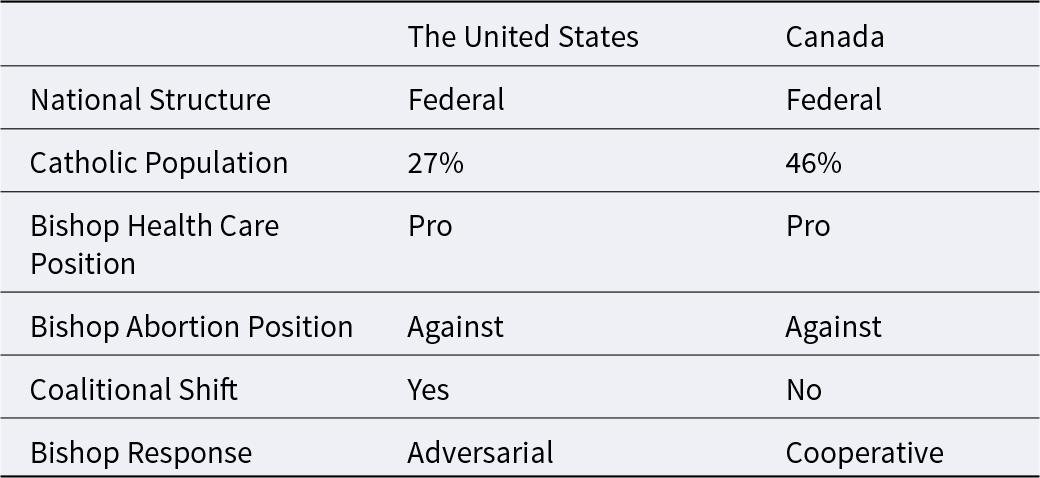
Sources: Gallup (2007) and the Dominion Bureau of Statistics (1961).
Additionally, I investigate the effect of other variables and consider alternative explanations for the divergent bishop behavior. In this paper, I first verify that both conferences of bishops were invested in universalizing health insurance but restricting access to abortion and contraception.Footnote 42 This supports the foundational premise of my argument—that the bishops were reacting differently to decriminalization despite holding the same ideals. Then, I consider whether it was local reactions to Vatican II, rather than partisan cues, that determined bishop strategy after Roe v. Wade and the Criminal Law Amendment Act. I find evidence that the Catholic populations in both countries hoped that Vatican II would liberalize doctrines concerning reproductive care and that the hierarchies in both countries held heterogenous views about the controversies.Footnote 43 This means that the bishops’ divergent strategies cannot be explained by reactions to Vatican II in the laity and hierarchy because this is constant across cases. I also examine the alternative hypothesis that the American religious landscape is simply different and more extreme than in Canada, and that religious institutions were not responding to partisan cues, but that partisans were responding to preexisting antiabortion views in groups like evangelicals. I counter this argument by providing evidence that evangelicals, like Catholics, did not have uniform antiabortion views before Roe and were thus subject to the same partisan stimulus.Footnote 44 Lastly, I engage with the hypothesis that the bishops took different approaches to the issue because the method of expanding of abortion rights inspired different reactions, with legislative means provoking a more moderate response and expansion by courts causing a more adversarial one. I provide evidence against this explanation by showing that the bishops’ response was relatively muted in the immediate aftermath of Roe and only changed once Republicans began to embrace antiabortion policies, which suggests that it was not the decision itself that inspired an adversarial reaction. A brief timeline of these events can be found in Table 2.
Table 2. Timeline of Events
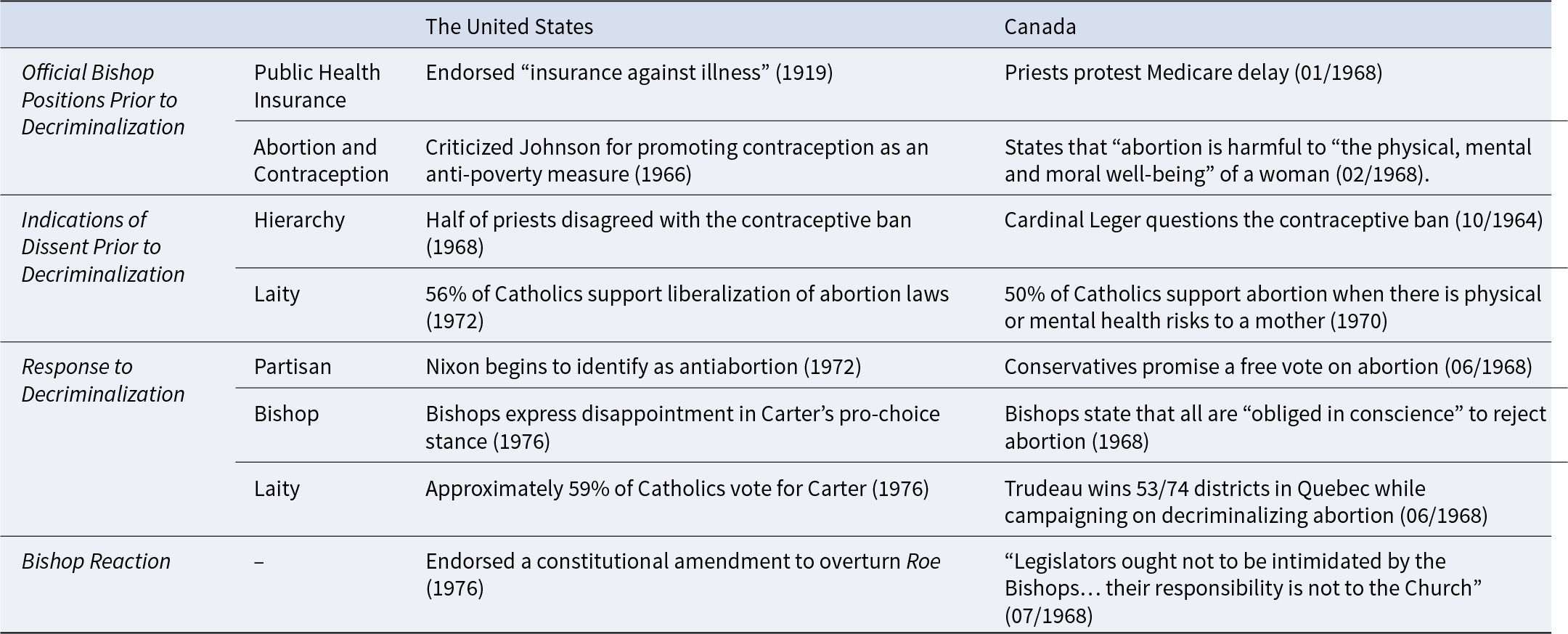
Sources: National Catholic War Council (1919), Critchlow (1999), Barrett (1968), Gallup (1972), Semple (1972), Apple Jr. (1976), The Globe and Mail (1964, 1968), Canadian Catholic Conference (1968), Boyd and Gillieson (1975), Westell (1968), Canadian Catholic Conference (1968), Seale (1968), George (1968), United States Conference of Catholic Bishops (1976).
Notes: This is a table providing evidence of similarities between groups. The sources’ dates do not indicate that earlier evidence does not exist, it indicates the earliest evidence found by the author of said claim. The dates also vary according to context. In the United States, abortion was decriminalized in 1973, and in Canada, it was decriminalized in 1969.
I support the argument that bishop strategy is dependent on partisan cues and investigate alternative hypotheses using published statements by the Vatican, the United States and Canadian Conferences of Bishops, as well as presidential and political party documents. However, the analysis still has some notable limitations. The first is that I primarily measure the rhetoric of bishops using documents released by the conferences. I chose this method because I am interested in the relationship between political parties’ strategies and bishops’ political behavior, and the conferences were the primary actors with whom the legislators communicated. Though I do refer to statistical surveys of bishops when available, I generally do not measure the exact ideological homogeneity of bishops themselves and the role that it might play in influencing the conferences’ statements. This means that I cannot verify if the bishops’ differences originate at the demographic level. Instead, I depend on the conferences’ statements to indicate the overall viewpoint of the bishops because they are often written and revised with democratic consent.Footnote 45 The second major limitation of the analysis is that the relationship between religion and politics could be endogenous. Religion was very influential in American and Canadian politics prior to the Revolution and the Seven Years’ War, respectively, so it is possible that the institutional features of American and Canadian government that drive partisan behaviors were influenced by religion in ways that I cannot measure and that may affect the results of the analysis.
2. The United States
In the 1960s and 1970s the United States Conference of Catholic Bishops witnessed a series of developments that realized and challenged their goals. The bishops had long supported national health insurance, and saw this value enshrined with the establishment of Medicare and Medicaid.Footnote 46 However, the expansion of health care coincided with the Supreme Court decriminalizing contraception, and pro-choice activists rhetorically linking abortion and contraceptive access with general commitments to providing equitable health care. These developments exacerbated the tension between the bishops’ moral principles, which they felt required them to obstruct abortion and contraceptive access while advocating for universal health insurance.Footnote 47
Further, the bishops had little to no influence on abortion policy until Roe v. Wade fueled institutional uniformity within the American Church and a significant coalitional shift within the parties. Prior to Roe, the Republican coalition was pro-choice and legislators often expanded access to abortion despite bishops’ protests.Footnote 48 The Catholic Church did condemn abortion before it became a mainstream conflict, and Roe did reinvigorate the conference of bishops’ antiabortion activism. However, it was not until the Republican Party deliberately kept the issue salient to win conservatives’ votes that the conference of bishops adopted a confrontational political strategy. The party’s cues indicated a path toward limiting abortion access which signaled to the conference that an uncompromising position could be successfully implemented. After which, the conference of bishops, invigorated by the Vatican II guidance to pursue justice, used their control over the Church’s financial resources to build an antiabortion organization: the Right to Life Committee. This activity was supplemented by the mobilization of evangelicals, which was a mass movement that complemented the top-down organization of the Catholic Church. Some antiabortion bishops also used their authority to censure Catholic politicians who supported decriminalization. This created a hostile environment for pro-choice Catholics.Footnote 49 The bishops’ confrontational strategy extends to resisting pro-choice activists’ conceptualization of abortion as medical care, thereby contributing to further polarization on health reform.
To support this argument, I will demonstrate that bishop rhetoric is dependent on partisan cues and directed at uncompromisingly defending a particular definition of health care using a mix of primary historical documents and secondary analyses to argue that (1) American bishops have supported national health insurance while disputing the idea that contraception and abortion belong in this category, that (2) the Catholic public was divided on the issues of contraception and abortion by the time of Vatican II and the pro-choice movement, that (3) the Republican Party used this divide for electoral gain, and that (4) this caused the conference of bishops to adopt adversarial strategies when debating health reforms.
2.1 How the Catholic Church engaged with health care debates before Roe
The Catholic Church has long held that societies need to value persons, and that states could foster this principle by providing social insurance and promoting family building. This ethos is sustained by bishops around the world—even in the United States despite its liberal individualist culture. In 1919, American Bishops released a statement arguing that human life is inherently priceless and that the state should thus “remove those industrial and social conditions which … encourage an unnatural restriction of families” and “make comprehensive provision for insurance against illness.”Footnote 50 This philosophy mirrors Pope Leo’s encyclical Rerum Novarum, which reads that “no human law can abolish … nor in any way limit the chief and principal purpose of marriage ordained by God’s authority from the beginning: ‘increase and multiply,’” and that “among the several purposes of a society, one should be to try to … create a fund out of which the members may be effectually helped in their needs … in sickness, old age, and distress.”Footnote 51 Therefore, both documents illustrate that bishops professed an early moral connection between supporting national health insurance plans and opposing contraception.
The American hierarchy infused their institutions with their values but were also largely cooperative with politicians that promoted contraception. For example, the Catholic Hospital Association, which was founded in 1915, promoted a logic of health care without contraception by pursuing the goals of centralizing patient care standards, protecting the Church's conscience rights, and writing a moral guide for Catholic health facilities.Footnote 52 However, the bishops were cordial with President Lyndon Johnson—they supported the Great Society even after Johnson began promoting family planning as an anti-poverty measure.Footnote 53At first, the bishops did criticize Johnson and this caused him to fear that his initiatives would alienate Catholics from the Democratic Party, but he maintained his relationship with the bishops by assigning two Catholics in his administration to temper their concerns.Footnote 54 Although the bishops were forthright in their values, they were willing to cooperate with those who did not share some of their goals.
The bishops’ cooperation with pro-contraception actors was challenged when pro-choice activists made the link between health care and abortion access, and the bishops were ill-equipped to respond. The tension between the bishops’ goals of expanding health care and restricting contraceptive access became most apparent when the Supreme Court invalidated all laws that banned married couples from buying contraceptives, and Congress passed Medicare and Medicaid a month later.Footnote 55 In the same year, the New York Times ran a story highlighting the “medical necessity” of legalizing abortion, saying that its illegality was a “shameful injustice” causing “chaos,” “a hidden crisis,” and “needless… pain.” The article then indicated a possible path to decriminalizing abortion by invoking the Fourteenth Amendment.Footnote 56 The Times later published a letter from a reader who shared personal knowledge of deaths due to illegal abortion procedures and argued that criminalization amounted to “moral hypocrisy.”Footnote 57 Two years later, the newspaper published another column arguing the need to prevent unsafe abortions by making medical assistance available.Footnote 58 At this point, the medicalizing language of abortion was embedding itself in mainstream health debates. Although the American Church’s goal of expanding their health ministry was realized after Medicare and Medicaid, the bishops found themselves unable to influence abortion policy.Footnote 59 Although most Catholics were Democrats, the bishops’ influence was limited to a few states where Catholics made up a substantial number of the population. In states where Republicans controlled the legislature, abortion and contraceptive access was often expanded despite bishops’ protests.Footnote 60 So while the American hierarchy objected to the growing permissibility of pro-choice views and the legalization of contraception, they had few political allies willing to support their position.
Furthermore, the hierarchy’s ability to influence political parties was weakened by heterogenous opinion within the Church. Bishops are endowed with the responsibility to interpret the Moral Directives and determine which procedures and practices are permitted in hospitals under the care of their diocese. Some bishops used this discretion to allow hospitals to distribute contraceptives and perform sterilizations.Footnote 61 Even after Pope Paul VI reiterated the ban on artificial contraception, half of American priests professed dissent and just over 40 percent stated that they had condoned the use of contraceptives after the encyclical was issued.Footnote 62 The hierarchy did not have a unified approach to reproductive health care, and this limited their ability to act as a bloc against expanded access to contraception and abortion.
The bishops’ influence was also limited because most lay Catholics wanted abortion laws to be reformed. In fact, journalists noted that the conference’s opposition to liberalizing abortion laws ran in sharp contrast to polling that showed that most Catholics preferred reform or believed that abortion should be a decision between a woman and her doctor alone.Footnote 63 There were also other indications of popular dissent. After Cardinal O’Boyle of Washington, D.C. censured thirty-nine priests for signing a statement that objected to the ban on artificial contraception, roughly 4,000 people attended a rally in support of them.Footnote 64 So, opinion within the laity was, perhaps, as heterogenous as opinion within the hierarchy and this meant that Catholic voters were not a unified bloc either.
In sum, the American Church’s comparatively strong stance against contraception and abortion was not inevitable. The conference of bishops has long condemned contraception and abortion, but it has also held that health care is a fundamental right.Footnote 65 When the public began to conceptualize reproductive rights as health care and some Catholics, including priests, expressed concurrence with this view, the bishops’ traditional position was challenged.Footnote 66 Hence, the bishops’ current position cannot be explained by popular opinion within the hierarchy and/or laity. In accordance with my argument, the bishops’ current behavior is not observed in the historical record. Rather, the bishops were more moderate in the past when their primary political allies were Democrats.Footnote 67 It was not until Roe v. Wade that the Republican Party exploited abortion debates for electoral advantage that the bishops abandoned their moderate approach for an adversarial one.
2.2 How the Republican Party changed the politics of reproductive care
After Roe v. Wade, the United States Conference of Catholic Bishops did use their power to limit the ruling's reach but their influence was largely contained within their own hospitals. Bishops adopted a revised version of the Moral Directives, which standardized ethical standards, in the hospitals under their care.Footnote 68 Bishops were able to deny patients abortions (and sterilizations) on ethical grounds because 47 states passed conscientious objection laws for medical providers, and Congress passed the Church and Hyde Amendments after Roe.Footnote 69 The Bishops did try to expand their influence to the political realm; the Church’s National Right to Life Committee, which was founded to monitor abortion rights legislation and encourage parishioners to activism, abandoned its denominational affiliation to attract protestant allies. In the end, the Committee remained largely Catholic, but it provided an organizational structure for concrete political action. Eventually, it would be the link connecting the American Conference of Bishops, evangelical protestants, and the Republican Party.Footnote 70
Yet, the alignment between Republicans and the conference was not preordained—it was created by the electoral ambitions of the party. The party had long supported women’s rights, it endorsed the Equal Rights Amendment before the Democrats and continuously affirmed its support well into the 1970s.Footnote 71 Additionally, prominent Republicans like Prescott Bush, George H. W. Bush, Dwight Eisenhower, and Peggy Goldwater all supported access to contraceptives.Footnote 72 Furthermore, Republican voters were more likely to be pro-choice than Democratic ones.Footnote 73 Richard Nixon adopted an antiabortion position but only after publicly endorsing contraception and rebuffing multiple attempts by Republican strategists to convince him to change his mind.Footnote 74 Nixon may have hesitated to change his position because there was not a preexisting antiabortion base to sway; both Catholics and evangelicals held heterogenous views.Footnote 75 However, Nixon was competing against antiabortion Catholic Democratic presidential candidate Edmund Muskie and needed to sway midwestern Catholics to win the election.Footnote 76
Nixon was a candidate in a period of intense partisan competition and unstable partisan coalitions due to the collapse of the New Deal coalition. This fact meant that the Republican Party had a possible path to forming a durable governing coalition if they could convert Catholic voters, who composed a quarter of the population and resided primarily in the Northeast and Midwest, and Southerners.Footnote 77 Republican strategists thus urged the party to adopt antiabortion policies and the language of “states’ rights;” these efforts were labeled the Catholic and Southern strategy.Footnote 78 It was thus not a given that the Republican Party would endorse antiabortion policies, it was simply a convenient strategy to win elections in a more competitive partisan landscape. So, notwithstanding his personal principles, Nixon released a statement labelling abortion as the “province of the states” and assured the Archbishop of New York that he was antiabortion in a private letter.Footnote 79 His strategy proved fruitful; he won, what was at the time, the most Catholic votes in Republican history.Footnote 80
Notwithstanding Nixon’s success, it would still take many more years for the Republican Party itself to endorse antiabortion policies. The Speaker of the House, Gerald Ford, did endorse a constitutional amendment to give the states absolute jurisdiction over abortion after the Roe Decision. However, he also chose a pro-choice candidate to be his vice presidential running mate and a pro-choice Republican National Committee chair.Footnote 81 Ford fully embraced restrictive abortion policies during the 1976 Election, but only after antiabortion activists rallied around his primary challenger, Ronald Reagan, and the Democratic Party nominated a born-again Christian, Jimmy Carter, for president. Ford and the Republican Party then endorsed a constitutional amendment to nullify Roe just as the Democratic Party platform officially affirmed the decision.Footnote 82
After the parties released their revised platforms, the United States Conference of Catholic Bishops met with the two presidential candidates. Carter defended the Democratic platform and “disappointed” the bishops when he refused to endorse an amendment that would ban abortions.Footnote 83 Ford, on the other hand, was determined to win the bishops’ approval.Footnote 84 He wrote a letter to the president of the conference, Archbishop Joseph L. Bernardin, where he professed belief that “government has a responsibility to protect life” and that everyone should be “concerned about an increased irreverence for life within advanced societies.”Footnote 85 Though the conference did not endorse Ford outright, it did call his position “encouraging” and, in a document that it regularly released ahead of elections, it urged parishioners to vote their conscience and endorsed a constitutional amendment to overturn Roe.Footnote 86
In the end, Ford’s attempts to attract Catholic voters to the Republican coalition had little immediate effect.Footnote 87 The Roe Decision alone was not enough to create an antiabortion movement from scratch, especially in a religion with pro-choice parishioners and moderate priests. Ford's inability to capitalize on the decision suggests that it was not the manner of legalization that inspired adversarial political behavior in the Church. In 1976, Ford and the Republican Party did not have a reputation for being reliably antiabortion and this likely inhibited their ability to make abortion salient.Footnote 88 However, his campaign did sway the most conservative antiabortion voters to the Republican coalition and thus laid the groundwork for the party to win a majority of Catholic voters in 1980, once it established itself as a genuine ally.Footnote 89
Once the Republican Party welcomed antiabortion voters, and the remaining pro-choice members left, the conference had the coalitional power that it needed to obstruct access to medical procedures it found objectionable. However, this power came with a cost. Even after the bishops allied with Republicans to block access to abortion, their commitment to universal health care did not falter.Footnote 90 Nevertheless, Republicans continued to exploit the tension between these views for electoral gain. In 1976, the party was against publicly funded health insurance and abortion rights while the Democratic Party supported both policies.Footnote 91 The bishops had thus chosen to partially align themselves with partisans who did not share their broader goals.
Since then, the bishops have uncompromisingly defended a conceptualization of health care that is not shared by either political party and this behavior complicates coalition building. Prior to the Roe Decision, Congress’ ability to expand health care provision required the careful management of unions, doctors, insurers, and the insured; and bishops adopted more tolerant attitudes toward contraceptives to achieve health reform and mitigate poverty. However, the Republican Party’s embrace of antiabortion policies indicated that the conference of bishops could achieve their antiabortion goals by adopting an adversarial stance during health care debates. This change in behavior makes health care coalitions more fragile by exacerbating ideological divisions.
For example, American bishops still support universal health care but opposed the Affordable Care Act because they objected to its liberal and conservative amendments.Footnote 92 While the bill was being drafted, conservative Democrats wielded their coalitional influence to impose an amendment that allowed states to exclude plans that covered abortions from their exchanges. Still, bishops did not approve of the bill because they were unsatisfied with its conscience protections for religious health care workers; and disapproved of the contraceptive mandate and an amendment that denied coverage to undocumented immigrants.Footnote 93 For these reasons, the conference did not endorse the final draft of the Affordable Care Act. Instead, the bishops released a statement calling the bill “profoundly flawed” and, while they did reiterate a belief that health care reform is “a moral imperative,” they also stated that the conference would not endorse a bill that did not “forbid federal funding of abortion” and “respect [one's] rights of conscience” because they felt that health care is a right for all.Footnote 94 So, paradoxically, the bishops were unwilling to participate in a coalition to expand access to care because they felt that their personal conceptualization of health care required them to withhold their support.
Although there was dissent within the institutional church, the nature of the disagreement goes to demonstrate the historical contingency of the affiliated organizations’ political strategies. Unlike the Conference of Bishops, the Catholic Health Association did endorse the Affordable Care Act.Footnote 95 However, this was not because the organizations had different moral principles—both groups highlighted the importance of protecting conscience rights and undocumented immigrants.Footnote 96 Although the bishops have explicitly stated that they “disagree that the divergence between the Catholic Conference and … the Catholic Health Association, represents merely a difference of analysis or strategy,” it remains the case that the bishops and the nuns used identical language of faith and “moral imperative” when explaining their respective positions.Footnote 97 It is quite clear then, that the differences in the Conference of Bishops and the Health Association’s positions were not due to a difference in fundamentals. Rather, it is an example of the two organizations emphasizing different, but shared, goals in response to different cues. Although the nuns at the Catholic Health Association agreed with the Conference of Bishops that abortion access should be restricted, they chose to accept the existing antiabortion provisions within the Affordable Care Act not only to achieve their goal of expanding access to other procedures but because they felt that conscience provisions could be used to limit reproductive care once the bill became law.Footnote 98
2.3 Discussion
Thus far, I have demonstrated a long tradition of American bishops fusing their pro-health care stance with an anti-contraception and antiabortion position, and I have argued that these commitments came into conflict after abortion rights activists promoted a conception of health care that included reproductive autonomy.Footnote 99 In the immediate aftermath of Griswold v. Connecticut, the bishops were willing to make compromises with the Democratic Party due to a lack of alternatives to achieve their political agenda and, possibly, liberal views in the laity and some members of the hierarchy.Footnote 100 The disagreement within the Catholic Church on the issues of contraception and abortion meant that the Church’s reaction to Roe v. Wade was not preordained. What ultimately drove American bishops to take a more forceful stance against the Democratic Party’s policies on contraception and abortion was the concerted effort by the Republican Party to make these issues salient.Footnote 101 The evidence, therefore, illustrates that American bishops adopted an adversarial strategy toward reproductive rights after Roe because the Republican Party’s cues made it seem like a viable way to achieve their policy goals and advance a conceptualization of health care that rivaled that of pro-choice activists.
I further test the conclusions drawn from the American case using a counterfactual. If coalitional shifts due to abortion policy cause the bishops to choose a more adversarial strategy during health care expansions, then there should be evidence that the lack of coalitional shift causes bishops to choose a more cooperative strategy. The Canadian case provides said evidence. While the Republican Party was able to keep abortion salient, split Catholic voters along partisan lines, and incentivize bishops to take an assertive policy stance; the Conservative Party was unable to make abortion rights a wedge issue in elections and, once Catholic voters continued to support the Liberal Party, the bishops were incentivized to take a cooperative stance. In the following section, I will outline this causal chain.
3. Canada
The 1960s was a decade of profound change in Canadian politics. Like their American counterparts, Canadian bishops supported public health insurance and thus were enthusiastic about Medicare.Footnote 102 Their commitment was tested, however, when rapid urbanization and Vatican II came together to inspire a secular shift in Québécois nationalism.Footnote 103 This shift deeply divided Catholics across the country, especially as the issues of contraception and abortion became salient with the Trudeau Government’s Criminal Law Amendment Act, 1968–1969.Footnote 104 The Conservative Party saw the divisions within Canada’s Catholics as an opportunity for electoral gain because the Liberals had a predominantly Catholic base.Footnote 105 However, the consolidation of Canada’s Catholics into secularizing Québec prevented the Conservatives from sparking a realignment. While the fracturing of the New Deal Coalition made American politics more competitive as the public debated abortion rights, Canadian politics was much less so due to Liberal Party dominance. This left the bishops without any viable allies against abortion and contraception, and led them to take a more cooperative approach to the Liberal agenda.
3.1 How secularization affected Canadian social policy
Like their American counterparts, the Canadian Church supported publicly funded health insurance.Footnote 106 The Canadian Conference of Catholic Bishops saw their values realized when provincial actors worked to implement universal care. By 1950, four provinces provided public hospital insurance. Then, in 1962, Saskatchewan implemented North America's first single payer regime.Footnote 107 However, the bishops’ aspirations could not be fully realized without federal subsidies to provincial health systems and the national government did not commit to a cost sharing plan for hospital insurance until 1958.Footnote 108 The federal government implemented a public funding scheme in July 1968, but only after much pressure from religious leaders and the public.Footnote 109
Notwithstanding the Conference’s support for universal health care, the bishops responded to increased access by taking measures to enshrine their ideological commitments in the hospitals under their jurisdiction. The most consequential of these measures, for our purposes, is their split from the American Catholic Hospital Association which allowed them to form the Catholic Hospital Council of Canada and write their own ethical code.Footnote 110 This measure was likely motivated by bishops’ opposition to procedures like abortion, which was becoming increasingly salient at the time. This is evident in a statement the bishops released just months after Medicare took effect, which argued that abortion was harmful to “the physical, mental and moral well-being” of a woman.Footnote 111 So, once the bishops achieved their goal of increased access generally, they focused their attention on limiting specific reproductive rights.
The Church held the cultural authority to influence social policy, especially in Québec where just over half of Canadian Catholics resided. In 1957, 85 percent of Quebecers were Catholic and, of those people, 88 percent of them stated that they attended religious services weekly.Footnote 112 Québec was a hub of conservative Catholicism and the populations’ devotion was reflected in their institutions. In 1961, 35 percent of all Québec Hospitals and 58 percent of all beds were owned by the Church; and once we include hospitals that were nominally secular but administered by the Church, 43 percent of hospitals and 71 percent of beds were under Catholic authority.Footnote 113 The Church was the primary provider of many social services and thus pervasive in Québécois life.Footnote 114
However, the nature of Québécois Catholicism began to shift around the time of Vatican II. In the decades between the start of the twentieth century and the end of World War I, Québec went from being predominantly rural to predominantly urban.Footnote 115 This shift had significant political consequences because it gave many French Canadians firsthand exposure to the extent that Anglophones dominated the provincial economy.Footnote 116 The resentment that followed fueled a secular nationalist movement that destabilized the Church’s political power.
When Vatican II began, secular nationalists were greatly invested in the prospect of liberalizing reproductive doctrine. Across the country, bishops and priests were reportedly condoning the use of contraception, particularly for married couples, in their parishes.Footnote 117 There was also clear discontent with the Vatican’s official reproductive policies within the laity, and some indication of support for liberal views in the hierarchy—the Archbishop of Montreal, Cardinal Léger, indicated support for abolishing the contraceptive ban.Footnote 118 For this reason, the Canadian hierarchy became known for their liberal attitudes and focus on “unity” during this time period.Footnote 119
Yet, the hierarchy’s comparatively liberal views did not necessarily make them willing to accept secularization. Rather, the changes instituted by Québécois nationalists tested their commitment to universal health care. The Church, through the Québec Hospitals Committee, previously stated that it would “loyally” collaborate with the province in making a health insurance plan that is entirely public. However, in the same statement, the Church also stated that it preferred a health insurance plan that was “compulsory” and “contributory” but largely run by private actors.Footnote 120 The Church preferred a system that mixed public and private authority most likely because it wanted to maintain control over its own hospitals among other social services.Footnote 121
In contrast, the nationalists understood Vatican II as the reiteration of a religious duty to assuage economic and social injustice; and as sanctioning the separation of church and state. They demonstrated a commitment to these principles by transitioning the province’s social services to the state, thereby transforming private Catholic hospitals into public institutions.Footnote 122 However, these changes were aimed at modernization and not about anticlericalism per se.Footnote 123 Although there is a long tradition of Québécois nationalists accusing the Catholic Church of co-conspiring with the British to oppress French Canadians, the nationalists argued that secularization would protect the Church’s reputation from the taint of politics.Footnote 124 The Church did not entirely disagree with these institutional changes—it had previously argued that provincially operated health insurance was “less evil” than the increasingly expensive health care system that was then the status quo.Footnote 125 Nevertheless, the policy changes caused tension between the Church and the nationalists, because bishops were being displaced as guardians of Québécois culture, and losing what they felt was their ministerial responsibility to protect human life and provide charity.Footnote 126
The tensions between universal health care and the bishops’ desire to protect “human life” became even more salient once the federal government moved to decriminalize abortions. While the Pearson Government waited for the national insurance plan to begin, Justice Minister Pierre Trudeau prepared the Criminal Law Amendment Act, which would allow hospitals to provide abortions if an in-house committee of three doctors certified that a woman’s health was threatened by her pregnancy.Footnote 127 Once the Medicare subsidization plan took effect, the legislation would essentially sanction government-funded abortions and the Catholic Church was determined to prevent that from happening.
In February 1968, the Canadian Catholic Conference appealed to the parliamentary subcommittee developing the bill by condemning abortion in no uncertain terms, calling it “an unspeakable [crime]” fundamentally at odds with civilization and progress. The bishops also stated that the law was overly broad and left too much to the discretion of individual doctors.Footnote 128 There was no mistake to be made—the Conference did not think that abortion was a form of health care, and they would not allow the procedure to take place in their hospitals.
3.2 How bishops confronted a secular world
Canada’s political elites were aware of the divisions taking root in the Church, but they were preparing to address it in different ways. A few months after the Conference presented their statement against Trudeau’s abortion bill to the parliamentary subcommittee, he became the Liberals’ leader and abortion became a wedge issue in the election. Conservative Catholic organizations were lobbying against the Criminal Law Amendment Act and some Liberals were openly uncomfortable with some provisions of the bill. The Conservative Party tried to exploit these tensions by promising not to decriminalize abortion without a free vote.Footnote 129 Despite the pressure to compromise, Trudeau refused to backtrack on his agenda.Footnote 130
Trudeau was wagering on the historic unpopularity of the Conservative Party, which had little appeal to Catholic voters, especially in Québec. After Canada was established in its current form, the Conservative Party dominated electoral politics and governed for 24 of the first 29 years after confederation.Footnote 131 Conservatives’ fortunes changed when the party made a series of decisions that French and Catholic Canadians thought indicated disrespect for their rights and culture. These decisions include ordering the execution of Louis Riel, who blocked federal authorities from entering Rupert’s Land because he felt that they intended to assimilate Franco-Catholic culture, even though the jury that found him guilty of treason recommended mercy.Footnote 132 The Conservatives also refused to intervene when Manitoba abolished a provision giving the French and English languages coequal status; and defunded its public Catholic schools.Footnote 133 Shortly thereafter, the Liberal Party won a national election with their francophone Catholic leader, Wilfrid Laurier, who persuaded the Manitoban Premiere to compromise.Footnote 134 These events established the Liberals as protectors of French and Catholic rights, and this perception was tied to a belief among Catholic Canadians that Conservatives did not respect their culture. Trudeau, then, was likely betting on the fact that the Liberal Party dominated electoral politics for decades, and that Catholic voters would be unwilling to abandon their partisan attachment because it was tied to their ethnoreligious identity.
The Liberals were also betting on the geographic features of their voting base. The historical dominance of the Liberal Party due to Catholic support should not have given Trudeau confidence that he could decriminalize abortions. In fact, it should have made the Liberals less likely to support decriminalizing abortion. However, the Liberals were counting on the regional structure of their electoral dominance when adopting a position on abortion access. While American Catholics were dispersed widely across the country, Canadian Catholics were less so. At the time of the election, roughly 46 percent of Canadians were Roman Catholic, 56 percent of which were Quebecers.Footnote 135 This meant that, due to the secularizing forces in Québec, most of the Church’s parishioners were not only Liberal partisans but also had liberal religious views.Footnote 136 Polls taken in the early 1970s suggest that around the time of decriminalization most Catholic Canadians did not support unrestricted abortion access, but 50 percent did support abortion to “save a mother’s life, or her mental or physical health” and 55 percent agreed that “the decision to have an abortion should be made solely by a woman and her physician.”Footnote 137 As a result of these trends, the appeals by the Conservative Party and antiabortion groups failed, and Trudeau won a majority mandate.
Trudeau's success did indicate that many Catholic voters supported his agenda, but it did not mean that his conflict with the Church was over. Not long after the election and the implementation of the federal Medicare plan, Pope Paul VI increased the salience of abortion once again. Even after a Vatican commission voted to repeal the contraceptive ban, the Pope released a statement, Humanae Vitae, in which he reiterated the Church’s opposition to “artificial contraception.” This left the Justice Minister, John Turner, who was now charged with reviving Trudeau's omnibus crime bill, deeply conflicted between his political party and his religion.Footnote 138 It appeared, on its face, that abortion would become polarizing enough within the Liberal Party to prevent policy change even if its effects did not necessarily manifest within the electorate.
However, the Church was willing to cooperate with Trudeau’s agenda, regardless of its official position, because the political coalitions of the time incentivized it. The bishops’ cooperation was evident in an official statement released by the Canadian Catholic Conference just two months after Humanae Vitae was published. In the Winnipeg Statement, the Conference stated that marriage and parenthood had an inherent dignity that needed to be respected. The bishops then said that even priests were finding it difficult to accept the Pope’s position on contraception and that it was not a sin to doubt the teachings of the Church. They also went a step further and encouraged Catholics to have “understanding and reverence” for those who doubt. Lastly, and most importantly for the Liberals and pro-choice activists, the conference assured Catholics that had a conflict between their religious and secular obligations that they could differ from the Pope’s opinion and still have a clean conscience.Footnote 139 This statement marked a change in rhetoric from the bishops, who had previously stated that all were “[obliged] in conscience” to reject abortion regardless of law.Footnote 140
To be sure, the bishops were changing their approach to decriminalization, but they were still staunchly antiabortion. They only changed their rhetoric because they recognized that neither party was sending a credible cue for allyship. Instead, the Liberals were clearly indicating that they had electoral support and that they were unwilling to preserve the status quo. This is evident because the bishops did, in fact, give Catholic MPs in the Liberal Party permission to legalize abortion and contraception even while professing antiabortion views. This suggests that the bishops were engaging in strategic behavior and not choosing allies based on philosophical agreement per se. Further, the conference would continue to ally with the Liberals at the expense of alienating more militant Catholics, suggesting that they were not entirely driven by preserving unity within the laity. Instead, I argue that, like the Catholic Health Association of America, the Canadian Conference of Bishops was abandoning the legislative realm in favor of blocking access to abortions using different means.
The bishops explicitly ceded influence on the Criminal Law Amendment Act and all but abandoned attempts to keep abortion criminalized. The Conference clarified their stance in a private meeting with Justice Minister Turner, so there is no mistaking the meaning of their change in rhetoric. Turner, who was reportedly torn between his duty to his political party and his faith, asked the bishops about the meaning of the Winnipeg Statement. He explained the intent of the bill, which he felt was not an extreme measure but an attempt to clarify the legality of established abortion practices. This interpretation of the bill fit well with the conference's demand that any bill be “confined to eliminating ambiguity without attempting to broaden the law,” though the bill still included undesired language that allowed abortions when the health of a mother is threatened.Footnote 141 The Conference’s president, Alexander Carter, told Turner that he accepted his position.Footnote 142 Clearly, the bishops were publicly condoning the individual right of conscience and thus ceding their influence on the issue.
However, this was not because the Conference changed its view on the permissibility of abortion. It was because they were choosing not to antagonize their political allies. When testifying to the Standing Committee on Health and Welfare, Most Rev. Remi De Roo, who was one of the representatives for the Canadian Catholic Conference, delivered a statement deliberated upon by all Canadian bishops, urged “respect for human life,” and raised concern that a provision allowing for abortions when the “health of the mother” is endangered would be too lenient. Nonetheless, he also stated that “[the bishops] do not feel that we have the whole answer. We do not want to impose a particular view … the decision on a solution we recognize as [the Committee’s] responsibility.”Footnote 143 When asked by a committee member whether Catholic legislators were bound by doctrine, Bishop De Roo responded that while one must make laws that serve the common good “he must [also] follow the dictates of his conscience.”Footnote 144 According to the bishops themselves, then, they still thought that abortion was wrong but were choosing to respect the role of government in determining law.
This view was not expressed by Bishop De Roo alone—other representatives also yielded to legislative authority. Rev. E.J. Sheridan told the Committee that “bishops [had] never been in favor of tightening the present law to exclude abortion.” He also added that “abortion is permitted under our present Criminal Code, and certainly the bishops have never moved, do not wish to move, in the direction of tightening that. In other words, we do not believe that our moral principle must be enshrined in criminal law.” Bishop De Roo seemed to express a similar sentiment once again when he stated that “far from wishing in any way to appear as sitting in judgment on the other groups or downgrading their moral principles and convictions, I would say that we not only admire the sincerity with which they approach this question but we also recognize in them a similar respect for life.”Footnote 145 Further, the secretary of the conference, Gordon George, would later state publicly that “no one … takes issue with Prime Minister Pierre Trudeau’s distinction between crime and sin in the matter of abortion.”Footnote 146 It was not simple happenstance that a representative from the conference was using cooperative rhetoric then, as other bishops engaged in the same strategic behavior.Footnote 147
Once abortion was decriminalized, the bishops returned to using hostile rhetoric that rejects the view that abortion is a form of health care. The fact that the bishops used cooperative rhetoric with the Liberals while still subjecting their hospitals to an ethical code that prohibited the “immediate cooperation in … abortion” further suggests strategic behavior on their part.Footnote 148 Especially since, a few years later, Roe was decided and a Canadian doctor, Henry Morgentaler, announced that he had performed thousands of illegal abortions.Footnote 149 The bishops responded by releasing a statement condemning the growing acceptability of abortion and euthanasia; and lamenting the fact that Catholic politicians were voting for laws that were antithetical to doctrine. They then went even further by stating that although priests were no longer “the conscience of the community” and that though judgment needed to be left to individuals, those who allow reason to overtake their faith are not “acting as a true Catholic” and that people who reject doctrine are responsible for their own suffering.Footnote 150 The discrepancy between what the bishops said to MPs when legislation was being considered and how they would react to later expansions in abortion access once again suggests that they were never truly ambivalent; they were being strategic.
To be sure, the bishops’ strategy was not primarily motivated by maintaining unity within the Church because it alienated militant antiabortion Catholics. Even after the bishops released their adversarial statement in response to Roe, the conference publicly distanced itself from antiabortion activists.Footnote 151 In 1985, for example, a Cardinal agreed to limit the number of protestors who would demonstrate outside of Ontario clinics and the amount of antiabortion literature that could be distributed in parishes.Footnote 152 It became more difficult to make these compromises after the Supreme Court invalidated laws regulating abortion access in R v. Morgentaler, and antiabortion protestors became more visible and their affiliated groups became increasingly litigious.Footnote 153 Yet, the bishops primarily focused their attention on limiting access at the point of care.
Although the bishops adopted a cooperative strategy when it became clear that they had no legislative allies, they later reframed their antagonism toward protecting religious freedoms. After the Criminal Law Amendment Act passed parliament, many Catholic hospitals refused to establish the committees required to perform abortions. In Québec, for example, only 14 of 250 hospitals had abortion committees and only a single abortion was performed in a French hospital after a year of decriminalization.Footnote 154 A survey of the whole country found that 10 months after the law changed, there was 4,375 abortions performed in Canada but only 181 performed in Québec.Footnote 155 And once the Supreme Court decriminalized all abortions in 1988, there was, counterintuitively, a tangible decline in access because the bishops used their conscience rights to avoid providing abortions and contraception in their hospitals.Footnote 156 Therefore, the bishops’ strategic behavior was quite successful because they were still able to impede access to abortion procedures even when it was decriminalized.
In contemporary debates, the bishops obstruct abortion access by accusing the government of violating principles of universal care when it attempts to allow private clinics to provide abortions. There is a historical pattern of women accessing abortions in private clinics due to publicly funded hospitals refusing to provide care.Footnote 157 In response, health ministers have tried to coerce provinces into paying for abortions performed in private institutions by invoking the Canada Health Act, which makes federal funding contingent on the provision of equal access to medically necessary procedures without extra cost to the patient.Footnote 158 A Catholic magazine based in Toronto responded to the measure by accusing the Government of creating a two-tier health care system and a bishop responded to federal efforts with accusations of dishonesty, neglect, and hypocrisy.Footnote 159 Bertrand Blanchet, the Archbishop of Rimouski, wrote a letter accusing the Government of misrepresenting the Constitution. He insisted that R v. Morgentaler was decided for procedural reasons and did not designate a constitutional right to an abortion nor require provinces to provide coverage for them. He also stated that the Government was overstepping its authority because health policy was constitutionally designated to the provinces. He then accused the Government of abdicating its responsibility to protect unborn life and hypocritically refusing to fund private institutions offering other services.Footnote 160
The bishops’ arguments are not only effective but also mirrored by antiabortion officials in the provinces. In the immediate aftermath of the Morgentaler Decision, some premiers refused to cover abortion services under provincial insurance, made it illegal to perform abortions outside of hospitals, or required two doctors to verify its medical necessity.Footnote 161 The Supreme Court banned many of these practices and the federal government fines provinces that refuse to fund private abortion providers, but the punishment has little force.Footnote 162 Many provinces would rather be fined by the federal government than face backlash from interest groups and, often, the provinces are making an apt calculus because federal governments refuse to make the fines significant in fear of facing electoral consequences.Footnote 163 Further, provinces sometimes defend their behavior using the language of equal access. In 2020, New Brunswick Premier Blaine Higgs rejected demands that his government fund abortions in private clinics on the grounds that it would set a precedent for privatizing health care.Footnote 164 Four years later, the province still refuses to fund abortions performed in private settings but has begun funding other private procedures.Footnote 165 For the Premier, at least, opposing private care serves as a convenient rhetorical tool to prevent abortion access.
Although the evidence presented thus far suggests that the bishops genuinely support universal health care, their behavior suggests that they adopted cooperative rhetoric during abortion debates because they accepted that they would be most influential in their own hospitals. The Canadian Conference of Catholic Bishops has opposed both abortion and privatization on moral grounds since the 1960s, at least. In 2005, the conference stated that Catholics should reject private health care as unjust and exploitative but then added that the “one of the hallmarks of the healing and caring ministry of the Church is a deep respect for human life and dignity … especially when … weakest and most vulnerable.” The statement also confirmed that bishops see their hospitals as a place for preventing supposed wrong-doing because it reads that the root of their motivation to maintain a presence in health care and promote “ethical reflection” in hospitals is grounded by the conviction that privatization is immoral and that all life is valuable.Footnote 166 In their own words, the bishops see Catholic hospitals as a place to prevent abortions and other procedures that they do not believe to be health care.
3.3 Discussion
The Canadian Catholic Conference chose not to antagonize the Liberals and the Criminal Law Amendment Act because there was no coalitional shift once abortion became salient, so bishops were incentivized to spend their time influencing policy elsewhere. This argument is supported by the fact that the bishops endorsed the Liberals’ universal health care plan and that their influence within the coalition was weakened when Vatican II fueled secularization in the nation’s Catholics. This shift encouraged the Liberals, a largely Catholic party with a stronghold in Québec, to introduce an omnibus crime bill that would decriminalize abortion. The Conservative Party saw the tension it caused within the Catholic laity and hierarchy, and attempted to exploit it for electoral gain. This attempt failed largely due to the consolidation of the nation’s Catholics into the newly secularized Québec. This left conservative bishops without a viable ally against abortion and motivated them to direct their discontent into another venue.
This is very different from the United States Conference’s behavior as documented in the previous section. The Canadian Bishops were very similar to their American counterparts. They had identical founding philosophies and have consistently professed a strong belief in universal care and against abortion access. They also had the opportunity to ignore national politics all together and focus on preventing abortions at the subnational level. The only difference between the two institutions, and thus the most probable cause for their differences in behavior, is that American bishops had an influential political ally willing to ban abortions and the Canadian bishops did not.
4. Conclusion
This paper demonstrated that Canada and the United States had significant Catholic populations that hoped that Vatican II would lead to more liberal doctrines on contraception and abortion.Footnote 167 This confirms that the countries’ bishops did not choose different strategies because their laities had different values—the groups had similar views. Despite liberal ideas taking hold in the American and Canadian Churches, both conferences remained dedicated to expanding public health care and obstructing abortion access.Footnote 168 When abortion became politically salient, the Republican and Conservative Parties adopted antiabortion policies to attract conservative Catholics to their coalitions, with varied success.Footnote 169 It was this variance that decided the strategies that the conferences would use in the aftermath, meaning that partisan cues can explain the disconnect between institutional philosophy and institutional strategy across cases.
This paper also shows that the relationship between health care and abortion remains salient irrespective of the countries’ institutions. Though it may be the case that the unique features of American institutions exaggerate the polarizing potential of some issues, it is still true that decriminalizing abortion and establishing national health insurance ignited great debate in Canada. However, the effect of this salience is determined by the strategic behavior of partisan actors, who are the gatekeepers of political debate. When partisans exploit divisive issues like abortion, it can offer opportunity to religious actors, cause them to change strategies, and complicate coalitions in the future. In the United States, the Republican Party adopted an antiabortion position and split Catholics across political coalitions. This makes coalition building around health care more complex, as the Church works with the Democratic Party to expand the public provision of health insurance and the Republican Party to restrict abortion access. A coalition to expand health care is not only dependent on the interests of doctors, insurers, and those insured; it is also somewhat dependent on the interests of the Catholic Church because it controls one in six hospital beds in the United States.Footnote 170
Further, the difficulty of coalition building is significant because the issues of health care and abortion have become even more salient in the wake of Dobbs v. Jackson Women's Health Organization. The overturning of Roe has occurred in tandem with a rise in demands for public health care and this raises the stakes of legislative action. Often, debates about health insurance dissolve into abortion debates because the parties do not agree about what should be considered as health care in the first place.Footnote 171 For Democrats, there is no public health care without reproductive coverage, and for Republicans public funding should not go to abortion procedures. As long as this conflict remains, we can be sure that antiabortion actors will view public health care expansions as Trojan horses. Considering how these views may not be mutually exclusive, especially among powerful interest groups, illuminates how the issue may affect the legislative process.
Acknowledgments
The author thanks David Bateman, Doug Kriner, Isabel Perera, Nic van de Walle, Amelia Arsenault, and the anonymous reviewers at Studies in American Political Development for their comments; and Jason Quidoz for asking the question that inspired this paper. A previous draft was presented at the 2023 Annual Meeting of the American Political Science Association and improved by comments from the panel and discussant.
Competing interests
The author declares none.


 Open access

