



People with mental illness often face stigma and discrimination, which can have serious adverse consequences for health, social inclusion and quality of life. Reference Thornicroft1 Quantitative studies have shown that media coverage can have a negative impact on public attitudes towards people with mental health problems. Reference Angermeyer, Dietrich, Pott and Matschinger2 The nature of such media coverage, and how far it changes over time, may therefore influence the impact of a concurrent programme against stigma and discrimination, such as that launched in 2009 by Time to Change (TTC). Reference Henderson and Thornicroft3 This four-year, £20.5 million anti-discrimination programme was funded by the Big Lottery Fund and Comic Relief, and among its aims was to have a positive impact on press coverage. Prior to TTC, in 2002, the ‘see me’ programme in Scotland developed a multisectorial alliance to challenge stigma and discrimination against people with mental health problems through a national media and publicity campaign. Reference Dunion and Gordon4 Before the campaign launch, press articles about mental health rarely carried comment by people with direct experience of mental ill health, and the concept of stigma was almost never broached by the press. During the campaign one study assessed the trend of reports relating to people with schizophrenia and found that the national media campaign did succeed in breaking the perceived link between schizophrenia and dangerousness over a 5-year period. Reference Knifton and Quinn5 This may have been due to see me and alliance partners, who were regularly asked to comment on articles or provide quotes, including the see me media volunteers, who have experience of mental health problems. Reference Dunion and Gordon4 However, a study looking at UK national daily newspapers which compared the quality of reporting of schizophrenia across two time points, before and during the see me campaign, found no significant change in the use of stigmatising descriptors. Reference Clement and Foster6
In New Zealand ‘Like Minds, Like Mine’ was a broad anti-stigma programme, which started in 1996. 7 A study by the Mental Health Commission of New Zealand, using systematic surveys of newspaper clippings over 3-month periods in 1997, 1998 and 2004, found improvements in the way people with mental illness were represented by the print media, and that there was a consistent decrease in negative reporting and an increase in positive reporting of mental health issues. One of the aims of the campaign was to educate print media staff about representing people with mental illnesses more positively, and this does appear to have made some impact.
In England an earlier anti-stigma campaign, Changing Minds, was led by the Royal College of Psychiatrists between 1998 and 2003. Reference Crisp, Cowan and Hart8 There is no evidence that public attitudes improved over this period - if anything there was a decline. Reference Mehta, Kassam, Leese, Butler and Thornicroft9 Although we did not find a study of media coverage for this period, it has been noted that there was a large amount of coverage given to homicides by people with previous contact with psychiatric services both before and during this time; Reference Anderson10 this might have influenced the effectiveness of the campaign on public attitudes.
As a component of the overall TTC evaluation, Reference Henderson and Thornicroft3 we studied newspaper coverage of topics related to mental illness before and during the first 4-year phase of TTC. Our study had the following overall aims: first, to seek evidence for positive change in newspaper reporting of mental health topics; and second, to interpret our findings on public attitudes to mental illness over the period 2008-2011 (see also Evans-Lacko et al, this supplement Reference Evans-Lacko, Henderson and Thornicroft11 ). We predicted that there would be:
-
(a) a significant increase in the overall proportion of anti-stigmatising articles (hypothesis 1);
-
(b) a significant increase in the proportion of articles featuring the following anti-stigmatising elements: mental health promotion (hypothesis 2a), stigma (hypothesis 2b) or injustice (hypothesis 2c);
-
(c) a significant decrease in the overall proportion of stigmatising articles (hypothesis 3);
-
(d) a significant proportional decrease in the proportion of articles featuring the following stigmatising elements: danger to others (hypothesis 4a) or pejorative language (hypothesis 4b);
-
(e) a significant increase in the proportion of sources who are people with a mental illness (hypothesis 5a), family, friends or carers (hypothesis 5b) or mental health charities (hypothesis 5c).
In addition to testing these hypotheses for 2008-2011, we compared data for 2010 and 2011. The rationale for this was that a number of disability charities have recently expressed concern that the UK government has portrayed people with disabilities in a negative light, Reference Boffey12 and that this has had an impact on public attitudes and behaviour towards these people. 13
Method
The Lexis Nexis Professional UK electronic newspaper database (www.lexisnexis.co.uk) was used to search through all articles from 27 local and national newspapers which were published in 2011 on two randomly chosen days (including Saturday and Sunday) of every month, and which referred to mental illness, no matter how briefly. The newspapers used for the article search were ten national mass-circulation (>100 000), general-interest daily newspapers (Daily Express, Daily Mail, Daily Mirror, Daily Star, Daily Telegraph, News of the World (until July 2011), The People (from July 2011), Sunday Express, Sunday Mail, Sunday Mirror, Sunday Star, Sunday Telegraph, Sunday Times, Guardian, Independent, Independent on Sunday, Observer, Sun and The Times) and the nine highest-circulation regional newspapers in England (Birmingham Evening Mail, Eastern Daily Express, Evening Chronicle, Evening Standard, Hull Daily Mail, Leicester Mercury, Liverpool Echo, Manchester Evening News and The Sentinel). To ensure geographical diversity of newspapers, no more than one newspaper per town or city was used. The News of the World went out of print in July 2011, so for August-December 2011 the Sunday tabloid paper The People was searched instead (as the next highest Sunday paper in mass circulation).
Search terms
Search terms consisted of 35 general and diagnostic terms covering the full range of mental disorders. Such an approach follows the recommendations of Wahl from his literature review of research on mental health reporting. Reference Wahl14 The full text of articles in the selected newspapers were searched using the following terms (* = wildcard): ‘mental health OR mental illness OR mentally ill OR mental disorder OR mental patient OR mental problem OR (depression NOT W/1 economic OR great) OR depressed OR depressive OR schizo! OR psychosis OR psychotic OR eating disorder OR anorexi! OR bulimi! OR personality disorder OR dissociative disorder OR anxiety disorder OR anxiety attack OR panic disorder OR panic attack OR obsessive compulsive disorder OR OCD OR post-traumatic stress OR PTSD OR social phobia OR agoraphobi! OR bipolar OR ADHD OR attention deficit OR psychiatr! OR mental hospital OR mental asylum OR mental home OR secure hospital’.
Inclusion criteria
Articles were included if they focused on mental illness, i.e. upon people with such a condition or upon the services they receive. Articles that used a search term in a context unrelated to mental health (e.g. ‘the government is schizophrenic about this issue’), described a non-clinical use (e.g. ‘I'm feeling a bit depressed about this’) or in which diagnostic or slang terms were used metaphorically (e.g. ‘he's driving me nuts’) were excluded. Articles relating primarily to developmental disorders such as autism, neurodegenerative diseases (e.g. Alzheimer's disease) or alcohol/substance misuse alone were also excluded as these were not the focus of the TTC programme.
Coding
To evaluate the content of newspaper articles in relation to mental health and stigma, articles were coded for their date, newspaper origin and article type (news, features or opinion), as well as for any diagnoses mentioned and any person or source directly or indirectly quoted. The central part of the coding process was to categorise the main theme or idea that was conveyed in each article into an ‘element’, identified as stigmatising, anti-stigmatising or neutral. Stigmatising themes were danger to others, problem for others, hopeless victim, strange behaviour, personal responsibility causes, sceptical of seriousness, or pejorative or inappropriate language. Anti-stigmatising themes were sympathetic portrayal (general public or public figure), causes of mental illness (genetic, psychosocial or other), recovery from or successful treatment of mental illness (pharmaceutical, psychosocial or other/not specified) and mental health promotion (stigma, injustice or prevalence). Finally, each article was coded overall as stigmatising, anti-stigmatising, mixed or neutral.
Identification of elements
Elements were derived from three sources: existing studies of mental health reporting; the wider literature on mental health stigma; and a process of inductive coding, in which a sample of articles was qualitatively analysed for recurrent themes and ideas. Each article was analysed for the presence of different elements, and (based on the relative weight of these elements) the aim of the coding was to identify the overall central message conveyed in each article, rather than to focus upon the various specific ideas mentioned. All individual elements were coded as either primary (the central focus of the article) or secondary (if mentioned only briefly). Any number of primary and secondary elements could be coded for a single article. Articles in which both stigmatising and anti-stigmatising elements were given equal weight (for example, both as primary elements) were coded overall as mixed. When no element was present, the article was coded overall as neutral. To ensure consistency with our own analyses of previous years, a detailed codebook was developed outlining the criteria to be used in coding elements. All 2011 articles were coded by A.T., the 2010 articles were coded by G.S. and the 2009 and 2008 articles by R.G. An interrater reliability (kappa) score of over 80% was achieved between each of the research workers and their predecessors.
Definition of the terms used in the hypotheses was necessary to clarify what exactly was coded for, as follows:
-
(a) mental health promotion: activities to improve knowledge and treatment of mental illness;
-
(b) stigma: people with mental illness face stigma and deserve sympathy;
-
(c) injustice: people with mental illness face unfairness resulting from their mental illness and deserve sympathy;
-
(d) danger to others: people with a mental illness are dangerous, including both violence and other aspects, e.g. driving dangerously;
-
(e) pejorative language: the use of language about people with a mental illness evoking prejudicial ideas or reducing them to their illness, e.g. ‘a schizophrenic’ or ‘the mentally ill’;
-
(f) people with a mental illness: both the general public and public figures;
-
(g) family, friends or carers of people with mental illness;
-
(h) mental health charities, including charities that are not primarily mental health-related.
Statistical analysis
The articles were coded using SPSS version 15 and analysed in Stata version 11.2 for Windows XP. The alpha threshold for statistical tests relating to the hypotheses was 0.05. Frequencies and proportions of elements in the articles were described. Univariate logistic regression models were used to estimate the odds that each of the hypothesised elements would occur in each year compared with the 2008 baseline data. Year was contained as a four-category variable with the reference category as the first year. Each element was allowed to occur only once per article, i.e. whether or not present in each article. This was different from the sources, where each source was allowed to occur multiple times within the same article. Frequencies and proportions of sources were also described. To allow for the possibility of non-independence of sources within the same article, random effects univariate logistic regression models were used to estimate the odds of a particular source occurring each year compared with the 2008 baseline. These models accounted for clustering by article. A Wald test was used to assess the overall statistical significance of the year variable as the predictor in each model, and a Holm-Bonferroni adjustment was used on the P-values of the Wald tests to reduce the probability of making a type 1 error after multiple testing. A Wald test was used to test for specific differences between the 2010 and 2011 data-sets.
Results
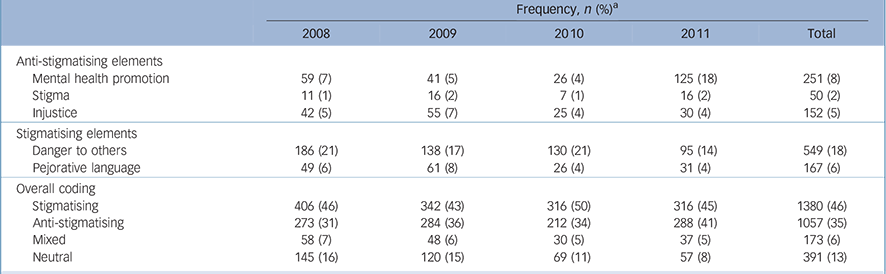
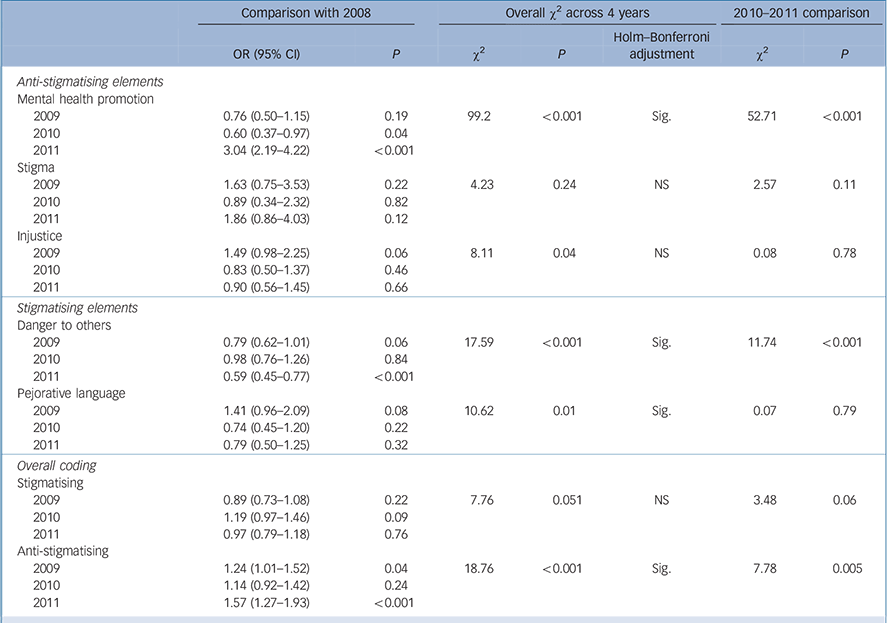
The numbers of articles retrieved by year were 882 (in 2008), 794 (in 2009), 627 (in 2010) and 698 (in 2011). Tables 1 and 2 address hypothesis 2, that there was a significant proportional increase in articles featuring the anti-stigmatising elements ‘mental health promotion’, ‘stigma’ or ‘injustice’. The data show that after using the Holm-Bonferroni adjustment for the Wald test there was a significant proportional increase (χ2(3) = 99.3, P⩽0.001) in the number of articles referring to mental health promotion over the 4-year period. Between 2010 and 2011 there was a particularly large increase (χ2(1) = 52.8, P = 0.001). Using a logistic regression model we saw evidence of a significant decrease in articles containing a mental health promotion element between 2008 and 2010 (OR 0.6, P = 0.04, 95% CI 0.4-1.0) and a significant increase between 2008 and 2011 (OR 3.0, P⩽0.001, 95% CI 2.2-4.2). Overall, these findings support hypothesis 2a. The proportion of articles referring to the anti-stigmatising elements ‘stigma’ and ‘injustice’, however, did not change significantly across or between the 4 years of study, so the results do not support hypotheses 2b or 2c.
Table 1 Frequency and proportion of elements and overall coding according to year
| Frequency, n (%)Footnote a | |||||
|---|---|---|---|---|---|
| 2008 | 2009 | 2010 | 2011 | Total | |
| Anti-stigmatising elements | |||||
| Mental health promotion | 59 (7) | 41 (5) | 26 (4) | 125 (18) | 251 (8) |
| Stigma | 11 (1) | 16 (2) | 7 (1) | 16 (2) | 50 (2) |
| Injustice | 42 (5) | 55 (7) | 25 (4) | 30 (4) | 152 (5) |
| Stigmatising elements | |||||
| Danger to others | 186 (21) | 138 (17) | 130 (21) | 95 (14) | 549 (18) |
| Pejorative language | 49 (6) | 61 (8) | 26 (4) | 31 (4) | 167 (6) |
| Overall coding | |||||
| Stigmatising | 406 (46) | 342 (43) | 316 (50) | 316 (45) | 1380 (46) |
| Anti-stigmatising | 273 (31) | 284 (36) | 212 (34) | 288 (41) | 1057 (35) |
| Mixed | 58 (7) | 48 (6) | 30 (5) | 37 (5) | 173 (6) |
| Neutral | 145 (16) | 120 (15) | 69 (11) | 57 (8) | 391 (13) |
a. Percentages calculated from the total number of articles containing the element divided by the total number of articles for each year.
Table 2 Stigmatising and anti-stigmatising elements: odds ratios, Wald and chi-squared tests and overall coding
| Comparison with 2008 | Overall χ2 across 4 years | 2010-2011 comparison | |||||
|---|---|---|---|---|---|---|---|
| OR (95% CI) | P | χ2 | P | Holm-Bonferroni adjustment |
χ2 | P | |
| Anti-stigmatising elements | |||||||
| Mental health promotion | |||||||
| 2009 | 0.76 (0.50-1.15) | 0.19 | 99.2 | <0.001 | Sig. | 52.71 | <0.001 |
| 2010 | 0.60 (0.37-0.97) | 0.04 | |||||
| 2011 | 3.04 (2.19-4.22) | <0.001 | |||||
| Stigma | |||||||
| 2009 | 1.63 (0.75-3.53) | 0.22 | 4.23 | 0.24 | NS | 2.57 | 0.11 |
| 2010 | 0.89 (0.34-2.32) | 0.82 | |||||
| 2011 | 1.86 (0.86-4.03) | 0.12 | |||||
| Injustice | |||||||
| 2009 | 1.49 (0.98-2.25) | 0.06 | 8.11 | 0.04 | NS | 0.08 | 0.78 |
| 2010 | 0.83 (0.50-1.37) | 0.46 | |||||
| 2011 | 0.90 (0.56-1.45) | 0.66 | |||||
| Stigmatising elements | |||||||
| Danger to others | |||||||
| 2009 | 0.79 (0.62-1.01) | 0.06 | 17.59 | <0.001 | Sig. | 11.74 | <0.001 |
| 2010 | 0.98 (0.76-1.26) | 0.84 | |||||
| 2011 | 0.59 (0.45-0.77) | <0.001 | |||||
| Pejorative language | |||||||
| 2009 | 1.41 (0.96-2.09) | 0.08 | 10.62 | 0.01 | Sig. | 0.07 | 0.79 |
| 2010 | 0.74 (0.45-1.20) | 0.22 | |||||
| 2011 | 0.79 (0.50-1.25) | 0.32 | |||||
| Overall coding | |||||||
| Stigmatising | |||||||
| 2009 | 0.89 (0.73-1.08) | 0.22 | 7.76 | 0.051 | NS | 3.48 | 0.06 |
| 2010 | 1.19 (0.97-1.46) | 0.09 | |||||
| 2011 | 0.97 (0.79-1.18) | 0.76 | |||||
| Anti-stigmatising | |||||||
| 2009 | 1.24 (1.01-1.52) | 0.04 | 18.76 | <0.001 | Sig. | 7.78 | 0.005 |
| 2010 | 1.14 (0.92-1.42) | 0.24 | |||||
| 2011 | 1.57 (1.27-1.93) | <0.001 | |||||
NS, not significant; sig., significant.
Tables 1 and 2 also refer to hypothesis 4, that there would be a significant proportional decrease in the proportion of articles featuring the stigmatising elements ‘danger to others’ and ‘pejorative language’. The Wald test showed that the proportion of articles containing the element ‘danger to others’ significantly decreased (χ2(3) = 17.6, P⩽0.001) across the whole 4-year span, as well as between 2010 and 2011 (χ2(1) = 11.7, P⩽0.001). The logistic regression model showed evidence of a significant decrease in articles containing the element ‘danger to others’ between 2008 and 2011 (OR 0.6, 95% CI 0.4-0.77, P⩽0.001). These findings support hypothesis 4a. Across the 4 years there was also a significant decrease (χ2(3) = 10.6, P = 0.01) in the use of pejorative language, shown by the Wald test, which supports hypothesis 4b.
Further, Tables 1 and 2 show the results relating to hypothesis 1 (a significant increase in the overall proportion of anti-stigmatising articles) and hypothesis 3 (a significant decrease in the overall proportion of stigmatising articles). For hypothesis 1, the results of the Wald test indicated that there was a significant increase (χ2(3) = 18.8, P⩽0.001) across the 4 years in the proportion of anti-stigmatising articles, as well as a significant proportional increase in anti-stigmatising articles between 2010 and 2011 (χ2(1) = 7.8, P = 0.005). In addition the logistic regression model provided evidence of a significant increase in anti-stigmatising articles reported between 2008 and 2009 (OR 1.2, 95% CI 1.0-1.5, P = 0.04) as well as between 2008 and 2011 (OR 1.6, 95% CI 1.3-1.9, P⩽0.001). In sum, these results support hypothesis 1. No evidence was found for a significant decrease in the overall proportion of stigmatising articles from 2008 to 2011, so there was no support for hypothesis 3.
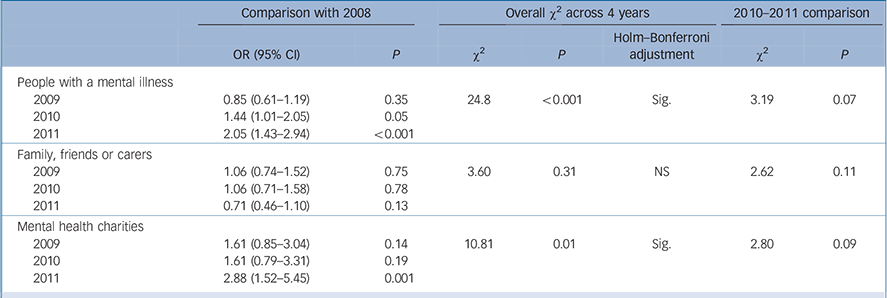
Tables 3 and 4 summarise the data for hypothesis 5, and show a significant increase in the proportion of sources referred to that were people with a mental illness (hypothesis 5a), family, friends or carers (hypothesis 5b) or mental health charities (hypothesis 5c). Across the 4 years, after using the Holm-Bonferroni adjustment, the Wald test showed that there was a significant increase (χ2(3) = 24.8, P⩽0.001) in the proportion of articles sourcing people with a mental illness. Similarly, the logistic regression model provided evidence of a significant increase between 2008 and 2010 (OR 1.4, 95% CI 1.0-2.1, P = 0.05) as well as 2008 and 2011 (OR 2.0, 95% CI 1.4-2.9, P⩽0.001) in the total number of times people with a mental illness were sourced. These findings support hypothesis 5a. In relation to the change in proportion of articles sourcing family, friends or carers, we found no significant result, thus failing to support hypothesis 5b. Concerning mental health charities, the adjusted Wald test showed that there was a significant increase (χ2(3) = 10.8, P = 0.01) in articles mentioning this source across the 4 years; in addition, the logistic regression model provided evidence of a significant increase in the number of articles citing this source between 2008 and 2011 (OR 2.9, 95% CI 1.5-5.4, P = 0.001), so hypothesis 5c was supported.
Table 3 Frequency and proportion of sources categorised by year

| Frequency, n (%)Footnote a | ||||
|---|---|---|---|---|
| 2008 | 2009 | 2010 | 2011 | |
| People with a mental illness | 149 (18) | 116 (16) | 100 (23) | 115 (28) |
| Family, friends or carers | 134 (16) | 116 (16) | 68 (16) | 48 (12) |
| Mental health charities | 17 (2) | 23 (3) | 14 (3) | 23 (6) |
a. Percentages calculated from the total number of articles referring to the source divided by the total number of articles for each year.
Table 4 Sources: odds ratios, Wald and chi-squared tests
| Comparison with 2008 | Overall χ2 across 4 years | 2010-2011 comparison | |||||
|---|---|---|---|---|---|---|---|
| OR (95% CI) | P | χ2 | P | Holm-Bonferroni adjustment |
χ2 | P | |
| People with a mental illness | |||||||
| 2009 | 0.85 (0.61-1.19) | 0.35 | 24.8 | <0.001 | Sig. | 3.19 | 0.07 |
| 2010 | 1.44 (1.01-2.05) | 0.05 | |||||
| 2011 | 2.05 (1.43-2.94) | <0.001 | |||||
| Family, friends or carers | |||||||
| 2009 | 1.06 (0.74-1.52) | 0.75 | 3.60 | 0.31 | NS | 2.62 | 0.11 |
| 2010 | 1.06 (0.71-1.58) | 0.78 | |||||
| 2011 | 0.71 (0.46-1.10) | 0.13 | |||||
| Mental health charities | |||||||
| 2009 | 1.61 (0.85-3.04) | 0.14 | 10.81 | 0.01 | Sig. | 2.80 | 0.09 |
| 2010 | 1.61 (0.79-3.31) | 0.19 | |||||
| 2011 | 2.88 (1.52-5.45) | 0.001 | |||||
NS, not significant; sig., significant.
Discussion
We found a significant increase in the proportion of anti-stigmatising articles between 2008 and 2011, which may be linked to the significant increase in articles featuring ‘mental health promotion’ elements. Although this finding is encouraging, as it occurred over the period of the TTC programme, it is not sufficient grounds to conclude that such changes were due to TTC. The same applies to our finding that people with experience of mental health problems and mental health charities are increasingly likely to be quoted. There was, however, no significant decrease in stigmatising articles over the same period, reflecting that the combined contribution of mixed and neutral elements decreased. The fall in articles about people with mental health problems posing a danger to others has declined, perhaps reflecting a reduction in coverage of homicides by people with previous contact with mental health services. However, this has not resulted in a fall in the overall proportion of stigmatising articles. We were unable to determine whether the increase in anti-stigmatising articles was due to an increased awareness among reporters of the impact of their content and style regarding the portrayal of mental health issues as a result of the TTC programme, or whether - since the proportion of stigmatising articles did not change significantly across the same period - the increase in anti-stigmatising articles reflects an awareness among journalists of public demand for articles that portray mental health issues in a non-stigmatising manner. The latter is more likely, as in order to change the tone and content of articles relating to mental illness across all print media in England, intensive work with reporters and editors would be required. A notable finding from this study is that more of the articles featuring ‘mental health promotion’ were reported in local rather than in national newspapers (data not shown). This type of ‘grass roots’ mental health promotion material, covering for example local fund-raising activities, might be an effect of the TTC campaign, in that more recently people are less ashamed to raise awareness about mental illness, possibly indicating a reduction in the levels of stigma attached to this type of illness.
Limitations
There are intrinsic limitations to quantitative analyses, namely that in the process of converting media articles into discrete categories, inevitably some of their complex meanings are lost. Further, this research focused on content analysis of the text in the articles alone, and did not code other contextual aspects related to the article, such as photographs used to illustrate the article or the nature and content of the headlines used. The newspaper articles were coded and analysed by different research workers, although paired-year interrater reliability results were over 80% between years, and all researchers used the same codebook for their analyses. Although the sample of 27 newspaper sources was a broad selection of those circulated in England, a wider assortment of print media sources could be used in further studies, such as magazines, as well as other forms of media including television or films, to compare how they portray mental illness over time.
Implications
Overall these findings provide promising results on improving press reporting of mental illness over the first 4-year phase of the TTC programme in England, with a significant increase in the number of anti-stigmatising articles. This supports the need for further research to investigate how far such changes are attributable to TTC. Second, the results indicate that further studies may be warranted to examine how far public attitude changes over this period are attributable to such media reporting trends. In terms of wider media policy, the 2011-2012 Leveson Inquiry (www.levesoninquiry.org.uk) into the culture, practices and ethics of the British press following the News International scandal will guide future press regulation and governance, consistent with maintaining freedom of the press and ensuring the highest ethical and professional standards in reporting. The evidence from studies such as this one may be taken into account in recommending a greater sensitivity towards reports about people with disabilities in general, and towards people with mental illness more specifically. Finally, these results provide a rationale in England for further print media interventions, such as reporting guidelines for journalists and newspaper editors on more responsible and less stigmatising reporting of mental illness in future.
Funding
The study was partly funded by the Big Lottery Fund and Comic Relief through their funding of the Time to Change programme. G.T., D.R. and C.H. are funded in relation to a National Institute for Health Research (NIHR) Applied Programme grant awarded to the South London and Maudsley National Health Service (NHS) Foundation Trust (G.T.). D.R. and G.T. are also supported in relation to the NIHR Specialist Mental Health Biomedical Research Centre at the Institute of Psychiatry, King's College London and the South London and Maudsley NHS Foundation Trust (G.T.). C.H. is also funded by a grant from Guy's and St Thomas' Charity.
Acknowledgements
We thank Sue Baker, Maggie Gibbons and Paul Farmer (Mind) and Paul Corry and Mark Davies (Rethink Mental Illness) for their collaboration.


 Open access


eLetters
No eLetters have been published for this article.