





Introduction
The health of ungulate populations may be affected by three main processes (Deem et al., Reference Deem, Karesh and Weisman2001): (1) landscape transformation, (2) shifts in population dynamics, and (3) changes in the ecology of diseases. The first is related to land-use change, which contributes to habitat fragmentation, habitat loss, macro- and microclimatic change, and environmental pollution. These factors favour interactions among humans, livestock, and wildlife, which in turn contribute to increased disease transmission across species (Daszak et al., Reference Daszak, Cunningham and Hyatt2000; Harvell et al., Reference Harvell, Mitchel, Ward, Altizer, Dobson, Ostfeld and Samuel2002). The indirect effects of land-use change consist of environmental changes related to human activities (e.g., temperature increase and shifts in precipitation regimes) and stress on wildlife populations, making them more vulnerable to either known or new diseases (Deem et al., Reference Deem, Karesh and Weisman2001; Harvell et al., Reference Harvell, Mitchel, Ward, Altizer, Dobson, Ostfeld and Samuel2002).
The second process affecting the health of wildlife species consists of shifts in population dynamics due to human activities such as high hunting pressure, illegal trade, and translocation of animals (Cunningham et al., Reference Cunningham, Daszak and Rodríguez2003; Kruse et al., Reference Kruse, Kirkemo and Handeland2004). Careless wild species translocations and releases of domestic animals (potential asymptomatic hosts) may help disseminate new pathogens and diseases in locations where native populations lack immunity. Wildlife markets constitute ideal scenarios for epidemic outbreaks because diverse animal species from multiple locations usually are kept in small and filthy cages, where secretions, excretions, food, water, and parasites are exchanged among them (Aguirre et al., Reference Aguirre, Catherina, Frye and Shelley2020; Galindo, Reference Galindo2022). The risk of zoonosis increases as animals are killed, sold, and transported from these markets to nearby cities and villages, as probably happened with the recent Covid-19 pandemic (Galindo, Reference Galindo2022). Another possibility is that the animals arriving in a new habitat may not have the natural defences against endemic diseases (Cunningham et al., Reference Cunningham, Daszak and Rodríguez2003; Daszak et al., Reference Daszak, Cunningham and Hyatt2000; Kruse et al., Reference Kruse, Kirkemo and Handeland2004). The third main process consists of changes in disease ecology occurring when the equilibrium among the host, the etiological agent, and their environment modifies. This can lead to ‘endemic stability’ loss, resulting in clinical disease (Deem et al., Reference Deem, Karesh and Weisman2001). The three processes described coupled with rapid human population growth, social inequality, deficient education, and weak environmental policies cause direct impacts on wildlife health and conservation (Valdez, Reference Valdez, Valdez and Ortega2014). These processes have synergic effects leading to increased poverty in rural communities, undervaluation, and higher demand for natural resources, resulting in higher impacts on wild populations, their habitats, and the environmental services they provide (Challenger and Dirzo, Reference Challenger, Dirzo, Dirzo, González and March2009).
The three families of Neotropical ungulates considered in this review (Cervidae, Tapiridae, and Tayassuidae) include 22 species, most of them frequently hunted for food and other purposes where they occur (Gallina, Reference Gallina2019). These species may be either recipients or transmitters of numerous parasitic, bacterial, and viral diseases with livestock, which could represent a conservation problem for wild populations (Kruse et al., Reference Kruse, Kirkemo and Handeland2004; Romero et al., Reference Romero, Ferguson, Güiris, López, Paredes and Weber2008). The risk of global disease spread highlights the relevance of maintaining epidemiological vigilance and research on ungulate populations (Daszak et al., Reference Daszak, Cunningham and Hyatt2000). This review aims to synthesize the state of knowledge on the epidemiology of infectious diseases, parasites, and health conditions of Neotropical ungulates. We offer evidence on information gaps and suggest directions for future research on their conservation.
Materials and methods
For this review, we compiled available information published on health aspects of Neotropical ungulate species between 1990 and 2022. We considered species distributed in the tropical areas of Mexico, Central America, South America, and the Antilles (Morrone, Reference Morrone2017). We excluded South American camelids (family Camelidae) from this analysis. We included papers in scientific journals, books and book chapters, theses and dissertations, proceedings of conferences and workshops, and technical reports. We also considered studies carried out in extensive Wildlife Conservation Units (UMA, in Spanish) and protected areas across Mexico. Our bibliographic searches were done using the resources available in the Web of Science, Scielo, Google Scholar, Research Gate, the National Consortium of Scientific and Technological Information (CONRICYT-Mexico), and the El Colegio de la Frontera Sur’s library information system (SIBE-ECOSUR). The keywords used in our searches were: Blastocerus, Catagonus, Dicotyles, Hippocamelus, Mazama, Neotropical, Odocoileus, Ozotoceros, Parachoerus, Pecari, Peccary, Pudu, Subulo, Tapirella, Tapirus, Tayassu, and Ungulates. These keywords were linked through Boolean connectors (AND, OR, NOT) with the terms: Body Condition, Conservation Medicine, Cortisol, Disease, Emerging Infectious Disease, Health Assessment, Microbiology, Parasite, Stress, Toxicology, Virus, and their correspondent terms in Spanish and Portuguese.
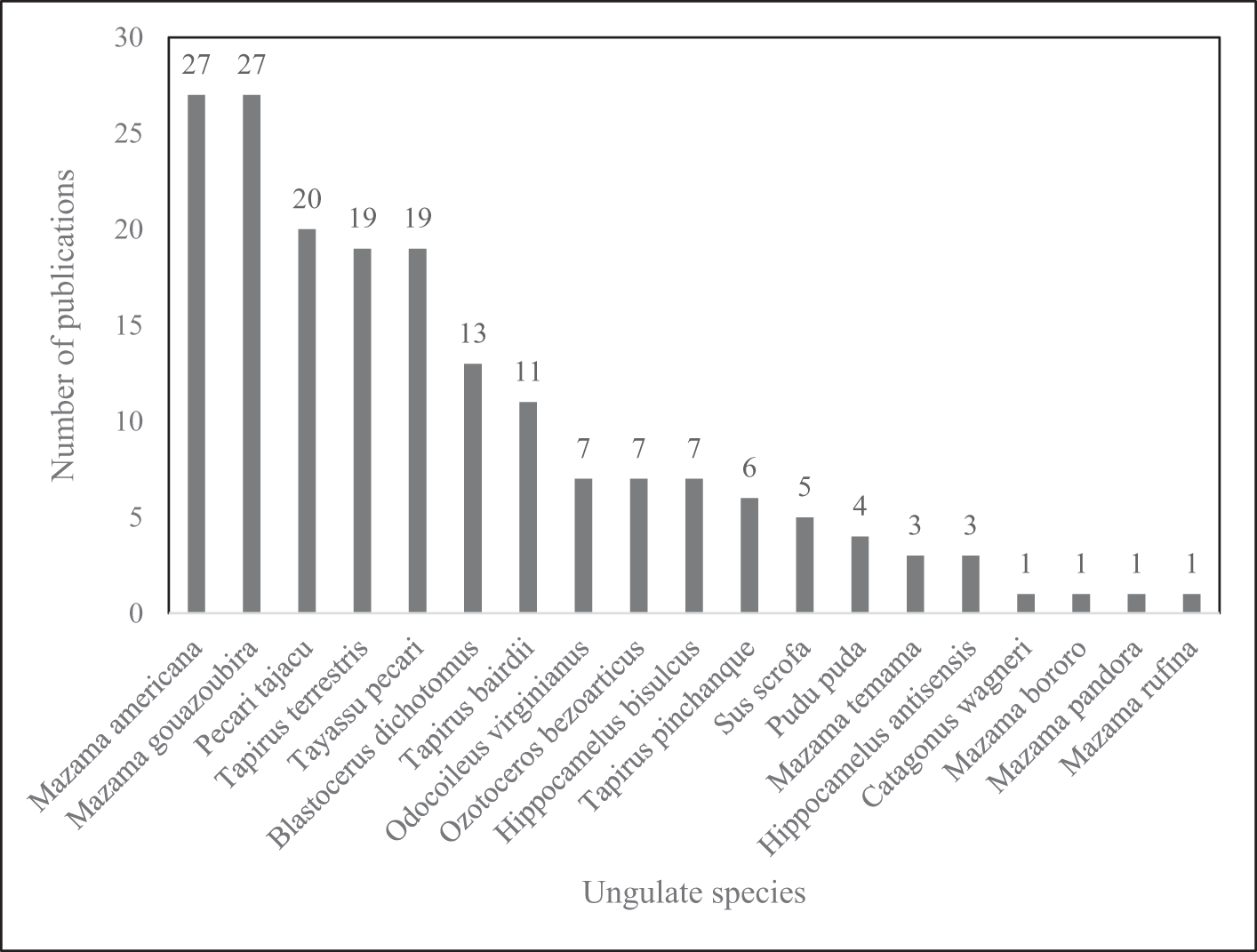
Number of publications on the health of free-ranging Neotropical ungulates in which each species appears (N = 122, 1990–2022). Most publications (67.2%) included more than one species.
We retrieved a total of 457 scientific publications, of which we discarded those focused on chemical contention, taxonomy, systematics, ecology (e.g., density, distribution, habitat use, and interactions, among others), papers in press or under review, and unfinished theses and dissertations. Although we considered publications including feral populations of domestic ungulates, we excluded studies done with captive animals or collection specimens unless they were very relevant to the discussion. After applying the above criteria, our final analyses consisted of 122 documents (see References and complementary list in Appendix S1).
The following data were retrieved from the documents reviewed: authors, year and type of publication, species, countries where the study took place, and topics covered. For studies carried out in Mexico, where both the Nearctic and the Neotropical regions converge, we only took those done in areas with Neotropical affinity (Morrone, Reference Morrone2014). The topics covered in publications were classified into seven categories: parasitology, bacteriology, virology, toxicology, pathology, body condition, and multi-themed studies. The publications titled ‘health assessments’ (those including hematic biometry, blood chemistry, and urine tests) were assigned to only one of the seven categories used. Studies including more than one topic (e.g., parasitology and bacteriology) were classified as ‘multi-themed’. Our analysis incorporated studies documenting both the presence and absence of infectious agents. Finally, we discussed the needs and prospects for future research on health issues of Neotropical ungulates, with emphasis on cervids, peccaries, and tapirs.
Results
Of the 122 studies (1990–2022; see Table S1 in Supplementary material) on health issues of free-ranging Neotropical ungulates retrieved, 83 (68%) were published between 2011 and 2022, while 34 (27.9%) corresponded to the period 2001–2010, and only 5 (4.1%) were produced between 1990 and 2000 (see References and complementary list in Appendix S1). Most of the papers (n = 101; 55.5%) focused on deer species (Cervidae), while peccaries (Tayassuidae) and feral pigs (Suidae) were included in 45 studies (24.7%), and tapirs (Tapiridae) in 36 (19.8%). Two thirds (n = 82; 67.2%) of these publications covered more than one species, although only 15 (12.3%) covered more than one family. There were 19 ungulate species included in the studies reviewed, of which the red brocket deer (Mazama americana, n = 27; 14.8%), the brown brocket deer (M. gouazoubira, n = 27; 14.8%), the collared peccary (Pecari tajacu, n = 20; 11%), the lowland tapir (Tapirus terrestris; n = 19; 10.4%), and the white-lipped peccary (Tayassu pecari, n = 19; 10.4%) were the most frequent (Fig. 1).
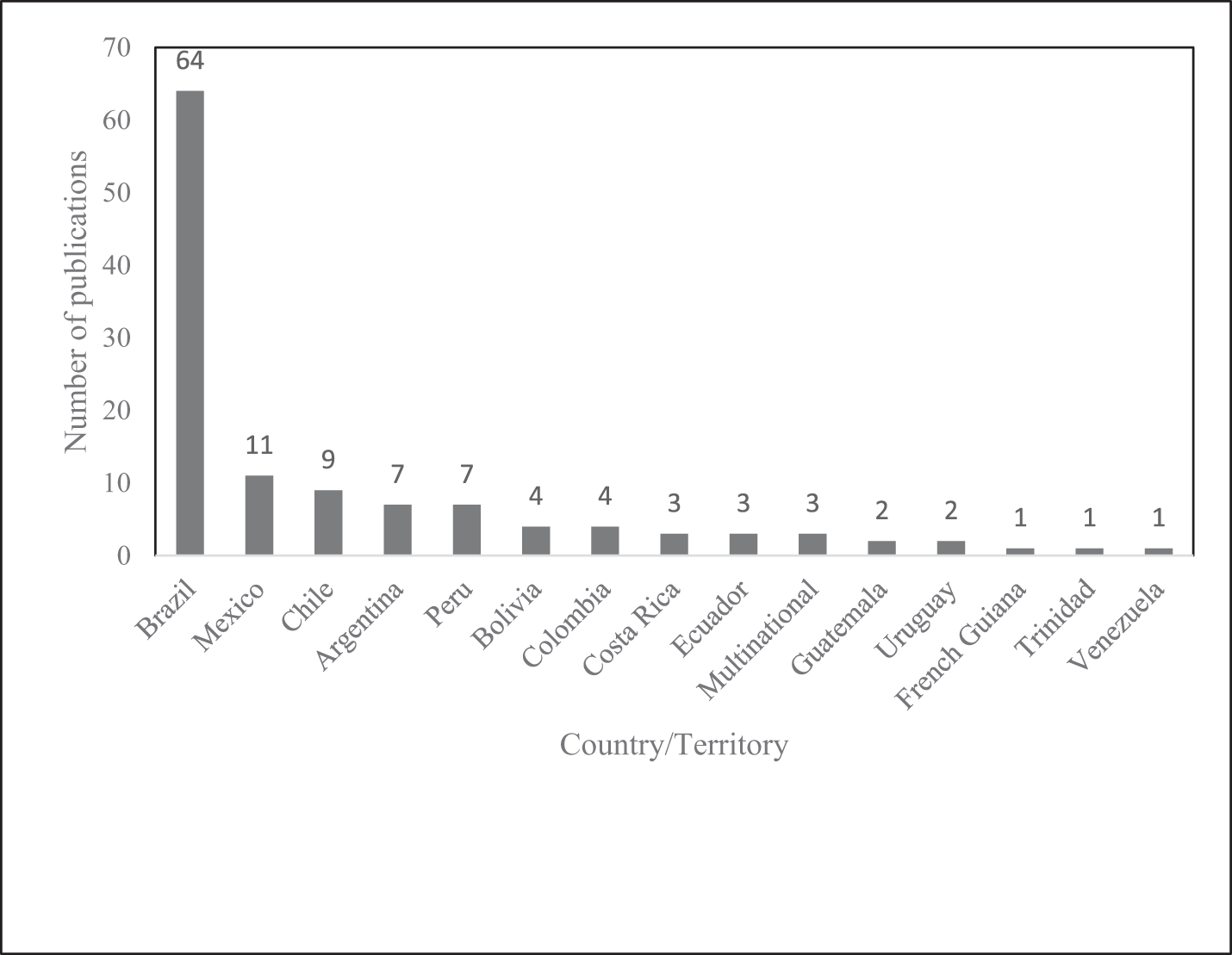
Over a half of the published research on the health of free-ranging Neotropical ungulates between 1990 and 2022 was done in Brazil (n = 64; 52.5%), followed by Mexico (n = 11; 9%), Chile (n = 9; 7.4%), Argentina (n = 7; 5.7%), and Peru (n = 7; 5.7%). These five countries accounted for about 80% of all publications, while other eight countries (Bolivia, Colombia, Costa Rica, Ecuador, Guatemala, Trinidad, Uruguay, and Venezuela) and the territory of French Guiana produced the remainder (Fig. 2). No studies conducted in Belize, El Salvador, Guyana, Honduras, Nicaragua, Panama, Paraguay, Suriname, and the Antilles (except for Trinidad) were retrieved in our searches.
Number of publications on the health of free-ranging Neotropical ungulates by country/territory (N = 122, 1990–2022).
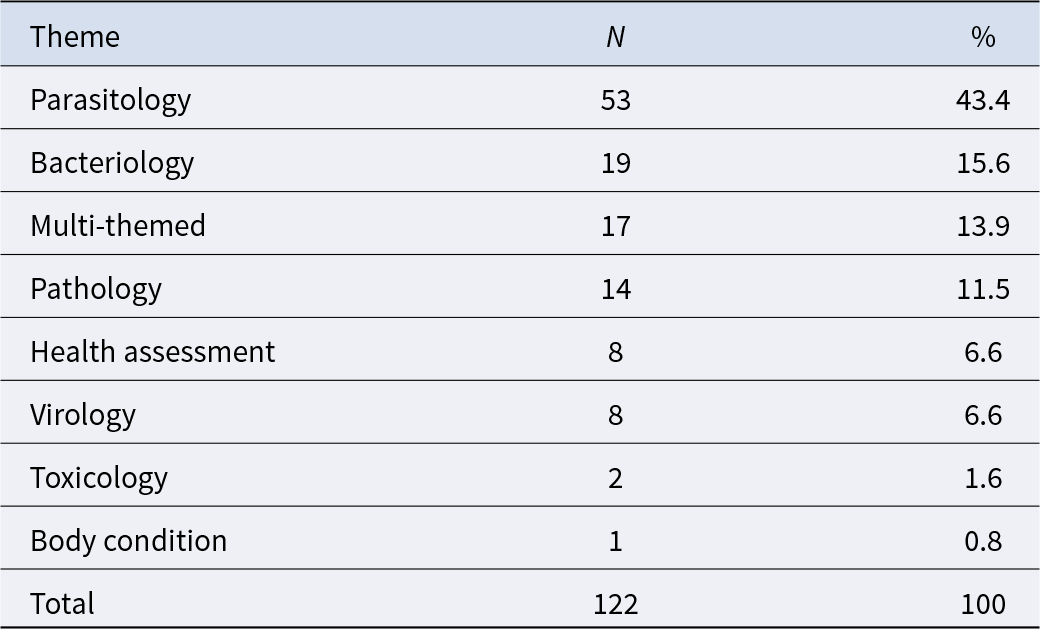
The majority (82.8%) of the reports were published in scientific journals, while dissertations and theses represented 8.2%. The remainder 9% was composed of book chapters, proceedings of conferences and workshops, and technical reports. The most frequent themes covered in the publications reviewed were parasitology (n = 53; 43.4%), bacteriology (n = 19; 15.6%), multi-themed studies (n = 17; 13.9%), and pathology (n = 14; 11.5%). Studies focused on health assessment, virology, toxicology, and body condition accounted for the remainder 15.5% (Table 1). The bacteria Leptospira spp. and Brucella spp., ticks, helminths, and bluetongue virus were the most frequently recorded organisms in Neotropical ungulates (Table 2, see References and complementary list in Appendix S1).
Number of publications on the health of free-ranging Neotropical ungulates by theme (N = 122, 1990–2022)
Etiological agents and frequent diseases recorded in publications on the health of free-ranging Neotropical ungulates (1990–2022)
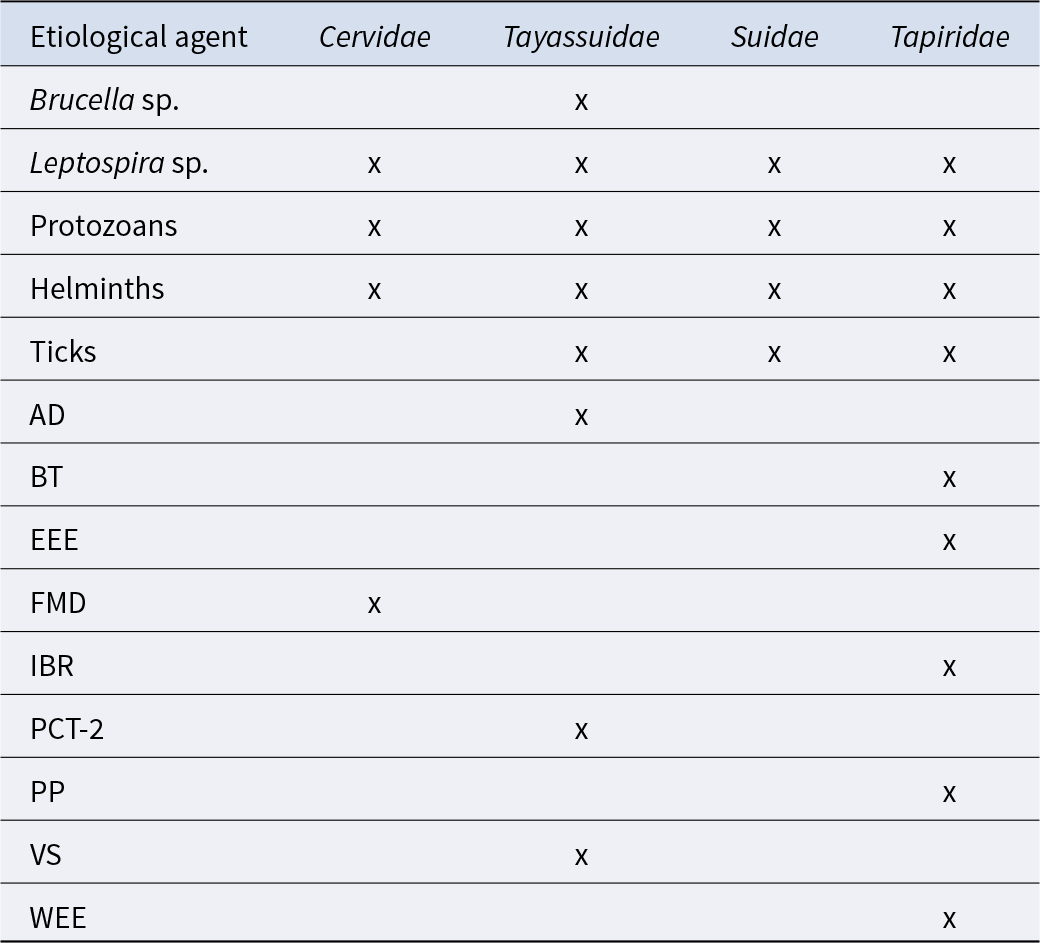
AD = Aujeszky’s disease; BT = bluetongue; EEE = East equine encephalitis; FMD = foot and mouth disease; IBR = infectious bovine rhinotracheitis; PCT-2 = porcine circovirus type 2; PP = porcine parvovirus; VS = vesicular stomatitis; WEE = West equine encephalitis.
Tapirs (Tapirus spp.)
The lowland tapir (T. terrestris) has been widely surveyed across Brazil, including health assessments of free-ranging populations, the seroprevalence of infectious diseases (Fernandes et al., Reference Fernandes, Medici, Testa and Micheletti2020; May-Junior, Reference May-Junior2011; Medici et al., Reference Medici, Mangini and Fernandes2014), and parasite evaluations (Lima et al., Reference Lima, Pereira, Nunes, Naegeli, Gatti, Rossi, Solange and Marcili2013; Malzoni et al., Reference Malzoni, De-Almeida-Jácomo, Kayo-Kashivakura, Mundim-Tôrres, Marvulo, Ragozo, Pereira-De-Souza, Ferreira, Vasconcellos and Morais2010; May-Junior, Reference May-Junior2011). At least two long-term surveys (1996–2021) have been conducted on tapirs in the Brazilian Atlantic Forest, the Cerrado, and the Pantanal (Labruna et al., Reference Labruna, Martins, Acosta, Serpa, Soares, Teixeira, Fernandes and Medici2021; Medici et al., Reference Medici, Mangini and Fernandes2014). Fernandes et al. (Reference Fernandes, Medici, Testa and Micheletti2020) compared the results of these surveys to their own obtained in the Brazilian Cerrado, showing that the tapirs of this region had more health problems than those of the Atlantic Forest and the Pantanal, probably due to a higher human disturbance present in the Cerrado. Leptospira spp., helminths (Agriostomun spp., Parascaris spp., Strongyloides spp., Trichosrongylus spp., Strongylus sp.), ticks (Amblyomma sp., Haemapysalis sp., Rhipicephalus sp.), bluetongue virus (Reoviridae), Trypanosoma terrestris, and Toxoplasma gondii have been the most frequently detected etiological agents in the lowland tapir (Malzoni et al., Reference Malzoni, De-Almeida-Jácomo, Kayo-Kashivakura, Mundim-Tôrres, Marvulo, Ragozo, Pereira-De-Souza, Ferreira, Vasconcellos and Morais2010; May-Junior, Reference May-Junior2011; Lima et al., Reference Lima, Pereira, Nunes, Naegeli, Gatti, Rossi, Solange and Marcili2013; Navas et al., Reference Navas, Día, Fernandes, Testa, Silva, Sansone, Medici and Catao2019; Table 2).
The only published assessment of parasites present in free-ranging mountain tapirs (T. pinchaque) was done by Bernal et al. (Reference Bernal, Orjuela-Acosta, Rodríguez, Lizcano, Medici, Mendoza, Shoemaker, Holst, Ríos-Castillo, Russo and Angell2008) in the Nevados National Park in the Central Andes of Colombia. These authors collected blood samples for haematology and identified the ticks Amblyoma multipunctum and Ixodes scapularis. For Baird’s tapirs (T. bairdii), parasitological evaluations have revealed the presence of the nematods Lacandoria sp., Neomurshidia sp., Bunostonum sp., Agriostomum sp., Brachylumus sp., Strongylus sp., Trichostrongylus sp., Nematodirus sp., Tapironema sp., Trichonema sp., Tziminema unachi, and the protozoans Eimeria sp. and Balantidium sp. (Cruz et al., Reference Cruz, Lira, Güiris, Osorio and Quintero2006; Güiris et al., Reference Güiris, Oceguera-Figueroa, Osorio-Sarabia, Pérez-Escobar, Nieto-López, Rojas-Hernández and García-Prieto2017; Méndez, Reference Méndez2017; Pérez-Flores et al., Reference Pérez-Flores, Lagunas, González and Oceguera2019; Romero et al., Reference Romero, Ferguson, Güiris, López, Paredes and Weber2008).
There have been few pathology assessments describing diseases on free-ranging tapirs. Navas et al. (Reference Navas, Día, Fernandes, Testa, Silva, Sansone, Medici and Catao2019) published a study recording their findings on the pathology of 35 tapirs killed on roads of the Brazilian Cerrado. They found degeneration in adrenal glands, necrosis, and loss of fascicular and reticular cells with replacement by fibrosis and cortical atrophy, interstitial pneumonia, glossitis, lung anthracosis, colitis, cholangitis, and pericholangitis in several of the individuals examined. Intestinal parasitosis seems to be common in wild tapirs (Navas et al., Reference Navas, Día, Fernandes, Testa, Silva, Sansone, Medici and Catao2019). Tapirs killed in collisions along roads have also been subject of toxicological studies in Mato Grosso do Sul, Brazil (Fernandes et al., Reference Fernandes, Medici, Testa-José and Canena2018). Among the main toxic compounds detected in these ungulates are the organochlorines, organophosphates, pyrethroids, carbamates, and minerals such as lead, copper, manganese, and cadmium. In a second study, the same authors found pesticides and heavy metals linked to commercial farming in the Cerrado (Fernandes et al., Reference Fernandes, Medici, Testa and Micheletti2020). No other published surveys on this matter were found for tapirs across the Neotropics.
Peccaries (Catagonus wagneri, Pecari tajacu, and Tayassu pecari) and feral pigs (Sus scrofa)
Research on the epidemiology of peccary species has been done particularly in Brazil and other South American countries (see References and complementary list in Appendix S1). Leptospira spp., Brucella spp., helminths, and ticks have been the more frequently studied infectious agents in peccaries of Bolivia, Brazil, and Colombia (Ferreira, Reference Ferreira2008; Karesh et al., Reference Karesh, Uhart, Painter, Wallace, Braselton, Thomas, House, Mcnamara and Gottdenker1998; Montenegro et al., Reference Montenegro, Roncancio, Soler, Cortés, Contreras, Sabogal, Acevedo and Navas2018; Table 2). The seroprevalence of leptospirosis was reported in white-lipped peccaries of the Brazilian Pantanal, where these ungulates interacted with livestock (De Freitas et al., Reference De Freitas, Keuroghlian, Eaton, Barbosa, Figueiredo, Nakazato, Oliveira, Miranda, Paes, Carneiro, Lima, Neto, Dutra and De Freitas2010). Brucellosis has also been detected in white-lipped peccaries of the Pantanal (Real et al., Reference Real, Dutra, Nakazato, Freitas, Keuroghlian, Almeida and Souza2010) and Quedas do Iguaçu, Brazil (Mangini et al., Reference Mangini, Gazino-Joineau, Carvalho-Patricio, Fortes, Goncalves, Margarido, Kluczkovsky and Klemz2004). These surveys were focused not only on peccaries but also on feral pigs, cows (Bos indicus), dogs (Canis lupus familiaris), jaguars (Panthera onca), sheep (Ovis aries), horses (Equus caballus), and domestic pigs that tested positive to brucellosis and leptospirosis in Pontal do Paranapanema, Brazil (Ferreira, Reference Ferreira2008).
Montenegro et al. (Reference Montenegro, Roncancio, Soler, Cortés, Contreras, Sabogal, Acevedo and Navas2018) detected leptospirosis in collared peccaries (prevalence = 78%) and feral pigs (prevalence = 100%) at several study sites in Colombia, while Lord and Lord (Reference Lord and Lord1991) isolated Brucella spp. from lymph nodes and spleens of collared peccaries from Venezuela. Other bacteria found in lung tissues of white-lipped peccaries and collared peccaries from Brazil were Pasteurella multocida and Mycoplasma hyopneumonae (Martins et al., Reference Martins, Brombila, García, Sousa, Oliveira, Hamad, Ogata, Gennari and Richtzenhain2014). Regarding viral diseases, Montenegro et al. (Reference Montenegro, Roncancio, Soler, Cortés, Contreras, Sabogal, Acevedo and Navas2018) detected classic porcine fever, porcine circovirus type 2, and vesicular stomatitis in peccaries and feral pigs of Colombia. However, they did not find Aujesky’s disease in their samples. In Brazil, Mangini et al. (Reference Mangini, Gazino-Joineau, Carvalho-Patricio, Fortes, Goncalves, Margarido, Kluczkovsky and Klemz2004), Paes et al. (Reference Paes, Fonseca, LARC, Jardim, Piovezan, Herrera, Mauro and Vieira-da-motta2013), and Martins et al. (Reference Martins, Brombila, García, Sousa, Oliveira, Hamad, Ogata, Gennari and Richtzenhain2014) found porcine circovirus type 2, porcine herpesvirus type 1, and Aujesky’s disease in both peccaries and feral pigs.
In Bolivia, Karesh et al. (Reference Karesh, Uhart, Painter, Wallace, Braselton, Thomas, House, Mcnamara and Gottdenker1998) examined the parasites and infectious diseases present in white-lipped peccaries at Noel Kempff National Park. They found evidence of Leptospira sp., Mycoplasma hyorhinus, Aujesky’s disease, vesicular stomatitis, vesicular exanthema of the pig, and San Miguel’s marine lion virus. All peccaries (both white-lipped and collared) sampled by Karesh et al. (Reference Karesh, Uhart, Painter, Wallace, Braselton, Thomas, House, Mcnamara and Gottdenker1998), and by Rodríguez et al. (Reference Rodríguez, Mollericona and Nallar2019) in Bolivia were infested by ticks (Amblyomma sp.). A similar case was reported for the Chacoan peccary (Catagonus wagneri) in Salta, Argentina, where Nava et al. (Reference Nava, Mangold, Mastropaolo, Venzal, Oscherov and Guglielmone2009) detected Amblyomma boeroi in 14 carcasses. Helminths in peccaries have only been reported by Carlos et al. (Reference Carlos, Tantaleán, Leguía, Alcázar and Donadi2008) in Peru, who identified Ascaris sp., Ancylostomatidae, spiruroid type, and the trematode Paragonimus sp.
In Mexico, Romero et al. (Reference Romero, Ferguson, Güiris, López, Paredes and Weber2008) detected the nematodes Globocephalus usosubulatus, Parabronema pecariae, and Texicospirura turki; the trematode Paramphistomum sp., and the cestode Moniezia benedeni in both collared peccaries and white-lipped peccaries of the Lacandon Forest. The only protozoans reported for wild peccaries, collared peccaries, and feral pigs in the Neotropics are Trypanosoma cruzi and T. evansi, which were identified by Herrera et al. (Reference Herrera, Abreu, Keuroghlian, Freitas and Jansen2008) in Brazil. These authors concluded that the parasitemia by T. evansi could have been due to the stress resulting from prolonged droughts and habitat loss. Being social species, peccaries and pigs may be good reservoirs of these parasites in both natural and humanized settings. Finally, the only survey to assess the presence of toxic compounds in peccaries was conducted by Karesh et al. (Reference Karesh, Uhart, Painter, Wallace, Braselton, Thomas, House, Mcnamara and Gottdenker1998) in Bolivia, with negative results.
Cervids (Blastocerus dichotomus, Hippocamelus spp., Mazama spp., Odocoileus virginianus, Ozotoceros bezoarticus, and Pudu spp.)
Several epidemiological studies on free-ranging deer of South America were published between 1990 and 2022 (see References and complementary list in Appendix S1). Deem et al. (Reference Deem, Andrew, Marcela and William2004) reported the presence of Amblyomma spp. ticks, Lipoptena mazamae (Hippoboscidae) flies, and an unknown louse species in grey brocket deer (Mazama guazoubira) of Bolivia. These authors reported the presence of Leptospira interrogans, bovine respiratory syncytial virus, and probably, the epizootic haemorrhagic disease virus (EHDV). The nematodes, cestodes, and protozoans Trichuris ovis, Paramphistommum spp., Schistosoma sp., Moniezia sp., and Eimeria sp. have also been found in grey brocket deer of Bolivia (Beltrán et al., Reference Beltrán, Angulo and Gonzales2009; Deem et al., Reference Deem, Andrew, Marcela and William2004). In Brazil, Szabó et al. (Reference Szabó, Labruna, Pereira, Duarte, Labruna, Pereira and Szabo2003) found that the parasitic load and the number of tick species increased in pampas deer (Ozotoceros bezoarticus) after their habitat shrunk because of the flooding caused by the Puerto-Primavera dam. The nematodes Physocephalus sexalatus, P. lassancei, Texicospirura turki, and Pygarginema verrucosa have also been detected in brocket deer (Mazama americana and M. gouazoubira), and the pampas deer of the Brazilian Pantanal (Hoppe et al., Reference Hoppe, Tebaldi and Nascimento2010; Silva et al., Reference Silva, Nascimento, Bonuti, Mapeli and Arantes1999). Polymerase Chain Reaction (PCR) tests have allowed determining the incidence of Theilerya sp., Babesia sp., Anaplasma sp., Brucella abortus y Leptospira interrogans in wild brocket deer (M. gouazoubira), pampas deer, and swamp deer (Blastocerus dichotomus) in Brazil (Da Silveira et al., Reference Da Silveira, Rabelo and Ribeiro2011; Mathias et al., Reference Mathias, Girio and Duarte1999; Mongruel et al., Reference Mongruel, Benevenute, André, De Oliveira, Zacarías and Seki2017). Regarding virology assessments, the bluetongue virus and the deer chronic wasting disease were detected in Brazil by Mazzoni et al. (Reference Mazzoni, Câmara, Diniz, Cubas, Coelho, Maldonado, De Moraes, Oliveira, Angelo, Portela and Nunes2018), and Ribeiro et al. (Reference Ribeiro, De Melo, Barbanti, Duarte, Mendes, Torres, Wanderley, Gomes and Garcia2017). Similarly, pathological retrospective studies and clinical cases in free-ranging Brazilian cervids have been published by Cunha et al. (Reference Cunha, Assunção, Jackson, Souza and Valente2014), Echenique et al. (Reference Echenique, Soares, Uzal, Ladeira, Albano, Bandarra and Schild2018), and Navas et al. (Reference Navas, Día, Fernandes, Testa, Silva, Sansone, Medici and Catao2019). No publications on the epidemiology or parasites of Mazama bricenii, M. chunyi, and M. nana were found in our searches.
Some studies have been done about parasites and diseases of the huemul deer and the taruca deer (Hippocamelus spp.). Analysing faeces of the Patagonian huemul deer (Hippocamelus bisulcus) collected in the Aysen and Magallanes regions of southern Chile, Hinojosa et al. (Reference Hinojosa, Pérez, López, Rubilar, Llanos and González2019) found eggs of Moniezia sp., Nematodirus sp., Eimeria spp., and Strongyle-type nematods. In the same area and for the same deer species, Vila et al. (Reference Vila, Briceño, McAloose, Seimon, Armién, Mauldin, Be, Thissen, Hinojosa, Quezada, Paredes, Avendaño, Silva and Uhart2019) observed foot disease probably caused by poxvirus, and Hernandez et al. (Reference Hernandez, Verdugo, Cardenas, Sandoval, Morales, Olmedo, Bahamonde, Aldridge and Acosta-Jamett2019) isolated the bacteria Echinococcus granulosus from pulmonary tissue and found larvae of Taenia hydatigena. Previously, Hinojosa et al. (Reference Hinojosa, Blumer, Camacho, Silva, Quezada and Brevis2014) observed in the same area a huemul female with numerous melanic tumours diagnosed as fibroma, while Morales et al. (Reference Morales, Aldridge, Bahamonde, Cerda, Araya, Muñoz, Saldias, Lecocq, Fresno, Abalos and Retamal2017) detected the presence of Corynebacterium pseudotuberculosis in abdominal abscesses of two huemul specimens. In southern Argentina, Reissig et al. (Reference Reissig, Helman and More2020) identified the protozoan Sarcocystis sp., while Flueck and Smith-Flueck (Reference Flueck and Smith-Flueck2017) documented severe osteopathologies and muscle atrophy in seven huemul deer, probably due to a selenium and iodine-deficient diet. The only study retrieved about parasites of the taruca deer (Hippocamelus antisensis) was conducted by Gomez-Puerta et al. (Reference Gomez-Puerta, Pacheco and Angulo2016) who identified the helminths Trichostrongylus axei, Mazamastrongylus sp., and Taenia hydatigena in a specimen from the southern Peruvian Andes.
Considerably fewer publications exist on the Southern pudu (Pudu puda). Oyarzun et al. (Reference Oyarzun, Muñoz and Valenzuela2018) found the nematode Dictyocaulus eckerti in lungs of pudu from southern Chile, while recently, Santodomingo et al. (Reference Santodomingo, Robbiano, Thomas, Parrague, Cabello, Vera, Valencia, Moreira, Moreno, Hidalgo and Muñoz2022) detected the protozoan Babesia sp. and the bacteria Borrelia sp. in pudus of Chiloé Island. In Argentina, Reissig et al. (Reference Reissig, Helman and More2020) identified infection by the protozoan Sarcocystis sp. on pudus from the Patagonian National Parks. The only virological study on wild pudus was conducted by Hidalgo et al. (Reference Hidalgo, Cabello, Novoa, Celis, Ortiz, Kemec, Lagos, Verasay, Mansell, Moreira, Vergara, Millán and Esperón2022), who found caprine herpesvirus-2 present in samples of dead animals from southern Chile. No publications on the epidemiology or parasites of the Northern pudu (Pudu mephistophiles) were retrieved from our searches.
Several surveys on the infectious diseases and parasites of cervids have been done in Mexican extensive wildlife management units (UMA). González (Reference González2001) and Barranco (Reference Barranco2016) detected protozoans and nematodes of the genus Eimeria sp., Otertagia spp., Cooperia spp., Moniezia spp., Haemeonchus spp., Trichostrongylus spp., Trichuris spp., and Capillaria spp. in white-tailed deer. Mukul et al. (Reference Mukul, Zapata, Montes, Rodríguez and Torres2014) identified the presence of the nematode Strongylus sp., ticks (Amblyomma cajennense), fleas (Pulex irritans), lice (Gliricola porcelli), and flies (Lipoptenena sp.) in brocket deer (M. temama) and white-tailed deer of the Yucatan Peninsula. In the same region, Ojeda et al. (Reference Ojeda, Rodriguez, Esteve, Pérez, Modarelli and Villegas2019) detected Ehrlichia chaffeensis, Anaplasma phagocytophilum, A. odocoilei, Amblyomma mixtum, A. parvum, A. cf. oblongoguttatum, Ixodes affinis, Ripicephalus microplus, R. sensu lato, and Haemaphysalis juxtakochi in brocket deer and white-tailed deer.
Discussion
In the context of increasing demand to feed the global human population, interactions between wildlife and livestock are becoming more frequent, which heightens the risk of pathogen transmission among wild animals, livestock, and humans (Gordon IJ, 2018; Jones et al., Reference Jones, Grace, Kock, Alonso and Rushton2013). Effective biosecurity measures that are cost-effective are required to control various risks (Jori et al., Reference Jori, Hernandez-Jover, Magouras, Dürr and Brookes2021). The emergence of virus-borne diseases such as AIDS, Ebola, Avian Influenza, and antibiotic-resistant bacteria during the twentieth century, and more recently, the COVID-19 pandemic highlight the need for cooperative work among physicians, veterinarians, economists, sociologists, anthropologists, environmentalists, and other specialists (Cook et al., Reference Cook, Karesh and Osofsky2004; Daszak et al., Reference Daszak, Cunningham and Hyatt2000). In 2004, the Wildlife Conservation Society (WCS) emphasized the relevance of understanding the ecology of emerging wildlife diseases under the ‘One World-One Health’ approach. This approach proposes the integration of medicine and ecosystem health through 12 ‘Manhattan Principles’ seeking to prevent disease and maintain ecosystem health for the benefit of society, wildlife, and livestock (Gibbs, Reference Gibbs2014). Neotropical wildlife species are food sources for rural societies throughout Latin America (e.g., Naranjo et al., Reference Naranjo, Guerra, Bodmer and Bolaños2004; Ojasti, Reference Ojasti, Guerra, Calmé, Gallina and Naranjo2010); therefore, we need to understand the relationship between the health issues of wildlife, livestock, and people.
Although the majority (68%) of available publications on the epidemiology, parasites, and health conditions of Neotropical ungulates were produced in the last decade (2012–2022), knowledge is clearly uneven among topics, species, and countries. Out of the 33 countries in Latin America and the Antilles, research on the subjects of this review in free-ranging ungulates has been conducted in only 13 countries. Among these, Brazil, Mexico, Chile, Argentina, and Peru have produced 80% of all publications. The studies done in Brazil (52.5% of the total) have included parasitology, bacteriology, virology, and toxicology (Fernandes et al., Reference Fernandes, Medici, Testa and Micheletti2020, Reference Fernandes, Medici, Testa-José and Canena2018; Lima et al., Reference Lima, Pereira, Nunes, Naegeli, Gatti, Rossi, Solange and Marcili2013; Malzoni et al., Reference Malzoni, De-Almeida-Jácomo, Kayo-Kashivakura, Mundim-Tôrres, Marvulo, Ragozo, Pereira-De-Souza, Ferreira, Vasconcellos and Morais2010; May-Junior, Reference May-Junior2011; Medici et al., Reference Medici, Mangini and Fernandes2014). Parasitology has been the most frequent field of study in Mexico (Cruz et al., Reference Cruz, Lira, Güiris, Osorio and Quintero2006; Güiris et al., Reference Güiris, Oceguera-Figueroa, Osorio-Sarabia, Pérez-Escobar, Nieto-López, Rojas-Hernández and García-Prieto2017; Romero et al., Reference Romero, Ferguson, Güiris, López, Paredes and Weber2008). In Argentina, Bolivia, Chile, and Colombia, researchers have covered a wider array of topics, such as general health assessments, bacteriology, virology, and parasitology in peccaries and deer (e.g., Bernal et al., Reference Bernal, Orjuela-Acosta, Rodríguez, Lizcano, Medici, Mendoza, Shoemaker, Holst, Ríos-Castillo, Russo and Angell2008; Deem et al., Reference Deem, Andrew, Marcela and William2004; Flueck and Smith-Flueck, Reference Flueck and Smith-Flueck2017; Hinojosa et al., Reference Hinojosa, Pérez, López, Rubilar, Llanos and González2019; Karesh et al., Reference Karesh, Uhart, Painter, Wallace, Braselton, Thomas, House, Mcnamara and Gottdenker1998; Montenegro et al., Reference Montenegro, Roncancio, Soler, Cortés, Contreras, Sabogal, Acevedo and Navas2018; Rodríguez et al., Reference Rodríguez, Mollericona and Nallar2019; Suárez et al., Reference Suárez, Lizcano and Orjuela2008).
It is unclear if the differences in government spending on healthcare and research explain the inequality in the number and thematic coverage of retrieved publications because each country recognizes different priorities (Arriagada et al., Reference Arriagada, Aranda and Miranda2005). In most countries, human health institutions are still separated from animal health agencies despite the potential benefits of the One Health approach (Gibbs, Reference Gibbs2014; Zinsstag et al., Reference Zinsstag, Schelling, Bonfoh, Schelling, Bonfoh, Fooks, Kasymbekov, Waltner and Tanner2009). This makes it more difficult to determine if research funding for zoonotic diseases is sufficient.
Studies on free-ranging wildlife have logistic constrains (i.e., capture and handling of animals, hiring of specialized field guides, access to the study area, and sample collection and transport; De Thoisy et al., Reference De Thoisy, Demar, Aznar and Carme2003). Besides, epidemiologic monitoring of zoonotic diseases in wild host species may be difficult to apply in Neotropical countries because of the need for multidisciplinary task forces including veterinary doctors, ecologists, zoologists, epidemiologists, geographers, and mathematicians, among others (Gil and Samartino, Reference Gil and Samartino2001). The lack of continuity in political and financial incentives to train and update specialists makes it difficult for many Latin American countries to be self-sufficient in the generation of information about the health of their wildlife species (Schütz et al., Reference Schütz, Hacon, Silva, Moreno and Nagatani2008). Considering the above, it looks pivotal to identify the drivers of emerging infectious diseases and establishing an epidemiological monitoring system on wildlife populations across the Neotropics.
Most research and publications on wild ungulates in Brazil have been done in public universities and research centres such as São Paulo University, Oswaldo Cruz Foundation, Institute of Ecological Research (IPE, in Portuguese), the Brazilian Institute of Conservation Medicine, and the IUCN Tapir Specialist Veterinary Group. Perhaps the outstanding biodiversity and large size of Brazil’s tropical ecosystems (especially the Amazon) draw more interest and funding for research by national and international agencies, which favours higher scientific output. In other Latin American countries, almost all research on the health of ungulates has been done in public institutions. On the other side, remarkable differences in the distribution and density of Neotropical ungulate populations across species and habitats could be playing important roles in the amount of research devoted to assessing their epidemiology of infectious diseases, parasites, and general health conditions. This may help to explain why only four widely distributed species (red brocket deer, collared peccary, white-lipped peccary, and lowland tapir) have received more attention (54.7% of the publications reviewed) than the other 18 Neotropical ungulate species combined. After our review, we identified the following information gaps and needs for further studies on the health of Neotropical ungulates.
Tapirs
The environmental factors and the complex biological cycles determining the selective presence of certain pathogens in some wildlife species have not yet been fully understood. For example, there are places where peccaries and tapirs coexist with livestock. However, brucellosis has been detected in peccaries, but not in tapirs. Similarly, antibodies against diseases such as leptospirosis and toxoplasmosis have been found in coexisting tapirs and livestock (Malzoni et al., Reference Malzoni, De-Almeida-Jácomo, Kayo-Kashivakura, Mundim-Tôrres, Marvulo, Ragozo, Pereira-De-Souza, Ferreira, Vasconcellos and Morais2010; Mangini et al., Reference Mangini, Medici and Fernandes2012). Because of that, it is required that future epidemiological research initiatives consider the size of habitat fragments as well as ungulate and livestock population densities. This could help identifying why certain ungulate species are more prone than others to get infected by pathogens. For both Baird’s and mountain tapirs, it will be needed to investigate the seroprevalence or isolation of infectious agents similarly to what has been done with the lowland tapir.
The priority diseases to be investigated in Neotropical ungulates should be those that are relevant for public health, the conservation of wild species, and those present in livestock at a regional scale (Quse and Fernandes, Reference Quse and Fernandes2014). For example, leptospirosis is transmitted where livestock interacts with free-ranging ungulates and has been detected in tapirs of Brazil and Costa Rica (De Freitas et al., Reference De Freitas, Keuroghlian, Eaton, Barbosa, Figueiredo, Nakazato, Oliveira, Miranda, Paes, Carneiro, Lima, Neto, Dutra and De Freitas2010; Hernandez-Divers et al., Reference Hernandez-Divers, Aguilar, Leandro and Foerster2005). Thus, it should be a priority to assess the effects of these diseases in tapirs across Latin America. Other diseases potentially threatening tapir populations occurring nearby human settlements are encephalitis (i.e., Nile, East equine, and West equine), whose vector is present in southeastern Mexico and may affect equines and humans (Ulloa et al., Reference Ulloa, Ferguson, Méndez, Danis, Casas, Bond, García, Orozco, Juárez, Farfan, García, Rosado, Edwards, Komar, Hassan, Unnasch and Rodríguez2009). Horses have been used as sentinels of the Equine infectious anaemia in Guatemala and a potential threat for Baird’s tapirs has been identified (Lepe et al., Reference Lepe, García, Fountain, Ponce, Gonzalez and Escobar2018). Therefore, the search for antibodies against this disease in wild tapirs may constitute a good opportunity for doing research.
Few studies have focused on the analysis of the relationship between disease intensity and habitat features, for instance, the parasite composition on tapir faeces and their relationship with the vegetation cover (Alvarado, Reference Alvarado2018). The environment can play a fundamental role in preserving certain parasites and commensals in tapir droppings (Güiris et al., Reference Güiris, Rojas, Berovides-Álvarez, Cruz-Aldán, Chávez-Hernández, Moguel-Acuña, Pérez-Escobar and Palacios-Mendoza2009). This is an opportunity to do relevant research for conserving these ungulates, especially in highly disturbed sites.
Peccaries and feral pigs
Feral pigs have received attention as potential disease vectors for livestock and wild ungulates in Brazil because many of them were introduced during the Paraguay War (Medici et al., Reference Medici, Mangini and Fernandes2014; Paes et al., Reference Paes, Fonseca, LARC, Jardim, Piovezan, Herrera, Mauro and Vieira-da-motta2013). Similarly, Montenegro et al. (Reference Montenegro, Roncancio, Soler, Cortés, Contreras, Sabogal, Acevedo and Navas2018) found evidence of transmission of leptospirosis between feral pigs and peccaries in Colombia. Nonetheless, no epidemiological studies have been done on feral pigs in Mexico, even though this species is already present in the southeastern part of the country (Hidalgo-Mihart et al., Reference Hidalgo-Mihart, Pérez, Pérez, Contreras, Angulo and Hernández2014; Weber, Reference Weber1995). In contrast, Mérida (Reference Mérida2015) found presence of brucellosis (30% of the samples) and leptospirosis (34%) in white-lipped peccaries and feral pigs of Uaxactún, northern Guatemala. All feral pigs examined were heavily infested by ticks. The ecological and sanitary impact of these pigs on wild ungulate populations and their habitats across southern Mexico and Central America would constitute another research need to be attended to whenever possible.
Toxicological research on peccaries and feral pigs has been barely done in Latin America. Peccaries, tapirs, and deer sometimes feed on corn, soy, and other plantations across Latin America (Lima et al., Reference Lima, Peres, Abrahams, Junior Ca da, Costa G and Santos2019; Romero et al., Reference Romero, Naranjo, Morales and Nigh2006; Ruiz et al., Reference Ruiz, Castro, Rivero, Bello and Sánchez2014; Serrano et al., Reference Serrano, Reyna, Molina and Naranjo2021), so they could be exposed to toxic compounds such as glyphosate and other pesticides. Therefore, there is a high probability to detect these toxic compounds in free-ranging ungulates across Colombia, where great amounts of herbicides were used since the mid-1980s to eradicate illegal crops (Idrovo, Reference Idrovo2015). On the other side, analyses of hormones as stress indicators in ungulates have been applied in captive peccaries to assess the effects of density and space availability on their levels of cortisol (Mangini et al., Reference Mangini, Medici and Fernandes2012; Montes et al., Reference Montes, Solís, Yokoyama, Mukul and Segura2009, Reference Montes, Melo, Mukul, Segura and Castro2012; Nogueira-Filho et al., Reference Nogueira-Filho, Carvalho, Silva, Fernandes and Nogueira2012). However, there are no published surveys of these hormones on peccaries in the wild.
Cervids
There have been evidences of ectoparasites, endoparasites, bacteria, and viruses, such as the bovine respiratory syncytial virus, and the EHDV in South American cervids (see Beltrán et al., Reference Beltrán, Angulo and Gonzales2009; Da Silveira et al., Reference Da Silveira, Rabelo and Ribeiro2011; Deem et al., Reference Deem, Andrew, Marcela and William2004; Hoppe et al., Reference Hoppe, Tebaldi and Nascimento2010; Mayor et al., Reference Mayor, Guimaraes, Le Pendu, Da Silva, Jori and López2007; Mongruel et al., Reference Mongruel, Benevenute, André, De Oliveira, Zacarías and Seki2017, and many other references in Appendix S1). Nevertheless, research describing shifts in the parasite composition after human disturbance, and pathological studies on Neotropical cervids are very scarce (Cunha et al., Reference Cunha, Assunção, Jackson, Souza and Valente2014; Echenique et al., Reference Echenique, Soares, Uzal, Ladeira, Albano, Bandarra and Schild2018; Hinojosa et al., Reference Hinojosa, Blumer, Camacho, Silva, Quezada and Brevis2014; Navas et al., Reference Navas, Díaz, Matushima, Fávero, Sánchez, Sacristán, Ewbank, Marques, Barbanti, Dos Santos, Cogliati, Mesquita, Maiorka and Catão2018; Szabó et al., Reference Szabó, Labruna, Pereira, Duarte, Labruna, Pereira and Szabo2003).
In the case of Mexico, closeness to the United States, climatic conditions, and socio-economic factors impose remarkable differences in natural resource management between the north and the south of the country. While large numbers of private ranches and extensive UMAs (many with exotic ungulate species for sport hunting) prevail in the north, communal land ownership, subsistence hunting, and a complex sociocultural environment are more frequent in the south, which complicates the functioning of the UMA system originally designed for the north (Weber et al., Reference Weber, García and Reyna2006). This disparity is mirrored in the body of published information about Mexican ungulates, where the white-tailed deer and the mule deer (Odocoileus hemionus) have been a lot more studied in northern Mexico than all wild ungulate species in the Neotropical portion of the country.
In northern Mexico, the bluetongue virus, Boophilus sp. ticks, EHDV, bovine diarrhoea virus, protozoans (Theileria cervi), and the bacteria Borrelia burgdorferi, Brucella abortus, Brucella mellitensis, and Leptospira sp. have been found in mule deer and white-tailed deer populations (Cantu et al., Reference Cantu, Ortega, Mosqueda, Garcia-Vazquez, Henke and George2008; Contreras et al., Reference Contreras, Mellink, Martínez and Medina2007; Martinez et al., Reference Martinez, Salinas, Martinez, Cantu and Miller1999; Pavón et al., Reference Pavón, Cárdenas, Rábago, Barrón and Mosqueda2020). Although the work by Cantu et al. (Reference Cantu, Ortega, Mosqueda, Garcia-Vazquez, Henke and George2008) on white-tailed deer was not done within the Neotropical region, it is one of the few in which some environmental factors were analysed as drivers of the host’s response to an etiological agent.
In contrast, in central and southern Mexico, there have been a very few reports of ectoparasites, endoparasites, and rickettsiae in both free-ranging and UMA deer (Barranco, Reference Barranco2016; González, Reference González2001; Mukul et al., Reference Mukul, Zapata, Montes, Rodríguez and Torres2014; Ojeda et al., Reference Ojeda, Rodriguez, Esteve, Pérez, Modarelli and Villegas2019; Romero et al., Reference Romero, Ferguson, Güiris, López, Paredes and Weber2008). Hence, it is necessary to increase the quest for etiological agents that have already been described in the north of the country to create an epidemiological map of them.
Prospects for future research
While there have been many publications on health issues of Neotropical free-ranging ungulates, most of them have only focused on describing microorganisms or their seroprevalence. However, there are still important information gaps that need to be addressed, particularly in fields like environmental toxicology. Even diseases that are traditionally considered relevant for wildlife, livestock, and humans, such as rabies, require further study in this region. According to an epidemiological study based on official databases, only 2.6% of the 1,037 cases of rabies detected between 2001 and 2013 were found in white-tailed deer (Bárcenas et al., Reference Bárcenas, Loza-Rubio, Zendejas-Martínez, Luna-Soria, Cantó-Alarcón and Milián-Suazo2015). However, these authors concluded that rabies had been under-registered and had spread to new areas. Castellanos and Venegas (Reference Castellanos and Venegas2015) photographed a lowland tapir being bitten by false vampire bats (Desmodus rotundus) in Yasuni National Park, Ecuador, showing that wild ungulates may be exposed to rabies at any time.
Orta et al. (Reference Orta, Rosell, Cartró, O’Callaghan, Moraleda and Mayor2018) discovered that red brocket deer, collared peccaries, and lowland tapirs consumed soil contaminated with oil in the Peruvian Amazon. Since these animals are hunted for food in the region, it is crucial to investigate whether geophagy could be a means through which humans are exposed to highly toxic substances such as heavy metals, radioactive isotopes, and hydrocarbons. Therefore, investigating the impact of the oil industry and pesticides on the health of wildlife and people in the Neotropics is highly relevant.
Accessing free-ranging ungulates for clinical examination and sampling is a primary challenge in their health research, leading to many surveys utilizing hunted specimens. (Deem et al., Reference Deem, Andrew, Marcela and William2004; Lord and Lord, Reference Lord and Lord1991; Romero et al., Reference Romero, Ferguson, Güiris, López, Paredes and Weber2008). An alternative to this limitation would be studying livestock populations as models of infectious diseases in conditions like those of wild ungulates, considering the adaptability of the microorganisms to their hosts. In order to better understand the dynamics of diseases, nomadic and free-ranging livestock herds can serve as useful models for monitoring, as suggested by various studies (Abril-Galve et al., Reference Abril-Galve, Lozano and Martínez1994; Alberghini, Reference Alberghini2019; Centelles et al., Reference Centelles, Martínez, Cabrera, Castillo and Larroza2021).
In southeastern Mexico, Díaz (Reference Díaz2006) and Martínez-Mota et al. (Reference Martínez-Mota, Valdespino, Sánchez and Serio-Silva2007) found higher cortisol levels in the faeces of black howler monkeys (Alouatta pigra), jaguars (Panthera onca), and pumas (Puma concolor) occupying disturbed habitats compared to those using pristine areas. These kinds of studies have not yet been done in Neotropical ungulates that require large tracts of tropical forest in relatively good condition (e.g., tapirs and white-lipped peccaries; Naranjo et al., Reference Naranjo, Amador, Falconi and Reyna2015). Further research is necessary to determine the impact of habitat variables and human disturbance on parasitic load and physiological stress in these species.
In this review, we found that most of the research published between 1990 and 2022 corresponded primarily to parasitological, bacteriological, multi-themed, and pathological surveys on deer, peccaries, and tapirs. We emphasize the need for further research focused on poorly known epidemiological aspects of Neotropical ungulates that have received little attention in the past, especially the Chacoan peccary, the taruca deer, pudus, the least known Mazama species (i.e., M. bororo, M. bricenii, M. chunyi, M. nana, and M. rufina) and wild camelids (i.e., Lama guanicoe and Vicugna vicugna). In particular, ecotoxicological and pathological studies are needed to assess the effects of agrochemicals and other human disturbances (e.g., feral species) on wild ungulate populations throughout the Neotropical region. It is also important to increase the reach and depth of epidemiological knowledge for wild ungulates out of Brazil. Funding for research and training of local specialists (especially virologists) will be essential for that purpose. Nonetheless, modest surveys on the parasitology, bacteriology, and haematology of local ungulate populations could be promoted in the short term in countries such as Belize, Cuba, Dominican Republic, El Salvador, Guyana, Honduras, Jamaica, Nicaragua, Panama, Paraguay, Puerto Rico, and Suriname, where some research groups and basic infrastructure already exist. Those studies would help to better understand the roles of ecological mechanisms and anthropic processes influencing the health of these mammals. Improving and expanding our knowledge on these elements, particularly in species and countries with the highest information gaps, should be a priority for their sustainable management and conservation.
Supplementary material
The supplementary material for this article can be found at https://doi.org/10.1017/S1466252325000040.
Acknowledgements
We would like to express our gratitude to Mexico’s National Council for Science and Technology (CONACYT) and El Colegio de la Frontera Sur (ECOSUR) for providing the first author with a scholarship to pursue doctoral studies. Two anonymous reviewers provided insightful comments to improve this manuscript and Gregory Jones edited the English.
Competing interests
The authors declare none.
Disclosure statement
The authors report there are no competing interests to declare.


 Open access

