


Introduction
Rails (Rallidae) are found on all continents except Antarctica, with many oceanic islands harbouring endemic and often flightless species (Winkler et al. Reference Winkler, Billerman, Lovette, Billerman, Keeney, Rodewald and Schulenberg2020). Among bird taxa, rails have the highest proportion of documented extinctions: 24 species have become extinct worldwide since around 1500 CE (Lévêque et al. Reference Lévêque, Buettel, Carver and Brook2021). Notably, five species became extinct in the twentieth century, all from Pacific islands (Steadman Reference Steadman1995, Reference Steadman2006; Steadman and Martin Reference Steadman and Martin2003). Therefore, the preservation of the few remaining populations of island endemic rail species is of utmost importance for conservation efforts. In the central and eastern Pacific, only two such species remain: the Henderson Island Crake Zapornia atra, confined to Henderson Island (27 km²) in the Pitcairn group, and the Galápagos Rail Laterallus spilonota from the Galápagos Islands.
The first quantitative status assessment of the Galápagos Rail (Rosenberg Reference Rosenberg1990) showed that it was common in the humid highlands of Santa Cruz Island (fern zone) and Sierra Negra volcano on Isabela Island (ferns and grasses) and had a patchy distribution in Santa Cruz farmland. On Santiago Island, the species was rare, apparently due to vegetation damage by goats. It was also rare on Fernandina Island due to the limited extent of suitable habitat. Rosenberg (Reference Rosenberg1990; personal communication) recorded only one distinctive call response to playback on San Cristóbal Island and did not record the species on Floreana Island. The population on Santiago recovered after goat eradication, which finalised in 2005 (Cruz et al. Reference Cruz, Carrion, Campbell, Lavoie and Donlan2009), while the population on Isabela declined between 1987 and 2005 due to continued pressure from free-living herbivores (Donlan et al. Reference Donlan, Campbell, Cabrera, Lavoie, Carrion and Cruz2007). In the fern zone on Santa Cruz, surveys in 2000 and 2007 showed a decline, which was attributed to the spread of the invasive red quinine tree Cinchona pubescens (Gibbs et al. Reference Gibbs, Shriver and Vargas2003; Shriver et al. Reference Shriver, Gibbs, Woltz, Schwarz and Pepper2011).
The Galápagos Rail is a sister species of the Black Rail Laterallus jamaicensis, with a common ancestor 1.2 MYA (Chaves et al. Reference Chaves, Martinez-Torres, Depino, Espinoza-Ulloa, García-Loor and Beichman2020). It first colonised the oldest eastern islands (San Cristóbal or Santa Cruz) before spreading westwards (Chaves et al. Reference Chaves, Martinez-Torres, Depino, Espinoza-Ulloa, García-Loor and Beichman2020).
The Paint-billed Crake Neocrex erythrops has a wide but patchy distribution in South America and southern Central America. It is thought to be highly mobile, possibly even migratory, and due to its shy and reclusive nature within dense vegetation, little is known about its natural history (Taylor et al. Reference Taylor, Bonan, Boesman, Sharpe, del Hoyo, Elliott, Sargatal, Christie and de Juana2020). The Paint-billed Crake was not encountered by any of the expeditions to the Galápagos between 1835 and 1906 and thus not mentioned in Swarth (Reference Swarth1931). The first recorded sightings in the archipelago were two birds collected in 1953 on Santa Cruz (Bowman Reference Bowman1960). Given that historical collecting expeditions would have been unlikely to overlook the species, and assuming it was not introduced by humans, a natural colonisation event probably led to its establishment sometime in the first half of the twentieth century.
Both BirdLife International (2020) and Taylor et al. (Reference Taylor, Bonan, Boesman, Sharpe, del Hoyo, Elliott, Sargatal, Christie and de Juana2020) estimated the total population of the Galápagos Rail to be between 5,000 and 10,000 individuals, erroneously referring this estimate to Rosenberg (Reference Rosenberg1990), who did not include population numbers in his paper.
The present paper describes the current distribution and provides up-to-date population estimates for the Galápagos Rail and Paint-billed Crake. We further discuss historical distribution and population trends for both species throughout the archipelago, considering the extent and suitability of existing habitats on different islands. We additionally include a separate set of monitoring data for the Galápagos Rail from the highlands of Santa Cruz from 2022 to assess the 15-year trend since 2007. Based on our results we re-evaluate the conservation status of the Galápagos Rail.
Methods
Study areas
From 2015 to 2025, we visited all the major islands of the Galápagos archipelago except Fernandina, at least once. Large islands (Santa Cruz, San Cristóbal, Santiago, Floreana, and Isabela) were visited several times (see Supplementary material Table S1).
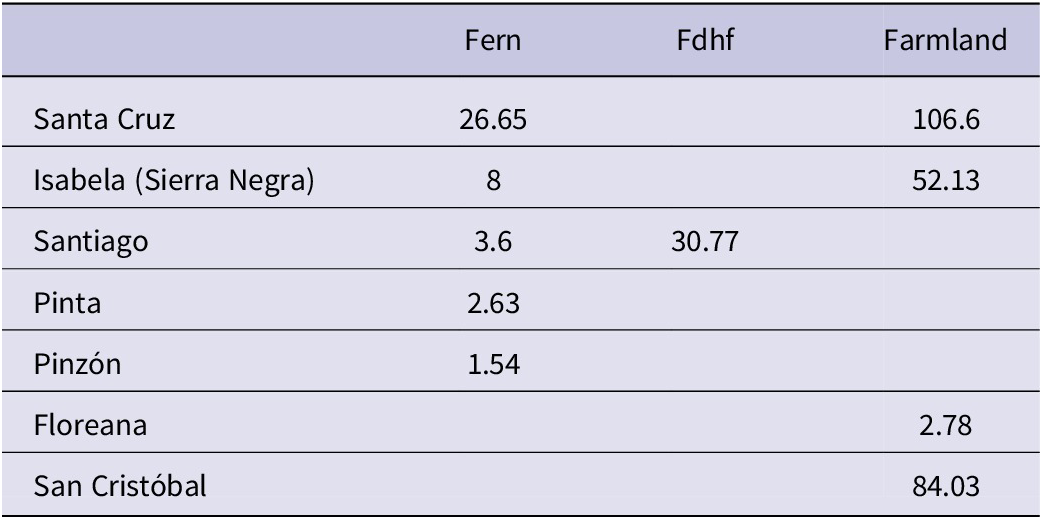
We determined the areas of most habitats (Table 1) used by both study species using data from Huttel (Reference Huttel1986) and Rivas-Torres et al. (Reference Rivas-Torres, Benítez, Rueda, Sevilla and Mena2018). In some cases, additional spatial data and first-hand observations during our surveys were used to adjust habitat boundaries. A polygon file for these habitat categories is provided as electronic supplement (S3). For San Cristobal we used the polygons from Dvorak et al. (Reference Dvorak, Fessl, Nemeth, Anchundia, Cotín and Schulze2020). The fern zone that occurs on the rim of the crater of Sierra Negra, Isabela, was not found in any mapping data. Thus, we estimated the area of this habitat (8 km2) with Google Earth (version 7.3.6.9796).
Extent (km²) of suitable habitat for Galápagos Rails (fern and Fdhf) and Paint-billed Crake (farmland). Fdhf = fern-dominated humid forest
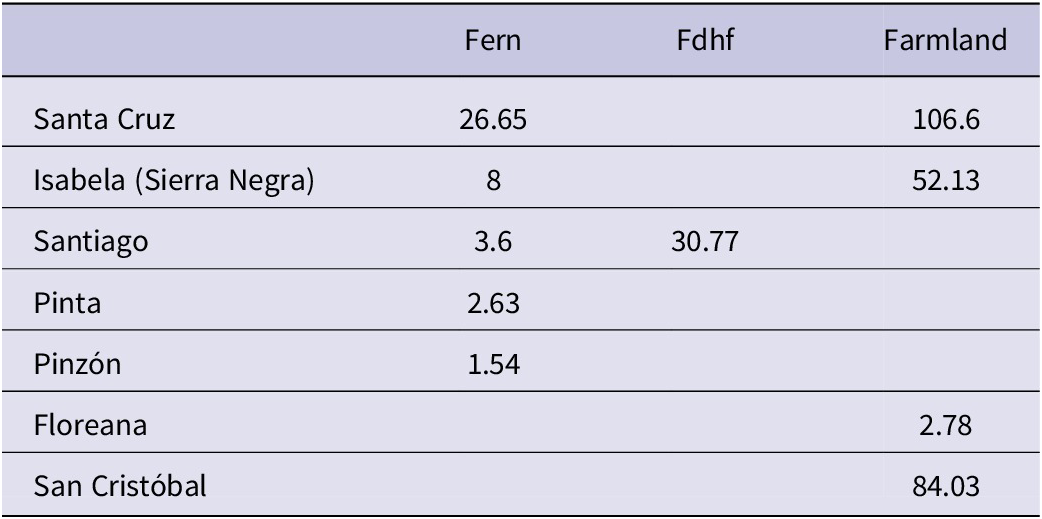
For the Galápagos Rail, we classified the fern zones on the five surveyed islands inhabited by the species as suitable habitat (Fernandina was not surveyed). On Santiago, areas of humid forest mixed with ferns were also classified as suitable habitat. As the known distribution of the Paint-billed Crake in Galápagos encompasses mainly farmland, we classified agricultural zones on the four inhabited islands (Floreana, Isabela, San Cristóbal, and Santa Cruz) as suitable habitat (Table 1).
Census methods
This study used two distinct data sets based on different methodologies: first, distance sampling on point counts (with occasional use of playback, see below) to estimate population sizes by calculating densities across different habitats on various islands; second, exclusively within an area in the highlands of Santa Cruz, point counts using a detailed playback protocol. We obtained recordings of the species’ calls (territorial and primary calls) from the Library of Natural Sounds at Cornell University.
Landbirds on all islands
We used point counts with distance estimation, following a protocol developed by Dvorak et al. (Reference Dvorak, Fessl, Nemeth, Kleindorfer and Tebbich2012, Reference Dvorak, Nemeth, Wendelin, Herrera, Mosquera and Anchundia2017, Reference Dvorak, Fessl, Nemeth, Anchundia, Cotín and Schulze2020), to collect data on the abundance of all landbird species, including the two rails, across each island and vegetation zone. Point selection was not random due to the prevalence of thick, spiny, and frequently impenetrable vegetation across many parts of the Galápagos Islands. Thus, counting points were located along existing paths and small roads. Between three and six observers participated in data collection on each island, and to ensure consistency, joint training sessions were conducted before the start of data collection. Each point count lasted five minutes, during which we estimated the distance between the observer and a bird with a precision of 5 m within 20 m of the observer and of 10 m beyond that. We conducted almost all surveys in January and February of each year (Table S1) to coincide with the breeding season of all small landbird species.
The breeding season of the Galápagos Rail extends from September to April (Franklin et al. Reference Franklin, Clark and Clark1979). Calling activity was generally high during the two months of our surveys (January and February), with almost all records being of calling birds (only calling birds entered into the distance analysis). We used playback occasionally in areas devoid of spontaneous song but with suitable habitat to check for the presence of the species or to confirm its absence from the islands without recent records (i.e. Floreana and San Cristóbal). If birds reacted within 15 seconds of beginning playback we estimated distances for their first aural contact; later calls were omitted from the distance analysis, because such birds might have approached before responding.
The Paint-billed Crake occurred at a much lower density and with a more clustered distribution than the Galápagos Rail and occupied a wider range of habitats. Spontaneous calling of the Paint-billed Crake was infrequent, and often only one call was heard during a five-minute counting period. Playback was occasionally used to confirm tentative aural records or to assess presence in suitable habitat; responsiveness was lower than the Galápagos Rail.
Both species spend most of their time hidden in dense vegetation, and direct observations are very rare. Quantitative surveys are therefore only possible on the basis of calling birds. The proportion of non-calling and therefore not detectable individuals cannot be determined with these survey methods, which are commonly used for small rails. The high level of calling activity and very high local densities at some sites suggest, at least for the Galápagos Rail, that a large proportion of the birds present were on territory and likely to be recorded acoustically. Nevertheless, it must be assumed that the population figures for both species represent minimum numbers and true densities may be higher, especially for the Paint-billed Crake.
We analysed distance data and calculated absolute densities using the software Distance 7.3 Release 2 (Thomas et al. Reference Thomas, Buckland, Rexstad, Laake, Strindberg and Hedley2010). The Distance program assumes that all birds present at the point are detectable and estimates the number of undetected birds as detectability declines with distance from the point. To describe this pattern statistically, the program used four combinations of key functions and expansions (Buckland et al. Reference Buckland, Anderson, Burnham, Laake, Thomas and Borchers2001): Half-normal/Cosine, Uniform/Simple polynomial, Hazard-rate/Cosine, and Half-normal/Simple polynomial. For both species, Distance chose the Hazard key function without series expansion based on the lowest value for the Akaike information criterion (AIC) (3231.672 for Galápagos Rail, 1709.398 for Paint-billed Crake). The intervals of the distance data were grouped automatically by the program. Assuming that detectability in the preferred habitats of both species shows little variation between islands and years, all distance data were pooled to obtain their respective detection functions. Then, we calculated the mean densities and 95% confidence intervals (CIs) by bootstrapping the individual records (1,000 iterations).
For both species, population size estimates for different islands, or in the case of Isabela different volcanoes, were obtained by multiplying the area of suitable habitat (Table 1) by the calculated densities.
On all islands except Santiago, the counting unit for the Galápagos Rail was the pair. While on territory, spontaneous calling typically involves both members of a pair calling in synchrony. Therefore, when densities were relatively low, distinguishing calling pairs from each other was straightforward. On Santiago, where densities were very high and territories very small and close to each other, it was difficult to differentiate pairs during the five-minute counting period, so we considered the individual as the counting unit and obtained an estimate of the number of pairs by dividing the number of individuals counted by two.
Population trend of the Galápagos Rail on Santa Cruz
We compared point-count data from the 2022 survey with data from the 2000 and 2007 surveys of the Galápagos Rail within the fern/miconia Miconia robinsoniana vegetation zones around the Media Luna crater on Santa Cruz. We used the same 197 sampling points as in the 2007 survey by Shriver et al. (Reference Shriver, Gibbs, Woltz, Schwarz and Pepper2011), and a comparable methodology as used in previous studies conducted in 1986, 2000, and 2007 (Gibbs et al. Reference Gibbs, Shriver and Vargas2003; Rosenberg Reference Rosenberg1990; Shriver et al. Reference Shriver, Gibbs, Woltz, Schwarz and Pepper2011). Points were spaced approximately 100 m apart. At each point, an observer (HS) conducted a four-minute count in an area with a radius of 25 m around the point, between 06h30 and 13h00, from January to March. In the first minute, a playback of the Galápagos Rail’s calls was broadcast from a speaker connected to a smartphone placed about 1.5 m above the ground and pointed for 15 seconds in each of the four cardinal directions. Rail responses were recorded during this minute and for the following three minutes.
Results
Current distribution and population size of the Galápagos Rail
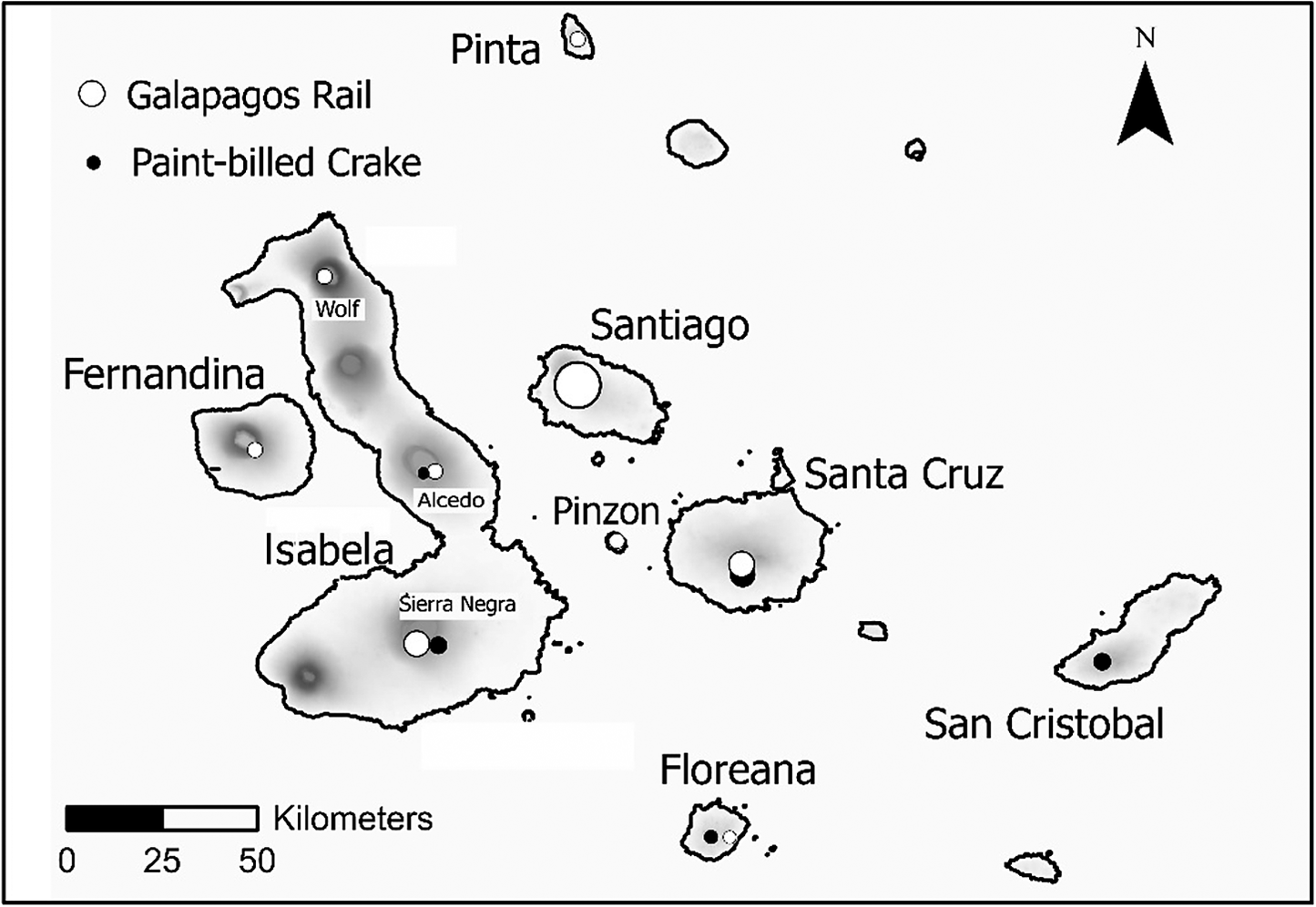
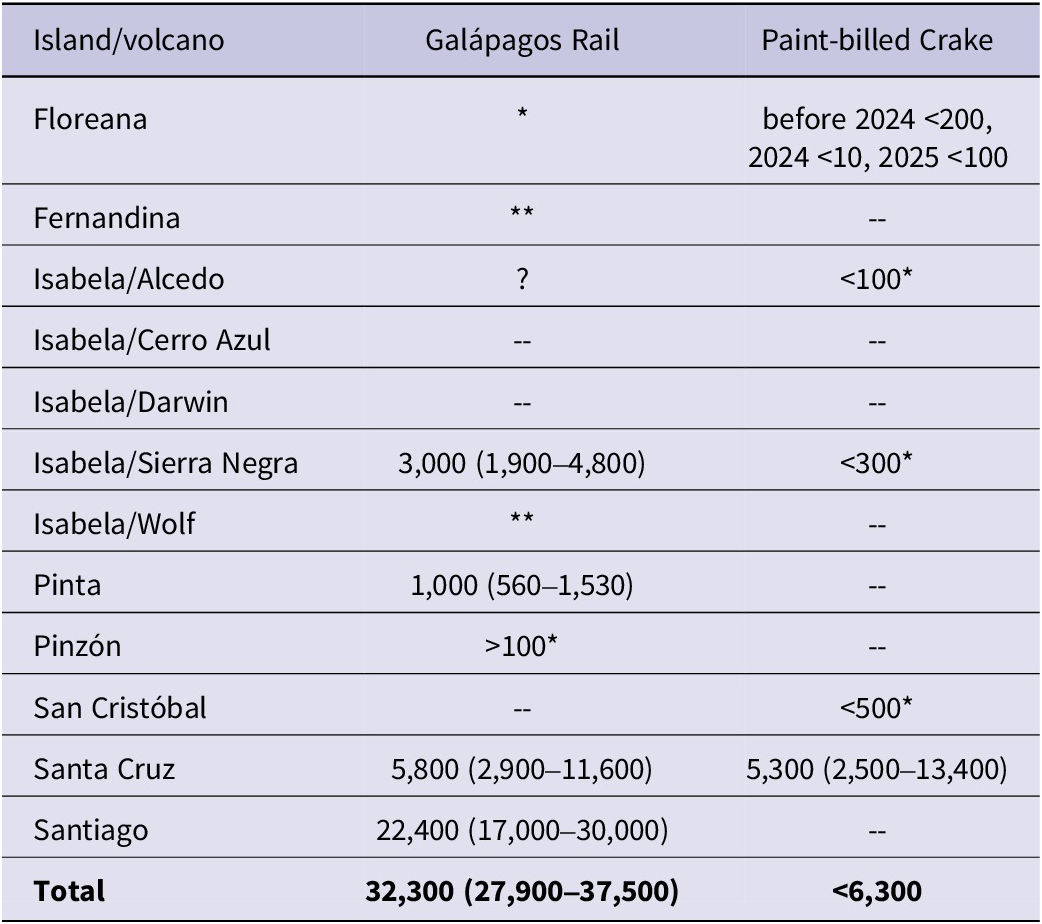
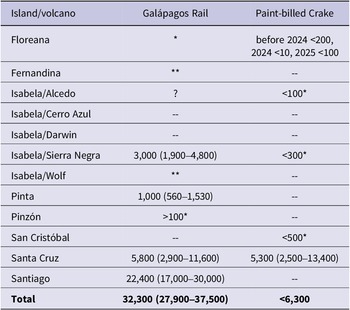
The Galápagos Rail currently occurs on seven islands (Figure 1); six islands were surveyed during 2015–2025. We estimated the total population size on these islands at 32,300 (95% CI 27,900–37,500) breeding pairs (Tables 2 and S2). The areas of fern on two northern volcanoes on Isabela and the volcano on Fernandina were not surveyed, but these three areas are known to harbour breeding populations. Since their humid zones cover a combined area of around 86 km² (Rivas-Torres et al. Reference Rivas-Torres, Benítez, Rueda, Sevilla and Mena2018), the extent of suitable fern habitat could be considerable (see below) and may harbour larger populations of several hundred if not more than a thousand pairs.
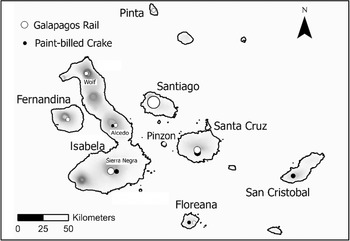
Distribution of the Galápagos Rail (Fernandina, Isabela, Pinta, Pinzón, Santa Cruz, Santiago, and Floreana) and the Paint-billed Crake (Floreana, Isabela, San Cristóbal, and Santa Cruz) on the Galápagos Islands. Point size corresponds to population estimates: small point ≤1,000 pairs, medium-sized point >1,000 and <10,001 pairs, and large point >10,000 pairs.
Population estimates (number of breeding pairs) with 95% CIs of Galápagos Rail and Paint-billed Crake. -- = not found by the landbird project, no records in the literature; * = recorded by the landbird project, but no density estimate possible due to small sample size; ** = not surveyed or recorded by the landbird project, but species known from other sources to be present; ? = surveyed by the landbird project, no birds found, but known from two distinct observations (DA, T. de Roy). On Floreana, the rodent and cat eradication using baits in autumn 2023 reduced the Paint-billed Crake population to almost zero. Some birds have been observed in the agricultural zone in February 2024 (Roland Digby, personal observation) and in 2025, we found the birds at 8% of the counting points
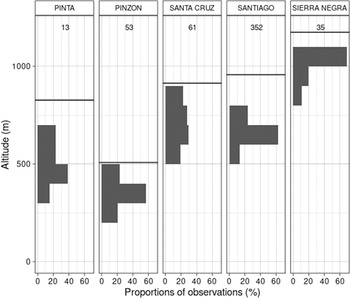
The majority (~65%), comprising 22,400 pairs, occurred in the highlands of Santiago. There, the species was primarily found on the flat highland plateaus and valleys in the north-west between 500 m and 800 m a.m.s.l. (Figure 2); there were only three records below 500 m, at 340, 450, and 484 m a.m.s.l. The highest densities of around 10 pairs/ha were recorded in pure stands of bracken fern Pteridium aquilinum, which cover 3.6 km² of the highlands of Santiago. The Galápagos Rail appeared to occupy the entire area of bracken at this very high density. A much larger part of the highlands (30.8 km²) is covered by a humid forest dominated by cat’s claw Zanthoxylum fagara with a ground layer of bracken. Although abundance was lower in these areas, with an average density of around six pairs/ha, it was widespread and detected at 50 of the 68 counting points (Table S2).
Altitudinal distribution of Galápagos Rails on five islands/volcanoes (2015–2020) with number of observations. The maximum altitude of each island is marked by a bar. On Pinzón, we had additionally a single observation of a calling bird at 150 m a.m.s.l.
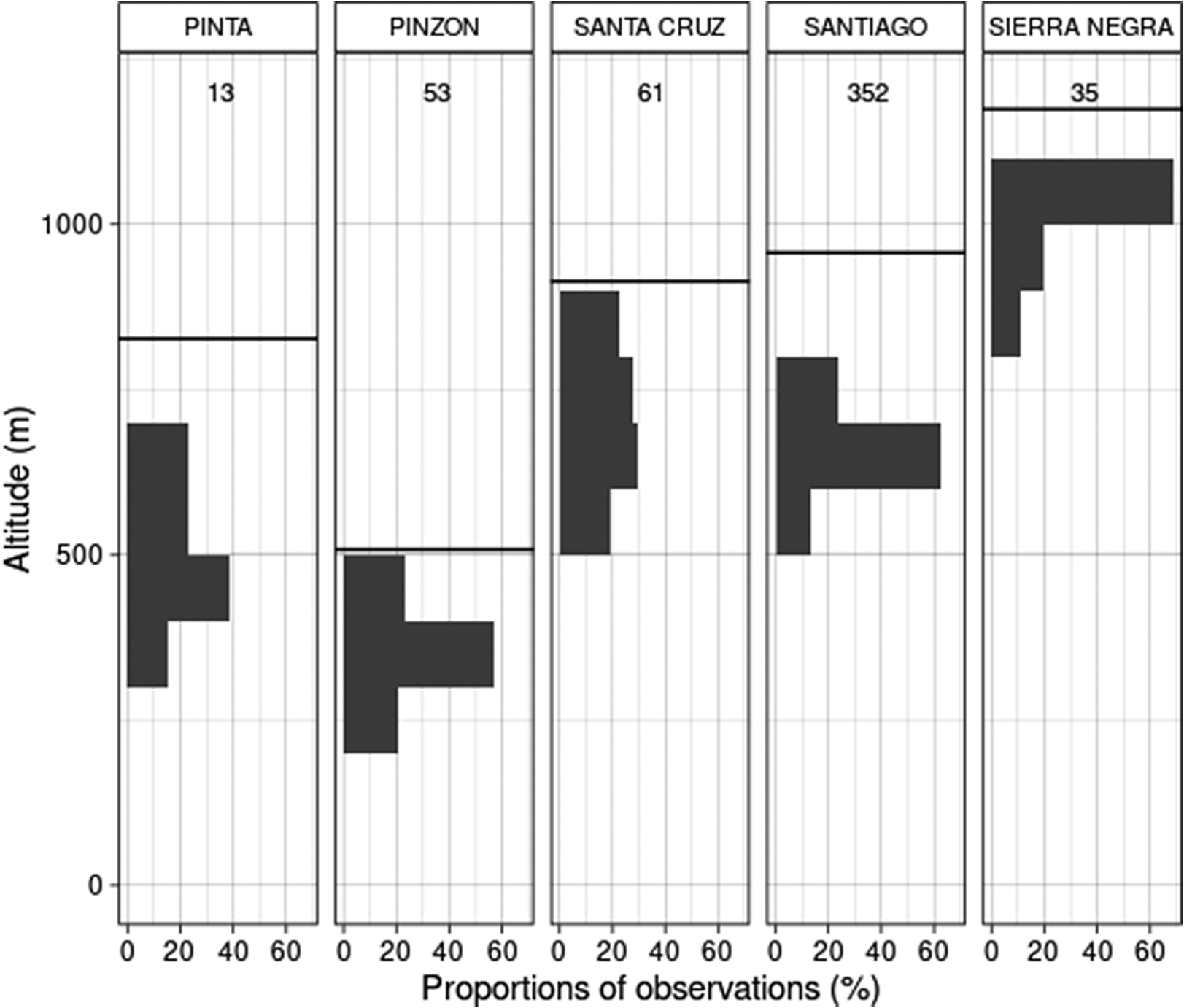
On Santa Cruz, the Galápagos Rail was almost exclusively found in the highlands between 525 m and 860 m a.m.s.l. (Figures 2 and 3). It was virtually confined to pure fern stands or mixed stands of bracken and miconia, covering 26.7 km². In these areas, the species was apparently widespread, with an average density of 2.2 pairs/ha (Table S2), resulting in a population estimate of about 5,800 pairs for Santa Cruz. No Galápagos Rail was recorded in grassland (mainly elephant grass Pennisetum purpureum) or on agricultural land below 500 m a.m.s.l. A single individual was heard on the border between the National Park and the agricultural zone at 395 m a.m.s.l.
Records of Paint-bill Crakes and Galápagos Rails in the agricultural zone and in various vegetation types of the highlands of Santa Cruz.

On Isabela, we only encountered Galápagos Rails on the southern flank of the Sierra Negra volcano, where it was confined to stands of bracken and moist grassland above 800 m (Figure 2). With a mean density of 3.8 pairs/ha and an area of about 8 km² of suitable habitat, we calculated a population of about 3,000 breeding pairs. As on Santa Cruz, the Galápagos Rail was absent from the lower-lying agricultural areas, gardens, and grassland during our visit in February 2020, with only one calling individual recorded in the agricultural zone, at 476 m a.m.s.l. in 2015. On Isabela Island’s volcanoes Cerro Azul, Alcedo, and Darwin, we did not find the Galápagos Rail, and on Wolf volcano we did not reach the higher elevations with suitable habitats.
On Pinta Island, the small, fern-dominated humid zone around the summit of the volcano (2.6 km²) had a breeding population of about 1,000 pairs, with densities of 3.8 pairs/ha (Figure 2).
Finally, on Pinzón, at least three birds were heard in a wet area near the summit in January 2018 (Figure 2). This was the first record of the species on Pinzón. In 2024, we repeated our point counts and found the species in 50% of all points in the wet summit area and in the transition zone with the lowest altitudes of 150 m a.m.s.l. (Table S2).
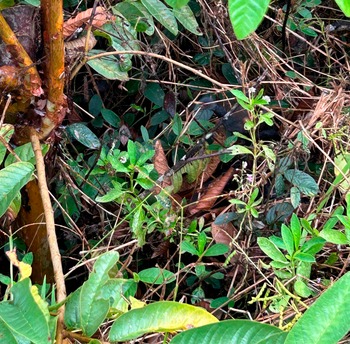
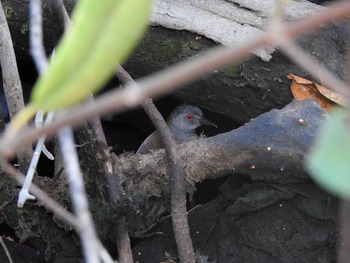
Despite repeated, intensive week-long surveys over six breeding seasons, we did not detect the Galápagos Rail on Floreana or San Cristóbal until 2024 (for details see Dvorak et al. Reference Dvorak, Nemeth, Wendelin, Herrera, Mosquera and Anchundia2017, Reference Dvorak, Fessl, Nemeth, Anchundia, Cotín and Schulze2020, Reference Dvorak, Nemeth, Wendelin and Fessl2021). In February 2025, during a landbird monitoring trip to Floreana to assess the impact of the rodent and cat eradication effort initiated in autumn 2023, we recorded the Galápagos Rail at three different sites (Table S4). Our observations included six acoustic records (audio files S5 and S6), two visual confirmations, and one photograph (Figure 4). Two sites, where spontaneous vocalisations were detected, were located in the transition zone of southern Floreana at elevations of 240 m and 260 m a.m.s.l. approximately 1 km apart. The third site, in the north-east, yielded four additional records: two obtained using playback at ~340 m a.m.s.l. and two more (one spontaneous, one using playback) at ~320 m a.m.s.l.
A Galápagos Rail at “Peor es nada”, in a mixed highland forest area in February 2025. (Photograph: Cristian Poveda, CDF)
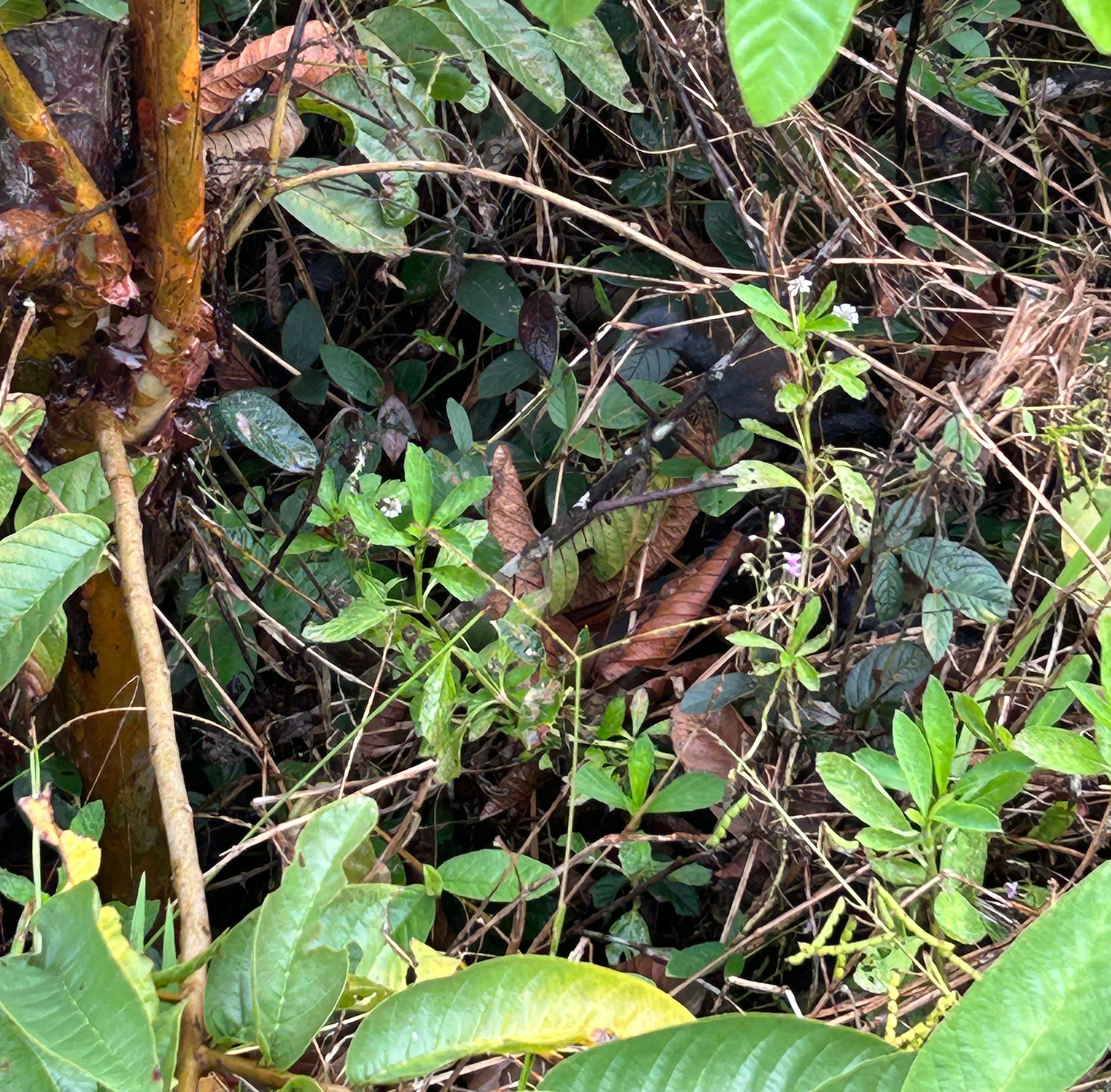
The habitat consisted primarily of grassland overgrown with guava trees, with dense ground vegetation composed of grasses and herbs.
The total area of suitable habitat on the five islands (excluding Floreana) surveyed is 73.19 km² (Tables 1 and S3). Although we lack precise figures on the extent of fern habitat on Fernandina and on Isabela’s Wolf and Alcedo volcanoes, rough estimates based on satellite images available at https://earth.google.com suggest that they do not exceed 5–7 km². Therefore, we estimate that the area of occupancy as defined by IUCN (2022) is about 80 km².
Current distribution and population size of the Paint-billed Crake
The Paint-billed Crake was found on the four inhabited islands with humid highlands, i.e. Santa Cruz, San Cristóbal, Isabela, and Floreana (Tables 2 and S1), and we estimate its total breeding population on the Galápagos to be at least 6,200 pairs.
The largest population was found on Santa Cruz, where the species occurred on the southern side of the island, from the lower transition vegetation zone (140 m a.m.s.l.) to the lower limit of the fern zone at about 700 m a.m.s.l. (Figure 3). Most observations came from the agricultural zone, where we recorded the Paint-billed Crake on 20% (24 of 117) of all census points in 2019. We also found the species in the small remnant of Scalesia forest around the Los Gemelos craters. In the area of Mina de Granillo Rojo – a Scalesia forest invaded by blackberry Rubus niveus and invasive tree species – we recorded only a few Paint-billed Crakes. Densities were low compared with the Galápagos Rail and never exceeded 0.2–0.3 pairs/ha (Table S2). We estimate the total population size on Santa Cruz at 5,300 breeding pairs, of which 2,400 are in the agricultural zone and 1,900 in the transition zone (Table 2).
On Isabela, we recorded the Paint-billed Crake on the Sierra Negra volcano and the Alcedo volcano in the centre of the island (Table S2 and Figure 1). All eight records from Sierra Negra were from the agricultural zone between 230 m and 600 m a.m.s.l., but no density estimates could be calculated from the small sample. The breeding population is probably no more than a few hundred pairs. On Alcedo, we recorded only two birds, near the volcano rim at 860 m and 900 m a.m.s.l.
On San Cristóbal, we found the Paint-billed Crake at 9 of 141 census points in 2015 (6.4%), and no birds at any of the 75 points censused in 2017. Observations in 2015 were from overgrown pastureland at altitudes between 500 m and 560 m a.m.s.l. (seven birds), while one bird was recorded in the agricultural zone at 320 m and one in the transition zone at 115 m a.m.s.l. (Table S2). Considering these observations, we assumed an approximate number of at least 500 breeding pairs.
On Floreana, the Paint-billed Crake was mainly found in the small agricultural zone and neighbouring areas with Scalesia and highland forest. In 2015, it was recorded at 7 of 168 census points (4.2%), and in 2016 at 5 of 195 points (2.6%). The use of the poison brodifacoum to eradicate rodents on Floreana in autumn 2023 led to a decline in the Paint-billed Crake population to almost zero. In February 2024, only single birds were sighted in the agricultural zone (Roland Digby, personal communication), and our counting team heard none. In 2025, we recorded 11 birds at 130 counting points, and along the main road, Paint-billed Crakes were frequently observed crossing.
Population trends of the Galápagos Rail at Media Luna (Santa Cruz)
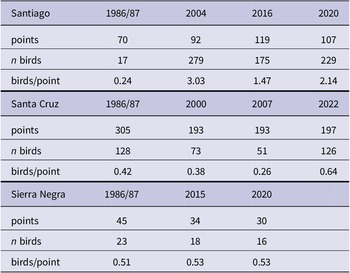
In 2022, we detected the Galápagos Rail at 94 of the 197 census points (48%). This detection rate was significantly higher (χ2 = 38.09, df = 4, P <0.0001) than in previous censuses, which recorded 29% in 2000 and 16% in 2007 (Shriver et al. Reference Shriver, Gibbs, Woltz, Schwarz and Pepper2011). Significant differences in detection rates were found between the 2000 and 2022 (χ² =19.18, P <0.0001) and 2007 and 2022 surveys (χ² =30.47, P <0.0001), which remained significant after applying the Bonferroni correction (adjusted α = 0.0167). The abundance of the Galápagos Rail also showed a significant increase compared with 2000 (χ2 =14.4, P = 0.0002) and 2007 (χ2 =44.85, P <0.0001). In 2022, we recorded a total of 126 individuals (average/point and SE 0.75 ± 0.05), whereas Shriver et al. (Reference Shriver, Gibbs, Woltz, Schwarz and Pepper2011) counted 73 birds in 2000 (average/point and SE 0.4 ± 0.05) and 51 in 2007 (average/point and SE 0.26 ± 0.05).
Discussion
Our surveys from 2015 to 2025, alongside other published and unpublished reports, confirmed the presence of breeding populations of the Galápagos Rail on seven islands (Table 2), including the first records for Pinzón and the rediscovery on Floreana.
The Paint-billed Crake is now distributed on four inhabited islands where it was found predominantly in farmland areas. The two species overlapped only marginally in their ranges; further studies are needed to clearly investigate whether there is competition between them.
Galápagos Rail – distribution and habitat
Today, over 99% of the known Galápagos Rail population inhabits fern and wet grassland habitats in the highlands of the larger islands (Figure 1). On Santiago, its density can reach 10 pairs/ha in fern habitat. Very small territory sizes and high local densities of 1–2 pairs/ha are common in small rail species (Taylor and van Perlo Reference Taylor and van Perlo1998). In Brazil, Mauricio and Dias (Reference Mauricio and Dias1996) found territories as small as 500 m² for the Red-and-white Crake Laterallus leucopyrrhus.
In the nineteenth century, the Galápagos Rail was found in very different habitats on the respective islands compared with today. For instance, on Santiago, it occurred “in the tall grass, which grew abundantly on the main peak at 863 m a.m.s.l.”, and it occupied a similar habitat (“just below the fern-belt which caps the highest portion of the island”) on Pinta (Gifford Reference Gifford1913), whereas now it occupies the bracken fern vegetation that has replaced the grass on both islands. On Isabela, it was commonly found at sea level (“among thick ferns near fresh water in the vicinity of Villamil”; Gifford Reference Gifford1913), but absent in recent searches (personal observations). On Santa Cruz, it was common in humid forests at altitudes between 137 m and 335 m a.m.s.l. (Gifford Reference Gifford1913), whereas nowadays the species can be mainly found between 500 m and 860 m a.m.s.l. It was also collected in mangrove areas on the north-eastern coast in Conway Bay opposite Daphne and in the mangroves of Academy Bay (Gifford Reference Gifford1913; Salvin Reference Salvin1876). Similarly, on Baltra it was collected in mangrove forests on the south coast (Gifford Reference Gifford1913), where mangroves are now absent (personal observation). On Fernandina, it was found “in a mangrove swamp on the east shore” (Snodgrass and Heller Reference Snodgrass and Heller1904). The Galápagos Rail has not been reported from any of these mangrove sites since, but it still inhabits the mangroves of Playa Tortuga Negra and Caleta Black in the north-west of Isabela (Figure 5).
A Galápagos Rail in mangroves at Playa Tortuga Negra, Isabela. (Photograph: Ibeth Alarcón, CDF, September 2021)

The high predation pressure by cats and rats in the lower and middle altitudes of the islands may be why the Galápagos Rail is now mainly restricted to higher altitudes. The rail’s colonisation of Pinzón after the eradication of black rats Rattus rattus in 2012 (Rueda et al. Reference Rueda, Carrion, Castano, Cunninghame, Fisher, Hagen, Veitch, Clout, Martin, Russell and West2019) and its spread to drier areas support this hypothesis. Its persistence in the mangroves of north-west Isabela could be attributed to rat control carried out since 2007 to protect the Mangrove Finch Camarhynchus heliobates (Fessl et al. Reference Fessl, Young, Young, Rodriguez-Matamoros, Dvorak and Tebbich2010). Similarly, our recent discovery of the Galápagos Rail in the transition zone of Floreana, 15 months after the initiation of rodent and cat eradication efforts, provides further evidence of species recovery following predator removal.
The historical presence of the Galápagos Rail in Floreana remains uncertain. Harris (Reference Harris1973) stated “breeds on Floreana” without providing specific details. A year later, he wrote: “The ponds hold ducks and Gallinules and both rails breed” (Harris Reference Harris1974). However, it is unclear whether these statements were based on personal observations or derived from undisclosed sources. Twelve years later (January 1987) Rosenberg (Reference Rosenberg1990) did not find the Galápagos Rail during systematic counts with playback on 150 points and thus considered them “rare or extirpated from Floreana” and mentioned that a local naturalist had not seen the species on the island since 1983. All our previous searches were unsuccessful (Dvorak et al. Reference Dvorak, Nemeth, Wendelin, Herrera, Mosquera and Anchundia2017, Reference Dvorak, Nemeth, Wendelin and Fessl2021). On Floreana, local people use the term “pachay” for the Paint-billed Crake, and on other islands this name is applied to both species of small rails. Proof of the existence of the Galápagos Rail on Floreana relies solely on the interpretation of the origin of specimens collected by the Beagle expedition, which visited the islands in 1835. Several authors attributed one of these specimens to the island of Santiago (Rothschild and Hartert Reference Rothschild and Hartert1899; Salvin Reference Salvin1876; Swarth Reference Swarth1931), but after a detailed revision of the collection, Sulloway (Reference Sulloway1982) concluded that “FitzRoy collected his specimen on Charles Island” (which is the alternative name for Floreana). Further evidence of its earlier presence is a fossilised tibiotarsus found in 1995 at Barn Owl Cave (Layer II, Level 4) dated to the late Holocene (c.5,000 to 500 years old) (D.W. Steadman, personal communication and in Dvorak et al. Reference Dvorak, Nemeth, Wendelin, Herrera, Mosquera and Anchundia2017). We conclude that there is only one historical record, the specimen from 1835 (see also Dvorak et al. Reference Dvorak, Nemeth, Wendelin, Herrera, Mosquera and Anchundia2017). Determining whether the species persisted in very low numbers or recolonised after the eradication of large herbivores in 2011 or the more recent rodent and cat eradication trials will require genetic analysis.
For San Cristóbal, there is a single record from January 1987 of a bird responding to playback in the agricultural area of El Chino at 200 m a.m.s.l. (Rosenberg Reference Rosenberg1990; D. Rosenberg, personal communication). There is no record of this species from any of the collecting expeditions in the late nineteenth and early twentieth centuries (Swarth Reference Swarth1931) and there are no fossil records (D.W. Steadman, personal communication). Its absence from San Cristóbal is puzzling, considering the extent of apparently suitable habitat in the highlands. Although Rosenberg (Reference Rosenberg1990) speculated that “San Cristóbal probably once had a very large rail population”, there is no evidence that it ever bred there.
On Isabela, we detected the species only on Sierra Negra volcano. There are a few reports of its presence on Alcedo volcano, where it was recorded below the southern rim in April 2016 (DA personal observation). T. de Roy (in litt., 23 April 2021) summarised her experience from many visits to the area as “heard many times, but not seen, always somewhere on the SE rim outer slope”. Its presence on Wolf volcano was first mentioned by Donlan et al. (Reference Donlan, Campbell, Cabrera, Lavoie, Carrion and Cruz2007), who recorded it on 10 out of 37 counting points in December 2004. We are not aware of any further records, and we did not reach suitable habitat for the species during our single visit to the volcano in 2020. Since 2010, the Galápagos Rail has been repeatedly reported from two breeding sites of the Mangrove Finch on the north-western coast of Isabela Island (DA, BF and members of the Mangrove Finch Conservation Project verbally 2019). There is photographic evidence from Playa Tortuga Negra (I. Alarcón, September 2021; Figure 5) and Caleta Black (S. McPherson, March 2022).
On Pinzón, our discovery of the Galápagos Rail in February 2018 was later confirmed by T. de Roy (personal observation 2021) as “a small population in a small misty, humid area on the southern edge”. Conditions for the species have improved since the rat eradication in 2012 and the Galápagos Rail population has expanded to lower, drier areas in the transition zone (DA February 2023; P. Castaño verbally April 2023; our data 2024).
On Fernandina, the Galápagos Rail is known to occur, probably in moderate numbers, from both historical (Gifford Reference Gifford1913) and recent sources. Donlan et al. (Reference Donlan, Campbell, Cabrera, Lavoie, Carrion and Cruz2007) did not find it at 29 highland census points in December 1986 but recorded it at 11 of 16 points on the south to south-west slope in December 2004. T. de Roy (in litt., 23 April 2021) “heard the rail, very rarely, on the densely vegetated SE rim area”. During a trip to the north-west rim in 2021, DA did not observe any Galápagos Rails over a c.7 km² area of patchy vegetation of Scalesia trees and shrubs during a period of three days.
Paint-billed Crake – habitat and recent expansion
On the South American mainland, the Paint-billed Crake inhabits various open to semi-open habitats including “grassy marshes, rank grass, wet to dry pastures, corn and rice fields, gardens, drainage ditches, humid woodlands and savanna, and overgrown bushy areas” (Taylor and van Perlo Reference Taylor and van Perlo1998). In the Galápagos, the original dense, closed canopy vegetation cover of the transition and humid forests provided little, if any, suitable habitat. On the four Galápagos islands where the Paint-billed Crake currently occurs, it predominantly occupies agricultural zones in open and semi-open grasslands mainly consisting of elephant grass. It also inhabits surrounding areas of open forest, wetlands or fern stands, all of which have been created by human activities over the past 150–200 years. As with the Cattle Egret Bubulcus ibis and the introduced Smooth-billed Ani Crotophaga ani, both of which first appeared in the 1960s (Wiedenfeld Reference Wiedenfeld2006), the Paint-billed Crake apparently found suitable habitat on the Galápagos Islands only after people began clearing the original vegetation and cultivating the land in the transition and humid zones.
The sudden appearance of this species on the Galápagos is a mystery. Bowman (Reference Bowman1960) was the first to mention its occurrence: “it is now firmly established that two species of rail are resident on Indefatigable [=Santa Cruz] Island” and continued: “In 1953 I collected two individuals of a somewhat larger red-legged rail, clearly referable to the species Neocrex erythrops, hitherto unreported on Galápagos”. Twenty years later, Harris (Reference Harris1973) summarised its status as “Resident. Nests on Santa Cruz and Floreana … could occur on San Cristóbal and Isabela”. The Paint-billed Crake was not recorded by any of the collecting expeditions in the nineteenth and early twentieth century (Gifford Reference Gifford1913; Ridgway Reference Ridgway1896; Rothschild and Hartert Reference Rothschild and Hartert1899; Snodgrass and Heller Reference Snodgrass and Heller1904). Therefore, despite its extremely secretive habits (Taylor and van Perlo Reference Taylor and van Perlo1998), we conclude that the species did not formerly occur as a breeding bird on Galápagos.
Long-range vagrancy is common in rails, including the Paint-billed Crake (Taylor and van Perlo Reference Taylor and van Perlo1998). In Galápagos, there are several cases of movements between islands, for instance, a dead Paint-billed Crake found on Rábida Island in 1989 (Castro and Phillips Reference Castro and Phillips1996) and four records of Paint-billed Crake from Genovesa Island between 1972 and 1986 (Harris Reference Harris1973; T. Grant in Wiedenfeld Reference Wiedenfeld2006). The present data show that the first records from Santa Cruz in the early 1950s were followed by a rapid expansion and that it is now firmly established on Floreana and San Cristóbal and common on Santa Cruz. On Isabela, we found it in the agricultural zone on the flanks of Sierra Negra, and at least a few Paint-billed Crakes had already colonised Alcedo.
In Santa Cruz, the Paint-billed Crake has shown population growth over the last 20 years. No records were reported in the agricultural zone during point counts in 1997 and 1998, then numbers sharply increased to a maximum in 2015 (9, 22, 64, and 28 individuals in 2008, 2010, 2015 and 2019 on 110–115 points counted in the respective years (MD and BF unpublished data; Charles Darwin Foundation [CDF] Galápagos Landbird Project unpublished data). Long-term bird monitoring in the Scalesia forest at Los Gemelos revealed the expansion of the Paint-billed Crake into this new habitat: absent in 1997/98, 2008, and 2010, one bird recorded in 2012, fairly common in 2014 and 2015, at 7 of 25 and 11 of 24 census points, respectively (MD unpublished data; CDF Galápagos Landbird Project unpublished data).
Intraspecific competition?
While the distribution and density of the Paint-billed Crake on Santa Cruz have increased in the upper transition and agricultural zones, as well as in the adjoining fern zone and Scalesia forest, the Galápagos Rail has disappeared from farmland and transition zone areas, where it was still locally present 50 years ago (Harris Reference Harris1974). This raises the question of whether interspecific competition is responsible. However, while the Galápagos Rail was largely absent over most of the agricultural zone in the 1990s, the Paint-billed Crake was still very rare at that time; its sharp increase only started after around 2000. Therefore, it seems more likely that deteriorating habitat conditions, probably in combination with predator pressure, were the main reasons for the Galápagos Rail’s disappearance from the agricultural zone, rather than competition with the larger Paint-billed Crake. It remains to be seen what will happen in the two areas where the two species have recently come into contact: east of the Scalesia forest of Los Gemelos, and at the border between the agricultural zone and the National Park (Figure 3).
Conservation and its effects on Galápagos Rail populations
Santiago currently harbours 65% of the global Galápagos Rail population, making it crucial for the species’ survival. Santiago’s example shows that Galápagos Rail populations can recover rapidly. The island’s natural vegetation was largely destroyed by introduced herbivores by the mid-1980s, leading to a significant reduction in suitable habitat (Rosenberg Reference Rosenberg1990), and a low rail density (Table 3). Twenty years later, the complete removal of herbivores from the island (Cruz et al. Reference Cruz, Donlan, Campbell and Carrion2005), resulted in a remarkable recovery of vegetation and, subsequently, the Galápagos Rail (Donlan et al. Reference Donlan, Campbell, Cabrera, Lavoie, Carrion and Cruz2007) (Table 3). The dense, uniform stands of bracken that emerged after goat eradication, though potentially problematic for the recovery of other plant species, now provide breeding habitat and perhaps protection against predation by the black rat. Similarly, Pinta’s Galápagos Rail population quickly increased following feral goat eradication (Campbell et al. Reference Campbell, Donlan, Cruz and Carrion2004). Today, Pinta’s population exhibits the lowest genetic diversity, reflecting the past population bottleneck, or recolonisation by a few individuals (Chaves et al. Reference Chaves, Martinez-Torres, Depino, Espinoza-Ulloa, García-Loor and Beichman2020).
Comparison of relative densities (birds/point) of the main breeding populations in the highlands of Santiago, Santa Cruz, and Sierra Negra on Isabela. 1986/87 from Rosenberg (Reference Rosenberg1990), 2004 from Donlan et al. (Reference Donlan, Campbell, Cabrera, Lavoie, Carrion and Cruz2007), 2000 and 2007 from Shriver et al. (Reference Shriver, Gibbs, Woltz, Schwarz and Pepper2011), 2015–2022 from this study
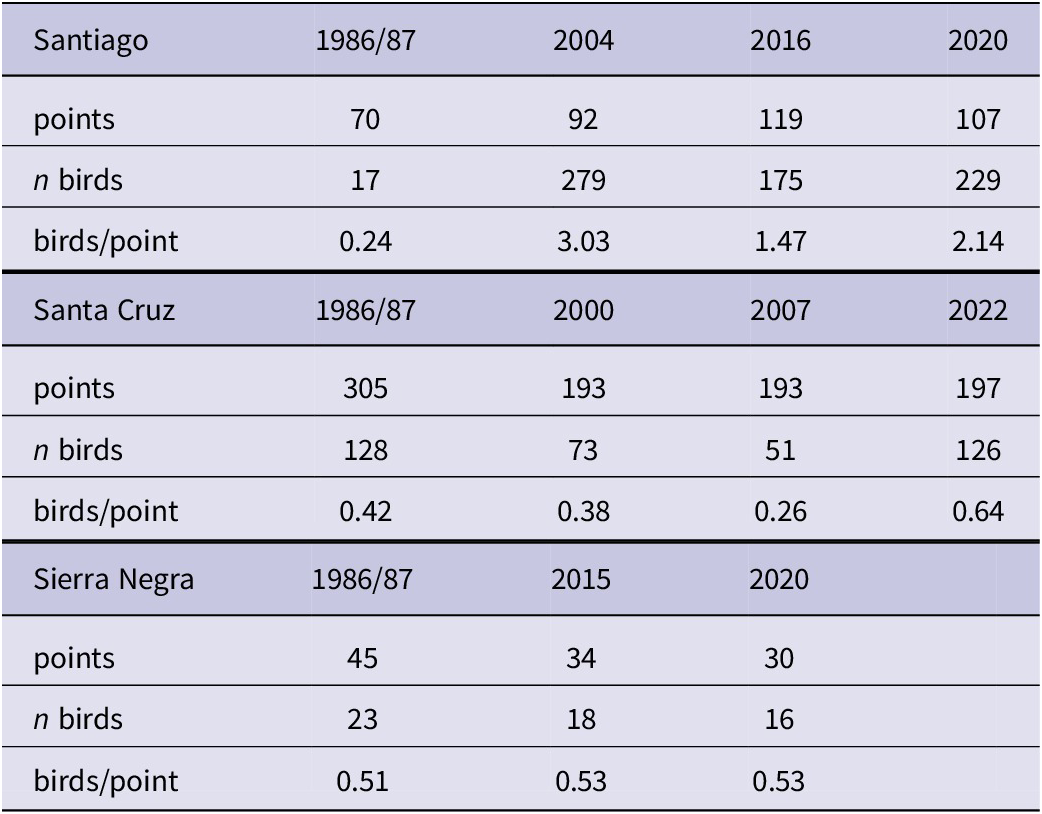
Between 2007 and 2022, the abundance of the Galápagos Rail significantly increased around Media Luna on Santa Cruz (Table 3). Comparing current and previous vegetation composition suggests that this increase is related to successful control of the red quinine tree (Shriver et al. Reference Shriver, Gibbs, Woltz, Schwarz and Pepper2011). Until 2004, this invasive plant spread in the highlands to cover an area of 110 km² (Buddenhagen et al. Reference Buddenhagen, Renteria, Gardener, Wilkinson, Soria and Yánez2004). By 2011, based on satellite imagery, the area occupied by this tree was estimated to be less than 15.4 km² (Trueman et al. Reference Trueman, Standish, Orellana and Cabrera2014). Currently, there are more dead trunks and fewer living quinine trees in the study area compared with 2007 (Shriver et al. Reference Shriver, Gibbs, Woltz, Schwarz and Pepper2011; Silva Reference Silva2022).
There was no apparent change in the density of Galápagos Rails in the highlands of Sierra Negra volcano between 1986, 2015, and 2020 (Table 3).
Conservation status of the Galápagos Rail and proposal for a change in Red List category
The Galápagos Rail is currently classified on the global Red List as “Vulnerable”, meeting criteria C1 and C2a(i), based on an assumed population size of 3,300–6,700 mature individuals, the restricted range, and a decline of 1–19% in 10 years (BirdLife International 2020). As the species is endemic to Ecuador, it is also categorised as “Vulnerable” on the national Red List (Jiménez-Uzcátegui et al. Reference Jiménez-Uzcátegui, Freile, Santander, Carrasco, Cisneros-Heredia and Guevara2019).
Based on our fieldwork, the total population is much larger than previously thought, so criterion C (population is <10,000 individuals) is not met. The population trend on the three main islands, Santiago, Santa Cruz, and Isabela, has been stable to strongly increasing over the last 30 years. Criteria A and B, based on decreasing populations and/or losses in the extent of occurrence/area of occupancy during the last 10 years, are therefore not met either, so the species should no longer be retained in the “Vulnerable” category. However, the species is known to be susceptible to changes in habitat conditions, especially driven by invasive plants and animals. Additionally, a large part of the total population is found on only one location in the highlands of Santiago, where a dynamic process of habitat change and succession is currently taking place (H. Jäger; CDF, personal communication). Thus, it qualifies for the category “Near Threatened” (IUCN 2012) following the examples shown in IUCN (2022) on the basis of almost meeting criterion B for “Vulnerable” status. Its area of occupancy (only c.80 km²) is far below the threshold of 2,000 km² set by sub-criterion A and it is known to exist at no more than 10 locations – but it does not meet either of the two other sub-criteria necessary to be classified as “Vulnerable”.
Supplementary material
The supplementary material for this article can be found at http://doi.org/10.1017/S0959270925000115.
Acknowledgements
We thank all institutions that made our surveys possible and all the individuals that supported us in many ways. A special thank you to Cristian Poveda for his participation in the point counts in Floreana in 2025 and his ability to take a picture proof of the Galápagos Rail! Our study was part of the Galápagos Landbird Project, implemented jointly by the CDF and the Galápagos National Park Directorate who provided us with permits (PC09-15, PC33-16, PC07-17, PC01-18, PC30-19, PC11-20, PC30-22, PC22-23, PC29-24), logistic support, and help in the field. Funding was provided by Galapagos Conservancy, Galapagos Conservation Trust, International Community Foundation with grants awarded by The Leona M. and Harry B. Helmsley Charitable Trust, Lindblad Expeditions-National Geographic Fund, Island Conservation, and the Swiss Association of Friends of Galapagos. This publication is contribution number 2632 of the CDF for the Galápagos Islands. We thank James Gibbs and Greg Shriver for access to their original databases for Galápagos Rail distribution in Media Luna, Santa Cruz. Emily McFarling revised the English of a previous version and André Mauchamp helped with the reference section, among others. The manuscript was greatly improved by the comments of anonymous referees and suggestions by an associate editor.



 Open access

