


The main objective of forensic psychiatric treatment is to prevent future violent behaviour. According to the Risk-Need-Responsivity model, Reference Andrews and Bonta1 this is best achieved by systematic assessment of the patient's risks for violence and by focusing treatment on these criminogenic needs. The Good Lives model extends this idea by emphasising the importance of strengthening protective factors to help clients build a ‘good life’ they are reluctant to lose. Reference Ward, Mann and Gannon2 Various risk assessment instruments have been developed, recently also including assessment of protective factors, such as the Short Term Assessment of Risk and Treatability (START) Reference Webster, Nicholls, Martin, Desmarais and Brink3,Reference Nicholls, Brink, Desmarais, Webster and Martin4 and the Structured Assessment of PROtective Factors (SAPROF). Reference De Vogel, de Ruiter, Bouman and de Vries Robbé5 Research on these instruments, however, has focused almost exclusively on their predictive capabilities. Whether the use of risk assessment instruments in forensic psychiatry actually helps to prevent violent behaviour, through the selection of more suitable or better treatment, remains unclear. Reference Douglas and Kropp6 Our study addressed this question in out-patient forensic psychiatry, a setting that calls for an ongoing process of assessment and management of short-term variable risks and needs, Reference Drieschner and Boomsma7-Reference Van den Brink, Hooijschuur, van Os, Savenije and Wiersma10 and specific attention to client motivation for treatment, which is often enforced but no longer mandatory (see online data supplement). Reference Drieschner and Boomsma7 Shared decision-making has been shown to increase client satisfaction, treatment adherence and quality of life in longer-lasting treatment relations, Reference Joosten, DeFuentes-Merillas, de Weert, Sensky, van der Staak and de Jong11 and thus, in line with the Good Lives model, is thought to be associated with reduced recidivism. Reference Ward, Mann and Gannon2 We therefore developed a method of periodically monitoring violence risks and treatment needs, Reference Van den Brink, Hooijschuur, van Os, Savenije and Wiersma10 aimed to foster shared decision-making by actively involving the person receiving forensic out-patient psychiatric care in risk assessment and care planning. This method's ability to prevent violent behaviour in these individuals is tested here.
Method
The Risk Assessment and Care Evaluation (RACE) study is a cluster randomised controlled trial (RCT), registered with The Netherlands Trial Register (NTR1042), which was conducted in The Netherlands between September 2007 and September 2010. The aim of the study was to determine whether periodic risk assessment and subsequent care planning with people receiving forensic psychiatric out-patient care were associated with a reduction of recidivism and improvement in the person's quality of life, psychosocial functioning and satisfaction with care. If case managers were to have clients randomised to both treatment groups, then this could result in spill-over of the intervention effect. Therefore, we randomised case managers, with their whole case-load, to either care as usual or the intervention. For the clients, a follow-up period of 18 months was planned, or until either end of care or end of study if that were sooner. The primary outcome was the proportion of clients with one or more incidents of violent or criminal behaviour in the 6 months before end of follow-up. Case managers recorded incidents of violent or criminal behaviour on a standard form in the case file (see online data supplement DS1 for a more detailed description of the method).
Participants
Based on a pilot study, Reference Van den Brink, Hooijschuur, van Os, Savenije and Wiersma10 a power analysis indicated that 340 participants should be included in each study group (see online data supplement). Our study was conducted in three out-patient forensic psychiatric services in each of the three northern provinces of The Netherlands, whose case-loads were representative of the country as a whole. Reference Bouman, de Ruiter and Schene12 All case managers and clients of the participating services were eligible for the study. We defined case managers as those with primary responsibility for the care planning of their clients. As we expected the intervention to be effective only in longer-lasting treatment relations, Reference Joosten, DeFuentes-Merillas, de Weert, Sensky, van der Staak and de Jong11 we excluded cases with expected discharge within 6 months or with infrequent treatment contacts (less than once a month on average). Informed consent was asked for client interviews at baseline and follow-up. Approval was obtained from the Dutch medical ethical committee for mental healthcare.
Randomisation
After initial interviews (by N.A.C.T.) with the case managers to determine their eligibility and characteristics, the second author (R.H.S.v.d.B.), who was masked to the case managers' identities, executed the randomisation procedure. Case managers were randomised consecutively, in random order, in strata defined by participating service, composition of case-load (predominantly clients with violent v. sexual offences), professional background (academic v. non-academic) and years of experience in forensic psychiatry (2 or more years v. less). Further details of the randomisation procedure are given in the online data supplement.
Intervention
In the control group, case managers provided care as usual to their clients; this did not involve standardised methods of risk assessment or care plan evaluation other than on an incidental and ad hoc basis. Case managers in the intervention group provided regular care and were instructed to use the RACE protocol for all evaluations of their clients' treatment plans. Legally, treatment plan evaluation should occur at least once a year. Since the intervention adopted a noticeably different approach to the treatment plan evaluations compared with procedures in care as usual, masking of clients or case managers was not an option.
Care as usual consisted of combinations of medication, individual (psycho)therapy, forensic psychiatric home care, specialised groups and training modules. Examples of specialised groups are those for hands-on sex offenders, hands-off sex offenders, and those with impulse control disorders, autism spectrum disorders or borderline intellectual functioning. Training modules for social, vocational, living and communication skills as well as those addressing insight were available.
The intervention consisted of two parts: a structured approach to risk assessment, and a care plan evaluation utilising the key strengths and vulnerabilities identified during the first part of the intervention. According to our protocol, case managers first assessed the client's risk and protective factors with the START. Independently, clients did the same using a specially developed client version of the START (available from the authors). Both case manager and client identified the client's key strengths and critical vulnerabilities and then discussed them with each other in a structured way, with the aim of agreeing on the types of care to be included in the new treatment plan. To encourage shared decision-making, case managers were instructed to point out the similarities and differences between the key and critical items they selected and those selected by the client, to motivate their own choices and treatment proposals, and to ask clients about their opinions and suggestions for treatment. The emphasis was on reaching an agreement on the final treatment plan that suited both parties. Consecutive treatment plan evaluations should include a review of previous agreements.
Case managers were trained in the use of the Dutch version of the START, Reference 't Lam, Lancel and Hildebrand13 and the structured approach to shared care planning, described earlier. Clients received no training, but case managers answered their questions if necessary. In accordance with the START manual, case managers rated the stable, historical risk factors of their clients (such as early maladjustment, history of violence and prior supervision failure) at baseline, using the Historical, Clinical, Risk Management - 20 (HCR-20). Reference Webster, Douglas, Eaves and Hart14 These historical factors are meant to serve as background information for the interpretation of the variable, dynamic, factors scored on the START. To maintain comparability between the intervention and care as usual groups, case managers rated the factors for all participating clients at baseline.
Outcome
The primary outcome consisted of the proportion of clients with one or more violent or criminal incidents in the 6 months before the end of follow-up. Both violent and criminal behaviours are considered important indicators of treatment outcome. Violent behaviour included intentional behaviour with the potential to physically harm a person or animal and seriously threatening or intimidating aggression. Criminal behaviour additionally covered such behaviour as exhibitionism, possession of child pornography, stalking, drug dealing, driving without a licence or under influence, possession of an illegal weapon, vandalism and theft. Not included was the use of illegal drugs, since this is not considered a crime under Dutch law. Case managers were instructed to use a standard form to record any incident that could potentially satisfy the definition. The form was included in the client's case file. Definition of an incident as violent or criminal was determined through consensus among three forensic psychiatric experts, unaware of the randomisation status of the client.
Additional outcome information was collected during interviews at baseline and follow-up with clients who were willing to participate and provided consent. Trained research assistants used an extended version of the MacArthur Violence Screens when asking about incidents in the previous 6 months. Reference Monahan, Steadman, Silver, Appelbaum, Robbins and Mulvey15 Incidents reported by clients during these interviews were coded and analysed in the same way as incidents reported in case files. Interviewers were masked to client randomisation status.
Statistical analysis
Incident reports obtained from either case files or client interviews were analysed separately. Outcome was coded as either presence (1) or absence (0) of violent or criminal incidents during the 6 months prior to follow-up. Baseline incidents were coded in a similar manner for the 6 months prior to the baseline assessment. Differences in baseline and follow-up proportions of the outcome were calculated with a chi-squared test for paired observations (McNemar's test). The intervention effect was tested in a logistic multilevel analysis, Reference Snijders and Bosker16 based on intention to treat, controlling for violent or criminal behaviour at baseline and length of follow-up. Clients were the first-level units of analysis; case managers were considered a random factor and formed the second-level units. Analyses were conducted with MLwiN version 2.23 Reference Rasbash, Browne, Healy, Cameron and Charlton17 and PASW Statistics version 18.0.3 on Windows 7.
Results
We randomised 58 case managers, of whom 24 (41%) were men, with an average age of 41.7 years (s.d. = 10.4, range 22-59) at the start of the study. The majority (n = 37, 64%) had not obtained an academic degree but 35 (60%) had at least 2 years' experience in forensic psychiatry (mean 7.4 years, s.d. = 5.8, range 0-20); their individual case-loads consisted, on average, of 17 clients (s.d. = 10, range 1-40). Most case managers (79%, n= 46) provided treatment in an individual rather than a group setting, and their main focus was on clients with aggressive or other problems (59%, n = 34), although some of them focused solely on sex offenders (17%, n = 10) or provided only forensic psychiatric home care (24%, n = 14). Nineteen case managers left their post during the study; where possible, their clients were transferred to another case manager in the same study group, otherwise they were excluded (n = 3) (Fig. 1).
To include clients in the study, case managers conducted a baseline rating of their client's functioning. For 43.7% (n = 492) of the 1127 eligible clients this initial rating could not be completed in time, i.e. before end of care or end of the study inclusion period, and therefore these clients had to be excluded along with 3 clients (0.3%) whose case manager had left. There were some minor, clinically irrelevant, differences between included and excluded clients (see online supplement). Characteristics of the clients included in the intervention and control groups are presented in Table 1. Clients in the two groups were of similar age (mean 39.6 years, s.d. = 11.9, range 18-82). Those in the intervention group were more likely to be men (94.2% v. 87.0%) and more often had a history of property offences (36.7% v. 28.4%) or substance-related offences (15.2% v. 8.7%) compared with the control group. There was no difference in diagnostic characteristics, legal order or mean score on the historical risk factors of the HCR-20.
Study profile.
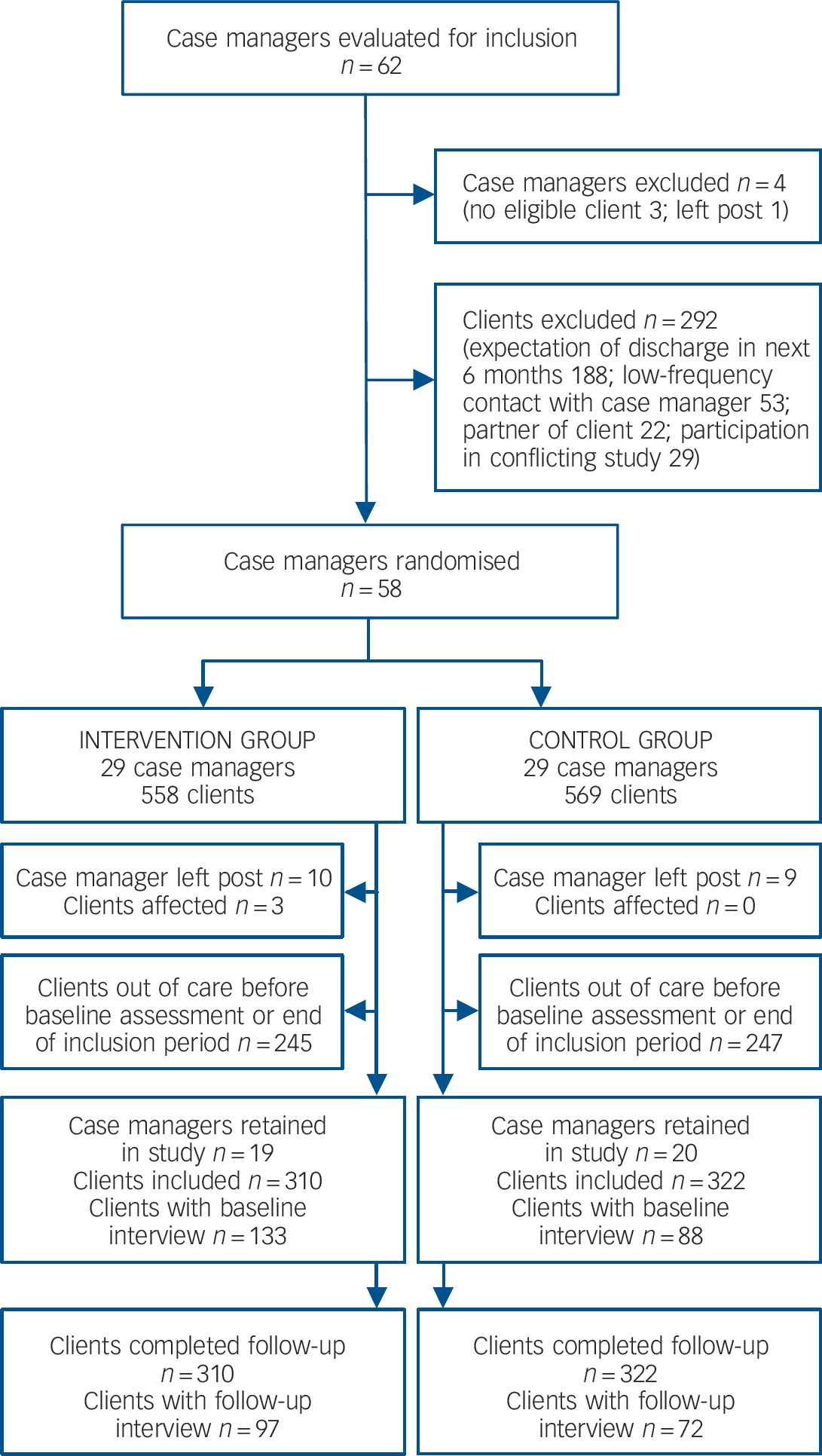
Overall, a third (35.0%, n= 221) of included clients agreed to an interview with a research assistant at baseline, of whom three-quarters (76.5%, n = 169) also completed an interview at follow-up. More clients in the intervention group agreed to a baseline interview than in the control group (42.9% v. 27.3%, P<0.01), but there was no significant difference in the proportion of clients failing to attend the follow-up interview (27.1% v. 18.2%, P = 0.13).
Fidelity to study plan
The follow-up period was 16.2 months on average (s.d. = 5.3, range 6-38). The control and intervention groups did not differ in this respect: mean 16.0 (s.d. = 4.8) v. 16.4 (s.d. = 5.8); P = 0.37. Of the 310 clients in the intervention group, 201 (64.8%) received the intervention, i.e. had a care plan evaluation according to the RACE protocol, of whom 72 (23.2%) received the intervention, as planned, more than once (range 2-4; total number of interventions 297). Case managers completed 326 START assessments for 203 clients (range 1-6 per client), and 199 clients completed 293 client versions of the START (range 1-4).
The 109 clients in the intervention group who did not receive an intervention (35.2%) had been in care longer before their inclusion in the study than those who received several interventions (30.2 months v. 19.5 months, P = 0.02). Participants receiving more than one intervention were more likely than those with no or only one intervention to have committed a sexual offence with a child aged 16 years or under (30.6% v. 19.7%, P = 0.05), whereas those who had received at least one intervention were more likely than those receiving none to have committed a sexual offence involving someone over 16 years old or of unknown age (23.5% v. 14.5%, P = 0.06). Participants who had received at least one intervention were more likely than clients who had received no intervention to participate in client interviews at baseline (52.2% v. 25.7%, P<0.01) and follow-up (37.8% v. 19.3%, P<0.01). There was no significant difference between the three intervention subgroups in client's gender, age, legal order, psychiatric diagnosis or mean score on the historical risk factors of the HCR-20.
Model fidelity was assessed by observing treatment plan discussions which were scored on a checklist of trained elements of the intervention (see online supplement). On average, 71% of the trained elements were administered. Reference De Bruijn18
Proportion of clients with incidents
For the two study groups combined a significant reduction from baseline (21.5%) to follow-up (15.3%) was found in the proportion of clients with an incident reported by the case manager in the case file (reduction 6.2%, 95% CI 2.3-10.1, n = 632; McNemar's χ2 (1) = 8.75, P<0.01). Case manager-reported frequencies of violent and criminal behaviour are shown in Table 2. Because of the small numbers involved, testing for differences between individual types of incident was considered inappropriate. Although proportions of client-reported incidents were higher than case manager-reported incidents at both baseline (52.1%) and follow-up (40.8%), analyses showed similar results. For reason of conciseness we only describe the results for case manager-reported outcomes here; client-reported outcomes are given in online Table DS1.
Characteristics of the included participants (n = 632)

| Intervention
group (n = 310) |
Control
group (n = 322) |
P | |
|---|---|---|---|
| Age, years: mean (s.d.) | 40.0 (11.2) | 39.1 (12.4) | 0.37 |
| Gender, % male | 94.2 | 87.0 | <0.01 |
| Duration of care before inclusion, months: mean (s.d.) | 25.6 (24.3) | 26.7 (25.4) | 0.59 |
| Attended baseline interview, % | 42.9 | 27.3 | <0.01 |
| Attended follow-up interview, % | 31.3 | 22.4 | 0.01 |
| HCR-20 score, historical items: mean (s.d.) | 7.8 (3.7) | 8.0 (3.9) | 0.51 |
| Legal order at start of treatment, %Footnote a | 0.89 | ||
| Criminal treatment order | 16.2 | 16.6 | |
| Civil treatment order | 0.6 | 1.3 | |
| Probation | 27.8 | 27.6 | |
| No order/voluntary | 55.3 | 54.5 | |
| Forensic history, % | |||
| Sexual offence against person ⩽16 years old | 20.4 | 20.8 | 0.90 |
| Sexual offence against person >16 years old or unspecified | 22.3 | 17.7 | 0.15 |
| Violent offence | 55.7 | 52.2 | 0.38 |
| Arson | 6.1 | 5.0 | 0.52 |
| Stalking | 3.2 | 4.3 | 0.47 |
| Property offence | 36.7 | 28.4 | 0.03 |
| Substance-related offenceFootnote b | 15.2 | 8.7 | 0.01 |
| Psychiatric diagnosis, % | |||
| Axis I disorder | |||
| Psychotic disorder | 7.2 | 6.6 | 0.75 |
| Impulse control disorder | 26.6 | 26.3 | 0.93 |
| Paraphilia | 20.4 | 19.7 | 0.84 |
| Substance-related disorder | 37.8 | 31.7 | 0.11 |
| Mood disorder | 21.1 | 16.9 | 0.19 |
| Other Axis I disorder | 37.3 | 39.4 | 0.58 |
| No Axis I disorder | 6.9 | 8.5 | 0.46 |
| Axis II disorder | |||
| Cluster A personality disorder | 1.3 | 1.3 | 0.95 |
| Cluster B personality disorder | 26.3 | 27.3 | 0.79 |
| Antisocial personality disorder | 10.5 | 10.7 | 0.96 |
| Borderline personality disorder | 15.5 | 12.5 | 0.29 |
| Cluster C personality disorder | 11.2 | 9.4 | 0.47 |
| Personality disorder NOS | 32.6 | 29.8 | 0.45 |
| No personality disorder or missing diagnosis | 31.2 | 34.2 | 0.44 |
| Borderline intellectual functioning or less | 11.5 | 11.0 | 0.83 |
HCR-20, Historical, Clinical, Risk Management - 20; NOS, not otherwise specified.
a. Hierarchical categories.
b. Includes substance abuse, sale or production of illegal substances and driving while intoxicated.
Intervention effect
Logistic multilevel analyses were performed for incidents at follow-up obtained from case files (Table 3) and from client interviews (online Table DS2). Both analyses were based on intention to treat, and included all participants in the intervention group regardless of the number of interventions they had received. Using case-file data there was no significant effect for clients in the intervention group to be either more or less likely (odds ratio (OR) = 1.46, 95% CI 0.89-2.44, P= 0.15) to have had an incident at follow-up than control group participants. Findings regarding the implementation of the intervention warranted additional logistic multilevel analyses for ‘as treated’ comparisons (including only clients who received at least one intervention) and ‘as planned’ comparisons (including only clients with more than one intervention) with the control group. Results of these analyses did not change intention-to-treat findings (‘as treated’ OR = 1.34, 95% CI 0.76-2.38, P = 0.32; ‘as planned’ OR = 1.89, 95% CI 0.89-3.99, P = 0.10).
Discussion
The preventive effect of risk assessment in general - and for forensic psychiatry in particular - as mediated by better or more suitable treatment for clients has not been studied adequately. We examined whether risk assessment and subsequent shared care planning, in which the case manager and client together translate the identified risks and needs into a treatment plan, reduced violent and criminal behaviour by people using out-patient forensic psychiatric services. During treatment there was an overall reduction in the proportion of clients with recidivism. However, no additional reduction was achieved by the intervention. We therefore have to conclude that our study does not show that risk assessment combined with shared decision-making in subsequent care planning results in a preventive effect on violent or criminal behaviour of this client group.
How to interpret these results? Is risk assessment with shared care planning ineffective in reducing violent and criminal behaviour? Or are firm conclusions precluded because the implementation of the study was wanting? Arguments for both interpretations are discussed. First, we lost almost half (44%) of our eligible clients because case managers did not assess client baseline functioning in time to include these cases in the study. The delay in baseline assessment also caused the included participants to be in treatment longer before they received the intervention. On average these individuals were in care for 26 months before inclusion, so those in the intervention group had already developed a way of interacting and care planning with their case manager before they were introduced to our intervention. In these circumstances the effect of the intervention on violent and criminal behaviour might have been less than when the intervention was used to shape the therapeutic relationship from the start. Furthermore, treatment during the delay period might have already reduced the incidence of violent and criminal behaviour, making it harder to realise and show an additional intervention effect.
Participants with incident reports of violent or criminal behaviour obtained from case files for the 6 months prior to the baseline and follow-up assessments

| Baseline, n (%) | Follow-up, n (%) | |||||
|---|---|---|---|---|---|---|
| Whole sample (n = 632) |
Intervention
group (n = 310) |
Control
group (n = 322) |
Whole sample (n = 632) |
Intervention
group (n = 310) |
Control
group (n = 322) |
|
| Sexual offence | ||||||
| Against person ⩽16 years old | 6 (0.9) | 3 (1.0) | 3 (0.9) | 5 (0.8) | 4 (1.3) | 1 (0.3) |
| Against person >16 years old or unspecified | 6 (0.9) | 4 (1.3) | 2 (0.6) | 5 (0.8) | 4 (1.3) | 1 (0.3) |
| Violence | 53 (8.4) | 26 (8.4) | 27 (8.4) | 41 (6.5) | 20 (6.5) | 21 (6.5) |
| Threatening aggressionFootnote a | 63 (10.0) | 30 (9.7) | 33 (10.2) | 39 (6.2) | 27 (8.7) | 12 (3.7) |
| Arson | 2 (0.3) | 1 (0.3) | 1 (0.3) | 1 (0.2) | 0 (0.0) | 1 (0.3) |
| Stalking | 4 (0.6) | 1 (0.3) | 3 (0.9) | 1 (0.2) | 1 (0.3) | 0 (0.0) |
| Property offence | 27 (4.3) | 9 (2.9) | 18 (5.6) | 18 (2.8) | 7 (2.3) | 11 (3.4) |
| Substance-related offenceFootnote b | 12 (1.9) | 4 (1.3) | 8 (2.5) | 6 (0.9) | 3 (1.0) | 3 (0.9) |
| Any violent or criminal actFootnote c | 136 (21.5) | 66 (21.3) | 70 (21.7) | 97 (15.3) | 56 (18.1) | 41 (12.7) |
a. Includes threatening verbal and non-verbal aggression.
b. Includes sale or production of illegal substances and driving while under the influence of a substance. Does not include use or misuse of illegal substances.
c. Numbers do not add up owing to fitting multiple categories and multiple incidents during observation periods. Low numbers prevented testing for differences on individual types of incident.
Imperfect implementation of our study plan is also plain in the number of clients in the intervention group who did not receive the intervention (35%), or received it only once (42%) rather than several times as planned. If the intervention is not delivered, one should not expect an effect, or - as in the second subgroup - one should not expect the intended effect size. The introduction of shared decision-making in treatment relations has been shown to increase patient satisfaction, treatment adherence and quality of life, but only in longer-lasting treatment relations and when it is part of a process of care rather than an isolated event. Reference Joosten, DeFuentes-Merillas, de Weert, Sensky, van der Staak and de Jong11,Reference Priebe, McCabe, Bullenkamp, Hansson, Lauber and Martinez-Leal19 Repeating the intervention, therefore, seems imperative to achieve an effect on client behaviour. However, additional ‘as treated’ and ‘as planned’ analyses did not show an intervention effect either. The results of such analyses should be interpreted with caution, since participants who received the intervention one or more times might be selected groups. Nevertheless, the negative results of these additional analyses make it unlikely that imperfect implementation could be the sole explanation for not finding an effect of the intervention on violent and criminal behaviour.
Possibly the intervention was ineffective in the setting in which it was studied, for example because usual care is already good at reducing recidivism. The overall reduction in proportions of clients with incidents from baseline to follow-up seems to confirm this. However, this may not be interpreted as an effect of treatment per se, as it might also be the result of independent processes such as spontaneous recovery or intensification of supervision. As noted earlier, the long period of usual care before client inclusion could have limited the effectiveness of the intervention once clients were exposed to it. Also, the possibility remains that the intervention might not have been much of an improvement over good-quality usual care provided by the rather experienced case managers participating in this study. Additionally, it could be that the intervention was ineffective because case managers might have been unable to make the necessary translation of the identified risks and needs into effective treatment. Douglas & Kropp refer to this as an ‘ongoing risk reassessment and management revision process’ to achieve what they call a ‘prevention-based paradigm for violence risk assessment’. Reference Douglas and Kropp6 Possibly case managers were unable to identify or implement effective treatment appropriate to the identified risks and needs. For example, it may be difficult to do anything about a client's poor financial situation or to change an ongoing destructive relationship. The case managers may simply have been unable to do anything about the risks and needs they saw.
Intervention effect on violent or criminal incidents

| Case-file data (n = 632) | ||
|---|---|---|
| OR (95% CI) | P | |
| Incidents at baseline (yes) | 2.14 (1.32-3.47) | <0.01 |
| Duration of follow-up | 0.98 (0.94-1.02) | 0.35 |
| Intervention | 1.46 (0.89-2.44) | 0.15 |
Finally, the intervention may not have had a preventive effect on violent and criminal behaviour because shared care planning shifted the focus of treatment from the ‘criminogenic’ needs of the client, i.e. those that are predictive of antisocial behaviour, to quality-of-life needs that are unrelated to such behaviour. This is the principal objection by supporters of the Risk-Need-Responsivity model of offender rehabilitation to the competing Good Lives model. Reference Andrews, Bonta and Wormith20 The latter model argues that criminal behaviour is an inappropriate way of fulfilling basic human needs, and that it may be counteracted by developing socially acceptable ways to fulfil those needs. Reference Ward, Mann and Gannon2 Those favouring the Risk-Need-Responsivity model contest this, claiming that successful enhancement of the well-being of offenders may even increase crime if major criminogenic risks are not addressed. Reference Andrews, Bonta and Wormith20 It is pointed out, for example, that traditional clinical treatment targets such as anxiety and emotional empathy fail to demonstrate predictive validity for criminal behaviour. Reference Andrews and Bonta1 This would mean that only case manager-selected, empirically supported ‘criminogenic’ treatment goals could reduce recidivism among forensic psychiatric clients, and that the shared decision-making we introduced in treatment planning might in fact be undesirable in this setting.
Although we found no effect of our intervention on violent and criminal behaviour in this sample, the intervention might well have altered the therapeutic relationship between client and case manager. Reactions of case managers indicated that they valued aspects of the intervention and that they wanted to maintain elements such as the structured risk assessment by both case manager and client. In addition, the shared decision-making in care planning may have increased patient satisfaction and quality of life, as reported for this approach in general. Reference Joosten, DeFuentes-Merillas, de Weert, Sensky, van der Staak and de Jong11
Study strengths and limitations
To our knowledge this is the first investigation of the preventive effect of risk assessment in clinical practice. Studies so far have reported only on prediction with the aid of risk assessment, even though the ultimate goal of forensic psychiatric treatment is prevention. Reference Douglas and Kropp6 Also, we included clients' self-assessment of their vulnerabilities and strengths on the START and implemented a care planning procedure explicitly based on principles of shared decision-making. We consider both elements useful to encourage clients to be more involved with their treatment - an issue that is of particular importance in forensic psychiatry, where people often enter treatment under formal or informal coercion. In out-patient forensic psychiatry case managers are additionally confronted frequently with people they consider to be in need of continued care, even after the treatment order has expired. Therefore, motivating the individual to seek treatment is of crucial importance in this setting. Shared decision-making may be useful for reaching this goal, Reference Joosten, DeFuentes-Merillas, de Weert, Sensky, van der Staak and de Jong11 although we could not find positive effects for it on client violent or criminal behaviour. Our study shows that taking the client's perspective into account may be worthwhile in forensic psychiatry. Many more participants reported a violent or criminal incident in the study interviews than were registered by their case managers in their case files. Systematically enquiring about the clients' ideas about risks, strengths and needs may stimulate disclosure and encourage clients to become more involved in their treatment. Both clients and case managers considered the client self-appraisal version of the START an interesting option to attain this goal.
Our study has several limitations, such as the delay in study inclusion and the proportion of clients in the intervention group not receiving the intervention, or receiving it only once. Additionally, a limited number of participants agreed to be interviewed at baseline and follow-up (35% and 27% respectively), and this was significantly lower in the control group than in the intervention group. Apart from mere chance, this difference might also indicate that case managers in the control group felt less involved in the study than their colleagues in the intervention group. The former had fewer contacts with research staff and fewer tasks related to the study than the latter. This may explain why they possibly were less committed to the study. Limited success in motivating the case managers to carry out activities for the study, therefore, appears to be an overarching theme in all the above limitations of the study. Case managers experienced the study tasks as burdensome and difficult to combine with their clinical work. Many of these tasks were necessary for the study but not part of the intervention itself. Therefore, they further complicated the already difficult undertaking of implementing a new intervention in practice, and testing its effect in a pragmatic clinical trial. Finally, our data and study design prevented us from examining the independent effects the use of risk assessment instruments and the shared decision-making approach had on the outcome, and whether the intervention led to adjustments in treatment, in response to identified needs and risks, and hence to differences in treatment between the study groups.
Implications of the study
Although risk assessment is a common practice in forensic psychiatric care, it remains unclear whether it actually helps to achieve the ultimate treatment goal of prevention of violent or criminal behaviour. Our study indicates that this goal may not be reached through risk assessment embedded in shared decision-making.
Funding
The study was funded by a grant from ZonMw, The Netherlands Organisation for Health Research and Development (grant 100 003 023). Further funding was provided by the participating mental health organisations of Drenthe, Friesland and Groningen (Lentis) and the University Centre of Psychiatry of the University Medical Centre, Groningen.
Acknowledgements
We express our great appreciation to all case managers, other staff and clients of the mental health organisations of Drenthe, Friesland and Lentis, who contributed to this study.




eLetters
No eLetters have been published for this article.