


Introduction
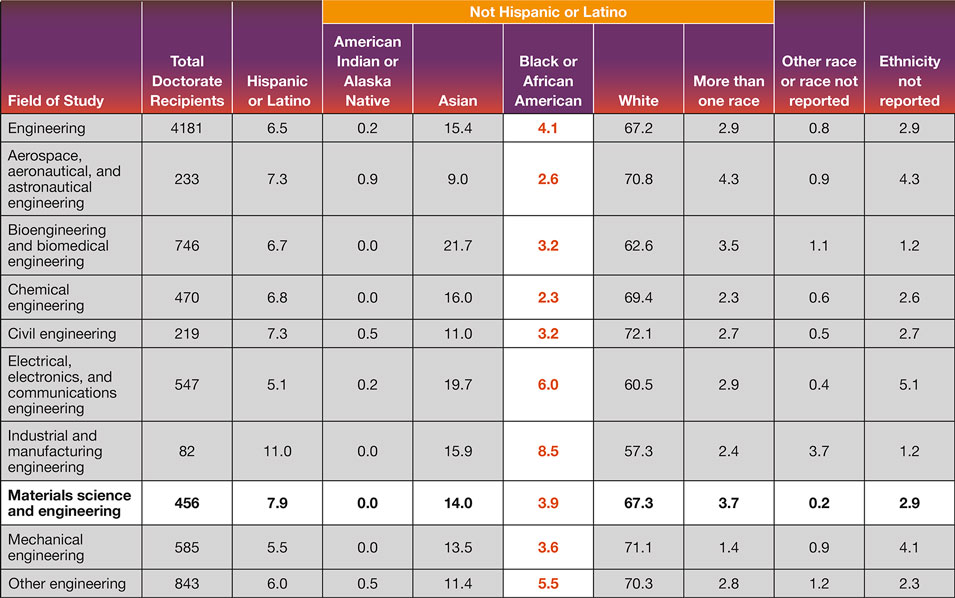
Diversity and inclusion in science, technology, engineering, and mathematics (STEM) fields is a global issue. The challenging issues facing the world relating to STEM diversity cross national borders and require leveraging the talents of diverse constituents.1 Active international efforts at inclusive talent development are being undertaken to empower persons from groups historically underrepresented in STEM communities.Reference Delaine, Williams, Sigamoney and Tull2,3 The US National Action Council for Minorities in Engineering (NACME) reports that in the United States, African Americans are one of the most underrepresented minority groups in engineering relative to their population. This is in spite of a great deal of progress in “growing African American scientists, engineers, and technologists since the Howard University School of Engineering opened in 1910.”Reference Slaughter, Tao and Pearson4 The number of African Americans in engineering at all degree levels is not representative of their percentage in the US population. Table I shows a sampling of 2016 data from a National Science Foundation (NSF) survey of doctoral recipients in engineering.5 Figure 1 illustrates a snapshot of African American representation in US colleges of engineering. These statistics show that African Americans remain underrepresented relative to US demographics.6–8
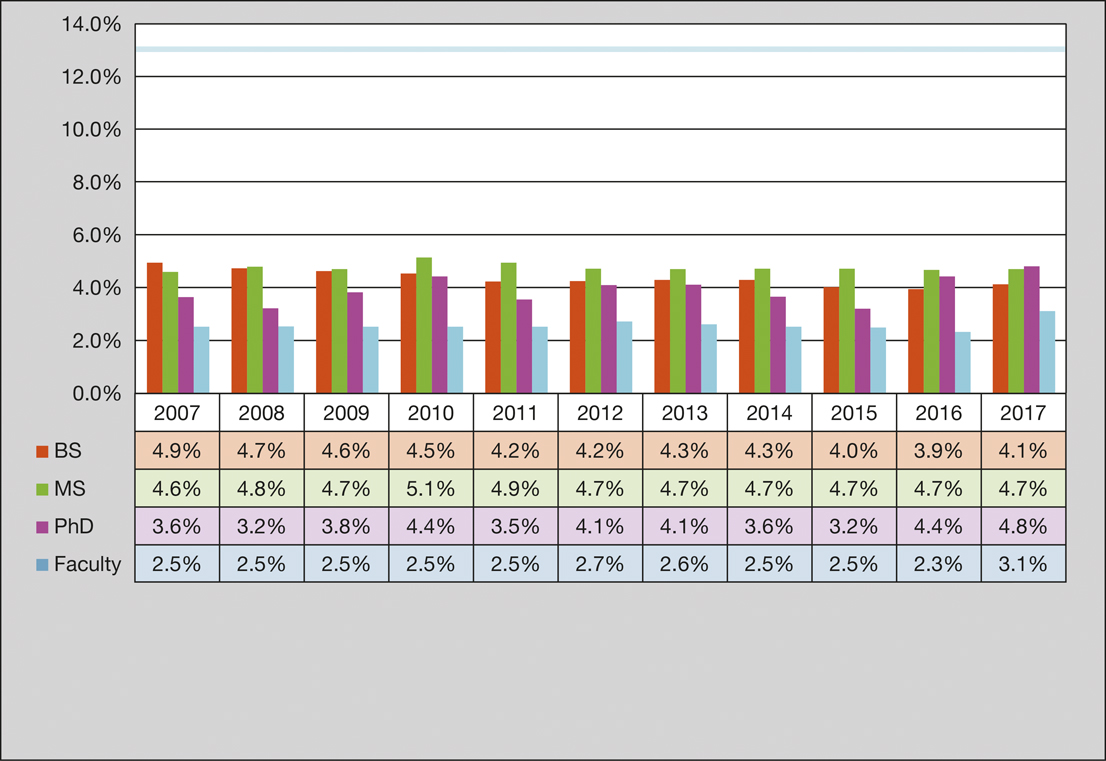
African Americans at US engineering schools (2007–2017). African Americans as a percentage of US citizens holding engineering degrees and faculty positions at US institutions are underrepresented relative to their numbers in the US population. Data gathered from American Society for Engineering Education (ASEE) reporting.6,8 The blue line at ∼13% represents African Americans as a percentage of the US population over the 10-year period, as reported by the 2000 US Census.7
In 2012, a workshop on Ethnic Diversity in Materials Science and Engineering was co-sponsored by the NSF, the US Department of Energy (DOE), the Materials Research Society (MRS) Foundation, North Carolina State University, and the University Materials Council (UMC).9 Comprised of department heads, chairpersons, directors, and group leaders from academic programs in the materials field in US, Canadian, and Australian universities, UMC is a forum for sharing best practices related to materials science and engineering (MS&E).10 UMC addresses student recruitment, accreditation, emerging research areas, curricular improvements, intellectual property policies, implications of the latest materials related studies, and the health of research funding for MS&E.
Focusing on issues affecting recruitment and retention and long-term success in MS&E, the 2012 workshop participants examined diversity data in MS&E departments. According to the US National Center for Science and Engineering Statistics, although African Americans make up 12.2% and Latinos 16.3% of the US population, they received only 2.5% and 5.3% of MS&E degrees awarded in 2010, respectively.5 Workshop attendees explored the pathways to undergraduate STEM majors, to graduate education, and to success in the workforce.9 The workshop participants included graduate students and postdoctoral associates, administrative leadership, and government and industry professionals in the MS&E community. While voices of change emanated from participants, the gatekeepers of change reside in the leadership. At the heart of the recommendations to increase retention, recruitment, and career success of ethnically diverse groups were topics with a focus on three groups: (1) individuals, (2) academic leaders, and (3) federal agencies. Each group was provided an overarching theme followed by specific actions needed to support the theme.9
■ Individuals: Become culturally competent through awareness of and intentional efforts to overcome unconscious bias and stereotyping. Seek interaction with professionals from different demographic groups.
■ Academic leaders: Take responsibility for implementing cultural, organizational, and systemic changes within your span of control, including within your institution and externally through professional organizations.
■ Federal agencies: Utilize the authority of federal agencies through grants and other resources to support opportunities to increase the presence and success of women and other underrepresented groups, and build a more inclusive professional culture.
Our goal in this article is to shift the conversation away from the dire message about the lack of African Americans in the field and focus on positive advancements, namely, the leadership of African Americans in engineering and the role of professional societies in their leadership development. Reflecting on the action plan for ethnic diversity in MS&E and STEM, we posit that there is a constituency missing in the groups called out in the bulleted list, namely, professional societies. While it is critically important to recognize technical achievements and the early champions of change, it is also crucial to highlight the importance of professional societies, and challenge them to develop a greater level of authentic inclusion of African Americans in their organizations. Further dissemination of best practices across societies may be helpful in aligning global efforts at inclusion.Reference Delaine, Williams, Sigamoney and Tull2
Societies include, but are not limited to, those focused on (1) advancing diversity and inclusion via empowerment; (2) developing underrepresented groups within specific disciplines; (3) originating and facilitating cross-disciplinary interactions; and (4) leading change in the realm of providing services, information, and tools for stakeholders to create a diverse workforce of engineers.
In June 2018, the US National Academy of Engineering held a workshop titled “Engineering Societies’ Activities in Promoting Diversity and Inclusion.”12 The purpose of this meeting was to explore the role of engineering societies in promoting diversity and inclusion in the engineering profession, examine societies’ activities, provide an opportunity for societies to share promising practices, and investigate possible collaborative actions. This event included 19 organizations of the approximately 120 engineering societies. Led by Leah Jamieson, past president of the Institute of Electrical and Electronics Engineers and former Dean of Engineering at Purdue University, the group held discussions on promising practices and activities from other organizations, and opportunities for collaborations and action items. Ultimately, sharing of best practices will enable organization leaders and participants to develop a more complete understanding of the cultures and “norms” that exist in diverse disciplines.
Historical perspectives
The book Changing the Face of Engineering: The African American Experience chronicles the broad contribution of African Americans to engineering across sectors (i.e., industry, academia, government, and business).Reference Slaughter, Tao and Pearson4 It includes a detailed history of the impact of pre-college initiatives, university level programs and professional organizations on African Americans in engineering. In the chapter entitled “Race for the Gold: African Americans—Honorific Awards and Recognition,” Taborn and DeenReference Taborn, Deen, Slaughter, Tao and Pearson13 highlight the critical role of professional recognition in celebrating the achievements of African American engineers. These authors observed that, “Against pervasive negativity about Black contributions to American society, individual honors and awards in the African American community have shored up a communal narrative of achievement and actuated various awards of recognition of success have been critical in encouraging historically underrepresented students to pursue careers in STEM fields.” Heeding these lessons, it is essential for honorific recognition to start early in one’s career. Smaller, local (organizational and community) prizes lead to more prestigious regional prizes and serve as a foundation for career capstone recognition (e.g., Fellow, election to Academies, etc.). Leaders are instrumental in nominating, evaluating, and coordinating awards and prizes in many engineering societies.
Engineering leadership development
Informal and formal engineering leaders are found in a wide range of work environments, including academia, national labs, industry, and government. The current diversity of leaders in engineering in the United States in all of these sectors is not representative of current US demographics. The percentages of women and underrepresented minorities in engineering leadership are low, and growth rates are slow, if not in decline.Reference Fu, Reid, Terpenny, Thurston, Vance, Finger, Wiens, Kazerounian, Allen and Jacobson14
Positioning African Americans and others from diverse groups to head engineering companies, departments, agencies, and institutions requires intentional efforts to develop emerging leaders to take on new opportunities. “Gaining experience by doing is second nature to engineers and is key to learning to apply important leadership skills. Integrating a feedback loop from more experienced leaders who may have an opportunity to observe and provide constructive feedback is also essential to building effective leaders” (L. Cole, personal communication). In “transforming your STEM career through leadership and innovation … it is important to get a clear understanding of what it means to be a leader and what leadership entails. Leadership is an activity that should take place throughout your career, whether you’re leading yourself in a project, a small team, or an entire organization,” said Pamela McCauley, industrial engineering professor, University of Central Florida.Reference McCauley15
Leaders are developed through a set of processes that expand an individual’s effectiveness in management and governance roles.Reference McCauley, Van Velsor, Ruderman, Van Velsor, McCauley and Ruderman16 The “boundary-spanning” nature of professional societies’ activities positions the societies as critical elements in advancing inclusion through granting opportunities for a more diverse set of developmental relationships. Effective leaders not only learn and develop themselves, they also facilitate the development of others. “Mentorship” and “sponsorship” through both multiple developmental networks help professionals ascend to higher organizational roles.Reference Chanland and Murphy17–Reference Mendez, Conley, Keith, Haynes and Gerhardt20 There are several strategies that engineers and scientists can implement when seeking a professional coach or mentor, such as at society meetings. In discussing mentoring in Success Strategies from Women in STEM: A Portable Mentor, Christine Grant, associate dean of Faculty Advancement in the College of Engineering at North Carolina State University, challenges people to approach potential mentors with confidence. “You can also ask them their perspective on the greatest leadership gap and explore your role in the professional organization.”Reference Pritchard and Grant21
In both informal and formal professional society leadership roles (elected or appointed), emerging leaders from underrepresented groups are exposed to various leadership styles and a diverse group of “followers” providing an interesting context to engineering leadership in one’s primary organization (e.g., company, university). Lisha Cole, a director/cluster lead for Pfizer’s Essential Health-Global Regulatory Affairs, recalls how her experiences shaped her leadership style: “My experience as a leader in NSBE [National Society of Black Engineers] helped lay the foundation for my inclusive leadership style. I served locally as chapter president, as well as on the National Board as a regional representative. Both of these experiences laid the foundation of my understanding of meeting people where they are to achieve effective problem solving and the value of diverse perspectives in sound decision making.” Cole further says, “Well into my career, I continued to draw on my experiences with NSBE while serving as a committee chair and, ultimately, as a member of the Executive Board of Pfizer’s African American Leadership Network, one of the company’s colleague resource groups (CRGs). CRGs are groups of colleagues who are part of and/or who support the goals of a diverse population. They offer support, developmental opportunities, mentoring, and networking opportunities to help their members enhance their skills and advance their careers.… They also contribute their unique backgrounds and viewpoints to help advance Pfizer’s business, and they help their outside communities by participating as a group in many volunteer and philanthropic activities.”22
Survey of African American engineers in leadership roles
To explore this issue further, we carried out an informal survey on a set of African American engineers in leadership roles to ascertain the role of professional societies in the development of their own skills. We also explored the role of professional societies in the development of future engineering leaders. We asked two questions:
1. How did your experience as a leader in a professional/technical society (e.g., NSBE, ASEE, The American Society of Mechanical Engineers) provide a foundation for your current role as an engineering leader?
2. What can professional societies do better to develop engineering leaders (in a global sense – you can focus on African Americans in your response)?
Five important aspects of leadership development in professional societies are expanded upon below.
1. Professional organizations led by students or those focused on student enrichment serve as a first step in leader development.
Professional enrichment available to students through all points on the engineering academic pathway serves as a critical foundation in the development of future African American leaders. Some organizations focus primarily on providing services and resources for early career students (e.g., Southeastern Consortium for Minorities in Engineering and NACME), while others serve to facilitate change in the participation of African American students in engineering (National Association of Multicultural Engineering Program Advocates). Student-led organizations, such as NSBE, provide experiential learning opportunities for undergraduates to sharpen leadership skills. As one of the largest student-governed organizations, NSBE has more than 500 chapters and nearly 16,000 active members in the United States and abroad. Founded in 1975, NSBE supports and promotes the aspirations of collegiate and pre-collegiate students and technical professionals in engineering and technology. Active international student chapters include groups in Canada, Ghana, Nigeria, Germany, Lithuania, Bahamas, Cameroon, and South Africa. NSBE’s mission is “to increase the number of culturally responsible Black Engineers who excel academically, succeed professionally and positively impact the community.”23 These aspirational goals produce a myriad of leaders who benefit the global engineering diaspora.
Several engineering leaders (e.g., executive directors, organizational CEOs) have been cultivated since they were student members of professional societies. Karl W. Reid became the NSBE Executive Director 32 years after joining the student chapter at the Massachusetts Institute of Technology (MIT). In discussing the impact of NSBE in developing leaders, Reid stated, “NSBE has done its part by developing a year-round curriculum for its regional and national student leaders based on 19 leadership competencies built on three pillars: leading self, leading others, and leading the organization.” Reid goes on to emphasize the importance of understanding and training in the global aspects of leadership in that NSBE is “… providing international experiences, particularly those that enable members to apply their engineering knowledge to co-create local solutions in developing and developed countries is key to developing a global vision. Fifteen percent of NSBE’s global leadership resides outside of the United States. In 2018, we are celebrating NSBE Ghana’s 20th Anniversary. Biannually, NSBE Ghana has hosted US student leadership visits and we are actively exploring ways to foster partnerships between NSBE chapters and their institutions in the US with those in Ghana and other parts of the world. Such collaborations further catalyze critical global leadership development.”
Gary S. May, a former NSBE student leader and National Board member, currently the Chancellor of University of California, Davis, recalls that professional societies “helped my people skills (teamwork, communication), organizational skills (running meetings), [and] confidence.” May gained his first leadership experiences as a NSBE undergraduate student leader. His ability to impact change from a leadership position was critical in moving the needle in the national participation of African Americans in engineering.
Similarly, Michele Lezama reaped the benefits early on of the engineering organizations that she has led over the past several years; her extensive leadership impacts both university and corporate settings. Early in 2018, Lezama began her role as president and CEO of NACME. As an undergraduate, she received a NACME scholarship. Later on, she received a GEM (graduate education for minorities) Consortium graduate fellowship; GEM is a nonprofit organization dedicated to increasing the number of underrepresented individuals who pursue and receive a master’s degree or doctorate in engineering or science by providing full fellowships. Lezama eventually served as the executive director of GEM. Prior to leading GEM, Lezama served as executive director of NSBE, an organization she first experienced as an undergraduate student member.24
2. Inclusive engagement of African American engineers in disciplinary professional societies is important for diversifying leadership.
At the core of professional engineering societies are volunteers who develop programming, manage outreach, disseminate best practices, and oversee continued technical training. Paula T. Hammond, MRS member, who is the David H. Koch Chair Professor of Engineering at MIT and Head of the Department of Chemical Engineering, commented that her participation in professional societies “provided insight[s] into how large professional societies work, increased (my) skills of persuasion, listening, bargaining and negotiation, engaging others, and provided opportunit[ies] to impact society in a way that helps others, which was gratifying and informed me on skills and strengths that I have and those that I could learn more about.” The society leadership is typically elected from and by volunteers, making it essential for successful candidates to leverage their engaged scholarship and their service to the organization.
ASEE advances innovation, excellence, and access at all levels of education for the engineering profession25 with an emphasis on educating current and future engineers. Gregory Washington, the Stacey Nicholas Dean of Engineering at the University of California, Irvine (UC Irvine) Samueli School of Engineering, is working to increase the participation of African Americans in engineering. Trained as a mechanical engineer, his core area of interest is dynamic systems, with an emphasis on “smart” materials that require no traditional gears, but respond to temperature changes and can be used to harvest energy.26 As the first African American dean of engineering at UC Irvine, Washington stated, “ASEE benefits me as an engineering dean through the Engineering Deans Council, of which I am currently chair, which keeps me connected to my peers and tapped into a useful knowledge base.”27
A presenter in the Ethnic Diversity in Materials Science and Engineering Workshop, Joycelyn Harrison, Division Director at the Air Force Office of Scientific Research (AFOSR), recalled her early career as a student. “MRS was a wonderful forum to give my first technical talk; it was a nurturing environment to give talks as a graduate student. This experience was essential in my leadership of an interdisciplinary team of materials researchers at NASA Langley (as chief of Advanced Materials and Processing Branch of NASA’s Langley Research Center). In my current role as Division Director at AFOSR, the Air Force’s basic research funder, I have chaired sessions at MRS and co-authored an invited review paper on nanocomposites for structural light-weighting.”
Grant also reflected on her first national technical presentation at the National Organization for the Professional Advancement of Black Chemists and Chemical Engineers (NOBCChE). “This presentation was an important step as a graduate student to identify African American mentors and coaches early in my academic career, providing a supportive environment and research fellowships. The multidisciplinary nature of NOBCChE enabled chemists, chemical engineers and materials scientists to present technical content in the same venue.”
3. Diversity committees within professional societies are community incubators that seed ideas for change.
Convening a diverse group of professionals in a professional society to engage in authentic conversations on core aspects of organizational and workforce diversity and inclusion can result in initiatives that propagate to the entire society membership for implementation. This idea exchange is crucial for the inclusion of a diverse set of views in professional society activities. Two of the recommendations from the Ethnic Diversity in Materials Science and Engineering Workshop were for professional societies to (1) continue to increase membership and grow annual budgets to raise awareness of diversity issues, and (2) for members to take an active role in promoting the recommendations for increasing diversity and addressing the needs of diverse individuals in their societies.9
For example, the American Institute of Chemical Engineers (AIChE) Minority Affairs Committee “promotes activities that encourage the education and training of disadvantaged minorities in engineering and related disciplines; fosters the employment of minorities at all levels of skills within the engineering field; encourages minority entrepreneurship; and directs the expertise of engineers to the solution of special social and economic problems faced by the such minorities. It also serves as a clearinghouse for information on programs, meetings, and contacts involving ethnic minorities where AIChE could, or might, be able to make a contribution to this societal problem area.”28
Grant recalled her early leadership as an assistant professor in the Environmental Division of AIChE as a coordinator of a group of session chairs. “In addition to session programming, my leadership as the chair of the Minority Affairs Committee (MAC) provided a view of the technical and the societal impact aspects of AIChE. I was able to combine my own leadership abilities with the committed coaching by senior AIChE members to make a difference in our committee within an operating council. It was, however, the leadership opportunity as a member of the Board of Directors that provided a foundation of insights into ‘leading leaders,’ an important experience for my role as associate dean of faculty advancement in the North Carolina State University College of Engineering.”
Another former National Board Director in AIChE, Andre R. Da Costa’s perspective is that “In addition to supporting MAC and other diversity entities, I’ve always been a proponent of minorities integrating and participating in the leadership of mainstream institutions. Professional societies, like AIChE, should emphasize that and provide opportunities accordingly.” In a rare career move, Da Costa transitioned from being a successful industrial leader (director/chief engineer at PG&E, CHE manager at Corning, engineering manager at Chevron, and process development manager at Membrane Technology and Research) to an academic position as the Herbert H. Dow Chair in Chemical Process Safety at Michigan Technological University. Da Costa’s familiarity with the intricate nuances of academia, enhanced by participation with academic colleagues in his professional society, helped guide his transition.
4. Nominating and electing African American engineers to Fellow in professional societies is important to elevate engaged African American leaders.
The recognition of technical accomplishments and discipline-specific leadership in professional societies via Fellow nomination and election is important to fully engage African American engineers alongside their peers to lead and facilitate organizational change. The recognition of Fellow often results from the culmination of years in the profession, leadership in various aspects of the profession (e.g., elected society leadership, technical session programming, or promotion of discipline to society), and scientific/engineering contributions to the discipline. Professional societies have nuanced variations in their descriptions of requirements for election to Fellow. Eligibility criteria may include “service to the profession,” “significant professional accomplishment,” and some senior level of standing.29,30
In AIChE, there are now three African American women Fellows, and all of them have administrative leadership positions in the Academy. In a recent podcast, they spoke about their current positions in the Academy and the importance of their professional society in their leadership.31 That step-change increase from zero (African American women Fellows) less than five years ago provides a broader circle of peers with the potential to recognize the contributions of a more expanded group of African American chemical engineers.
The assessment of MRS Fellow nominations seeks evidence of significant accomplishment in activities supporting the materials community, as well as a distinguished research record. Additional details on the MRS process can be found on the organization’s website: www.mrs.org/fellow-nomination-info.30
5. Professional societies can frame and address diversity by centralizing inclusion efforts and data collection.
Important leadership efforts of professional societies include collection and curation of data on society demographics, actions to move diversity from special committees to the mainstream, and crosscutting collaborations that facilitate global alignment for STEM inclusion. As societies attend to their demographic make-up, they must also examine the engagement of individuals from underrepresented groups as presenters and participants, as leaders and award recipients, and as voices in articulating strategies for broadening participation. Societies should note the challenges of multiple marginalized identities (i.e., race, gender, ability status, sexual orientation, religion, and nationality) that could impact engagement and leader development.
A new initiative of the American Association for the Advancement of Science focuses on a rating system for institutions to provide a mechanism to evaluate their progress with the issues associated with diversity in STEM. In the STEM Equity Achievement Change (SEA Change) program, educational institutions commit to removing barriers to STEM achievement for women, minorities, and people with disabilities through participation in a program of voluntary self-assessment.32 There are rich opportunities for professional societies to connect with this initiative to provide a pathway that celebrates success and highlights growth in the diversity realm.
What can professional societies do next?
One of the highest academic leadership roles in engineering is dean. Interviews of African American engineering deans reveal several factors that contribute to their development as leaders.Reference Leggon, Slaughter, Tao and Pearson33 “There was a consensus among the interviewees that in order for professional associations to address issues of broadening the participation of African Americans in engineering, it is first necessary to have African Americans active in those organizations—and the earlier [in the career path] the better, because professional associations can provide socialization, which, in turn, impacts throughout an individual’s career.” Indeed, these associations can provide leadership training and opportunities: “By doing service work in an organization, you will get leadership positions relatively early. It starts from a mentality to serve, and not everybody has that mentality.” Once again, the deans discussed how leadership and service are—or at least should be— inextricably intertwined.Reference Leggon, Slaughter, Tao and Pearson33
Harrison of the AFOSR believes that “Diversity enriches innovation—different viewpoints and perspectives on a team will result in better products. Cultural diversity contributes to innovation—helping to promote a healthy materials pipeline and resulting in a strong materials workforce. MRS needs to continue to have a strong outreach to students as a starting point on their career journey. MRS should continue their innovations, creating forums that discuss new ideas in technology to foster supportive environments in promoting this innovation.”
When it comes to the future development of engineering leaders, Paula Hammond said that it requires “… greater recruitment of a diverse field of candidates for offices, thoughtful inclusion across backgrounds in selecting committees, and greater open engagement with efforts that engage African Americans and other groups. With respect to African Americans in general, there is a need to reach out to those communities at all income levels and inform them on careers in engineering at early ages.” May pointed out the need to “increase the emphasis on professional skills (sometimes called ‘soft’ skills)” in professional societies’ development of future leaders.
Cole expounded on the critical role of professional societies in the development of future leaders and the role of mentoring in the process. “Professional societies can facilitate informal and formal mentoring to better develop engineering leaders. Having access to a diverse group of mentors can help build engineering leader confidence as well as allow them to learn from the experience of others, which can also contribute to rapid application of new skills. In addition, societies can provide opportunities for emerging leaders to gain the invaluable experience of directly leading diverse groups.”
Reid notes that engineering societies can explicitly foster the leadership development of its members; a starting point could be based on the traits that the National Academy of Engineering outlined in their Engineering of 202034 vision statement. Professional societies can play a pivotal role in the diversification of science and engineering professions and the authentic inclusion of engaged African Americans in the direction of science and engineering disciplines. The development of leaders across academia, industry and governmental entities benefits from the opportunities to grow, serve, and eventually lead in student-led, career-enhancing, and paradigm-shifting organizations. While diversity in professional society leadership is important, it is equally important to engage the entire profession in the quest to move beyond diversity toward equity and inclusion.
COMING IN 2019
A promising progression of the diversity initiatives within MRS will manifest at the 2019 MRS Spring Meeting (in Phoenix, Ariz.) in a symposium titled “High Impact Practice—Increasing Ethnic and Gender Diversification in Engineering Education.” The keywords for abstract submission are access, diversity, education, equity, inclusion, partnerships, and retention, indicating a comprehensive treatment of the topics associated with broadening participation in the materials community.35
Proposed session topics include:
■ The historical forces and outcomes of the national effort to increase the racial and cultural mix of students in engineering education and the workforce
■ Model programs that address the challenges to broaden participation across K–20 engineering continuum
■ Corporate advocacy and partnerships to support programs to increase retention
■ Freshman and transfer student STEM bridge programs
■ Support for low-income, first-generation, and undocumented engineering students
■ Black males and academic success
■ Women in engineering, minority females, and the double blind
■ Sustainable STEM outreach programs
■ Role of theories on academic and social integration, engagement, persistence, and belonging related to attrition
■ Expert resources in retention and development of URES and women in engineering
■ Partnership across K–20 STEM continuum allied with technical corporations and the National Science Foundation.
Acknowledgments
The authors would like to acknowledge the engineering leaders who lent their voices to demystify the process of ascending to high ranks within the engineering professions.



