


Psychotic and behavioural symptoms affect the majority (90%) of patients with dementia at some stage during their illness, behavioural disorders being particularly predominant in the severe stages of the disease. They often do not present as discrete psychiatric diagnoses but rather as sub-syndromal clusters of symptoms that vary over time (Reference TariotTariot, 1999).
Management involves assessment and manipulation of medical and psychosocial factors. Drugs then can be considered to target specific symptoms. Psychotic symptoms generally respond to neuroleptics (Reference SchneiderSchneider, 1999). Treating behavioural disturbance is more complex and current research focuses on a range of drugs, including neuroleptics, anticonvulsants, antidepressants and anxiolytics (Reference HerrmannHerrmann, 2001).
Classical antipsychotics have proven efficacy in dementia (Reference Schneider, Pollock and LynessSchneider et al, 1990), treating psychotic symptoms as well as reducing agitation and aggression. However, the dose needs careful titration because neurological, cardiovascular and anticholinergic side-effects often limit their use.
Atypicals seem to be tolerated better and in view of the emerging evidence are suggested by some as first-line medication (Reference HerrmannHerrmann, 2001). Risperidone has been the most widely researched, with consistent results (Reference Bhana and SpencerBhana & Spencer, 2000). Katz et al's randomised controlled trial of 625 patients found that risperidone (1 mg daily) reduced psychosis, paranoid/delusional ideation and aggression in 60%, with a relative lack of side-effects (Reference Katz, Jeste and MintzerKatz et al, 1999). Likewise, olanzapine has been shown to improve psychosis and agitation in severe dementia (Reference Street, Clark and GannonStreet et al, 2000), the main side-effects being sedation and gait disturbance. Preliminary results on the use of quetiapine have been promising. The use of clozapine in dementia is limited by side-effects, notably syncope and agranulocytosis (Reference HerrmannHerrmann, 2001).
Anticonvulsants such as carbamazepine and valproate have been used successfully in the management of agitation and aggression in dementia, being less neurotoxic than lithium (Reference TariotTariot, 1999). A small placebo-controlled trial of carbamazepine in 51 patients with dementia showed significant improvement in agitation and aggression, the side-effects being common but mild (Reference Tariot, Erb and PodgorskiTariot et al, 1998). Valproate has also been shown in small open studies to be effective and well tolerated, but controlled studies are needed (Reference Davis, Ryan and AdinoffDavis et al, 2000).
Recent focus has been given to the use of antidepressants in the management of behavioural disorders in dementia as a means to correct altered serotonin transmission. Controlled trials reveal trazodone and citalopram to be the most effective in reducing agitation and irritability in patients (Reference TariotTariot, 1999; Reference HerrmannHerrmann, 2001).
Benzodiazepines, buspirone and hormonal treatments have also been used, with some anecdotal evidence to support them. In particular, cyproterone acetate has been suggested in sexual disinhibition (Reference Harris and WierHarris & Wier, 1998). It has also been proposed that cholinergic drugs may be beneficial in this area (Reference Levy, Cummings and Kahn-RoseLevy et al, 1999).
Method
After piloting locally, a semi-structured questionnaire was sent to all the members of the Faculty of Old Age Psychiatry in the winter of 1999/2000. The list was provided by the Royal College of Psychiatrists and included consultants, associate specialists and staff grade doctors. Each questionnaire was treated anonymously by the use of a numerical code. Individuals were asked to state how long they had practised in old age psychiatry.
The questionnaires were sent to 377 psychogeriatricians and a follow-up to non-responders was sent 8 weeks later. Further contact to remaining non-responders was made by telephone.
The questionnaire consisted of a structured table listing commonly used psychotropic drugs for a range of symptoms and a blank column for the clinician to add ‘other’. The list of drugs and groupings was derived directly from the British National Formulary (BNF, British Medical Association & Royal Pharmaceutical Society of Great Britain, 2000) and consisted of:
-
(a) classical antipsychotics: chlorpromazine, promazine, thioridazine, haloperidol, droperidol, trifluoperazine, sulpiride, flupentixol and zucopenthixol;
-
(b) atypical antipsychotics: risperidone, olanzapine, quetiapine and clozapine;
-
(c) antidepressants: fluoxetine, sertraline, paroxetine, citalopram and trazodone;
-
(d) mood stabilisers: valproate, carbamazepine and lithium carbonate;
-
(e) benzodiazepines: diazepam and lorazepam;
-
(f) ‘other’.
The symptoms included were:
-
(a) psychotic: delusions, auditory hallucinations and visual hallucinations;
-
(b) behavioural: agitation, aggression, wandering and sexual disinhibition;
-
(c) anxiety and lability.
For each individual drug and symptom in the table, each respondent was asked to indicate whether he/she would use the drug frequently, occasionally or never, although only ‘frequent’ responses were analysed. This was to ensure the clinician's preferred response.
Both individual drugs and BNF categories were analysed with descriptive statistics using the software package SPSS.
Results
A total of 247 (66%) completed questionnaires were returned from the 377 sent out. Of 130 non-respondents, 116 (89%) could not be contacted by phone.
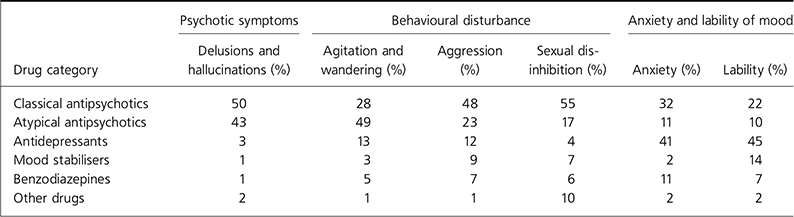
Symptoms were combined as follows, once patterns of similar response emerged (see Table 1).
Prescribing profiles for symptoms
| Psychotic symptoms | Behavioural disturbance | Anxiety and lability of mood | ||||
|---|---|---|---|---|---|---|
| Drug category | Delusions and hallucinations (%) | Agitation and wandering (%) | Aggression (%) | Sexual disinhibition (%) | Anxiety (%) | Lability (%) |
| Classical antipsychotics | 50 | 28 | 48 | 55 | 32 | 22 |
| Atypical antipsychotics | 43 | 49 | 23 | 17 | 11 | 10 |
| Antidepressants | 3 | 13 | 12 | 4 | 41 | 45 |
| Mood stabilisers | 1 | 3 | 9 | 7 | 2 | 14 |
| Benzodiazepines | 1 | 5 | 7 | 6 | 11 | 7 |
| Other drugs | 2 | 1 | 1 | 10 | 2 | 2 |
Psychotic symptoms
For delusions and hallucinations, the prescribing pattern indicated a preference for the categories of classical antipsychotics (50%) and atypical antipsychotics (43%).
The single most frequently chosen drug for psychotic symptoms was risperidone (63% for delusions, 62% for auditory hallucinations and 55% for visual hallucinations). Haloperidol was second (36%, 32% and 26%, respectively) and olanzapine was third (30%, 29% and 22%, respectively).
Behavioural disturbance
Classical antipsychotics were chosen as follows: agitation and wandering, 28%; aggression, 48%; and sexual disinhibition, 55%. Atypical antipsychotics were chosen as follows: agitation and wandering, 49%; aggression, 23%; and sexual disinhibition, 17%.
The three most common individual choices for agitation were thioridazine (37%), risperidone (35%) and trazodone (33%); for wandering, the choices were thioridazine (17%), risperidone (17%) and trazodone (12%); and for aggression, the choices were risperidone (38%), haloperidol (34%) and thioridazine (29%).
For sexual disinhibition, the preferred categories were classical antipsychotics (55%) and atypical antipsychotics (17%). The most common individual choices were haloperidol (15%), thioridazine (11%) and risperidone (10%).
Anxiety and lability of mood
Anxiety
The preferred drug categories were antidepressants (41%) and classical antipsychotics (32%). The most commonly chosen drugs were thioridazine (32%) and trazodone (32%).
Lability of mood
The preferred categories were antidepressants (45%) and classical antipsychotics (22%), with mood stabilisers accounting for only 14%. The most frequently selected individual drugs were trazodone (20%), citalopram (12%) and paroxetine (11%).
Clinicians' prescribing patterns
Prescribing patterns were compared between faculty members practising in old age psychiatry for 10 years and under and 11 years and over. No significant difference was found between the two profiles.
Discussion
The focus of our survey was to highlight the problems facing the old age psychiatrist when managing psychotic and behavioural symptoms in dementia. These symptoms are often more troublesome than the effects of cognitive decline, may lead the patient into institutional care, and are difficult to manage (Reference TariotTariot, 1999). There is a lack of evidence-based findings and the drugs traditionally used have side-effects that are particularly poorly tolerated in these patients. Furthermore, since this survey was conducted, the use of thioridazine has been restricted and droperidol has been withdrawn for all patients because of concerns about safety. We suggest that this will turn the spotlight onto the risk—benefit ratio of all our prescribing in the future.
There are no clear guidelines for the symptoms about which we chose to enquire. We omitted affective symptoms because we believed these treatments to be less controversial. The profiles of prescribing patterns between the two ‘generations’ of psychogeriatricians were remarkably similar. Here, the threshold of 10 years as a specialist was chosen in view of the advent of selective serotonin reuptake inhibitors and atypical antipsychotics into clinical practice.
We omitted the more detailed enquiry of depots because we were more interested in the classes of drugs used, although flupenthixol and zuclopenthixol were asked about generally. Interestingly, there were no comments about the use of depots in the responses and no recent discussion in the literature.
If we look at the findings from our survey, we can see that there is general agreement about treating psychotic symptoms with antipsychotics, with the classical and atypical antipsychotics chosen in approximately equal numbers (50% and 43%, respectively). There is less agreement when considering individual behavioural symptoms, although overall the classical antipsychotics were chosen in almost half of cases, the majority being for the more disruptive and potentially threatening behaviours, notably aggression and sexual disinhibition. Interestingly, thioridazine was widely used for individual behavioural symptoms, including the symptom of wandering, despite its tendency to cause falls (Reference Schneider, Pollock and LynessSchneider et al, 1990). Furthermore, a Cochrane review concluded that there was no evidence to support its use in dementia and it may expose patients to excess side-effects (Reference Kirchner, Kelly and HarveyKirchner et al, 2001).
The survey revealed minimal prescribing of mood stabilisers in the treatment of agitation (3%), despite the small yet significant support in the literature (Reference Tariot, Erb and PodgorskiTariot et al, 1998; Reference TariotTariot, 1999; Reference Davis, Ryan and AdinoffDavis et al, 2000). Furthermore, even for lability antidepressants and classical antipsychotics were favoured (45% and 22%, respectively) over mood stabilisers (14%).
Neuroleptics were by far the most popular choice of treatment for sexual disinhibition (although a significant 10% chose ‘other’, with most stating cyproterone acetate, but the evidence for this is largely anecdotal (Reference Harris and WierHarris & Wier, 1998).
In conclusion, we strongly recommend further research in this area to inform our practice, especially with the recent restricted use of thioridazine, which was so popular in our survey. Overall, although there is rationale and some evidence supporting our current prescribing patterns, there are no drugs that are specifically licensed for the treatment of psychotic and behavioural symptoms in dementia. This is to be the subject of a further paper.
Declaration of interest
This study was entirely funded by the Neurodegeneration Research Group academic research fund and no remuneration or support was received from any drug company contacted in the course of the survey.
Acknowledgements
Thanks to Dr Willie Ryan (Chairman) and the Committee of Consultants in Psychogeriatric Medicine for their support.


 Open access


eLetters
No eLetters have been published for this article.