





1. Introduction
The pace and scale of environmental change has accelerated so rapidly that global stewardship and governance for sustainable development is of utmost importance (Folke et al., Reference Folke, Polasky, Rockström, Galaz, Westley, Lamont, Scheffer, Österblom, Carpenter, Chapin, Seto, Weber, Crona, Daily, Dasgupta, Gaffney, Gordon, Hoff, Levin and Walker2021). The alleviation of poverty, reduction of inequalities, provisioning of food, quality education, and energy access to 8 billion people involves trade-offs among the ecosystem services upon which citizens and societies ultimately depend. In response to these global challenges, most of the world has committed to pursuing the 17 United Nations' sustainable development goals (SDGs) and their 169 targets (UN, 2015). The SDGs reflect the triple bottom line for people, profit, and the planet and are a novel approach to global governance through goal setting (Biermann et al., Reference Biermann, Kanie and Kim2017).
While the goals are nominally co-equal in importance, mounting evidence shows that social and economic goals are prioritised over environmental ones (Craig & Ruhl, Reference Craig and Ruhl2019; Eisenmenger et al., Reference Eisenmenger, Pichler, Krenmayr, Noll, Plank, Schalmann, Wandl and Gingrich2020; Forestier & Kim, Reference Forestier and Kim2020) and that achievement of the SDGs will not necessarily prevent environmental destruction (Zeng et al., Reference Zeng, Maxwell, Runting, Venter, Watson and Carrasco2020). Indeed, some have argued that the SDGs reinforce an economic growth paradigm and will lead to further unwanted environmental change, essentially counteracting their intended transformation to sustainability (Eisenmenger et al., Reference Eisenmenger, Pichler, Krenmayr, Noll, Plank, Schalmann, Wandl and Gingrich2020).
Critics of the SDGs have argued that the goals were formulated through political negotiation rather than derived from an integrative theoretical framework of sustainable development (Eisenmenger et al., Reference Eisenmenger, Pichler, Krenmayr, Noll, Plank, Schalmann, Wandl and Gingrich2020; le Blanc, Reference le Blanc2015). Attempts at triangulating among partial environmental, economic, and social theories are unlikely to coalesce into governance mechanisms and political priorities that can achieve a triple bottom line. Specifically, without a recognition of the environment's fundamental role in human well-being and an understanding of social–ecological system (SES) function, the achievement of social goals and targets for local settings over short time frames does not guarantee sustainability for the biosphere over the long term (Folke et al., Reference Folke, Biggs, Norström, Reyers and Rockström2016).
The SDGs are beyond their midway point and negotiations will soon need to begin to decide the global development agenda that will succeed them – a process that will undoubtedly benefit from an SES perspective (Berkes & Folke, Reference Berkes and Folke1998; Folke et al., Reference Folke, Biggs, Norström, Reyers and Rockström2016; Reyers et al., Reference Reyers, Moore, Haider and Schlüter2022, Reference Reyers, Folke, Moore, Biggs and Galaz2018; Selomane et al., Reference Selomane, Reyers, Biggs and Hamann2019). While scholars have for some time made calls to build development agendas consistent with our understandings of SESs, the contribution to sustainable development from the theory of social–ecological resilience, in particular, is only just being explored (Elmqvist et al., Reference Elmqvist, Andersson, Frantzeskaki, McPhearson, Olsson, Gaffney, Takeuchi and Folke2019; Reyers et al., Reference Reyers, Moore, Haider and Schlüter2022). This discussion is especially pertinent given the call for ‘climate-resilient development’ in the latest report of the Intergovernmental Panel on Climate Change Working Group II (IPCC, 2022), as well as the sprinkling of goals to enhance ‘resilience’ throughout the SDGs themselves. Such a foundation requires a clear understanding of the features of social–ecological resilience and how those system features are supported or obscured by the current sustainable development agenda (Reyers et al., Reference Reyers, Moore, Haider and Schlüter2022).
Resilience is an emergent property of SESs that describes how much disturbance a system can withstand without shifting to a new configuration with a different set of processes, structures, and feedbacks (Allen et al., Reference Allen, Angeler, Chaffin, Twidwell and Garmestani2019). The theory addresses the surprising and unpredictable dynamism of complex systems of humans and their environments, accounts for the capacity of SESs to learn, adapt, and transform, and describes non-linear scaling and cross-scale interactions of systems moving through multi-scale adaptive cycles (i.e. panarchy) as its basic model (Gunderson et al., Reference Gunderson, Allen and Garmestani2022; Gunderson & Holling, Reference Gunderson and Holling2002). Social–ecological resilience concepts were proposed and tested in coupled human and natural systems (Folke et al., Reference Folke, Biggs, Norström, Reyers and Rockström2016) and imply that social and economic elements cannot be decomposed or separated from a complex and dynamic environment (Folke et al., 2016, Reference Folke, Polasky, Rockström, Galaz, Westley, Lamont, Scheffer, Österblom, Carpenter, Chapin, Seto, Weber, Crona, Daily, Dasgupta, Gaffney, Gordon, Hoff, Levin and Walker2021). Social–ecological resilience literature demonstrates that governance must account for scale, cross-scale interactions, and SES dynamics (Folke, Reference Folke2006; Gunderson & Holling, Reference Gunderson and Holling2002; Holling, Reference Holling1973) even in pursuit of static goals. Such system dynamics and cross-scale interactions make it impossible for a managed system to maintain a desired goal state for any length of time (Angeler et al., Reference Angeler, Chaffin, Sundstrom, Garmestani, Pope, Uden, Twidwell and Allen2020).
The concept of social–ecological resilience, as originally developed by Holling (Reference Holling1973), has been diluted through time, and has lost focus upon its core underpinnings: the multi-scale processes and structures that define linked systems of humans and their environments. Here, we refocus research on social–ecological resilience to this core conception, which applies to dynamics in linked social, ecological, and economic systems. This refocus on Holling's perspective ensures that SES research is based upon a sound foundation that accounts for the essential role of biophysical systems in social–ecological resilience.
An important question for building the next global development agenda on resilience thinking, therefore, is the extent to which the current SDGs incorporate critical aspects of SES dynamism as revealed through social–ecological resilience research. Nevertheless, critical analysis of global sustainable development frameworks from a social–ecological resilience perspective is limited. A recent review by Reyers et al. (Reference Reyers, Moore, Haider and Schlüter2022) highlighted six shifts towards resilience thinking that, if implemented, will contribute to future sustainable development: from capitals to capacities, from objects to relations, from outcomes to processes, from closed to open systems, from generic interventions to context sensitivity, and from linear to complex causality. Earlier, Selomane et al. (Reference Selomane, Reyers, Biggs and Hamann2019) determined the limited extent to which the SDG indicators account for five key features of SESs that relate to sustainable development: feedbacks, resilience, heterogeneity, nonlinearity, and cross-scale dynamics. Here we dive deeper into the key factors that affect the resilience of SESs and determine the extent to which they are accounted for in the current SDGs. The intersection between social–ecological resilience and the SDGs should serve as a starting point for building their next iteration soundly on theory, and the gaps should be filled where SDGs miss key factors affecting resilience. It is our identification of the features of social–ecological resilience that are supported or obscured by the SDGs that advances on previous contributions.
To assess the intersection between social–ecological resilience and the SDGs, we analyse the 169 SDG targets against a suite of 43 biophysical, social, and economic factors that affect social–ecological resilience (see Section 2 for details). Our comparison reveals critical differences between the SDGs and social–ecological resilience insights with respect to management and governance of SESs that operate within and interact across multiple scales. It is beyond our scope, and indeed will require years of inclusive deliberation, to formulate an explicit development agenda based on SES resilience to replace the SDGs; yet, our findings illuminate where to start. Future development goals should account for scale and cross-scale interactions, slow changes in driver variables, underlying non-stationarity, and possible tipping points, particularly as the impacts of climate change accelerate SES dynamism. The next global sustainable development agenda can build on the strengths of the current SDGs in terms of social–ecological resilience – namely, in the environment-focused goals (SDGs 2, 13, 14, 15) – and should be wary of the implications of missing key factors that affect the resilience of SES. Here we further the discussion on why.
2. Methods
We conducted a qualitative assessment of the extent to which the 169 SDG targets align with key factors contributing to social–ecological resilience. We focused on SDG targets instead of indicators to reduce the ‘slippage’ away from potentially transformative goals when translated into targets and further into indicators, which has been well documented (Fisher & Fukuda-Parr, Reference Fisher and Fukuda-Parr2019; Fukuda-Parr & McNeill, Reference Fukuda-Parr and McNeill2019). First, we derived from the literature a list of 43 system factors across 10 biophysical, social, and economic dimensions that are known to influence social–ecological resilience (Tables 1–3). Next, the 169 SDG targets were assessed to determine which of the 43 resilience factors they aligned with. This alignment was based on the official descriptions of the SDG targets and was carried out through debate and expert judgement among the authors. Any SDG target that implicates a resilience factor was considered to align with that factor (Tables 1–3). For example, SDG target 14.3 is to ‘[m]inimize and address the impacts of ocean acidification…’, which is a slow variable affecting the resilience of marine SESs. Thus, SDG target 14 aligns with the resilience factor of ‘identification of slow variables’ in the biophysical dimension of resilience (Tables 1–3). We were favourable to the SDGs in that even weak connections with resilience factors were considered to align, so our assessment is a ‘best case’ scenario of how well the SDGs account for social–ecological resilience. In addition to those targets aligned with a particular resilience factor in Tables 1–3, we also include target 13.1 (‘Strengthen resilience and adaptive capacity to climate-related hazards and natural disasters in all countries’) because it has resilience at its core although it does not align with a specific factor.
List of biophysical resilience factors that are addressed (at least in part) by SDG targets

References to the literature where our understanding of each resilience factor is developed are given as superscript numbers and the reference list can be found in the Supplementary material.
List of social resilience factors that are addressed (at least in part) by SDG targets

References to the literature where our understanding of each resilience factor is developed are given as superscript numbers and the reference list can be found in the Supplementary material.
List of economic resilience factors that are addressed (at least in part) by SDG targets

References to the literature where our understanding of each resilience factor is developed are given as superscript numbers and the reference list can be found in the Supplementary material.
Following alignment of the 169 SDG targets with the 43 social–ecological resilience factors, we determined which SDGs best encompass core, foundational social–ecological resilience factors (Holling, Reference Holling1973) by calculating the fraction of targets within each SDG that aligned with any resilience factor. We also tabulated which resilience factors and incorporated (at least in part) into the SDGs. The first of these analyses tells us where the strengths lie in terms of social–ecological resilience in the current SDGs; the second tells us where the current gaps are in terms of building a global sustainable development agenda on social–ecological resilience.
3. Results
Our comparison of the SDG targets against the factors that contribute to social–ecological resilience yields four primary results. First, several of the SDGs have significant alignment with social–ecological resilience in terms of their targets. Perhaps unsurprisingly, given social–ecological resilience's origins in ecology, the SDGs with the strongest links to social–ecological resilience are: the environmental SDGs (SDGs 13, 14, and 15); SDG 6 – Clean Water, which is partly an environmental goal; and SDG 2 – Zero Hunger, which has strong ties to agriculture, fishing, and aquaculture and hence to the environment (Figure 1). Strong examples of the ways in which these SDGs acknowledge factors of social–ecological resilience include: the protection of biodiversity; the conservation of different ecosystems (e.g. mountains, coastal areas) in light of their spatial heterogeneity; the management, protection, and restoration of ecosystem services; the attention to slow variables such as ocean acidification and desertification; and the integration of climate and environmental change into regional planning and finance. However, these same SDGs with strong connections to resilience factors are also consistently under-prioritised in the implementation of the agenda (see Craig and Ruhl, Reference Craig and Ruhl2019; Custer et al., Reference Custer, DiLorenzo, Masaki, Sethi and Harutyunyan2018; Forestier and Kim, Reference Forestier and Kim2020). SDG 17, Partnerships, also has strong connections to social–ecological resilience, a result of the fact that the two share emphases on multiple voices, participation, and redundancy within governance.
Performance of each SDG in terms of targets aligning with social–ecological resilience factors. Bars represent the fraction of targets within each SDG that align with one or more of the 43 resilience factors. All of the environmental targets within the SDGs of climate (SDG 13), oceans (SDG 14), and life on land (SDG 15) align with factors of resilience (although the resilience connections to target 13.1 are implicit and general rather than specific), as do most of the targets for zero hunger (SDG 2) and clean water (SDG 6). Good governance (SDG 16) and partnerships (SDG 17) also align well with social–ecological resilience. The weakest SDGs in terms of their cognisance of social–ecological resilience are the traditional development goals of no poverty (SDG 1), good health and wellbeing (SDG 3), and quality education (SDG 4).
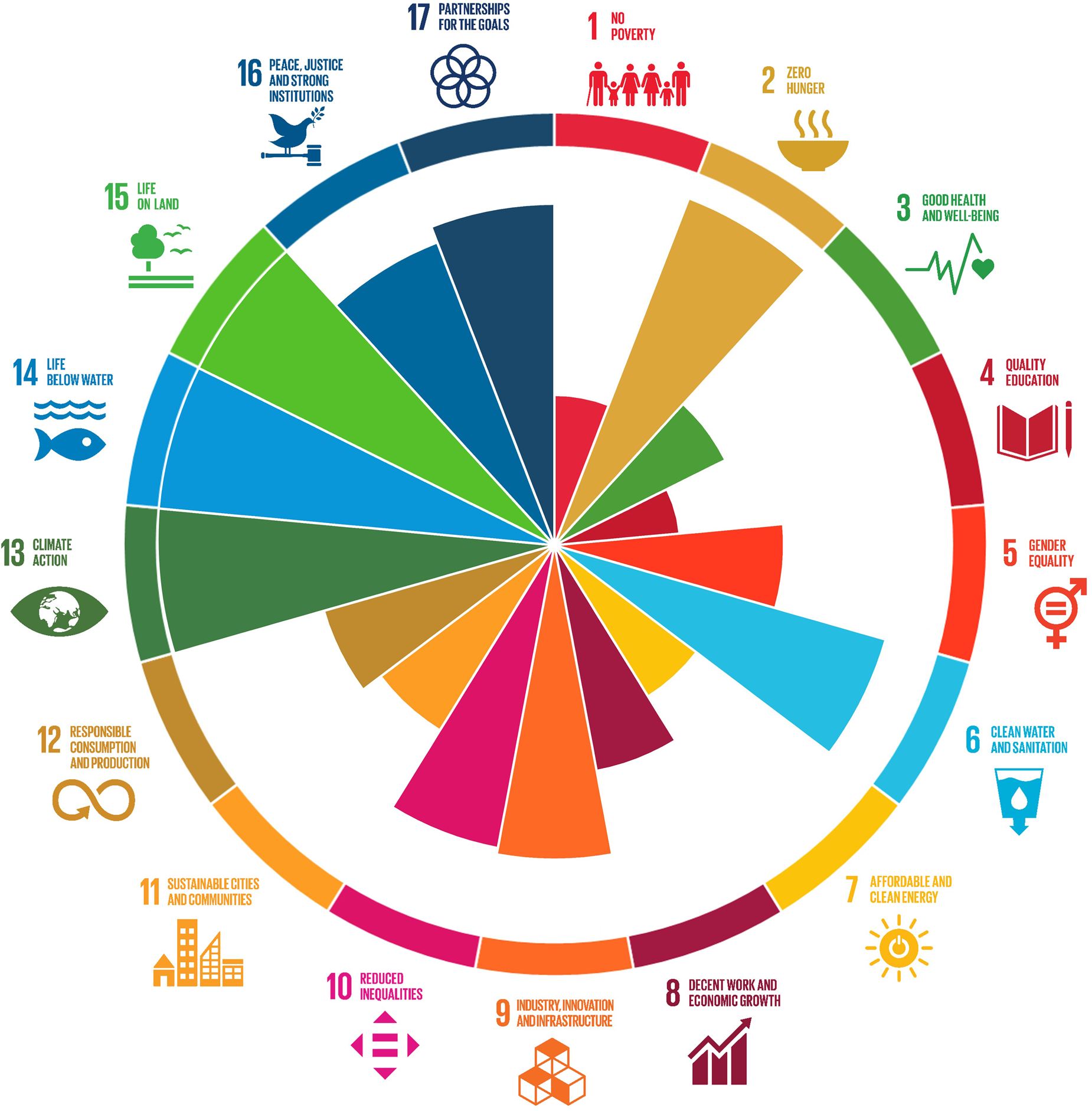
Second, and more intriguing, the United Nations' current descriptions of several SDGs and targets that should have clear connections to social–ecological resilience often do not. Of particular interest here are the traditional development goals: SDGs 1 (No Poverty), 3 (Good Health and Well-Being), and 4 (Quality Education). All three of these SDGs are critical to social adaptive capacity, social–ecological resilience, and effective governance. Nevertheless, the targets within these goals do not explicitly reflect critical factors of social–ecological resilience (Figure 1). For example, most targets within SDG 4 are typical development targets (e.g. build schools, increase the number of teachers, ensure that all children achieve literacy and numeracy) that, although critical and laudable, do not capture other types of knowledge and learning that are necessary to effectively govern social–ecological resilience. Quality Education targets that consciously incorporate social–ecological resilience would include: the adoption of social learning frameworks into organisations and institutions at multiple scales and outside formal education (Berkes, Reference Berkes2009); the sharing of knowledge; and a recognition and incorporation of different forms of knowledge (e.g. indigenous knowledge) (Mastrángelo et al., Reference Mastrángelo, Pérez-Harguindeguy, Enrico, Bennett, Lavorel, Cumming, Abeygunawardane, Amarilla, Burkhard, Egoh, Frishkoff, Galetto, Huber, Karp, Ke, Kowaljow, Kronenburg-García, Locatelli, Martín-López and Zoeller2019) that extend several steps beyond target 4.7's ‘appreciation of cultural diversity and of culture's contribution to sustainable development’. The failure of the current goals most pertinent to future governance to embrace critical factors of social–ecological resilience provocatively suggests that the nations developing environmental governance through pursuit of the SDGs are not developing the pluralistic and multi-scale governance institutions and organisations necessary for environmental governance in the Anthropocene. This failure, in turn, perhaps reveals a latent institutional resistance to acknowledging that sustainable development should be conceived of less as a goal (or 17 goals) than as a structured, iterative process that must be governed within a continually changing world.
Third, the SDGs as a whole fail to incorporate several key factors critical for adaptive or transformative governance of SESs (Figure 2). Thirteen of the 43 factors are completely missing from the SDGs, including cross-scale redundancy, temporal variability, ecosystem feedback indicators of any type, bridging organisations, social modularity, and trust among stakeholders. Fifteen more factors affecting social–ecological resilience are present in only one or two of the SDGs, including different types of diversity (e.g. within-scale biodiversity, economic diversity, and response diversity) and most of the social capital and governance factors that resilience scholars deem necessary for effective governance of social–ecological resilience (Craig et al., Reference Craig, Garmestani, Allen, Arnold, Birgé, DeCaro, Fremier, Gosnell and Schlager2017; Folke, Reference Folke2006; Garmestani & Benson, Reference Garmestani and Benson2013; Gunderson & Holling, Reference Gunderson and Holling2002). These factors are critical for facilitating the adaptability and transformability of SESs, and the omission of many could lead to the erosion of social–ecological resilience at multiple scales, including, eventually, at the global scale. For example, the social–ecological resilience of the Earth depends upon self-organisation of the many biophysical systems that manifest at multiple scales and enable the planet to withstand perturbations (Gunderson et al., Reference Gunderson, Allen and Garmestani2022). This multi-scale organisation of Earth provides resilience, but it also means that change can happen quickly and unexpectedly (nonlinear change). While physical processes of Earth are often continuous and scalable, coupled human–biophysical systems are modular and multi-scale (Gunderson & Holling, Reference Gunderson and Holling2002). Thus, accounting for scale and cross-scale interactions is critical for improving the SDGs in order to avoid disastrous consequences.
Alignment of SDG targets with 43 social–ecological resilience factors. In terms of social–ecological resilience, the SDG strengths lie in their communication, inclusive decision making, financial support, regulatory incentives, economic diversity, and transparency in governance and law. On the contrary, ecological factors of resilience are seriously lacking in the SDGs, particularly with regards to scale, cross-scale interactions, and non-stationarity. *Note: monitoring, review, and follow-up underpin the 2030 Agenda, yet strictly speaking, the framework is not structured in such a way to enable iterative learning as part of the SDGs, which is critical for managing social–ecological resilience.

Finally, our finding that all SDGs address the key factors of monitoring and reporting (Figure 2) requires further interpretation as to whether the SDGs' conception of monitoring meets the requirements that social–ecological resilience would demand. Clearly, monitoring is needed to evaluate system trajectory and response to interventions. Yet, monitoring alone is insufficient for sound environmental governance if the information does not lead to social learning. When dealing with dynamic SESs, a structured, iterative process for governance that incorporates monitoring information at decision points is essential for learning and sound governance (Herrmann et al., Reference Herrmann, Schwarz, Allen, Angeler, Eason and Garmestani2021). The SDG indicators used for monitoring and evaluation have already come under heavy scrutiny for their failure to capture indispensable system variables, important differences between contexts, and feedbacks between the environment and society (Reyers & Selig, Reference Reyers and Selig2020; Reyers et al., Reference Reyers, Stafford-Smith, Erb, Scholes and Selomane2017; Szabo et al., Reference Szabo, Nicholls, Neumann, Renaud, Matthews, Sebesvari, AghaKouchak, Bales, Ruktanonchai, Kloos, Foufoula-Georgiou, Wester, New, Rhyner and Hutton2016; Zeng et al., Reference Zeng, Maxwell, Runting, Venter, Watson and Carrasco2020), as well as for their highly contested and political nature (Fisher & Fukuda-Parr, Reference Fisher and Fukuda-Parr2019; Fukuda-Parr & McNeill, Reference Fukuda-Parr and McNeill2019). Adding to these concerns, a monitoring framework based on social–ecological resilience would include variables essential to defining system state (Reyers et al., Reference Reyers, Stafford-Smith, Erb, Scholes and Selomane2017), including indicators that can give early warning of regime shifts (Folke, Reference Folke2006), instead of merely monitoring progress towards static targets, as in the SDGs. In addition, because of within-scale and cross-scale interactions, the SDGs' current emphasis on national-scale monitoring should be expanded to provide information regarding the state and functioning of SESs operating at multiple spatial and temporal scales, both sub-national and super-national (Gunderson & Holling, Reference Gunderson and Holling2002), especially those SES that cross national borders (e.g. transnational river basins; Scown, Reference Scown2020).
4. Discussion
Our analysis reveals that the strengths of the SDGs in terms of social–ecological resilience lie in the environment-focused goals (SDGs 2, 6, 13, 14, 15). Nevertheless, the targets as currently formulated are missing three critical components. First, the SDGs do not adequately account for scale, cross-scale interactions, and the dynamism of SESs. Second, the framework of goals and targets implies stationarity (i.e. that development can continue in a continuous fashion towards fixed end points), resulting in an inadequate monitoring process that is neither appropriately structured nor iterative – two requirements necessary to enable learning and adjustment in goals. Finally, the SDGs and targets do not address social, ecological, or governance capacity for adaptation and transformation in the face of non-stationarity and tipping points.
The only example of a strength of the current SDGs with regards to cross-scale interactions and governance is that of target 6.5 to ‘By 2030, implement integrated water resources management at all levels, including through transboundary cooperation as appropriate’. Integrated and transboundary water resources management is essential to account for cross-scale interactions in river basins. Take, for example, the case of the Mekong River Basin. The Mekong Delta is at risk of drowning largely because of land subsidence and a reduction in sediment delivery to the delta (Dunn & Minderhoud, Reference Dunn and Minderhoud2022; Dunn et al., Reference Dunn, Darby, Nicholls, Cohen, Zarfl and Fekete2019; Minderhoud et al., Reference Minderhoud, Middelkoop, Erkens and Stouthamer2020). While land subsidence is largely caused by groundwater extraction at the delta scale (Minderhoud et al., Reference Minderhoud, Erkens, Pham, Bui, Erban, Kooi and Stouthamer2017), the construction of dams (often for hydroelectricity production in pursuit of sustainable development) throughout the basin drives the decline in sediment delivery (Dunn et al., Reference Dunn, Darby, Nicholls, Cohen, Zarfl and Fekete2019). While one or a few dams on tributaries may not dramatically impact basin-wide sediment flows, many dams on many tributaries add up to basin-scale effects (Schmitt et al., Reference Schmitt, Bizzi, Castelletti and Kondolf2018). Without integrated transboundary water resources management (and, perhaps even with), Vietnam, where the Mekong Delta is mostly located, is at the mercy of upstream countries pursuing their own water resources development.
Our results support earlier findings that feedbacks between the environment and society are key knowledge gaps for sustainable development (Mastrángelo et al., Reference Mastrángelo, Pérez-Harguindeguy, Enrico, Bennett, Lavorel, Cumming, Abeygunawardane, Amarilla, Burkhard, Egoh, Frishkoff, Galetto, Huber, Karp, Ke, Kowaljow, Kronenburg-García, Locatelli, Martín-López and Zoeller2019), that the SDGs have limited cognisance of scale, cross-scale interactions, and the dynamics of SESs (Selomane et al., Reference Selomane, Reyers, Biggs and Hamann2019), and that the Agenda focuses on economic growth over ecological integrity (Eisenmenger et al., Reference Eisenmenger, Pichler, Krenmayr, Noll, Plank, Schalmann, Wandl and Gingrich2020). The current SDGs promote a fixed form of governance to achieve goals; whereas development goals built on social–ecological resilience would instead promote governance institutions and organisations that acknowledge continuous change and potential surprises, that value adaptive and transformative capacities as critical strengths in iteratively maintaining social, economic, and environmental goals over time, and that actively incorporate data collection and institutional mechanisms to enable the social learning necessary for governing SESs.
Intentionally or not, the SDGs promote governance regimes that define a relatively static end social–ecological state to be achieved – one that meets goals and targets. Targets are by definition end points to be achieved. By contrast, governance consistent with our understanding of social–ecological resilience should be dynamic and focused upon processes – that is, governance able to define and re-define the targets themselves in a structured, iterative framework in response to changing conditions (Garmestani & Benson, Reference Garmestani and Benson2013; Herrmann et al., Reference Herrmann, Schwarz, Allen, Angeler, Eason and Garmestani2021). More importantly, the SDGs and targets tempt governments to think solely within their own borders rather than considering a dynamic and interactive system of systems that operates across several scales, none of which neatly match national borders (Gunderson & Holling, Reference Gunderson and Holling2002; Scown, Reference Scown2020). National governments that pursue SDGs while failing to account for social–ecological resilience are unlikely to achieve the social–ecological–economic stability and equity that they seek and run the risk of eroding the resilience of SESs at multiple scales over time, therefore putting at risk the living systems upon which all life depends.
More broadly, our study shows that the SDGs and social–ecological resilience currently embody fundamentally different worldviews. Social–ecological resilience embodies a worldview of continuous change and emphasises diversity, redundancy, adaptability, and transformability. Diversity and especially redundancy often aren't efficient, particularly when viewed with short-term myopia, but governance for social–ecological resilience prioritises guaranteeing long-term function over a wide range of conditions rather than optimising currently desired outputs under static conditions. To make the distinction concrete, governance for forests based on social–ecological resilience seeks to ensure that some form of biodiverse forest providing multiple ecosystem services still exists a century from now, while stationarity-based development governance seeks to ensure a set yearly tonnage of pine timber over the term of the relevant political cycle (see, cf. Heilmayr et al., Reference Heilmayr, Echeverría and Lambin2020).
Despite the claim that they are transformative, the SDGs are arguably still based on a paradigm of economic growth and efficiency under static conditions (Eisenmenger et al., Reference Eisenmenger, Pichler, Krenmayr, Noll, Plank, Schalmann, Wandl and Gingrich2020), rather than a worldview compatible with SES dynamism. For example, target 8.1 requires that countries ‘sustain per capita economic growth’, while target 7.3 seeks to ‘double the global rate of improvement in energy efficiency’. SESs that are managed based on static end points, growth, and efficiency may be ultimately vulnerable to both natural and human-induced disasters and unexpected events. Indeed, a focus on growth and efficiency can lead to increased resource consumption and associated environmental damage (Eisenmenger et al., Reference Eisenmenger, Pichler, Krenmayr, Noll, Plank, Schalmann, Wandl and Gingrich2020) – known as Jevons' paradox (Alcott, Reference Alcott2005).
A sustainable system should be both in a desirable state and resilient to future intrinsic and extrinsic surprise – that is, it can withstand disturbances coming from within and outside of the system while resisting reorganisation into a new state. However, although pursuit of development goals often induces governance systems and managers to actively (and expensively) fight transformation (Angeler et al., Reference Angeler, Chaffin, Sundstrom, Garmestani, Pope, Uden, Twidwell and Allen2020) (e.g. maintaining energy subsidies and infrastructure focused upon fossil fuels instead of transitioning to renewable energy), governance based on social–ecological resilience views those SESs on the brink of unsustainability – systems currently in a desirable state but no longer resilient to surprises – as opportunities. Managers operating under the social–ecological resilience paradigm would actively manage these systems for transformation, deliberately pushing the system beyond its resilience to foster a shift into an alternative, desirable configuration (Chaffin et al., Reference Chaffin, Garmestani, Gunderson, Benson, Angeler, Arnold, Cosens, Craig, Ruhl and Allen2016; O'Brien, Reference O'Brien2011; Westley et al., Reference Westley, Olsson, Folke, Homer-Dixon, Vredenburg, Loorbach, Thompson, Nilsson, Lambin, Sendzimir, Banerjee, Galaz and van der Leeuw2011). As one example, the difference in these approaches may be critical to the sustainability of the world's cities, which are now home to the majority of the world's population (with many living in poverty) and are the source of the majority of greenhouse gas emissions (Elmqvist et al., Reference Elmqvist, Andersson, Frantzeskaki, McPhearson, Olsson, Gaffney, Takeuchi and Folke2019). In order to achieve desirable cities, decision-makers must understand and manage their social–ecological resilience – which can in many cases be undesirable in the form of poverty traps and technological ‘lock-in’ – and govern cities through transformations towards desirable configurations, fostering new transportation systems, new building and neighbourhood design, and new job opportunities, among many other components (Elmqvist et al., Reference Elmqvist, Andersson, Frantzeskaki, McPhearson, Olsson, Gaffney, Takeuchi and Folke2019).
Despite our findings that the strongest connections to social–ecological resilience lie in the environment-focused SDGs, nations' priorities in implementing the current agenda promote social and economic goals ahead of environmental ones. Instead, environmental governance should reflect the reality that the Earth's planetary biosphere is itself a large-scale complex adaptive system whose survival depends on myriad of feedbacks among physical, chemical, and biological processes operating at multiple temporal and spatial scales (Gunderson & Holling, Reference Gunderson and Holling2002). While this large-scale system has been in a relatively stable conservation phase for roughly the last 12,000 years of the Holocene – probably not coincidentally encompassing the entire history of human civilisation – the planet also has tipping points at multiple scales, some of which may be in imminent danger of being crossed (Armstrong McKay et al., Reference Armstrong McKay, Staal, Abrams, Winkelmann, Sakschewski, Loriani, Fetzer, Cornell, Rockström and Lenton2022; Hughes et al., Reference Hughes, Carpenter, Rockström, Scheffer and Walker2013; Steffen et al., 2015, Reference Steffen, Rockström, Richardson, Lenton, Folke, Liverman, Summerhayes, Barnosky, Cornell, Crucifix, Donges, Fetzer, Lade, Scheffer, Winkelmann and Schellnhuber2018 ). In contrast to the current SDGs, social–ecological resilience emphasises that the environment is the boundary of – not co-equal to – social and economic development goals (Benson & Craig, Reference Benson and Craig2014; Craig & Ruhl, Reference Craig and Ruhl2019; Gunderson & Holling, Reference Gunderson and Holling2002) and that dynamism and tipping points at the planetary scale may put humankind at risk. For example, Steffen et al. (Reference Steffen, Rockström, Richardson, Lenton, Folke, Liverman, Summerhayes, Barnosky, Cornell, Crucifix, Donges, Fetzer, Lade, Scheffer, Winkelmann and Schellnhuber2018) described a set of environmental systems that have acted together to stabilise the Earth's Holocene climate through a series of negative feedbacks. However, these systems could flip into alternative regimes, creating reinforcing positive feedbacks that cascade to the planetary scale and destabilise the climate, resulting in a so-called ‘hothouse’ Earth with potentially devastating consequences for ecosystems, societies, and economies (Steffen et al., Reference Steffen, Rockström, Richardson, Lenton, Folke, Liverman, Summerhayes, Barnosky, Cornell, Crucifix, Donges, Fetzer, Lade, Scheffer, Winkelmann and Schellnhuber2018). Although the extreme example of ‘hothouse’ Earth is heavily contested and the likelihood is entirely unknown, recent updated analyses of ‘tipping elements’ in the Earth system suggest that some are at risk of being crossed even at current levels of warming (Armstrong McKay et al., Reference Armstrong McKay, Staal, Abrams, Winkelmann, Sakschewski, Loriani, Fetzer, Cornell, Rockström and Lenton2022). The presence of such tipping points in Earth systems led scholars to push for planetary ‘must haves’ in the current set of SDGs (Griggs et al., Reference Griggs, Stafford-Smith, Gaffney, Rockström, Öhman, Shyamsundar, Steffen, Glaser, Kanie and Noble2013), but evidence suggests that these are not being prioritised (Craig & Ruhl, Reference Craig and Ruhl2019; Forestier & Kim, Reference Forestier and Kim2020; Zeng et al., Reference Zeng, Maxwell, Runting, Venter, Watson and Carrasco2020).
The global influence of humans on Earth systems not only presents urgent challenges, but also the critical opportunity to steward the environment in desirable ways even at the planetary scale (Biermann et al., Reference Biermann, Abbott, Andresen, Bäckstrand, Bernstein, Betsill, Bulkeley, Cashore, Clapp, Folke, Gupta, Gupta, Haas, Jordan, Kanie, Kluvánková-Oravská, Lebel, Liverman, Meadowcroft and Zondervan2012; Folke et al., Reference Folke, Biggs, Norström, Reyers and Rockström2016; Steffen et al., Reference Steffen, Rockström, Richardson, Lenton, Folke, Liverman, Summerhayes, Barnosky, Cornell, Crucifix, Donges, Fetzer, Lade, Scheffer, Winkelmann and Schellnhuber2018; Sterner et al., Reference Sterner, Barbier, Bateman, van den Bijgaart, Crépin, Edenhofer, Fischer, Habla, Hassler, Johansson-Stenman, Lange, Polasky, Rockström, Smith, Steffen, Wagner, Wilen, Alpízar, Azar and Robinson2019). Governance based on social–ecological resilience acknowledges that most management targets must be subject to continual adjustment even when no obvious shocks or stressors are operating on the system of interest, a need that becomes even more critical when systems are actively changing in response to global warming, ocean acidification, and a myriad of anthropogenic stressors such as land-use change (Garmestani et al., Reference Garmestani, Twidwell, Angeler, Sundstrom, Barichievy, Chaffin, Eason, Graham, Granholm, Gunderson, Knutson, Nash, Nelson, Nystrom, Spanbauer, Stow and Allen2020). If we are to steward the planet through these challenges via global goals such as the SDGs, then these governance-inducing global agendas must better account for multiple scales of SESs, cross-scale interactions, feedbacks between the environment and society, non-stationarity, and the social attributes of governance. However, as our analysis shows and others have argued (Mastrángelo et al., Reference Mastrángelo, Pérez-Harguindeguy, Enrico, Bennett, Lavorel, Cumming, Abeygunawardane, Amarilla, Burkhard, Egoh, Frishkoff, Galetto, Huber, Karp, Ke, Kowaljow, Kronenburg-García, Locatelli, Martín-López and Zoeller2019; Reyers & Selig, Reference Reyers and Selig2020; Scown, Reference Scown2020), the current SDGs do not (or only weakly in some cases) incorporate these critical factors of social–ecological resilience. We argue that the next global sustainable development agenda should at least equally prioritise the current strengths of the environment-focused goals (SDGs 2, 6, 13, 14, 15), build on the ‘good governance’ foundations of SDGs 16 and 17, fill critical gaps we have identified in those factors affecting social–ecological resilience, and design a monitoring and evaluation framework that is multi-scale, iterative, and adaptive to changing societal and environmental requirements over time.
5. Conclusion
Our comparison indicates that the current SDGs do not account for scale, cross-scale interactions, and the dynamics of SESs. As such, governance based on the SDGs is unlikely to be equal to the task of either achieving or maintaining those goals. Governance systems that assume stationarity and the substitutability of ecological function for social and economic prosperity must transform into institutions and organisations that prioritise the continuing functionality and resilience of the ecological components of SESs. Or, to reverse the framing, if nations want to eradicate poverty and hunger, educate their populations, and ensure economic livelihoods for their citizens well into the future, they must first assess what a changing climate, cross-scale interactions, and changing feedback loops will mean for the social–ecological resilience of their communities.
Social–ecological resilience is a body of theory derived from decades of observation and study of coupled human and natural systems, whereas the current SDGs are a set of idealistic goals that only partially address what is known about dynamic SESs. Social–ecological resilience allows for shifting approaches to governance (such as moving from fostering adaptation to encouraging transformation) and encourages assessment, learning, and re-evaluating or changing goals as necessary. The current SDGs fail to incorporate several key factors critical to the productive governance of SESs at multiple scales that are accounted for by social–ecological resilience. The next global sustainable development agenda should be a structured, iterative process that enhances learning about the dynamic process of sustainability through time, and nested within a resilience-based governance framework (Garmestani & Benson, Reference Garmestani and Benson2013; Herrmann et al., Reference Herrmann, Schwarz, Allen, Angeler, Eason and Garmestani2021). Environmental governance at all scales – global, national, regional, and local – must embrace the best available understanding of SES dynamism if humanity is to navigate and thrive in the Anthropocene (Biermann et al., Reference Biermann, Abbott, Andresen, Bäckstrand, Bernstein, Betsill, Bulkeley, Cashore, Clapp, Folke, Gupta, Gupta, Haas, Jordan, Kanie, Kluvánková-Oravská, Lebel, Liverman, Meadowcroft and Zondervan2012; Garmestani et al., Reference Garmestani, Ruhl, Chaffin, Craig, van Rijswick, Angeler, Folke, Gunderson, Twidwell and Allen2019; Sterner et al., Reference Sterner, Barbier, Bateman, van den Bijgaart, Crépin, Edenhofer, Fischer, Habla, Hassler, Johansson-Stenman, Lange, Polasky, Rockström, Smith, Steffen, Wagner, Wilen, Alpízar, Azar and Robinson2019). Thus, using a social–ecological resilience lens to evaluate and reform the SDGs, increasing their capacity to promote truly effective environmental governance for the long term, helps strengthen future iterations of global sustainability agendas.
Supplementary material
The supplementary material for this article can be found at https://doi.org/10.1017/sus.2023.8.
Data
All data are available in Tables 1–3. Figures are produced by counting and compiling the data in Tables 1–3.
Acknowledgements
The authors thank several anonymous reviewers whose input greatly improved the manuscript. This research was partly made possible through a collaboration between MWS, AG, and CRA within the Water, Climate, and Future Deltas Hub of Utrecht University's interdisciplinary Pathways to Sustainability programme. Any opinions, findings, and conclusions or recommendations expressed in this manuscript are those of the authors and do not necessarily reflect the views of the National Science Foundation. The research was not performed or funded by EPA and was not subject to EPA's quality system requirements. The views expressed in this manuscript are those of the authors and do not necessarily represent the views or the policies of the U.S. government.
Author contributions
All authors contributed to the conceptualisation of the study and writing of the manuscript; MWS, AG, CRA, and LG led the analysis; RKC led the interpretation and implications for governance; MWS visualised the results.
Financial support
This manuscript is based upon work supported by the National Science Foundation under Grant No. DGE-1735362 to CRA. MWS was supported in part by the Swedish National Research Council (FORMAS) project 2018/0010 ‘Recasting the disproportionate impacts of climate change extremes (DICE)’.
Conflict of interest
The authors declare no conflict of interest.


 Open access

