

1. Introduction
Twenty-first century engineers must possess skills that enable them to reach across disciplines, and integrate into communities to identify issues related to mobility, climate change and diversity, among others, and develop solutions. To achieve this goal, engineering education training must embrace innovative projects experiences in capstone design education. Bio-inspired AI design draws inspiration from natural systems, leveraging vision systems inspired by the human retina, Owl’s eye, snake eye, etc. that are remarkable at extracting and analysing the essential information for vital functional needs such as navigating through complex environments, and adaptability to inform the design process [1], among others. By engaging engineering students in bio-inspired systems thinking concepts and applications of complex adaptive systems in nature, it is possible to derive innovative solutions to modern design challenges. Multidisciplinary approaches have been incorporated in design engineering curricula by integrating bio-inspired design and projects into engineering courses [2-6]. There are very limited bio-inspired concepts in K-12 lesson modules and experiences. In order to attract students, including girls and minority students to STEM careers, there is a great need to expose K6-8 students to bio-inspired design and AI for their education.
Through an NSF funded ITEST project (ImageSTEAM), we are developing a series of lesson modules incorporating AI and computer vision into middle school curricula. ImageSTEAM, is a teacher professional development module that creates lessons surrounding computer vision, machine learning, and computational cameras targeted for middle school grades 6-8 classes. Teacher professional development workshops were conducted in the states of Arizona (Arizona State University) and Georgia (university of Georgia) from 2021-2024 where lessons were co-created with teachers to introduce various specific AI and visual computing concepts while aligning to state and national standards. As an outreach of the NSF project, an experiment was conducted to develop a lesson module on bio-inspired AI and vision to middle school grades through the capstone design project.
2. Background and literature review
Bio-inspired design thinking concepts have been used by several institutions to educate students on design innovation and inspiration. Several institutions including Oregon State University, Arizona State University (ASU), University of California, University of Georgia, James Madison University, Baldwin Wallace University, Purdue University, Clemson University, Penn State University-Erie, University of Maryland, Indian Institute of Science, University of Toronto and Ecole Centrale Paris as well as The Hague University of Applied Sciences, Utrecht University, and Karadeniz Technical University [7, 8] implemented bio-inspired systems thinking concepts and bio-inspired design (BID). Systemic sustainability concepts from systems perspective and systems thinking were used to solve design challenges [9, 10]. Stevens et al. [11] identified the gaps in teaching biomimicry systems thinking concepts, and discussed the need for further research into complex systems and system thinking concepts for bio-inspired design education.
Even though the above studies demonstrate that the BID concepts were integrated into engineering programs at undergraduate and graduate levels, very limited studies were done to incorporate BID concepts into the K12 curriculum. Gencer et al. [12] developed BID activities for 5th grade classrooms to introduce students to the engineering design process through the natural world. Sabo et al. [13] introduced 10th grade students to a BID lesson module that increases students’ interest in engineering. Alemdar et al. [14] developed online teacher professional learning modules on BID education. Nagel and Pidaparti [15] as well as Glier et al. [16] through their research suggested that both teachers and students faced challenges in identifying analogies between the biological and engineering domains and found that biological systems that can be integrated into an engineering design problem.
2.1. Research question
To explore the benefits of incorporating bio-inspired design thinking concepts in undergraduate engineering design education through a project that enhances their learning and project experiences. This project experience is related to K-12 curriculum and helping teachers to adopt a lesson module based on the capstone designed project. In terms of using Bio-inspired Vision Intelligence as a project theme for instruction and learning, the following research question is being investigated.
RQ: How does the integration of bio-inspired AI and vision in K-12 lesson modules impact student engagement and interest in STEM careers?
This RQ aims to investigate the hypothesis that integrating bio-inspired AI and vision design concepts significantly improve the learning experiences of K-12 students by making lessons more interactive and relatable. Also, developed lesson modules and resources will help teachers to adopt them in middle school curriculum. The following sections provide the methodology, proof-of-concept with examples for middle school children and student reflections.
3. Methodology
Course details
Capstone design project is a 2-semester course in UGA College of Engineering for senior students in the Mechanical, Electrical, Computer Systems, Civil, Environmental, Agricultural, Biological, and Biochemical engineering program. Students work as a team on a project as per their selection based on a list of available projects. The implementation aspects of the capstone design project process are briefly described below.
Design problem statement
Biological vision systems (inspired by the human retina, owl’s eye, snake eye, etc.) are remarkable at extracting and analysing essential information for vital functional needs such as navigating through complex environments. Examples include finding food or escaping danger. Biological visual systems perform these tasks with high sensitivity and strong reliability despite natural images being highly noisy, cluttered, variable, and ambiguous. Developing a product that demonstrates this vision intelligence through a product design (computational cameras) will help middle schoolers learn about images and artificial intelligence. The developed product will also help attract students to STEM disciplines for their careers.
Design requirements
The goal of this project is to design, build and test a product mimicking bio-inspired vision intelligence to educate middle school children and to attract them to STEM disciplines.
Students were required to solve the above design problem following the design process/methodology [17]. The design specifications included, accessibility, educational value, confirmation to standards of learning, student engagement, teacher’s acceptability, and cost. The selected design team addressed these specifications following the design process starting from stakeholder requirements, QFD process and research exploration to come up with the final concept and prototype implementation, each of which are briefly described below.
Approach
The process of designing and developing the product began with the identification of the problem. It was determined that the design team needs to figure out a way to inspire middle school students to pursue a career in STEM. The next course of action entailed defining the scope of the project. The qualitative analysis determined that the product needed to be easy to use for all parties and easily accessible with a computer. Once the scope of the project is determined, further research is required to figure out how the team can integrate the design into a lesson plan that tackles the established problem and is within the scope of the project. The Georgia Standards of education regarding environmental science explicitly state that a learning objective is to “Obtain, evaluate, and communicate information to investigate the flow of energy and cycling of matter within an ecosystem” [8], with a subset that specifies biomes in Georgia. Based on the information gathered, it was decided to use three specific biomes, temperate forest, marine, and savanna, to mimic bio-vision. One question remained: What is the best platform that fits the problem, scope of project, and other research parameters? Other factors to consider included the cost of the design and feasibility. With these considerations, 3 different design concepts were devised; an augmented reality mobile application, a web application, and a simulation with google classroom integration. Using decision matrices and analysis methods, the group decided to pursue Unity programming. It is low to no cost and the most feasible as compared to the web application. Additionally, the lack of programming knowledge required to generate homemade code for apps or websites would be an additional hurdle compared to the simulation. As such, the simulation and quiz concept have the potential to be most beneficial in keeping students engaged and accomplishing the goal of motivating students to pursue STEM education.
Unity is a programming language that can be manipulated to work for specified parameters. The environments for the code are already set-up which eliminates a lot of the technical obstacles that would go into coding a website. Specifically, Unity will be used to design a program that will showcase 3 different animals in 3 different biomes in a 3-Dimensional view. The biomes and animals include a white-tailed deer in the Temperate Forest, a sea turtle in a Marine Biome, and an elephant in the Savanna. Students will respond to a questionnaire before and after viewing the visual stimuli. Pre and post responses will allow the evaluation of the deliverables’ effectiveness in teaching the students. The simulation will demonstrate how each animal eyesight aim their respective biome. The lesson plan is designed to highlight the influence that vision has on decision making for animals. The aim is to integrate this program into Google Classroom to increase ease of accessibility and controllability, for end users of any technical background.
4. Results and discussion
The design team followed the systematic design methodology starting from design requirements through the QFD process, brainstorming to generate conceptual designs and evaluating them for their final design concept. Further, the team developed a prototype for testing and design evaluation.
Conceptual designs
The design team explored three different types of animals – white tailed deer (Georgia State’s animal); sea turtles; and elephants as shown in Fig. 1 for their conceptual designs. Each of the animal’s unique vision aspects are briefly described.
White-tailed Deer: White-tailed deer’s rods serve a discriminatory role in colour vision to discriminate between plant species/parts and enhanced predator-detection capabilities. Deer can distinguish colours during the day in the blue to yellow-green range and can also perceive longer wavelengths (orange and red). At night, deer see colours in the blue to blue-green range, with their rods’ moderately wide spectral sensitivity permitting some discrimination of longer wavelengths [18].
Sea turtles: Sea turtles possess flat corneas and spherical lens which allow them to see underwater in contrast to humans who have curved corneas which allow them to see above air but not as well underwater. Turtles use the bioluminescence of other organisms to detect prey such as jellyfish [19]. Also, turtles are capable of seeing ultraviolet light, a capability shared with other organisms but not with humans [20].
Elephants: Asian elephants can differentiate objects and detect light levels [21]. They can distinguish between black and white, but their vision capabilities are significantly reduced in bright light [22]. Elephants are colourblind to red and green. Living in grasslands and savannas, they use their height to study and size up approaching animals, compensating for their vision limitations.
Bio-inspired vision Concepts for three biomes (temperate forest, savanna, and marine) and three animals demonstrating differences between human and animal vision (source: Google Images)

Detailed design and evaluation
The detailed design encompasses two primary components. The first component is a Unity application designed to demonstrate three distinct natural biomes from the perspectives of both humans and a corresponding animal. This application allows users to visually explore these biomes, thereby reinforcing the concepts of bio-inspired vision. The main functionality, animal vision, is achieved through the use of filters and the manual recolouring of selected Unity assets to match the biological specifications of the respective animal vision. Additional functionalities, such as changing the biome view, rotating the camera, and switching between animal and human vision, are facilitated by the built-in capabilities of the Unity program.
The second component is an educational lesson plan tailored to deliver the Unity program’s content in a format optimized for middle school science classes. This lesson plan is modelled after conventional lesson plan structures and aligns with the Georgia Standards of Learning. Supplemental quizzes are integrated with the Unity application and the lesson plan. Teachers will assess students’ ability to detect visual stimuli during the Unity application demonstration and facilitate guided discussions on bio-inspired vision concepts. This approach enhances student engagement through interactive quizzes and uses quiz results to emphasize the advantages of bio-inspired vision over human vision.
Design prototype
For the prototype, the Unity program and the prototype was designed to be more interactive for middle school students. Consequently, the prototype for all three biomes includes the capability to switch between biome views, with observation limited to the use of a computer mouse. To switch between biome views, the keys 1 and 2 change the vision between human and animal perspectives. In game mode, moving the mouse across the screen rotates the stationary camera.
Temperate forest biome: This biome replicates a deer’s natural environment and surroundings. The deer’s vision is displayed using a filter plane with transparent material. Compared to human vision, deer can see better in dim light at dusk and dawn due to their sensitivity to the blue spectrum. Deer lack a yellow filter to block UV light, enhancing their ability to see at these times. The prototype displays both human and deer vision at dusk, showing that human vision cannot see far into the distance. For example, humans might see movement in a cloudy area but not identify the animal. In contrast, the deer’s vision displays bright colours because the light entering the retina is reflected back, allowing them to easily detect the motion of a bear that a human might miss. The high-density rods in a deer’s eyes help detect motion rather than sharpen colour vision. Since humans can filter UV light and block certain wavelengths, the prototype shows that at dusk, human vision is sharpened in dim light but cannot see shadows or greater distances as effectively as deer vision.
Savanna biome: This biome approximates the biological vision characteristics of an elephant, considering their enhanced field of vision and ability to view distance. These characteristics allow elephants to detect potential predators and herd members more easily than humans, thanks to their peripheral vision and sensitivity to light during the daytime.
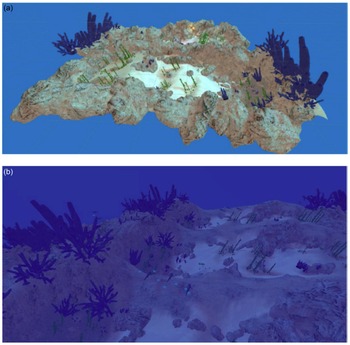
Marine biome: This biome aims to replicate the foliage and environment unique to a sea turtle’s natural surroundings. An example of marine biome with/without filter is shown in Fig. 2. Both human and sea turtle visions are simulated with a transparent colour filter that mimics the unique composition of each organism’s rod and cone structure. This allows sea turtles to have superior vision for detecting bioluminescent jellyfish, their primary prey.
Example of marine biome with/without filter of the prototype developed (a) Marine biome with no filter (b) Marine biome with filter

Lesson module development - deliverables
Lesson modules were developed using the Google Classroom lesson plan was primarily guided by the Georgia Education Standards (www.georgiastandards.org/). Two key standards are demonstrated in the design. The first standard involves obtaining, evaluating, and communicating information to examine the interdependence of organisms with one another and their environments. The second standard focuses on obtaining, evaluating, and communicating information from multiple sources to explain the theory of evolution of living organisms through inherited characteristics. Additionally, the standards emphasize establishing relationships between organisms and terrestrial biomes. Examples of biomes provided include the marine biome, the temperate forest biome, and the savanna biome, which were chosen for implementation in the design.
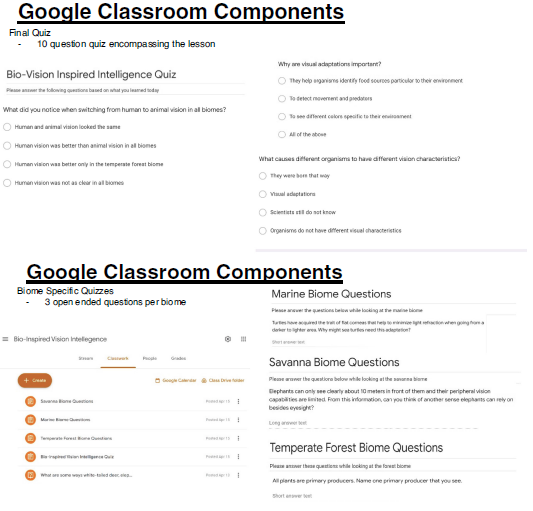
Introducing students to the concept of bio-vision and educating them about the specific visual characteristics of the animals studied is crucial. To facilitate this, teachers are provided with the necessary introductory information to help students understand the tasks and answer questions. Following the introductory information, the Unity Programming demonstration begins, during which students answer a series of questions outlined on the Google Classroom platform and the components are shown in Fig. 3. There are three open-ended questions for each specific biome and a ten-question quiz at the end to conclude the lesson. The open-ended questions keep students actively engaged and encourage critical thinking, an essential component of STEM education. This approach prepares students for potential STEM careers, aligning with the design goals. The final lesson plan encompasses the essential learning objectives from the Georgia standards while encouraging students to pursue careers in STEM.
The lesson module development components through Google Classroom

In summary, the final software developed over two semesters successfully meets the established design requirements for creating a product that demonstrates bio-inspired vision intelligence while encouraging students to pursue careers in STEM education. The software and lesson structure can be adapted to fit variations in science curricula across different states for future lesson plan development. The final biome program efficiently showcases multiple biome views and vision perspectives in an easily accessible format with intuitive controls. Due to time constraints, the prototype testing was not carried out with middle school students/teachers. However, the prototype was demonstrated during the Engineering Design Showcase, and the feedback/comments are briefly discussed in the next section.
Design project evaluation and student reflections
Throughout this project, each team member developed valuable collaboration and project management skills, enabling the efficient completion of project deliverables. The project team held biweekly meetings with the client to demonstrate project progress, learning objectives, and receive feedback on prototypes. Additionally, all team members met frequently to discuss project goals and communicated regularly through Slack to stay up-to-date with deadlines and product requirements.
Although rigorous prototype testing has yet to occur, the project design team aims to apply the knowledge gained from their collaborative efforts to future endeavours that may benefit the public education system. Projects intended to benefit the public are not created with monetary profit in mind; the primary goal of the Capstone Project Team was to develop an accessible product that meets stakeholder requirements while encouraging students to pursue STEM education for the benefit of society. The team hopes that the concepts developed in this project will inspire similar efforts throughout the education system.
Future improvements
During the Engineering Capstone Showcase, additional suggestions for improving the product were received. Judges for capstone design projects include industry, faculty and alumni and evaluated the design and deliverables. The judges recommended that the scale of the finished product be made variable so that primary schools can also use it for lesson plans, as modern students are more familiar with advanced technology compared to previous generations. Another suggested improvement involves adding a movement function to the camera, allowing students to comprehensively explore the biome. This free-roaming functionality would enable students to interact more with the scenes, and a potential object-dropping feature to assess the effects of the colour filter would enhance the educational value of the product. Embedding the program on a host website accessible by teachers and students worldwide was also suggested, which would significantly increase the product’s accessibility and eliminate the need for individual installations. Finally, it was noted that five minutes of flex time might be too short when accounting for variations in lessons, especially at earlier school levels; a future improvement would involve reconfiguring the lesson timeline to allow for more free time near the end.
5. Concluding remarks
This study presents details of a capstone design project course developed by UGA engineering student team that involves integrating bio-inspired AI and vision into middle school curriculum to attract students to pursue STEM interest and careers. The developed product involves a Unity application designed to demonstrate three distinct natural biomes from the perspectives of both humans and a corresponding organism and an educational lesson plan tailored to deliver the Unity program’s content in a format optimized for middle school science classes. The prototype developed was demonstrated at the senior design showcase and the feedback received from the judges will be used to further improve the product for general applications. The students who worked on this project gained valuable experiences based on their reflections. The final report and lesson modules along with the resources developed indicate that the project successfully developed and tested a biological vision system inspired by different animals. This product when completely developed aimed to educate and attract middle school children to STEM disciplines by using computational cameras to help them learn about AI through unique perspectives. The project outcomes also aligned with the initial expectations. While the project met its primary objectives, there will be challenges and learnings related to aligning bio-inspired concepts with existing curriculum and Standards of Learning. One limitation to this study is the results are preliminary and no testing were done at the middle schools. In general, the student’s performance and reflections encourage further use and exploration of the product and the lesson modules for middle school education.
Acknowledgements
The author thanks Drs. Renny Badra and John Mativo of UGA for their discussions and support. This work is supported by the U. S. National Science Foundation through a grant NSF-ITEST-1949493 & 1949384. Also, thanks to UGA CoE Capstone Stone Design team (Cydney Barnes, Caitlin Jones, Daniel Kim, Megan Lucente, AJ Waterer) for their contributions to this paper.


 Open access

