




In the Age of Questions, Holly Case (Reference Case2018, 59) asserts that “during the interwar period the nationality question morphed into the minority question.” This apparently insignificant sentence, in fact, reveals a new sensibility in the historiography of minorities and minority rights.
Until recently this literature had been written as if the term minority itself had no history. In most works, minority was used as a category of analysis projecting into the past contemporary understandings of the concept (see, among others, Jackson Preece Reference Jackson Preece1998; Fink Reference Fink2006; Liebich Reference Liebich2008). In the last decade, however, several authors have noted how the term minority did not appear in any of the treaties that are considered to be the cornerstone of minority rights history in the traditional account, from the religious treaties of the 16th and 17th centuries to the national ones of the 19th, including the 1878 Treaty of Berlin. These authors have thus concluded that until the end of World War I (WWI) minority was not a “guiding term in struggles over questions of cultural and national recognition” (van Rahden Reference Van Rahden2022, 36; see also Adorjáni and Bari Reference Adorjáni and Bari2020; Robson Reference Robson2021, 1–2).Footnote 1 This new historiographical trend has proposed to examine minority as a category of practice, i.e. to focus on how contemporary actors conceived minorities in different places and at different points in time and to reconstruct the evolution of the concept prospectively rather than retrospectively (on categories of practice and analysis see Brubaker and Cooper Reference Brubaker and Cooper2000).
This article builds on this historiographical turn and complements it in three ways. First, it asks whether minority really became a salient concept in discussions about national, ethnic, linguistic and religious difference all of a sudden in the interwar period, or whether it was already an available, although not dominant, concept before WWI. In the first section, it shows that our contemporary conception of minority did not originate out of thin air in 1919. It in fact had a longer history, although not as long as the traditional account has suggested.Footnote 2
Second, the article points out that the new historiography has not examined in detail the process of transition from nationality to minority questions that occurred around WWI. Most of the new literature has simply located the dawning of the era of minority questions after the conflict and proposed some explanations for such shift. This article by contrast dissects the key period between the last years of WWI and the early 1920s. It asks which were the main actors and phases in this process of transition. The article shows how the conceptual switch began already in 1917 and progressively built momentum until reaching a peak with the adoption of the minority treaties and declarations signed between 1919 and 1923.
Third, the article dissects some neglected consequences of this shift. It demonstrates that the transition was incomplete, since the boundaries between minorities and nationalities remained extremely porous, with many actors, even those with an expertise in the matter, using the terms as equivalent concepts. Finally, the article shows that the “morphing” of nationality into minority questions reinforced an association of the latter with Central and Eastern Europe that has lingered on to our time.
Recently, part of the new historiography has also offered tentative explanations for the transition from nationalities to minorities. Till van Rahden (Reference Van Rahden2022, 21–46) has emphasized the “triumph” of democracy immediately after the war. Adorjáni and Bari (Reference Adorjáni and Bari2020) have stressed the enshrinement of the nation-state as the “normal” unit of political organization. Robson (Reference Robson2021) has insisted on the great powers’ manipulation of the new Eastern European states. For reasons of scope, this article does not offer a comprehensive explanation of the causes of this transition. However, at different moments, it highlights how each of these three factors have driven the process in different ways and with varying momentum. It also qualifies some of the arguments of the new historiography. It especially emphasizes how the spread of popular sovereignty and the principle of nationality (rather than democracy itself) produced the question of minorities – even within imperial settings, hence before the full transition to nation-states, notably in coincidence with processes of federalization or autonomy (real or planned).
Methodologically, the article combines traditional methods of intellectual history with the use of massive databases of digitized text that can be examined through quantitative text analysis techniques. More specifically, the article relies on Google Books corpora (in English, French and German) to analyze changes in the usage of the term minority in the 19th and early 20th century through n-grams visualizations and the analysis of keywords in context.Footnote 3 The article also focuses on key peace organizations that played a leading role in promoting nationality and minority rights during and immediately after WWI, as well as on nationalist movements in Central and Eastern Europe and their declarations of independence towards the end of the war. It additionally examines the preparations for the Paris Peace Conference, notably through the studies of the American Inquiry and the French Comité d’Études Politiques, as well as the minutes of Conference itself.
Minorities and Nationalities Before WWI
Recent works have claimed that minority was not an important concept in the vocabulary of diversity before WWI (Adorjáni and Bari Reference Adorjáni and Bari2020; Robson Reference Robson2021; van Rahden Reference Van Rahden2022). In fact, a closer look suggests that the categories of nationality and minority were intertwined from the end of the 18th century onwards. Although the former was more frequently used throughout the 19th century, the latter became progressively more salient. By the beginning of the 20th century, minority was a common, although not hegemonic, term used to describe relations among groups in different societies in Europe, North America, South Asia and North Africa.
The concept of nationality consolidated its relevance in intellectual debates about political representation in the mid-19th century, notably after the 1848–1849 revolutions. It was used already at the beginning of the century in discussions about the American Revolution and the union of Ireland and Great Britain, as well as in the pioneering work of Giuseppe Mazzini (Reference Mazzini1909[1835]). Between 1850 and 1875, Pasquale Mancini (Reference Mancini1851), John Stuart Mill (Reference Mill1861), Lord Acton (Reference Acton1862) and Johann Kaspar Bluntschli (Reference Bluntschli1852, Reference Bluntschli1875, see also Mazzini (Reference Mazzini and Mazzini1909[1871]) contributed decisively to its crystallization under the term “principle of nationality,” meant as the idea that “the State and the nation must be co-extensive” (Acton Reference Acton1862, 14). The concept of nationality further developed around the so-called Eastern Question, which involved the creation of several new states in Central and Eastern Europe as a consequence of the slow dissolution of the Ottoman Empire (on the nationality question see Weitz Reference Weitz2015; Case Reference Case2018, 35–71; Liebich Reference Liebich2023).
Similarly, it was at the turn of the 19th century that the word minority began acquiring the current meaning of a group perceived to be different from the majority population of a specific state because of certain characteristics, notably language, religion, ethnicity – the latter typically phrased in that era as ‘race’ – or nationality. This understanding mostly grew out of the conception of minority as a group numerically lower in size than the majority of members of an assembly, notably concerning decision-making processes in parliament. Within these deliberative processes considerations of arithmetic supremacy or inferiority became increasingly salient. The new meaning however differentiated itself because of the “rigid” nature of the minority label attributed to the group, that could not be changed so easily as with party or ideological affiliations in deliberative assemblies.Footnote 4 Thus, the concept segued from an understanding based on purely arithmetical relations into one predicated on the perceived “essence” of a specific community.Footnote 5 In this “rigid” sense, the categories of minority and majorityFootnote 6 appeared for the first time (in the English language) in discussions around the union of Great Britain and Ireland, where they fitted both the condition of the Irish Catholics in the broader union (and empire) and the position of the Irish Protestants in the island itself (see Plowden Reference Plowden1803, Mackintosh Reference Mackintosh1819). For instance, in 1819, commenting on the question of Catholic emancipation and the hypothetical introduction of universal male suffrage in Ireland, the Whig politician James Mackintosh warned that the Catholics would become “tyrants” and the Protestant “slaves.” “That the majority of a people may be a tyrant as much as one or a few,” Mackintosh argued, “is most apparent in the cases where a state is divided, by conspicuous marks, into a permanent majority and minority” (Mackintosh Reference Mackintosh1819, 184-185). Anticipating by forty years some of John Stuart Mill’s considerations on the tyranny of the majority (see Mill Reference Mill1859, Reference Mill1861), Mackintosh’s text illuminates the connection between minority questions and the rise of popular sovereignty and majority rule.
The concepts of majority and minority continued populating discussions about Ireland throughout the 19th century, especially concerning Catholic emancipation (in the first third of the century) and the disestablishment of the Church of Ireland (in the 1860s). Yet it is only with the debate around the First Home Rule Bill, in 1886, that minority became a mainstream concept in discussions about difference in the Kingdom (this time mostly referring to the Protestant minority in the island) (see Hansard’s Parliamentary Debates 1886, 587, 633 and 1007; The Times 1886). By the late 1830s, the term appeared in its “rigid” meaning also in North America, to describe relations between anglophones and francophones in Upper and Lower Canada (see Commissioners for the investigation of all grievances affecting His Majesty’s subjects in Lower Canada 1837; Lamberton Reference Lamberton1839). There as well, the “rigid” understanding of the concept of minority came into frequent usage only much later, notably in the 1860s, coinciding with the process of federalization of the country (see, for instance, Provincial Parliament of Canada 1865). The formation of the Canadian confederation also led to the first constitutional clause containing the word minority in this meaning, Section 93 of the British North America Act. In both the Irish and Canadian contexts, the projection of scenarios of autonomy or federalization brought into sharper focus the question of minorities, either at the broader imperial/federal scale or at the provincial one.
Shortly afterwards, the term appeared in India and North Africa, to describe relations between Hindus and Muslims as well as between Muslims and Copts (see Samuelson Reference Samuelson1890; Wentworth Dilke Reference Wentworth Dilke1890). In the early 20th century, within the framework of discussions about representative government, imperial reform and, eventually, self-government, the All-India Muslim League embraced minority representation as a tool to defend the interest of Muslim minorities in the country and explicitly called for it in its 1908 Congress (see An Indian Musalman 1909, 354). Likewise, three years later in a similar context, the Coptic community of Egypt adopted a program that included proportional representation for religious minorities among its main items (Hussein Omar Reference Omar2022).
By the turn of the 20th century the categories of majority and minority had become salient concepts in the vocabulary of difference in English discussions taking place in Europe, South Asia and North America. By then, they had also become consolidated in French and, especially, in German. The first (very veiled) reference to the “rigid” understanding of the term minority in a French dictionary appeared in 1874, when the 11th volume of the Pierre Larousse Grand Dictionnaire Universel (Great Universal Dictionary) added the definition of “the smallest party in a State, or in an assembly” (my emphasis) (Larousse Reference Larousse1874). A decade later, Ernest Renan (Reference Renan1883, 26) referred to “religious minorities” in his Le judaisme comme race et comme religion (translated in English as Judaism: Race or Religion?), while at the end of the century Émile Durkheim (Reference Durkheim1897) deployed the concept extensively in his Le Suicide (Suicide: A Study in Sociology), as did authors reporting on majority-minority relations in the Habsburg Empire (see, for instance, Schmidt-Beauchez Reference Schmidt-Beauchez1898). Yet the universalist, purportedly civic, and centralist ethos of the French Republican tradition constrained the spread of the category of minority in domestic debates.Footnote 7
In the German-speaking world, the terms Minderheit and Minorität began being used in their rigid meaning during the deliberations of the Austrian Parliament in Kremsier, in 1848-49, notably regarding issues of democratic procedure in the election of the provincial assemblies and the Imperial Parliament (Struve Reference Struve2004).Footnote 8 Yet the concepts acquired special relevance only towards the end of the 19th century, notably in the Austrian half of the Empire (then called Cisleithania), around the implementation of Article 19 on equality between peoples (Volksstämme) of the 1867 Fundamental Law concerning the General Rights of Citizens. In the absence of implementation legislation, the Imperial Court (the Reichsgericht) and the Supreme Administrative Court (the Verwaltungsgerichtshof) developed an extensive case law that added flesh to the general principle enshrined in Article 19. The two courts defended individuals (most often represented by collective bodies) against the imposition of majority languages at the municipal, district or crown land levels, notably by regulating the creation of minority schools. This concerned all nationalities within the state, as, despite the privileged position of German, there was no official language in Cisleithania and, in mixed areas, communities that constituted a majority in one place could easily find themselves in a minority somewhere else (Stourzh Reference Stourzh1985: 53-248; Judson Reference Judson2016, 27-28). In the decade immediately preceding WWI, legislative agreements that introduced forms of non-territorial autonomy protecting minorities in specific crown lands (notably in Moravia in 1905, Bukovina in 1909 and Galicia in 1914) complemented the activities of these two courts (see Kuzmany Reference Kuzmany2024, 92-125, who also discusses the agreement adopted in Bosnia in 1910).
The courts’ documents generally referred to peoples (Volksstämme) or nationalities (Nationalitäten), but they also consistently used the grammar of minorities and majorities.Footnote 9 Yet these discussions remained elite discourses that circulated within limited circles. The popularization of the couple majority-minority in its rigid sense within the German-speaking space owed more to the work of some Habsburg politicians and statisticians with a fixation for the linguistic make-up of the Empire.Footnote 10 Johannes Zemmrich was probably the most influential among them (see Zemmrich Reference Zemmrich1898; Zemmrich Reference Zemmrich1899; but also Rauchberg Reference Rauchberg1905; among the politicians see von Dumreicher Reference Von Dumreicher1893; Prade Reference Prade1896). At the turn of the 20th century, using official statistics gathered from 1880 onwards, Zemmrich began investigating the territorial distribution of language use (which for him automatically meant nationality) down to the level of single districts and municipalities. He portrayed a situation in which national groups engaged in an existential fight for survival against each other in different parts of the Empire. Within this context, he deployed extensively the terms minority and majority to identify opposing communities playing a zero-sum game of territorial losses and gains (see Zemmrich Reference Zemmrich1898; Zemmrich Reference Zemmrich1899; see also Rauchberg Reference Rauchberg1905).
Zemmrich believed that a clearer picture of the Empire’s linguistic composition was needed to solve nationalist conflicts that were becoming ever more salient. In this perspective, the categories of majority and minority were not pertinent at the imperial level, because no community could claim the position of majority there, but only in localized contexts. They were especially relevant in discussions about the possible federalization of the Empire, as the creation of autonomous crown lands with clear linguistic majorities problematized the presence of minorities. This consideration later fed into the work of widely read political thinkers such as Otto Bauer. Bauer identified the minority question as a central component of the broader nationality question and located its unfolding within individual crown lands. Commenting on the program of the Austrian Social Democratic Workers’ Party, Bauer argued that there was “a flaw in our nationalities program” and this consisted in the fact that the party had “not answered the question of national minorities” (Bauer Reference Bauer1907, 460).
At the beginning of the 20th century, both nationality and majority-minority (in their rigid understanding) were instruments in the conceptual toolkit of understanding and representing difference. Majority and minority became ever more salient with the spread of ideas of popular sovereignty and the projection of future scenarios of federalization, or other forms of territorial redefinition, that foreshadowed the formation of quasi-nation-state units within imperial settings. In other words, although the categories of minority and majority became hegemonic in discussions about difference only with the rise of self-determination as one of the main principles of political legitimacy towards the end of WWI (as we will see in the next section), their salience began increasing much earlier. Even within dynastic empires people could imagine a future in which the principle of nationality and majority rule would become dominant and bring into focus the question of minorities. That notwithstanding, until WWI the category of nationality (nationalité in French, Nationalität or Volksstamm in German) was more broadly used. People also tended to use a vocabulary of concrete groups (Catholics, Jews, Muslims, English, Irish, Germans, Czechs, etc.) rather than the general and abstract categories of majority and minority.
This was especially the case in international peace agreements. Throughout the 19th century, multiple international treaties, notably the Congress of Vienna in 1815, the Treaty of Paris in 1856 and the Treaty of Berlin in 1878, included clauses that guaranteed special rights to specific religious or linguistic communities. For this reason, they are usually considered as precursors of the interwar minority treaties. The Treaty of Berlin in particular, which regulated the end of the Russian-Turkish War and relations between the Ottoman Empire and the newborn states of Serbia, Montenegro and Romania, as well as the autonomous Principality of Bulgaria, contained extensive clauses on religious freedom and equality of civil and political rights (Fink Reference Fink2006, 3–38). Yet the word minority did not appear in any of these treaties and was used only in a few implementation documents (see, for instance, European Commission on Eastern Roumelia 1878, 169–170).
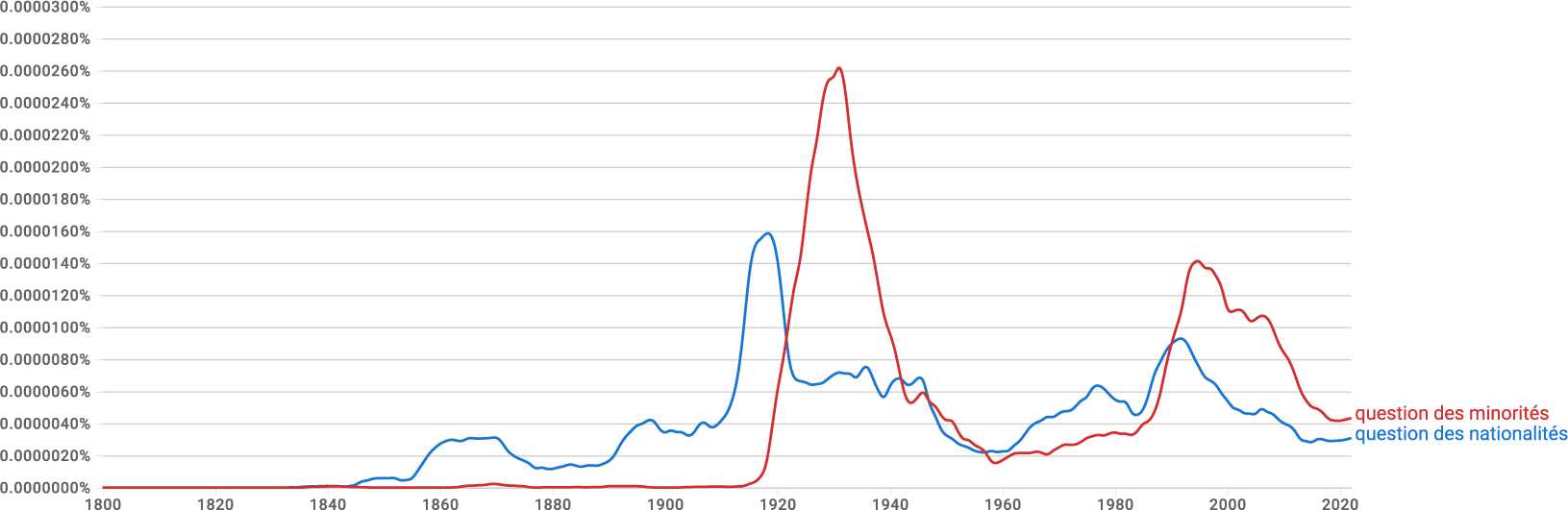
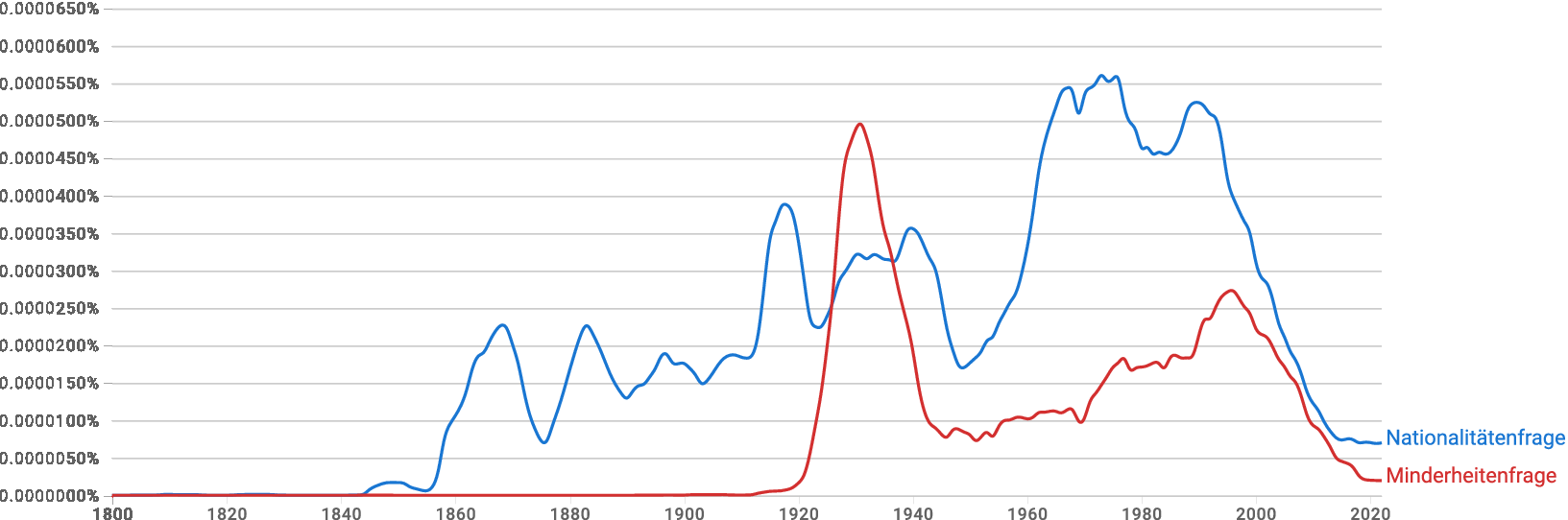
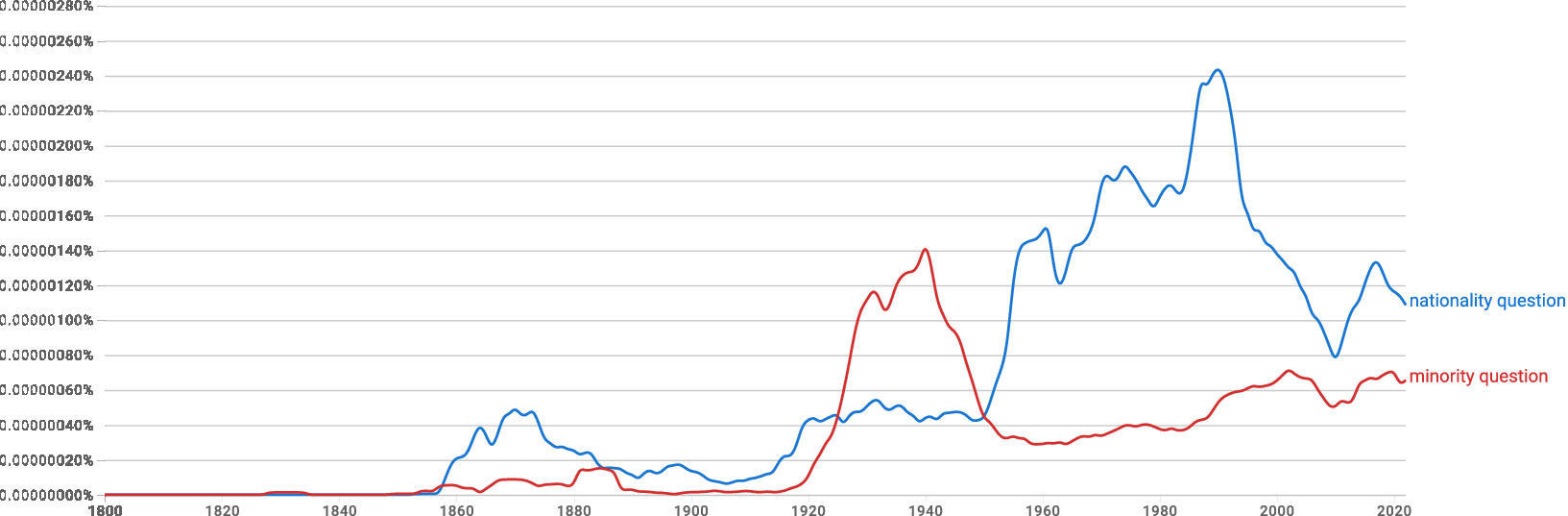
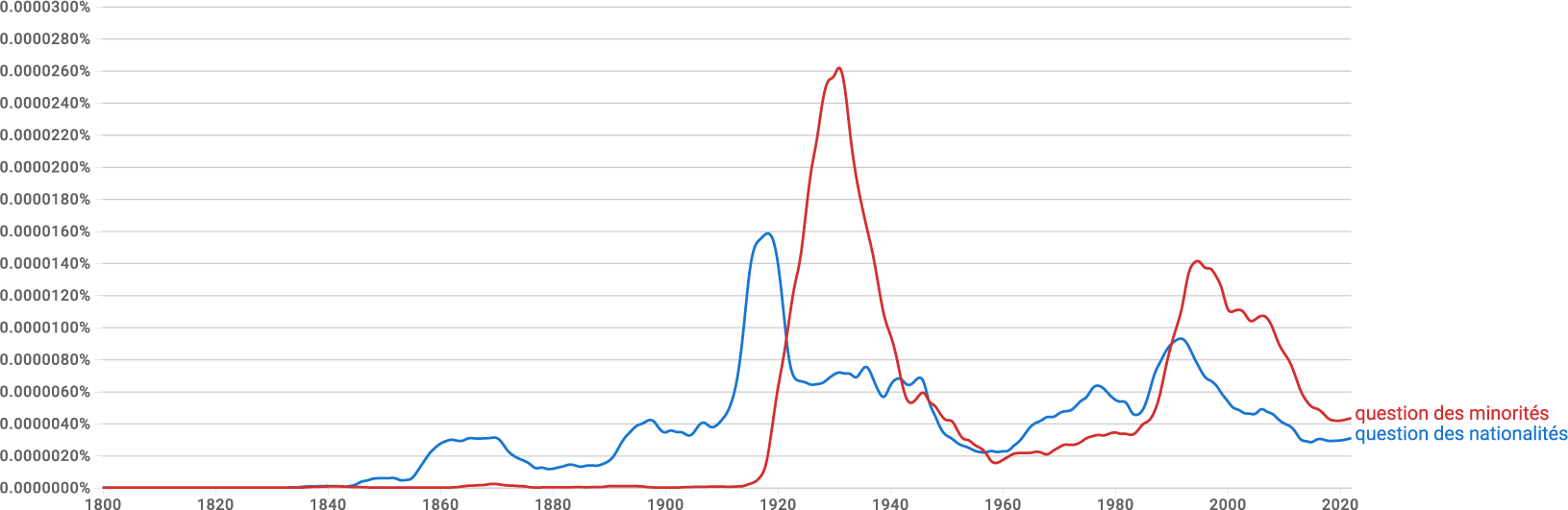
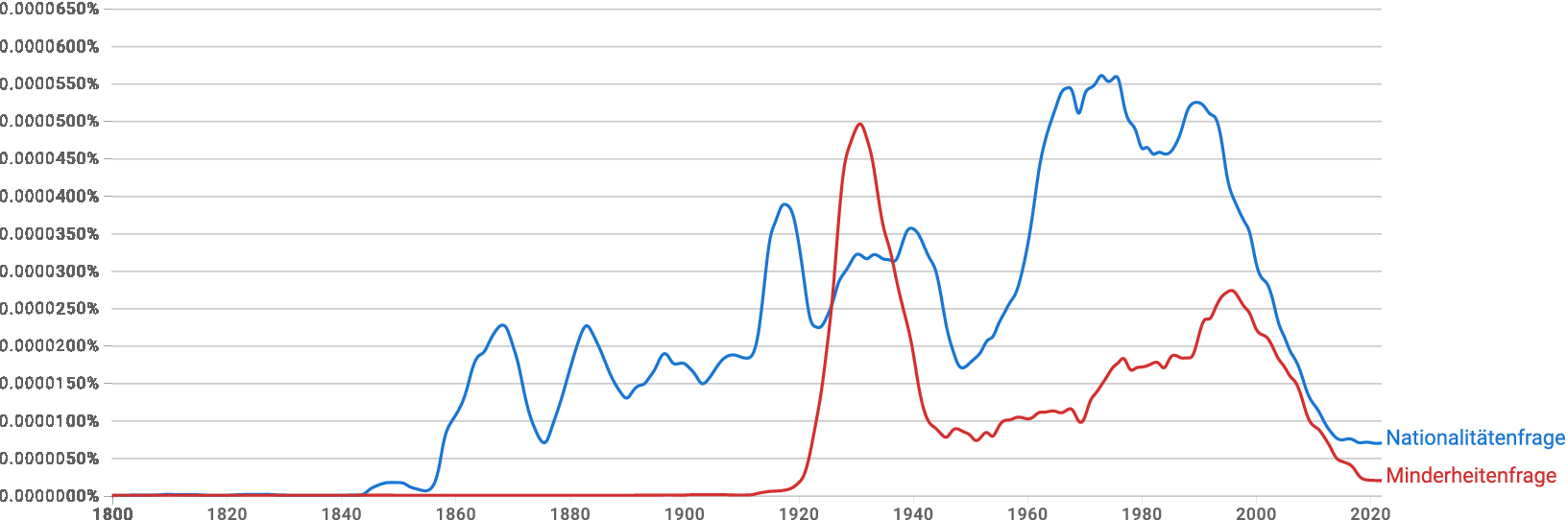
The reciprocal salience of the words nationality and minority became inverted after WWI, as the following anecdote illustrates. In 1921, the Minorities Section of the League of Nations was seeking literature on the minority question. Joseph Kunz, Director of the Juridical Section of the Austrian Association for the League of Nations, wrote to the Section’s staff to recommend some works on the Austrian experience. Kunz’s reply began with an apparently insignificant sentence: “on the minority question, or, as we rather called it, the nationality question….”Footnote 11 Kunz made explicit the “morphing” – in Holly Case’s terminology – of one question into the other. The Google n-grams in Figure 1, 2 and 3 below, provide further evidence of this transition. They suggest that, paradoxically, the consecration of the principle of nationality, now in the Wilsonian formulation of the principle of self-determination (on this shift see Liebich Reference Liebich2023, 70–77; Núnez Seixas Reference Nuñez Seixas and Nuñez Seixas2020), as one of the main principles of political legitimacy in international affairs contributed to the progressive replacement of the nationality question with the minority question. How did this happen precisely? The next sections examine this process in more detail.
Google N-grams of “Nationality Question” and “Minority Question” in the English Google Books corpus, 1800–2022.
Source: author’s elaboration using Google Books Ngram Viewer (https://books.google.com/ngrams).

Google Ngrams of “Question des nationalités” and “Question des minorités” in the French Google Books corpus, 1800–2022.
Source: author’s elaboration using Google Books Ngram Viewer (https://books.google.com/ngrams).
Google Ngrams of “Nationalitätenfrage” and “Minderheitenfrage” in the German Google Books corpus, 1800–2022.
Source: author’s elaboration using Google Books Ngram Viewer (https://books.google.com/ngrams).
Did it All Begin in 1919?
Till van Rahden (Reference Van Rahden2022, 37) has described 1919 as the “annus mirabilis” when minority acquired the meaning it has today and (rigid) minorities entered the world stage in marching ranks. In reality, the process was more gradual. The switch began already during the war and can be approached through the works of two of the most important peace organizations with an interest in national groups of the time: the Union des Nationalités (Union of Nationalities, UdN) and the Central Organisation for Durable Peace (CODP).
That the UdN was a child of the 19th century’s vocabulary of difference is clear from its very name. Founded in 1912, the UdN aimed to promote the principle of nationality and the defense of the rights of national groups through the organization of conferences on the topic and the publication of a periodical, Les Annales des Nationalités (on the UdN see Núñez Seixas Reference Núñez Seixas2001, 114–139). In 1916, the organization approved a Declaration of the Rights of Nationalities in which the word minority was nowhere to be found, although the word did appear in some of the discussions around it, both in Les Annales des Nationalités and behind closed doors.Footnote 12 In 1917, however, the UdN began deploying the language of minorities and majorities more consistently. One of the first occurrences coincided with Woodrow Wilson’s speech to the Senate in January of that year. The UdN saw the speech as one of the first official recognitions of the principle of nationality and wrote to the American statesman to congratulate him. The organization reminded Wilson that the vision he had summoned implied “a regime of freedom that takes into account the rights of national minorities” (Les Annales des Nationalités 1917a). Throughout the year, several articles examined the matter more in detail. In a piece the paper described different situations that could lead to the formation of minorities, as well as solutions for their protection including territorial and personal autonomy (Les Annales des Nationalités 1917b). The letter of a reader in the same issue suggested that the application of the principle of nationality would lead to the creation of minorities and pointed to voluntary population exchanges as the most suitable solution (E.W. 1917).
Therefore, from 1917 onwards, the UdN used the categories of minority and majority more frequently in the pages of Les Annales des Nationalités. However, the organization also tended to stick to a vocabulary of “oppressed nationalities” and concrete groups (see, for instance, Les Annales des Nationalités 1917c, 1918a; Thomas Reference Thomas1918). Minorities were left in the background because the intellectuals who were driving the organization believed until the very end of the war that the claims of all nationalities would be addressed at the coming peace conference. However, some observers within the organization also correctly pointed out – as an anonymous article did in 1918 – that “the peoples liberated will have to take into account the rights of their minorities everywhere and everywhere they accept this obligation.” “The various practical applications of the right of peoples to self-determination – the same article continued – lead to entanglements, potential sources of conflict that beget naturally the idea of self-limitation” (Un diplomat 1918). Despite its reluctance to deploy systematically the grammar of minorities and majorities, the UdN acknowledged that the realization of the principle of nationalities would inevitably create minorities. This in turn generated the need to impose constraints (the “self-limitation” mentioned above) on dominant majorities. A similar reasoning is also visible in the work of the Central Organisation for Durable Peace (CODP).
The CODP was born out of the attempts of different European peace organizations to create a coalition that could centralize their efforts. The main goal was to prepare the ground for the coming peace by putting together intellectuals from neutral and belligerent countries to discuss how international affairs could be organized and a repetition of the conflict avoided (on the CODP see Zabriskie Doty Reference Doty1945). In 1915, the organization produced a Minimum Program, meant as a road map for peace talks. Article two asserted that “the States shall guarantee to the various nationalities, included in their boundaries, equality before the law, religious liberty and the free use of their native languages” (de Jong van Beek en Donk Reference Jong van Beek en Donk1917, 25).
The deployment of the vocabulary of nationalities visible in the Minimum Program, which did not mention minorities at all, appeared also in many other internal discussions during the first two years of the organization’s existence. In 1915, for instance, different bodies that constituted the CODP formulated proposals concerning the themes to be discussed at its founding meeting. Only one, the International Peace Bureau (IPB), mentioned minorities. The IPB argued that the coming peace should be based on the right of people to self-determination, reject any annexation without the consent of the populations concerned and, in states with multiple nationalities, provide guarantees concerning the rights of minorities.Footnote 13 Yet the IPB was the exception in 1915. Even personalities that would later use the categories of majority and minority extensively in their writings did this rarely until 1917.Footnote 14 One clear example is the Secretary General of the CODP himself, Benjamin de Jong van Beek en Donk. As late as January 1917, describing the activities of his organization to the editors of the journal Bulletin des Nationalités de Russie, he wrote that one of the CODP’s goals was to establish rules concerning “the rights of people belonging to a nationality other than that of the majority of the country (religion, language, political freedom), and to guarantee these rights, if possible internationally” (my emphasis).Footnote 15 Here de Jong summoned the concept of minority without using the word. Only a few months later, however, he began writing in terms of majority and minority more consistently.Footnote 16 This was in large part due to the work of the Norwegian historian Halvdan Koht and the Research Commission he chaired.
After the adoption of the Minimum Program, the CODP set up a series of research commissions and tasked them with elaborating further upon the different items of the Program. Commission II was in charge of studying the ways of implementing the article on the rights of nationalities. Koht coordinated the work of 16 members: among them the leader of the UdN Jean Gabrys, the Italian sociologist Robert Michels, the British Liberal politician Charles Roden Buxton, the Hungarian historian Oskar Jàszi, and the Austrian jurists Rudolf Laun and Eugen Ehrlich. In 1917, the Commission issued a draft treaty on the rights of national minorities, which contained elements that would find an echo in the post-war minority treaties (Koht Reference Koht1917). Koht was at the core of the switch from an article on the rights of nationalities to a draft treaty on the rights of minorities. Already in 1916, when within the CODP few referred to national groups as minorities, Koht sent out a questionnaire to the members of the Research Commission with the following questions:
-
1. Would it be desirable and possible to protect national minorities within the separate states in any respect by international treaties? If so, what ought to be the contents and purpose of such treaties? By what means should national minorities be able to secure their right of recognizance?
-
2. What ought to be the rules governing the conditions of national minorities in respect to a) school organisation, b) church organisation, c) judicial proceedings, d) political privileges?Footnote 17
Furthermore, while many of the reports that the members of the commission delivered still tended to use the categories of minority and majority only sparingly, Koht’s final report clearly defined the commission’s work as being about the question of national minorities. As he wrote in the conclusion, “we will never stress enough that the whole policy of nationalities developed here has two goals: on the one hand, to protect national minorities and their historical development; on the other, to prevent those internal disagreements that could dismember and weaken states” (Koht Reference Koht1917, 26).Footnote 18
The reason why Koht focused so early on and so decisively on the question of minorities is not entirely clear. He might have been influenced by the International Peace Bureau, through the text that this submitted to the foundational meeting of the CODP in April 1915 (see above). He might also have been inspired by the German peace movement, notably through pacifist and journalist Lilly Jannasch. In January 1916, Jannasch shared within the CODP a document entitled “Neutral preliminaries for peace negotiations” that included a clause on “guaranteeing the rights of national minorities in nationally mixed states,”Footnote 19 by which Jannasch probably meant nationally mixed nation-states. A handwritten note on a copy of the “preliminaries” held in Koht’s personal papers – possibly from de Jong van Beek en Donk to Koht – indicated that these clauses were a proposal for the neutral press, but they could constitute a basis for further discussion. The note concluded that “a start has to be made.”Footnote 20 Two months later Koht sent out his questionnaire with an emphasis on national minorities, rather than nationalities.
Another hint at the reason behind the shift from an article on the rights of nationalities to a draft treaty on the rights of minorities can be gleaned from Koht’s published work. A year after sending out his questionnaire, in the final report of the Commission he chaired, Koht suggested that minorities came into sharper focus with the realization of the principle of nationality. “No matter how hard we try to separate nations into independent political units,” he wrote, “it is impossible to ensure everywhere the congruence of political and national borders” (Koht Reference Koht1917, 7). In other words, self-determination would always produce some minorities.
The category of minority began enjoying broader international resonance between the end of 1917 and the beginning of 1918. A streak of national movements in different European areas proclaimed their right to self-determination, while at the same time guaranteeing their commitment to the rights of minorities. These declarations signaled how the protection of minorities was becoming, in the collective consciousness of the time, at least in Europe, a requirement for modern statehood. The first such statement came from the Diet of Vilnius in September 1917, when it declared that “Lithuania will form an independent state. The rights of ethnic minorities will be respected” (quoted in Les Annales des Nationalités 1918b). At the beginning of 1918, some Czech members of the Imperial Parliament in Vienna and the provincial Diets of the Czech lands also asserted the right to self-determination of the Czechoslovak nation. A future Czechoslovak state, they assured, would grant “full and equal rights to national minorities” (quoted in Les Annales des Nationalités 1918c). A month later, in February 1918, the Ukrainian People’s Republic adopted a bill on non-territorial autonomy that acknowledged the right of any national minority on the Republic’s territory “to freely organize one’s national existence” (Loi sur l’autonomie personnelle de la Republique nationale ukrainienne 1918; see also Kuzmany Reference Kuzmany2024, 263–267). A few days later, the Congress of the Ukrainian deputies sitting in the Imperial Parliament in Vienna demanded the constitution of a Ukrainian region within the Habsburg Empire and assured that “the Ukrainian people of Austria will guarantee to the political minorities on its soil the rights of national autonomy and equality before the law” (quoted in Les Annales des Nationalités 1918d). The list of declarations closed with a speech by the Yugoslav leader Anton Korošec in the Austrian Imperial Parliament on October 2, 1918, a few weeks before the fall of the Empire. Following what had by then become a transnational template, Korošec called for the recognition of the right to self-determination of the southern Slavs and simultaneously promised that the new Yugoslav state would offer “to the minorities of other nationalities existing within our people…all the rights necessary to their national, civilizational and economic development” (Les Annales des Nationalités 1918e).
The grammar of majorities and minorities penetrated not only the work of peace organizations and national movements. It also informed the extensive peace expertise that the Entente built ahead of the Paris negotiations. This was especially the case within the American Inquiry and the French Comité d’Etudes Politiques (Committee of Political Studies). Both were bodies of academics charged with studying the most important European territorial and economic questions. Both believed that the rigorous and scientific study of territorial issues could lead to a just and lasting peace (Prott Reference Prott2016, 27–53).
The American Inquiry was a huge organization that churned out over 2,000 reports between November 1917 and May 1918. Most of the Inquiry’s papers played on both registers of nationalities and minorities, often using the two terms as synonyms. Minority however tended to appear more often in the context of discussions concerning the creation of new states based on the principle of self-determination.Footnote 21 In this respect, the report entitled “Minority questions in Austria-Hungary. A survey of the historical evolution of the problem of minorities in the Habsburg Monarchy,” drafted in April 1918, was an interesting exception. The author, Robert J. Kerner, was an expert on the Habsburg Empire and a Professor at the University of Missouri. His parents were Czech immigrants. He had travelled and worked extensively in Europe. His report was one of the first texts in English to use the expression “minority question” in the title. This was not the only innovation. In the report, Kerner proposed to examine nationality questions in the Habsburg Empire chiefly as minority questions. He wanted to illustrate how, since 1848, the Habsburg Empire had tried to solve the problem of minorities. “In Austria-Hungary as a whole,” Kerner added, “the question of nationalities is a minority question, since no nation has a majority of the population in the dual monarchy or in either of its two greater divisions. It is only when each of the historical provinces is discussed,” he added, “that we find national majorities in addition to the ever-present, perplexing minorities.”Footnote 22 Other people before Kerner had already formulated this idea, from Otto Bauer (Reference Bauer1907) to Rudolf Laun (Reference Laun1917a, Reference Laun1917b). Yet Kerner reversed the terms of the debate. While for the other authors, the minority question was a sub-question within the broader problem of nationalities, in Kerner’s work the majority-minority framework became dominant.
In the French context, it was Antoine Meillet, a linguist and expert of Armenia, who introduced the language of minorities within the works of the Comité d’Études Politiques. Meillet drew the body’s attention on the key role that minorities would play at the coming negotiations. In the redrawing of the European borders that would inevitably occur in Paris, he argued, different groups would have to be protected by “the general minority rights that the Peace Conference will be obliged to constitute in Eastern Europe” (Meillet Reference Meillet1919, 338). In line with Meillet’s recommendations, minority protection appeared as a guiding principle in Prime Minister Clemenceau’s conference plan (see Tardieu Reference Tardieu1921, 98).
In his opening speech at the Conference, on January 18, 1919, the French statesman stressed the link between minority rights and the realization of the principle of nationality: “if you are to remake the map of the world, it is in the name of the peoples, on the condition that you shall faithfully interpret their thoughts and respect the right of nations, small and great, to dispose of themselves, and to reconcile it with the right, equally sacred, of ethnical and religious minorities” (my emphasis) (FRUS-PPC 1919, 453–454). In this, Clemenceau echoed similar conclusions drawn by American diplomats. The Lippmann-Cobb Memorandum (Reference Link1985[1918]), for instance, which provided a road map for the conference based on Wilson’s Fourteen Points, admitted that minorities would inevitably arise from the creation of new states in Paris. Hence, protection should be given to them. In the British context, it was the British Joint Foreign Committee (JFC), an organization created to link the activities of the Board of Deputies of British Jews and the Anglo-Jewish Association, that, in December 1918, drew the attention of the Foreign Office on the “intense desire of all the different ethnographic minorities in Eastern Europe to preserve their cultural identity.” The body thus called for the protection of the “autonomous management” of the “religious, educational, charitable, and other cultural institutions” of “all religious and cultural minorities” (Joint Foreign Committee 1918). In other words, all of these actors seemed to agree that the transition from plurinational dynastic empires, which in some cases such as Cisleithania did not even enforce a single official language, to new states supposed to be the states of and for one clear national majority brought into sharper focus the question of minorities. The stage was set for the Peace Conference to tackle the newly arisen minority question.
Tipping the Scales, or Almost: Paris and the Porous Border Between Minorities and Nationalities
The Peace Conference tipped the scales in favor of the grammar of minorities and majorities. Yet the “morphing” from nationality to minority questions was not totally complete. While the majority-minority dichotomy became the dominant framework of interpretation in interwar discussions about difference, the category of nationality proved resilient. Many observers used the two terms as synonyms, and some switched tactically from one to the other depending on their strategic needs.
The delegates in Paris addressed the question of minorities from the outset. The first draft of the League of Nations’ Covenant that Wilson wrote at the Conference, on January 10, 1919, contained an article on minority rights. This stated that “the League of Nations shall require all new States to bind themselves as a condition precedent to their recognition as independent or autonomous States, to accord to all racial or national minorities within their several jurisdictions exactly the same treatment and security, both in law and in fact, that is accorded the racial or national majority of their people” (my emphasis) (Miller Reference Miller1928b, 91). Once again, the realization of the right of self-determination (through the constitution of the new states) required the recognition of rights to the new countries’ minorities. This also implied that minorities were a problem to be solved and one that was limited to the “New Europe” arising from the dissolution of the continental empires.
By mid-February 1919, however, the diplomats had rejected including any reference to minority rights in the text of the Covenant (see Miller Reference Miller1928a, Reference Miller1928b; Fink Reference Fink2006, 155–158). The issue was then put on hold until the end of April, when it resurfaced owing to pressure from Jewish organizations, international events such as the Pinsk shooting,Footnote 23 and the increasing realization among the delegates that addressing this question could no longer be postponed. By mid-May, a team led by the British diplomat James Headlam-Morley and reunited under the name of Committee on New States had drafted most of the clauses of the Polish minority treaty, which later functioned as a template for all others. At the plenary session of May 31, the great powers presented the states of Central and Eastern Europe with a draft of the first international treaty that explicitly defended, and mentioned, the rights of “racial, linguistic and religious minorities” (Fink Reference Fink2006, 209–236).Footnote 24
The Polish minority treaty was signed on June 28, 1919, in coincidence with the signature of the Treaty of Versailles. In the second half of 1919, similar treaties with the other states of Central and Eastern Europe were concluded. The last Eastern European countries to join the new rights regime were the three Baltic Republics. By 1923, these had issued declarations in which they committed to respecting the rights of their minorities along the standards of the minority treaties. In 1924, 15 countries were bound by minority clauses under the guarantee of the League of Nations (Fink Reference Fink2006, 211–280). The treaties provided collective (not corporate) rights to individuals. In other words, minorities as such held no rights and they were not recognized as subjects of international law. Yet individuals could enjoy rights qua members of minority groups.Footnote 25 The minority treaties thus created a status that granted international entitlements. While there was no official right to petition that would automatically trigger an international legal procedure, the League of Nations set up a Minorities Section that received submissions from individuals or organizations denouncing mistreatment. In this way, the treaties created a structure of incentives to mobilize the minority label to tie international rights to specific local contexts. This structure of incentives generated an outpouring of petitions that described systematically the relations among groups as majority-minority relations (on the petition system see Cowan Reference Cowan2003, Reference Cowan, Mulle, Rodogno and Bieling2023). In turn, this contributed even further to the consolidation of the new grammar of majorities and minorities through a cascade of publications on the topic. In the period 1800–1918 only 9 publications in English had contained the terms “minority/ies” (in its “rigid” sense) along with the words “question(s),” “rights” or “protection” in their title. During the interwar period, 73 such works were released (172 if one includes the League of Nations’ official publications on the subject).Footnote 26
The transition from the question of nationalities to that of minorities had occurred. Joseph Kunz, the Director of the Juridical Section of the Austrian Association for the League of Nations that we met in the introduction, was one of the first to openly acknowledge it in 1921. He was soon joined by Nicholas Murray Butler (Reference Butler, Eisenmann, Rappard, Harris and Buell1926, 5), an American philosopher and President of Columbia University. Butler noticed that “the question of minorities is but a new form of the old problem of nationalities.” Imre Mikó, a Hungarian intellectual who penned several texts on the topic of minorities, reiterated the concept at the beginning of the 1930s. “What, before the War, was called the ‘nationality question’,” he wrote, “since the Minority Treaties is called in the sphere of public law and politics ‘minority (or better yet, ‘national minority’) question’” (quoted in Adorjáni and Bari Reference Adorjáni and Bari2020, 4).
However, the category of nationality did not disappear. Nationalist leaders all over Europe did summon the grammar of minorities and majorities strategically to be able to claim the rights attached to it (Núñez Seixas Reference Núñez Seixas2023, 484). Yet often they did so reluctantly, since the shift from nationality to minority questions implied that the groups who were attributed the minority label had somehow missed the opportunity to create their own state. In other words, minority rights came at the price of shelving collective dreams of independent statehood (or of rejoining another existing state). The term nationality, by contrast, conveyed a lingering wish not to relinquish aspirations to achieve complete self-determination.
Ferenc Faluhelyi, a Hungarian jurist who headed an institute for the study of minorities at the University of Pècs, clearly felt the taste of permanent subordination that came along with the minority tag. “There is something in that expression,” he argued, “in that name something new, something of the knowledge that a people that has had the status of a minority thrust upon it, can no longer live as it did…when it was in the majority, can no longer live life as majority peoples do” (quoted in Case Reference Case2018, 68). Similarly, the Catalan nationalist Joan Estelrich, who wrote multiple publications on the topic of minorities, concluded that “the term minority has rightfully been contested as leading to confusion and because people are reluctant to apply it to compact national groupings” (Estelrich Reference Estelrich1929, 10) – and this despite the fact that he himself used the word systematically to refer to the Catalan people.
Often, however, the nuanced distinction between the words minority and nationality was lost. Many interwar actors simply used the two terms as synonyms, even if the subtle differences between these words were clear to them. The porosity between the two concepts penetrated even the works of the most important organization defending minority rights in Europe at the time, the Congress of European Nationalities (CEN). While the name of the organization stuck to the old vocabulary of difference, its official goal was the promotion of the rights of European minorities.Footnote 27 This came along with explicit acceptance of the borders redrawn in Paris and the commitment of the individuals that composed the minority to act as loyal citizens of the state where they lived. Josip Vilfan, a representative of the Slovenian minority in Italy and the CEN’s President throughout its history, complained, in 1927, that the concepts of “‘minorities’, ‘national minorities’ and ‘nationalities’ are used haphazardly in the discussions” (quoted in Dyroff Reference Dyroff and Seixas2020, 260). Vilfan might have exaggerated, and the members of the CEN might have shown some regularities in their deployment of these concepts. Still, the frontier between them was very blurred. Imre Mikó even argued that there was “conceptual anarchy” in the usage of these words, while Max Hildebert Boehm, a German publicist and sociologist who in the late 1920s directed the Institut für Grenz- und Auslanddeutschtum (Institute for Border Studies and the German Diaspora) in Berlin, lamented that the term nationality had changed its meaning to become a synonym of minority (Boehm Reference Boehm1925, 122).
The morphing was incomplete, but not inconsequential. The term minority implied a bundle of individual rights and foreclosed any broader process of collective transformation. It also conveyed an idea of inferiority (Smith and Hyden Reference Smith and Hiden2012, 24). Nationality on the other hand conjured up images of group equality and left the door open to the realization of nationalist utopias (Dalle Mulle and Bieling Reference Dalle Mulle and Bieling2021, 271–272; Núnez Seixas 2023, 482–485).Footnote 28 As Arthur Toynbee (Reference Toynbee1922, 586) aptly suggested “the protection of minority is incompatible with instability of frontiers.” That however was not the only consequence of the incomplete transition from nationalities to minorities.
Minorities as a Question of Eastern Europe
In 1917, the Austrian jurist Rudolf Laun made a statement that would sound extravagant only a few years later. Austria, he argued, is “the cradle of national minority protection and thus of the – we hope – future nationality law of the world” (Laun Reference Laun1917b, 28–29). In May 1919, during the final phases of the Paris Peace Conference, Clemenceau defended the very opposite idea when he suggested that “everyone’s record of minority treatment is not quite the same.” Clemenceau had in mind the policies of the Romanian government, which for three decades had discriminated against its Jewish population despite being bound to respect minority rights by the 1878 Treaty of Berlin (see Fink Reference Fink2006, 30–38). Yet he referred to Western and Eastern Europe as monolithic blocks and rejected a uniform application of the minority treaties to all League members. Wilson mobilized similar stereotypical understandings of East and West when he reminded the Council of Four that “we are dealing with states that until now have treated Jews in the spirit of the Middle Ages. Our goal must be to favour the transformation of this state of mind.”Footnote 29
Eastern Europe had been associated with images of exotic backwardness and savagery since the age of the Enlightenment (Wolff Reference Wolff1994; Todorova Reference Todorova1997). Yet at the end of the War the lines separating Eastern and Western Europe became thicker. The minority treaties defined minorities as a “problem of Eastern Europe” (Macartney Reference Macartney1931, see also Frank Reference Frank2017, 46), one of which the western half of the continent, “more stable in its political organization, had lost even the memory” (Fouques Duparc Reference Fouques Duparc1922, 17). The area of the former continental empires had a complex and varied record in the management of difference, going from the sophisticated conceptual and practical tools devised in the Habsburg Empire to the antisemitic pogroms carried out in some areas of Poland in the months immediately after the end of WWI. However, only the latter came to embody the “real” Eastern Europe in the mind of the statesmen in Paris and the broader collective consciousness after the Peace Conference, at least in Europe and North America.
At the Peace Conference a synecdochical association was established. Poland and Romania, defined as lands of endemic heterogeneity, backwardness and, eventually, conflict, came to embody all of Eastern Europe. In early June 1919, for instance, during a meeting of the Council of Four, Wilson suggested that “the Jews are treated in perfectly equal terms by the great powers, France, Italy, Great Britain, the United States. Hence, it is not on their territory that we find this Jewish element that can become a danger for the peace of Europe, but in Russia, Romania, Poland, wherever the Jews are persecuted.”Footnote 30 The statement implicitly justified the differential application of the minority treaties that the “New Europe” was so hotly contesting. Defining the “Jewish element that can become a danger” as inexistent in Western Europe implied the idea of Jewish assimilation in the West and its absence in the East. The reference to the persecution of the Jews suggested a reason for their lack of assimilation. Wilson was arguing that the West was capable of dealing with difference through tolerance and inclusion. In his line of reasoning, civilization, homogeneity and stability went hand in hand. Wilson’s thought betrayed an inflated sense of Western superiority and certainly overestimated the absence of antisemitism in Western Europe and North America. Above all, however, it extrapolated conclusions on the basis of considerations concerning two Eastern European countries and projected them over all others in the area, erasing any difference within and between them (for a similar point see Wolff Reference Wolff2020, 203).
In the immediate post-war years another synecdochical association was forged. France, defined as a place of perfect homogeneity and civilization, became the epitome of Western Europe, as well as of the civilization and modernity associated with this part of the continent.Footnote 31 In a book that became a reference on the topic of minorities in the interwar period, the French diplomat Jacques Fouques Duparc (Reference Fouques Duparc1922, 17–18) portrayed France as “the best example of a perfectly homogenous nation.” In a strange comparison, he argued that the notion of minority was not very familiar to the French spirit and that “in order to find ‘minorities’, one needs to go back in the history of France to the age before the Revolution, or to examine the current situation of the states of Central and Eastern Europe.” Fouques Duparc pitted France against a dangerously heterogenous Central and Eastern Europe. A similar process of association appears in the work of Carlile Macartney, another major interwar expert of minority questions. Macartney described the Western conception of equality (“obviously” nowhere to be found in the East) as a notion that “inevitably carried with it that of uniformity, the idea of the assimilation of diverse elements into a homogenous whole.” Then, Macartney sought an example that could illustrate the concept. Unsurprisingly, he found it in France: “The Italian and Polish immigrants into France,” he wrote, “even the negroes of the French colonies, are encouraged to become ‘de bons Français,’ to forget their origin, adopt the French language and culture, and even to intermarry with the true French stock.” Then, in a jump that obscured all differences within this allegedly monolithic entity called Western Europe, he concluded that “this idea has, in fact, produced the distinctive nationalities of the west” (Macartney Reference Macartney1931, 677).
French diplomats nourished the myth of French homogeneity. When, in 1925, the Lithuanian representative at the League of Nations proposed the generalization of the minority treaties to all League members, the French delegate Henri de Jouvenel famously commented that the minority treaties did not apply to France “because she had no minorities.” “In order to find minorities in France,” de Jouvenel added, “they would have to be created in the imagination” (League of Nations 1925, 17). Conjuring up the unlikely idea of a Breton petitioning the League, de Jouvenel glossed over the much more serious problem of Alsace, a region that only a few years earlier had experienced processes of ethnic sorting and mass expulsions (Zahra Reference Zahra2008; Prott Reference Prott2016, 148–179). Although France became the symbol of Western homogeneity, France was not the only Western European country in which governmental elites denied the presence of minorities. At the very same meeting in which De Jouvenel reaffirmed France’s national homogeneity, the British representative, Viscount Cecil, produced a similar statement (League of Nations, 1925, 17) – and obviously did not mention sectarian violence and discrimination in Northern Ireland. Throughout the interwar period, Benito Mussolini described Italy as one of the most homogenous countries in Europe. “The Italian nation of 42 million people,” he declared to a German journalist in 1926, “is more unified in its structure than almost any other nation” (Fraenkel Reference Fraenkel1926).Footnote 32 Many German-speaking and Slovenian/Croatian-speaking Italians in South Tyrol and Venezia Giulia read his words in disbelief.
One of the best examples of the consolidation of the stereotypical opposition between the allegedly homogenous, civilized West and the heterogeneous, uncivilized East lies in the treatment that the great powers and the League of Nations reserved to Ireland. Estonia, Lithuania and Latvia were not created in Paris. They thus did not sign the minority treaties. Yet they were pressured into making declarations that they would respect the same standard of minority treatment as established in the treaties. Ireland was not created at Paris either. Yet it was a new country, born out of a bloody war of independence followed by a civil war, with little state experience and with a Protestant loyalist minority of about 10 per cent of the overall population of the country (Hughes Reference Hughes, Mulle, Rodogno and Bieling2023) – as a comparison, minorities in Estonia were deemed to account for 12 per cent of the total number of inhabitants. That notwithstanding, the great powers and the League, did not pressure the Irish Free State to issue any declaration concerning minority rights. This inconsistency did not go completely unnoticed. Lucien Wolf, Foreign Secretary of the Joint Foreign Committee, did broach the topic in 1923. In a private conversation with Irish Senator Alice Stopford Green, Wolf suggested that the Irish Free State should issue a minority rights declaration. Green promised that she would forward Wolf’s advice to the Irish representatives in Geneva.Footnote 33 No statement followed suit though, also because the League did not force the Irish delegation to release one. On the contrary, in December 1922, the League’s Secretary-General, Eric Drummond, informed the Irish diplomat Michael MacWhite that Ireland could be admitted to the League without a special session of the Assembly devoted to studying the Irish application. Drummond believed that, “there being happily no minorities question in Ireland,” the Council would probably be able to approve the application in an ordinary meeting.Footnote 34 In September 1923, the plenary session of the Assembly of the League of Nations welcomed the Irish Free State as its 53rd member. Its Protestant minority was not mentioned.
Conclusion
The current history of minorities and minority rights in Europe offers two opposite accounts of their origin and development. On the one hand, an older literature tells a story of deep roots and continuity, harking back to the religious wars of the 17th century and following the linear progress of minority rights up to the interwar period. On the other hand, a more recent version of this story highlights the discontinuities between the old vocabulary of plurality and dynastic legitimacy – dominated by non-numerical terms such as nationality, Volk, peuple and the language of concrete groups – and that of majorities and minorities in the context of nation-states based on popular sovereignty and majority rule. This new historiography has stressed the watershed moment of 1919, as the real birthdate of minorities and minority rights. In this article, I have taken a different view. More specifically, I have built on the semantic approach of the more recent historiography, but I have qualified the conclusions of these authors in three fundamental ways.
First, while the latter argue that minority was not a guiding concept in discussions about diversity until the interwar period, I suggest that the concept of minority in its “rigid” acceptation was fundamentally intertwined with the principle of nationality from the turn of the 19th century. Although its presence in discussions about religious, linguistic, ethnic and national difference was thin at first, it progressively grew to become a common, although not hegemonic term in different European, North American and even some South Asian and North African contexts between the end of the 19th and the early 20th century. In other words, the minority breakthrough that did occur in the months after WWI did not come out of nowhere.
Second, the new historiography has emphasized 1919 as the real watershed. By contrast, I argue that the transition from the vocabulary of nationality to the abstract grammar of majorities and minorities began already during the conflict. While 1919 did see exponential growth in the usage of the term minority, which consolidated in the following years, by late 1918 the word had already become mainstream in the works of important peace organizations, had appeared in many of the independence declarations released by different national councils in Central and Eastern Europe, and populated the studies of the expert bodies set up by the Entente to inform the coming peace talks. In other words, by January 1919, the ground was ready for the category of minority to play a leading role in Paris. This challenges realpolitik interpretations of the emergence of the language of majorities and minorities as a consequence of the deliberate choice of the great powers to infringe upon the sovereignty of the new states of Central and Eastern Europe (see Robson Reference Robson2021) – which does not mean denying that the great powers did use the new language instrumentally and applied it asymmetrically for reasons of self-interest.
In this respect, although I have not aimed to offer a systematic causal explanation of the transition from the nationality to the minority question, at different moments throughout the article I have emphasized how the realization of the principle of nationality brought into sharper focus the categories of majority and minority. In this perspective, it was not so much democracy as such that turned minority as a central category in Western perceptions of linguistic, ethnic, religious or national difference, but rather the generalization of the principle of popular sovereignty under the formula of self-determination, as suggested by the currency of the concept of minority even in authoritarian regimes.
Third, I have examined the main consequences of such terminological shift. I have shown how the new grammar of majorities and minorities implied an understanding of relations between groups as based on notions of domination and subordination. Then, I have stressed the resilience of the category of nationality, as well as its extensive overlaps with that of minority. Although the two words did convey different nuances and contemporary actors used them to refer to distinct groups and situations, many observers also understood these simply as synonyms. In particular, the concept of nationality became increasingly equated with that of a minority nationality. At the same time, minorities and minority questions came to be defined as a “problem” of Eastern Europe. The asymmetric application of the minority treaties, in particular, favored a thickening of the stereotypical borders between East and West that existed already before WWI, but had not been codified as tightly. This process consolidated mental hierarchies that have lingered on until today.
Acknowledgments
Previous versions of this article received feedback from the editors of this special issue, as well as from Börries Kuzmany, Anna Adorjáni, Oskar Mulej, Ágoston Berecz, Yuki Murata, Gábor Egry, Jana Osterkamp and the participants in the workshop The Historical Persistence of National Diversity, organized at the University of Vienna in April 2024. I thank them all very much for their useful insights.
Financial support
The research on which this article is based received funding from the Swiss National Science Foundation (grant n. 169568) and the European Union’s Horizon 2020 research and innovation programme (Marie Skłodowska-Curie grant agreement n. 847635).
Disclosure
None.

 Open access

