


The decades since the end of the Second World War have seen not one educational revolution but two. In the developed world, a full secondary education to age 18 or 19, ending with some form of upper secondary diploma, has become the rule for the overwhelming majority of young people. Teenagers have effectively disappeared from the labour market, except in those few countries that have preserved a large-scale apprenticeship sector.
Hard on the heels of this change has come explosive growth in higher education enrolments. Tertiary education was, until the last third of the twentieth century, available only to a small minority of citizens of the developed let alone the developing world. Today, continuing on from secondary to tertiary education is the ‘new normal’ in rich countries. The proportion of young adults in the OECD who have completed – let alone started – a tertiary programme reached 44% in 2017, and shows every sign of continuing upwards, with some countries already at or above 60% graduation rates for young adults (OECD 2018). Meanwhile, in developing countries, tertiary enrolment and graduation rates are rising faster, and to much higher levels, than was the case for the current ‘first world’ at comparable levels of income per head (UNESCO 2018; Wolf and McNally Reference Wolf and McNally2011).
Although there are some genuine differences between countries in how they organise upper secondary and tertiary participation, these differences have actually decreased in recent decades, and convergence is continuing. Alongside the massive growth in enrolments there has been a general move towards a dominant model of education: one that gives priority and prestige to academic certification. This general tendency has been strengthened greatly by tertiary expansion. At upper secondary levels, most countries still offer differentiated pathways, both vocational and academic. However, the growth of academic tertiary programmes has not only shifted the balance of enrolments among young people of upper secondary age towards academic options, but has also been accompanied by declining prestige for non-academic options. This article discusses the economic and political drivers that have shaped this general trend. It also analyses the extent to which developments have disappointed governmental expectations that tertiary expansion will deliver greater economic growth and social mobility, and discusses policy implications.
Rising Enrolments: Patterns and Drivers
The twentieth century is, economically as in many other ways, bifurcated by the Second World War. Before it, there were periods of general economic growth but there were also economic downturns in which countries entered into severe recessions, most notably and catastrophically the Great Depression. After the Second World War, the West and the ‘Asian tiger’ countries experienced decades of unprecedented growth for 30 years.
Economic change and growth are unquestionably part of the reason for the post-war transformation in education. Two hundred years ago, most of our ancestors laboured in the fields. Even 50 years ago, so did the large majority of the developing world’s population. But as economies grew, people flocked to towns and cities: meanwhile, agriculture has become increasingly mechanised and indeed automated. Many early industrial jobs involved heavy manual labour, but white-collar jobs have become increasingly important. In 1900, around 5% of the European workforce were in professional, technical and higher managerial jobs. By 2000, it was 25%.
The conventional explanation of educational expansion is that it took place in response to this changing labour market. More and more jobs required, first, basic literacy, and then ever more advanced mastery of not just basic reading but complex writing, comprehension and mathematics. Therefore, formal education expanded.
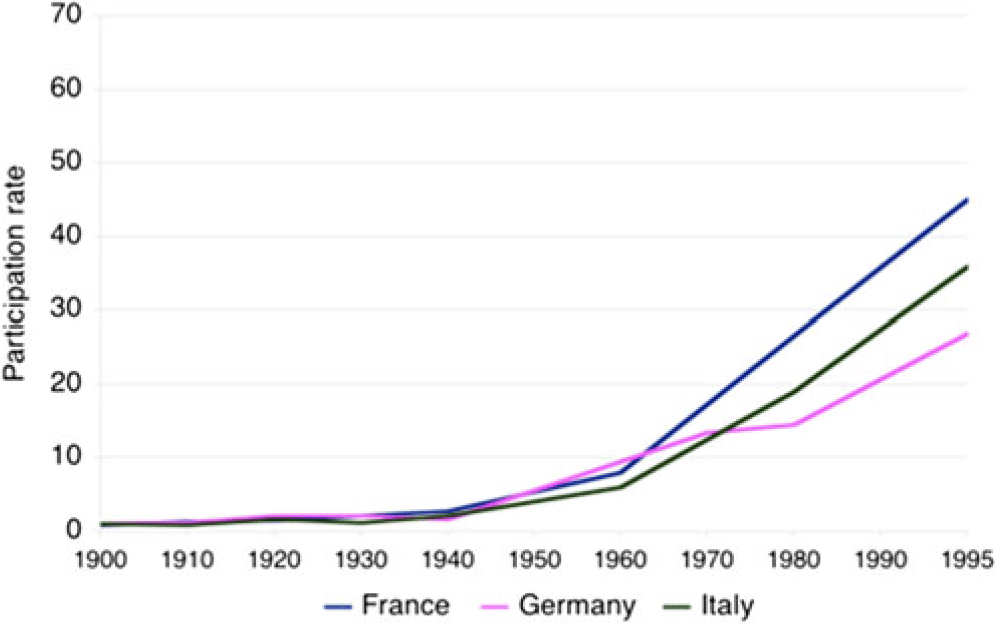
There is considerable truth in this argument, of course. No modern economy could function without large numbers of highly educated people, many with very specialised knowledge and skills, which require long periods of education and training. But what Figure 1 demonstrates is that, rather than growing in line with the labour market, tertiary enrolments follow a very distinctive pattern. They grow slowly and gradually for a while, and then suddenly take off. This accelerated expansion is not in line with labour market changes or demands, as discussed further below. Moreover, as can be seen in Figure 2, countries that have developed since the Second World War have reached levels as high as or higher than ‘old’ First World economies at income levels that are significantly lower.
Patterns of university enrolment in major European economies: proportion of an age cohort enrolling. (To view this figure in colour please see the online version of this journal.)
University enrolment rates as a proportion of the cohort in old and new industrial economies. (To view this figure in colour please see the online version of this journal.)

In recent decades, alongside rising secondary and tertiary enrolments, there has been a pronounced trend towards ‘over-qualification’, especially for graduates. Obviously, for given employment levels, the more graduates there are in the population, the higher the proportion of jobs that will be held by graduates. However, many jobs are now being done by graduates which, in the past, were done by non-graduates, without there being any major intrinsic change in the nature and demands of the job.Footnote 1 Studies vary in their estimates of over-qualification levels, but almost without exception find it to be very high, typically between 20 and 40%. Moreover, graduates who are underemployed at the start of their careers seem to suffer a permanent disadvantage compared with other graduates, and do not enjoy faster wage growth than non-graduate workers in their sectors (Korpi and Tåhlin Reference Korpi and Tåhlin2009; Diem and Wolter Reference Diem and Wolter2014; Green and Henseke Reference Green and Henseke2016; Baran Reference Baran2018).
It is possible that overall productivity levels nonetheless increase when jobs are held by individuals who are much more highly qualified than in the past. However, the data on individuals’ wage growth do not indicate this and, as discussed further below, there is no concrete evidence of broader productivity gains. At the same time, the growth in highly skilled professional and higher managerial jobs is slowing. They are still expanding as a share of the labour market but far more slowly than in the post-war decades.
These results suggest that something else is driving recent surges in university enrolment and graduation rates, over and above the demands of the labour market. The next sections argue that there are indeed two forces at work. The first is the importance of education as a positional good; and the second is the belief of governments in the beneficial economic and social effects of a rapid expansion of higher education.
The Struggle to Stand Out: Education as a Positional Good
Formal education systems have, as their core purpose, the inculcation of knowledge, skills and values, and it is this mission which dominates the day-by-day endeavours of both teachers and students, and also education ministries and inspectorates. But formal education also has another crucial role, which becomes more and more important the more universal and prolonged formal education becomes. It is to sort and rank students at the point where they make key transitions either between different parts of the education system itself, or between education and the labour market.
This function of schooling has become ever more important as the proportion of people involved in extended formal education has risen. At the end of the nineteenth century, for example, primary schooling was becoming very common, or universal, across Europe and North America; and most of these countries also operated selective academic secondary schools. These either were free to all students, or, although fee-paying, had places for which the state provided scholarships. Post-war, most – but not all – state education systems became ‘comprehensive’ and the role of primary schools in sorting became far less salient. The key points within education became, instead, the points at which students are admitted into more or less academic upper secondary programmes (for example, one or other type of baccalauréat), and/or at the transition from upper secondary to higher education: for example, attaining the university entrance certificate, or, increasingly, achieving the upper secondary results that enable entry to highly selective institutions, such as the French Grandes Écoles, ETH Zürich or Cambridge.
In addition to these internal sorting points, formal education also provides employers with a hierarchy of attainment. Substantive attainment is also important in the labour market. Thus, we know from longitudinal studies which carry out independent tests of attainment, that substantive literacy and numeracy skills have a significant impact on individuals’ success in life even after controlling for formal qualifications (Murnane et al. Reference Murnane, Willett and Levy1995; Adkins and Noyes Reference Adkins and Noyes2016). But employers also use formal qualifications, including, notably and increasingly, degrees, as a way of ranking applicants (Arkes Reference Arkes1999). Completing formal qualifications indicates both that the completer is more able than non-achievers, and, also importantly, that they have the character traits required to complete their course successfully.
Direct confirmation of the labour market role of formal qualifications comes from a number of sources. We know from multiple sources that people with higher qualifications tend to do better, earning more and obtaining higher status jobs. This appears clearly to be in part because of skills acquired (OECD 2018; Maurin and McNally Reference Maurin and McNally2008). However, the formally qualified also do better than people with the same academic attainment level who, for one reason or another, do not obtain the formal certificate (Jaeger and Page Reference Jaeger and Page1996; Wolf Reference Wolf2002). For example, in England, two key ‘gateway’ qualifications are taken at age 16: an English Language exam and a Mathematics exam. Success in these ‘General Certificate of Secondary Education’ examinations is crucial in determining admission (or non-admission) to an academic upper secondary programme. Comparison of students whose marks on the exam put them just one side or the other of the pass mark (so within any plausible confidence interval) show that pupils who just fail move on to a much less favourable trajectory at this key juncture (Machin et al. Reference Machin, McNally and Ruiz-Valenzuela2018). And, as noted above, the increasing number of jobs that are either formally or in practice ‘graduate entry’ or ‘graduate only’ reflects the way in which employers use degrees as a simple and also defensible sifting and shortlisting mechanism.
Throughout the post-war period, but especially since the late 1980s, public demand has, not surprisingly, encouraged governments to increase the size of academic secondary and upper-secondary enrolments relative to those that do not allow for tertiary entry. Most have also increased the number of possibilities for students in non-academic streams to move across to academic ones (Green et al. Reference Green, Wolf and Leney1999). The UK is one of a sizable number of European countries that moved from a system of selection at the elementary/secondary transition to one of ‘comprehensive’ secondary schooling. This change remained controversial on the political Right for many years, but was driven overwhelmingly by public opinion and, more specifically, the often vocal discontent of parents whose children were at risk of not gaining places at academic ‘grammar schools’ (Mandler Reference Mandler2020).
The same ever-growing demand for more education underpins the ways that tertiary education enrolments have outpaced the slowing growth in jobs that require a long, formal tertiary education. As more and more jobs are, effectively, reserved for graduates, so university is seen not as a guarantee of well-paid and stimulating employment, but rather as a precondition of any chance of such jobs. In other words, tertiary education may not open doors – but its absence slams doors in your face. In large urban societies, employers, and especially large and high-profile employers, quite rationally use formal qualifications to identify which applicants are worth shortlisting.
When only a small proportion of the adult population holds degrees, it is worthwhile, and indeed necessary, for most employers to look in detail at the potential, and achievements, of those who do not. But when half or more of the relevant age-group are graduating, why would any rational recruiter who is aiming to hire top talent spend huge amounts of time figuring out who, among the academic non-achievers, is a hidden gem? Recruiters can and do use formal education as a cost-effective sifting mechanism.
Moreover, employers increasingly use not just completion of tertiary education, but also information on where exactly that education was obtained. In countries such as the USA and UK, where there is a very clearly identified hierarchy of tertiary institutions, the pre-entry academic attainment of students is very closely associated with the prestige of the university attended. This provides employers with a good reason to prefer the graduates of one institution over another. However, the extent to which people benefit from attending an institution is far from fully accounted for by average pre-entry attainment.
For example, data on UK graduate earnings now allow us to control for both prior attainment and for subject studied. They show that, eight or so years after graduation, the individual institution attended accounts for a large part of earnings variation in and of itself. Employers, it would seem, fall over each other to employ those whose degree ‘signals’ unusually high quality (Britton et al. Reference Britton, Dearden, Shephard and Vignoles2016; Belfield et al. Reference Belfield, Britton, Buscha, Dearden, Dickson, van der Erve, Sibiet, Vignoles, Walker and Zhu2018). Top institutions also provide unusually good opportunities to create networks and make connections that will be useful later in life (Wolf Reference Wolf, Amsden, DiCaprio and Robinson2014). Not surprisingly, competition to enter these ‘winner-take-all’ institutions is extremely fierce, not only nationally but also internationally (Frank and Cook Reference Frank and Cook1995; Reeves Reference Reeves2017; Wolf and Jenkins Reference Wolf and Jenkins2018).
Subsidising Supply: Governments’ Promotion of Academic Tertiary Expansion
The competitive dynamics created by expanding tertiary education explain why more and more people wish to go to university. They also explain the shape of the curves shown in Figures 1 and 2. Once enrolments reach a critical level, more and more people feel not just that going to university might be a good idea, but that not going could be a very bad one. Tertiary education becomes about avoiding doors slamming in your face, rather than embarking on a fairly clear future career path. In this situation, demand is turbo-charged.
But tertiary education is very expensive. A very large proportion of those who currently participate would find it, more or less, impossible to do so if they had to pay the cost directly, from savings or commercial loans. They can attend because governments pick up the bill. Public expenditure on tertiary education in the ‘EU22’ averages 2.6% of all government spending, compared with 2.8% for all primary education (OECD 2018). In most European countries students either pay no tuition fees or very low ones, covering a small proportion of the total cost.Footnote 2
Why do governments all over the world pay for a much higher proportion of an age cohort to attend tertiary institutions than would be indicated by labour market demand alone? Why have they underwritten an increasing divergence between graduate supply and labour market demand? Modern governments face constant demands for increased spending, including the apparently insatiable demands of health care. Fiscal stress is the normal state of affairs. Yet they have not only funded higher education expansion but have, in many cases, given it more favourable treatment than other parts of the education system. OECD figures show that, between 2005 and 2015, the share of government spending dedicated to primary and secondary education fell in all the European countries for which data exist, but this was not the case for tertiary spending (OECD 2018).
Partly this reflects citizen demand. But those same citizens want greater expenditure in many areas. Higher education has done well, in this context, not just because of its popularity with voters, but for two other reasons: its perceived social role – discussed further below – and a near-universal belief that expansion promotes economic growth.
Educating for Growth
Countries vary in the extent to which economic motives for higher education expansion crowd out other motives: but a firm belief in the ability of education, and specifically higher education to power the economy pervades both the developed and developing worlds. It was very clearly evident in the EU’s ‘Lisbon Strategy’ adopted in 2000. This was intended to make Europe the ‘most competitive and dynamic knowledge-based economy in the world’, and the central commitment made by governments was to increase education spending as a direct contribution to growth and dynamism. All signed up to a substantial increase in per capita spending on human resources (essentially education and training) and specifically to ensuring that ‘the number of eighteen to twenty-four year olds […] who are not in further education and training should be halved by 2010’ (European Commission 2000).
The English government has been a notably explicit proponent of ‘growth through education’. In 2015, it removed any cap on the number of publicly-funded university places, and passed legislationFootnote 3 to make it easier not only for existing institutions to expand but for new ones to be established. A White Paper, Success as a Knowledge Economy, preceded and explained the legislation (Department for Education 2016). This was explicitly economy- and growth-oriented, and included, as important evidence to support the reforms, the statement that ‘Doubling the number of universities per capita is associated with over 4 per cent higher future GDP per capita’.
Taken literally, this was an extraordinary statement. It would suggest that, for the good of their countries, academics should all agitate to have their current universities divided up into four, or eight, or maybe 16 different institutions. The underlying analysis was a (single) econometric study in which the number of universities was one of the variables showing a positive relationship with GDP per capita.
Of course, this relationship could perfectly well work the other way (the richer you are, the more universities you have). But most politicians, government officials and academics are sincerely convinced that education creates skills which have a direct positive effect on the size and growth rate of the economy: and that, insituations where many citizens are experiencing stagnant or even falling wages, a remedy is to lengthen and improve their education.
For example, Raghuram Rajan, an eminent academic economist and former Governor of the Bank of India – India’s central bank – argues that growing inequality and stagnant wages, whether in the USA or in India, reflect, in sizable part, the poor quality of education for the less advantaged and/or restricted opportunities to attend university. ‘[T]he prospect of riches seems to be slipping out of reach for many partly because a good education, the passport to prosperity, is becoming unaffordable’ he argues. ‘To restore [our societies’] legitimacy, industrial economies have to restore opportunity to the middle class by improving education and creating the support structures that allow people to train for, obtain and keep good jobs’ (Rajan Reference Rajan2012; see also Rajan Reference Rajan2019).
Similarly, leading US economists Goldin and Katz, surveying the growth in inequality in the US, argue that ongoing technological change creates constant pressure on the education system to keep up, both by growing in size and by increasing quality. Inequality in Europe has grown less, they state, because ‘Europe’ (which they tend to treat as a single entity) has continued to expand its education system (Goldin and Katz Reference Goldin and Katz2008, see especially Chapter 9).
Expanding higher education attracts governments because of these arguments. It has the added attraction that the education system is, to a considerable extent, directly under governmental control. Governments are increasingly held responsible for delivering growth – and challenged by this demand. And here is something they can actually do.
However, much of the optimism about the results of higher education derives from the fact that graduates earn more, on average, than non-graduates. This is interpreted as showing that the graduates have more skills which the labour market finds useful. If new graduates are ‘produced’ they will therefore have the skills, and the earnings, too. Both the country and they will get richer.
Unfortunately, this is a non sequitur. The higher graduate earnings that have so entranced politicians are relative. They mean that graduates earn more than non-graduates, but they tell you nothing about the absolute amount that either group makes. It is perfectly possible for graduates to go on earning more than non-graduates while everybody gets poorer. Something like this has already happened in the USA for college-educated males below the top 20%. Their average wages have stagnated or fallen, but going to college still appears to be a good idea for the individual, with positive wage returns, because men who have never attended college have fared even worse (Abel and Deitz Reference Abel and Deitz2014).
Too many people, including many politicians, have taken a finding about the relative prosperity of graduates and interpreted it as meaning that increases in graduate numbers will lead to increases in absolute prosperity. In some countries (such as the USA), many graduates are already clearly failing to enjoy greater prosperity than the non-graduates who occupied an equivalent position in the wage distribution in previous years. However, overall, the world economy has continued to grow, and the general upsurge in higher education enrolments may have been playing an important role in that. In that case, one might reasonably expect decades with high graduation rates to have enjoyed higher productivity growth compared with immediately previous periods with lower graduation rates. This is not the case. Quite the contrary. Figure 3 shows productivity trends over the period since the Second World War for five large Western economies. Productivity can be defined in a number of ways and Figure 3 uses labour productivity growth. In other words, it shows the growth (or fall) in the amount people produce per hour.
Labour productivity growth in selected Western economies 1959–2014. Source: https://www.conference-board.org/data/productivity.cfm. (To view this figure in colour please see the online version of this journal.)
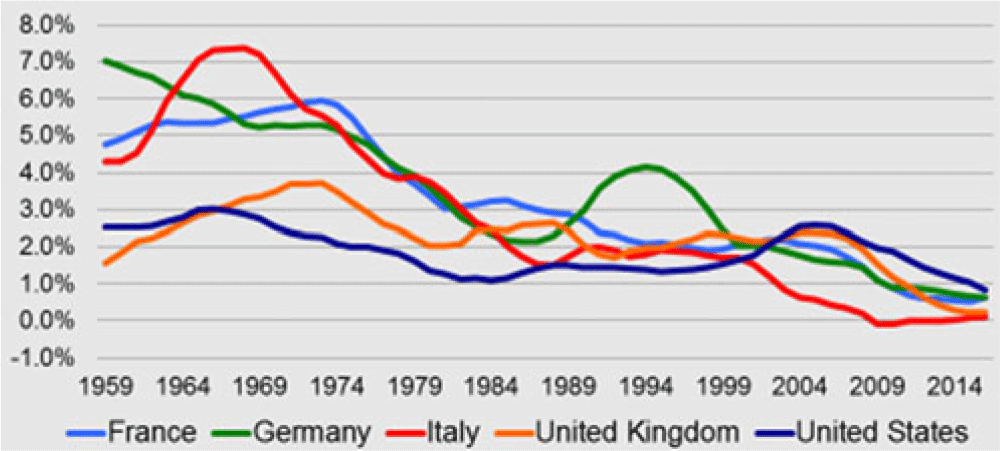
In the period immediately after the Second World War, economies ruined by the war regained and then surpassed their pre-war prosperity. It is the period that the French refer to, with reason, as ‘les trente glorieuses’ and it shows clearly in Figure 3. The US and UK enjoyed less strong productivity growth, but it was still maintained at a high level. However, Figure 3 also makes it clear that the developed economics are experiencing a long decline in productivity growth. This is obvious from the 1970s on – in other words, over the period in which university enrolments were not merely growing but growing remarkably fast. And the slowdown continues, even more markedly, in the twenty-first century, even as graduation rates continue on upwards.
Figure 4 takes the century from 1910 to 2010 and examines the United States, where mass higher education first emerged. The productivity data are taken from a recent book by Robert Gordon (Reference Gordon2016), who argues that, compared with the amazing innovations and productivity growth at various other periods in quite recent industrial history, the period of the last 40 years has been quite disappointing. IT provided some productivity gains, and smartphones and the internet have certainly altered the way we behave and connect with each other. But his argument, which some people dispute but for which he makes a strong case, is that if you compare the recent past with just a little further back, innovation has been slowing down.
US productivity and higher education growth. (To view this figure in colour please see the online version of this journal.)

Figure 4 shows both the average annual growth in total factor productivity (taking Gordon’s figures) and the change in the percentage of the US population enrolling in college over successive ten-year periods (available from the National Center for Education Statistics). There was slow productivity growth between 1900 and 1910; pretty slow growth between 2000 and 2010 and very fast growth between 1940 and 1950. Meanwhile, the percentage in the American age cohort enrolling in college grew very rapidly in the 1950s and 1960s, and then in the 1980s and 1990s. Overall, the periods after the 1970s when these greatly increased graduate cohorts entered the labour market have been marked by a slowdown in total factor productivity growth.
Obviously, none of this means that universities are not fundamental to any developed, technically-oriented economy. No modern state can operate without them, whether in their traditional role as teaching institutions, or as a source of research and applications. But stagnant or declining productivity growth is not what governments think they are buying when they underwrite continued and expensive university expansion.
The Social Functions of Education
What of governments’ other major proclaimed objective in expanding higher education – namely increasing opportunity and social mobility? University expansion has been welcomed by politicians of all persuasions as an effective way to achieve both, with the increased numbers of ‘first-in-the-family’ university students welcomed as a clear sign of an open and meritocratic society. An extreme example of the belief that expanding university enrolments equalises opportunity is to be found in Mexico, where the left-wing President, Andrés Manuel López Obrador, has promised, to that end, to make higher education an obligatory part of citizens’ ‘basic education’, abolish entrance exams for university, and open 100 new public universities. But the basic conviction is general.
In every prosperous country there are indeed far more people from poorer families attending tertiary education than there were 50 years ago. But it is much less obvious that this has equalised opportunity, or transformed social mobility. On the contrary, relative life-chances have changed very little. And the expansion of universities has done little, or indeed less than nothing, for many young people, especially in deprived areas.
As noted above, in the immediate post-war period, the rapidly changing structure of the labour market ensured that many people moved to better paid and more skilled jobs than their parents, without anyone’s upward movement needing to be balanced by another’s matching downward one. This change has now slowed. However, it is also true that if you look at the whole post-war period, people’s relative chances of being socially mobile have not shifted very much. In other words, there has been rather little underlying change in the extent to which ‘class histories’ matter.
Any generation that is born at the right time, when the labour force is being transformed in ways that increase the number and proportion of skilled and well-paid jobs, will have very different experiences and opportunities from its grandparents or great-grandparents. But this is because the overall labour market changes, and this can happen both with, and without, changes in relative opportunities. The evidence for the rich countries of the West indicates that, since the Second World War, the relative chances of a working-class child, middle-class child, or upper-middle-class child have been very stable (Bukodi and Goldthorpe Reference Bukodi and Goldthorpe2019).
A working-class child remains much less likely to end up in an elite upper-middle-class professional occupation than does a middle-class child. The latter, in turn, is much less likely to end up in the most elite jobs than a child born to a ‘top’ family. Upper-middle-class children dominate the most elite universities, and remain much more likely to graduate than those from working-class homes, even though more of the latter now also enter some form of higher education. Expanding higher education faster does not in and of itself seem to have much impact on the relative advantage bestowed by the class and nature of someone’s family of origin (Reeves Reference Reeves2017).
The Impact on Vocational Training
Overall, the huge growth in higher education has reflected and reinforced a dynamic that pushes more and more individuals, and governments, towards still further expansion. One result is that many young people do and will find that their studies do not provide them with the route to professional success and prosperity that predecessor generations could expect. Education is not just about seeking career success of course: but this motive is at the heart of our modern system, and indeed always has been (Dore Reference Dore1997 [1976]).
In addition, the growth of universities has had a direct effect on the non-academic part of countries’ formal education and training systems – commonly referred to, in English, as ‘vocational’. (This ignores the fact that highly vocational courses, such as medicine and law, have been university-based for many years, but there is no obvious alternative terminology.) Many young people still do not attend university. But as more and more people follow academic pathways in upper secondary school, with a view to entering higher education, vocational options have generally shrunk, not only in size but also in prestige (Carnevale and Strohl Reference Carnevale and Strohl2013).
The dynamic at work is the one described above. The larger the higher education sector, the more young people and their parents worry that employers will assume that non-graduates are less able, less hard-working and less desirable as employees. This further increases demand for tertiary entry – and also creates a negative attitude to alternative vocational tracks.
This may lead many young people, especially but not only those who are not academic high-achievers, to make choices which, at least in terms of future income and employment, are non-optimal. There remain many skilled jobs in the economy for which higher education-based training is unsuitable, but which pay well and also register high satisfaction among practitioners. The fact that large numbers of degrees now ‘pay’ less well than the average non-graduate wage reflects the existence of well-paid non-graduate jobs as well as the existence of many graduates in non-graduate positions (Cavaglia et al. Reference Cavaglia, McNally and Ventura2018). Moreover, flight from non-graduate pathways is also creating major skill gaps in some countries (Park Reference Park2011; Independent Panel 2019).
The pressures on vocational pathways are similar everywhere. However, countries with very well-established apprenticeship systems have been by far the most successful in maintaining vocational alternatives to academic, tertiary-bound pathways that are themselves prestigious rather than defaults after academic failure (Bosch and Charest Reference Bosch and Charest2010; Busemeyer and Trampusch Reference Busemeyer and Trampusch2012). Germany, Austria, Denmark and, most of all, Switzerland are the main examples of this, although even they have experienced ongoing increases in the numbers entering higher education (Steedman Reference Steedman2012). Some other countries, most notably the Netherlands, have maintained a very clear distinction between academic and vocational tertiary tracks, preserving high-quality vocational tertiary institutions which are a positive rather than a negative choice.
The common denominator among these successful systems is slightly paradoxical. They are the systems that have not made transfer between the two routes extremely easy (or, perhaps more accurately, have not tried to make them easy) and which have instead preserved quite distinct systems and high barriers between them.
The most plausible explanation derives from the same dynamic as was set out above. Emphasising possibilities for transfer between pathways may be presented by governments as a possible two-way street: but, in practice, they have been a response to increasing demands for access to the academic pathway, not to the vocational one (Green et al. Reference Green, Wolf and Leney1999). Consequently, they are perceived as a ‘second chance’ possibility, which further underlines the lower status of the vocational option. Conversely, if the two systems are quite distinct, it is possible for the vocational education sector to develop its own internal hierarchy, rather than always appearing at the bottom of the overall educational pyramid.
Such prestige can be associated with specialist institutions – notably in the catering and hotel sectors, where institutions can develop a national and indeed international brand. It can also, and most easily, be developed within apprenticeship, where the prestige of a position is directly associated with the prestige of the employer. Apprenticeships offer both a distinctive contribution in terms of substantive skills and experience, and also an alternative source of status which is entirely independent of the educational hierarchy. Thus, not surprisingly, apprenticeships with the great German and Swiss engineering firms carry an international cachet. Even in the UK, where apprenticeship decayed for many years, an apprenticeship with Rolls-Royce remains hugely prestigious and competitive, with more applicants per place than for Oxford or Cambridge and very high entry standards. However, small local firms can also have a strong local reputation, so that training, and job references, from them carry significant weight in local labour markets.
Such recognition and prestige are impossible to create when what is on offer is a vocational stream within a multi-stream upper secondary system, or a vocational post-school option within a general multi-sector institution. This, in turn, provides a clear lesson for policy, though one which many countries would find hard to implement. Apprenticeships need to be preserved, where they are still present and strong, as a clearly distinct and separate pathway and brand. Attempts to integrate them into general education risk simply devaluing them and also reducing their substantive quality.
Where the apprenticeship system is not, and is very unlikely to become large enough to absorb a sizable proportion of school-leavers, vocational options need to be as distinct as possible, and also allow for the emergence of an internal hierarchy of provision, with some options that are clearly more prestigious and competitive than others. Without that, young people will simply see this as a pathway that cannot offer them any competitive advantage in adult life. This requires both sizable investment and a commitment by policymakers, which can be hard to sustain in the face of highly understandable pressures for all lower-achievers to be offered courses at which they can succeed, rather than a continued possibility of (relative) failure.
However, the alternative and more likely future is one of continuing higher education expansion, which will largely reproduce the academic hierarchy formed in secondary school, and offer no alternative pathways to career success. The bigger the higher education sector becomes, the lower the funding-per-student is also likely to be, with obvious effects on quality. In other words, by chasing growth and social mobility though educational expansion, we risk achieving neither, and destroying academic quality in the process.
About the Author
Alison Wolf, Sir Roy Griffiths Professor of Public Sector Management, King’s College London; expert adviser on skills and manpower policy to the UK Prime Minister (2020–), and non-affiliated peer in UK House of Lords (Baroness Wolf). In 2011 she completed the Wolf Review of Vocational Education for the government, and was a member of the expert panel for the government’s 2019 Review of Post-18 Education and Funding (the ‘Augar Review’). Her publications are on the relationship between education and the labour market; vocational education; university funding and management. Her books include Does Education Matter? Myths about Education and Economic Growth (Penguin 2002); Improving skills at work (Routledge, 2011); (edited with S McNally) Education and Economic Performance (Edward Elgar, 2011); The XX Factor: How Working Women are Creating a New Society (Profile, 2013). Her current research is on the changing university sectors, including staffing patterns and academic careers: public lectures and transcripts on this are available at https://www.kcl.ac.uk/events/series/kings-lectures-2019.


 Open access

