





Outfitted in a padded suit, gloves, and a protective face mask, Tokuji Ono remembered when the dog trainer yelled, “Kill!” A pair of German Shepherds charged. One dog leaped at him from six feet away, grabbing onto the knotted burlap sack that he held at his neck. The second dog sunk its teeth into his right arm and yanked vigorously. Ono fell down when the trainer gave him the signal, then the two dogs lunged and snarled at him. After struggling with the animals for a few minutes, the trainer called the dogs off. In describing himself and twenty-three fellow Japanese American soldiers, he stated, “We were dog bait.”Footnote 1
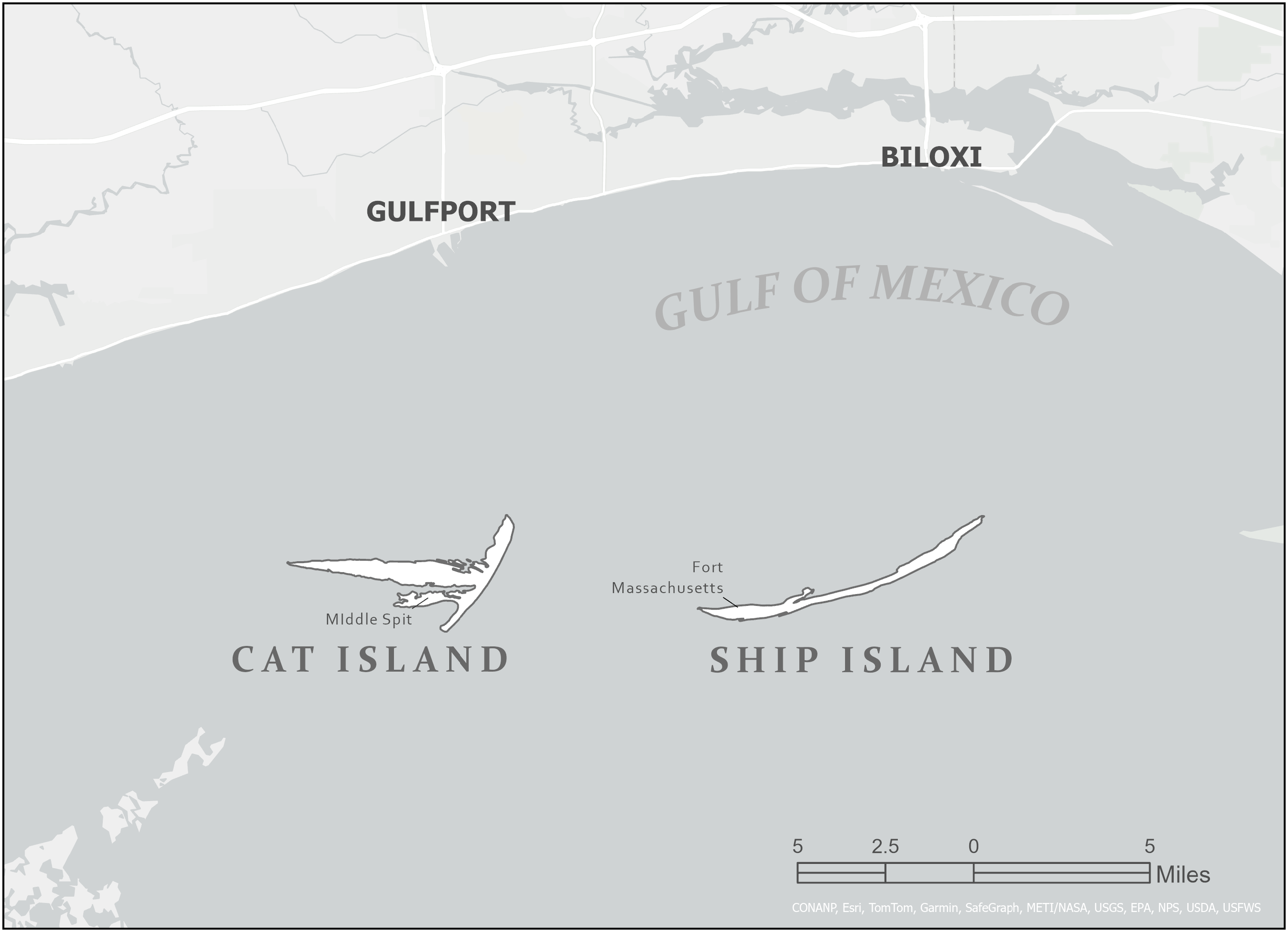
Ono’s brief time as canine lure occurred on Cat Island during the Second World War. Shaped like the letter T pushed on its right side, this barrier island sits in the Gulf of Mexico roughly nine miles south of Gulfport, Mississippi (Figure 1). Each north-south arm is about six miles long and one mile wide, with raised sand bars and flat areas dotted with grasses. Live oak, longleaf pine, palmettos, and thick foliage populate its east–west base, while Middle Spit sprouts from the southern arm and shelters marshes and swamps. With its isolated locale and lush vegetation, Army officials believed it was a suitable place to train dogs for future deployment in the Pacific.Footnote 2
Cat Island, Mississippi and vicinity, Courtesy of Aaron H. Gilbreath.

This project was part of a larger initiative to prepare dogs for combat. Dogs for Defense (DFD), a group established in January 1942 by dog trainer and breeder Arlene Erlanger, took the lead. Its primary function was to convince Americans to contribute their canines to the armed forces. Once the military decided to move forward with a war dog program, the Remount Branch of the Army Quartermaster Corps (QMC) established four War Dog Reception and Training Centers (RTC) across the nation: Front Royal, Virginia; Camp Rimini, Montana; Fort Robinson, Nebraska; and San Carlos, California. Here, veterinarians examined the animals, determined their suitability for military service, and trained them to join the K-9 Corps.Footnote 3
The Cat Island project provided another opportunity for dogs to aid the war effort. Former Swiss Army officer William Prestre, the founder and director of the program, maintained that dogs could learn to track and attack the Japanese enemy and thus serve as invaluable resources to Allied forces in the Pacific. However, the dogs needed “live bait” on which to develop and practice their skills. Officials from the Army Ground Forces (AGF), which oversaw this top-secret program, conflated the Japanese enemy with Japanese Americans and assumed that they had the same smell. They then identified members of the 100th Infantry Battalion—made up almost entirely of Japanese Americans from Hawai’i—as the perfect proxy and lure.Footnote 4
Predicated on the theory that Japanese people emitted a distinct scent, the Cat Island project built upon a long history of olfactory racism. In the seventeenth and eighteenth centuries, Anglo slaveholders posited that African people were innately pungent, which reinforced “biological definitions of inherent racial differences” and justified white dominance.Footnote 5 With the growth of a racially mixed population in the nineteenth century, the supposed existence of a black odor became even more salient because “sight alone could not always reliably authenticate race.” As historian Mark M. Smith has argued, “seeing remains—and always has been—extraordinarily important for locating racial identity,” yet it was also “mediated and articulated” by the other senses. Smell was of particular importance.Footnote 6
The links between racial inferiority and smell extended to Asian immigrants. In late nineteenth-century San Francisco, city officials and observers believed that “foul and disgusting vapors” emanated from Chinatown, stigmatizing its inhabitants as diseased and degraded. Although scientists were adopting germ theory at this time, miasma theory—the idea that disease originated from putrefying organic matter—remained influential and marked this neighborhood and its residents as public health threats.Footnote 7 On the outskirts of early twentieth-century Monterey, California, Chinese squid fishermen similarly irked businessmen, city officials, and visitors, who complained that their village was “unspeakably dirty and redolent with the odor of decaying fish” and threatened property values and the tourist economy. In all of these cases, “olfactory racialization” justified Chinese marginalization and displacement.Footnote 8
The perceived presence of racial odors also supported the use of dogs to hunt humans. By the early sixteenth century, European colonizers ordered dogs to attack Indigenous fugitives. Anglo slaveholders later used them to capture self-emancipating individuals.Footnote 9 Dog breeding emerged, and the Cuban bloodhound, known for its strength, ferocity, and keen olfaction, became the most coveted slave-hunting dog between the Haitian Revolution and the Civil War. To develop canine “anti-black conditioning,” trainers secured a black person to a tree, then set the hounds on their track. They also allowed dogs to lick and sniff enslaved people’s blood so that they could recognize “the common black odor that was believed to be separate and distinct from individual slaves’ scents.”Footnote 10 At the turn of the twentieth century, police forces continued to use some of these training methods, unleashing dogs on black outlaws or indebted sharecroppers.Footnote 11
This earlier animal history resonates with wartime Cat Island, where dogs once again became a tool to assert white power over a non-white adversary. Especially after Japan’s attack on Pearl Harbor, most Americans developed a deep-seated hatred of the Japanese, fueled by social and behavioral studies pointing to their inherently aggressive character and graphic imagery depicting them as apes, vermin, or with grotesque subhuman features. As historian John Dower has argued, they were “a race apart, even a species apart—and an overpoweringly monolithic one at that …. a uniquely contemptible and formidable foe who deserved no mercy and virtually demanded extermination.”Footnote 12 Training dogs to detect and attack them, then, could contribute to their much needed defeat. Indeed, as historian Brett Walker suggests, animals were “not separate from humanity, but rather an intimate partner in our species’ biological and historical transcendence.”Footnote 13 While serving as dog bait, Japanese American soldiers were also ordered to engage in violent behavior toward dogs, unwittingly conforming to and reinforcing the image of the vicious, cold-blooded Japanese enemy.
The Cat Island project was arguably a product of this anti-Japanese sentiment, but it also represented a significant shift in the construction of racial odors. Unlike the rhetoric surrounding Chinese immigrants decades earlier, the Japanese scent was not considered offensive or a mark of inferiority. Prestre and military officials only seemed to care that it was supposedly different from other groups of people and detectable by dogs, which could give the Allied forces a tactical advantage in combat. However, military officials were more circumspect than Prestre. They developed a measured approach that reflected strategic considerations and aligned with emerging doubts surrounding scientific racism. During the interwar years, anthropologists Franz Boas, Ruth Benedict, and others rejected the concept of race as a fixed biological category and implicitly called into question the very existence of racial odors.Footnote 14
The Gulf Coast environment informed the Cat Island project as well. Elsewhere in the wartime United States, natural resources were extracted and processed to supply the “Arsenal of Democracy.”Footnote 15 There was no resource development on Cat Island, but its geography, flora, and seclusion still served a martial purpose: the training of war dogs. While Prestre and military officials confronted several environmental problems as they implemented the program, Japanese Americans actually embraced the island’s nature because it resembled their Hawai’ian homes. Similar to many of the 120,000 Japanese Americans incarcerated in War Relocation Authority (WRA) camps, they did not wither in the isolating landscape and instead recognized that environmental amenities offered a salve for the brutal treatment they endured.Footnote 16
Just as quickly as it emerged, the Cat Island project ended without sending a single Japanese attack dog to the Pacific theater. This outcome was not surprising. For Prestre to succeed, race and environment needed to be stable and immutable. Neither were. As a result, the project reinforced Japanese American racial difference even as it challenged it. It degraded Japanese American soldiers as dog predator and dog prey even as it gave them a chance to restore their humanity on the beaches and waters of the Gulf Coast. These paradoxes emerged precisely because human constructions of race and environment were malleable and ever-changing. Although Japanese Americans became dog bait, they also exposed the precarious foundations on which the Cat Island project rested.
Launching the Cat Island Training Project
In implementing his plan for Cat Island, William Prestre was irascible and stubborn. He made specific requests for supplies, dog breeds, and the qualifications of his white trainers and was adamant that Japanese Americans must be available as live bait. Military officials did not reject the premise of Prestre’s plan, but they proceeded cautiously. In addition to weighing the environmental advantages and disadvantages of possible training sites, they worried about the broader strategic and security implications of using Japanese Americans as canine lures.
Prestre first wrote to the War Department in June 1942 and proposed training dogs to “rout the enemy or at least cause so much disruption that his position could easily be taken by normal means.” Intrigued by his pitch, the Army brought him to Washington, D.C. to consult with the Operations Division. He put forth an ambitious plan that required 20,000 to 30,000 dogs and insisted that he receive a captain’s rate of pay.Footnote 17 The Military Intelligence Division, the Federal Bureau of Investigation, and the Office of Naval Intelligence looked into Prestre’s background. Finding “nothing of a derogatory nature,” they had no reason to “question [his] loyalty.”Footnote 18
On July 16, 1942, Brigadier General Idwal H. Edwards, Assistant Chief of Staff for the War Department, issued a memorandum to the AGF, expressing a desire “to conduct a service test or experiment on the employment of dogs … to attack the enemy soldier.” While he was not committed to using dogs in this manner, it was “desirable to know the possibilities and limitations of such use.” This experiment had to be conducted on “a small island … in the interests of secrecy and safety.” He also asked that Prestre be employed as the “chief trainer” but suggested exercising “a reasonable amount of caution” because of his access to sensitive military information. Finally, the memo authorized the use of 200 dogs, which could be obtained from DFD, and fifty enlisted men for a period of three months.Footnote 19
It is unclear why the War Department was so quick to approve Prestre’s proposal. On the one hand, some critics had long questioned dogs’ olfactory skills. For instance, a 1914 German study of police dogs found that they could not distinguish reliably between different people. Researchers concluded that a canine’s power of scent was less important than its desire to “win the approval and avoid the disapproval of his master.”Footnote 20 Such assessments undermined Prestre’s plan. On the other hand, several European nations deployed dogs during the First World War with considerable success; they found and transported wounded soldiers, delivered messages, and worked on sentry detail. Americans took notice at the time, but interest fizzled. When the U.S. military finally started a war dog program in spring 1942, expert trainers were scarce and a standardized training program was nonexistent.Footnote 21 That Prestre approached the War Department when his purported skills were in demand may have worked to his advantage.
The AGF wasted little time and began to investigate possible project sites. Lieutenant Colonel A.R. Nichols explored five islands, all offshore from Mississippi or Florida, and concluded that Cat Island was the best option. He explained, “Detailed reconnaissance of Cat Island thoroughly convinces me that vegetation, opportunity for secrecy, etc. are so far more desirable than those of any other site we considered as to more than off-set the somewhat easier problem of construction and supply to be found at any of the other places.” In addition to foliage that “closely approximates tropical vegetation,” the island had an adequate water supply from shallow wells. Considering canine health, it was also preferable to the east coast from North Carolina to Florida, a region with a deadly heartworm infestation that could “destroy the project.” A parasitic roundworm, heartworm is transmitted to dogs when a mosquito bites an infected animal (wild or domestic), picks up larval worms, then bites and infects another animal.Footnote 22 Of course, Cat Island may have had disease-carrying mosquitos, so the dogs were not necessarily safe from harm there.
Excluding the insect situation, Nichols sought an island that at least partially resembled those in the Pacific so that the dogs could train in combat-like conditions. At the time, U.S. military knowledge of the Pacific environment was expanding. In March 1942, the Allied Geographical Section began to gather information about the Southwest Pacific Area. Comprised of American, Australian, and Dutch personnel, the unit produced terrain studies, handbooks, and special reports with maps, photographs, climatic data, and “any information which could be of assistance to military personnel, such as landing spots, vegetation, native foods, and the dangers which could be encountered in these unknown regions.”Footnote 23 It is unclear if Nichols obtained these materials. Regardless, he concluded that Cat Island bore some likeness to this theater of war.
By mid-August 1942, the details of the project began to take shape. Nichols was formally charged to develop the program and remain at Gulfport for its duration.Footnote 24 To staff the project, Major John R. Kimmell of the AGF Special Project Division provided four officers and several enlisted men, including those with past dog-handling experience. Prestre and twenty-five men would report to RTC at Front Royal, Virginia, for a one-month training program before settling on Cat Island.Footnote 25 The number of dogs was reduced to 100, with Prestre having the authority to select the breeds. Construction of the training facility was well underway by the end of August, with a projected completion date of September 19, 1942.Footnote 26
Given Prestre’s exacting demands, this date proved to be unrealistic. He rejected the twenty-five enlisted men who trained at Front Royal because they did not “possess the necessary qualifications for this type of work.”Footnote 27 The traits he sought, however, were contradictory. First and foremost, he wanted men who were from the West or Southwest: “Ranchers and sons of ranchers. Men who have actively participated in ranch life. Good horsemen and hunters.” He wanted “a ‘Davy Crockett,’” not the “white collar type man.” At the same time, he preferred college graduates and would not accept anyone with less than a high school education.Footnote 28 In reality, Prestre’s gold standard was not Davy Crockett but more akin to George Bird Grinnell or Theodore Roosevelt: educated elites who hunted for large game in the American West.Footnote 29 Either way, it would not be easy to find two dozen men who fit this mold.
Of course, Prestre’s most controversial request was the use of Japanese Americans as targets. At a meeting with AGF staff, he made it clear “that successful results from this project cannot be obtained without the use of at least twelve Japanese-Americans as assistant trainers …. These trainers would be used as ‘bait’ for the dogs.” He assured them that “all possible precautions could be taken against their personal injury.” AGF Commanding General Lesley J. McNair understood the logic of Prestre’s request, given that “his entire scheme of training is based on the use of the human scent.” However, he emphasized the possible repercussions. Japan knew about the mass detention of Japanese Americans in the United States and kept apprised of their conditions so as to calibrate its own treatment of American captives.Footnote 30 Not only could using Japanese Americans as dog bait “cause adverse public sentiment,” it could also “furnish the basis of a serious charge by the enemy, and might result in reciprocal action against American Prisoners in the hands of the Japanese.” Concluding that the program “involves too great a risk compared with any gain which can be foreseen,” he nixed the use of Japanese Americans.Footnote 31
Nichols had similar reservations. In a letter to Kimmell, he wrote:
PLEASE [A]VOID AND AVADE [SIC] SOLDIERS IF ITS [SIC] HUMAN[LY] POSSIBLE TO DO SO. SECONDLY, THEY ARE HIGHLY UNDESIRABLE BECAUSE WE HAVE TO HOUSE THEM WITH AND TREAT THEM THE SAME AS OUR TRAINERS AND WHITE SOLDIERS AND PRIMARILY THERE’S THE CHANCE OF AN ACCIDENT WHICH WOULD BE DAMN HARD TO COVER UP AND KEEP A SECRET IF ONE OF THEM HAD TO BE HOSIPATALIZED [SIC]. (YOU BETTER TEAR THIS LETTER UP AND EAT IT).Footnote 32
He further noted that “a considerable amount of diplomatic ‘holding down’” would be necessary in order to accomplish that which “is of definite military value.”Footnote 33 As with McNair, the potential fallout—whether at home or abroad—weighed heavily on Nichols.
Ultimately, the AGF decided to use Japanese American soldiers from the 100th Infantry Battalion. Comprised of 1,432 Japanese Americans who were members of the 298th and 299th Regiments of the Hawai’i National Guard, this unit formed in May 1942 because U.S. military officials viewed them as possible security threats. They were shipped to the mainland and trained at Camp McCoy in Wisconsin.Footnote 34 In September 1942, Army leaders requested that Major James Lovell, the battalion’s executive officer and assistant commander, report to the Special Projects Section at Fort Myer, Virginia. After learning about the project, he traveled to Cat Island, met with Nichols, and selected the Third Platoon of Company B for dog bait duty.Footnote 35
With the live bait issue solved, McNair issued a formal directive on October 20, 1942, specifying that training was to be conducted between November 1, 1942 and January 31, 1943. Prestre was to train general utility dogs to warn handlers of the enemy presence and attack and kill any enemy within 100 yards with a command or silent signal. Specialized dogs would be able to find enemy trails, lead handlers to enemy assembly points, warn handlers of the enemy presence “at such a distance as to enable our troops to gain surprise,” and attack and kill the enemy. Finally, dogs working in packs would likewise be trained “to assault and kill [the] enemy within 200 yards,” assist friendly troops during combat, and continue attacking until given a signal or command.Footnote 36
Meanwhile, Lieutenant Colonel Ridgely Gaither confirmed arrangements to house Japanese American soldiers on Ship Island, six miles east of Cat Island.Footnote 37 They lived here because Prestre wanted to keep their scent away from the kennels and training area on Cat Island.Footnote 38 They stayed on the western part of Ship Island near Fort Massachusetts, a fortification used by both the Union and Confederacy during the Civil War.Footnote 39 U.S. Coast Guard staff who maintained the island’s lighthouse station were informed of the “secret nature” of the project and instructed “to make no reference to the type of Army personnel housed on the island.”Footnote 40
Military officials also finalized the Japanese American “assistant trainers,” contingent on their responses to a loyalty questionnaire. Despite their U.S. citizenship and military service, they still demanded scrutiny. While Lovell later insisted that he had refused to distribute the questionnaire because, “these men had already been accepted into the army and if there was any question of loyalty, it was too late,” his objections must have been overruled.Footnote 41 Similar to the loyalty questionnaire issued to all Japanese American adults confined in the WRA camps in 1943, it asked respondents to provide personal information such as birthplace and parents’ occupation. Tokuji Ono surmised that men with significant ties to Japan were excluded. He quipped, “So we have to show that we were American citizens through and through and all that. Why? I don’t know.”Footnote 42 Colonel John T. Bissell of the War Department’s Military Intelligence Service subsequently informed Kimmell that nine men had questionable loyalty.Footnote 43 G-2 intelligence rejected four additional men.Footnote 44
In the end, three officers, one Japanese American cook, and twenty-four enlisted Japanese American soldiers made their way to Ship Island on November 3.Footnote 45 Their transport was shrouded in secrecy. They flew on two military planes from Camp McCoy to the Army Air Base Municipal Airport in New Orleans. They had no idea of their destination or mission, although Lovell told them to pack fishing lines, fishhooks, and bathing suits. When they asked him for more details, he responded that “we would enjoy the place we were going to and that it will remind us of home.” From the airplane, they watched the landscape below shift from brown to green and presumed that they were traveling south. Nichols met them at the airport, which had been vacated “so that no one could possibly see who arrived.” They then traveled by truck and boat to Ship Island.Footnote 46 Notices published in newspapers in New Orleans; Mobile, Alabama; and Pascagoula, Biloxi, and Gulfport, Mississippi, warned residents not to approach within one thousand yards of either island or risk being fired upon without warning.Footnote 47
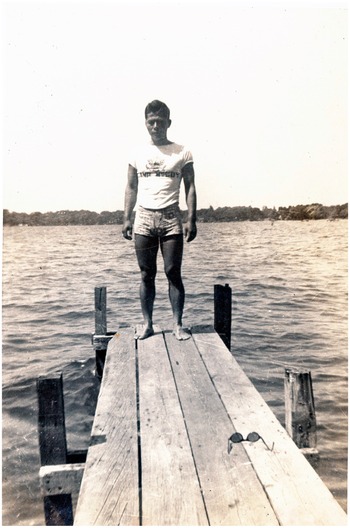
During their first days on Ship Island, the men of the 100th Infantry Battalion had no information about their mission. To pass the time, they swam in the ocean, played on the white sand beaches, explored the fort, and fished off the pier (Figure 2). After this almost idyllic introduction to the Gulf Coast, Nichols brought the men to Cat Island, where Lovell informed them of their mission. He later recalled, “[I] explained what the project was and told them there were some dangers, but we wanted to perform this in the same manner as we had performed all of our jobs: give it the best effort.”Footnote 48 The men were not told explicitly why they were chosen for the project, but it did not take them long to figure it out. “These dogs were being trained to attack Japanese. They were thinking we were the same kind of Japanese as the imperial Army Japanese,” Tokuji Ono explained.Footnote 49 Prestre assumed that there was no biological—and thereby olfactory—distinction between people of Japanese ancestry. Now they just needed to train the dogs to pick up their scent and attack.
William Takaezu on a dock in the Gulf of Mexico, 1942–1943. Courtesy of Mrs. William Takaezu and the 100th Infantry Battalion Veterans Organization.

Training Dogs and Humans
As daily routines became established, the Cat Island project encountered a number of challenges. Some were environmental, as the material conditions of Cat Island, Ship Island, and the Gulf were harsh and interfered with Prestre’s training program. The dogs, moreover, did not always submit to his demands. The biggest challenge was Prestre himself, convinced of the efficacy of his methods even though he failed to produce results. Still hoping to gain a strategic advantage with Japanese-detecting war dogs, military leaders recalibrated the project. As for the Japanese American soldiers, the racial violence of dog training was partly offset by abundant recreational opportunities along the coastline.
While its seclusion and vegetation made Cat Island an appropriate site for the project, its environment was unsatisfactory in many ways. According to Nichols, upkeep could be backbreaking, “in vie[w] of the condition that the camp area was in.”Footnote 50 In addition to the heat, humidity, mosquitos, and alligators that lurked in the swamps, the water was brackish and had a sulphuric taste and smell.Footnote 51 With increased occupancy, the well went dry. Water was then transported from Gulfport and had to be boiled before drinking.Footnote 52 On Ship Island, the coal supplies were exhausted quickly, so the Japanese American soldiers had to scour the island for pinecones and dry logs to heat their water.Footnote 53
Another significant challenge was transporting the Japanese Americans between Ship Island and Cat Island. This journey was dependent on weather and equipment, both of which were unpredictable. If the seas were rough, the boat did not show up. During one voyage, the engine died, and the men were left adrift in the Gulf of Mexico as darkness fell. Since they did not have a radio, they lit flares until a Coast Guard picket boat finally towed them back to Ship Island. On another occasion, the winds were so strong that the captain refused to dock at the pier and instead waited fifty yards offshore on the other side of the island. James Komatsu rowed a boat to meet him, but he then struggled against fierce headwinds that blew him out to sea. Taneyoshi Nakano stripped down to his underwear, jumped into the water, swam to the boat, and helped Komatsu row back to shore.Footnote 54 At a later date, the soldiers were moved to Cat Island, thereby eliminating these transportation challenges.Footnote 55
Prestre believed that the questionable skills of his non-Japanese American trainers also hindered the project. On November 7, 1942, he asked for ten more dog trainers, reminding his AGF superiors that they had agreed to enlist “capable men who would have nothing to do except training dogs.” Instead, Prestre complained that his staff was comprised of several “truck drivers, miners, cafeteria men and salesmen, who are not the ‘David Crockett’ type tha[t] was promised.” He reiterated his desire for trainers chosen from among western ranchers, “who are used to handling dogs and horses” and had attended college for one or two years.Footnote 56
Given Prestre’s constant demands and dubious results, Nichols’s doubts grew. He asked Prestre to prepare a training schedule, to no avail. On November 16, he noted, “Prestre seems to be getting quite a lot of discipline into the dogs, but I do not know how much of it will back fire [sic], because of rough treatment. He hasn’t progressed beyond disciplinary trainings and I can’t discover when he intends to do so.”Footnote 57
Prestre’s “rough treatment” of the dogs contravened conventional police dog training practices of the early twentieth century. These principles were applicable to war dogs, which likewise supported state power. Manuals emphasized “the importance of the emotional connection between dog and human.” Patience and kindness were paramount to developing this bond. Although trainers were trying to harness the dogs’ capacity for violence, they themselves were advised to use punishment sparingly “because it could physically harm the dog and damage their character, undermining their suitability for police work.”Footnote 58 Nichols’s observations suggested that Prestre had flaunted, rather than adopted, these practices.
Nonetheless, seemingly confident in his training methods, Prestre finally provided his training plan at the end of November 1942. He planned to train four types of dogs. Scout dogs, working off leash, would find and report to their master. Attack dogs, in packs of ten and without leash control, would strike the Japanese enemy and reassemble on command. Trailing hounds, working alone and in packs, would be able to trail or cast out for the Japanese scent, “following it until they bring the enemy to bay.” Finally, messenger dogs would carry a message from the pack master to the unit commander.Footnote 59
Nichols immediately scorned Prestre’s ability to achieve these objectives. He noted, “it is seriously doubted, that little or anything, of practical military value, can, or will be demonstrated at the completion of the probationary period of this project.” Even though Prestre, by his own admission, was not an expert dog trainer, he resented suggestions from his more experienced assistants. His “original and unusual methods” also approached “unnecessary cruelty.” In fact, his training “appears to be directed, more toward trying … to prove his theory feasible, rather than toward simply developing the animals’ acute senses and natural traits into equipment of military value in the hands of tactical troops.” This produced either “cowed” dogs or ones that will not attack anything except their handlers or each other. As a result, Nichols estimated that Prestre had ruined all but fifteen or twenty dogs. The project was thus “a waste of time and money,” even though he believed that dogs could be useful in jungle warfare.Footnote 60
Japanese Americans’ postwar accounts also criticized Prestre’s training methods. When working with scout dogs, they hid all over the island—in trees, in marshes—with a jar of horse meat. According to Yasuo Takata and Raymond Nosaka, two of the soldiers assigned to Cat Island, “Each dog trainer then sent his dog out to find us. When the dog spotted us, the trainer would fire a shot and we would drop dead with a piece of meat held in our hands in front of our necks.” At this point, “the dogs would eat the meat and lick our faces. I don’t know whether the dogs smelled the meat or our ‘Jap blood’.” They also suggested that some animals did not see them as adversaries. In fact, if the dogs were too friendly, they used whips, slingshots, and rocks to chase them away.Footnote 61
Nosaka also trained attack dogs. First, they enraged the dogs—German Shepherds and Labrador and Chesapeake Bay retrievers chained to a tree—by beating them with a knotted burlap bag. Adding to their fury was the fact that, according to fellow soldier Robert Takashige, the dogs were extremely hungry because they were only fed six times a week. As Takata and Nosaka recalled, “Can you imagine the dog growling, snarling and springing at you every time you hit him with a burlap bag! It didn’t take too long before the dogs were growling and pulling on their chains when they saw us coming.” They worried that the chains might break, although “Thank God it never did happen.”Footnote 62
Next, they taught the dogs to bite the knotted burlap bags. During this phase, the men wore helmets with a neck guard, face masks, and hockey gloves while holding the burlap bag in front of their necks. When the trainer gave the “Kill” command, the dog would rush to the men, bite at the burlap, and try to rip it away and pull the men down. Takata and Nosaka recalled, “You had to punch them or kick them away. It was like sparring, only you had a dog on the other side.” They also used the burlap bags to train the “arm” dogs. Now wearing full attack suits, they looped the bags around their right wrists so that the dogs grabbed their right arms. While the padding provided protection, they could still feel the sharp dog teeth on their skin.Footnote 63
During these exercises, Nosaka remembered bracing himself and protecting his neck as the dogs charged, knocked him over, and bit his arm. Once the trainer stated, “that’s enough,” the animals pulled away. This process was repeated several times. When the dog became accustomed to Nosaka, the trainer tied the animal to a fence and told him to hit it with a stick. He balked, stating “Shee, I can’t do that! I have dogs in my house.” But rather than disobey orders and risk punishment, he started with a light tap. The trainer implored him to hit the dog harder until it bled, at which point he told Nosaka to stop, put the stick away, walk backwards for ten yards, and turn around. The trainer yelled “Kill” again, and the now-irate dog charged.Footnote 64
These encounters illuminated how racial and animal oppression intertwined. As Paula Cepeda Gallo and Chloë Taylor argue in the context of police dogs, “animals are central vectors for white supremacist ends only through their own subjection to violent dominion.” The same insight can be applied to the dogs of Cat Island. Prestre’s trainers ordered Japanese Americans soldiers to exploit and abuse the dogs, then used them to terrorize Japanese American soldiers. The eventual goal was to ready the animals to attack the Japanese enemy.Footnote 65 Ordered to participate in this brutal process, Nosaka betrayed his deep affection for dogs and enacted the virulent imagery of the ruthless Japanese enemy. Thus, the Cat Island project racialized and dehumanized Japanese Americans on two levels—as dog prey and dog predator.
But neither the soldiers nor the dogs always complied with orders. According to Tokuji Ono, one soldier requested and received a different assignment because he “could not see himself tormenting a dog that way, needlessly.” Moreover, the dogs did not always become angered when the men struck them. Ono recalled incidents when the trainer gave the “kill” command, and the dogs just sniffed at the men’s feet. Even after being hit, some dogs just turned with their tail between their legs, rather than redoubling their efforts to attack the Japanese American soldiers. Frustrated, the trainer got “mad like heck.”Footnote 66 In these instances, both humans and dogs refused to torture each other and reinforce the racist and violent aims of the project.
For Ono, Prestre’s methods and the entire odor-based premise of the program were problematic. On one occasion, “just for the hell of it,” he slipped on a Japanese imperial army uniform, which Prestre kept on hand for the training mannequins. He remembered thinking, “My complexion, stature—I looked like a damn imperial army soldier.” However, he added, “Smell wise, I’m sure we don’t.”Footnote 67 In effect, Ono called attention to the malleability of racial constructions. A simple uniform could transform him, visually, into the enemy. However, he rejected the idea of a singular Japanese odor and implicitly repudiated scientific racism.
Military officials did not reject the existence of a racial odor, but they did begin to rebuff Prestre. By early December 1942, they moved to discharge him because he had created “a rather hopeless situation in the project.” Nonetheless, McNair still believed in the merit of war dogs and proposed that Nichols take over the project with the assistance of Sargeant John Pierce, “one of the best dog trainers in the United States.”Footnote 68 Prestre may have failed, but the dogs still had strategic value. Indeed, by early January 1943, Nichols reported that a few dogs had been trained successfully in “anti-Jap detection.”Footnote 69
Prestre’s days were clearly numbered, but Lieutenant Colonel Ridgely Gaither went through with his inspection on January 12 and 13, 1943. He observed the dogs as they ran up to a dummy or a “heavily padded Japanese” and grasped for a piece of meat tied to the throat. If the dummy or human fell down, the dog returned to its place in line and received a meat reward. Gaither noted, “There seemed to be no ferocity in the dogs’ actions and the meat seemed to be the incentive. It reminded me somewhat of a vaudeville animal act.” Two soldiers then assisted the Japanese American to his feet, then another dog rushed to him, put its paws to his chest, and knocked him down again. Gaither observed no “intent on the part of the dog to do bodily harm. It was simply part of the routine.” He was more impressed by a pack of foxhounds, “who demonstrated remarkable ability to track and tree a Jap.” In combat, these dogs could be used to locate Japanese infiltrators and snipers.Footnote 70
Gaither’s mixed review may have stemmed from Prestre’s divergence from the QMC’s forthcoming war dog training manual. While the manual was not published until July 1943, military officials may have had some awareness of emerging best practices. In training silent scout dogs, the manual instructs the trainer to give quiet praise when the animal indicates that it has picked up the enemy scent. Once the dog points out the general direction of the enemy, the enemy appears, waves a sack, and runs away. The trainer—not the enemy—then rewards the dog. This exercise is repeated by increasing the distance between the dog and the enemy, hiding the enemy in different places, and switching the person who serves as the enemy. The goal is for the dog “to pick up any human scent other than his master’s.”Footnote 71 Prestre inverted the QMC protocol by trying to train the dogs to pick up a supposed Japanese scent and having the “enemy” reward the dogs. As for the attack dogs, Prestre conformed to the QMC’s manual insofar as it instructed trainers to have dogs bite a sack, followed by an arm pad. However, the trainer is supposed to say, “GET HIM” (not “KILL”), and there is no mention of beating the dogs.Footnote 72
Prestre remained adamant about the efficacy of his methods and blamed any problems on outside factors, not his own incompetence. One problem was that the island was sickening the dogs, citing “something being wrong with the soil.” He noted that the dogs “were losing their ambition and zest” and that the Japanese American soldiers “walked around on the island too much, thus confusing the scent.” Finally, Prestre charged that a lack of interest among officers and problems procuring necessary supplies hindered his work.Footnote 73
Nichols dismissed Prestre’s complaints. He called his theory about the island being unsuitable for dogs as an “old wives tale,” even while acknowledging that the Gulf Coast in general “was not a particularly healthy place for dogs.” He also believed that the dogs were losing their motivation because of “brutal treatment,” which included electric shockers, bull whips, and being dragged through sand by a horse when they got out of line. As for Japanese Americans wandering around the island, Nichols explained that this was unavoidable because the boat used to transport them from Ship Island to Cat Island broke down and foul weather made it impossible to operate. Ultimately, Nichols was biding his time until Prestre’s training program was completed, confident that “it was going to prove nothing, and would have to be entirely altered in order to initiate a different type of training.”Footnote 74
In the meantime, Nichols authorized Pierce to train his own dog, the grandson of Hollywood star Rin Tin Tin, and two other “nondescript dogs” in assault work. With the assistance of two Japanese American soldiers, “their training was remarkable,” Gaither exclaimed. These dogs located the Japanese in “the thickest country and promptly attacked them on signal from their trainer” with a “marked ferociousness.” They could detect the difference between “Japanese” and “American” soldiers, “fully appreciated the need to destroy the Japanese,” and only attacked when ordered. Contrary to Prestre’s assertion that assault dogs could work in packs to attack the enemy, Pierce also demonstrated that one person could control no more than two dogs. Gaither concluded that working dogs in packs “should not be exploited further.”Footnote 75
It is doubtful that these dogs did, in fact, distinguish between Japanese American and white soldiers. Based on the QMC training manual, it seems more plausible that the dogs differentiated between the individual body odor of Pierce and the Japanese American soldiers and attacked because they were obedient to him, not because the soldiers were non-white. The QMC manual also affirmed the importance of this relationship between trainer and dog and downplayed a dog’s ability to follow a human trail. “If he becomes separated from his master in unfamiliar surroundings he will trail him,” it noted, but otherwise a dog was only interested in sniffing for other dogs or animals.Footnote 76
Ultimately, Gaither’s primary concern was the dogs’ military value, so he recommended that the Cat Island project continue on a smaller scale until March 1, 1943. Part of his reasoning was that a large number of dogs should not be trained in the United States “due to the wide difference in climatic conditions and heavy casualty rates to be expected upon taking them into the tropics.” If the scaled-back program showed promise, the dogs and trainers could be sent to Australia for more training, then deployment in the Pacific.Footnote 77 While Gaither was persuaded that the dogs could be trained to detect the Japanese—that the enemy did have a distinct smell—he proceeded deliberately and sought concrete evidence of the animals’ battle skills.
Another group of military personnel inspected the Cat Island project less than two weeks later. According to Kimmell, they observed that the dogs were “in very poor health and many had died apparently due to the strenuous and brutal methods used in disciplining them.” They also “attacked” the Japanese American soldiers by “tugging and pulling at their garments,” with “no actual ferocity” on display. Kimmell concluded that Prestre was “tempermentally [sic] unsuited and professionally unqualified as a dog trainer” and that the training of assault dogs for mass attacks was “inpracticable [sic].” Nonetheless, he, like Gaither, maintained that dogs could be trained to detect Japanese people and become “invaluable in jungle warfare.”Footnote 78 Military strategy continued to guide the AGF’s approach to the Cat Island project. Given the tactical value of Japanese-detecting dogs, he was not ready to completely abandon it.
Thus, Kimmell recommended that the Cat Island training program be transferred from the AGF to the Commanding General, Services of Supply and curtailed to focus on training scout and patrol dogs for use against the Japanese. To this end, ten or fewer Japanese American soldiers would need to be available.Footnote 79 Prestre, however, insisted that his entire training program had been a success. He demanded that Nichols and his officers watch a “show” that he had prepared. Nichols agreed and reported sarcastically that it was “an impressive spectacle” that would be convincing to “a person WITHOUT KNOWLEDGE OF BOTH TACTICS AND DOGS.” With the exception of the trailing hounds, the dogs’ performance was “artificial and ‘forced.’” Prestre finally left Cat Island on February 2, 1943, but he also announced his intent to “make plenty of trouble for any and all that opposed him … up to and includ[ing] the president.” Echoing the AGF’s rhetoric of strategic value, he charged that his adversaries “had denied [a] valueable [sic] weapon to our forces.”Footnote 80
Notwithstanding Prestre’s threats, the Cat Island project continued on a reduced scale, still guided by a belief that dogs could detect a Japanese scent. It focused on training scout dogs to operate in jungle patrols, with only an experimental program for attack dogs.Footnote 81 In addition, officials were ready to deploy six trailing hounds that “without failure find any Japanese foot scent they cross, even though several hours old, and will silently trail that scent an indefinite distance.”Footnote 82 It is uncertain if these dogs were ever shipped to the Pacific theater.Footnote 83
Prestre may have been banished from Cat Island at this point, but he followed through on his previous threats. In March 1943, he lodged several charges against Nichols, prompting McNair to request an investigation by the Commanding General of the Third Army in Fort Sam Houston, Texas.Footnote 84 Among his allegations were that Nichols had commandeered extra kennels for his personal hunting dogs, prioritized the care of these animals over the dogs-in-training, and brought civilians to Cat Island in violation of secrecy orders. He also charged that Japanese Americans were only present for an average of two hours per day instead of six. Kimmell conducted the investigation, concluded that these allegations were unfounded, and recommended no further action.Footnote 85 Brigadier General John Lentz later suggested that the Federal Bureau of Investigation (FBI) should determine if Prestre needed surveillance.Footnote 86
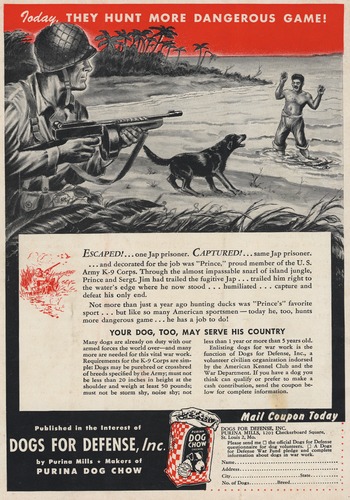
With Prestre fully discredited, the military activated the Cat Island War Dog Reception and Training Center on April 15, 1943.Footnote 87 The Quartermaster took over and expanded the facilities to accommodate 400 dogs.Footnote 88 Personnel focused on preparing scout and messenger dogs for “jungle operations,” but reports did not mention any continued efforts to train them to track or attack the Japanese (Figure 3).Footnote 89 Had AGF officials still believed that Japanese-detecting dogs could be produced, they may have kept Japanese American “bait” on Cat Island. Instead, they were quick to abandon Prestre’s program—and the odor theory on which it rested. This suggests that they did not hold strong convictions about the existence of a singular Japanese smell.
By the time this advertisement was published, the Cat Island program had ended. Nonetheless, Dogs for Defense still encouraged Americans to donate their canines by suggesting that their pets could aid Japanese capture. “The Dog News,” from The National Dog Magazine XXI, no. 8 (August 1943). Courtesy of the Division of Military and Society, National Museum of American History, Smithsonian Institution.

At the end of 1943, the 828th Signal Pigeon Replacement Company came to Cat Island to determine if dogs could transport Army homing pigeons to isolated areas inaccessible by vehicle or foot. The camp closed on July 15, 1944.Footnote 90 Meanwhile, eight Quartermaster War Dog Platoons were deployed to the Pacific theater and used successfully as scout dogs.Footnote 91
While Japanese Americans did not produce packs of ferocious attack dogs, they did win praise from their AGF superiors. Gaither noted, “Although their part in the entire project is distasteful to them they have cooperated wholly and completely and have frequently performed outstanding service in the training. Several of them have been severely bitten and yet continue the training without complaint.” For performing “up and beyond the call of duty,” he recommended that at least two soldiers be awarded the Legion of Merit.Footnote 92 Kimmell also endorsed Yukio Yokota, Taneyoshi Nakano, and Tadao Hodai for the Soldier’s Medal for heroism and bravery.Footnote 93 After serving as a proxy for the Japanese enemy, these men were singled out as exceptional American servicemen.
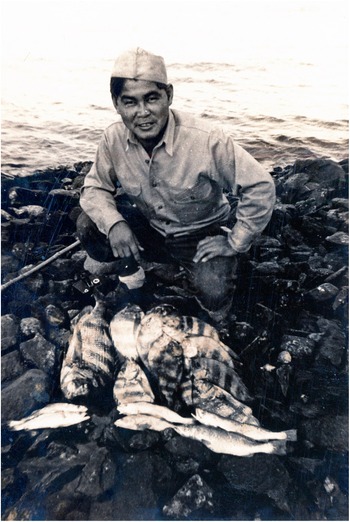
The Japanese American soldiers rejoined their battalion at Camp Shelby, Mississippi, unprepared for the rigors of infantry training after “living a life of Riley” on Cat Island. As Takata explained, they had “better than bankers’ hours.” They woke up at 9 a.m., trained the dogs, then ate lunch. After working for another couple of hours, they were done for the day. At that point, Takata, Nosaka, Ono, and Takashige remembered fishing for mullet and sheepshead or gathering oysters from the shore at low tide. The fish were plentiful, just like “old Hawaii,” Takata recalled (Figure 4). The men also rowed out to shrimp boats and bought buckets of crustaceans for fifty cents apiece. Besides swimming or hitting a softball every so often, the men had minimal physical activity and put on weight.Footnote 94 After leaving Cat Island, they regained their fitness and headed to North Africa on August 21, 1943. One month later, they landed on the beaches of Salerno, Italy, where they helped to push the Germans north. The battalion later became attached to the all-Japanese American 442nd Regimental Combat Team, which is the most decorated unit for its size and length of service in the history of the United States military.Footnote 95
Herbert Ishii with the day’s catch on Cat Island, Mississippi, 1942–1943. Courtesy of Mrs. William Takaezu and the 100th Infantry Battalion Veterans Organization.

Conclusion and Postscript
In reflecting on their time on the Cat Island project, the men involved—both white and Japanese American—were incredulous that the military invested significant resources in a project with a questionable premise. Yasuo Takata noted, “We didn’t smell Japanese. We were Americans. Even a dog knew that!”Footnote 96 John Russell, a white dog trainer and member of the 41st Scout Dog Platoon, added, “People didn’t understand that the scent of a Japanese-American is the same as an American or a European. You’d have to get men from Japan if you wanted the true body odor caused from diet and environment.”Footnote 97 Takata and Ray Nosaka likewise affirmed the relationship between food and smell. They quipped, “The high command finally concluded that the Buddhaheads from Hawaii did not secrete a peculiar odor of their natural ancestors. They forgot to feed us ‘chazuke, koko, and takuwan,’” referring to Japanese dishes of green tea or dashi broth poured over rice, pickled cabbage, and pickled daikon radish, respectively.Footnote 98 A recent scientific study reinforces and builds upon these earlier understandings of body odor, noting that numerous intrinsic (e.g. sex, age, emotions) and extrinsic factors (e.g. diet, disease, climate, hygiene) contribute to an individual’s scent.Footnote 99
But during the war, the larger anti-Japanese milieu helped to justify Prestre’s project. While James Lovell wondered, in retrospect, “how a president ever came to buy the theory that blood and sweat smelled differently, one race from the other,” he understood that “the president was susceptible to any well-intentioned idea that would exact yet another pint from the perpetrators of The Day of Infamy.”Footnote 100 It was also significant that Roosevelt had a preexisting belief that Japanese Americans were “immutably foreign and dangerous.”Footnote 101 Indeed, the Cat Island program reinforced existing conceptions of their racial inferiority. Whether as predator or prey, the Japanese American men of the 100th Infantry Battalion were degraded every time they donned their padded suits, struck a dog, or waited in fear as the enraged animals charged. They were reduced to animals and the subhuman enemy, irrespective of their American citizenship.
Nonetheless, these men found pleasure in the waters and on the beaches that reminded them of Hawai’i. The environment may have been confounding at times for Prestre and AGF officials, but it helped Japanese Americans restore their humanity. Given the brutal battles that they later fought in Europe—three members of the Cat Island crew, Masao Hatanaka, James Komatsu, and Patrick Tokushima, were killed in action—perhaps it is not surprising that Robert Takashige later noted that his days on Cat Island were “the best time I ever had.”Footnote 102
Ultimately, Prestre’s success rested on a stable, immutable conception of both race and the environment, neither of which existed. First and foremost, the dogs could not be trained as he promised because a Japanese odor did not exist. AGF officials only adhered to the racial odor theory insofar as it supported military strategy and gave the Allied forces a tactical edge. When it became clear that Prestre’s concept was unsound, they abandoned the experiment and trained the dogs for other purposes. The Japanese American soldiers left Cat Island and marched to battle, no longer dog bait or a stand-in for the Japanese enemy.
As far-fetched and inexplicable as the Cat Island project may sound today, many of its key themes remain salient in contemporary American race relations. First, the connections between race, ethnicity, and odors continue to affect immigrants and people of color, who confront discrimination due to their perceived odors. They have developed “olfactory anxieties” as they try to avoid the trope of the “smelly immigrant.”Footnote 103 For Asian American communities in New York City, for example, the desire to be accepted as respectable Americans has led to ambivalence about the smell of their food. Some individuals have compromised their food preferences or developed strategies to contain food odors, even as their foodways evoke nostalgia and allow them to remain rooted in their cultures. In short, odors “are important constituent elements in the cultural construction of difference and inequality.”Footnote 104
While no longer predicated on the existence of a racial odor, the use of dogs to intimidate and subdue non-whites has also persisted. During the civil rights era, law enforcement often used dogs to control and intimidate black activists. For instance, to fight crime and defend racial segregation, Birmingham, Alabama, Mayor Bull Connor created a K-9 corps in 1959 and unleashed these animals upon 1963 demonstrators.Footnote 105 Over fifty years later, the Ferguson, Missouri, Police Department used dogs “to inflict punishment” on protestors in the wake of Officer Darren Wilson’s fatal shooting of Michael Brown in 2014.Footnote 106 Whether deployed on Japanese American soldiers who stood as proxies for the Japanese enemy during the Second World War or Black Lives Matter demonstrators who questioned anti-black violence, dogs were powerful tools to subdue an apparent racial adversary.
************
In November 1943, Ray Nosaka got a shrapnel wound in his thigh during combat near Santa Maria Oliveto, Italy. It was early evening, and the sky was just beginning to darken. He was cold and had to wait until morning for transport, so he crawled into a nearby cave for shelter. Out of nowhere, a dog appeared. He explained, “He wasn’t afraid; he came straight to me … So I pet him, and I fed [him] whatever I had; and sle[pt] with him.” Then, “he just went away …. he disappeared.”Footnote 107 One year after he had started a mission that required him to beat dogs, Nosaka found comfort from another dog. On that cold evening, they had the same needs: food, shelter, and companionship.Footnote 108 He explained, “I felt warm inside, thinking I had the chance to befriend this stray dog, to, in a way, make up for the dogs I had to hit while in training.”Footnote 109
After he recovered and spent three more months behind battle lines, Nosaka returned to Hawai’i and received a Purple Heart, a Bronze Medal, and a Congressional Gold Medal. He was active with the 100th Battalion Veterans Club and worked for the Internal Revenue Service and the Veterans Administration. Out of all the Japanese Americans who served on Cat Island, he was the most outspoken, talking to newspaper reporters and academic researchers and even appearing on an episode of PBS’s History Detectives in 2009. Nosaka passed away in 2014 at the age of ninety-eight, with a scar from a Cat Island dog bite still visible on his forearm.Footnote 110

 Open access

