


Introduction
With research becoming more team-based [Reference Fortunato and Bergstrom1, Reference Wuchty, Jones and Uzzi2], it is critical that universities develop strategies to foster team science and the pursuit of collaborative funding. At the Michigan Institute for Clinical & Health Research (MICHR), the University of Michigan’s home for the NIH Clinical & Translational Science Award, we created infrastructure to support translational teams in developing large-scale grants, such as NIH U-and P-series mechanisms, that require researchers with diverse expertise and knowledge to harmonize efforts around a shared research vision. Currently, our established support services include strategic input from grant experts, proposal management, pilot grant funding, and grant editing, which are ideal resources for teams who are fairly cohered and have identified a funding opportunity announcement they want to pursue.
However, we encountered a significant number of faculty whose needs were outside of our established scope. Broadly, these were faculty who wished to tackle complex translational research problems and recognized they would need to work across disciplinary boundaries to be successful. While eager to engage in team science, they were challenged with how to mobilize new collaborators around intractable problems, identify common interests and priorities, and define tangible next steps. This suggested to us that to truly build and advance translational teams and agendas, particularly those cross-disciplinary in nature, we needed a pathway of comprehensive support services that commences years before the team will be effectively positioned to pursue large-scale funding. A critical first step in this pathway, and the focus of this manuscript, was accelerating the production of shared research ideas and priorities at the earliest stage of team formation.
The path to tackling a complex problem is not linear, which provides unique opportunity for creativity and exploration among members of a team [Reference Blackwell, Wilson, Street, Boulton and Knell3–Reference Kaner, Lind, Toldi, Fisk and Berger5]. However, the common meeting scenario – where there is often a lack of purpose and structure, diminished engagement when a few voices dominate the conversation, and no clear decisions or actions rendered – is not conducive for groups navigating ambiguity and seeking innovative solutions and commonalities within the traditional siloed academic environment. To advance cross-disciplinary translational teams at this early phase of ideation and organization, we looked to the fields of design thinking and human-centered design to create immersive environments in which groups, coming together for the first time, could participate in structured but creative activities that promoted collaborative brainstorming.
The Hasso Plattner Institute of Design (Stanford d.school) as well as companies such as IDEO have been at the forefront of popularizing the use of design methods for unleashing creativity across disciplinary boundaries in order to address challenging problems. The tools and approaches of a designer have been used in research to explore the future of synthetic biology [Reference Bernstein6], to address complexities in coastal sustainability [7], and to understand challenges in engaging mothers experiencing opioid misuse [Reference Weihe, Lynch, Moore, Cockrum, Hawryluk and Claxton8]. There are hundreds of tools that comprise a designer’s toolkit, and selecting the right ones depend on myriad factors, including the audience and what the group aims to accomplish [Reference Gray, Brown and Macanufo4, Reference Kaner, Lind, Toldi, Fisk and Berger5, Reference Hanington and Martin9–Reference Sanders and Stappers11]. At MICHR, we were inspired by Gamestorming, which provides numerous “games” or activities with different purposes [Reference Gray, Brown and Macanufo4]. To accommodate busy faculty schedules, our goal was to string together a series of games that would move groups through phases of blue-sky thinking, pattern building, prioritization, mapping interest, and action planning in 4 hours or less; we called these facilitated sessions Research Jams. In addition to using activities in Gamestorming, our recent commentary highlights our rationale for leveraging specific design techniques, such as understanding user needs, the power of visual artifacts, amplifying diversity, and convergent and divergent thinking, to move groups from collective ideation to action [Reference LaPensee and Doshi12]. Research Jams were used with teams in the development phase; these facilitated sessions fostered a psychologically safe environment for co-creation toward the ultimate goal of establishing shared understanding of a complex problem [Reference Hall, Vogel, Stipelman, Stokols, Morgan and Gehlert13]. While our efforts to increase faculty competitiveness for large-scale grants was the motivator for developing Research Jams, their utility is not limited to the long-term pursuit of a specific funding opportunity or to translational teams. These sessions could be implemented with any new group who wants to build community around shared ideas and identify tangible actions to advance their collective priorities.
Here we describe our experience designing and implementing two Research Jam models. We share assessment of their immediate impact, longer-term outcomes, lessons learned, and future plans to embed Research Jams within a comprehensive pathway of support that culminates in the submission of team-based grants.
Methods
Designing Research Jam “Models”
We designed and pilot-tested two Research Jam models, beginning in July 2019, to serve as the first intervention within our expanded pathway of support. These models were created by stringing together a series of activities or games [Reference Gray, Brown and Macanufo4, Reference Lipmanowicz and McCandless10] and were based on several co-creation principles. First, we grouped games such that participants would first maximize creativity by generating many diverse ideas (diverging) and then focus on prioritizing and decision-making (converging) [Reference Guilford14]. Second, we chose games that allowed participants to create visual artifacts using tools such as colorful sticky notes and dots, personalized “interest” cards, and eye-catching templates. Visual tools and artifacts are critical for capturing individual ideas, sharing them with others, and creating common focal points for discussion [Reference Nielson15]. Third, we selected variations of games that would elicit input from all participants and would appeal to both introverts and extroverts, including individual ideation as well as small and large group activities. Finally, so that next steps were identified to test and advance the initial vision, all participants engaged in building an action plan to drive work forward. A further description of each of these models is provided below:
The Ideation Jam
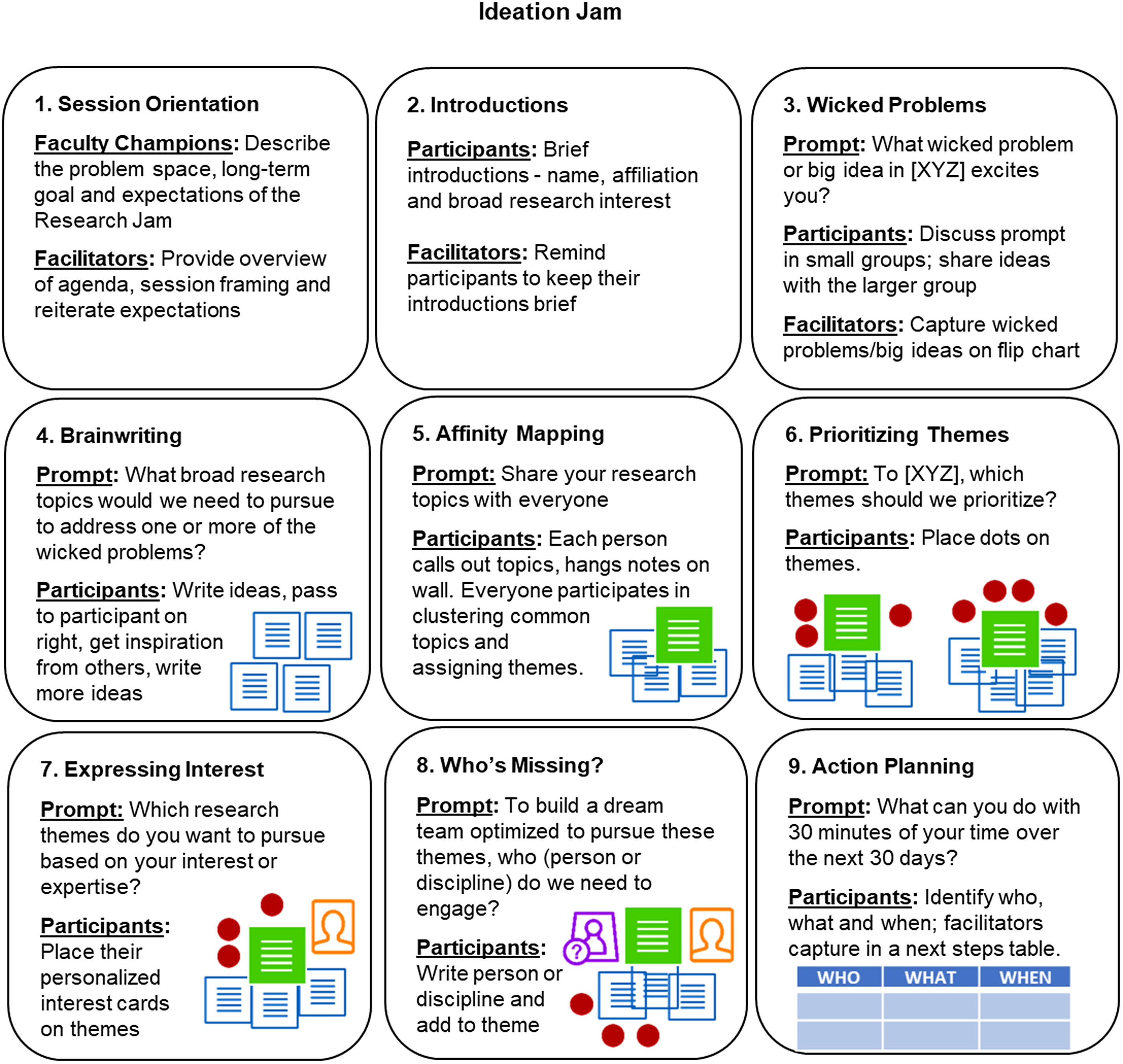
The Ideation Jam (Fig. 1) was designed for groups who wanted to mobilize toward addressing complex or “wicked” translational research problems. Following context setting by the faculty member who requested the Research Jam, also known as the faculty champion, and participant introductions (Steps 1–2), we moved into the divergence phase, where participants thought expansively around identifying wicked problems (Step 3) and research topics (Step 4) and subsequently clustered research topics into themes (Step 5). An activity such as brainwriting (Step 4), where participants wrote ideas and passed them to another person, allowed for individual ideation as well as the opportunity to build on the ideas of others. Affinity mapping (Step 5), where participants worked collaboratively to cluster ideas and assign themes, was an excellent activity for sparking conversations and having participants assume ownership of the ideas their group was generating. The Ideation Jam then transitioned to convergence, where participants prioritized themes (Step 6), added their personalized interest cards to themes they were interested in pursuing (Step 7), identified colleagues or disciplines not present at the session who would be critical to advancing the work (Step 8), and committed to low-burden next steps that could be completed in short turnaround (Step 9). The interest cards were named as such because we did not want participants to feel they needed specific expertise in an area to be a valuable team member; indeed, this was an ideal opportunity for researchers to engage in new work that excited them. All prompts embedded within activities were tailored to needs, such as prioritizing (Step 6) around becoming national leaders in a problem space, gaining momentum quickly, or positioning for a future center grant. An example of where we customized the Ideation Jam was to replace the wicked problems prompt with a framing question, which provided a more focused direction for the session.
An example in-person Ideation Jam, including prompts, participant actions, and facilitator actions. Step 3 is adapted from the The Surprising Power of Liberating Structures. Steps 4–9 are adapted from Gamestorming. [XZY] in Step 3 denotes the field of study of the research group. [XYZ] in Step 6 denotes prioritization should be refined to meet the needs of the research group; examples include to create momentum quickly or to become a national leader.
The Visioning Jam
The Visioning Jam (Fig. 2) was best suited for groups who wanted to coordinate efforts around a broad initiative that encompassed numerous focal points, including research, clinical care, education, training, and scholarship. Following a session introduction (Step 1), we used a Low-Tech Social Network activity (Step 2) as an opportunity for participants to co-create a visual map of connections within the room; this activity often highlighted new bridges among participants. In the divergence phase, participants envisioned a future state in which their initiative was wildly successful and described what that would look like (Step 3). This visioning step provided a foundation for mapping the scope of the initiative through the model canvas (Step 4), where participants identified the audience(s) they would serve, the value they would offer their audience(s), and the key activities they would pursue to bring value to their audience(s). Like the Ideation Jam, convergence activities included prioritizing key activities (Step 5) and defining next steps (Step 6), and all prompts were refined in accordance with group needs. One example of where we customized the Visioning Jam was to replace the Low-Tech Social Network activity with small group networking.
An example in-person Visioning Jam. Steps 2–6 are adapted from Gamestorming. In Step 3, [XYZ magazine] denotes selecting a medium that will resonate with the research group; examples include Science Magazine or features within a university-specific magazine. [XYZ] in Step 5 denotes prioritization should be refined to meet the needs of the research group; examples include to create momentum quickly or to become a national leader.

Tailoring Models to “User” Needs
We intended for the Research Jam models to be flexible in structure and tailored to group needs. Indeed, empathy [16] – the ability to deeply understand different people and scenarios – is a key component of human-centered design and one we used when interviewing the faculty requesting the Research Jam. We designated these “point of contact” faculty as faculty champions, and they collaborated with us iteratively throughout the design and planning process (Fig. 3). Questions we posed to the faculty champion in order to understand needs and objectives included: What is the complex scientific problem you want the group to consider? What is the long-term vision for the group? What would be ideal outcomes at the conclusion of a Research Jam? What participants have you already identified and who do you think is missing? and Will the participants have foundational knowledge of the complex scientific problem? We used the answers to refine the Research Jam framework, to craft the prompts used to elicit information from participants throughout the session, and to prepare all participants in advance for what to expect during the session. Following this initial discussion, we met at least two more times with the faculty champion to finalize the design of the Research Jam.
Research Jams Service Blueprint. The diagram depicts three service phases across the Research Jam process journey and how they interface with client touchpoints. The client for the Research Jam, Onboard Participants, Satisfaction Survey, and Report touchpoints includes the faculty champion(s) and the Research Jam participants. The client for all other touchpoints is the faculty champion(s).

Another critical component to understanding user needs relates to making sessions accessible to everyone. For example, and while far from an exhaustive list, we wanted to ensure the space and activities, such as posting sticky notes on walls, accommodated a wheelchair user; that visual artifacts and printed materials were legible for those with low vision; that microphones were used if participants had hearing loss; and that food was appropriate for those with intolerances. Seeking this information early allowed for all participants to fully and equally engage in the session.
Pre-Session Planning
Once the Research Jam model was finalized, we coordinated additional key elements for a session. First, physical space is an important component of the creative process, and ideating in a novel environment removed from traditional workday pressures can foster innovation [Reference Doorley and Witthoft17–Reference West19]. We typically hosted in-person sessions in unique locations around campus that had large open walls for clustering sticky notes and ample space for participants to move around and converse comfortably. Second, cognitive diversity within groups can support more effective problem-solving, particularly when the underlying issue is complex [Reference Page20, Reference Reynolds and Lewis21]. As needed, we helped faculty champions identify potential collaborators with divergent knowledge and expertise (Fig. 3), and we also emphasized the importance of engaging early-career faculty in collaborative research. Third, we created the visual tools needed for establishing common focal points; using large post it notes, we constructed a visual agenda, wrote all prompts for eliciting information throughout the session, and designed canvases/templates for displaying artifacts generated during the session. We also created personalized interest cards for each participant, which included their photo, professional rank/title, affiliation, and contact information (Supplementary Fig. 1); these were adapted from Gamestorming Trading Cards [Reference Gray, Brown and Macanufo4]. Finally, we onboarded participants by providing a participant list with pictures, names, contact information, and areas of research interest; by setting session expectations and sharing the purpose of the Research Jam; and by ensuring they had foundational knowledge of the problem space (Fig. 3). For the latter, we have used journey mapping to create visual stories [Reference Howard22], such as a patient’s experience living with a particular disease, that were easy to conceptualize.
The COVID-19 pandemic and rapid transition to remote work required us to quickly pivot in-person Research Jams to virtual experiences. There were myriad virtual whiteboard options for fostering collaboration, and we selected Miro. Miro allowed participants to capture their ideas on sticky notes, cluster them during the affinity mapping exercise, and move prioritization dots and interest cards (Supplementary Figs. 2 and 3). To recreate brainwriting, we designed individual workspaces where each participant wrote ideas before they moved to another participant’s workspace to read their ideas and generate new ones. Small group activities were possible using the breakout room function in Zoom.
Post-Session Activities
After the session (Fig. 3), we distributed a brief survey to participants that included both closed- and open-ended questions. Our main outcomes of interest were perceived utility of the session in surfacing shared ideas and participant interest in pursuing ideas/topics that emerged. We also inquired about resources needed to advance the work and suggestions for improving the session. We distilled all information generated during the session into a formal report, which was provided to the faculty champion within 2 weeks. We offered to meet with the faculty champion after the session to discuss the report, our general observations, and additional support that MICHR could provide.
Resourcing Considerations
Research Jams required significant resourcing for design, management, and implementation. The MICHR group that spearheaded this work was comprised of seven staff members with diverse backgrounds and roles, including human-centered design, team science, research development, project management, and administrative coordination. Several staff were experienced facilitators, a critical skill for effective session delivery. The management of ideas and group dynamics, particularly when navigating ambiguity, was a complex process. The facilitators needed the skills to foster an inclusive environment, actively listen, manage time and conflict, keep conversations focused, and be flexible and adaptive. We also had a faculty partner, an established researcher at the University of Michigan, with a wealth of expertise in leading large projects and teams, who provided guidance and feedback on the overall strategic effort. When mapping support to the Service Blueprint (Fig. 3), our project manager provided general oversight for all steps, three team members were involved in all meetings with the faculty champion, and one team member was needed for onboarding participants, distributing the satisfaction survey, and creating the report. Four team members, including two facilitators, attended in-person Research Jams and six attended virtual sessions.
Case Study
To envision this process in entirety, we will use Group Three (Table 1) as a case study. The faculty champion contacted us in October 2019 to request a Research Jam. Following an introductory meeting to understand user needs, the MICHR team identified the Ideation Jam as the appropriate model and confirmed an implementation time frame of February 2020 when a key collaborator would be in town. Based on answers to our user needs questions, we decided to replace the wicked problems prompt (Fig. 1, Step 3) with a specific framing question that would lead directly into the brainstorming activity (Fig. 1, Step 4). The faculty champion had a robust list of potential participants but looked to us to help fill disciplinary gaps, including participants with arts or music backgrounds. Over the subsequent 3.5 months, we met with the faculty champion for an additional four meetings that were each 1 hour in duration. The earlier meetings focused on discussing the overall Ideation Jam framework, potential participants, and venues. The later meetings focused on refining prompts (Fig. 1, Steps 4 and 6–9) and creating the journey map. Between meetings, we worked with the faculty champion by email to connect her with potential participants and finalize the prompts and journey map. Ten days before the Research Jam, MICHR staff created the visual tools and shared session expectations with participants via email. Post-session, we distributed the satisfaction survey within 2 days and provided the report to the faculty champion within 2 weeks. We debriefed with the faculty champion 3 weeks after the session. Broadly across all groups (Table 1), the frequency and length of meetings with the faculty champion(s) varied depending on the status of the participant list and whether support materials, such as journey maps, were desired; we have implemented Research Jams following as few as two 1-hour meetings with the faculty champion. In addition, this case study spanned a time frame of 4 months because it relied on the attendance of a specific collaborator. Depending on participants’ availability and the Michigan Institute for Clinical & Health Research (MICHR) staff capacity, a 1-month time frame from initial contact to implementation was also feasible.
Characteristics of the seven groups that participated in a Research Jam. Unit represents a University of Michigan department or division or an organization outside of the University of Michigan.

Results
Since launching Research Jams, we have hosted five Ideation Jams and two Visioning Jams, with group and session characteristics shown in Table 1. Each Research Jam was 3 to 4 hours in duration, with 4 hours optimal for virtual sessions. Each Research Jam was cross-disciplinary, as indicated by 4–12 units (i.e., University of Michigan departments or divisions or external organizations) represented in each session. Although the complex research problems under consideration were translational or clinical in nature, the diversity in unit representation highlighted faculty champions’ willingness to engage new and different viewpoints at the earliest stages of mobilization. Indeed, across all sessions, 45% of participants had primary appointments outside of the Medical School, where the majority of the University of Michigan’s biomedical research occurs; three of the sessions included experts from art, music, dance, architecture, and/or anthropology. Importantly, the majority of Research Jams involved health professional staff and/or research fellows, underscoring that the input of all group members was critical regardless of professional rank. The sessions were effective in generating many ideas. For example, Ideation Jams produced a range of 13–35 wicked problems and 127–374 research topics; research topics ultimately clustered to 13–25 themes via affinity mapping. Asking Ideation Jam participants who they would need to engage with outside of the session to drive the work forward elicited meaningful conversation; an average of 19 individuals, disciplines, communities, and/or populations were suggested across sessions as being instrumental for advancing the groups’ ideas.
We distributed surveys to 113 Research Jam participants from 6 sessions (4 Ideation and 2 Visioning) and had an overall 45% (n = 51; Fig. 4) response rate; the 16 participants in our first Ideation Jam (Group One) provided feedback to an informal email inquiry. For the remaining Ideation Jams (42% response rate, 32/76), 94% of respondents indicated that the session was helpful for surfacing shared research ideas and 84% felt that topics emerged they wanted to pursue. For Visioning Jams, (51% response rate, 19/37), 95% of respondents expressed that the session was helpful for moving the group toward a shared vision, and 100% indicated that activities emerged their group should pursue. Thirty-six survey respondents replied to open-ended questions, and Table 2 highlights themes identified across at least two or more responses. Notably, a desire for additional interactions/meetings with individuals or groups and funding were the most noted resources/strategies desired to advance the work. While the majority of respondents had no suggestions for improving Research Jams, assistance with technology in remote sessions and longer session duration were the most highly recommended.
Survey responses to quantitative (Likert) satisfaction survey questions for Ideation Jams (n = 5) and Visioning Jams (n = 2). Surveys were distributed to a collective 113 participants, with an overall response rate of 45% (n = 51). Survey questions in full: (a) The Ideation Jam was helpful for surfacing shared ideas. (b) By the end of the Ideation Jam, one or more topic(s) emerged that I want to pursue. (c) The Visioning Jam was helpful for moving our group toward a shared vision. (d) By the end of the Visioning Jam, one or more activities emerged that our group should pursue.

Responses to the two open-ended satisfaction survey questions. Themes (i.e., appeared in two or more responses) and one example comment are shown. Additional interactions/meetings comprise researchers meeting one on one, with the small subgroups that emerged during the affinity mapping activity, and with the original Research Jam group.

Although we initially designed Research Jams to be an in-person experience, we quickly moved to virtual implementation in response to COVID-19. We transitioned all Ideation and Visioning Jam session plans into the Miro online collaboration platform (Supplementary Figs. 2 and 3), building one additional hour into the agenda to provide time for a Miro tutorial, for participants to navigate the platform throughout the activities, and to support multiple breaks. When comparing participant feedback between the in-person versus virtual sessions (Supplementary Table 1), responses differed across the two domains of agreement (agree or somewhat agree) regarding utility for surfacing shared ideas (100% in-person; 87% virtual) and interest in pursuing topics that emerged (100% in-person; 81% virtual). Indeed, more participants from the in-person sessions fully “agreed” in response to both questions (75%; 24/32) compared to participants in the virtual sessions (39%; 12/31). In contrast, more virtual participants from the Visioning Jam fully “agreed” with both questions (93%; 13/14) compared to the in-person session (79%; 19/24) with the caveat that only two groups have used the Visioning Jam model. In terms of resources/strategies needed to drive the work forward, the themes were similar between the in-person and virtual session participants. As expected, virtual participants’ recommendations for improving the session largely focused on difficulties with navigating the online collaboration platform as well as the desire to have more time in breakout rooms.
Although our long-term intention is for Research Jams to be the first in a series of interventions designed to advance collaborative efforts, several groups have reported significant progress as a direct result of Research Jams. Group One developed and secured a NIH research education grant after the Ideation Jam surfaced a desire to build a better pipeline of research and mentoring activities in their problem space. Group Three introduced two subspecialty clinical offerings at Michigan Medicine, the academic medical center at the University of Michigan, leading to enhanced multispecialty care for their disease of interest. The Group Three faculty champion noted that although their session was held primarily with the expectation of spearheading novel research collaborations, the expansion of clinical offerings was catalyzed by the session and the growth mindset that the activities elicited. The faculty champion also said that the formal backing of MICHR provided credibility to launch a new research direction and to draw in a diverse array of individuals for whom this would also be a new direction in their work. Fulfilling action items identified in the Ideation Jam, Group Five organized additional workshops for faculty to learn more about each other’s research, and they engaged several new researchers who were named in the “Who’s Missing” activity. A subgroup emerging from Group Five met monthly to draft a collaborative R01 that will be submitted this year. Group Seven reported that the Visioning Jam guided creation of their collective mission and vision; helped participants “see themselves” as part of the community; and defined their first projects. The Group Seven faculty champion said the session was structured in such a purposeful way that participants felt it was worth their time to attend, and that the activities helped them identify what everyone had in common, whereas the siloes in academia often emphasize differences. Several other groups used their formal reports to organize small working groups based on themes and associated interested individuals that emerged from the affinity mapping and interest mapping activities.
Discussion
Our experience supporting faculty teams in developing large-scale grants revealed there was a significant need for us to establish infrastructure to mobilize groups toward addressing significant, or wicked [Reference Rittel and Webber23], translational research problems long before they would write applications. Our initial efforts focused on groups in “Day 1” of building their research agendas and teams; we leveraged design thinking and human-centered design strategies, coupled with a half-day time frame, to spark creativity and generate ideas; to foster enthusiasm and community; and to create buy-in for the next phase of planning and experimentation. Funders and the National Academies have also used think-tank style events to spur cross-disciplinary collaborations as exemplified by the National Science Foundation Ideas Labs [Reference Collins, Kearney and Maddison24], the United Kingdom Engineering and Physical Sciences Research Council Sandpits [Reference Giles25], and the National Academies Keck Future Initiative [26]. These programs were impressive in scope, with participants from various disciplines selected through an application process to attend residential retreats where they collaboratively ideated around pre-identified themes and competed for funding. The extended duration of these sessions allowed for deep exploration and refinement of potential projects, time for participants to get to know each other, and the opportunity to hear research or inspirational talks and/or view posters. While Research Jams were also designed to spark creativity and engagement around a big problem, their half-day duration is intended to be a low-burden commitment by comparison. Research Jams also differed from these larger initiatives in that the complex problems under consideration were a call to action by the faculty champion rather than a top-down mandate; attendance was by invitation rather than an application process; and funding was not available specifically for these efforts although groups were welcome to apply to the pilot grant offerings housed at MICHR. We intended for our Research Jam models to be accessible for other team science and research development professionals to adopt and implement at their own institutions. Importantly, our models should easily transfer beyond translational teams and have broad utility across a range of scientific domains and group compositions.
Transitioning in-person Research Jams to virtual platforms was unanticipated, with benefits and challenges associated with remote experiences. Participant satisfaction following virtual Ideation Jams was lower than for in-person sessions, and almost 30% of virtual survey respondents noted challenges with technology as an area for improvement. Although a small number for comparison, this difference was not observed with Visioning Jams, where virtual participants were given view only access to the Miro board while MICHR staff populated and moved artifacts. It is possible that time spent on technology issues distracted Ideation Jam participants from fully engaging in activities and discussion. We also speculate that participants faced home life distractions during COVID-19 that prevented complete immersion in the session. Broadly, we suspect participants were more apt to multitask during virtual meetings because they could turn off their videos and address other work priorities unnoticed. Those less likely to actively participate in virtual meetings tend to be less fulfilled by the experience [Reference Gershman27], and group brainstorming is most effective when participants pay attention to the ideas of others [Reference Brown, Tumeo, Larey and Paulus28]. Virtual sessions also shifted the dynamic and underlying intention of certain activities. For example, affinity mapping in-person was a great activity for igniting spontaneous conversations among participants as they worked together to cluster ideas; however, this activity was more individual and reflective in a virtual session as only one conversation could take precedence at a time. The most significant advantage to virtual Research Jams was the ability to foster inclusivity through engagement of external partners, or colleagues nationally and internationally, in these early-stage conversations; they were also more practical for faculty with hectic schedules. In the future, we will only recommend a Research Jam be conducted virtually when geographic distance is a significant barrier to engagement and collaboration.
We have learned many lessons implementing Research Jams. First, virtual sessions required more resources for implementation, and collaboration platforms could be frustrating for participants who were using them for the first time. Alternative options include using tools that may be more familiar, such as Zoom voting and Zoom chat, for activities such as prioritizing and expressing interest, respectively. There is also a wealth of virtual platform options that vary in ease of use. Second, we learned that overcommunicating session goals and expectations was necessary. While we addressed these in our onboarding process, we coached the faculty champion to provide critical framing of the problem space, anticipated session outcomes, and their desired long-term goals during the first 10–15 minutes of the session. Both facilitators and faculty champions emphasized that the Research Jam was simply the first step in the collaborative journey – one that was intended to guide groups in understanding research and activities they were best suited to pursue together. In absence of this grounding, participants had unrealistic expectations, including that comprehensive pilot projects would be delineated. Our experience suggests that smaller interest groups emerging from the Research Jam would benefit from a facilitated session focused on developing pilot projects. Third, we emphasized the importance of creating cognitive diversity within research groups to foster creativity, but scientific quality and innovation are also positively impacted by gender and ethnic diversity [Reference AlShebli, Rahwan and Woon29–Reference Nielsen, Alegria and Börjeson31]. While we shared these insights with faculty champions as they coordinated Research Jam participants, we aim to be more intentional in how we educate about these critical team characteristics. Fourth, abundant visual artifacts were produced with each activity, and this could be overwhelming for participants to process as we moved efficiently through activities. We learned it was crucial to provide time between activities for participants to silently reflect on the information generated. Finally, regarding survey results, we were struck by the number of respondents who said topics or activities emerged they wanted to pursue. While it is possible that nonrespondents would have disagreed with these statements, we learned to not expect that all participants will remain engaged with the group moving forward. Indeed, Research Jams provided a unique opportunity for faculty champions to identify collaborators who have the potential to be most invested in the work before it begins. Future evaluation of Research Jams will seek to understand if and how participants’ ways of working change over time using open-ended questions, such as described in Murphy et al. [Reference Murphy, Samuels and Kolb32], which are intended to identify a broad array of outcomes. We will map survey responses to the transtheoretical change model [Reference Prochaska and Velicer33], which posits that changes in behavior progress through a series of stages, including contemplation, preparation, and action. Combined, these data should reveal specific ways that Research Jams foster early-stage team mobilization as well as inform whether additional interventions are needed to drive individuals to action.
While Ideation and Visioning Jams can be implemented as a stand-alone intervention to help groups begin moving in a common direction, we intend for them to be the first step in a comprehensive pathway of support services that will span 2–4 years of a team’s evolution. Ultimately, we aim to advance both research agendas and team functioning to increase the chances of grant success. In response to open-ended survey feedback, and to complement Research Jams in our support pathway, we will make project managers available to coordinate and advance research priorities, develop and launch several pilot grant mechanisms targeting various stages of team mobilization, and offer trainings that are informed by translational team and individual competencies [Reference Lotrecchiano, DiazGranados and Sprecher34]. Our ultimate goal is to partner and embed with emerging translational teams, providing them with the right resources at the right time, on their journey to funding success.
Supplementary Material
To view supplementary material for this article, please visit https://doi.org/10.1017/cts.2021.823.
Acknowledgments
The authors would like to thank Janine Capsouras for her assistance in organizing these sessions, Jane Bugden who coordinated the satisfaction surveys, Linde Huang who created templates and provided critical feedback during our startup phase, and Elias Samuels who provided evaluation advice. This work was supported by the National Institutes of Health (NIH/NCATS UL1TR002240).
Disclosures
The authors have no conflicts of interest to disclose.


 Open access

