


1. Introduction
The conceptual design phase is crucial for producing innovative solutions that integrate functionality, behavior, and aesthetics, serving as the basis for design creativity (Reference Andreasen, Hansen and CashAndreasen et al., 2015; Reference Tufail, Park, Wang and KimTufail et al., 2026). Design is fundamentally a social and communicative practice (Reference Kleinsmann and ValkenburgKleinsmann & Valkenburg, 2008), in which meaning is negotiated, concepts are communicated, and solutions evolve through discussion and collaborative inquiry. In design education, students navigate between collaborative engagement, discussing, critiquing, and co‑creating knowledge with peers, and individual ideation, wherein they independently synthesize and refine concepts. Although group work is often employed to simulate professional practice, there is limited understanding of how students engage with resources across these conditions and how each shapes core cognitive processes (Reference Eris, Martelaro and Badke-SchaubEris et al., 2014). Despite its potential to enhance cognition through discussion and reflection (Reference Herrera-PavoHerrera-Pavo, 2021), collaborative learning presents a paradox: it can be less efficient than individual work, particularly for complex tasks. This paradox highlights challenges such as increased cognitive load, complex group dynamics, and difficulties in managing digital resources. Cognitive load theory (CLT) explains this tension through competing mechanisms. Collaboration can foster a “collective working memory” that distributes cognitive load (Reference Kirschner, Sweller, Kirschner and ZambranoKirschner et al., 2018), yet the coordination and communication it requires may induce extraneous load that overwhelms working memory capacity and impedes the schema‑building germane load essential for learning (Reference Sweller, van Merriënboer and PaasSweller et al., 2019). Unstructured group work may thus hinder the very learning it aims to facilitate, a conflict underscored by evidence that effective collaboration depends on structured processes (Reference Martinec, Horvat, Škec and ŠtorgaMartinec et al., 2018), while individual work may sometimes promote deeper cognitive engagement (Reference Ma, Liu, Zhu and KangMa et al., 2025).
Although CLT originates in cognitive psychology, its application to design contexts has expanded significantly. Design research has investigated cognitive load in relation to sketching (Reference Zimmerer and MatthiesenZimmerer & Matthiesen, 2021), prototyping (Reference Camburn, Viswanathan, Linsey, Anderson, Jensen, Crawford, Otto and WoodCamburn et al., 2017), and collaborative sessions (Reference Martinec, Horvat, Škec and ŠtorgaMartinec et al., 2018), exploring methods to manage load through structured approaches and tools (Reference Hay, Cash and McKilliganHay et al., 2020). Building on these studies, we apply CLT to the specific cognitive demands of conceptual design by focusing on a fundamental social condition: working individually versus in an unstructured group. While prior research has examined task structure variables such as dependency and sequencing (Reference De Dreude Dreu, 2007; Reference Marks, Mathieu and ZaccaroMarks et al., 2001), we hold these constant to isolate the impact of the social condition itself. This enables direct examination of the collaboration paradox through a CLT lens, employing a mixed‑methods approach to assess cognitive load, behavioral patterns, and qualitative cognitive processes. The study is guided by three research questions (RQs):
RQ1: How do individual and group-based design conditions affect cognitive load during conceptual design?
RQ2: What distinct design perspectives, problem-solving strategies, and information processing patterns emerge in these conditions?
RQ3: How do observed behavioral patterns in the design process correlate with cognitive load?
2. Conceptual framework
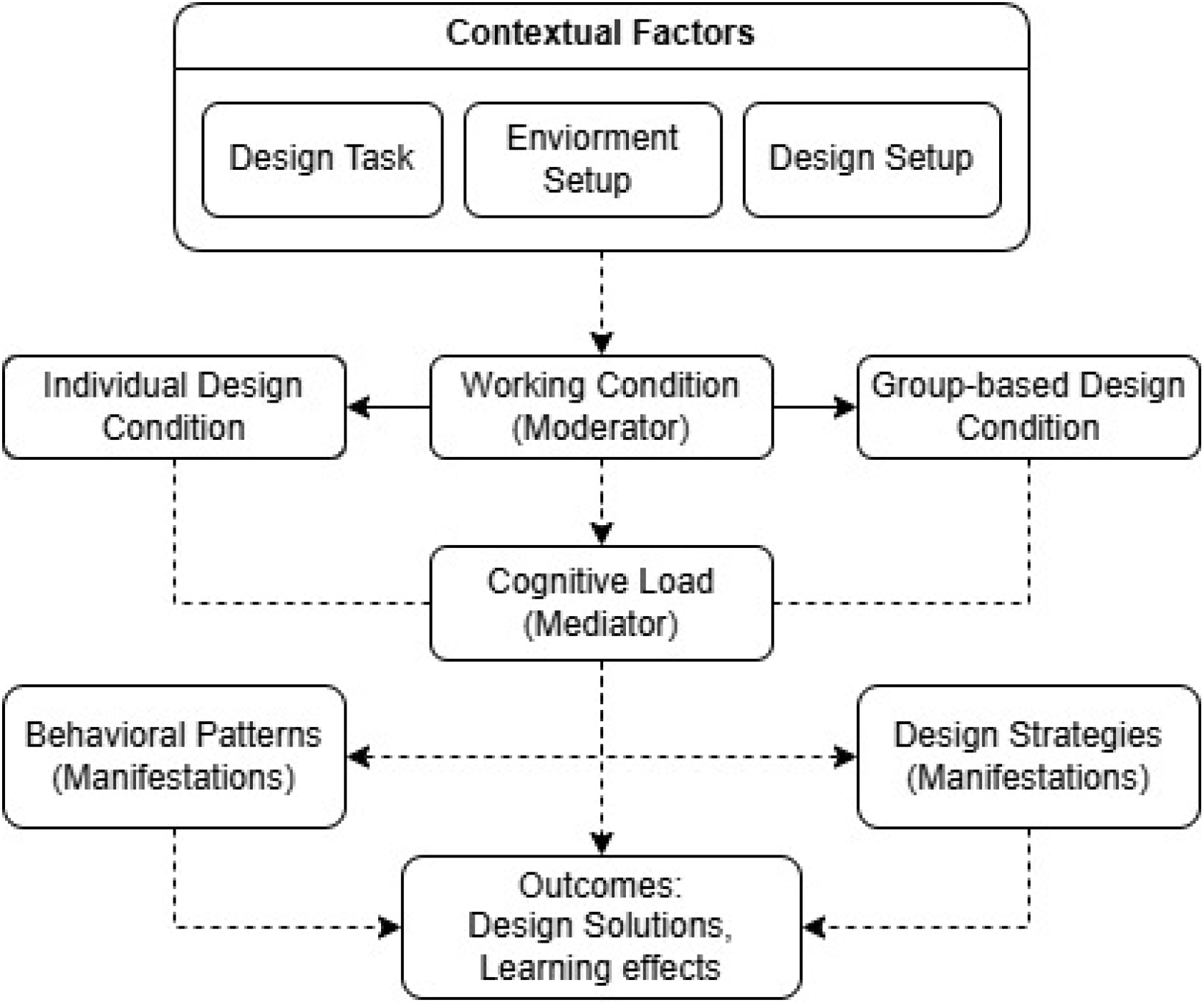
To guide our investigation, we developed a conceptual framework that integrates CLT with design cognition perspectives (Reference Cash, Daalhuizen, Valgeirsdottir and Van OorschotCash et al., 2019; Reference Khadilkar and CashKhadilkar & Cash, 2019), specifying how the social condition of design work shapes cognitive and behavioral processes. While richer models of collaborative work exist (e.g., activity theory; Reference Bedny and KarwowskiBedny & Karwowski, 2004; Reference Perišić, Štorga and GeroPerišić et al., 2023), our framework focuses on the primary cognitive pathway initiated by the fundamental condition of working alone versus in a group. We emphasize team size, specifically, the contrast between individual work and three‑person groups, as a crucial factor moderating cognitive load distribution, group performance, and coordination demands (Reference Hackman and VidmarHackman & Vidmar, 1970; Reference StewartStewart, 2006). The framework posits that the group condition is defined by synchronous interaction, verbal and nonverbal communication, and a collective cognitive focus on a shared design task. It includes activities such as collaborative brainstorming, shared reasoning about design requirements, and co‑creation of solution spaces, which are fundamental to design teamwork (Reference Stempfle and Badke-SchaubStempfle & Badke-Schaub, 2002). In contrast, the individual condition indicates the absence of social interaction, wherein designers work in isolation, relying entirely on internal cognitive resources and personal engagement with tools and information. This study extends CLT by proposing how the social dimension of work moderates the allocation of working memory resources. Collaboration introduces a trade‑off: it theoretically provides a “collective working memory” that can distribute intrinsic load and enhance germane load through knowledge co‑construction, but it also introduces transactive activities (e.g., coordination, communication) that consume resources as extraneous load (Reference Kirschner, Sweller, Kirschner and ZambranoKirschner et al., 2018; Reference Sweller, van Merriënboer and PaasSweller et al., 2019). We hypothesize that in unstructured group work, these transactional costs dominate, increasing extraneous load and thereby limiting the deep, schema‑building germane load essential for learning (Reference Andreasen, Hansen and CashAndreasen et al., 2015). These internal cognitive states manifest in observable behaviors. The framework thus proposes a causal pathway: working conditions influence cognitive load distribution, which in turn shapes behavioral engagement patterns (e.g., focused execution vs. broad exploration). These behavioral patterns then lead to the development of distinct design strategies and perspectives (e.g., systematic problem‑solving vs. narrative ideation), ultimately producing different cognitive and design outcomes. All relationships are moderated by contextual factors such as task characteristics and environmental setup.
As shown in Figure 1, this framework guides our mixed‑methods design: quantitative measures of cognitive load test the proposed mediation, digital activity logs examine behavioral manifestations, thematic analysis explores emergent design strategies, and design outcomes provide evidence of endpoint differences. It thus provides an integrated roadmap for investigating how working conditions shape design cognition from its cognitive foundations to its outcomes.
Conceptual framework

Figure 1 Long description
A conceptual framework diagram illustrating the factors influencing design conditions, cognitive load, and outcomes in design education. The diagram is structured with contextual factors at the top, including Design Task, Environment Setup, and Design Setup. These factors influence the Working Condition, which acts as a moderator and affects both Individual Design Condition and Group-based Design Condition. The Working Condition also impacts Cognitive Load, which serves as a mediator. Cognitive Load influences Behavioral Patterns and Design Strategies, both of which are manifestations. These, in turn, affect the Outcomes, which include Design Solutions and Learning Effects. The diagram shows the relationships and flow between these elements, highlighting how contextual factors, working conditions, and cognitive load interact to shape design processes and learning outcomes.
3. Research methods
3.1. Research design and participants
A mixed-methods design was employed, involving the collection of quantitative and qualitative data, which were analyzed independently before integration. This approach facilitates a comprehensive, multi-faceted understanding of the design processes under investigation. Twelve master’s students in industrial design (8 male, 4 female; aged 24–30) with 2–3 years of product design experience participated. Participants were randomly and equally assigned to one of two conditions, differing solely in the social context of the concept generation phase: individual design condition (IC) in which six participants (coded IC1–IC6) worked in complete isolation, and a group-based design condition (GC) where another six participants were divided into two triads (coded GC1–GC3, GC4–GC6). GC began the task with a collaborative ideation session before proceeding to individual work.
All subsequent data, cognitive load scores, activity logs, interview transcripts, and final design outputs were collected and analyzed at the individual level (N = 12). The primary independent variable was thus the social condition of work (IC vs. GC) during the initial concept generation phase. All participants provided informed consent.
3.2. Experiment setup, design task and procedure
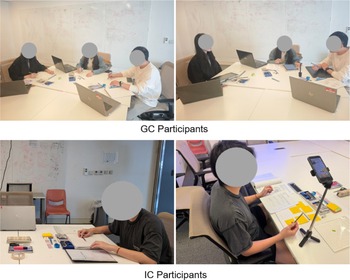
The physical and digital setup for both conditions is illustrated in Figure 2. IC participants worked in separate, partitioned stations. GC triads collaborated in a shared space within a partitioned area. All participants had access to an identical, standardized suite of design tools: computers with internet access, tablets, digital sketchpads (Microsoft Whiteboard), AI resource access, and traditional drawing materials. Data collection included synchronized video and audio recording and automated digital activity logs.
Participants design activities and the design experiment setup for IC and GC

Participants completed a 90-minute conceptual design task framed within a realistic brief presented below. The task required designing an innovative “gift box” that opened from the lateral sides, integrating functional, aesthetic, and experiential attributes. This brief was chosen for its open-ended nature, which is conducive to conceptual exploration, while its clear constraints (e.g., the opening mechanism) provided a consistent problem space for both conditions, allowing a more precise attribution of observed differences to the social variable rather than task interpretation.
“…ABC Company specializes in customized gift boxes, offering a diverse array of packaging choices, including various types of gift boxes and bags for apparel, stationery, jewelry, and souvenirs. They have been manufacturing gift box items that are aesthetically pleasing and functionally competent. They plan to develop innovative gift boxes that integrate novel design aspects, including experiential attributes in addition to aesthetic and functional features. As a designer, your task is to generate a design concept that redefines the experiential attributes of the gift box. In particular, you are asked to design a gift box concept that opens by lifting it from the lateral sides. When the recipient simultaneously holds and opens the box from both the left and right sides, the top cover automatically unfolds to reveal the gift.
Please explain, the main concept behind the proposed design, the design approaches at each stage of the concept design, and how you are addressing the design problems that emerge in the design process of the gift box”
After a 15-minute standardized briefing, participants began the 90-minute design session. For the GC, this entire period was dedicated to collaborative brainstorming and discussion within their triad. For the IC, it was dedicated to individual work. Following this, all participants, regardless of condition, independently finalized their design concepts, produced individual sketches, and completed all post-task measurements individually. This ensured that outcome variables were comparable at the individual level. Participants completed a validated 9-item cognitive load scale (Reference Leppink, Paas, van Gog, van der Vleuten and van MerriënboerLeppink et al., 2014), with three items each for intrinsic, extraneous, and germane loads rated on an 11-point Likert-type scale. In addition, individual retrospective interviews were conducted, and digital activity logs and design outputs were collected.
3.3. Data collection and analysis
Individual cognitive load scores were compared between the two conditions. Due to the small sample size, non-parametric Mann-Whitney U tests were used for between-group comparisons, with a focus on interpreting effect sizes (Cohen’s d). Digital activity logs, which tracked application usage and time allocation, were analyzed using descriptive statistics to compare process efficiency and resource use patterns (e.g., time spent on design tools vs. information search).
Qualitative data comprised audio/video recordings of the design sessions, transcribed retrospective interviews (48 pages of transcripts), and design documentation (sketches, notes). The data underwent reflexive thematic analysis (Reference Braun and ClarkeBraun & Clarke, 2006), informed by a theory-building approach (Reference Miles, Huberman and SaldañaMiles et al., 2013). To mitigate comparative bias, data for the IC and GC were analyzed separately in the initial phases, generating independent codebooks (IC: 78 codes; GC: 87 codes). The analysis proceeded in three steps. First, a within-condition theme development, initial coding and thematic mapping were conducted for each condition using NVivo software, resulting in 165 initial codes and condition-specific thematic maps. Theme prevalence was noted within each condition. Second, with comparative cross-condition analysis, the developed themes were systematically compared across conditions to identify fundamental explanatory mechanisms and condition-specific subthemes, moving beyond description to explanation. Third, through an integrated model development, the comparative insights were synthesized into an integrated theoretical model depicting the relationships between working conditions, cognitive mechanisms, and outcomes.
4. Results
4.1. Design outcomes and visual patterns
The final design concepts provided tangible evidence of the divergent cognitive pathways activated by the two conditions. Representative sketches are presented in Figure 3. IC design outcomes were characterized by systematic, user-centered solutions focused on functional robustness and intuitive usability. For example, IC1’s concept featured a detailed, mechanically innovative opening mechanism with explicit ergonomic considerations, while IC5 developed a trapezoidal box balancing aesthetic form with stability and preservation functions. These outputs reflect an integrated problem-solving approach, synthesizing technical constraints and user needs. GC design outcomes were characterized by narrative-rich, experiential concepts. Designs prioritized emotional impact and cultural narrative over mechanistic innovation. For instance, GC2 proposed a “square wooden box” that used an embedded screen to deliver digital content, and GC6 created a “floating” concept incorporating mountains and clouds to evoke “Chinese beauty”. These outputs reflect associative, experience-driven ideation. This visual divergence aligns with the core mechanisms proposed in our framework, where IC fostered integrated schema development for problem-solving, while GC fostered narrative construction through distributed cognition.
Participants design sketches

4.2. Digital activity patterns
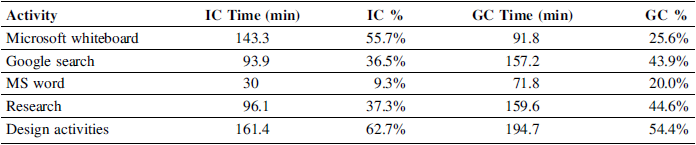
Analysis of digital activity logs revealed distinct behavioral patterns between conditions, detailed in Table 1 (aggregate statistics) and Table 2 (top activities).
IC and GC Participants’ statistics of digital activity logs

Note: Group metrics represent aggregated group data. ‘Activity’ refers to any discrete logged digital action (tool usage, search, resource access).
Time allocation for top digital activities by IC and GC participants

Despite dedicating 39% more total personal time to the task (358.2 vs. 257.5 minutes), GC participants were 23% less efficient in time per activity (0.90 vs. 0.69 minutes). The allocation of effort differed fundamentally. IC participants spent most of their time (55.7%) on the core design tool (Microsoft Whiteboard). In contrast, GC participants spent only 25.6% of their time on Whiteboard, exhibiting a “search-intensive, design-minimal” pattern, with 44.6% of time dedicated to information acquisition (vs. 37.3% for IC). GC participants used 73% more distinct digital resources (19 vs. 11) than IC participants. Engagement within GC triads was also uneven; the most active participant contributed over eight times more input than the least active. These patterns manifest the external resource regulation mechanism, where cognitive effort is distributed across diverse external tools rather than focused on deep engagement with main design work, leading to a “search trap”.
4.3. Cognitive load in the design process
Quantitative cognitive load measurements (See Table 3) validate the cognitive engagement patterns inferred from the behavioral and thematic data.
Descriptive statistics for cognitive load by condition

Note: values are mean ± standard deviation; * = significance level at 0.001.
Mann-Whitney U tests confirmed a statistically significant difference only for germane load (U = 0.5, p = 0.002), with no significant differences for intrinsic (U = 9.0, p = 0.465) or extraneous load (U = 17.5, p = 0.828). The large effect size (*d* = 2.29) for germane load indicates that IC processes fostered substantially deeper, schema-building cognitive engagement than GC processes, while both conditions presented similar levels of task complexity and environmental processing demands.
4.4. Thematic analysis results: mechanisms of cognitive adaptation
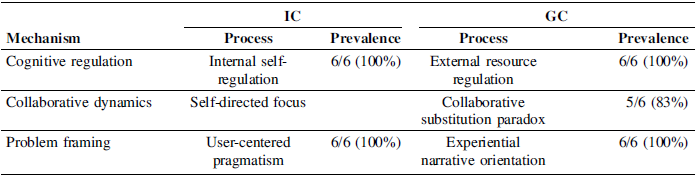
Reflexive thematic analysis identified three fundamental explanatory mechanisms (See Table 4) that elucidate how working conditions shape design cognition.
Comparative mechanisms and their prevalence in IC and GC

4.4.1. Cognitive regulation strategy
IC participants employed internal self-regulation, characterized by goal-oriented framing, sequential processing, and targeted information searches.
‘‘…I started by defining the design requirements based on user needs. The gift box had to solve real problems for people” (IC2).
“…My process was clear: define design requirements, analyze problems, set themes, conceptualize, and then refine. This systematic approach helped me manage complexity.” (IC2).
“…I kept modifying Google search keywords to narrow the answer range. Each search was targeted toward solving a particular design problem I had identified.” (IC2).
Conversely, GC participants relied on external resource regulation, using the Internet and AI as cognitive substitutes and engaging in broad exploratory searches.
“I thought about the shape of the gift box and searched on the internet. I found many structures on the internet and I combined them to make my design” (GC3).
“I chatted with AI bots and viewed other designers’ work, and this is how I solved the issues” (GC4).
“I spent time browsing Pinterest and multiple websites for broad inspiration. Collecting various structural examples gave us more options to choose from” (GC3).
4.4.2. Collaborative substitution paradox
The collaborative substitution paradox was a critical finding that digital resources were frequently substituted for, rather than facilitated, interpersonal collaboration among GC participants. For IC participants, parallel analysis revealed self-directed focus patterns, characterized by independent decision-making and minimal external coordination needs.
“Very few group activities because we had the internet so we didn’t need to discuss” (GC5).
“No group activities in the traditional sense. We had very few group activities because we had the internet” (GC5).
“We talked about the mechanical structure only” (GC1).
4.4.3. Problem-framing orientation
The two conditions fundamentally shaped problem framing. IC participants adopted a user-centered pragmatism. The IC pathway involves internal self-regulation driving user-centered pragmatism, leading to focused, analytical processing.
“Consider the way the product itself is used, and provide convenience to users on the premise of reducing the burden on users” (IC1).
“Think about the pain points of the receiver. Help the receiver maximize satisfaction through product packaging design” (IC2).
GC participants adopted an experiential narrative orientation. The GC pathway is initiated by the collaborative substitution paradox, which promotes external resource regulation and an experiential narrative orientation, resulting in broad, exploratory processing.
“The emotional impact was more important than pure functionality. We wanted to create ‘wow moments’” (GC4).
“The main idea is to make a gift with a big shocking surprise to make the receiver happier” (GC2).
“The main idea behind the design is floating. I draw mountains and clouds when the user lifts the side… to resemble a situation full of Chinese beauty” (GC6).
5. Discussion
This study explored the collaboration paradox by examining how the social condition of work shapes cognitive processes in conceptual design. Integrating CLT with design cognition through a mixed‑methods approach, we move beyond documenting differences to uncovering the mechanisms that underpin them.
Regarding RQ1, our quantitative results confirm that IC processes fostered significantly higher germane cognitive load than GC processes, while intrinsic and extraneous loads were statistically similar. This difference is explained by the cognitive regulation mechanism identified in our qualitative analysis. IC participants engaged in internal self‑regulation, constructing systematic mental models through goal‑oriented framing and targeted searches, a pattern consistent with findings on managing complexity during conceptual design (Reference Tufail, Zaib, Uzma, Karim and KimTufail et al., 2024; Reference Hay, Cash and McKilliganHay et al., 2020). This deliberate, schema‑building process is cognitively demanding but fosters the deep learning essential for design expertise (Reference GoldschmidtGoldschmidt, 2014) and is central to CLT. In contrast, GC participants defaulted to external resource regulation, using digital tools as cognitive substitutes. This distributed approach, while potentially managing intrinsic load, redirected cognitive effort from deep schema construction to broad information navigation, resulting in lower germane load. The similar levels of extraneous load are revealing: they suggest that in this unstructured group condition, expected coordination costs were offset by a different kind of process loss, the collaborative substitution paradox, addressed under RQ3. This paradox has been observed in studies where unrestricted digital access in design teams led to fragmented activities and reduced collective cognition (Reference Eris, Martelaro and Badke-SchaubEris et al., 2014; Reference Kleinsmann and ValkenburgKleinsmann & Valkenburg, 2008).
Regarding RQ2, the divergent design perspectives stem from a fundamental problem‑framing mechanism. IC participants adopted user‑centered pragmatism, framing the task as solving functional problems and meeting user requirements. This orientation is fundamental to human‑centered design (Reference NormanNorman, 2016), systematic design processes (Reference Pahl, Newnes and McMahonPahl et al., 2007), and requires constant cognitive integration of constraints and empathy, a process inherently demanding in terms of germane cognitive load (Reference Andreasen, Hansen and CashAndreasen et al., 2015). GC participants, however, employed an experiential narrative strategy, conceptualizing the task as generating emotional impact or cultural narratives. This shift embodies an abductive, sense‑making approach to design problems (Reference DorstDorst, 2011) and corresponds with broader, associative cognitive processing that can enhance ideation. This mechanism explains why GC concepts were narratively strong but often focused on additive technology rather than integrated mechanical innovation, highlighting a different facet of design creativity centered on experience and meaning.
Regarding RQ3, the “search‑intensive, design‑minimal” behavioral pattern in GC is the tangible outcome of the collaborative substitution paradox. Digital resources, rather than catalyzing collaboration, often substituted for it. This paradox explains a critical process loss: the theoretical benefits of “collective working memory” (Reference Kirschner, Sweller, Kirschner and ZambranoKirschner et al., 2018) were unrealized because cognitive resources were expended in parallel on independent browsing rather than being shared through integrative discussion. This phenomenon aligns with challenges observed in distributed design teamwork, where technology can fragment shared understanding (Reference McComb, Boatwright and CaganMcComb et al., 2023) and in co‑design sessions (Reference Sanders and StappersSanders & Stappers, 2008). The paradox highlights how the social complexities and dual motivations of group work, if unmanaged, can prevent collaborative learning benefits.
These findings provide empirical evidence for our conceptual framework (Figure 1), demonstrating that the working condition initiates divergent cognitive pathways with measurable consequences for cognitive engagement, behavioral strategy, and design outcomes. The IC pathway with internal self‑regulation results in user‑centered pragmatism and focused, analytical processing, leading to systematic, problem‑focused outcomes. The GC pathway with collaborative substitution paradox results in external resource regulation and experiential narrative orientation, resulting in associative, experience‑focused outcomes.
This study extends CLT by explicitly modeling the social condition of work as a critical moderator of cognitive load distribution, contributing a process theory of design cognition in different social contexts. The collaborative substitution paradox is a key theoretical insight for digitally saturated learning environments, challenging the assumption that connectivity guarantees collaboration. Furthermore, the experimental environment, unrestricted digital access, was not neutral but a key mediator of this paradox. Our findings suggest that different environmental constraints (e.g., limiting internet access, mandating analog prototyping) could fundamentally shift these dynamics, an important gap for future research.
Our findings support a systematic, objective‑oriented approach to structuring design tasks. To address the substitution paradox, educators should create collaborative phases with explicit protocols (e.g., structured brainstorming, defined roles) that necessitate interaction and knowledge integration, rather than merely superficial idea exchange. The choice between individual and group work should be guided by specific learning objectives. Individual work is particularly effective for deep schema development and systematic problem‑solving. Structured collaboration is advantageous for objectives such as divergent thinking or perspective‑taking in project‑based design education. Therefore, curricula must explicitly teach metacognitive regulation and collaboration strategies, promoting the reflective practice essential for efficiently managing both individual and group tasks.
6. Conclusions and future works
This study demonstrates that the social condition of work significantly influences cognitive pathways in conceptual design. Three core mechanisms explain this influence: a shift from internal self‑regulation to external resource regulation; the emergence of a collaborative substitution paradox, in which digital tools replace rather than support interaction; and a divergence in problem framing from user‑centered pragmatism to experiential narrative construction. This study concludes that the cognitive benefits of collaboration are not automatic but are contingent on structure. Unstructured group work carries a high risk of process loss and reduced germane cognitive engagement, as digital resources often substitute for co‑creation.
This study has several limitations that inform future research. First, the sample size, while sufficient for an in‑depth, theory‑building mixed‑methods study, warrants caution in generalizing quantitative findings and underscores the importance of validation. Second, the use of a single, relatively simple design task within a specific cultural context limits generalizability to more complex, iterative design problems and other educational settings. Future research should employ more complex, construction‑intensive, and validated design tasks to test the persistence of the identified mechanisms and should replicate the study with larger, more diverse samples across different cultural contexts. Additionally, incorporating multimodal data (e.g., eye‑tracking, EEG) could enhance subjective cognitive load assessments, capture mechanisms in real time, and explore how individual differences (e.g., cognitive style, prior knowledge, collaboration self‑efficacy) moderate the effects of working conditions. Longitudinal studies are needed to examine the long‑term impact of different work structures on the development of design expertise and metacognitive skills. Finally, future work should test specific structural interventions, such as time‑limited search intervals, mandatory consensus‑building sessions, or defined role assignments, aimed at mitigating the collaborative substitution paradox and harnessing collective working memory effectively.
This study advances an empirical understanding of how working conditions shape cognition, moving beyond simple individual‑versus‑group comparisons and providing a more in-depth foundation for informed educational choices. The goal is to equip educators with the knowledge necessary to create learning environments that consistently foster the deep, adaptive thinking essential for future designers.
Acknowledgement
The work was supported by the Hong Kong Polytechnic University [ZVZ5].




 Open access

