


Introduction
Depression is the most common old-age psychological and psychiatric condition and is one of the major contributors to disability and mental health-related disease burden (GBD 2019 Mental Disorders Collaborators, 2022). Estimates show that depression affects approximately 280 million people globally (Abbafati et al., Reference Abbafati, Abbas and Abbasi-Kangevari2020), and the COVID-19 pandemic escalated the condition for older adults who were at greater risk of the pandemic (Santomauro et al., Reference Santomauro, Mantilla Herrera and Shadid2021). A recent meta-analysis showed that the global prevalence of depression was 35.1% (95% CI = 30.2–40.4%) among older adults (Cai et al., Reference Cai, Jin and Liu2023), but data from sub-Saharan Africa (SSA) provide a looming picture (Gyasi et al., Reference Gyasi, Quansah, Boateng, Akomeah, Yakubu, Ahiabli, Aikins, Owusu-Sarpong, Dumbe, Nimoh, Phillips and Hajek2024; Stieglitz et al., Reference Stieglitz, Adams, Bärnighausen, Berghöfer, Kazonda and Killewo2023), with the current prevalence of 43.1% (Bedaso et al., Reference Bedaso, Mekonnen and Duko2022), given the precarious aging circumstances in SSA.
Depression has been related to a higher risk of health problems, including cardiovascular diseases, stroke, cognitive impairments, suicide behaviours, early death, and poor quality of life among older people (Abbafati et al., Reference Abbafati, Abbas and Abbasi-Kangevari2020; Choi and Marti, Reference Choi and Marti2024; Gyasi and Phillips, Reference Gyasi and Phillips2020; Walker et al., Reference Walker, McGee and Druss2015). Given that the SSA population is currently aging dramatically, and the number of individuals ≥60 years is projected to increase from 50 million in 2020 to 67 million by 2025 and 163 billion by 2050 (WHO, 2021), the prevalence and the burden of depression in this setting are expected to increase significantly in the very near future. Notably, the already strained health system may lack the capacity to manage geriatric depression effectively (WHO, 2022). Therefore, it is crucial to identify the psychosocial-related risk factors for probable depression (PD) to promote healthy aging and sustainable development goal agendas in low- and middle-income countries (LMICs). PD is used in this study to mean the early detection of clinically undiagnosed depression using a standardized screening tool.
Indeed, some of the major psychosocial-related risk factors for PD are social isolation and loneliness, which have been recognized as ‘the new geriatric giants’, with major public health concerns (Freedman and Nicolle, Reference Freedman and Nicolle2020) and are largely interrelated bidirectionally among older populations (Pan, Reference Pan2024). Conceptually, loneliness connotes a subjective painful (emotional) feeling due to a discrepancy between the desired and the actual degree of connections (van Tilburg, Reference van Tilburg2021; WHO, 2025). Social isolation is a quantifiable reflection of a reduced social network size and paucity of social contact or connections (Steptoe et al., Reference Steptoe, Shankar, Demakakos and Wardle2013). These largely result from life course transitions and wilful experiences, such as the loss of family or close friends, role loss, or declining functional capacity (Hajek et al., Reference Hajek, König, Sutin, Terracciano, Luchetti, Stephan and Gyasi2024). Social isolation and loneliness are highly prevalent among older adults in LMICs and are forerunners of mental disorders, including PD, particularly during the COVID-19 pandemic (Gyasi et al., Reference Gyasi, Peprah, Abass, Pokua Siaw, Dodzi Ami Adjakloe, Kofi Garsonu and Phillips2022; Hajek et al., Reference Hajek, König, Sutin, Terracciano, Luchetti, Stephan and Gyasi2024; Mushtaq and Khan, Reference Mushtaq and Khan2024) due to limited opportunities for interpersonal interaction (Gyasi, Reference Gyasi2020).
Theoretically, social isolation and loneliness may have significant biological, cognitive, and social consequences that may increase the risk of PD (Hawkley and Cacioppo, Reference Hawkley and Cacioppo2010). The hypothesized pathways linking these associations may include the lack of social stimulation in the brain, which can result in lower emotional reserve, negative cognitive schemas, and poorer affective resilience (Evans et al., Reference Evans, Llewellyn, Matthews, Woods, Brayne and Clare2018). Inflammatory and stress responses in the brain, reduced immunity, poor sleep quality, and higher risk of neurodegenerative conditions have also been ascribed as important potential mechanisms (Hawkley and Cacioppo, Reference Hawkley and Cacioppo2010). However, the precise psychosocial pathways linking social isolation/loneliness and PD in LMICs are largely unknown. One systematic review found that all 10 studies reported a significant and positive association between loneliness and depression among older adults (Van As et al., Reference Van As, Imbimbo, Franceschi, Menesini and Nocentini2022). Among 9171 individuals aged ≥50 years in England, Lee et al. (Reference Lee, Pearce, Ajnakina, Johnson, Lewis, Mann, Pitman, Solmi, Sommerlad, Steptoe, Tymoszuk and Lewis2021) found a 1-point increase in loneliness score associated with a 0·16 (95% CI = 0·13–0·19) increase in depression score. Moreover, analyzing the English Longitudinal Study of Aging data, Zhu et al. (Reference Zhu, Kong, Han, Tian, Sun, Sun, Feng and Wu2024) found a significant and positive lagged effect of social isolation on depression among 6787 older adults (β = 0.037, P < .001). Furthermore, a systematic review of 127 studies found that larger and more diverse networks, along with closer social ties, were associated with lower depression (Reiner and Steinhoff, Reference Reiner and Steinhoff2024). However, all included studies were conducted in high-income countries (HICs). This is a limitation, as HICs-based data may not be generalizable to SSA, given the differences in aging, socioeconomic status, and culture. Again, little is known about the joint associations of loneliness/isolation and geographic differences with depression, even though former studies have found rural-urban disparities in depression (Kim et al., Reference Kim, Hwang and Kim2024; Vyas et al., Reference Vyas, Reynolds, Donneyong, Mischoulon, Chang, Cook, Manson and Okereke2022; Wang et al., Reference Wang, Xu, Sun, Chen, Pang and Zang2024). As no effective depression treatment exists in the SSA region, it is particularly important to understand the modifiable risk factors for depression and their precise pathways in later life to delay or postpone the onset and progression of any clinical symptoms. Research highlighting these associations is needed to improve the mental health of aging adults, particularly in the LMIC settings (Reiner and Steinhoff, Reference Reiner and Steinhoff2024).
Therefore, this study aimed to examine the associations of loneliness and social isolation with PD among older adults in Ghana. It also aimed to quantify the extent to which psychosocial factors (e.g. sleep problems (SP), loneliness, and social isolation) potentially mediate these respective associations. It was hypothesized that social isolation and loneliness would be associated with higher odds of PD among older adults. It was further expected that loneliness or social isolation and SP would, respectively, mediate the loneliness- and social isolation and PD associations.
Methods
Study design and participants
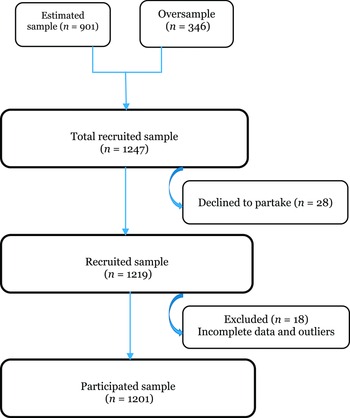
This cross-sectional study analyzed the data on the Aging, Health, Psychological Well-being, and Health-seeking Behaviour Study. This representative study aimed to understand how individual, interpersonal, and health/clinical factors contribute to well-being in old age from the SSA context. It was conducted in Ghana between 2016 and 2018 (Gyasi, Reference Gyasi2018). Survey participants were randomly selected (using a multistage clustered sampling design approach) from non-institutionalized individuals aged 50 years or older in six districts and metropolitan areas. Detailed documentation regarding the study design, recruitment of study participants, and measurement of study data has been extensively described in the previously published literature (Gyasi et al., Reference Gyasi, Phillips and Abass2019). The sample size was determined, assuming a 5% margin of error, a 95% confidence interval (CI), a 1.5 design effect, a 5% type I error, a 15% type II error, and a 50% default prevalence in the target population. With a 38% oversampling, a sample of 1247 was obtained for this study. The model reached a statistical power of 85% and a 5% (two-sided) significance level to detect an odds ratio of ≥2. After excluding 46 potential respondents due to unavailability and questionnaire defects, an analytic sample of 1201 community-dwelling older adults was realized (see Fig. 1). Face-to-face interviews were conducted by trained staff using a standard questionnaire. Questionnaires were translated into local dialects based on a standard procedure for quality control following the WHO translation guidelines for assessment instruments (Üstun et al., Reference Üstun, Chatterji, Mechbal and Murray2005). The survey response rate was 96%.
Flowchart of the sample selection.

Ethics issues
Ethics approval was obtained from the Committee on Human Research, Publications and Ethics (CHRPE), School of Medical Sciences, Kwame Nkrumah University of Science and Technology, and Komfo Anokye Teaching Hospital, Ghana (Ref: CHRPE/AP/507/16). In addition, written informed consent was obtained from all participants after they were briefed on the study objectives and their rights in the study. Respondents were assured of confidentiality and anonymity of the information they provided.
Procedure
Probable depression (PD)
PD was the main outcome variable, conceptualized as having a depression symptom score above established cut points. Depressive symptoms were assessed with the Center for Epidemiological Studies Depression Scale (CES-D) (Radloff, Reference Radloff1977). The participants were asked ten questions about their feelings and behaviours over the past week. Each item was scored on a four-point scale: 0 = rarely (<1 day), 1 = some or a little of the time (1–2 days), 2 = occasionally or a moderate amount of time (3–4 days); and 3 = most or all of the time (5–7 days). Sleep-related item of the CES-D-10 was excluded to avoid any incidence of multicollinearity. The nine items were summed, generating an index ranging from 0 to 27; higher scores reflect greater depressive symptomology. The Cronbach’s alpha of the CES-D-9 was .861 in this study. The effectiveness of CES-D in older African populations has been shown (Baron et al., Reference Baron, Davies and Lund2017). Based on recommended thresholds from previous research, those who scored any score equal to or above nine were classified as having PD (Miller et al., Reference Miller, Anton and Townson2008).
Loneliness
Loneliness was assessed with the University of California, Los Angeles three-item loneliness scale: ‘How often do you feel you lack companionship?’, ‘How often do you feel left out?’, and ‘How often do you feel isolated?’ Responses on a 3-point scale (1 = hardly ever or never; 2 = some of the time or sometimes; 3 = often or always) (Hughes et al., Reference Hughes, Waite, Hawkley and Cacioppo2004) were summed, ranging from 3 to 9. Higher scores reflected a greater degree of loneliness with Cronbach’s alpha, α = 0.81.
Social isolation
Social isolation was assessed with six items relating to the Berkman-Syme Social Network Index (Berkman and Syme, Reference Berkman and Syme1979). Here, 1 point was assigned to each of 1) unmarried/living alone, 2) never/once/twice contact with friends/relatives per year, 3) no social participation, 4) nobody assists you in seeking care at health facility, 5) nobody to share concerns/fears with, and 6) no feeling emotional bond with other people. Alternative responses provided for each item were assigned 0 point. The overall score ranged from 0 to 6, with higher scores indicating greater social isolation (Cronbach’s alpha = .891). Continuous score was used in regression models, but categorized the index into: a) not isolated (score 0), b) moderately isolated (score 1–2), and c) severely isolated (score 3–6) for descriptive analysis (Noguchi et al., Reference Noguchi, Saito, Aida, Cable, Tsuji, Koyama, Ikeda, Osaka and Kondo2021).
Sleep problems (SP)
SP were defined using data from a fatigue-related questionnaire with a modest-to-high sensitivity for detecting clinically relevant obstructive sleep apnoea in the general population (Senaratna et al., Reference Senaratna, Perret, Matheson, Lodge, Lowe, Cassim, Russell, Burgess, Hamilton and Dharmage2017). Participants were asked: ‘Overall, in the last 30 days, how much of a problem did you have with sleeping, e.g., falling asleep, waking up frequently during the night, or waking up too early in the morning’? and ‘Overall in the last 30 days, how much of a problem did you have due to not feeling rested and refreshed during the day (for example, feeling tired, not having energy’)? Each item had 5-point Likert response options, ranging from 1 (none) to 5 (extreme), with increasing scores indicating higher SP (α = .830 in this study).
Covariates
The following characteristics were considered as potential covariates (Cai et al., Reference Cai, Jin and Liu2023; Gyasi et al., Reference Gyasi, Quansah, Boateng, Akomeah, Yakubu, Ahiabli, Aikins, Owusu-Sarpong, Dumbe, Nimoh, Phillips and Hajek2024; Stieglitz et al., Reference Stieglitz, Adams, Bärnighausen, Berghöfer, Kazonda and Killewo2023). Sociodemographic factors included age (in years), sex (male/female), geographic location (rural/urban), educational status (primary/secondary/tertiary), employment status (unemployed/employed), and income level (in Cedis). Lifestyle factors included alcohol consumption (no/yes) and physical activity based on the International Physical Activity Questionnaire (metabolic equivalent task – the sum of days performing walking, moderate, and vigorous activity) (Craig et al., Reference Craig, Marshall and Sjöström2003). Health variables included pain severity (continuous 0–4 points) based on the Medical Outcomes Study Short Form-36 (MOS SF-36) scale (Ware et al., Reference Ware, Kosinski and Keller1995), self-rated health status (continuous 0–4 points) based on one item, mobility (continuous 2–8 points) based on two items from the MOS SF-36, diabetes status (no/yes), and hypertension status (no/yes).
Statistical analysis
All analyses were conducted using IBM SPSS V.25 Software, and the level of significance was P < 0.05 (two-tailed). Descriptive analyses were first calculated to describe the sample and reported as means and proportions. Second, X 2 and t-tests were used to compare respondent characteristics by loneliness and social isolation statuses. Next, logistic regression models were used to evaluate the associations between loneliness and social isolation and PD. Model 1 accounted for age, sex, spatial location, education, employment status, income level, pain severity, and self-rated health status. Model 2 accounted for all covariates in Model 1, as well as SP and loneliness or social isolation. Model 3 included Model 2, lifestyle factors (alcohol consumption and physical activity), and health factors (i.e. mobility limitations, diabetes, and hypertension). Next, the study tested whether geographic location moderated the associations of loneliness and social isolation with PD (Model 4). The interaction terms were separately added to the fully adjusted model (Model 3). In the event that a significant interaction was observed, stratified analysis using rural/urban status was performed. Finally, upon realizing a substantial attenuation of OR in Model 2, the study explored whether loneliness or social isolation and SP mediated the association of social isolation and loneliness with PD, respectively. Ordinary least squares regression-based PROCESS Macro analytic framework was used to evaluate the extent to which these potential mediators explained the association between social isolation- and loneliness-PD.
Results
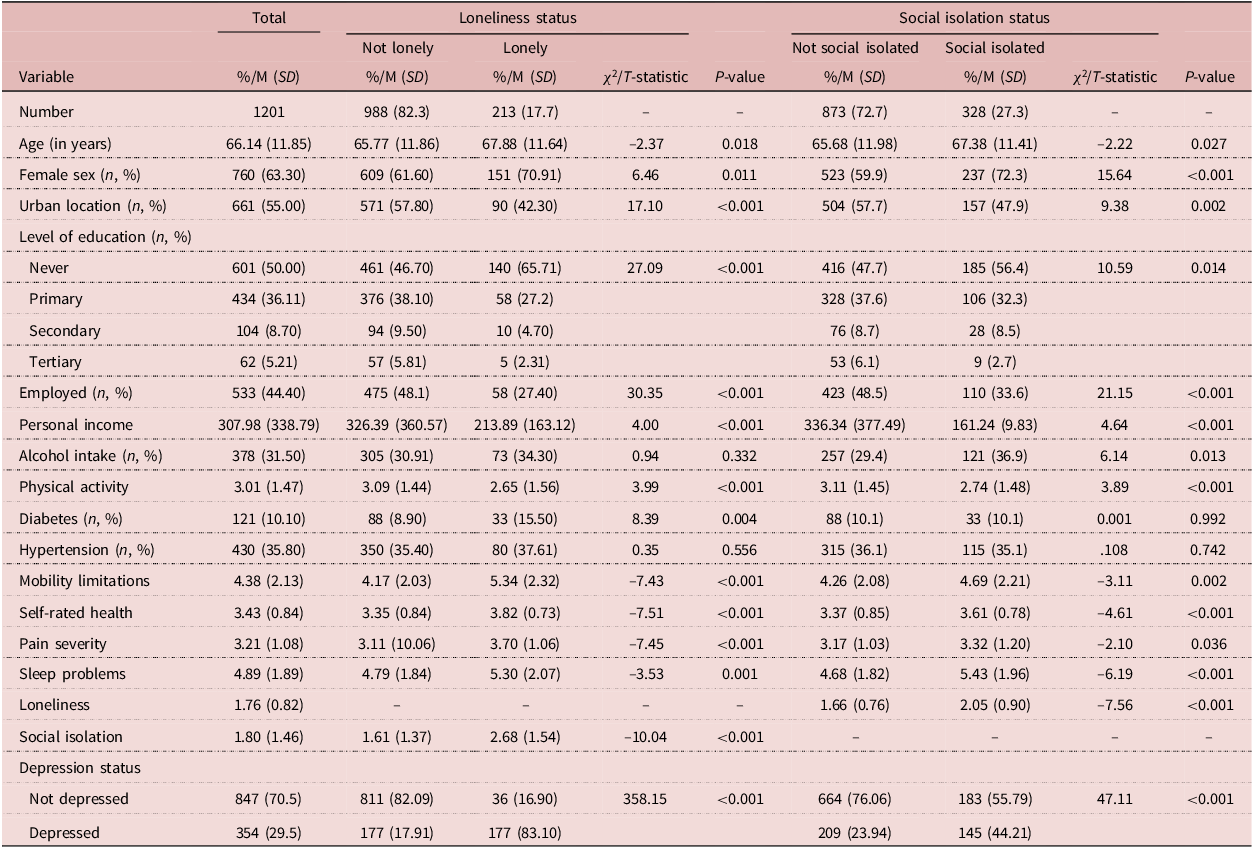
Detailed characteristics of the overall sample and loneliness and social isolation statuses are shown in Table 1. Among 1201 participants, the mean (SD) age was 66.14 (11.85) years, and 63.3% were women. Most respondents lived in urban settings (55.4%) and never attended (50%) or attended only primary school (36%). Less than half were employed (44%), and income levels were generally low (307.98 [338.79]). About a third consumed alcohol (32%), 36% reported hypertension, and about 10% lived with diabetes. The prevalence of PD was 29.5%. Approximately 18% reported feeling lonely, while 27% reported being socially isolated. Loneliness and social isolation increased significantly with older age, female sex, residence in rural areas, lower levels of income and education, and physical inactivity. The socially isolated and those who reported being lonely experienced poorer health outcomes across all health measures compared to those who were not lonely or isolated. Crucially, the prevalence of PD was higher among those who were lonely (83.1% vs. 17.9%, χ2(1) = 358.15, P < 0.001) and socially isolated (44.2% vs. 23.9%, χ2(1) = 47.11, P < 0.001) compared with their respective counterparts.
Characteristics of Study Sample – Overall and by Loneliness and Social Isolation Statuses

Note: M – mean score; SD – standard deviation; SI – social inclusion.
P-value is based on either ordinal χ 2 tests or independent sample t-test.
Multivariable results
Table 2 presents the multivariable logistic regressions of the associations of loneliness and social isolation with PD. Loneliness and social isolation were related to PD when adjusting for age, sex, spatial location, education, employment, income, pain, and self-rated health (Model 1), with an attenuated adjusted OR of 3.15 (95% CI = 3.27–6.26) and 1.23 (95% CI = 1.09–1.38) when loneliness or social isolation and SP were taken into account (Model 2). The reduced adjusted OR for PD from 4.46 in Model 1 to 3.15 in Model 2 (in terms of loneliness) and from 1.38 in Model 1 to 1.23 in Model 2 (in terms of social isolation) suggests that loneliness or social isolation and SP may explain a substantial proportion of the association of loneliness or social isolation with PD. However, the association was almost the same with OR of 3.15 (95% CI = 3.26–5.28) for loneliness and 1.24 (95% CI = 1.10–1.41) for social isolation after further adjustment for alcohol consumption, physical activity, mobility, diabetes, and hypertension (Model 3).
Associations of Loneliness and Social Isolation with Risk of Depression among Older Adults: Estimated by Logistic Regressions

Note: Model 1 is adjusted for age, sex, spatial location, education, employment status, income level, pain severity, and self-rated health status.
Model 2 is adjusted for confounders in Model 1 and social isolation or social isolation and sleep problems.
Model 3 is adjusted for confounders in Model 2, alcohol consumption, physical activity, mobility limitations, diabetes, and hypertension.
Model 4: Contains the interaction term of loneliness × spatial location or social isolation × spatial location.
√: Potential confounding variables.
***P < 0.001; **P < 0.005; *P < 0.05.
Interaction and stratified analyses
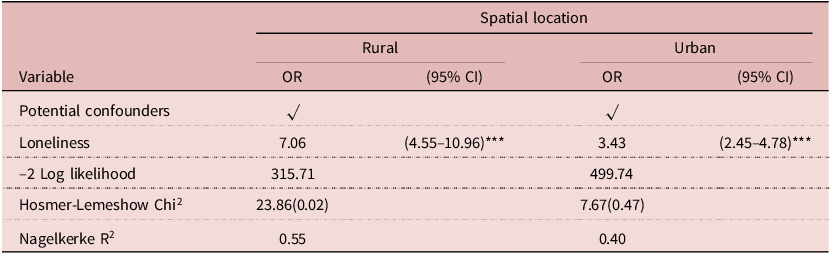
The effect modification of spatial location on the association of loneliness and social isolation with depression via interaction analysis was tested (see Model 4 of Table 2). After full adjustment, there was a significant interaction between spatial location (urban vs rural) and loneliness on PD (OR = 0.57, 95% CI = 0.35–0.95). However, there was no significant effect-modifier of the social isolation-PD association by spatial location. Upon realizing the significant interaction, stratified analysis was conducted based on urban/rural status (Table 3). The association of loneliness with PD was significant in both sub-groups, but the effect was more pronounced among rural dwellers (OR = 7.06, 95% CI = 4.55–10.96) than those in urban areas (OR = 3.43, 95% CI = 2.45–4.78).
Spatial Differences in the Association between Loneliness and Depression among Older Adults: Estimated by Logistic Regressions

Note: OR – odds ratio; CI – confidence interval.
Each model was adjusted for age, sex, spatial location, education, employment status, income level, pain severity, self-rated health status, social isolation or social isolation, alcohol consumption, physical activity, sleep disorder, mobility limitations, diabetes, and hypertension.
√: Potential confounding variables.
***P < 0.001.
Mediation analysis
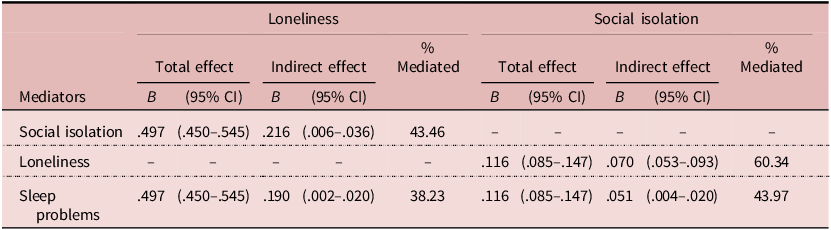
Table 2 indicates that the association of loneliness and social isolation with PD was mainly explained by social isolation or loneliness and SP. Therefore, mediation analysis was conducted using adjusted Model 4 in the PROCESS Macro plug-in and bootstrapping technique (Table 4). The analysis showed that social isolation (indirect effect B = 0.216, 95%bootsCI = 0.006–0.036) explained 43.46% and SP (indirect effect B = –0.190, 95%bootsCI = 0.002–0.020) yielded 38.23% of the link between loneliness and PD. Moreover, loneliness (indirect effect B = 0.070, 95%bootsCI = 0.053–0.093) explained 60.34% and SP (indirect effect B = –0.051, 95%bootsCI = 0.004–0.020) mediated 43.97% of the association of social isolation with PD (Table 4).
Mediation Analyses on the Association of Loneliness and Social Isolation with Depression among Older Adults

Note: B – unstandardized regression coefficients; CI – confidence interval.
The empirical 95% CI does not include zero to define statistical significance.
Discussion
Principal findings
In this large and representative population-based study, loneliness (OR = 3.15; 95% CI = 3.26–5.28) and social isolation (OR = 1.24; 95% CI = 1.10–1.41) were associated with higher odds of PD even after the inclusion of a wide range of potential confounders. Furthermore, this analysis found a significant interactive role of loneliness and spatial location on PD, such that the association between loneliness and PD was stronger among rural residents than their urban counterparts. Finally, the loneliness-PD association was mediated by social isolation (43.46%) and SP (38.23%), whereas the social isolation-PD association was mediated by loneliness (60.34%) and SP (43.97%).
Theoretical interpretations of findings
The findings add to the growing literature relating social isolation and loneliness to higher odds of PD. A systematic review of 10 studies found that loneliness and social isolation were positively associated with PD (range OR = 0.41–17.76) (Van As et al., Reference Van As, Imbimbo, Franceschi, Menesini and Nocentini2022). In a nationally representative sample of 9,171 older English, Lee et al. (Reference Lee, Pearce, Ajnakina, Johnson, Lewis, Mann, Pitman, Solmi, Sommerlad, Steptoe, Tymoszuk and Lewis2021) showed that baseline loneliness was associated with greater depressive episodes. Zhang et al. (Reference Zhang, Kuang, Xin, Fang, Song, Yang, Song, Wang and Wang2023) observed in a longitudinal cohort study of 634 older in Hong Kong that those with smaller social networks and heightened loneliness levels were more likely to report higher odds of PD. Similarly, Hsueh et al. (Reference Hsueh, Chen, Hsiao and Lin2019) found among 3920 individuals in Thailand that loneliness and social isolation increased the risk of developing depressive symptomatology, including suicidal behaviours in later life. This study extends the evidence to older populations residing in the SSA context and also posits that loneliness shows a stronger association with PD than social isolation. Crucially, the present study quantifies the psychological pathways linking loneliness or social isolation and PD, as well as the modifying role of spatial variation in these associations. Indeed, no previous studies have explored these dynamics among older samples.
Several plausible interpretations of the observed associations may be ascribed. Social isolation explained nearly 44% of the loneliness and PD association, while loneliness mediated 60.34% of the social isolation and PD association. Loneliness and social isolation are directly linked (Leigh-Hunt et al., Reference Leigh-Hunt, Bagguley, Bash, Turner, Turnbull, Valtorta and Caan2017; Pan, Reference Pan2024), and they relate positively to poor health outcomes in older adults (Noguchi et al., Reference Noguchi, Saito, Aida, Cable, Tsuji, Koyama, Ikeda, Osaka and Kondo2021). Studies have shown that as people age, their social networks shrink due in part to the loss of a spouse or close friends, retirement, physical and cognitive limitations, or limited mobility (Corno and Burns, Reference Corno and Burns2022; Wrzus et al., Reference Wrzus, Hänel, Wagner and Neyer2013). Moreover, weak social connections via limited opportunities for friendship and a sense of belonging may erode self-confidence, self-efficacy, and motivation (Bradley et al., Reference Bradley, Dowrick and Lloyd-Williams2023), leading to feelings of emotional isolation and loneliness. These factors can isolate or cause individuals to withdraw from social interactions, leaving them with fewer opportunities for social engagement and connection. Social isolation and loneliness, in turn, can fuel PD, including feelings of loss of purpose, hopelessness, worthlessness, grief, and diminished self-esteem and value (Wolters et al., Reference Wolters, Mobach, Wuthrich, Vonk, Van der Heijde, Wiers, Rapee and Klein2023).
This analysis identified SP to mediate 38.23% and 43.97% of the loneliness- and social isolation-PD links, respectively. Prior epidemiologic and clinical studies have shown that loneliness and isolation, along with emotional alienation, contribute to feelings of fear, insecurity, anxiety, and worry (Wolters et al., Reference Wolters, Mobach, Wuthrich, Vonk, Van der Heijde, Wiers, Rapee and Klein2023; Zhang et al., Reference Zhang, Kuang, Xin, Fang, Song, Yang, Song, Wang and Wang2023). These negative emotions can disrupt sleep by activating the body’s stress response, leading to the release of the stress hormone (cortisol) and increased levels of inflammatory markers (Russell and Lightman, Reference Russell and Lightman2019). Increased stress response due to elevated cortisol and inflammatory markers (e.g. C-Reactive Protein, Interleukin-6, Fibrinogen) can interfere with sleep architecture (Maggio et al., Reference Maggio, Colizzi, Fisichella, Valenti, Ceresini, Dall’Aglio, Ruffini, Lauretani, Parrino and Ceda2013). The disruption of the natural sleep-wake cycle may ultimately contribute to higher odds of PD in old age. In addition, loneliness and social isolation may impair the hypothalamic-pituitary-adrenal (HPA) axis and glucocorticoids (Hawkley et al., Reference Hawkley, Cole, Capitanio, Norman and Cacioppo2013), which regulate stress responses and sleep patterns. The impaired HPA axis can disturb the circadian rhythm and sleep health (Incollingo Rodriguez et al., Reference Incollingo Rodriguez, Epel, White, Standen, Seckl and Tomiyama2015), disrupt neurotransmitters (e.g. serotonin and norepinephrine), and increase negative mood (Mehta et al., Reference Mehta, Giri and Mallick2020) and PD via feelings of sadness, fatigue, and hopelessness (Domènech-Abella et al., Reference Domènech-Abella, Lara, Rubio-Valera, Olaya, Moneta, Rico-Uribe, Ayuso-Mateos, Mundó and Haro2017). Other pathways not explored in this study may be essential. For example, social isolation and loneliness strongly correlate with physical inactivity (Schrempft et al., Reference Schrempft, Jackowska, Hamer and Steptoe2019). Those who are isolated or lonely tend to have reduced motivation to engage in physical exercise, and this can worsen health conditions and reduce mood-boosting endorphins (Naureen et al., Reference Naureen, Saleem, Naeem, Bilal, Hassan, Shafiq, Hussain and Roohullah2022), leading to higher odds of PD.
Furthermore, the analysis showed that geographical differences moderated the association between loneliness and PD. This finding is not entirely surprising, for previous studies have found similar observations. For example, among 5,103 older adults in China, Li et al. (Reference Li, Liu, Xu and Zhang2016) observed that those in rural areas reported more depression than their urban counterparts. People in rural settings often have smaller social networks, less access to adult-oriented services, and lower median incomes (Weaver et al., Reference Weaver, Himle, Taylor, Matusko and Abelson2015). These poor socioeconomic and environmental conditions are well-established risk factors for poorer mental health outcomes. Again, living arrangements in rural settings are oftentimes characterized by a high degree of dependence on close family members and friends (Kendall and Anglewicz, Reference Kendall and Anglewicz2018). Loneliness levels for older adults may increase as these confidants migrate or pass away.
The results extend the relevant literature on the effects of loneliness and social isolation on PD in older adults in the SSA context. This study is relevant to public health and policy decisions by considering the role of psychosocial determinants of well-being, including loneliness and social isolation, in managing PD in old age. Clinicians and family caregivers should pay particular attention to socially isolated and detached older adults who are likely to experience depressive symptomatology. Interventions to embed older adults in resourceful interpersonal relationships may enhance their sense of belonging and potentially improve their experiences of depressive episodes (Gyasi et al., Reference Gyasi, Phillips and Abass2019). Practical actions to mitigate loneliness and ensure social connectedness alongside specific sleep interventions may be effective options for addressing PD and its major disorders in later life. These findings suggest that efforts to reduce social isolation and loneliness to foster social connections and support may be essential to reducing the odds of experiencing PD in old age.
The strengths of the study are the large/representative sample size from the SSA context, where research on this topic is very limited, the inclusion of loneliness and social isolation measures, and the use of validated measures with strong psychometric properties. However, some limitations exist. First, the variables were measured by self-report, which may lead to social desirability and recall biases. While the use of self-report and widely used validated scales to quantify social and health variables is encouraged, future studies might consider objective assessment and tracking the loneliness/social isolation and PD levels over time. The cross-sectional design did not allow the establishment of causal inferences between loneliness/social isolation and PD.
Conclusions
The cross-sectional data indicate that social isolation and loneliness were positively associated with PD, and the associations were significantly mediated by loneliness or social isolation (respectively) and SP. Geographic location modified the association between loneliness and PD, rather than the association between social isolation and PD. Geographically based interventions targeting social isolation and loneliness could reduce PD by addressing SP among older adults. Future longitudinal and cross-cultural data to understand and address the causal associations of loneliness and social isolation with depression among older adults are warranted.
Author contribution
Razak M. Gyasi: Conceptualization, Supervision, Methodology, Formal analysis, Data curation, Writing – original draft, Writing – review and editing. Simon Mariwah: Data curation, Investigation, Writing – review and editing. Simon Boateng: Data curation, Investigation, Writing – review and editing. Collins Adjei Mensah: Data curation, Writing – original draft, Writing – review and editing. Joana Kwabena-Adade: Data curation, Investigation, Writing – original draft, Writing – review and editing. Aminu Dramani: Data curation, Writing – original draft, Writing – review and editing. Joseph Osafo: Data curation, Writing – original draft, Writing – review and editing. André Hajek: Conceptualization, Methodology, Writing – original draft, Writing – review and editing. Kabila Abass: Data curation, Writing – original draft, Writing – review and editing. David R. Phillips: Supervision, Methodology, Writing – review and editing.
Funding statement
This work was supported by Lingnan University, Hong Kong [grant numbers: RPG1129310], to Razak M. Gyasi (https://www.ln.edu.hk/about-lu/introducinglingnan). The funders had no role in the study design, data collection, and analysis, decision to publish, or preparation of the manuscript.
Competing interests
The authors declare no conflicts of interest.
Ethical standard
Written informed consent was obtained from all participants. Ethics approval was obtained from the Committee on Human Research, Publications & Ethics (CHRPE), School of Medical Sciences, Kwame Nkrumah University of Science and Technology, and Komfo Anokye Teaching Hospital, Ghana (Ref: CHRPE/AP/507/16).


 Open access

