

Dr S thinks that the regulation in his country is permissive, and that it needs a law for non-hematological stem cell research. During a conversation with Dr T about international science collaboration, Dr S explains that his country needs decent regulation: ‘without the basics, ‘no one wants to collaborate with us’. Dr T smiles, ‘Even if there is no regulation, we will follow it! Any regulation in the world!’
If viewed as a global arena, it seems that the regulation of regenerative medicine is steered hegemonically by powerful countries. But coming across a cynical ‘anything goes’ attitude towards scientific regulation, like the one expressed by Dr T in the epigraph above, might give us the impression that regulation is merely part of a game and that it is really all about finding the right technological solutions for biomedical problems. This chapter illustrates how it is neither the one nor the other.
In Chapter 2, we saw that under the global dynamics of regulatory capitalism, LMICs have been under pressure to engage in particular forms of regulatory boundary-work when regulating regenerative medicine. Nevertheless, Chapter 3 argues that notions of Western hegemonic power are becoming outdated as a main analytical tool for understanding global regulation: changing global reconfigurations of power and scientific institutions in the global life-sciences have created structural spaces for both enterprises and regulators to negotiate new regulation. As discussed in Chapter 1, in regenerative medicine, brokerage activities empower an increasingly diverse range of actors, including scientists, entrepreneurs and regulators. Theories of world hegemony too easily assume that national catching-up policies in LMICs are automatically directed at mimicking modes of governance prevalent in HICs.
In this chapter, I use two examples of regulatory boundary-work from the PRC and India. Both are large LMICs with the ability to centrally mobilise resources for expensive scientific programmes, such as regenerative medicine, to examine how international pressures condition regulatory construction with the desire to compete for global leadership in the field. Their ‘catching-up’ policies have been linked to economic growth targets, so that the adoption of regulatory templates from abroad is by no means straightforward. Nevertheless, such emulation is presumed by two approaches: the global hegemony approach, which critically suggests that LMICs are forced to adjust to ‘global requirements’ by building the regulatory capacity attractive to global investors (e.g., Bharadwaj and Glasner 2009; Salter et al. Reference Salter, Zhou and Datta2015; Zhang and Datta-Burton 2022), and by some science and technology studies (STS) approaches, such as biomedical platform theory, which maintains that regulation is contingent upon the technological requirements of biomedical platforms.
Below, two case studies on regulatory capacity building in China and India from approximately 2005 to 2010 show that any global notion of regulatory hegemony should be understood as dynamic and modulated by conflicting local needs and developments especially in large LMICs (Petryna Reference Petryna2009; Harmon and Kale Reference Harmon and Kale2015). Rather than thinking in terms of the wholesale import of guidelines, we need to think in terms of regulatory capacity building, which I view as the ability to develop regulatory requirements to cater to the local dilemmas that obtain as a result of regulatory differences, both internationally and at home. The first case study shows how China’s regulators have needed to negotiate clashing local and global interests through regulatory capacity building. The second case study on the Indian company Stempeutics illustrates the considerations involved in regulatory capacity building, indicating that technological factors cannot provide the sole rationale for building a biomedical platform (Keating and Cambrosio Reference Keating and Cambrosio2000, Reference Keating and Cambrosio2003). Rather than focusing on the adoption of regulations and standards that fit the technological rationale of advanced biomedical platforms, we need to take into account the temporal advantages of pioneering industries and the resource-limited settings of LMICs. We will then discover how standards and guidelines are both emulated and adapted to the current needs of countries through contested claims over technological potential and its economic viability, over time creating new international spaces for gaining competitive edge.
Regulatory Capacity Building and the Governance of Clinical Stem Cell Research in China
Although, as we saw in Chapter 2, international organisations, such as the ISSCR and the International Society for Cellular Therapy (ISCT), and many countries and regions have developed guidelines for regenerative medicine, the international, national and regional guidelines for clinical stem cell research differ and are subject to continual revision. International authority has been ascribed to the guidelines of the ISSCR (2008) and the ISCT (2015), and many countries treat the standards of drug regulatory authorities in the US and the EU as a basis for collaborative research. But in some LMICs, including China and India, the articulation of ‘international guidelines’ with local practices has led to sustained regulatory dilemmas. In China, life science innovation is earmarked as a main driver for economic progress, and bioscience and biotechnology have become key areas for government support and funding for scientific research over the last decades (CURE 2009; China National Center for Biotechnology Development 2011; Wang Reference Wang2011; MoST 2013). But global pressures to follow international guidelines left governments squeezed between elite laboratories, keen to be seen as ‘cosmopolitan’, and other interest groups with their own regulatory preferences. In China, the initial regulatory reforms of 2009, aimed at policing and enabling the field of clinical stem cell applications, clashed with the interests of established communities of practice. This effort of national regulatory harmonisation led to a prolonged regulatory stalemate until 2015.
In China, various sets of regulation have been issued in the years between 2000 and 2015. They include the ‘Drug Administration Law’ issued by the Ministry of Health (MoH 2001) – now part of the National Health and Family Planning Commission (NHFPC) – the ‘Quality Control Standards for Clinical Drug Trials’ (China Food and Drug Administration [CFDA] 2007) and the ‘Interim Regulations on the Ethical Review of Biomedical Research Involving Human Subjects’ (MoH 2007). Regulations directly pertaining to clinical stem cell science only appeared in 2009, 2012, 2013 and 2015.
In 2009, the MoH promulgated the Management Measures for the Clinical Use of Medical Technologies. This regulation classified a range of new medical technologies and procedures into three categories where stem cell transplants were classified as ‘Category 3’. This category of medical technologies involves serious ethical problems and safety and efficacy issues that still need to be resolved through clinical trials. The regulation stipulated that clinical applications of stem cell technology had to be halted by 31 October 2009, if they had not applied for or passed auditing (MoH 2009). But though stem cell interventions required MoH approval before clinical application, for-profit clinics and a number of hospitals continued to provide ‘stem cell therapy’.
In January 2012, the MoH issued the ‘Notification on Self-Evaluation and Self-Correction Work regarding the Development of Clinical Stem Cell Research and Applications’ (MoH 2011). It gave stem cell research institutions a period of six months for self-evaluation and self-correction. Clinical stem cell research and clinical trials came to a virtual standstill in most laboratories and hospitals of academic institutions, although there were exceptions, including military and police academies, private hospitals and some lower-tier academic and medical institutions.
In March 2013, the MoH published three interrelated draft regulations for public comments: ‘Administrative Measures for Clinical Stem Cell Research Trials’, ‘Administrative Measures for the Research Base of Clinical Stem Cell Trials’, and ‘Guiding Principles for the Quality Control of Stem Cell Research Preparation and Preclinical Research’ (MoH 2013). These draft-regulations prepared the way to the regulation of clinical stem cell research and applications in China (Sui and Sleeboom-Faulkner Reference Sui and Sleeboom-Faulkner2015). It was not until August 2015 that the MoH published the trial administrative measures for clinical research for stem cells (CFDA 2015). It affirmed that stem cell technologies would be regulated as pharmaceutical products, with the exception of routine treatment with hematopoietic stem cells (HSCs). The CFDA published standards and technical procedures for the collection, manufacture and storage of stem cells for clinical use, and it also specified the required criteria for safety and efficacy assessment in preclinical studies. Only the highest-level hospitals (tier-three) were permitted to conduct stem cell clinical trials. Applications for these trials were to address provincial branches of the NHFPC and CFDA, and to be assisted by expert committees, while the NHFPC and CFDA jointly review the projects. Clinical trials needed to be registered online at the Chinese Medicine Registry and Management System (see Rosemann and Sleeboom-Faulkner Reference Rosemann and Sleeboom-Faulkner2016).
Despite these regulatory efforts, the regulatory framework had not allowed clinical stem cell researchers from state laboratories to formally register new clinical procedures and products (Rosemann Reference Rosemann2013). Even after the announcement of the draft regulations, in 2015 there were still many loose regulatory threads pertaining to market permissions, international collaboration, ‘compassionate interventions’ and the implementation of regulatory rules for for-profit and other unauthorised stem cell procedures. Nevertheless, the purpose of the government in this period of regulatory strife had not necessarily been to conform to ‘hegemonic Western ethics’. For, it was not a secret that the implementation of guidelines was half-hearted and allowed a wide variety of stakeholder efforts, such as those of private hospitals, companies and military hospitals, to forge ahead with clinical stem cell research (Sipp Reference Sipp2009; Cyranoski Reference Cyranoski2012). As a result, elite laboratories saw themselves as casualties of a regulatory regime that was selectively implemented to their disadvantage: their translational research was subject to close regulatory oversight through the funding they received.
But rather than ascribing normative motives to the government, I will here discuss the regulatory orientations that have shaped regulatory capacity building in China.
Regulatory Orientations
In China, stem cell communities have emerged that each in their own way have adapted to China’s science policies on regenerative medicine and its regulatory policies, as well as local needs and opportunities. Examples can give us an idea of why different attitudes towards regulation have developed. I have identified five regulatory orientations on the basis of over fifty visits to state laboratories, public and private hospitals and enterprises in the period of 2006–2015, including those described below. I use the notion of ‘regulatory orientations’ to refer to the different political attitudes of scientific communities towards national regulatory institutions. I delineated the five regulatory orientations on the basis of organisational closeness to the political centre, financial independence and business strategy. Stem cell institutions in China have been allowed to develop their own regulatory dynamics for a sustained period. Their path-dependent and locally entrenched nature means that communities of practice have emerged that have formed their own regulatory orientations, some more impervious to the power of the national regulatory regimes than others. Detailing the complexity of networks may shed light on the regulatory challenges in a large LMIC.
Beijing’s Chinese Academy of Medical Sciences: Close to Power
The Chinese Academy of Medical Sciences (CAMS) relies heavily on state support and illustrates how the state has affected its standards of protocol creation, safety and efficacy. At CAMS, Professor Zhao Chunhua, an early leader in immunology and foetal stem cell research (Eurekalert 2009), led research on clinical applications of hematopoietic stem cells (HSCs). He complemented these with what are controversially known as bone marrow–derived mesenchymal stem or stromal cells (BM-MSC) (cf. Bianco Reference Bianco2014). Zhao was the first in China to receive support from China’s Food and Drug Administration (CFDA) (the current China Food & Drug Administration [CFDA]) to start a clinical trial for patients with graft-versus-host disease (GvHD). GvHD has been a priority area, as it is widespread among China’s Thalaseamia patients that have received hematopoietic stem cell transplantation.
In 2003, when Zhao first asked permission to use BM-MSC in a clinical trial, no clear guidelines were available for the use of allogeneic cells, defined by the CFDA as category-3 drugs in need of research review. Zhao’s group provided regulators with basic explanations of the procedures and helped to create the very regulation that gave them permission to go ahead with the BM-MSC trial in patients with GvHD in 2004 (Cha, 15/5/2007*, also see Chen 2009). In December, Zhao began to collaborate with another CAMS team in Tianjin, which had access to patients in the People’s Liberation Army (PLA) 307 Hospital (People’s Daily 2005). In 2006, phase II of the GvHD clinical trial commenced, but in 2009, when phase II was close to completion, the then-CFDA put a general halt to clinical stem cell applications. Nevertheless, Zhao was able to continue recruitment for clinical trials for biliary cirrhosis (ClinicalTrials.gov 2016), and for GvHD, in collaboration with CAMS, Zhejiang University and various military hospitals, which are regulated separately (ClinicalTrials.gov 2016b). In 2012, Zhao’s study was the first ‘pilot’ case to receive permission to conduct clinical trials ‘to test the new regulatory system’ (Cai, 28/10/2012*).
Being close to the corridors of power is advantageous: first, it helps in acquiring state support. In 2004, the Ministry of Science and Technology (MoST) invested approximately 40m RMB (some US$ 4.8m) into the research (People’s Daily 2005). Second, Zhao could help create the regulation from which his own research would benefit as standard model, and third, Zhao had access to a network of hospitals and state supported academies. Most elite laboratories of well-known academies and universities receive state funding through which they are tied to state policies. Usually, such elite laboratories develop a regulatory orientation of toeing the official regulatory policy-line. However, CAMS, by being close to power, was able to adopt a proactive orientation by contributing to regulatory developments.
Tianjin’s Stem Cell Cluster: Stem Cell Industrialisation
The entrepreneurial cluster around Tianjin Municipality exemplifies the hybridisation of state-supported higher educational institutions that have been able to attract private funding. Such clusters combine funding received from state institutions, local governments and private companies. Their institutional complexity provides them with the leverage to carve out developmental pathways that are not always supported by the central government. In 2000, Tianjin set up the National Stem Cell Engineering (NSCE) Industrialization Base, where its Research Center developed a technological platform (2002), which was to serve the development of the life sciences. Professor Zhongchao Han, a successful scientist who had spent eleven years in Paris, was asked to run the famous Institute of Hematology of the CAMS /Peking Union Medical College (PUMC). The Institute of Hematology received major funding from the state (IH 2014) and from private sources for the construction of buildings in the TEDA development zone. Han co-created the company Union Stem Cell & Gene Engineering (USCGEN) and, together with Zhao Chunhua, he set up the Tianjin Umbilical Cord Blood Bank in 2001. The local government invested over 10 billion RMB in the Tianjin Huayuan Hi-tech Park, where the Tianjin UCB was established. Claiming to meet international standards, it obtained a license from the MoH (IH 2014).
Under Han’s direction, fifty-odd hospitals in Tianjin started sending umbilical cord blood (UCB) to the bank. Soon, USCGEN managed and owned the entire process of UCB collection and research: recruitment, banking, cryopreservation, clinical application of stem cells, R&D, manufacture and the distribution of monoclonal antibodies and gene chips. In June 2002, USCGEN set up the University for Pregnant Women to persuade couples to donate UCB (Union Stem Cell 2014). With the support of the National Development and Reform Commission and the Tianjin City Government, the Cell Product National Engineering Research Center was set up in 2004. In the same year, however, Han pulled out his shares from USCGEN and established Tianjin Amcell Gene Engineering Co., Ltd., producer of human umbilical cord MSCs, adipose-derived MSCs, placenta-derived MSCs and amniotic membrane-derived MSCs. Its projects were financially supported by Tianjin City and backed by the work of the Institute of Hematology. In January 2007, Han also set up Hanshi or Huaxia Ganxibao Lianmeng (translated as ‘The Beijing Health and Biotech Group’), which specialised in placenta UCB banking (HanShi Lianhe Reference HanShi2011). In 2008, the Tianjin City UCB Bank and the China Bone Marrow bank linked up with Tianjin Xiehe hospital, which had opened in May 2007 and started to specialise in stem cell transplantation and genetic diagnosis in 2008. It has become a large-scale centre for stem cell storage, research and applications (Li, 5/11/2012*).
While receiving considerable state funding for the Institute of Hematology and the Cell Products & National Engineering Research Centre, Han’s network was mainly indebted to local investors. Links between this industrialisation hub, the country’s largest UCB bank, the placenta bank and the Institute of Hematology have yielded both wealth and fame. Han had built long-term international collaborations with laboratories in France and with Amcell and occupied important national positions as regulator, as respected academician, as ‘father of family banking in China’, as one of the initiators of a licensed UCB bank and as advocate of ethical research. The dense interlacing of powerful state and commercial institutions was a major challenge to regulatory oversight. Clamping down on one of these networks can affect the services of others, as financial and personal relations connect them. By contrast, elite laboratories that advocate ‘international’ procedures question the standards of the MSCs banked and used in clinical applications by Han. In their view, only transparency could lead to harmonised standards, which they regard as essential to safeguarding their reputation (Hou, 17/10/2012*).
The Military and Stem Cell Activities: A Separate World
China has a diverse network of military hospitals and research institutes, which can be found in all major Chinese cities. From 2005 to 2015, as today, they form a special category of medical service provision, which, together with university hospitals, are seen as the best in the country. Military hospitals have their own set of rules and regulations for clinical stem cell procedures and are overseen by military bodies such as the People’s Liberation Army – separate from the Ministry of Health – which answer to the Central Military Commission (cf. Art. 109 in MOJ 2021). Military research institutes provided stem cell therapies without state authorisation, including the Academies of Military Medical Sciences (AMMS 2014), and Peoples’ Liberation Army (PLA) universities, such as military police hospitals, PLA hospitals (Lyn Reference Lyn2011; Shizhentang 2014), navy hospitals (Intec 2014) and armed forces hospitals (B&D 2014; Sinostemcells 2015). Its simultaneous closeness to and regulatory isolation from the state has given the military advantages above other stem cell enterprises. Despite the announcement of the new 2015 draft regulation, military hospitals continued to provide unauthorised treatment through arrangement with small private clinics operating on hospital’s premises and under its license (Song Reference Song2011; Jourdan Reference Jourdan2016; Zhang Reference Zhang2017).
The military hospitals were early providers of stem cell interventions. According to An Yihua, director of the stem cell transplant department at Beijing’s General Hospital of the Chinese People’s Armed Police Forces, Chinese hospitals have been using foetal brain cells to treat patients since the 1980s. An’s hospital alone has treated thousands of patients with neural stem cells since 2003, including foreign patients from twenty countries (Tam Reference Tam2011). Many small hospitals followed suit. Top tier military hospitals, though relatively autonomous from a regulatory point of view, collaborate also with international contract research organisations (CROs) in multicentre clinical trials, such as the collaborative study of a phase I/II ischemic stroke trial by Neuralstem and BaYi Brain Hospital (Neuralstem 2014), and with hospitals and research institutes at home. Both CAMS and AMMS have close research links with the military hospitals to further translational research. The military provide therapies, not so much for profit but to study their efficacy rather. As such, the publication of research results at home is thought to be invaluable as a source of experience with stem cell procedures and as a basis for making research progress. In addition to state research institutions, there are also private research centres and hospitals that collaborate with the military by providing cell-processing services (Dan, 30/11/2012*).
Due to their exceptional status, the military hospitals have remained well-financed, closed pockets for research and the provision of stem cell procedures for a sustained period. The military have set up a solid research basis and publish widely, especially in Chinese journals. Despite the January 2012 Notification (MOH 2011), the military continued to collaborate with both private hospitals and prestigious academic research institutions such as CAS, providing them with access to patients at least until our visit later in the autumn of that year.
The Guangzhou Alliance: Mutual Self-help
The Guangzhou Alliance exemplifies university-linked alliances active in translating regenerative medicine into clinical applications. On 19 June 2008, twelve research institutes, hospitals and companies involved in regenerative medicine in the Guangzhou area forged a collaboration to set up the Guangzhou and Regenerative Medicine Alliance to facilitate clinical applications (Guangzhou Shengwu-Yiyaowang 2014). This collaborative network illustrates how it has been possible for a regional organisation to formulate its own standards for safety, efficacy, scientific protocols and ethics. Six stem cell science institutes in Guangzhou started developing clinical applications for the Guangzhou City Large S&T Expert Program (Guangzhou Shengwu-Yiyaowang 2014). The Alliance, headed by Professor Pei Duanqing from the Guangzhou Institute for Biomedicine and Health (GIBH), aimed, first, to further basic stem cell science, technological innovation and design industrialisation strategies, second, to provide technological training, contribute technical equipment to Guangzhou’s development and sharing of resources and, third, to develop clinical stem cell procedures.
One example is the Alliance, referred to in Chapter 2. This collaboration among a tissue-engineering centre (TEC) with various hospitals transplanted MSCs into thirty patients with GvHD, reporting progress in twenty-two patients (Guangzhou Shengwu-Yiyaowang 2014). Although TEC received funding from the Ministry of Education for basic stem cell research in 2007, it also received funding from the local government in Guangdong for translational research. In 2000, the research team found that administering BM-MSCs to rats decreases immunological rejection in GvHD, compared to transplantation of BM alone. The team leader (Deng, 25/4/2013*) told me that he had not considered clinical applications until he heard about a Japanese researcher using a mother’s BM-MSCs for her child’s GvHD and about Osiris conducting clinical trials on GvHD. As his university did not have enough funding for clinical trials, and funding from local government covered clinical studies alone, TEC started collaborating with hospitals from the Alliance using small amounts of funding, initially for two to three years. They planned to apply for a state license after the basics had been put in place. To the team leader, this research was not about making money, but about ‘returning the favor to the taxpayer’ (Deng, 25/4/2013*).
The Alliance had the following labour division: GIBH would provide technology, two women’s hospitals biomaterials, the Centre for Cells and Tissue Engineering, Southern Medical University, Guangdong Province People’s Hospital, the Third Affiliated Hospital of the Guangzhou Medical Academy and Guangzhou City’s First People’s Hospital would form the clinical research basis, while the companies Hanshi, Seer and Guangzhou Huanhuang were to commercialise. The Alliance used its own rules for conducting research and clinical translation to accommodate the high patient demand and to fulfill expectations of local investors: researchers were to have institutional review board (IRBs) permission before starting clinical research and register the research with the Guangzhou Hygiene Department. But after the government denounced unregulated experimental stem cell applications in May 2009, the Alliance started to invite staff from the CFDA as visiting professors to stay in the know about the ever-changing standards and regulations and to coordinate its activities with the CFDA. This, then, was to facilitate future applications for marketing licenses (Deng, 25/4/2013*).
The research orientation of the Alliance was incentivised by local needs and local research funding, which made use of alternative regulation until in 2009 it started to toe the official line. And after the publication of the 2015 draft-regulation, the research institutes related to the Alliance have started to operate on certified hospital premises as registered experimental interventions may be used as last resort treatment (CFDA 2015; Rosemann and Sleeboom-Faulkner Reference Rosemann and Sleeboom-Faulkner2016). In the meanwhile, local governments still exert funding pressures to provide stem cell interventions for GvHD and to start clinical trials.
Semi-dependent Enterprises from Changsha: In Anticipation of Guidelines
Semi-private life-science enterprises that have close links to the state, even though largely operating independently, tend to collaborate with the state in developing new guidelines in accordance with state rules. Xiangya Reproductive Hospital exemplifies this. Xiangya’s biomedical research in Changsha goes back three generations: Director Lu Guangxiu followed in her father’s footsteps, and her son followed in hers. In 1984, she opened China’s first in vitro fertilisation (IVF) clinic, and in 2003, she became president of the Institute of Reproduction & Stem Cell Engineering (Central South University) and president of the Reproductive & Genetic Hospital CITIC-Xiangya. CITIC (China International Trust and Investment Corporation) funded the initial commercialisation of the research.
The case of Lu’s ‘family enterprise’ illustrates that close state collaboration here meant conforming to official guidelines and a turn from applied to basic research. In 2004, the National Development and Reform Commission decided to fund a second national centre for stem cells, the National Centre for Human Stem Cell Research Engineering (NC-SCRE) in Changsha, and asked Professor Lu to lead it. The committee invested 20m RMB, while Lu had to raise an additional 90m RMB, which was partly provided by the Changsha local and Hunan Provincial governments (Li, 5/11/2012*). In 2009, Lu formed an enterprise, the Hunan Guangxiu Biological Science Co., Ltd., to build the National Centre and the Hunan Guangxiu Hospital next door. Apart from the clinically graded embryonic stem cell bank, CITIC-Xiangya and the NC-SCRE have an umbilical cord bank, a cord blood bank, a placenta bank and an induced pluripotent stem cell (iPSC) bank. Although CITIC-Xiangya have both a private and a public UCB bank, they now want to focus on the public bank to develop clinical stem cell interventions for patients with cerebral palsy, spinal cord injury, ischemia (for diabetes), cirrhosis of the liver and pancreatitis. The head of the UCB emphasised, however, that no clinical applications had yet been made: ‘Patients keep ringing to ask for help. But it would be a violation of state regulation, and we have no evidence for safety yet’ (interview Zhang). Lu and her team were the first researchers to engage with and publish on bioethics issues in practice. As soon as the new regulation is promulgated, the Changsha group hopes to receive funding for their UCB projects. Among their contacts in Beijing are Zhao Chunhua, who had permission to use BM-MSCs, and Wu Zuke, a famous academician from AMMS, who works with military hospitals (Li, 5/11/2012*). While Zhao and Wu continue their research, Changsha is waiting for the green light.
Although largely independent, this Changsha-based research hub, like many others, needs the support of regulators, licenses and collaborators in Beijing (CAMS/PUMC) to continue their lucrative IVF hospital. Ethics and research authorisation are crucial to their ability to conduct business and to their general credibility. This enterprise is known for its provision of training courses, ethics activities and publications and charity. Although regulatory stasis hampered its aspiration for translational research, toeing the official regulatory line was thought to be ‘ethical’ and rewarded in the long-run.
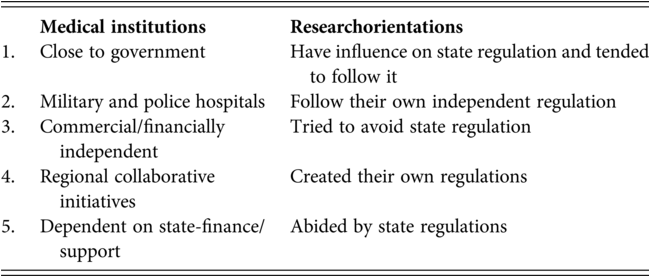
The Research Orientations described above can be summarised in Table 3.1, which illustrates that institutions with different interest and background are not easily governed.
Regulatory Capacity Building and Regulatory Orientations
Building regulatory capacity in China requires juggling international and local opportunities, possibilities and requirements. Although the research institutions exemplified above (see Table 3.1) are discrete in some ways, they are also involved in alliances and organisations that are tied in with networks adhering to different scientific norms and regulations. These cross-cutting linkages can be found across China and beyond. Thus, we saw that Hanshi in Tianjin was a member of the Guangzhou alliance; Beijing’s CAMS operated a biobank with Tianjin’s Institute of Hematology; Changsha works closely with Beijing’s PUMC, CAMS, but also Lu Daopei hospitals, which works closely with military hospitals (Dan 30/11/2012*); and, besides having links to the cord blood banks of various provincial capitals, Beike has close links with Sun Yat-Sen University in Guangzhou. The networks are also sustained by myriad collaborations with research institutions abroad.
The sustained cultivation of life-science networks with their own communities of practice and the emergence of local regulatory orientations, summarised in Table 3.1, made the creation of an effective national regulatory infrastructure a major challenge. In the past, standards used in clinical stem cell practices developed by local investors and the stem cell industry contrasted with those vetted in official regulatory announcements. The 2015 draft regulation promised to eliminate this inconsistency. But local stem cell research communities had already invested in material and intellectual resources, patient recruitment, research networks, commercial relations and collaborative agreements with municipal, provincial and national governments over a sustained period of time, which entailed particular ways of dealing with standards and regulation in clinical stem cell research. They display a range of regulatory orientations regarding standards for safety, efficacy, scientific protocol, licensing and ethics, shaped variously through local, regional, public, private and state institutions. It is through these diverse regulatory orientations that the Chinese government had to balance the building of regulatory capacity with its international life-science strategy.
Regulatory Struggles and Responsible Innovation in India
A second example of regulatory boundary-work of an LMIC illustrates how the desire to economically compete and international reputation shape the development of a regulatory framework for regenerative medicine. India’s regulatory development, as embodied in the development of the company Stempeutics, illustrates that the importation of ‘ideal’ regulation from abroad is not independent from local conditions and economic ambitions and not determined by the standards set by its biomedical platform. When adapting regulations from abroad, compromises were made between ‘the ideal’ models used by the laboratories of the global elites and the standards aimed for at home.
In under a decade, policy-makers transformed the image of India as a land of commercial provider of stem cell transplants into a country of ‘responsible’ production of cell-based products. This effort is illustrated by the transformation of the regulatory orientation of Stempeutics Research Private Limited. Stempeutics was a trend-setting and leading ‘biomedical platform’ in the development of stem cell–based medical devices and therapeutic products, with facilities in Bangalore and Manipal (India) as well as in Kuala Lumpur (Malaysia). This case study shows how Stempeutics’ transformation created the conditions for a major shift in stem cell research and cell-based product development in India.
This shift in the organisation of a biomedical platform is often represented as a technological development. In the STS literature, biomedical platforms are assumed to spread through the dynamics of scientific and technological requirements of the biomedical products concerned (e.g., Keating and Cambrosio Reference Keating and Cambrosio2000, Reference Keating and Cambrosio2003). The notion of platform refers to both the equipment and technology and to the implementation and coordination of biomedical interventions (Keating and Cambrosio Reference Keating and Cambrosio2003: 345). For instance, instruments that count the number of CD4 cells in HIV-patients need to serve AIDS control activities. The order created by the platform results from a consistency of purpose between the various parts, such as the match between measurement and diagnosis. Platforms, then, rather than for political or commercial aims, generate configurations of techniques/instruments for certain (biomedical/technical) purposes (Keating and Cambrosio Reference Keating and Cambrosio2003: 348). Forming both technological support and a springboard for action, platform dynamics are not incentivised by the politics of scientific and technological change but are the result of it.
Functionalist approaches to research platforms can easily draw attention away from the role of turf struggle in their development. Rather than tracing the scientific and technological dynamics of the biomedical platform, the case of Stempeutics illustrates the contentions and political considerations in moving from a platform of commercial stem cell provision to one of ‘responsible’ producer of stem cell products. The evolution of Stempeutics’ biomedical platform in India shows that in a globalising world with scientific and technological pioneers and followers, the shift between platforms is dominated by international and national entrepreneurial considerations, political interests, regulatory limitations and resource constraints. Pioneering a novel biomedical platform in India, Stempeutics altered protocols, procedures and standards reconfigured to suit its own situation, product requirement, institutional capacity, available expertise, collaboration, equipment and so on. Accordingly, it developed its own regulatory orientation.
Stempeutics regulatory orientation regarding stem cell research, clinical trials and product-development changed radically in the period between 2006 and 2014. These changes were driven by the introduction of new regulations (see below). Enquiring about the radical changes in company strategy, the Company’s CEO welcomed Prasanna Kumar Patra, my co-researcher, and me to talk with personnel about the history of Stempeutics and its stem cell–based products in September and October 2013 and between May and June 2014. The story of Stempeutics illustrates what happens when an enterprise decides to develop biomedical products similar to those in pioneering countries – but on the basis of adapted methods of protocol writing and regulation from abroad and with limited intellectual and material resources. It shows how political incentives create spaces for the regulatory orientation that skews the relation between biomedical product and biomedical need, for instance, by privileging biomedical products according to regulatory convenience and following the path of least regulatory resistance.
Regulatory Capacity Building
In 2007, the Indian Council of Medical Research (ICMR) and the Department of Biotechnology (DBT) jointly released the Guidelines for Stem Cell Research and Therapy. The regulation would guarantee safe and efficacious stem cell research and treatment using the three categories of Permitted, Restricted and Prohibited. The notion of ‘therapy’ in the title of the Guidelines had created much confusion, as it has the positive connotation of medicine that works. So why restrict or prohibit it? The 2013 National Guidelines for Stem Cell Research (2013) retained the earlier classification of stem cell research but with an additional layer of oversight, besides the Institutional Ethics Committee (IEC), in the form of an Institutional Committee for Stem Cell Research (IC-SCR) and the National Apex Committee for Stem Cell Research and Therapy (NAC-SCRT). Crucially, and following practices abroad, it omitted the word ‘therapy’ from the Guidelines, emphasising that there could be no guidelines for therapy until its efficacy was actually proven. The guidelines included both basic research and translational applications, but not therapy, making applications contingent upon permissions. This development was reflected in Stempeutics’ shift from therapy provision to translational research and its role as ‘model’ for the development of stem cell applications in India.
Following regulatory changes in the United States, the Guidelines further emphasised that the use of any stem cells in patients, other than hematopoietic stem cells for approved indications, had to be investigational. Investigational, following regulatory developments in the US, refers to experimental research that has been authorised. Accordingly, any stem cell applications in humans were to take place within the purview of an approved and monitored clinical trial with the intent to advance science and medicine: the use of stem cells in patients outside an approved clinical trial was to be considered as malpractice (ICMR-DBT 2013). The amendment in the Drugs and Cosmetics Act (DCA) mandates that all stem cells and cell based products that can be used for therapeutic purposes shall be referred as Stem Cell and Cell Based Products (SCCPs) and that all activities related to their usage, that is, manufacture, isolation, collection, storage and transplantation into patients required a license granted by the Drug Controller General of India (DCGI)/ Central Drugs Standard Control Organisation (CDSCO 2013). This regulation inaugurated the development of a sharp discursive divide between the leading elite laboratories, such as Stempeutics, and the sea of unauthorised stem cell clinics (Tiwari and Raman Reference Tiwari and Raman2014), a phenomenon further discussed in the next chapters. Important in the current study, however, is the assumption, held by both scientists and managers, that the elite laboratories had imported regulation solidly built on the scientific and functional requirements of their biomedical platform. As will become clear below, the importation of regulation, also when adapted, conditioned not just technological necessities but also altered the biomedical possibilities.
Stempeutics’ Shift in Stem Cell Business
Stempeutics in 2007 changed its business plan from a lucrative clinical provider of stem cells to a mainly research-based allogeneic stem cell product development corporation. The stories behind Stempeutics’ new regulatory orientation personnel narrate as an epic of ‘responsible innovation’.
Stempeutics was established by the Manipal Group in 2006 in Bangalore in the midst of India’s biotech boom, of which Bangalore was a vibrant hotspot. The Manipal Group or Manipal Education and Medical Group (MEMG) is one of India’s largest private institutions in education, research and healthcare, active at home and abroad. In 2006, MEMG appointed a scientist, Dr Ratan Pal (pseudonym*), as the first director and scientific head of Stempeutics. By then, Dr Pal had spent over four years at Reliance Life Sciences in Mumbai, another frontline private stem cell company in India, and before that he was with a public-sector research institute named National Institute of Immunology (NII), in New Delhi. Dr Sanjay Singh, a scientist who until recently was in charge of Stempeutics’ Malaysian branch first sets Stempeutics’ decision to reorganise in a national regulatory context. He explained that, in 2006, Dr Pal was utilised by Stempeutics and the Manipal Group to generate revenue through stem cell therapy related services. But after the introduction of the 2007 ICMR-DBT and stem cell guidelines, he realised that the activities of Stempeutics and Manipal were not going to remain lucrative (Singh, 24/5/2014*).
Next, Dr Singh set the decision to reorganise in a global economic and scientific context, explaining that, at the time, there were many stem cell companies in the West, especially in the US and Canada, that were getting encouraging results from mesenchymal stem cells, and many were engaged in allogeneic stem cell product development (Singh, 24/5/2014*). Dr Pal impressed upon the Manipal Group the marketing advantages of the strategy of changing the enterprise from therapy provision to stem cell–based product development grounded on research. Dr Pal then recruited young scientists from reputed institutes such as the Indian Institute of Science (IISc), Bangalore, including Dr Uday, Dr Jyothi and Dr Rakhi. The parallel exercise of translational research at Stempeutics and the provision of clinical stem cell applications at Manipal Hospital continued until 2008, after which Stempeutics decided to stop therapy provision altogether and focus entirely on stem cell research and product development. Dr Pal and Stempeutics’ management decided to focus on allogeneic stem cell products.
In 2007–2008, Dr Pal moved to Stempeutics’ Malaysian branch at Kuala Lumpur as the head of the unit, and after a few years he left Stempeutics to open his own company in Mumbai called Kanishka (pseudonym*). Subsequently, there was a structural shift in Stempeutics’ entrepreneurial activities. The organisational set-up of Stempeutics was rewired in pursuit of linking up basic research, cell processing, industrialisation and therapy provision. This set-up resembles the heterogeneity and interconnected nature of the biomedical platform described by Keating and Cambrosio (Reference Keating and Cambrosio2000), where it is ‘less of a thing than a way of arranging things’ that characterises its network-activities (Keating and Cambrosio Reference Keating and Cambrosio2000).
After Dr Pal moved out of Stempeutics, Mr M. Kumar, the current CEO, an engineer by training and a close aid of MEMG, was asked to lead Stempeutics’ business side. He joined Stempeutics in August 2008 and was made responsible for generating funding and looking for partners that could support Stempeutics’ research activities. Dr Singh described the importance of entrepreneurial networking across national boundaries that took shape under Mr Kumar’s leadership. By this time, only the Manipal Group was investing in Stempeutics, and their earlier revenue from clinical applications and stem cell processing had already dried out. Then, Cipla became collaborator in 2009 and it agreed to fund the research by giving Rs. 50 crore (US$8 million) every year towards research. The scientific team of Cipla (an Indian multinational pharmaceutical and biotech company) became convinced by the proposal of Stempeutics for allogeneic stem cell product development (Kumar, 24/5/2014*).
Stempeutics’ development of stem cell–based products using allogeneic MSCs now only focused on eight indications: ischemic cardiomyopathy (ICM), acute myocardial infarction (AMI), (liver cirrhosis (LC), critical limb ischemia (CLI), CS, chronic obstructive pulmonary disease (COPD), diabetes mellitus (DM) and OA (osteoarthritis). Financial constraint influenced the selection of indications. Stempeutics’ scientist, Dr Chaturvedi (pseudonym*) explained that the expenses per disease condition, from basic, to pre-clinical to clinical, are huge, so that focusing on many disease conditions was not financially viable (Kumar, 28/5/2014*).
The shift from exclusively ‘therapy’-provision to the simultaneous practice of research and clinical interventions and, finally, to stem cell-based product development, led Stempeutics to expand and reshape its networks and to develop a new scientific infrastructure and functional regulatory approval mechanism. This socio-scientific network structure brought public-sector research institutes, clinical research organisations (CROs), pharmaceutical companies, corporate hospitals and small clinics together, forging a new collaborative biomedical platform. Advanced technological and scientific infrastructures were created around the stem cell–based product development process at Stempeutics with the support from the Manipal Group and Cipla pharmaceuticals.
Regulatory Capacity Building and the Biomedical Platform
Regulatory capacity was central to Stempeutics’ threefold plan of ethical standardisation, protocol development and clinical data generation. Forming institutional review boards (IRBs), managing and educating board members capable of evaluating a project application and providing technical recommendation required, according to Stempeutics, immense resource mobilisation. Its role in regulatory capacity building eventually led to Stempeutics’ invitation to play an advising role in India’s regulatory efforts of regenerative medicine. CEO Mr Kumar explained that, along with the regulatory and policy-making bodies, they tried to address the regulatory concerns and to make scientific practices meaningful, accountable and transparent (Kumar, 27/5/2014*).
Regulatory capacity building, then, was seen as key to both scientific and business development. To Stempeutics, the opportunity to co-create research regulation meant that it could more easily comply with the new regulation, handle regulatory knowledge and build scientific research on a nationally and internationally acknowledged basis. In other words, it had the regulatory authorities to vouch for the legitimisation of its scientific research, as it had helped build it.
It was then that Stempeutics decided to develop a biomedical platform for three stem cell–based products that were destined for the market: Stempeucel, Stempeutron and Stempeucare. Stempeucel is a stem cell product based on cultured adult allogeneic mesenchymal stromal cells. Stempeucel was targeting various degenerative disorders as an on-demand off-the-shelf product available to clinics and hospitals. It uses cryopreservation techniques to attain higher numbers of viable cells after thawing and without losing their multi-potent differentiation and cytokine production capacity. Stempeutics had regulatory approval for clinical trials on three indications: Liver Cirrhosis (LC) in India, Osteoarthritis (OA) in India and Malaysia, and Critical Limb Ischemia (CLI) in India. For Acute Myocardial Infarction, Stempeucel was in phase I in India, and for Ischemic Cardiomyopathy it was in the pre-clinical stage in Malaysia. It had received phase 2 approval from the DCGI for Diabetes Mellitus Type 2 and for COPD in India, and Phase ½ approval for Cerebral Stroke from NPCB in Malaysia (Stempeutics webpage 2015).
Stempeutron is a point-of-care, fully automated stem cell isolation device for the isolation of autologous stromal vascular fraction (SVF) from fat tissue, intended for cosmetic and reconstructive procedures. This device can be used for breast reconstruction/cosmetic breast augmentation, facial restructuring, deformity correction and scar and wrinkle reduction (Stempeutics webpage 2015). Kumar, its CEO comments:
Compared to other similar products worldwide, Stempeutron was to be cost-effective and more flexible. Its uniqueness lies in the use of the ‘filtration method’ (rather than a ‘centrifugal method’, used by Cytori), ‘robotic arms’ and being ‘tubeless’.
Kumar explained that the product was expected to be one-fifth of the price charged by multi-national companies, such as Cytori (Kumar, 27/5/2014*).
Stempeucare is a conditioned medium derived from BM-MSCs for cosmetic applications. The conditioned medium contains more than 200 growth factors and cytokines, of which Stempeutics had quantified about 30. They are claimed to play an important role in tissue regeneration and repair (Stempeutics webpage 2015). Some of these factors would possess biological activity for skin repair and rejuvenation. One skin health product in the Stempeucare range has passed the phases of pre-clinical efficacy and safety. According to Stempeutics’ CEO, ‘it has received the Karnataka Government’s approval for a human volunteer study. Its launch was expected within six months; while a Stempeucare product for hair growth was expected to reach the market soon, too’ (Kumar, 27/5/2014*).
These three products developed at Stempeutics target different categories of clients, follow different regulatory pathways – in India or Malaysia – and cater to different market logics (Figures 3.2–3.4). Stempeutics attaches importance to developing three quite different products for strategic reasons. Dr Singh reasoned that:
As a cell-based allogeneic product, Stempeucel will have a long gestation period and it is [to go] through an uncertain regulatory approval process. One is not sure when it would come to the market and one can get back his money.
Economic and regulatory considerations clearly play an important role in the decision about therapy targets. The other two products, Stempeutron and Stempeucare, are relatively less capital-intensive and have a shorter gestation period. According to Dr Singh, they have a market waiting for them:
The global market for cosmetic surgery services were $31.7 billion in 2008, a figure that was expected to reach $40.1 billion in 2013, with a compound annual growth rate (CAGR) of 5.2 per cent.
The International Society of Plastic Surgeons survey ranks India fourth in the number of cosmetic surgical procedures (850,000) performed per year (compared to 3,100,000 in the number one ranking US). India also ranks fourth in the number of breast augmentation surgeries performed annually, which is market valued at US$ 600 million market (PharmaBiz 2012). Keeping these market figures in mind, Mr Kumar emphasised that, while the medical device market was projected to grow to $5.5 billion in 2014, with a CAGR of 15 per cent, indigenously developed technologies would address the temporary financial shortfall. Therefore, while the first product is the ultimate objective of Stempeutics, the latter two are meant to capture the currently emerging market. In other words, what is affordable, sellable and regulatorily manageable was the key to product functionality: how products work is important financially, scientifically and reputationally, but where the means did not reach, the efficacy of the product might have to be near-enough and first applied in less well-regulated areas. Biomedical platforms, then, can be disjointed.
Stempeutics’ New Regulatory Orientation as Model
By switching its focus from clinical stem cell applications to product development, Stempeutics had already been able to improve its image as a ‘responsible’ industry, but its role in changing India’s regulatory scenario turned it into a ‘model’ for others to follow.
India had reformed its stem cell regulation between 2008 and 2012. This was a time of expansion of clinical stem cell applications and of patients visiting India for stem cell treatment from abroad (Srinivasan Reference Srinivasan2006; Bharadwaj and Glasner 2009). In this period, the ICMR and DBT took steps to address gaps in the 2007 stem cell guidelines. This happened in the context of media reports about medical malpractice, false clinical claims and issues of patient safety, vilifying the practices of unlicensed therapy providers (Lau et al. Reference Lau, Ogbogu, Taylor, Stafinski, Menon and Caulfield2008; Pandya Reference Pandya2008; Kiatpongsan and Sipp Reference Kiatpongsan and Sipp2009; Patra and Sleeboom-Faulkner Reference Patra and Sleeboom-Faulkner2009; Bharadwaj Reference Bharadwaj2012; Tiwari and Raman Reference Tiwari and Raman2014).
Stempeutics played an active role in this crucial period in India’s regulatory revision by representing the stem cell industry in India in various committees. This provided Stempeutics with an opportunity to familiarise itself with the systemic, scientific and managerial requirements for regulatory approvals. Dr Vimal (pseudonym), who represented Stempeutics at several deliberations and drafting committees of guidelines, explained that the application for clinical trials was difficult on two counts. First, Stempeutics was new to the field, which itself was emerging, so there was a need to develop R&D protocols for pre-clinical and clinical studies and to write good project proposals. And second, as regulatory bodies and their external expert committee members had limited knowledge of stem cell science and technology, including the evaluation of project proposals and research outputs, it was a learning experience for most (Vimal, 8/5/2014*). As one former evaluation committee member for clinical trials on osteoporosis, Professor Srinivasan (pseudonym), remarked:
The Stempeutics case was more of a learning experience than an evaluation. We had to look at what happened in cases in the USA and other places. At times, we dealt with ‘firsts’, so we had to educate ourselves before assessment took place.
With hindsight, many at Stempeutics believe that the initial challenge turned into an advantage for Stempeutics. Dr Vimal explained that after the first approval in 2009, they learned how to negotiate and how to reach the expectation levels of the regulatory committee members. They then were invited to all deliberations on regulatory body meetings. Some of the staff became invited members to various committees.
Initially, Stempeutics hardly knew how protocols were to be prepared, how clinical-grade cells were made for products, how to address the needs of the regulators and how to plan clinical trials. In fact, members of its central regulatory body admitted that they had lacked expertise. In 2017, the Drugs Controller General actually granted conditional approval for manufacturing and marketing of Stempeucel products for the treatment of Critical Limb Ischemia. This was celebrated as a major triumph. Stempeutics, then, is satisfied that it has transformed its image from being engaged in unauthorised stem cell experimentation to a leader and benefactor of regulatory capacity building.
Stempeutics has emerged both as an experimental space of the state’s regulatory experiment and as an agent in addressing the regulatory challenges of cell-based product development. Nevertheless, the question remains how Stempeutics’ research outcomes will be received and also how they will be rated scientifically. First, the reputation of India’s regulation as un-implementable may still stain Stempeutics’ name, and, second, the fact that Stempeutics conducts clinical trials also in Kuala Lumpur, where regulation is viewed as more forgiving, may arouse doubts about the quality of the trials. Clearly, in order for a biomedical platform to work, it does not just need to be in functioning order and comply with international standards; it also needs to be recognised as such. Stempeutics’ biomedical platform developed stem cell products based only partly on India’s medical needs and mainly on what was regarded as internationally lucrative, risky and regulatory feasible. At the same time, its products catered to different categories of clients, followed different regulatory pathways and targeted different market logics.
The varying product requirements make for different political, economic and regulatory demands of the biomedical platform. The challenge for Stempeutics, then, was to prepare itself to steer the course of harmonisation as a ‘process of recognizing and reconciling regulatory differences’ (Issai 2009) in the evolving Indian stem cell field, rather than to explore the standards and infrastructure appropriate for a desired therapeutic product. In short, Stempeutics’ shift in its business plan was incentivised largely by the politics of standardisation and international competition and affected the operational basis of the biomedical platform. In other words, the biomedical platform was not so much about how to cater to particular biomedical conditions in an effective way but about which products and regulatory pathways could lead to permissions, recognition and the market.
Conclusion
Although we cannot generalise the implications of the case studies to the world, it is possible to discern a pattern of boundary-work based on the way regulation is created in LMICs under regulatory capitalism. The hegemonic currency of ‘international regulation’ has implications for rising powers and large LMICs, if not for other countries, too. Although, in theory, enabling innovative research and technologies in ambitious LMICs to compete internationally with elite laboratories elsewhere, innovators do not have the space to develop standards that are suitable to the financial capacity and availability of expertise relevant to particular biomedical platforms. In both China and India, this situation led to a split between elite scientific laboratories that aim to compete in the ‘international science community’ and those involved in the life-science industry and medical care. This split is one of several that result from regulatory capitalism, which polarises creators and followers of regulation on both an international level and on a national level, leading governments to engage in regulatory boundary-work and local players to develop particular regulatory orientations.
We saw that even model biomedical companies and institutes struggle to follow the high standards of regulation, which they themselves sometimes help to develop. This situation aggravates the conflict between elite research centres and other research institutions, including those in the biotech industry. Although the biotech industry invests in research equipment, materials and processes, it has often shied away from the prohibitive costs of clinical trials. We saw that in China this led local investors to collaborate with researchers and hospitals directly, developing their own guidelines, a shift of translational research to the military hospitals and to clandestine therapy provision; in the example of India’s Stempeutics, we saw that industry was invited to play a role in formulating the regulation, which raised the preparedness of industry to invest. Nevertheless, this did not prevent commercial providers from continuing to offer unauthorised stem cell interventions.
Regulatory capacity-building, then, does not just serve scientific and technological requirements for ‘catching up’ with advanced players in the race to clinical firsts in regenerative medicine; rather, it follows the strategic priorities of competing internationally in the future and being competitive to survive in the present. The chapter’s case studies show from different angles how the development of regulation in LMICs are closely linked to government policies that need to cater to economic growth targets and address public health issues, including thalassemia, GvHD, Diabetes Mellitis and liver cirrhosis. To remain competitive, companies strategically target products that are sought after, such as ‘cosmetic cell therapies’ and conditions with existing treatments, next to other long-term therapeutic product targets.
A widespread view, including STS debates on biomedical platforms, attribute the technological rationale of biomedical platforms as informing regulation. What is underexposed, however, is that the globalisation of regulation gives a temporal advantage to pioneering industries. Rising powers show that the future of regenerative medicine does not so much result from a linear process of scientific and technological capacity (Keating and Cambrosio Reference Keating and Cambrosio2000, Reference Keating and Cambrosio2003) but is actively created in the present through contested claims over technological potential and its economic viability. For this reason, ‘regulatory capacity building’ is not just a matter of mimicking industrially advanced countries. Global regulatory hegemony is partial and dynamic and therefore modulated by the reality of local needs and developments, especially in LMICs. This chapter, therefore, concludes that neither global hegemony approaches nor approaches that emphasise the scientific rationale of regulations are sufficient to explain the global dynamics of regulatory development in the field of regenerative medicine. Any such explanation would have to take into account the dialectic between the political desire to compete globally and the regulatory orientations that underpin the country’s regulatory boundary-work.


 Open access