

Introduction
John Hart Ely’s Democracy and Distrust is one of the best-known works of constitutional theory globally.Footnote 1 Its focus, however, was almost exclusively on the recognition of rights – substantive and procedural – in constitutional adjudication. It largely preceded modern debates about the appropriate use of judicial remedies in constitutional cases.
‘Comparative political process theory’ (CPPT)Footnote 2 or ‘comparative representation-reinforcing theory’ (CRRT),Footnote 3 in contrast, squarely addresses the scope and strength of judicial remedies. Both theories take as a starting point the experiences and developments of leading constitutional courts around the world on a range of substantive and remedial questions, including their use of suspended declarations of invalidity and engagement-style remedies.
Many CPPT/CRRT scholars have also written extensively about the issue of constitutional remedies.Footnote 4 Nevertheless, attention in CPPT/CRRT scholarship to remedial questions does not mean that there is consensus among comparative scholars over the appropriate use of ‘novel’ judicial remedies, such as suspended declarations.Footnote 5 Some scholars suggest that delayed remedies provide welcome opportunities for courts to avoid direct confrontations with the political branches of government that are likely to damage the institutional standing of courts.Footnote 6 Others suggest that delayed remedies offer the potential for a valuable form of democratic ‘dialogue’.Footnote 7 But a few scholars also argue that delayed relief is an abdication of judicial responsibility to provide justice to individual litigants, or a form of ‘justice denied’.Footnote 8
How then does one reconcile these competing accounts of new judicial remedies? In this article, we turned to recent work by one of us (Dixon) on ‘responsive judicial review’ (RJR) to offer a distinctive account of the appropriate scope and strength of judicial remedies within CPPT/CRRT. The starting point for RJR is the understanding that, in construing open-ended constitutional provisions, constitutional courts should consider both the advantages and risks to democratic governance and responsiveness that result from ‘strong’ or active forms of review. The advantage of judicial review is that it can help overcome three broad threats or ills associated with democratic majority rule, namely the accumulation of electoral or institutional monopoly power by political elites, the effects of democratic ‘blind spots’, and ‘burdens of inertia’.Footnote 9
The operative word here is ‘can’, rather than will; there are a range of quite demanding preconditions before courts can satisfactorily perform this role – including a reasonably high degree of formal and de facto judicial independence, legal and political support structures for judicial review, access to courts, and, as the article explores, adequate judicial remedial power.Footnote 10 Judges must also possess sufficient legal skills and political acumen, and timing and luck must be on their side.Footnote 11 And as Ely himself noted, judicial review can be troubling from a democratic perspective: courts may misjudge the contours of democratic majority in ways that lead to reverse democratic burdens of inertia or damaging forms of institutional backlash.Footnote 12 If judicial review is consistently too strong when countering democratic dysfunction, this may also discourage legislators from taking active responsibility for doing their job or contribute to what Mark Tushnet has called a form of ‘democratic debilitation’.Footnote 13
Therefore, according to RJR theory, courts should also seek to balance these competing risks – by adopting a carefully calibrated mix of strong and weak forms of remedial relief (“strong-weak” or “weak-strong” review).
In cases where the political branches are seeking to exercise anti-democratic monopoly power, RJR theory posits that there will often be good reason for courts to issue strong and immediate relief as a means of countering such threats to electoral and institutional pluralism. The case for delayed relief in such cases will be purely for prudential considerations, and the use of delayed relief herein should depend on a showing of a real risk of democratic backlash against the grant of a strong-form judicial remedy.
On the other hand, in cases involving democratic blind spots or burdens of inertia, RJR theory would advise against strong forms of judicial review as there are real dangers they can incur reverse inertia and democratic debilitation, or democratic backlash. For such cases, the argument for deploying weakened remedies is also principled and pragmatic: delayed remedies create an opportunity – and focal point – for legislative action on an issue without triggering the potential legal and practical obstacles imposed by stronger, more immediate forms of judicial relief. At the same time, RJR theory posits that legislative inertia can be prohibitive and powerful when delayed remedies are deployed. Hence there is also a need for courts to create additional incentives for legislative action – in the form of an explicit court-defined ‘penalty default’ should the legislature fail to act. The logic behind ‘weak-strong remedies’ of this kind – coercive prescriptive remedies that only apply after the legislature defaults – is that it provides a temporary window of opportunity – and incentive – for legislative action on the issue, but with an explicit warning to the political branches that failure to act will lead to pre-defined strong-form relief provided by courts.
This combination of weak-strong relief, we argue, offers a normatively attractive account of how the incentives for strong and/or weak remedies should be balanced before judicial deployment, especially when addressing cases involving legislative blind spots and burdens of inertia. This approach takes into account serious concerns about both the democratic and sociological legitimacy of judicial review and the risks to democratic responsiveness arising from both the judicial over- and under-enforcement of rights. It also finds support in the actual practice of courts operating in a range of constitutional democracies worldwide. Only in exceptional cases involving threats to democracy itself will the better option be the deployment of strong-strong review (strong reasoning and remedies), or the pairing of strong judicial reasoning with (wholly) weak remedies when prudential considerations prevail.
To illustrate this, we turn to a range of Asian cases to highlight the promise and pitfalls of purely weak and strong approaches to judicial remedies, as well as the attraction of more finely calibrated weak-strong remedial combinations from a democratic perspective. Asia is one of the world’s largest regions, with enormous constitutional as well as social, political, cultural, and economic variation. It thus provides fertile ground for illustrating these complex context-specific arguments. It is home for both and the area expertise of one of us (Yap). And it is territory that is less well-trodden than other regions, which are the more ‘usual cases’ in comparative constitutional law.
The remainder of the article is divided into five parts following this introduction. Part II outlines Ely’s idea of representation-reinforcing review and its relative inattention to the issue of judicial remedies, especially remedial innovation in the form of weakened judicial remedies, and we underscore how these innovations are now at the centre of comparative political process theory. Part III turns to the relevant Asian cases to illustrate the importance, as well as dangers, of weakened remedies in addressing some of the democratic concerns that animated Ely’s own theory, namely concerns about democratic backlash and legitimacy. Part IV evaluates – from a responsive constitutional perspective – the balance one should strike between weak and strong remedies, with illustrations from Asian cases. Part V offers a brief conclusion.
Part II:Process-theory and weak versus strong remedies
Courts and political process theory
Ely’s basic argument in Democracy and Distrust was simple: in a system of ‘strong’ judicial review such as the US, judicial decisions purporting to construe open-ended provisions of the Constitution raise significant democratic difficulties. There are few legal or textual signposts available to guide courts in making such decisions. And they lack any claim to political legitimacy in making decisions about fundamental values, especially given the finality of judicial review under Art V of the US Constitution. Hence, Ely argued, courts should minimize making judgments of this kind. Instead, courts should exercise their powers of constitutional judicial review only in three relatively narrow categories of cases: where there was an alleged violation of a clear, rule-like provision of a written constitution, where they were seeking to protect the channels of political change, and/or protect ‘discrete and insular minorities’.Footnote 14
These arguments echoed the reasoning of Justice Stone in United States v. Carolene Products Co footnote number four.Footnote 15 But Ely placed these arguments within the context of a general theory of judicial ‘representation-reinforcement’, or account of courts’ role as linked to the protection and enhancement, rather than displacement, of the political process.
Ely’s version of political process theory has had significant influence in the United States constitutional academy.Footnote 16 It has likewise been studied by leading global lawyers, judges, and scholars, and in some cases, informed their approach to constitutional theory and decision making.Footnote 17 But it has also been subject to sustained criticism: many leading US scholars have questioned the distinction Ely drew between constitutional ‘process’ and ‘substance’, and between ‘discrete and insular minorities’ and other groups subject to historical disadvantage and marginalization.Footnote 18 And many comparative scholars have pointed to the ways in which it failed to capture challenges to democracy or the innovations in judicial review within their own constitutional systems.Footnote 19
Two striking limitations of Ely’s version of political process theory, from a comparative perspective, concern the degree to which it focused on ‘strong’ or final forms of judicial review, such as those found in the US, and how it centred on the substantive scope of rights-provisions as opposed to judicial remedies.Footnote 20 The two limitations are also related.
Courts and weakened judicial review
On some level, all judicial review is non-final over the long-term. As social norms change, so too do the social and political attitudes of judges. And as existing judges retire and are replaced by new judges, both judges’ legal and political approaches may change. The attraction of weak form judicial review, however, is that it is attentive to the timeframe for change of this kind from a democratic perspective. For proponents of weak form judicial review, judicial review will be democratically legitimate if there is broad concordance between majoritarian understandings and constitutional rules over the short to medium – and not just long – term. The difference between systems of ‘weak’ and ‘strong’ judicial review is also that they provide a range of formal mechanisms through which this can occur, in addition to the processes of judicial renewal.
One such mechanism is a power of legislative ‘override’ of the kind found in s 33 of the Canadian Charter of Rights and Freedoms 1982: Section 33 provides that both federal and provincial legislatures in Canada may ‘expressly declare’ that legislation ‘shall operate notwithstanding a provision included in section 2 or sections 7 to 15 of this Charter’.
Another mechanism is the power of implied repeal that exists under any constitutional instrument that is small ‘c’ or statutory in nature. In the UK, for example, the Human Rights Act 1998 was enacted as an ordinary statute and by ordinary legislative majority vote. This means that, as a matter of domestic law, the operation of any given provision of the Act can be displaced by clear words found in a subsequent statute. The same is true in New Zealand and in various Australian states and territories with statutory charters of rights. It was a feature of the Canadian 1960 Bill of Rights. This is also one reason why Stephen Gardbaum has linked the idea of weak review to the ‘new Commonwealth model’ of constitutionalism.Footnote 21 Other than Canada, post-1982, all these countries have rights charters enacted by statute and have created the same (express or implied) remedial structure as the UK HRA.Footnote 22
But there are also other countries in which courts have enforced rights in a ‘sub-constitutional’ way, which parallels the new Commonwealth model. This is true in some instances in the US in the context of statutory interpretation and the judicial use of the ‘clear statement’ rule.Footnote 23 And it is a defining feature of constitutional decision-making in Asia, including Japan.Footnote 24
In other countries, a common mechanism for legislative override is found in procedures for formal constitutional amendment. Most countries provide for processes of constitutional amendment that are far more flexible than in the US. Indeed, by most measures, the super-majority requirements for proposal and ratification of amendments under Art V of the US Constitution are now the most demanding when compared against other constitutional democracies worldwide.Footnote 25 And flexible amendment processes provide a highly effective means of weakening the finality of judicial decisions: amendment procedures give legislatures – and in some cases voters themselves – power to override or alter constitutional norms in future cases.
Another mechanism is the power of legislatures to impose limits on the jurisdiction of a constitutional or appellate court. The logic behind mechanisms of this kind is that when courts render decisions that meet with disagreement, legislators may express that disagreement by re-enacting the original statute and removing the jurisdiction of the courts to strike it down based on their prior reasoning. Admittedly, mechanisms of this kind are rarely fully effective. Courts often find ways to read down ouster provisions of this kind, or strike them down as unconstitutional.Footnote 26 Nonetheless, they provide another means by which judicial review may be at least partially or temporarily weakened in certain systems. In the US, for example, Article III of the Constitution allows Congress to make ‘exceptions’ to appellate jurisdiction of the Supreme Court, and an implied power of this kind is found in countries (such as the UK) with a small ‘c’ statutory constitution.Footnote 27 In India, this kind of jurisdiction-stripping legislation has also been combined with formal constitutional amendments to weaken the finality of court decisions, though the Supreme Court of India has also responded by invalidating these ouster clauses if they violate the Constitution’s implied basic structure.Footnote 28
In addition, courts themselves may contribute to weakening the finality of their decisions through decisions that are decided narrowly, or judges apply flexible or weakened approaches to stare decisis.Footnote 29 Narrow forms of reasoning involve judges providing reasons adequate to justify their decision in a particular case while avoiding issues or arguments that could constrain the resolution of similar cases in the future. They thus represent an attempt by courts to leave express scope for legislative ‘dialogue’ with a court’s ruling.Footnote 30
And as Cass Sunstein notes, narrowness (or breadth) also has a temporal dimension: broad decisions may become narrower over time if courts adopt a weakened or flexible approach to stare decisis. Some countries in the civil law tradition have no formal doctrine of precedent, but even in that context, courts generally show some respect for a consistent pattern of prior decisions.Footnote 31 And courts in the common law world often apply fairly strict norms of stare decisis, even if these norms may vary between constitutional and non-constitutional cases.Footnote 32 One way of weakening the finality of judicial review, therefore, is to relax these norms – and in ways sensitive to expressions of (reasonable) democratic disagreement with court rulings.Footnote 33
Weakened judicial remedies
Another important means by which judicial finality is weakened is through the judicial deployment of weak remedies, which may be authorised by legislation or simply judicially created. Strong remedies involve immediate and concrete relief by courts to individuals, often by the grant of coercive orders against the state. In some cases, they may even involve coercive orders against specific named individuals, ongoing forms of coercive monitoring of the implementation of those orders, and damages or contempt-based sanctions for non-compliance of judicial rulings by individual public officials.Footnote 34 Weak remedies, in contrast, involve courts choosing to limit either the coercive or immediacy of the relief they provide. This may involve delaying the time at which a court decision comes into effect or limiting the effect of a decision to future – as opposed to past – events.
Another variant of weak-strong judicial review involves an initial decision by a court that is weak in scope and remedial relief, but that is followed by subsequent cases that involve broader forms of reasoning, or strong or more coercive forms of relief. This is a not weak-strong review in the strict sense (involving a single decision) – but has important continuities or similarities with it, especially if the escalating strength of review is due to increased judicial power and legitimacy or a demonstrated form of governmental non-compliance with an earlier weaker judicial order.Footnote 35
The same is true of judicial orders that involve strong remedies that flow from ‘weak’ or narrow grounds of judicial reasoning. For instance, if a court reasons narrowly but issues an immediate and coercive remedy, judicial review may be considered weak-strong in nature, whereas if a court reasons narrowly and issues a purely declaratory remedy, judicial review can properly be classified as weak-weak in nature.Footnote 36 (See Table 1 below for a concise illustration of the taxonomy).
Combinations of weak and strong review
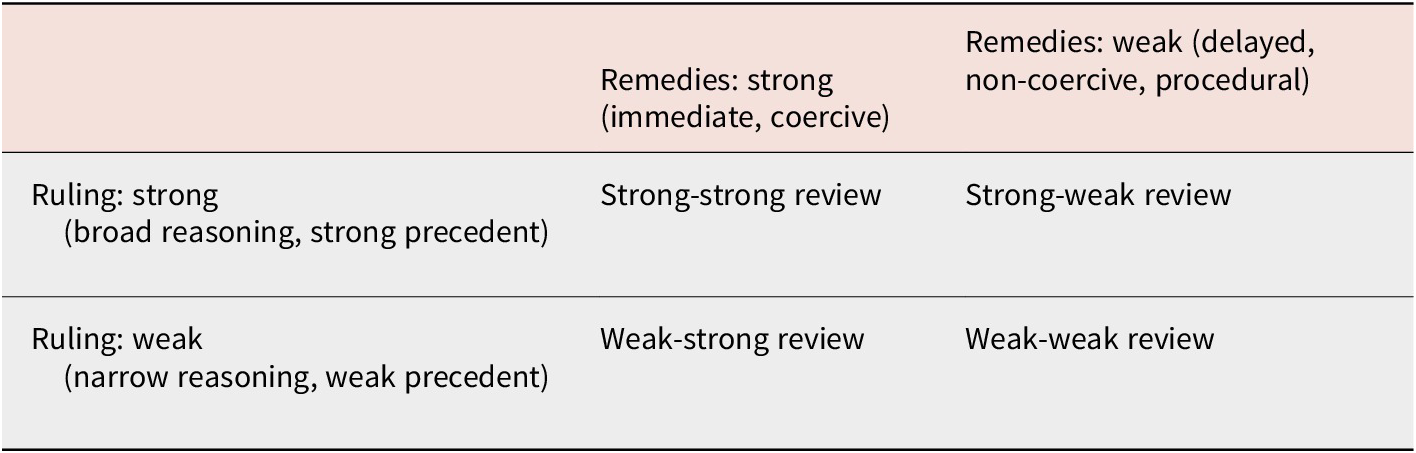
Some constitutions expressly provide for judicial remedies that lack any direct legally coercive effects. The HRA, for instance, confers two broad remedial powers on courts: the power to read down legislation to ensure conformity with protected rights (namely those rights under the European Convention on Human Rights incorporated by the Act) (s 3), and to issue a ‘declaration of incompatibility’ (s 4). Unlike traditional forms of declaratory relief, which give courts power to invalidate laws, these declaratory powers also have no direct legal effect: they simply indicate to the legislative branch that there is incompatibility between constitutional norms and a given statute. The expectation is that in most cases, where a declaration of this kind is issued, the legislature will respond by amending the relevant law to ensure compatibility with constitutional norms. But legislatures also have the power not to respond in this way if they disagree with courts on the impugned legislation’s incompatibility. And this creates a form of weakened judicial finality.
In other countries, courts themselves have developed their own variant on weak remedies.Footnote 37 They have adopted a range of delayed forms of remedy, including prospective forms of overruling and suspended declarations of invalidity.Footnote 38 And in some cases, they have endorsed the idea of ‘engagement-style’ remedies: orders to parties to engage in negotiation about how the relevant state objective could be pursued consistently with the protection of constitutional rights.Footnote 39
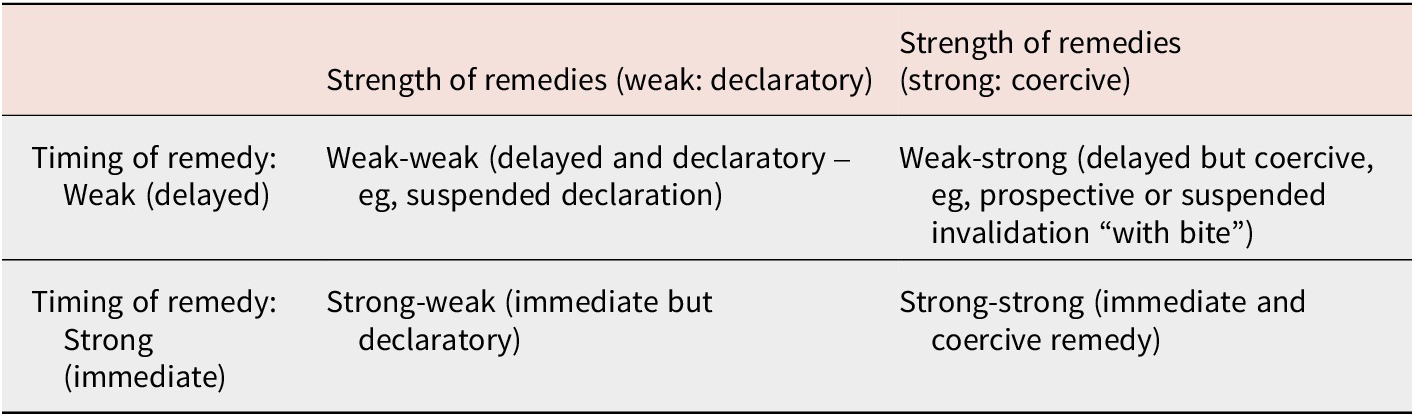
Judicial remedies themselves can also involve a combination of strong and weak relief: legal compulsion to act accompanied by some temporal delay in the execution of the relief. Remedies of this kind (i.e., coercive but delayed remedies) can take two forms: the prospective invalidation of legislation or a delayed declaration of invalidity (suspension order). In the first example, the judiciary does not retrospectively invalidate the legislation under review but instead applies their judgment prospectively to future cases that arise under the same law. In the second, the impugned law is declared unconstitutional, but the law is only invalidated on a future date pre-determined by the Court. This also involves a purely weak form of remedy, where prospective invalidation is strong-weak (i.e., coercive but delayed in nature). (See Table 2 below for a concise illustration of various remedial combinations.)
Variants of weak and strong remedies
Arguments for and against weakened remedies
Weakened judicial reasoning and remedies both have a range of advantages: they can help ameliorate the sting of judicial rulings for the government or mollify elite and popular actors opposed to a stronger judicial ruling. Delayed remedies in particular can also allow time for governments and private parties to adjust to the practical requirements of a court decision and for legal attitudes and/or political and economic conditions to shift before a court’s reasoning binds. This can increase public and elite support for court decisions.Footnote 40
The prospective invalidation of legislation is also particularly valuable in legal cultures unaccustomed to strong-form judicial review or when the governments have frequently retaliated against confrontational judicial rulings by ousting judicial review or even the judges themselves.Footnote 41 This kind of ‘strong-weak’ judicial review was a hallmark of the US Supreme Court’s approach in Marbury v Madison, where the Court asserted broad powers of constitutional judicial review under Art III but then declined to exercise it in the particular case.Footnote 42 It is also a common ‘second order’ deferral tactic of courts elsewhere.Footnote 43 And it is clearly distinct from persistent forms of judicial restraint or avoidance because its premise is that courts can and will confront constitutional questions and employ strong remedies if and when legal and political conditions change.Footnote 44
Suspended declarations of invalidity, in turn, are often attractive to courts where there are a range of constitutional options that could be implemented in light of the court’s ruling.Footnote 45 In such cases, the court typically wants to give an opportunity to the legislature to decide how best to choose among the competing remedial alternatives available.Footnote 46 Remedies of this kind give legislatures the opportunity to respond to courts without facing any form of reverse inertia and with a clear timeframe for action that can make it easier for the political branches to coordinate around the need for change. This again increases scope for legislative and executive dialogue with a court.
To some degree, remedies of this kind predated the publication of Democracy and Distrust. Even in the US, much of the courts’ remedial innovation occurred from the 1980s onwards. For instance, in Northern Pipeline, the US Supreme Court ruled unconstitutional the jurisdiction of the then federal bankruptcy court, but did so prospectively rather than retrospectively, and the decision took effect only after several months.Footnote 47 This was also effectively a form of weak-strong – i.e. coercive but delayed – remedy, or suspended declaration of invalidity, but one issued more than two years after the publication of Democracy and Distrust.
But Ely also downplayed the centrality of remedial innovation, even within the cases that were his focus. Almost any US constitutional theory must outline how it accounts for the decision of the Supreme Court in Brown v Board of Education,Footnote 48 and Ely discusses Brown on six occasions in the book. Yet at no point does his discussion refer to the remedial dimensions to Brown I and II and the Court’s willingness in Brown I Footnote 49 to defer questions of remedial relief to Brown II and in Brown II to endorse a delayed approach to implementation of its orders, at least where delay could be ‘necessary to carry out the ruling in an effective manner’.Footnote 50 This endorsement of the idea of implementation with ‘all deliberate speed’ was a quintessentially weak or delayed judicial remedy.Footnote 51 Yet it played no role in Ely’s analysis of the case.
Comparative political process theory, in contrast, puts weak remedies of this kind at the centre of its account of judicial representation-reinforcement. For instance, in calling for a turn toward a more ‘comparative political process theory’, Stephen Gardbaum notes the overlap between CPPT and three recent areas of interest in comparative constitutional law, including notable ‘the topic of weak-form (or weakened) judicial review’.Footnote 52 Hailbronner calls for a ‘contextual institutional approach’ that includes attention to context and the availability of political and judicial remedies,Footnote 53 and further notes the continuities between CPPT/CRRT and the scholarship of Michael Dorf, Charles Sabel and William Simon on judicial remedies, ‘democratic experimentalism’ and ‘destabilization rights’.Footnote 54
Other scholars in the CPPT/CRRT tradition pay close attention to both weakened forms of review and the legitimacy and effectiveness of various judicial orders and remedies. David Landau and Manuel Cepeda, for example, outline a ‘political process theory for fragile democracies’ that involves courts ‘protecting fragile democracies against erosion, improving the performance of democratic institutions, protecting discrete and insular minorities, and protecting against majoritarian political failures’.Footnote 55 But in doing so, they note the inter-relationship between these functions and the courts’ use of complex ‘structural remedies’ that involve ongoing monitoring of legislative and executive implementation, ‘the empowerment of previously excluded civil society groups’, and forms of ‘experimentation’ that facilitate feedback and in turn adjust the intensity of judicial monitoring.Footnote 56 Landau has also written elsewhere about the link between judicial representation-reinforcement and weak versus strong judicial remedies in contexts where governments are confronted with limited state capacity.Footnote 57
In his work on social rights, Malcolm Langford likewise pays close attention to theories of responsive and reflexive law and regulation, their relationship to both state and judicial capacity, and the scope and strength of judicial remedies.Footnote 58 The same is true for Katie Young in her work on comparative social rights: Young in this context notes different weak-forms of ‘catalytic’ accounts of judicial review, including deferential, conversational, experimentalist and managerial review, and places remedies at the centre of these various accounts.Footnote 59
There remains, however, little consensus among constitutional scholars about the scope that remedies should take, either under CPPT/CRRT or more generally. A number of scholars, including us, have argued for the virtues of weak-strong forms of judicial relief.Footnote 60 Others have argued that CPPT often points ‘points to a form of weak judicial review, because it leaves expansive room for action by the elected branches’.Footnote 61
Nevertheless, critics have also challenged the legitimacy of weakened, and especially delayed, judicial remedies – on the theory that they represent a departure from norms of judicial independence and responsibility.Footnote 62 Delayed remedies can undermine the provision of justice to individuals: hence, the famous idea that ‘justice delayed is justice denied’.Footnote 63 Non-coercive remedies can also reduce the incentives or likelihood that the legislature or the executive will engage in the necessary reforms.
Part III: Weak remedies in Asia
Both the advantages and disadvantages of weakened judicial remedies can be illustrated by referencing a range of Asian cases. Both types of strong-weak remedies have been used in Asia – for instance, prospective overruling has been used by courts in notable decisions in Malaysia, Bangladesh and Indonesia, while suspended declarations are mostly commonly used in Hong Kong, South Korea, and Taiwan.Footnote 64 These rulings have mitigated actual democratic opposition to – or backlash against – court decisions and enhanced the scope for legislative dialogue. Yet, in some cases, the legislature has ignored the court decisions, highlighting the pitfalls of distinctly non-dialogic legislative responses.
Avoiding governmental/public backlash
In countries where courts have to grapple with powerful or authoritarian governments, strong-form judicial review is rarely the norm, as the political branches can easily overrule the judges, if not remove them altogether. In turn, courts operating in such a fraught environment may choose to act prudentially when they confront the government. We may witness this in Malaysia, Bangladesh, and Indonesia.
Malaysia was ruled by the Barisan Nasional (BN) coalition government from the country’s independence in 1957 until the coalition government’s resounding defeat by the opposition bloc – Pakatan Harapan (PH) – in the 2018 general elections. As is typical of courts operating within dominant party democracies, the Malaysian courts had previously done little to countermand BN’s hegemony when the latter was in power.Footnote 65 Judicial power, when exercised, has been asserted carefully.
In Semenyih Jaya Sdn Bhd v Pentadbir Tanah Daerah Hulu Langat Footnote 66 the Federal Court of Malaysia – the nation’s highest court – in 2017 invalidated Section 40D of the Land Acquisition Act, which had imposed a duty on a judge to adopt the opinion of lay assessors when awarding compensation to persons whose land had been acquired by the government. According to the Court, this impugned law had usurped the ‘judicial power’Footnote 67 conferred on courts. Nevertheless, in an attempt to reduce the ‘sting’ of the decision, the Court declared that the invalidation would only apply prospectively, such that all past and pending proceedings on land compensation that had taken place under the impugned law prior to the date of the judgment ‘will remain status quo.’Footnote 68
The judgment is particularly noteworthy as it constituted the first invalidation of legislation by the Federal Court of Malaysia since its Lord President (now known as Chief Justice) and two other judges on the Supreme Court of Malaysia (now Federal Court of Malaysia) were impeached and removed on trumped-up charges of judicial misconduct in 1988.Footnote 69 After close to three decades of hibernation, the Federal Court re-asserted itself gingerly, testing the political waters, and the response from the government was to comply with or acquiesce in the Court’s calibrated show of force.Footnote 70 Since then, the Federal Court has gained confidence and political capital to declare federal legislation unconstitutional in two other instances.Footnote 71
With regard to Bangladesh, since its independence in 1971, the country has experienced two martial law regimes and undergone four states of emergencies. In countries where the armed forces are not under the firm control of the civilian government and the country oscillates regularly between military and civilian rule, high-octane judicial review can often facilitate or precipitate a hostile take-over by the armed forces and lead to the demise of the rule of law, as one may observe with Bangladesh’s neighbour Pakistan.Footnote 72 The most confrontational decisions of the Supreme Court (Appellate Division) have been instances where it sought to defend its institutional independence. Notably in 2017, after the Supreme Court (AD) invalidated a constitutional amendment that would have made judges removable upon a presidential order supported by a two-thirds majority in Parliament, instead of an independent Supreme Judicial Council’s recommendation for removal,Footnote 73 the government was so rankled that the Chief Justice had to flee the country after the ruling.Footnote 74
A more calibrated ruling was handed down by the Supreme Court (AD) in Abdul Mannan Khan v Bangladesh Footnote 75 (2011) when the Court invalidated the Non-party Caretaker Government (NCG) system introduced by the Thirteenth Amendment to the Bangladesh Constitution. The Thirteenth Amendment was passed in 1996 to allow an unelected NCG, headed by a retired Chief Justice, to oversee a pending parliamentary election and for this interim government to manage the country until the elected government took office. While the 13th Amendment was introduced to facilitate free and fair elections in Bangladesh, in practice this did not happen. The NCG system had politicized appointments to the Supreme Court as past incumbent governments had manipulated the retirement age of judges so that a Chief Justice sympathetic to their political cause could retire just in time to serve as the NCG’s Chief Adviser. Furthermore, this ‘interim’ unelected government had imposed emergency rule in Bangladesh for almost two years between 2007 and 2008. In a Short Order issued on 10 May 2011, the Appellate Division held that this Amendment would be prospectively invalidated, but the pre-existing NCG system could be retained for the next two parliamentary elections, thereby offering an olive branch to supporters of the NCG system.Footnote 76
The Constitutional Court of Indonesia (ICC) has been generally deferential to the government.Footnote 77 While Indonesia has not been controlled by a singular dominant party since the end of President Suharto’s authoritarian ‘New Order’ rule in 1998, the judicial passivity of the ICC is not inexplicable. While no political party has been able to win a majority of the seats in the lower house of the national legislature (DPR) since the introduction of open legislative elections in 1999, every President – directly elected by the people since 2004 – has stabilised his rule post-election by cajoling or coercing every significant party into a power-sharing arrangement that practically neutralised partisan conflicts.Footnote 78 In this way, President Susilo Yudhoyono (2004 – 2014) was able to gain a de facto 73 and 75 percent majority in the DPR after the 2004 and 2009 legislative election.Footnote 79 Similarly, President Joko Widodo (2014 – 2024) had co-opted Golkar, the second-largest party in the DPR, into his ruling coalition, thereby expanding his political base to about two-thirds of the legislature.Footnote 80 On the other hand, the ICC was only created in 2003 with few resources and political capital.Footnote 81 Furthermore, prior to September 2020,Footnote 82 all the ICC judges, including the Chief Justice, face re-elections.Footnote 83 To compound the Court’s political fragility, the institution had been plagued by high-profile corruption scandals.Footnote 84 Confronted with these political challenges that impede the ICC’s effective exercise of constitutional review, it is unsurprising that the Court has carefully calibrated its confrontations with the government of the day.
Perhaps the most controversial instance of conflict avoidance occurred in 2004 over the Bali Bombing Case. One of the alleged perpetrators of the bombing (which involved the bombing of two nightclubs in Bali that took the lives of over 200 people) was Masykur Abdul Kadir, who was convicted under anti-terrorism legislation passed in April 2003 that was retrospectively applied to his crime. And in July 2004, the Constitutional Court of Indonesia (ICC) held that this law was unconstitutional insofar as it had sought to impose criminal sanctions on events that pre-dated the passage of the law.Footnote 85 But soon after the decision was issued, the Chief Justice of the ICC convened a press conference and announced that the Court’s decision would only operate prospectively to future prosecutions under this law and would not overturn the past convictions of other Balinese bombers, including Abdul Kadir.Footnote 86 Notably, the ruling’s prospective effect was not mentioned at all in the Court’s opinion, but the judgment’s ostensibly ‘extra-judicial’ prospective effect played a significant role in diffusing domestic and international backlash against that decision.Footnote 87
The three prospective rulings and their aftermath can be contrasted with more controversial decisions where courts granted stronger, more immediate forms of remedy. For example, in Hong Kong, the Hong Kong Court of Final Appeal (HKCFA) invalidated local Hong Kong legislation and conferred the constitutional right of permanent residency in Hong Kong on every Chinese child living in Mainland China with a parent who was a Hong Kong Permanent Resident.Footnote 88 This triggered a public outcry as the decision would have increased Hong Kong’s local population by 25% overnight,Footnote 89 and this had immense resource allocative concerns on the city’s housing, transport, education, infrastructure and social welfare needs. And the local government swiftly responded by seeking an Interpretation from the Standing Committee of the National People’s Congress in Beijing to reverse this judicial ruling.Footnote 90 This was an instance where the HKCFA could have chosen a weaker remedy that enlisted the remedial assistance of the local legislature to stagger the arrivals of the Mainland Chinese into Hong Kong. For example, the HKCFA could have allowed the local government to implement this ruling with ‘all deliberate speed’Footnote 91, instead of invalidating the legislation outright, which triggered a prompt reversal.
Promoting dialogue
Courts in East Asia have also increasingly used suspended declarations of invalidity as a means of promoting dialogue with the legislature. In fact, this is the region in Asia where suspension orders are most ubiquitous, as courts in South Korea, Taiwan and Hong Kong have been at the forefront in granting these orders.Footnote 92
For judges to issue suspension orders regularly, courts must be able to trust that their legislatures will – more often than not – engage with them and enact corrective legislation during the grace period. Where legislatures display a consistent pattern of ignoring or flouting court rulings, the grant of suspension orders will be pointless, and strong courts may then need to avoid reliance on this remedy.Footnote 93
However, even under changing political conditions, there is good evidence that courts in Hong Kong have been able to rely on the prospect of legislative ‘dialogue’ of this kind. Even as Hong Kong is becoming more authoritarian today, the city’s continued importance as an international financial centre (4th in the worldFootnote 94) – undergirded by a respected independent judiciary – is indispensable to Beijing for linking Mainland China to the world economy such that China, through its State-Owned Enterprises can generate capital in Hong Kong to fund its domestic and foreign policy ambitions.Footnote 95 Therefore, the local and central governments have the economic incentives to respect Hong Kong’s judicial rulings generally to sustain global investors’ confidence in the city’s rule of law, which is pivotal for Hong Kong to maintain its international financial status.Footnote 96
Constitutional dialogue is even more prevalent in competitive democracies like Taiwan and South Korea. For Taiwan, we see dialogue in action when the TCC ruled in 2020 that the statutory provision, which imposed a minimum of five years imprisonment on all offenders convicted of cultivating marijuana, was disproportionate.Footnote 97 But, at the same time, the Court also gave the legislature one year to decide on the appropriate punishment in its legislative sequel.Footnote 98 The Taiwanese Legislative Yuan revised the law, and courts can now sentence offenders who cultivate marijuana for personal use to between one and seven years imprisonment.Footnote 99
Similarly, in 2015, the KCC left it to the South Korean’s National Assembly to re-calibrate the appropriate length of time offenders should remain on the Sex Offenders Registry, after the Court deemed a uniform 20-year rule for all cases disproportionate.Footnote 100 The National Assembly revised the law in 2017, and the time an offender’s personal information remains on the sex registry now varies according to the seriousness of the crime.Footnote 101
Both the South KoreanFootnote 102 and Hong KongFootnote 103 courts have deemed the blanket prohibition on prisoner voting incompatible with their Constitutions, but neither Court dictated the details of an acceptable legislative sequel. According to the KCC, there was a ‘scope of legislative discretion’Footnote 104 in determining the degree of culpability that would necessitate electoral disenfranchisement. Therefore, the ‘details of granting the right to vote to prisoners [should] be decided by the legislature exercising its discretion.’Footnote 105 For Hong Kong, the court also refused to determine at the first instance what type of voting restrictions would pass constitutional muster or ‘where the cut-off line should be drawn and how it should be drawn’.Footnote 106 In the end, the Hong Kong Legislative Council decided to allow all prisoners to vote, while the South Korean National Assembly responded by giving the vote to only prisoners sentenced to less than one year imprisonment.Footnote 107
Most recently in 2023, the HKCFA ruled that the local government’s failure to provide an alternative statutory framework to protect the core rights of same-sex couples was unconstitutional, but the Court also gave the government 2 years to enact remedial legislation.Footnote 108 Notably, the Court also chose to not define what these core rights should be, leaving it to the government to specify these rights in the first instance.
Overly weak remedies? – Judicial review and legislative inaction
At the same time, there are also cases where weak remedies have led to legislative inaction or non-compliance, rather than dialogue, in the abovementioned and other jurisdictions in Asia.
In Taiwan, for instance, the Constitutional Court has occasionally handed down weakened Suspension Orders: these decrees do not impose any binding deadline on the legislature to enact remedial legislation. In such instances, their government may be slow or even choose to ignore the judicial rulings. Interpretation No. 530 (2001)Footnote 109 is a prime example of a weakened Suspension Order that remains unimplemented in Taiwan. When the Judicial Yuan was originally designed in 1947, it was supposed to serve as the apex court under the Constitution of the Republic of China. But this constitutional design was never implemented in practice because of the vehement opposition from the Supreme Court, which existed even before the Constitution was promulgated. Instead, the apex court in the Judicial Yuan – the Council of Grand Justices, which is referred to as the TCC after 1993Footnote 110 – only has jurisdiction over constitutional issues; and other public and private law matters are the purview of the Supreme Administrative Court and the Supreme Court respectively. In Interpretation No. 530 (2001), the TCC ruled that the current institutional arrangement of the judiciary was inconsistent with the Constitution’s original intent and advised the legislature to revise related laws within two years, but the original arrangement would be left intact until legislative changes were implemented. Given that any judicial reform would lead to the abolition of the Supreme Court and the Supreme Administrative Court,Footnote 111 there was firm resistance from judges of the Supreme Courts and segments of the legal academy.Footnote 112 Unsurprisingly, the government has done little to implement this ruling.
In Indonesia, the use of Suspension Orders – known in their country as Conditional Constitutional Rulings – is rare.Footnote 113 This is because the government regularly drags its feet on compliance. In 2005, when the ICC held that the government had violated the Constitution by not allocating a minimum of 20% of the State Budget for educational expenses,Footnote 114 the Court also chose not to invalidate the law outright.Footnote 115 But when the government continued to be in default annually, the ICC’s patience eventually ran out and the Court in in 2008Footnote 116 invalidated the entire State Revenues and Expenditures Budget Law for that year. As the Court observed, ‘There are sufficient reasons for the Court to assess that there is a deliberate intention on the part of the regulator to violate the 1945 Constitution.’Footnote 117 When the legislatures continuously drag their feet over the implementation of specific court rulings, the judicial use suspension orders may be too ineffective, and the Courts may have to strengthen their remedy and issue an invalidation order at a suitable occasion.
Part IV: Towards weak-strong or responsive judicial remedies
How do we evaluate, harness, and even improve on these responsive judicial remedies in light of the promises and pitfalls illustrated above? Our aim in this part is to provide an answer drawing on theories of RJR. At the outset, we note that our account herein has significant continuities with our own prior work, as well as work by David Landau on ‘aggressive weak-form’ remedies.Footnote 118 It also overlaps with prior work by scholars such as Langford on responsive approaches to social rights review by courts.Footnote 119 Our aim, therefore, is to synthetise as well as generate new insights in this context, but also crystallize the relationship between CPPT/CRRT and various combinations of strong and weak judicial remedies.
RJR starts with the idea that commitments to constitutional democracy can be upheld and operationalised at two complementary and overlapping levels – ‘thin’ and ‘thick’ democracy. Thin notions of democracy focus on the ideal of electoral democracy, or the importanceFootnote 120 of regular, free and fair, multi-party elections to democratic accountability and popular control over government policy making.Footnote 121 Thicker understandings focus on broader commitments to individual freedom, dignity, and equality, which are fundamental to a system of legitimate self-government, but relies on appropriate forms of deliberation or public reason-giving to reconcile reasonable disagreements about these issues.Footnote 122 RJR embraces both of these understandings of democracy, though it suggests that each type/level of democracy will be strengthened by different types of judicial review.
Responsive judicial review identifies three broad sources of democratic dysfunction as the starting point for judicial intervention in modern CPPT: (i) antidemocratic monopoly power, in both an electoral and institutional sense; (ii) democratic blind spots and (iii) democratic burdens of inertia.Footnote 123 And while the first of these sources of dysfunction – political monopoly power – threatens thin commitments to democracy, the other two undermine a democratic system’s ability to advance thicker understandings of democracy.
The risks of judicial review will also be different in each case. Pursuant to a responsive approach, there are three broad risks to democracy when courts engage in strong and active forms of review: the risk of democratic backlash, reverse burdens of inertia, and democratic debilitation.Footnote 124 Democratic backlash against courts will threaten thin notions of democracy, whereas reverse democratic inertia and debilitation have the capacity to undermine thicker commitments to considered democratic deliberation on constitutional questions.Footnote 125
A central idea in RJR and earlier work by Dixon and Landau is the idea of the ‘democratic minimum core’.Footnote 126 This minimum core idea helps demarcate the (albeit blurred) boundary between thin and thick understandings of democracy.Footnote 127 That is, it represents the minimum content of thin versions of democracy. And it comprises three basic ideas or commitments: (i) a commitment to regular, free and fair multi-party elections; (ii) the protection of political rights and freedoms and (iii) institutional checks and balances sufficient to maintain (i) and (ii). Courts also play a central role in maintaining these checks and balances. Hence, attacks on courts, that threaten their institutional role and legitimacy will be significant threats to the democratic minimum core.
Reverse burdens of inertia and debilitation, in contrast, are risks associated with legislative and executive inaction despite reasonable disagreement with judicial rights-interpretation or excessive reliance on courts for rights-enforcement.. This kind of democratic ‘dysfunction’ is also a threat to thicker commitments to democracy, beyond the minimum core.
Another fundamental idea in RJR is the idea that, when engaging in judicial review, courts should seek to balance the risks to democracy arising from these various sources of dysfunction, including the risks of judicial over- and under-enforcement of thin and thick democratic commitments.
Many theories of judicial review emphasize the dangers of judicial activism. But the danger of excessive judicial restraint is equally great, especially if it leaves unchecked serious sources of democratic dysfunction. RJR therefore holds that courts should seek consistently to combine elements of weak and strong judicial relief, in ways that are sensitive to the specific source of democratic dysfunction and the political conditions they operate within.
In cases involving threats to the democratic minimum core, RJR suggests that courts will often need to adopt quite strong remedies: courts are seeking to limit deliberate and sustained attempts by would-be authoritarian actors to undermine electoral and institutional pluralism. Courts may therefore need to use both coercive and time-sensitive remedies to counter them. There will also be a few principled objections to them doing so. The judicial task, in this context, is to protect the minimum preconditions for a functioning democratic constitutional system, and only in a relatively small number of cases will there be genuine and reasonable disagreement about what is required to ensure that these conditions are met. Protecting the minimum core also includes the protection of courts themselves and their power and independence as one of the key ‘guarantor’ institutions capable of upholding other dimensions of the democratic minimum core.Footnote 128
But there may also be pragmatic limits on courts’ capacity to do so: in some cases, purely strong forms of review may lead to damaging forms of backlash against courts. Calling backlash of this kind ‘democratic’ in nature will often be a misnomer. The public at large may in fact support a court decision to limit the accumulation of electoral or institutional power by political elites. But there may be sufficient support from military or economic elites for legislative or executive actors that, for at least some period of time, the political branches can inflict significant damage on courts that threaten their authority. And as part III notes, a reliance on weak – or delayed – judicial remedies can substantially reduce this risk: it gives time for these conditions to change while simultaneously allowing courts to impose clear legal limits on future political attempts at anti-democratic constitutional change. In effect, the use of weak remedies will then constitute a form of implicit warning to the political branches about the possibility of escalating judicial intervention in future attempts to erode electoral and institutional pluralism.
Of course, weakened remedies will not always have this effect: in some cases, they may be viewed by the political branches as a sign of institutional weakness and create an excuse for the government to disregard the judicial decision.Footnote 129 Strong remedies, in contrast, may be deemed necessary to raise the stakes of non-compliance with a court order, including raising the potential political costs associated with non-compliance. This increases the attraction of and creates an argument for the use of strong judicial reasoning and strong remedies in cases involving threats to the democratic minimum core. But whether weak or strong remedies should be deployed in the end will also depend on the specific political context, especially whether the government has the capacity or temerity to remove judges or oust their jurisdiction.
On the other hand, in cases involving democratic blind spots and burdens of inertia, RJR recommends a somewhat different mix of weak and strong remedies. Here, if judicial review is too weak, it risks perpetuating rather than countering democratic blind spots and burdens of inertia. This is especially significant in cases where the rights of vulnerable groups or individuals are at stake or there are heightened risks of serious and/or irreversible harm to human dignity.Footnote 130
But equally, if judicial review is too strong, in addition to democratic backlash, it risks creating reverse burdens of inertia and democratic debilitation. Often, the very dynamics that create legislative inertia are likely to persist after a court ruling, such that legislatures have little practical capacity to engage in dialogue with the courts. According to RJR theory, strong judicial review can also create a reverse burden of inertia: if courts are too consistently effective in countering inertia and blind spots, such that there will be little incentive for legislative actors to take responsibility for their own role in constitutional implementation. And this will have systemic consequences for thick notions of democracy: courts consider only a small fraction of the full range of ways and areas in which legislation affects individual rights.Footnote 131 Debilitation of this kind therefore risks undermining rather than advancing the overall responsiveness of a democratic system to the protection of constitutionally valued rights and interests. This is especially true in cases involving complex burdens of inertia, such as bureaucratic inertia in the executive branch compounded by legislative failure in supervision. Failures of this kind are often a product of a weak state or weak state capacity, such that ordinary and reverse burdens of inertia are chronic and endemic in their societies.Footnote 132
Avoiding these risks requires courts carefully to balance strong and weak forms of relief and the democratic risks they pose. Specifically, RJR also points to the value – from the perspective of commitments to democratic responsiveness – of combining remedial strength and weakness in creative ways, including via weak-strong remedies, as well as a combination of weak rights and strong remedies.Footnote 133
As one of us (Yap) has noted, remedies of this kind could be considered a form of weak-form remedy ‘with bite’, or what David Landau labels an ‘aggressive’ form of weakened judicial remedy.Footnote 134 And their basic logic is simple: they provide legislatures with both a focal point and additional incentive for engaging in dialogue with courts.Footnote 135 This means that courts should impose a penalty default rule on legislators if there is inaction, but defer to legislators if they have deliberated and taken action. This form of ‘penalty default’ logic is analogous to contract law, such that legislators (like contracting parties) have broad scope to displace judicial reasoning, but only through considered action rather than inaction.Footnote 136 Under this penalty default structure, strong (ie broad and coercive) relief is the default, and weak (ie non coercive or non-binding rules) relief applies when legislators actively deliberate and respond to a court ruling.Footnote 137
A number of Asian cases again help illustrate the logic of this penalty default logic in action: In Hong Kong and Taiwan, in several important cases, their top courts have coupled the use of a suspension order with a remedial reading-in proviso that takes effect automatically, in the event of any legislative default, upon the expiry of the suspension period.
The HKCFA in 2013 ruled that the Registrar of Marriages, in applying the existing matrimonial legislation in Hong Kong that prohibited a post-operative male-to-female transsexual from marrying in the capacity of her acquired gender, had violated her constitutional right to marriage.Footnote 138 While the HKCFA issued a delayed declaration of invalidity that gave the Hong Kong legislature one year to reform this area of law, the Court decided at the outset that ‘it is necessary in principle that remedial interpretation’Footnote 139 be given to the impugned matrimonial legislation such that a transsexual in the claimant’s situation – one who had undergone a full male-to-female sexual reassignment surgery – would be legally recognized as a woman within the statutory meaning of the pre-existing law. Upon the expiry of the 12-month suspension period and in the absence of any legislative intervention, the Court held that the post-operative male-to-female transsexual person would be automatically recognized as a woman for the purposes of marriage in Hong Kong. Notably, the Hong Kong Legislative Council chose to do nothing, and the HKCFA’s remedial interpretation took effect immediately upon the expiry of the suspension period.
Similarly, a suspension order with remedial ‘bite’ was also issued by the TCC in May 2017 when it declared that Taiwan’s ban on same-sex marriage was an unconstitutional violation of a person’s freedom to marry. The Court gave the legislature two years to remedy this legislative exclusion. But at the same time, the Court ruled that if the Taiwan Legislative Yuan defaulted after the deadline, same-sex couples would be entitled to ‘apply for marriage registration to the authorities in charge of household registration … and [they] shall be accorded the status of a legally recognized couple, and then enjoy the rights and bear the obligations arising on couples.’Footnote 140 In 2019, the Legislative Yuan passed separate legislation that confers matrimonial rights on same-sex couples that are comparable to opposite-sex ones.Footnote 141
When courts deploy weak-strong remedies of this variety, they can ex-ante balance the three broad risks to democracy and substantially avoid rulings that, only with the benefit of hindsight, prove to be too strong or too weak. But it is also true that these delayed remedies may not provide individuals with timely or immediate justice. This concern, in turn, has led others to propose a distinctive form of ‘with bite’ remedy – namely suspended declarations combined with interim relief to individual petitioners, pending legislative reform.
Kent Roach, for example, advocates for specific immediate relief for the successful litigants to correct the constitutional wrongs suffered (for example, exemption from the unconstitutional legislation or interim injunctive relief) complemented with weaker dialogic general remedies that rely on the government’s superior institutional expertise to craft a comprehensive, long-term legislation that addresses polycentric/resource allocative concerns.Footnote 142
In Taiwan and South Korea, the Constitutional Courts have also issued just this kind of interim remedial reading of the unconstitutional law during the suspension period. In Interpretation No. 755 (2017),Footnote 143 the TCC granted interim relief to inmates who were statutorily denied the right to challenge all disciplinary actions imposed on them in prison. Pending legislative review, the TCC detailed the following interim measures:
Before the revision of the aforementioned laws, if inmates … want to challenge the decision made by the supervisory authority, they can directly litigate in local district administrative courts … Such litigation shall be filed within a peremptory period of 30 days from the date they received the decision from the supervisory authority. Regulations relating to summary proceedings in the Administrative Procedure Act shall apply mutatis mutandis to these cases… Footnote 144
A comparable remedy was also fashioned in South Korea. In 2018, the KCC ruled that law enforcement’s statutory power to search without a warrant the premises of any person – when investigating a criminal suspect in the dwelling – was incompatible with the constitutional guarantee on due process. While the Court granted the legislature time to remedy this situation, the KCC concurrently decided that prior to any legislative revision, the impugned statutory provision may only be applied by law enforcement when it was probable that the suspect was located in that premise and there was ‘an emergency situation [which] makes it difficult to obtain a search warrant ahead of the search.’Footnote 145
From a responsive approach to judicial review, there are clear advantages to this kind of two-track approach: it balances concerns vis-à-vis the judicial over-enforcement of rights with the need to provide individuals with timely justice. This will also be especially significant in criminal and civil proceedings – as opposed to pure public law cases – where future legislation is unlikely to be able to provide a sufficient remedy, even on a delayed basis. Civil law cases involve the property or contract rights of private parties, and hence there are often constitutional limits on retrospectively using legislation to alter the outcome in past cases. As for criminal cases, it would be highly unfair to keep a person incarcerated pending legislative reform if the impugned law in question has already been judicially deemed unconstitutional.
But a two-pronged approach of this kind can also create other public choice problems: if granted too frequently, interim relief can ultimately be so broad that it effectively creates a backdoor form of strong remedy; and such relief incentivises ‘queue jumping’ by individual petitioners as individual claims will be prioritised ahead of coordinated collective action on law reform.Footnote 146 A responsive approach, therefore, would commend the need to balance these other concerns too when courts choose interim ‘with bite’ remedies.
Part V: Conclusion
In the final analysis, we suggest that one of the greatest virtues of a comparative approach to political process theory lies in its attention to judicial remedies, but that attention must be fine-grained and nuanced to achieve its promise of a more truly democratic context-sensitive account of judicial review.
Weakened judicial remedies can take a variety of forms: they can involve remedies that are either non-coercive in nature, eg, pure non-binding declarations, or coercive remedies that involve the prospective invalidation of a statute or suspended declaration of invalidity. They complement or substitute for other types of judicial ‘weakness’, such as narrow or sub-constitutional rulings and structural mechanisms that allow for legislative overrides and constitutional amendments.
Weakened remedies can likewise have a range of potential advantages: they can help reduce political opposition to or backlash against a decision and increase the political space for, and likelihood of, meaningful democratic dialogue. And in doing so, they can enhance the sociological and political legitimacy of constitutional judicial review. This much is evident from our survey of Asian cases.
At the same time, weak remedies can have potential downsides as well as upsides, the salience of which will vary according to their context. They may be too weak to counter relevant sources of democratic dysfunction or unable to deliver justice to individuals even in the long run. This is also especially true in constitutional systems in which the legislative and executive branches have a weak commitment to the rule of law or where the good faith implementation of – or at least dialogic engagement with – judicial orders is absent. Again, the constitutional experience in Asia – especially Indonesia – helps illustrate the pitfalls.
How these advantages and disadvantages balance out will also depend on the context – and, for example, whether what is at stake is a battle over preserving the democratic minimum core or thicker, more contestable, democratic norms. Strong remedies are more likely to be warranted in the first case and less likely in the second.
The appropriate choice of remedies will likewise depend on the broader legal and political conditions of a country at the relevant point in time and the stock of legitimacy enjoyed by a court when seeking to engage in representation-reinforcing review. More powerful courts have more scope to engage in strong review than those that are newer and more fragile. Courts in countries with a strong civil society can often afford to rely on weaker, or more weak-strong, remedies than those where there is little chance of effective monitoring and follow-up by civil society, absent judicial involvement or supervision.Footnote 147
What remedies are most apt will also depend on whether legislation or practices under challenge are alleged to be over- or under-inclusive: democratic dysfunction in the operation of over-inclusive laws can often be cured through weak, statutory or sub-constitutional style remedies, whereas overcoming democratic pathologies in under-inclusive laws will often involve stronger forms of constitutional remedy (eg, reading-in or a suspended invalidation remedy), which are not formally subject to any legislative override.
The choice of remedies will also be influenced by the specific remedial tradition of a country at a particular point in time. Some jurisdictions in Asia, such as Taiwan, Korea and Indonesia, for example, have a clear recent history of deploying a wide range of strong, weak and weak-strong remedies, including suspended declarations of invalidity. But others, such as India, have little or no history of issuing these forms of remedy, and hence their deployment will require a careful set of arguments and reasoning by a court, including judges potentially foreshadowing their remedial shifts via a set of ‘doctrinal markers’.Footnote 148
In this article, we propose one way of balancing these advantages and disadvantages, which acknowledges the importance of these contextual factors but also urges lawyers, judges and scholars to consider the benefits of a mix of weak and strong remedial approaches. We further suggest that in arriving at the optimum combination, courts may be guided by and pay attention to comparative political process ideas, including the theory of responsive judicial review. That is, we suggest that courts should employ rather strong remedies when ‘the democratic minimum core’ is threatened, unless prudential considerations counsel otherwise.
But in cases involving threats to thicker democratic commitments to rights and deliberation, or potential democratic blind spots or burdens of inertia, RJR preaches the virtues of relying consistently on delayed remedies – but often in the form of a delayed or suspended declaration of invalidity accompanied by a pre-defined strong remedy that takes effect after a grace period, thereby giving ‘bite’ to this preliminary delayed remedy.
This kind of ‘weak-strong’ remedy is hardly a panacea for all concerns over judicial review as raised by Ely – it is a remedy only suitable for use in some cases, and that still leaves difficult issues of interim relief pending legislative reform to be addressed on a more case-by-case basis. But the advocacy of a weak-strong remedy is an extremely important advance on the accounts and toolkit of judicial review that existed in 1980, and even today. And for that reason, it deserves much greater global attention by comparative political process theorists and comparative judicial review scholars alike.


 Open access

