





1. Introduction
Liberal environmentalism – the idea that economic growth and environmental protection are not mutually exclusive, but co-constitutive – has provided the normative basis for international climate governance since the 1990s (Bernstein, Reference Bernstein2001; Oels, Reference Oels2005). It continues to inform the current institutional setup of multilateral climate policy (Ciplet & Roberts, Reference Ciplet and Roberts2017; Jernnäs & Linnér, Reference Jernnäs and Linnér2019). At the same time, as climate change itself intensifies, the natural systems that global climate policy institutions are mandated to govern experience crisis. The efficacy of contemporary global climate policy remains questionable, as ‘we haven't bent the global emissions curve’ (Stoddard et al., Reference Stoddard, Anderson, Capstick, Carton, Depledge, Facer, Gough, Hache, Hoolohan, Hultman, Hällström, Kartha, Klinsky, Kuchler, Lövbrand, Nasiritousi, Newell, Peters, Sokona and Williams2021, p. 653). Proponents of polycrisis research argue that the climate crisis is only one aspect of a greater picture, in that many systems around the world are currently plagued by crises, and that these crises are interconnected in such a way that they reinforce each other. If crises can ‘spill over’ between systems, as the lead article of this special issue argues, we should thus expect the norms that inform said institutions to be challenged in the face of current climate change data. This article argues that, contrary to such expectations, the increasingly obvious urgency of climate change has not been met with a rethinking of how global climate policy is carried out between nation states and multilateral institutions. The norms that comprise the ‘compromise of liberal environmentalism’ (Bernstein, Reference Bernstein2001) continue to be supported, implemented, and reproduced by industrialized nations, both in terms of how climate change is framed in discourse, and in terms of the institutions borne from this norm complex. Indeed, as Ciplet and Roberts (Reference Ciplet and Roberts2017) have argued, international climate governance may experience a ‘transition to neoliberal environmental governance’. Based on this diagnosis, the article then asks why liberal environmentalism is so remarkably persistent in the face of growing pressure on the climate. Why is there no systemic crisis of liberal environmentalism? To answer this question, the article relies on a neo-institutionalist approach informed by constructivist ontological assumptions about social norms. After discussing two competing explanations in neorealism and critical theory, I find that a neo-institutionalist framework offers the most comprehensive understanding given the data presented in the following sections.
The article employs qualitative content analysis as well as descriptive statistics using two bodies of material. First, it engages with selected policy documents and treaties which the current global climate policy institutions are based upon as well as secondary scientific literature to trace the development of these institutions. Second, it reviews the United Nations (UN) General Debate Corpus Dataset (Jankin et al., Reference Jankin, Baturo and Dasandi2017) to examine how liberal environmentalist norms have featured in discourse by global leaders on the UN stage. Thus, it intends to illuminate how liberal environmentalism is institutionalized in both the organizational setup as well as global discourse on climate change. I contend that liberal environmentalist norms have emerged during the Kyoto era in global climate policy and ‘cascaded’ after the apparent failure of the Kyoto Protocol. Norm cascades occur after a given set of norms present in an institutional setting reaches a tipping point of discursive presence, after which actors rapidly and increasingly start to refer to this new standard of appropriate behavior over previous norms. Liberal environmentalist norms were firmly institutionalized in the Copenhagen era from around 2005 to 2015 following such a tipping point. Both the failure of COP15 in Copenhagen and the relative institutional success of the Paris Agreement are expressions of this process, which is underscored by the qualitative and quantitative analysis of statements made by global leaders at the UNGA since 1991.
The article begins by defining liberal environmentalism and laying out its key characteristics. It then discusses the data and methods used in the analysis, before presenting the results. After presenting the evidence for liberal environmentalism's persistence, it then provides a theoretical explanation. Finally, it discusses this explanation in the context of this special issue, before drawing a conclusion.
2. Liberal environmentalism in the polycrisis
Following from Bernstein's definition, liberal environmentalism is closely related to paradigms such as sustainable development and green growth. It also predicates environmental protection and by extension climate protection on the (neo-)liberal global economic order (Zelli et al., Reference Zelli, Gupta and van Asselt2013), arguing that economic growth is necessary for climate protection and vice versa. Liberal environmentalism therefore represents a norm complex, which is comprised of a set of related norms. I rely on Ciplet's and Roberts’ (Reference Ciplet and Roberts2017) framework of (neo-)liberal environmentalism, which I extend by two additional norms in modernization and eco-managerialism (for an in-depth discussion of libertarian justice ideals, marketization, governance by disclosure, and exclusive decision-making, see Ciplet & Roberts (Reference Ciplet and Roberts2017, p. 150)). Although the authors examine the transition from liberal environmentalism to neoliberal environmentalism specifically, this framework holds value for analyzing both. Neoliberal environmentalist norms are not so different from earlier liberal environmentalist norms that they cannot be examined with a similar framework, because the fundamental connection between climate protection and economic growth is still the same. This results in six primary norms of liberal environmental governance of climate change (Table 1).
Liberal environmentalist norms

Source: Ciplet and Roberts (Reference Ciplet and Roberts2017), own account.
Proponents of modernization focus on technical innovation and progress as the crucial vector for solving climate change, especially so-called negative emission technologies such as carbon capture and storage (CCS) or geo-engineering. Modernization discourse thus goes beyond technologies that already exist today and will almost certainly contribute to resolving climate change, such as wind turbines or electric motors, and anticipates ones that are only in their infancy as of today but are still seen as possible solutions to climate change. A classic example for the latter would be nuclear fusion reactors. Eco-managerialism, on the contrary, can be summed up as the idea that all forms of human organization, be they governments, corporations, or international organizations (IOs), are essentially the same and can be managed according to the same general principles (Klikauer, Reference Klikauer2015; Muller, Reference Muller2018), and that these principles can be applied to the sustainable management of nature (Luke, Reference Luke, Fischer and Hajer1999; Stoddart, Reference Stoddart2007). I argue that on all six of these counts, the liberal environmentalist norm complex persists.
3. Data and methods
As this article examines both institutions and discourse, it relies on two different bodies of material for qualitative content analysis (Bowen, Reference Bowen2009; Krippendorff, Reference Krippendorff2018). As for the institutions of global climate governance, it draws on exemplary treaty documents and other official publications, as well as secondary literature. In regard to discourse, it relies on the UN General Debate Corpus Dataset (Jankin et al., Reference Jankin, Baturo and Dasandi2017). This dataset contains the minutes of all speeches held at the UN general debate between 1946 and 2022. Speeches held by representatives of member states at the UNGA serve as a measure for which issues are deemed important and worthwhile to bring to attention by these countries. Although there is certainly an element of performative speech for both international and national audiences, it can be assumed that the prioritization and framing of issues at the UN general debates is approximately reflective of a government's position. For the timeframe considered here – from 1991 until 2022 – the dataset contains 6132 speeches. For the sake of readability, these speeches are referenced using only the document number given to them in the official records of the UN General Assembly. The speeches have been coded relying on the software tool MAXQDA, using a context based literary search of occurrences of the term ‘climate change’ within one sentence of a set of terms serving as proxies for the six norms of liberal environmental governance. Context ranges of two, three, five, and ten sentences yielded too many false positives. These speeches are rather dense, because the speakers operate under time constraints. Therefore, it can be expected that discursive connections would occur within close contextual proximity. To make the body of text manageable for qualitative research, the speeches have then been coded according to a code system that is informed by these norms. The exact search items that were employed, as well as the search strings in which they were combined in MAXQDA, are listed in the Appendix. To account for possible false positives, the initial hits were then manually checked for validity (see ‘initial hits’ and ‘valid codings’ respectively). The codings are also visualized using descriptive statistics. The most prominent aspects omitted in neoliberal environmental governance ideals are notions of climate justice, equity, ‘polluter-pays’ principles of climate finance and historical responsibility for cumulative emissions, among others. To control for these factors, which may yet be discussed in UNGA speeches, a control search string has been applied to account for possible biases. This enables the analysis to examine how, if at all, these aspects are discussed, and more importantly, by whom. Small Island Developing States (SIDS), for instance, have long been acknowledging the unsustainable nature of current production and consumption patterns under the global economic order, if often just implicitly. However, these states depend on more powerful political actors and are often perceived as powerless beyond general calls to action and urgency (Weir & Pittock, Reference Weir and Pittock2017).
4. How liberal environmentalism persists in global institutions
The institutional landscape of global climate policy has been characterized as fragmented (Floyd, Reference Floyd2015; Zelli & van Asselt, Reference Zelli and van Asselt2013), complex (Lövbrand et al., Reference Lövbrand, Hjerpe and Linnér2017), and/or polycentric (Jordan et al., Reference Jordan, Huitema, Hildén, van Asselt, Rayner, Schoenefeld, Tosun, Forster and Boasson2015) due to the number of actors and stakeholders it is comprised of (Van Asselt & Zelli, Reference Van Asselt, Zelli, Jordan, Huitema, van Asselt and Forster2018). Participants include national and sub-national governments, international organizations, NGOs, private corporations, public–private partnerships, and more. The complexity of this ‘regime’ (Abbott, Reference Abbott2012; Keohane & Victor, Reference Keohane and Victor2011) is troublesome for analysis, because it requires careful selection of relevant cases from the vast number of institutions broadly related to climate change. This section will therefore examine two key elements of contemporary climate governance. First, the United Nations Framework Convention on Climate Change (UNFCCC), the Kyoto Protocol, and the Paris Agreement as the guiding multilateral treaties on climate change as well as some of the summits of the Conference of Parties to these treaties (COP), and second, the climate finance streams that enable the implementation of these agreements. The analysis of these elements should be understood as illustrative, not exhaustive, because examining all instances of climate governance through institutions which are informed by liberal environmentalism is beyond the scope of this (or indeed any) paper.
4.1 From Kyoto to Paris
Since the Rio summit in 1992, the UNFCCC has increasingly solidified its position as the ‘central coordinator of global climate action’ (Kuyper et al., Reference Kuyper, Schroeder and Linnér2018b, p. 345). It facilitates international climate change negotiations, provides technical expertise and advice, tracks the implementation of the NDCs under the Paris Agreement on the member state level and enhances public visibility and awareness of climate change. The UNFCCC is therefore by design rather limited in its capacities for independent action vis-à-vis its members. Its role is to support rather than to enforce, which some observers have been referring to as its ‘straitjacket’ (Busch, Reference Busch, Biermann and Siebenhüner2009). The UNFCCC is the parent treaty to both the Kyoto Protocol of 1997 and the Paris Agreement of 2015.
The Kyoto Protocol marked the climax of ‘mega-multilateralism’ in global climate governance. It established groups of countries under its Annex B, distinguishing between developing and industrialized countries, setting individual emission targets for each country. Where the former were granted some lenience in order to enable them to catch up with developed countries economically, the latter were given binding emission reduction targets amounting to about 5% emission reduction compared to 1990 levels on average (UNFCCC, 2024b). The Kyoto Protocol only entered into force in 2005, due to resistance by some of the largest emitting countries, mainly the United States. It thus remained inconsequential, not least because the United States never ratified the agreement. The Annex structure, its binding nature, and its focus on burden-sharing as well as the distribution of responsibility for emission reduction are widely regarded as the main culprits for its failure (Rosen, Reference Rosen2015). It could thus be argued that the failure of the Kyoto Protocol reinforced liberal environmentalist ideas, as the reasons for its failure were precisely the deviation from key elements of the liberal economic paradigm. Apart from its shortcomings, the Kyoto Protocol paved the way for some of the more successful elements of the Paris Agreement in its later years. The Clean Development Mechanism (CDM) under the Kyoto Protocol, for instance, contributed to institutionalizing market-based approaches of climate governance (marketization). Indeed, some argue that Kyoto might not have failed if its emissions trading regime had been more functional (Victor, Reference Victor2011).
In 2009, the parties came together for COP15 in Copenhagen. Anticipated to be one of the key events in finally designing a functional global climate regime, Copenhagen is now widely regarded as a crucial failure. One of the main reasons for this failure was the opposition of parties to a binding and especially to an enforceable agreement. Thus, Copenhagen represented the ‘end of mega-multilateralism’ (Bäckstrand & Lövbrand, Reference Bäckstrand and Lövbrand2019, p. 519) of earlier approaches to global climate policy institutions. COP15 thus marked a shift to voluntary non-binding multilateral climate policy. McGee (Reference McGee, Bäckstrand and Lövbrand2015) argues that Copenhagen's failure must be seen as an expression of the normative dominance of liberal environmentalism, as multilateralism gave way to bilateralism and minilateralism, favoring exclusive decision-making over multilateral and binding agreements. The ‘Copenhagen era’ from 2005 until 2015 also saw the emergence of technological innovations such as CCS, which was included in the Kyoto Protocol's CDM in 2011 (Low & Boettcher, Reference Low and Boettcher2020). These new technologies promised to enable sufficient decoupling of economic growth from carbon emissions, which would help ‘bridge’ the time period between the global carbon economy and its eventual successor. Modernization, according to this framing, would lower the impact of climate policy measures aimed especially at mitigation on the global economy.
The Paris Agreement of 2015 shifted away from the annex system in favor of a more decentralized approach with voluntary emission targets set by the parties to the agreement in the nationally determined contributions. It further institutionalized emissions trading through carbon markets through Article 6 of the agreement, making ‘greenhouse gas emissions a new commodity’ (UNFCCC, 2024a). Article 6(5) of the Paris Agreement aims to increase transparency to ensure the integrity of market-based approaches by streamlining how carbon emissions are counted. It thereby governs by disclosure – providing the necessary conditions for a functioning market without interfering with the carbon market itself. If carbon markets under the Paris Agreement are functioning as intended, then, the right to produce emissions can be bought, instead of being fully assigned by a regulatory entity, which is very much in line with libertarian justice ideals. The Paris Agreement also intended to involve more non-state and especially private actors in governance, leading to many instances of ‘hybrid governance’ (Kuyper et al., Reference Kuyper, Linnér and Schroeder2018a). Hybrid governance enables more flexible decision-making processes, but it also means that decisions and projects are often carried out outside of the centralized ‘regime’, lending itself to exclusive decision-making. Since the Paris Agreement, the COP summits have been rather uneventful in regard to the climate regime as a whole. Although the most recent COP27 in Sharm-el-Sheik was seen as a success by some observers, especially because of the agreement on a multilateral loss and damage fund (Kang et al., Reference Kang, Havercroft, Eisler, Wiener and Shaw2023), the implementation of such a fund remains doubtful in light of many open questions about its specific design.
4.2 Climate finance
Four main avenues for climate change mitigation and adaptation finance provided by developed countries can be distinguished, namely multilateral public, bilateral public and private funding, as well as export credits (OECD, 2022b). There is a notable gap in climate financing under the current regime, namely between the pledged annual 100 billion USD in support for developing countries by developed countries (OECD, 2022a) and what is actually being mobilized through public bilateral and multilateral funds (OECD, 2022b). It has been questioned by developing countries whether 100 billion USD per year will be sufficient for its purpose, and many have criticized that even these 100 billion have not been reached (CARICOM, 2021). The combined expressed financial needs for mitigation and adaptation to climate change in the NDCs to the Paris Agreement amount to about 6.1 trillion USD (Hattori et al., Reference Hattori, Takahashi and Tamura2022). Even if the 100 billion per year pledge made at COP15 in Copenhagen were to be fulfilled, it would take about 60 years to reach the needs estimated by receiving countries in sum. These numbers reinforce two important points. On the one hand, they show the unwillingness by developed countries to take into account historical emissions and to take an approach to climate finance based on a polluter-pays-principle. At the same time, they also serve to illustrate how voluntarism as a principle of governance took over from earlier attempts to achieve a binding and enforceable agreement through ‘mega-multilateralism’, such as the Kyoto Protocol. Overall, the institutional landscape of climate governance shows evidence for the persistence of liberal environmentalism. Thus, I support Stoddard and colleagues, who find a ‘hegemony of economic growth, price-making markets, and the financialization of the environment’ (Stoddard et al., Reference Stoddard, Anderson, Capstick, Carton, Depledge, Facer, Gough, Hache, Hoolohan, Hultman, Hällström, Kartha, Klinsky, Kuchler, Lövbrand, Nasiritousi, Newell, Peters, Sokona and Williams2021, p. 666), all of which can be viewed as expressions of (neo-)liberal environmentalism (Spash, Reference Spash2020). This persistence is reinforced by the failure of binding and enforceable multilateral approaches such as the Kyoto Protocol and the attempts to come to a similar agreement at COP15, as well as the relative institutional success of the Paris Agreement.
5. How liberal environmentalism persists in UNGA discourse
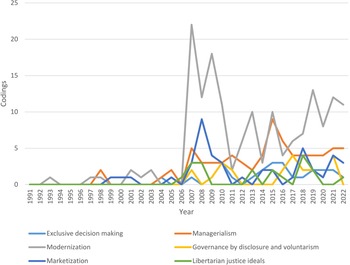
Evidence from UNGA speeches supports this argument. The number of mentions of climate change in connection with economic growth increases over time (see Figure 1). Codings for the norms presented in Section 2 increase over time as well and reach a clear tipping point between 2005 and 2006 (see Figure 2).
Number of codings connecting climate change and economic growth over time.

Liberal environmentalist norms over time.

Unsurprisingly, global production and consumption patterns under the liberal economic order are frequently problematized in UNGA speeches even in the early 1990s, echoing the concerns of the influential Limits to Growth report by the Club of Rome of 1972 (UNGA 48/13:13). However, these critical voices remain few and far in between. More importantly, they do not put forward systemic critiques beyond calls to improve the implementation of the UN climate agenda. Some discursive challenges are put forward by speakers from SIDS, but even then, they are not very explicit and rather represent general calls to action, although SIDS mention climate change in the UNGA at nearly double the rate compared to all other nations (Arias, Reference Arias2022).
The trajectories of climate discourse suggest that both ‘old’ liberal environmentalist and neoliberal environmentalist climate governance have been consolidated in the UNGA setting after 2000. They further suggest that the latter may indeed be an evolution of the former, which at the same time still relies on the same foundational compromise – the idea that economic growth and the protection of the global climate are not contradictory, but prerequisites for one another (Bernstein, Reference Bernstein2002). This compromise also predicates climate policy on the reproduction of the liberal economic order, in the sense that the latter is mandated to foster global economic growth through free trade, thereby creating the necessary financial conditions for climate protection in the first place (Zelli et al., Reference Zelli, Gupta and van Asselt2013). Qualitative assessment of the statements made by the speakers underscores this finding. Economic growth and development are by far the most frequently connected issue areas to climate change by speakers (see Figure 1), noting for instance that ‘climate change is a decisive challenge, which if not urgently managed will put at risk not only the environment but also the world's economic prosperity […]’ (UNGA 70/19:49) or that ‘further efforts need to be made to promote a green recovery and to build up national capacities for adaptation and mitigation of the impact of climate change, while simultaneously stimulating innovation and economic growth’ (UNGA 64/8:34). The following section will present this connection in more detail.
5.1 Libertarian justice ideals
The discursive evidence for libertarian justice ideals at the UNGA is much scarcer than what the institutional arrangements covered above suggest. However, there are contributions which show how some states, especially Western nations, connect climate governance to economic freedoms (see e.g. UNGA 73/10:32). These could well be summed up by the statement made by Václav Klaus, then president of the Czech Republic, in 2007:
At the conference on climate change held the day before yesterday, I resolutely warned against the unjustified alarmism of global-warming activists and their fellow-travellers in some Governments and international organizations, but even that potential problem, as well as any other, can never be solved without relying on freedom, free markets, free trade and other attributes of free society. (UNGA 62/7:28)
5.2 Marketization
Marketization becomes a prominent feature of climate discourse in the UNGA during the 2000s. Interestingly, there is no evidence for this more explicit rather than implicit focus on markets and private actors as vectors for successful climate change mitigation and adaptation before 1999, supporting the argument that this is a feature of a more recent development toward an even more market-based approach in global climate governance. From around the turn of the millennium onward, frequent references to market-based climate governance can be found in UNGA speeches. This includes both developing and developed countries. For instance, speakers call upon private actors to invest in climate-friendly projects and implement respective policies (UNGA 62/16:15, 73/9:51, 76/10:27). They also advocate for the expansion of carbon markets (UNGA 62/10:7, 76/3:8), the creation of new markets in fields such as energy or infrastructure (UNGA 64/5:29) and the expansion of public–private partnerships to combat climate change (UNGA 65/14:33). Another frequent point made by speakers is the idea of using climate change as an opportunity for business as well as the modernization of economies (UNGA 74/4:43). This argument has a strong connection to technological modernization (see below). As one representative put it, ‘We believe that addressing climate change is not a burden, but a fresh opportunity to create future drivers of growth through technological innovation’ (UNGA 70/13:29). In this view, climate change becomes a hopeful opportunity rather than a grim threat.
5.3 Governance by disclosure and voluntarism
UN member state governments have tried to put transparency and especially voluntarism at the forefront of governance processes since the early 2000s, culminating, among others, in the Paris Agreement and the sustainable development agenda at large. The increasing relevance of both elements is very much evident from UNGA speech data. Member states seem to agree that ‘all of us must work to ensure that global agreements, starting with the 2030 Agenda for Sustainable Development and the Paris Agreement on Climate Change, are truly binding, to assess with transparency various countries’ compliance with those agreements’ (UNGA 72/17:15). Although the nationally determined contributions to the Paris Agreement were exercises in voluntarism, their implementation is still seen as binding and transparency is seen as one mechanism by which to ensure compliance (UNGA 73/9:56). There have also been attempts to come up with new forms of transparency by measurement and the provision of data, that is, ways in which to measure both risk from climate change as well as progress toward set climate policy goals.
5.4 Exclusive decision-making
Exclusive decision-making is predominantly relevant in terms of financing, where aid is often provided bilaterally outside of the global climate finance infrastructure. The multitude of actors within climate finance makes the field hard to navigate for developing countries, which has been a frequent complaint in UNGA speeches (UNGA 69/19:6, 77/12:22). In fact, increasing bilateralism and minilateralism introduce so much complexity that some development agencies now offer specific programs whose only purpose is to enable developing countries to successfully access funding from third parties, such as the German GIZ's Climate Finance Readiness Programme. Better access to funding, especially bilateral funding, is thus a frequent topic in UNGA speeches of developing countries (UNGA 73/16:27), aiming to ‘enable international financial institutions and bilateral donors to better channel financial and technical resources towards countries most susceptible to loss and damage from climate change’ (UNGA 72/21:19). New mechanisms for funding have also been brought to the front, such as debt-for-climate-change swaps (UNGA 71/18:17), in which donor countries provide debt relief in exchange for commitments to ecological sustainability by receiving countries.
5.5 Eco-managerialism
As with many of the other norms, the idea that climate change must be ‘properly managed’ within the current order gained popularity in UNGA discourse since around 2000. The ‘management of climate change’ (UNGA 62/10:12, 64/4:11, 64/10:23), both mitigation and adaptation, is supposed to include measures such as creating carbon sinks, strengthening coastlines or improving disaster responsiveness (UNGA 65/17:15). It also entails mainstreaming climate change into ‘primary governmental and economic decision-making processes’ (UNGA 68/9:25). It further includes sustainable land management (UNGA 69/17:38), ocean management, and forest management (UNGA 72/7:11). Once again, this implicitly ties climate change to economic policy, because the reason that management of land, ocean, and forest is necessary in the first place is to render the continuing economic use of these ‘resources’ possible. In other words, managing climate change implies that there is some amount of climate change which is acceptable, if it is balanced against the economic growth to be gained by allowing that amount. For climate adaptation, management ideas are often connected to disaster risk management (UNGA 72/20:13, 69/18:26). There is some discursive overlap with the governance by disclosure norm, as managerialism often relies on standardized processes of evaluation through metrics, indicators, performance reports, and other forms of organizational ‘due process’. A recent example for this are climate change vulnerability indices (UNGA 72/21:19), which aim to provide readily accessible risk assessments for countries and region, thereby providing supposedly ‘hard facts’ for stakeholders in global climate adaptation and mitigation efforts.
5.6 Modernization
The idea that technology will contribute to the progress of human civilization is very old, and intimately tied to the teleological ontologies of classical liberal philosophy. It is therefore no surprise that technological innovation and progress are key elements of liberal environmentalism (Bäckstrand & Lövbrand, Reference Bäckstrand, Lövbrand and Pettenger2007, Reference Bäckstrand and Lövbrand2019). For climate governance specifically, technological advancement is sometimes treated as a kind of Deus ex machina, in the sense that once the required technologies have been invented, they will ‘solve’ climate change without further transformative action. Although such overly optimistic views are mostly shared by tech-enthusiasts in civil society and the private sector, there are traces of similar ideas at the UNGA level, such as frequent references to clean coal technology (UNGA 65/17:15). In any case, technology is seen as key vector for both mitigation and adaptation. Speakers put innovation at the forefront of sustainable development and green growth, while at the same time stressing the need for additional financial investments into these technologies (UNGA 62/5:7, 62/11:54, 64/3:43). ‘[…] Technology will be a big part of the solution – with electric cars, and with renewable energy fuelling our economies […]’ (UNGA 73/13:46). Although scholars have pointed out that all the technology needed to achieve carbon neutrality is already available (IPCC, 2022), access to these technologies is hindered by the unequal global distribution of resources. As developing countries rely on green technologies, but often lack the resources to acquire them, technology transfer has become a salient topic at the UNGA (UNGA 69/12:19). This specific element of modernization discourse clashes with libertarian justice ideals, such as private property rights, leading to a struggle between these rights and developing countries' push for declaring green technologies global public goods (UNGA 70/15:25).
In sum, there is evidence that the 2000s were even more crucial for the discursive consolidation of liberal environmentalism in global climate governance than the 1990s, at least as per the UNGA speeches. Alternatively, it could be that with the increasing urgency of climate governance states have discovered the UNGA as an arena to discuss these matters on the highest level, whereas such discussions would previously have been limited to issue-specific arenas such as the annual COP summits. Both of these interpretations however support the argument that liberal environmentalism and by extension, neoliberal climate governance, persist discursively as of today.
6. Liberal environmentalist norms and international relations theory
Why, then, does liberal environmentalism persist in global climate policy? Three theoretical strands or paradigms have emerged as the most influential in contemporary international relations (IR), namely neorealism, neo-institutionalism, and critical theory. All three can, in principle, be used to explain the persistence of liberal environmentalism, albeit to varying degrees of success. Although neorealist or geopolitical explanations are popular for the trajectories of global climate policy especially in public debates, they can hardly account for normative or ideational complexes such as liberal environmentalism. Rather, neorealists challenge the explanatory power of norms and ideas in the first place, relying on geopolitical factors to explain the persistence of the current climate governance system (Kamminga, Reference Kamminga2021; Paterson, Reference Paterson, Imber and Vogler2005). In this view, the determining factor for policy outcomes are powerful states, such as the United States, and their interest in acquiring gains in resources relative to their geopolitical rivals, for example by blocking transformative multilateral agreements or delaying climate finance (Purdon, Reference Purdon2017). Critical and poststructuralist approaches similarly focus on power, but prioritize examining its formation and exercise. For instance, Lövbrand and Stripple have applied Foucault's idea of ‘Governmentality’ to climate policy, arguing for a ‘productive understanding of power that challenges zero-sum representations of the distribution of power in world politics’ (Lövbrand & Stripple, Reference Lövbrand, Stripple, Stripple and Bulkeley2013, p. 34). However, at present, the critical literature on climate governance remains fragmented (Domingues, Reference Domingues2023), and it remains unclear what exactly constitutes a critical theory of climate change (or policy). Although critical discourse analysis has been rather successful in both defining and historically tracing different climate change discourses, its relationship with mainstream IR remains complicated. Neo-institutionalism is better suited for the task at hand. Neo-institutionalists argue that institutions must be understood as ‘social facts’ which shape the behavior of political actors. Political outcomes are the result of actors' preferences and utility-maximizing calculations of transaction costs (rational choice institutionalism), historical path dependencies following specific events in time as critical junctures (historical institutionalism) or certain institutional logics of appropriateness (sociological institutionalism).
Combining neo-institutionalism's assumption that institutions matter and its proposals on how they do so with a constructivist understanding of norms and ideas (Finnemore & Sikkink, Reference Finnemore and Sikkink2001) enables the analysis of norm complexes such as liberal environmentalism, which can be viewed as an institution itself in the broader sense. Asking why such a norm complex persists, then, is really asking how norms change, or as Sunstein (Reference Sunstein2019) succinctly puts it, ‘How change happens’.
Constructivist scholars have increasingly engaged with norm changes in world politics since the ‘constructivist turn’ in international relations (Checkel, Reference Checkel1998). International norms emerge when norm entrepreneurs, influential actors with organizational platforms, such as states, international organizations, or networks of like-minded individuals persuade stakeholders of new policy ideas (Finnemore & Sikkink, Reference Finnemore and Sikkink1998). Norms, then, are institutionalized ideas, which in turn are ‘causal beliefs’ about how the world works (Goldstein & Keohane, Reference Goldstein and Keohane1993) that provide problem definitions and policy solutions to these problems (Mehta, Reference Mehta, Béland and Cox2011). Sometimes, norms then reach a ‘tipping point’, after which they ‘cascade’, meaning that they are rapidly mainstreamed, codified, and institutionalized by actors within a given field (Sunstein, Reference Sunstein2019). Norm cascades can lead states and international organizations to internalize norms so deeply that non-conformity with these norms becomes inconceivable, thereby effectively removing them from political contestation, and thus rendering norms and sets of norms remarkably persistent.
I argue that a similar development can be observed for liberal environmentalism in climate policy. The norms that comprise liberal environmentalism persist because they were internalized and deeply embedded into the regime, after emerging during the Kyoto era and ‘cascading’ in the Copenhagen era, resulting in the Paris Agreement. This cascade is well supported by the data presented above. Statements at the UN General Assembly which connect climate change with economic policy in general as well as the chosen norms increase rapidly in quantity (see Figure 3) and become more explicit in quality over time in the respective time period. They are also reflected in the institutional developments presented above. National and international leaders conform to these norms because of the dual mechanisms of habitualization and institutionalization, thereby reproducing liberal environmentalism discursively. Norms proposing markets as the dominant allocative mechanism for the right to emit greenhouse gases, the engagement of the private sector, as well as the different modes of governance examined in earlier sections are all expressions of the core feature of liberal environmentalism – the idea that economic growth and climate protection are not exclusive, but complementary policy objectives.
Number of total codings over time.

This logic also works in the opposite direction, explaining why the ‘system’ (in Lawrence et al.'s terms) of liberal environmentalism is not currently in a crisis. There are no norm entrepreneurs which are powerful enough and have the organizational platform to enable the emergence of new norms. For instance, SIDS may call for more transformative action at the UN General Assembly and elsewhere, challenging the current connection between climate policy and the liberal economic order, but they do not possess the capacity to trigger sufficiently powerful norm cascades. Leaders such as Dr. Mark Bynoe of the Caribbean Community Climate Change Centre may demand for industrialized countries to ‘[…] for once put people over profits, and planet over politics’ (Felson & Bynoe, Reference Felson and Bynoe2021, p. 7), but they may still remain ‘at the mercy of private profit’ (Felson & Bynoe, Reference Felson and Bynoe2021, p. 10).
In sum, liberal environmentalism is so embedded now that the threshold for a tipping point toward new norms of more transformative action, which would loosen the discursive and institutional connection between economic growth and climate action, is very high. Normative systems can be persistent if they are institutionalized, even in the face of pressure. Such an argument necessarily privileges stability over change in the sense that it is quite strict in regard to what constitutes ‘change’. Stability therefore must not be confused with uneventfulness. On the contrary, climate governance has been supremely eventful even after Paris, despite the stability of its normative basis. There have been new institutional developments such as the establishment of a Loss and Damage Fund at COP28, calls for ‘truly transformative action’ have intensified, and the focus has in many ways shifted from the mitigation of climate change to the adaptation to climate change. However, developments such as these still occur in front of the same normative canvass – the seemingly universally agreed upon tenet that climate policy, above all, must be compatible with economic growth. It remains to be seen whether the stability argument will still hold true, should the biggest emitters continue to miss their emission targets. If the legitimacy of global climate governance is performance-based, failure to deliver on its promises may lead to more serious challenges in the future. At the same time, it may turn out that under a liberal economic and political international order, liberal environmentalism is indeed the only feasible normative framework for climate policy.
7. Conclusion
This article has argued that traditional IR theories offer many avenues to explain the persistence of liberal environmentalism and the absence of systemic crisis in climate governance. Constructivist institutionalism is especially well suited to explain the trajectory of this norm complex over time. Once they have emerged, norms can cascade rapidly and become institutionalized under the right conditions. Liberal environmentalist norms emerged in the 1990s, cascaded in the early 2000s and became institutionalized in the Copenhagen era, culminating in the Paris Agreement. They are thus likely to remain unaffected by the current polycrisis in international relations, if not for an emergence of new norms pioneered by adequately powerful actors.
A note on theory seems mandatory here. Generally, IR theories often fail to account for change over time, especially incremental change (Carstensen, Reference Carstensen2011). In other words, they are generally better suited to explain equilibrium than they are at explaining deviations from it (Blyth, Reference Blyth, Béland and Cox2011). Under conditions of multiple interconnected crises that plague international politics, systems can tip into crisis rapidly. However, as well as constructivism and institutionalism can explain the general process of norm change at some distance, they are less well suited to explain the mechanisms of this process on a micro-level. In the context of this article, this is evidenced by the fact that although there are clear tipping points identifiable in the UNGA data, it is much less clear why these tipping points occur at any given point in time, and not at another. The data do not necessarily seem to conform with any specific historical events when we control for the generally increasing salience of climate change as an issue in international politics over time. In regard to the current polycrisis in international politics, understanding the conditions under which crises of normative systems occur helps us to explain why they sometimes do not, even if we should expect them to. In a similar vein, crises do not necessarily spill over between systems. Just like there are conditions for crises to occur in the first place, there are conditions for their spilling over into systems other than where they originated. The framework offered by Lawrence and colleagues in the lead article of this issue provides a much-needed addition to the literature by examining these conditions.
Finally, to conclude this article, it is important to note that I do not put forward a critique of neoliberal environmental governance. The data presented here cannot be used as evidence for the efficacy (or the lack thereof) of liberal environmentalism and the institutions informed by it. Rather, I argue that neoliberalism is still very much at the core of international climate governance, both institutionally and discursively, and examines ways to make sense of this persistence. In line with the other articles from this special issue, much more research is needed to identify why crises spill over between systems, and why they sometimes do not.
Data availability statement
All data collected for this article are available upon request.
Acknowledgments
The author thanks Anna Novoselova and Marco Verweij for their helpful comments and their support in preparing this article.
Author contributions
The author confirms sole responsibility for the following: study conception and design, data collection, analysis and interpretation of results, and manuscript preparation.
Funding statement
This research received no specific grant from any funding agency, commercial, or not-for-profit sectors.
Competing interests
None.
Appendix
Results for search string 1: ‘climate change’ AND ‘econom*’

Results for search string 2: ‘climate change’ AND ‘market’ or ‘privat*’ or ‘manage’ or ‘regulat*’ or ‘bilateral’ or ‘sovereign’ or ‘transparen*’ or ‘liberty’ or ‘free’ or ‘innovat*’ or ‘techno*’

Results for control search string: ‘climate change’ AND ‘just*’ or ‘equit*’ or ‘financ*’ or ‘responsi*’ or ‘cumulat*’




 Open access

