


The development of the field of computing in Brazil followed a rather peculiar path, and its trajectory has shaped cultural production since the earliest encounters between artists and technology. Beginning in the 1960s, there were a few attempts by musicians and computer scientists to employ computers for artistic purposes within the country—a time when it was perhaps still possible to keep pace with the development of so-called Computer Music in North America and Europe. However, due to restricted access to foreign technologies and the political context following the 1964 military coup—two aspects that, as will be discussed, are deeply interrelated—it was not feasible to establish a national system in which consistent and ongoing production in the field of Music & Computing, both scientific and artistic, could emerge before the early 1990s. After all, it would have been impossible to develop a Computer Music system anywhere in the world between the 1960s and 1990s without the support of strong institutions and freedom of artistic expression. Brazil was no exception in this regard. To trace this trajectory, one must follow the timeline of early artistic experiments alongside public policies related to computing. This text does not aim to provide a comprehensive catalog of computer and music experiments in Brazil, but rather to offer a transversal cut that highlights key cases, allowing us to understand, at least in part, the relationship between the formation of the Computer Music field and public policies up to the mid-1980s. Tracking these developments helps to interweave two narratives that run in parallel—between agents who seldom intersect, yet whose actions are causally linked—connecting cultural practices and state policy. In the end, understanding the path of computer-mediated artistic production, as branches of various aesthetic projects, may provide insight into the conduct of the state during this period and help elucidate the constitution of the field of Electronic Music in Brazil.
The 1960s
The first computer-assisted musical composition likely created in Brazil was Klavibm II for piano, composed by Rogério Duprat and Damiano Cozzella at the Center for Numerical Calculation (Centro de Cálculo Numérico – CCN) of the Polytechnic School at the University of São Paulo in 1963, the same year the two also participated in the writing of the Manifesto Música Nova. The previous year, the composers had taken an introductory course in computer programming at the CCN, which had just been established to house the first computer purchased by the university. The IBM 1620 mainframe was acquired through a joint agreement between the Engineering, Economics, and Physics departments and cost approximately 500,000 US dollars.Footnote 1 This was the computer used to compose the piece – or more precisely, the computer that, according to the composers themselves, composed the piece for them. The score reads: ‘Klavibm II (no record) – composed by an IBM 1620 computer – São Paulo, 14-1-1963 – Programming: Damiano Cozzella and Rogério Duprat’ (Garcia and Manzolli Reference Garcia and Manzolli2007: 3). At that time, the CCN positioned itself as a hub for experimentation with the only mainframe in São Paulo available for academic research, since other computers in the city were dedicated exclusively to commercial use. For several years, the centre at Poli served as a welcoming environment where technicians and faculty expressed a desire to collaborate with people from diverse fields in order to tackle a wide range of programming challenges, explore the capabilities of the new equipment, and refine their skills as programmers.
In the field of artistic research, in addition to Duprat and Cozzella, the poets Décio Pignatari and Luiz Ângelo Pinto were also active. Influenced by Max Bense’s ideas on the relationship between aesthetics and statistics – what Bense termed ‘aesthetics-statistics’ (Esthetik-Statistik) – and by the study of semiotics, the pair developed projects analysing Brazilian literary texts. One of the processes they carried out involved counting the number of vowels and consonants in a given text and converting the results into percentages with the help of the computer. In one case, they found that the analysed text consisted of 48% vowels and 52% consonants. The research was based on a hypothesis by Bense: ‘a text in which the balance between vowels and consonants is altered will exhibit certain particular aesthetic and informational properties’ (Pignatari Reference Pignatari2002: 73). This interest in statistics stemmed partly from Bense’s theoretical work and resonated with the constructive tendencies present in Brazilian art movements of the time, while also reflecting the daily operations of the CCN, which produced statistical analyses and projections for various research fields.
The piece Klavibm II Footnote 2 seems to have followed a similar path, although no documentation by the composers detailing the creative process has survived. Researchers Denise Garcia and Jônatas Manzolli conducted an extensive analysis of the composition in order to speculate on the possible computational procedures involved in its creation.
(…) the first evident aspect in the score is that the notes do not form any kind of clusters (melodies or chords), with the music consisting of a sequence of notes described by three parameters: pitch, duration, and dynamics. The relationship between them is apparently autonomous and sequential, and the pitches are distributed across the entire possible tessitura of the piano. A second simple observation from the score showed that it was not a dodecaphonic work, since the notes are repeated right at the beginning. This led to the hypothesis that it might involve a serial distribution of all the piano keyboard notes. In fact, the piece is made up of 88 notes — precisely the number of keys on a piano.
(Garcia and Manzolli Reference Garcia and Manzolli2007: 16)Upon listening to the piece, one immediately notices its resemblance to other works of Aleatoric Music composed during the same period. This similarity may not lie strictly in the compositional method – though it likely relied on probabilistic calculations to distribute the 88 notes within the piano’s range – but rather in the choice of parameters that were stochastically controlled by the computer: pitch, dynamics and duration. Additionally, the use of the piano as the performing instrument further reinforces this connection, as it was strongly associated with Aleatoric Music, such as in John Cage’s Music of Changes, and with Total Serialism, as in Karlheinz Stockhausen’s Klavierstücke.
Pignatari notes that the composer duo had planned a second computer-assisted composition project for the following year, 1964, which ultimately did not come to fruition.
As avant-garde composers, their primary interest naturally lay in advanced musical research. However, the systems engineer in charge of operating the machine—without whose assistance nothing could have been accomplished—though supportive and genuinely interested, held rather conservative views on music. Moreover, he wished for the final output to be both recognized and appreciated within the university environment… As a result, Cozzella and Duprat proposed to “compose” a fragment of a Mozart sonata. But the outcome was, if not inevitable, at least obvious—and the process, arduous. It wasn’t long before they, disheartened, abandoned the project midway. (Pignatari Reference Pignatari2002: 73)
The poet’s account reveals that, despite the openness at the CCN to the use of the computer and the support of the research team, aesthetic conflicts between musicians and technicians were nevertheless present. This experience reiterates a familiar model of interdisciplinary interaction found in several institutions that fostered collaborations between artists and engineers worldwide – such as at Bell Labs – even if the composers’ time at the Polytechnic School was brief.
Around the same time as the failed attempt to make the computer compose a Mozart sonata movement, Cozzella, Duprat and Pignatari were invited to teach at the newly founded University of Brasília (UnB), whose Department of Music was headed by Cláudio Santoro. In his thesis Música Eletroacústica no Brasil: Composição Utilizando o Meio Eletrônico (1956–1981), Igor Lintz Maués notes that, in the early 1960s, Brasília had become an attractive hub for composers. Beyond the activity of the Music Department, there was coordination between institutions aimed at establishing a studio for electroacoustic music. Composer Reginaldo de Carvalho, recently relocated from Rio de Janeiro, formed a nucleus that involved the Centro de Estudos Musicais Villa-Lobos, the Departments of Music and Electronics at UnB, and the Rádio Educadora, with the intention of creating a studio dedicated to music produced using electronic media. Pignatari referred to the period as the ‘Brasília paradise’.
However, this momentum was soon undermined by the military coup. The UnB campus was invaded twice by the army – the first time in April 1964, and again in September 1965. Both episodes were violent and resulted in arrests and dismissals. The second invasion triggered a strike by faculty and students, culminating in the dismissal of 15 faculty members by the university’s rector. In response, 223 of the university’s 305 professors resigned. This event marked the end of the university’s ‘paradisiacal’ phase, and consequently, the dissolution of the electroacoustic music studio project – likely considered incompatible with the cultural policies of the regime. Carvalho returned to Rio de Janeiro, where he soon became director of the National Conservatory of Choral Singing. Duprat and Cozzella also returned to São Paulo and founded a commercial music company for advertising – gradually ceasing their activities in experimental music – while Santoro moved to Europe.
Upon returning to Rio, Carvalho established a private electroacoustic music studio, the Estúdio de Música Experimental (EME) (Maués Reference Maués1989: 11), and, as director of the Conservatory, renamed it the Instituto Villa-Lobos (IVL) in 1966. There, he launched the Centro de Pesquisa do Som e da Imagem (Center for Research on Sound and Image) (Ventura, apud Garcia Reference Garcia2012: 2). According to Maués, Carvalho was highly engaged in the development of electroacoustic music in Brazil, collaborating with composers active in research on music and electronics, such as Marlene Fernandes and Jorge Antunes. The IVL hosted a number of courses and lectures, including Antunes’s ‘Introduction to Electronic, Concrete, and Tape Music’ (1967–1968), and a talk by Pierre Schaeffer in 1971. Carvalho’s connection to Schaeffer’s Groupe de Recherches Musicales (GRM) in Paris proved significant, offering a pathway for Brazilian students to study abroad in the 1970s. One such case, as recounted by composer Rodolfo Caesar to Maués, involved Caesar himself, who studied at the institute before travelling to the GRM a few years later (Maués Reference Maués1989).
Following the enactment of the Fifth Institutional Act (AI-5) in 1968, which intensified censorship and political repression under Brazil’s military regime, Carvalho’s project at the IVL was gradually dismantled. Still in 1968, Antunes was ‘invited to leave’ the institution (Garcia and Manzolli Reference Garcia and Manzolli2007: 2), and, in 1972, Carvalho was replaced by active-duty General Jayme Ribeiro da Graça. This marked the beginning of a conservative shift at the IVL, which persisted throughout the harshest years of the regime.
After leaving the conservatory, Antunes went to Argentina to study at the Centro Latinoamericano de Altos Estudios Musicales (CLAEM), located at the Torcuato di Tella Institute in Buenos Aires, which also housed an electronic music laboratory. There, he worked with analogue electronic media. As noted by Argentine composer Francisco Kröpfl, although there was already interest in the use of computers, Argentine composers at that time were working exclusively with magnetic tape and synthesisers – many of them quite experimental and developed by engineer Fernando von Reichenbach. The transition to digital tools began in the late 1970s, following Argentina’s military dictatorship, a period that saw the closure of the electronic music laboratory at the University of Buenos Aires. This culminated in the creation of the Laboratorio de Investigación y Producción Musical (LIPM) in the early 1980s, which was fully dedicated to computer music.
In 1970, Antunes moved to Utrecht to study at the Institute of Sonology in The Hague, where he encountered computer-assisted composition techniques developed by Gottfried Michael Koenig and his team. With access to a Dutch-made mainframe, the Electrologica X-8, and Koenig’s Project 2 software, Antunes composed Music for 8 persons playing things (M-8)Footnote 3 in 1970. This piece does not use electronic sounds; rather, the computer was used solely to generate time structures that shift between different sonic densities – classified with terminology analogous to that of musique concrète: ‘punctuated sounds’, ‘punctuated sounds with resonance’, ‘clouds of points’, etc. The score is written in proportional notation, with the precise timing of each action marked, and is performed using objects such as metal scraps, paper, Styrofoam, and plastic, played with mallets, hammers or bows. Considering these elements, the piece can be characterised as an example of what would later be called instrumental musique concrète.
1970s
By the 1970s, it became clearer to trace the computing project envisioned by the Brazilian state, initially under military control and later by politicians and bankers. To grasp this trajectory, even in a brief manner, we must begin with the first and second National Development Plans (I PND and II PND), as well as the first and second Basic Plans for Scientific and Technological Development (I PBDCT and II PBDCT), with the first plans under the command of dictator Emílio Garrastazu Médici starting in 1972, and the second plans at the beginning of dictator Ernesto Geisel’s rule, starting in 1974.
This moment is highlighted not because it marks the beginning of state interest in the production and circulation of computers within the country – such initiatives had existed since the government of Juscelino Kubitschek – but because it represents a strategic turning point: the beginning of a gradual distancing from the international technology market in favour of developing a national computer industry.
As sociologist Peter Evans points out, until 1970, Brazil had a relationship with the computer market typical of a developing country: it imported and resold equipment from foreign companies, mainly IBM and Burroughs, which had been operating in the country since the 1920s, initially selling typewriters, tabulators and clocks. Throughout the 1960s, these companies expanded their presence in Brazilian universities. The largest IBM project in Brazil up to 1970 was likely the Rio Datacentro (RDC), inaugurated in 1968 at PUC-Rio, where research on software development was also funded by the American multinational. Thus, PUC-Rio became one of the leading centres for teaching and algorithm development in Brazil in the following years.
This scenario began to change in 1971, when, according to historian Gildo Magalhães dos Santos Filho, the outlines of what would later become the National Computing Policy (PNI) were being drafted. This was a decisive step for the development of computing in Brazil and, consequently, for activities that depended on digital technologies. An illustrative case of this new positioning occurred in 1968 when the Brazilian Navy purchased six British frigates equipped with computers and digital devices from the Ferranti company. The presence of this foreign technology raised concerns among the military, who feared creating a technological dependency on the British industry, perceived as a national security risk. The military’s technological renewal thus became an important driver for the creation of a national computer industry.
As a result of the I PBDCT and proposals from the Special Working Group (GTE), also led by the Navy, two research teams were hired to develop Brazil’s first minicomputer. The team responsible for the hardware was composed of students and professors from the Polytechnic School of USP, while the PUC-RJ team was in charge of the software. The choice of Poli-USP was based on their prior experience in building one of Brazil’s first university minicomputers,Footnote 4 the ‘Patinho Feio’, in 1971. PUC-Rio, in turn, had been offering courses focused on algorithm development since the late 1960s. The project resulted in the G-10 computer, which was successfully delivered to the Navy. Later, with the implementation of the II PND, the state-owned company Computadores e Sistemas Brasileiros S.A. (COBRA) industrialised the equipment, which, after some improvements, was marketed as the G-11 starting in 1975.
The commercialisation of domestically manufactured computers would only take off after the launch of the II PND in 1974 and the II PBDCT in 1976. These plans, in addition to providing for the establishment of a national industry, significantly increased investments in the area, aiming to make Brazil a technological development hub in Latin America. While the first PND only implicitly mentioned computers as a secondary concern, the second plan highlighted them as a priority: ‘The expansion of the production of electronic equipment and, especially, large-scale commercial computers, including for export, will continue’ (Plano Nacional de Desenvolvimento II 1975: 39).
Inspired by the results achieved by the Japanese economy, the II PND advanced in the same direction as the PED (Strategic Development Plan) and the I PND, deepening the investment cycle. In Japan, strong national companies generated technology and conglomerates as a form of intercompany articulation, fostering development and mobilizing the necessary capital to form the new power. In Brazil, the project to strengthen national companies and promote technological development led to the creation of state agencies and new sectoral funds. (Tavares Reference Tavares2010: 163)
The combination of an internal developmentalist policy – which sought national autonomy in technology and aimed for Brazil to become an exporter of computers in Latin America, which consequently would lead to a change in the international division of labour – with the global economic crisis that coincided with the Geisel period, also led the government to make changes in its foreign policy. As sociologist Francisco de Oliveira points out, this was the first moment in which the military did not automatically and unconditionally adhere to the demands of the United States (Oliveira Reference Oliveira2003). In the field of Foreign Relations, this policy was termed ‘autonomy through distancing’. This partial distancing can be seen as part of the strategy that led to the first radical measure of protectionism and greater friction with multinational companies, which occurred in 1977 when the government prohibited the production of minicomputers by foreign companies in Brazil. Multinational companies such as IBM, Burroughs, Olivetti, among others, which were already established in the country, were boycotted in a bidding opened by the State in favour of the development of the national industry, which at that moment consisted of only five brands (COBRA, EDISA, LABO, SID and SISCO). This happened in a decade of rapid growth in computer usage, considering that between 1969 and 1974, imports of digital devices increased by 600% in both the public and private sectors, and in the year of the II PND ‘they were the third most important product (after airplanes and crawler tractors) among the manufactured products imported by Brazil, representing about US$ 100 million in foreign exchange expenditures’. (Evans Reference Evans1986: 18). In 1977, the State denied permission to IBM, Burroughs, NCR, and other multinationals to produce minicomputers in Brazil. Major Jorge Monteiro Fernandes, a member of the Council who claims to have played a central role in negotiations with the Ministry of Planning, writes that the prohibition was a victory for Brazilian engineers working alongside the Armed Forces State against IBM, as the American company had found loopholes in the Council’s regulations to continue doing business in Brazil without adhering to the government’s requirements. This was a clumsy step because there was no domestic production of minicomputers to meet the demand of the open tender, and it led to the ‘Reserve of the Market’ in the country ‘without strategic planning, but as a tactical response to an action by IBM and a political imposition of a solution doomed to failure’. (Fernandes Reference Fernandes2010: 2). This policy greatly hindered the importation of digital technologies to Brazil and had a decisive impact on the cultural production that relied on computers. This policy was dismantled only in the 1990s under the government of Fernando Collor de Mello.
In this context, the field of music production, both in academia and in the phonographic industry, suffered from a scenario that generated a regime of precariousness and scarcity for those who relied on the use of digital technology. Computers were expensive, there were no incentives for the training of technicians, and software development for the area was practically nonexistent, which was also a general problem in the planning of the national computer industry. Therefore, it depended on state incentives or imports, which required approval from regulatory bodies that had made the process extremely difficult. Understanding this scenario, about seventeen years after the first experiments with Computing & Music conducted by Cozzella and Duprat, demonstrates how disruptive the military coup was to the cultural field.
Placing Brazil’s trajectory in dialogue with neighbouring contexts helps clarify shared constraints and distinct institutional outcomes. In Argentina, the Centro Latinoamericano de Altos Estudios Musicales (CLAEM, 1962–1971) briefly sustained a laboratory-based ecosystem where imported devices and custom builds coexisted with growing awareness of computer-assisted techniques. Political turbulence after 1966 reduced exchanges and ultimately curtailed operations, with lasting effects on training and circulation. In Chile, early initiatives associated with José Vicente Asuar likewise confronted abrupt disruption after the 1973 coup, dismantling academic continuity and exiling expertise. Brazil’s case differs less by the absence of rupture than by its paradox: significant, state-led investment in computing – aimed at technological sovereignty – unfolded alongside censorship, protectionist trade barriers, and limits on artistic exchange. The result was not institutional collapse but a persistent misalignment between technical capacity and the freedoms and infrastructures required for sustained musical experimentation. Read comparatively, these experiences underscore how the technological periphery generates divergent pathways: neither a simple lag behind international centres nor a fully integrated scene, but a field shaped by negotiation, constraint and intermittent opportunity.
Given this brief overview of the political context, it might be worth revisiting the case of the creation of the G-10 computer by the Brazilian Navy in 1972, whose project was developed by PUC-Rio and Poli-USP, as it parallels the ‘slow march’ of the development of Computing & Music in Brazil two years later, which was crucial for tracing some paths throughout the 1970s. In 1974, probably the first sonic experiments with computing began at these same institutions. In this case, the works discussed from this period were not yet done exclusively with computational synthesis through audio digital-analogue transducers, as the feasible approach at that moment was the development of hybrid techniques, such as the control of analogue synthesisers through interfaces that converted digital data into voltage differences, operating at lower update rates compared to the converters aimed at synthesis and sound analysis.Footnote 5 In São Paulo, at Poli-USP, Guido Stolfi and Celso de Oliveira developed a modular synthesiser, partly digital and partly analogue, controlled by a computer, and for this, the ‘Patinho Feio’ minicomputer, which preceded the G-10, was initially used. Meanwhile, the Computing & Music activities at PUC-Rio officially began in 1975, with the start of graduate research specifically aimed at sound synthesis, such as Aluizio Arcela’s master’s thesis ‘Dynamic Spectral Generator System for Musical Signal Synthesis’. The author writes that in the same year that his research started, a project to build a ‘musical machine’ (Arcela Reference Arcela1994: 2) was initiated at the Electrical Engineering Department. However, in the previous year, a black-and-white animation in 16mm was created by Arcela and José Parrot Bastos, titled Ballet Lissajous. The piece was composed and filmed at the Electrical Engineering Laboratory (LEEPUC), and also used sounds produced by analogue circuits following a digital logic, similar to the machine created by Arcela in the subsequent years.
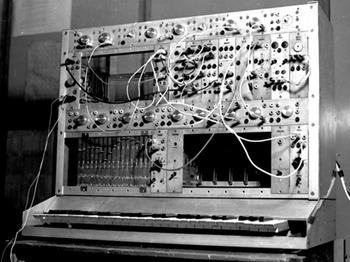
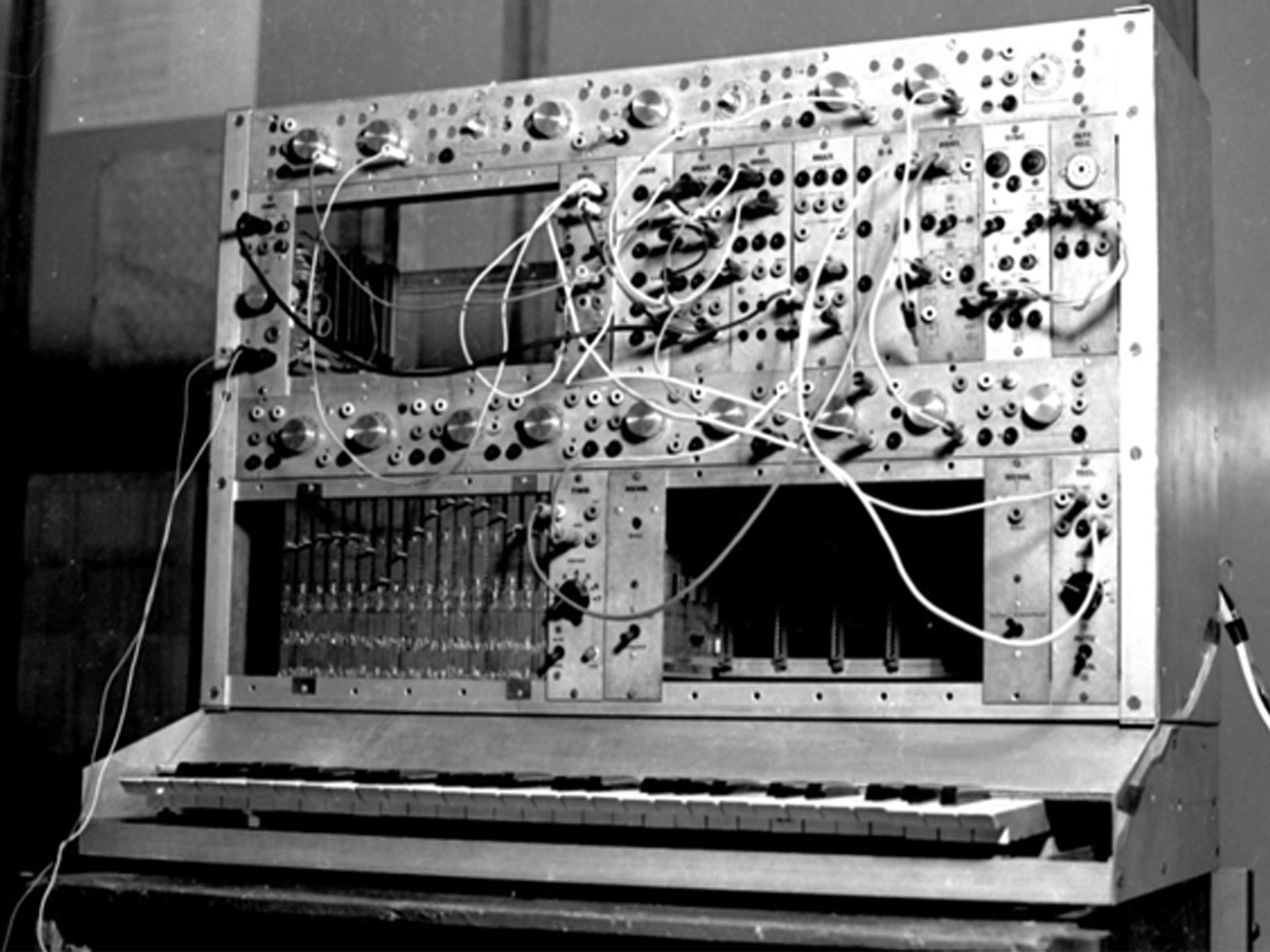
In the case of Stolfi and Aguiar, the driving force of their research was to create a modular synthesiser system similar to the one developed by Robert Moog in the 1960s, with the difference that part of its functioning would be digital, both in the control interface and in some modules of the system, such as the device that would alter the waveform of the oscillators (Figure 1). The synthesiser was built at the Electrical Engineering Department, and its parts were donated by the Engineering Technological Development Foundation (FTDE) and the Department itself. Most of the modules that made up the system were analogue: envelope generators, filters, amplifiers, voltage-controlled oscillators and noise generators. The digital part that transformed the timbre was very unique, as it allowed control similar to that of table-based synthesis, done by software in a purely digital domain, like in the case of MUSIC I, but applied to analogue oscillators:
The sound synthesis system (timbre generator) was based on a panel of 16 sliding keys, through which it was possible to “draw” the waveform. The positions of the keys were encoded in 4 bits per point and could be stored in memory. This allowed quick access to various pre-programmed timbres during operation. (Stolfi Reference Stolfi2003b: 1)
Image of the synthesiser built by Guido Stolfi. Source: Stolfi, G. Audio. lcs.poli.usp.br. Accessed September 17, 2024.
The idea of integrating the ‘Patinho Feio’ computer into the project came from Professor João José Neto, who at that time was part of the Digital Systems Laboratory (LSD) and was responsible for writing the software that would interface with the synthesiser, together with Eloah Cunha. The software was titled ‘Score Compiler’ and was able to control up to three sound parameters of the synthesiser simultaneously. Through this implementation, a repertoire for the instrument was developed from scores that were transcribed onto punched paper tapes for the computer’s execution. These works were generally classical pieces from the late Baroque, Classical, and 20th centuries, such as ‘Aria on the G String’Footnote 6 by J.S. Bach, ‘Continuum’, a harpsichord piece by Gyorgy Ligeti, and ‘Density 21.5’ for flute composed by Varèse. All these pieces are monophonic, with only one melodic line, but if the music had more than one voice, Stolfi developed a recording and synchronisation system for layering melodies. Among the repertoire mentioned by the author, there is a piece originally composed for the synthesiser called ‘Theory of Information’, composed by Dagomir Marquezi, who was researching the topic in the Department of Social Sciences (Pinto Reference Pinto2002). Later, the system was updated, and the ‘Patinho Feio’ was replaced by a Hewlett-Packard minicomputer, the ‘HP 21MX’, which had twice as many bits (16).
For this second version, Stolfi developed software titled ‘Quick Compiler’, in addition to other programs that ‘generated random music, with control over the relative probabilities of notes, tempos, and/or intervals’ (Stolfi 2003: 2). Thus, the programs made by Stolfi sound almost in real time, something similar to the experience of Duprat and Cozzella’s ‘Klavibm II’,Footnote 7 composed in the previous decade at the same institution.
In 1974, at LEEPUC, Arcela, in partnership with Parrot, composed the animation ‘Ballet Lissajous’Footnote 8 (Figure 2) which won the fifth prize at the National Short Film Festival of the Aliança Francesa, at the Museum of Modern Art of Rio de Janeiro (MAM-RJ). The short film, about eight minutes long, is based on a 16mm film of an oscilloscope screen, where different patterns are choreographed based on Lissajous figures. The film is dedicated to physicist Jules Antoine Lissajous. The figures are accompanied by electronic sounds, generated by oscillators with no further processing, which sometimes follow the forms literally, simulating a sonification of the drawings, and at other times, they distance themselves from the curves, which are precisely the most melodic moments, making the music the soundtrack for the ‘dance’. The forms obtained from the oscilloscope are quite diverse, demonstrating virtuosity in composition, and they alternate with abrupt cuts, and at times, the image becomes blurred by the camera lens movements.
Image taken from the film Ballet Lissajous, directed by Aluizio Arcela. Source: Mubi. Accessed September 17, 2024.

The following year, Arcela began his master’s research, which, broadly speaking, focused on additive synthesis and aimed at building a hybrid analogue-digital system. From this beginning, the engineer, who had a musical background – having studied with Hans-Joachim Koellreutter and Esther Scliar in the early 70s – developed extensive research on the topic, resulting in the creation of the synthesiser and articles. In 1978, he wrote the text ‘Experimental Fourier Series Generator’, in which he defines the desired possibilities and elaborates on his synthesis system:
This paper will describe a Fourier series generator for any number of terms, where each spectral component is obtained by frequency multiplication with reference to the fundamental frequency. All generated components are controllable in amplitude and phase across the entire audio range, and the resolution time is short enough to make the system’s transients imperceptible. (Arcela Reference Arcela1978: 4)
In an email exchange with researcher Carlos Palombini,Footnote 9 Arcela explains that his system did not use a computer or any type of microprocessor to control the sounds. The algorithms were implemented through a combination of integrated circuits (ICs) and other analogue components that executed logical commands, functioning as ‘counters, registers, and Boolean logic gates, all connected to analog devices such as the voltage-controlled oscillator, operational amplifiers, etc’. (Palombini Reference Palombini2000: 1). At this first moment, therefore, the digital refers more to the logic applied to the way of thinking about synthesis, rather than the use of a programming language that would be transduced into voltage to generate or control sounds. The transition to the use of computers occurred only in the following years, in 1979, when David Simonetti Barbalho, under Arcela’s guidance, implemented a programming language with geometric characters for sound synthesis, and, in another historical moment of computing in Brazil, Márcio Brandão presented the dissertation ‘Polphonic Synthesizer Controlled by Microcomputer’ in 1983 (Palombini Reference Palombini2000).
In 1976, Arcela was interviewed on the program ‘Música Eletroacústica, uma nova linguagem musical’ (M.E.N.L.M) on ‘Eldorado FM’ radio, produced by Rodolfo Caesar, Sérgio Araújo, Wanderley Gonçalves and J. C. Barbedo. The episode titled ‘O sintetizador’ features some pieces of Electroacoustic Music, interventions by a presenter, and brief conversations with the program’s creators, who speak briefly with Arcela. The program’s repertoire was generally focused on music produced in France – Bernard Parmegiani was certainly the most played composer in the episode series – most likely because shortly before this, Caesar and Araújo, both former students of Carvalho at IVL, had returned to Brazil after studying at the GRM and the Bourges Experimental Music Group (GMEB), respectively. In his brief appearance, Arcela speaks about the difference between additive and subtractive synthesis, emphasising that subtractive synthesis, present in commercial synthesisers – using the EMS VCS-3 as an example – was much simpler and cheaper compared to additive synthesis, which relies on more oscillators. He also talked about his master’s project, in which he was developing his ‘musical machine’ capable of playing 16 harmonic partials from a fundamental.
What stands out is that although there was no discussion about Computer Music in the episode, Arcela emphatically marks the difference between ‘musical creation’ and ‘musical research’ when speaking about synthesis and presenting his project. This is evident both when he differentiates commercial synthesisers from those used for academic research and when Caesar asks about the device’s control interface, and the interviewee once again emphasises its use focused solely on audio research. For the work being implemented at LEEPUC, musical creation was secondary; the study of sound, human perception and mathematical functions that could be demonstrated through sound synthesis would come first. Here, one can observe an aspect of the divide between composition and engineering that is present in the fields of Computing & Music, which would become more pronounced in the 1990s. At the same time, the discourse presented in the program about ‘the synthesizer’ often tries to dissociate the electronic sound instrument from its more common use in popular music of the 60s and 70s. The announcer, with his reverb-laden voice, mentions that there were several misconceptions in the use of synthesisers in pop music and gives the example of Wendy Carlos’s hits, where she played Bach on her modular synthesiser, using electronic sounds as mere extensions of traditional instruments through the keyboard, and another misconception was found in progressive rock, which used synthesisers only to create sound effects that adorned traditional music. According to the discourse presented in the radio program, these two approaches to musical technology disregarded the true potential of the synthesiser, which, from the program’s perspective, would be the discovery and elaboration of new timbres, in the broad sense of the concept, and musical forms. Indeed, the program producers’ concern about the imaginary that the synthesiser referred to at the time and the need to present other perspectives made sense. After all, synthesisers were certainly heard much more in popular music than in experimental music, and imagining other electronic sounds and applications without having contact with the Electroacoustic Music repertoire would not have been an easy task.
In the 1970s, electronic instruments slowly appeared on the national market, through both importation and domestic production, though still very limited. As a counterexample, which crosses the narrative of the truncated development of Computing & Music in Brazil, we can refer to the work of Luiz Roberto de Oliveira, who had training as an engineer and musician. He studied at the University of Berkeley in the early 1970s in the US, where he encountered analogue sound generators and processors, and specialised in ARP synthesisers, which he brought back to Brazil. In 1975, he taught the ‘Course on the Use of the Electronic Synthesizer’ at the São Paulo Museum of Art (MASP), which was very influential for the community of musicians who were beginning to show interest in electronic means, and as a result, the meetings became a point of reference. Before the end of the 1970s, Oliveira started to set up the “Norte Magnético’Footnote 10 studio, where he began a partnership with Stolfi to develop a hybrid analogue-digital system. Through the development of both software and hardware, Stolfi, with the collaboration of Klaus Rondon Koster and Carlos Freitas Luiz (Stolfi Reference Stolfi2003b), created an integration system between an ‘Apple II’ microcomputer and part of the analogue synthesisers and effect processors in the studio. First, they built a digital-analogue (DA) interface between the computer and an ARP 2600 synthesiser, and for that, they programmed a software to function as a sequencer in the BASIC programming language (Pinto Reference Pinto2002). The same process was repeated to control a second synthesiser, a ‘Prophet 5’, but with the addition of a matrix keyboard interface (Stolfi 2002). In this way, Stolfi applied and expanded the same process he had done with his own modular synthesiser and the ‘Patinho Feio’ to commercial synthesisers and a microcomputer. The next step was the development of a sampler capable of recording and playing back short audio clips, named ‘Papagaio’. The integrated circuits were brought from the US by Oliveira and allowed for analogue-to-digital and digital-to-analogue (AD/DA) conversion with a sample rate of 44 kHz and 16-bit resolution. The project was improved throughout the 1980s, with more memory and integration with editing software that allowed, through a graphical interface, cuts, dynamic envelope applications, and the storage of sounds for later use. The funding for this technology was probably made possible due to the commercial bias of the studio, which focused on jingle production. Still, experimental projects such as works by Lélo Nazário and Oliveira were produced. These hardware and software devices developed in the 1970s were later replaced by commercial equipment in the following decade with the diffusion of the MIDI protocol.
On the other hand, those focused solely on Electroacoustic Music activities were in a more precarious situation. Returning to the Eldorado radio program, another episode dedicated to Electroacoustic Music in Latin America stands out, as it reveals a sense, at the very least sceptical, of the program’s producers-composers regarding the conditions and possibilities for producing experimental music in the Southern Cone during that period. The same announcer, with his reverberant voice, first refers to the closure of CLAEM in Buenos Aires in the mid-70s, which had hosted composers from several Latin American countries, and emphasises how the end of its activities caused an exodus of musicians to Europe, which was further aggravated by the impossibility of setting up private studios, ‘since we are not producers of material and importation is very expensive. Acquiring a simple imported recorder would cost four times more than it would in its country of origin’. (M.E.N.L.M apud Damião Reference Damião2022: 70). Later, speaking specifically about the situation in Brazil, he mentions Carvalho’s initiatives, which were thwarted by the military, and how his attempt to establish an institutional Electroacoustic Music studio in the mid-1960s had only been realised at UnB in 1973, then under the direction of Jorge Antunes. Still, there was no course specifically dedicated to Electroacoustic Music at the university. This scenario, where everything seemed temporary, also forced ‘students eager to reformulate existing musical language or simply improve themselves, to leave the country for Europe or the US’. (M.E.N.L.M 1976). At the end of the speech, the opening of ‘Aquarela do Brasil’ – ‘Brasil, meu Brasil brasileiro’ – is played, sung with as much power as the announcer’s voice, but in this case, it can be said that the song is used with the signal inverted.
After this episode of the radio program, Arcela and Caesar carried out some activities together, aiming at the possibility of creating a computer synthesis project in Brazil. Before leaving GRM in 1976, Caesar had heard the first sound tests of Bénédict Maillard at the Bry-sur-Marne lab in Paris (Caesar and Damião Reference Caesar and Damião2022: 74). This made him envision the possibilities of computational synthesis, which were different from those developed by Arcela in his master’s project. Still, the engineer was already familiar with some of the experiences of the American Computer Music community. At that time, they contacted Matthews by letter at Bell Labs to obtain a copy of MUSIC V, which was sent a few months later in punched cards to be compiled in Brazil. Arcela did this at PUC-Rio, but the two never worked together at the university. Meanwhile, Caesar tried to gain access to another computer, together with two chemistry professors from the Federal University of Rio de Janeiro (UFRJ), José Bonapace and Silvana Rodrigues, who had been interns at GMEB. On the UFRJ campus, at Ilha do Fundão, a PDP-10 minicomputer had recently been repaired, and Bonapace offered to operate the machine for Caesar and Arcela’s musical aspirations (Caesar and Damião Reference Caesar and Damião2022). They all arranged to meet at a Japanese restaurant to meet the other professor responsible for the computer. However, he never arrived, as he died in a car accident on his way to the meeting, and the project was aborted.
The tragic story illustrates how, at the time, many coincidences and a bit of luck were needed to carry out any activity with computers in the cultural sector, even with massive state investment in the technology area. That is, even though research existed, access to institutions and political manoeuvring were required; it would have been very unlikely to develop such projects in the country at the same time that the ‘golden years’ of Computer Music were happening in Europe and the US, after the opening of IRCAM. Attempts to make Computer Music in Brazil were not lacking. However, without state support, which had an overtly conservative stance on culture, it would not have been possible to develop more consistent projects with longer duration and reach, let alone aspire to create a national system that encompassed both digital and analogue electronic music practices.
This paradox of simultaneous support and restriction reframes how we read innovation under constraint. On the one hand, the military government’s investment in computing infrastructure – motivated by techno-nationalist aims – furnished hardware, funding, and institutional frameworks that could have made more computer-mediated musical experiments conceivable. On the other hand, the same policy environment curtailed expression, restricted imports, and complicated international collaboration, producing an ecosystem in which technical capacity often outpaced cultural and institutional conditions. Innovation therefore proceeded by adaptation: repurposing machines, hybridising digital control and analogue synthesis, and engineering workarounds that balanced precision against scarcity. Far from signalling mere belated adoption, these strategies point to a distinctive Brazilian approach marked by resourcefulness and aesthetic invention under pressure. Recognising this interplay deepens the historiography of electronic and computer music in the Global South and helps situate Brazil’s early experiments as constitutive – not derivative – episodes in the global field.