

Introduction
Commodity index trading is a relatively recent financial development. Since the early 2000s, billions of dollars in new investments from Commodity Index Traders (CIT) have caused open interest in commodity futures markets to increase substantially (Masters, Reference Masters2008). While financial institutions have always played an important role in commodity markets, modern financialization, largely through index trading, may be a new avenue through which commodity futures and spot prices are affected, both in terms of level and volatility. New interest in this debate was sparked by hedge fund manager Michael Masters, after his 2008 testimony to the U.S. Senate. Masters identified a pattern between the level of asset allocation from commodity index trading in futures markets and the spot price of the underlying commodities.
Figure 1 shows index traders’ net long positions plotted against futures prices in both wheat SRW and soybean. A simple visual inspection suggests that there is some kind of link between the two. A similar trend can be seen in most agricultural commodities.

Masters argues that it was the investment strategy of large institutional investors that had created the 2008 price bubble in many commodity markets. The strategy consists of taking long positions in a variety of near-term futures contracts, the weighting of which replicates a commodity index, such as The Standard and Poor’s-Goldman Sachs Commodity Index (S&P-GSCI) and the Bloomberg Commodity Index. Both indices contain commodities with deep and liquid markets so can be accurately replicated with futures contracts. The contracts are sold before expiration with the gains used to purchase subsequent near-term contracts. By rolling over their investments, index traders can treat commodities as a new asset class and a means of portfolio diversification (Tang and Xiong, Reference Tang and Xiong2012). Returns to commodities typically outperform traditional assets in times of high inflation. This mechanism makes them an ideal instrument for investors to hedge against inflation, thus reducing portfolio risk. Corn and sugar tend to be invested in at higher proportions than the S&P-GSCI or Bloomberg Commodity Index, suggesting that commodity index traders are perhaps more flexible in their trading strategies than the term “index trader” implies. Large investors invest in groups of commodities that are expected to perform well, altering investment choices as longer-term fundamentals change. This implies that the impact of index trading may not be present in all commodities, as Masters suggests. Nevertheless, index traders represent a significant portion of market participation, large enough to potentially impact prices in some markets.
It has been noted that over the last century, whenever commodity prices were exceptionally low, farmers would accuse traders of artificially suppressing them, and in times of high prices, the public would accuse traders of inflating them (Petzel, Reference Petzel1981). Active traders, i.e., speculators, are vigilant to short-term fundamentals, only profiting with an accurate understanding of markets. Passive traders rely on long-term price increases, with less concern over short-term fundamentals. The difference between an active and a passive trading strategy is at the core of Masters’ argument. Passive and active traders do, however, trade with one another, making it difficult to examine the impact of either in isolation. One view is that active traders are the price movers, with passive traders simply providing market liquidity without leading to a deviation in price from supply and demand fundamentals (Fishe and Smith, Reference Fishe and Smith2019). The Masters Hypothesis claims the opposite, that the increase in passive investment has decoupled futures prices from market fundamentals (Masters, Reference Masters2008).
Agricultural commodity prices tend to be volatile. This is partly due to predictable seasonal trends and less predictable short-term supply and demand shocks. The short-run inelasticity of supply means that relatively minor shocks can have large price impacts. Without any means of hedging, producers would simply rely on the volatile spot market for all their transactions, leaving them fully exposed to market swings. Keynes (Reference Keynes1923) first proposed the concept of a risk premium in commodity markets with his theory of normal backwardation. He argued that futures prices are typically below spot prices, creating a premium that investors can profit from for their role in absorbing market risk from hedgers, i.e., commodity producers. The size of this premium is determined by the supply and demand of hedgers and speculators. This risk premium has been shown to have fallen since the financialization of commodity markets (Carter and Revoredo-Gihha, Reference Carter, Reveoredo-Gihha and de Gorter2022). One of the implications is that the spread between futures prices and spot prices decreases as more traders enter the market.
The aim of this research is to examine the Masters hypothesis and determine whether accounting for a broader range of financial market data continues to result in the hypothesis being rejected, as is observed in most research on the topic. A Factor-Augmented Vector Autoregressive (FAVAR) model is estimated for 13 agricultural commodities: corn, soybean, soybean oil, soybean meal, soft red winter wheat, hard red winter wheat, cotton, cocoa, sugar, coffee, live cattle, feeder cattle, and lean hog. The models include both futures price and CIT positions, along with a demand factor derived from a series of macroeconomic variables, including GDP, industrial production, unemployment, exports, and consumer prices for G7 countries. The FAVAR methodology allows for the inclusion of a large amount of relevant information traditionally excluded from standard VAR models, allowing for a better understanding of the link between index trading and futures prices. The prominent conclusion from most research is that prices drive CIT positions and not vice versa. There is, however, less consensus on the true dynamics of this relationship, only that there is evidence of Granger causality between the two.
Literature review
Most of the recent research implements Granger Causality tests, commonly estimating Autoregressive Distributed Lag (ADL) models.
 $${\rm{return}}{{\rm{s}}_t} = {\alpha _1} + \sum\limits_{i = 1}^m {{\beta _i}} \;{\rm{return}}{{\rm{s}}_{t - i}} + \sum\limits_{j = 1}^n {{\gamma _j}} \;{\rm{speculatio}}{{\rm{n}}_{t - j}} + {e_{1t}}$$
Equation (1) uses past values of futures returns as well as changes in speculative positions in order to explain returns. If ${y_j} \ne 0$
is statistically significant, speculative position changes granger cause (GC) returns.
${y_j} \ne 0$
is statistically significant, speculative position changes granger cause (GC) returns.
Irwin and Sanders (Reference Irwin and Sanders2011) estimate an ADL model using Commodity Futures Trading Commission (CFTC) data and both CIT net long positions as well as percent long positions. They looked at the returns to KCBT wheat, CBOT wheat, corn, and soybean futures contracts from January 2004 to September 2009. They found no evidence for CITs’ positions to granger cause returns. Rouwenhorst and Tang (Reference Rouwenhorst and Tang2012), Stoll and Whaley (Reference Stoll and Whaley2010), and Gilbert and Pfuderer (Reference Gilbert and Pfuderer2014) also fail to find significant evidence in favor of the Masters hypothesis using a similar approach.
Irwin and Sanders (Reference Irwin and Sanders2017) found a positive and statistically significant correlation between market returns and CIT positions in 11 of the 12 markets tracked by the CFTC between 2004 and 2015. These correlations, however, are inconsistent if looked at on a yearly basis, and most of them disappear if a weekly lag is applied. Given the efficiency of financial markets, weekly time series data may be too coarse to capture a causal relationship, which may appear to be contemporaneous.
Sims (Reference Sims1980) popularized the use of Vector Autoregressive (VAR) models, which are an extension of ADL models, to analyze macroeconomic situations. A simple bivariate VAR is shown below,
 $${\rm{ returns}}{{\rm{ }}_t} = {\alpha _1} + \sum\limits_{i = 1}^m {{\beta _i}} \;{\rm{ returns}}{{\rm{ }}_{t - i}} + \sum\limits_{j = 1}^n {{\gamma _j}} \;{\rm{ speculation}}{{\rm{ }}_{t - j}} + {e_{1t}}$$
 $${\rm{speculation}}{{\rm{ }}_t} = {\alpha _2} + \sum\limits_{i = 1}^m {{\delta _i}} \;{\rm{ returns}}{{\rm{ }}_{t - i}} + \sum\limits_{j = 1}^n {{\theta _j}} \;{\rm{ speculation}}{{\rm{ }}_{t - j}} + {e_{2t}}$$
Estimated individually, equations (2) and (3) are both ADL models. When estimated jointly, they form a bivariate VAR model. This multivariate framework incorporates the feedback mechanisms between prices and speculation.
Lehecka (Reference Lehecka2015) estimated a bivariate VAR model using a range of livestock, energy, and metal futures prices. Three categories of trading were used to measure hedging, speculative, and index trading activity, the conclusion being that traders tended to follow prices. This is the opposite of the Masters Hypothesis. McPhail et al. (Reference McPhail, Du and Muhammad2012) estimated a five variable Structural VAR model, incorporating a measure for global demand, supply, oil price, ethanol demand, and trading activity, as measured by Working’s Index. Working’s Index measures the amount of non-commercial trading pressure in commodities markets (Working, Reference Working1960). Non-commercial traders include both speculators and index traders, with index traders accounting for a growing proportion since the financialization of commodities markets. A structural shock to the Working’s Index led to a price decrease sustained for three months. This directional impact was not consistent with the Masters Hypothesis, and the conclusion was that global demand shocks were the most significant factor in futures price movement. Algieri (Reference Algieri2014) estimated a similar five variable Structural VAR model and concluded that non-commercial traders had a positive impact on wheat prices, with a 1% increase in Working’s Index leading to a 0.7% increase in the spot price. They also found that demand was the leading factor in price fluctuations.
FAVAR models
While estimating VAR models has become standard practice for many economists since Sims (Reference Sims1980), their use is not without criticism. The number of variables in a VAR model rarely exceeds eight and usually contains far fewer. This is due to the loss in degrees of freedom as additional parameters are added, reducing the model’s statistical power. This limits VARs to the analysis of only a few variables, which the researcher deems most relevant. In the case of index trading, market participants act on a wide range of information that cannot all be included in a standard VAR framework, leading to an omitted variable bias. FAVARs have been proposed as a solution to this limitation (Bernanke et al., Reference Bernanke, Boivin and Eliasz2005). FAVARs incorporate large amounts of data traditionally omitted from VARs. Through factor analysis, large data sets can be summarized by a smaller set of unobservable low-dimensional factors. These factors capture the observed variability in the large data set without burdening the VAR with an excessive number of variables. Furthermore, the factors derived from factor analysis can be more suitable for explaining broad macroeconomic concepts, such as global demand, than any single variable (Bernanke et al., Reference Bernanke, Boivin and Eliasz2005). It has also been shown that FAVAR models tend to outperform VARs in forecasting (Stock and Watson, Reference Stock, Watson, Clements and Hendry2011; Bernanke and Boivin, Reference Bernanke and Boivin2003).
Juvenal and Petrella (Reference Juvenal and Petrella2015) estimated a FAVAR model in their analysis of speculation in oil futures markets. Through factor analysis, they included information from a data set consisting of 151 macroeconomic and financial variables from G7 countries. They did not include a direct measure of passive index trading, but they found that while global demand shocks remained the most significant driver of oil prices, increased trading activity accounted for 14% of oil price movements. Liu and Liang (Reference Liu and Liang2017) estimated a similar model with the inclusion of a direct measure for index trading. They concluded that commodity index trading was the main contributor to oil price increases in 2004–07, 2011–13, and 2015–16.
Methodology
The FAVAR methodology used in this study closely follows that outlined in Bai et al. (Reference Bai, Li and Lu2016), where a detailed description can be found. A two-step method is proposed to estimate the FAVAR. The first step is factor analysis through Quasi-Maximum Likelihood estimation (QMLE). This approach has been shown to be more accurate than the more common principal components (PC) method of factor analysis (Bai and Li, Reference Bai and Li2016). The second step is the estimation of the FAVAR model, which closely resembles a VAR model, however, with the inclusion of the factors obtained in the first step.
Let ${g_t}$
be a vector of observable factors. These include any variable that would traditionally be included in a VAR model, in this case, index trading positions and commodity futures prices. Let
${g_t}$
be a vector of observable factors. These include any variable that would traditionally be included in a VAR model, in this case, index trading positions and commodity futures prices. Let ${f_t}$
be a vector of unobserved, latent, factors. These factors do not represent any specific variable but describe trends in a data set that would otherwise be too large to include in a VAR model.
${f_t}$
be a vector of unobserved, latent, factors. These factors do not represent any specific variable but describe trends in a data set that would otherwise be too large to include in a VAR model.
The FAVAR methodology assumes that g
t
and f
t
and jointly follow a VAR process. Let ${h_t} = {\left( {f_t^\prime, g_t^\prime } \right)^\prime }$
, then
${h_t} = {\left( {f_t^\prime, g_t^\prime } \right)^\prime }$
, then ${h_t}$
follows a VAR(K) process,
${h_t}$
follows a VAR(K) process,
 $${\rm{ }}{h_t} = {\Phi _1}{h_{t - 1}} + {\Phi _2}{h_{t - 2}} + \ldots + {\Phi _3}{h_{t - 3}} + {u_t}$$
where ${\Phi _1},{\Phi _2}, \ldots, {\Phi _k}$
are matrices of coefficients. To estimate the FAVAR model in equation (4),
${\Phi _1},{\Phi _2}, \ldots, {\Phi _k}$
are matrices of coefficients. To estimate the FAVAR model in equation (4), ${f_t}$
must first be estimated. This is done through the estimation of equation (5) by Quasi Maximum Likelihood (QML).
${f_t}$
must first be estimated. This is done through the estimation of equation (5) by Quasi Maximum Likelihood (QML).
 $${\rm{ }}{z_t} = \left( {\matrix{ \Lambda \hfill & \Gamma \hfill \cr } } \right)\left( {\matrix{ {{f_t}} \hfill \cr {{g_t}} \hfill \cr } } \right) + {e_t}$$ ${z_t} = {\left( {{z_{i{t^\prime }}} \ldots, {z_{Nt}}} \right)^\prime }$
is the large data set whose variability is described by
${z_t} = {\left( {{z_{i{t^\prime }}} \ldots, {z_{Nt}}} \right)^\prime }$
is the large data set whose variability is described by ${f_t}$
.
${f_t}$
. $\Lambda $
and
$\Lambda $
and $\Gamma $
are factor loadings with
$\Gamma $
are factor loadings with $\Lambda = {\left( {{\lambda _1}, \ldots, {\lambda _N}} \right)^\prime }$
and
$\Lambda = {\left( {{\lambda _1}, \ldots, {\lambda _N}} \right)^\prime }$
and $\Gamma = {\left( {{\gamma _1}, \ldots, {\gamma _N}} \right)^\prime }$
. Both
$\Gamma = {\left( {{\gamma _1}, \ldots, {\gamma _N}} \right)^\prime }$
. Both ${\lambda _i}$
and
${\lambda _i}$
and ${f_t}$
are of dimension
${f_t}$
are of dimension ${r_1} \times 1$
, and both
${r_1} \times 1$
, and both ${\gamma _i}$
and
${\gamma _i}$
and ${g_t}$
are of dimension
${g_t}$
are of dimension ${r_2} \times 1$
, with
${r_2} \times 1$
, with ${r_1}$
and
${r_1}$
and ${r_2}$
being the number of unobserved, i.e., latent factors, and observed factors respectively.
${r_2}$
being the number of unobserved, i.e., latent factors, and observed factors respectively. $r = {r_1} + {r_2}$
, making
$r = {r_1} + {r_2}$
, making ${h_t}$
of dimension
${h_t}$
of dimension ${\rm{r}} \times 1$
. In matrix notation, equation (5) becomes,
${\rm{r}} \times 1$
. In matrix notation, equation (5) becomes,
 $${\rm{ }}Z = \Lambda {F^\prime } + \Gamma {G^\prime } + e$$
Since the only known values in equation (6) are Z and G, OLS is not possible, motivating the use of QMLE. With the QMLE of equation (7), ${\tilde \lambda _i},{\tilde \gamma _{{i^\prime }}},{\tilde \Sigma _{ee}}$
is obtained, with
${\tilde \lambda _i},{\tilde \gamma _{{i^\prime }}},{\tilde \Sigma _{ee}}$
is obtained, with ${\tilde \Sigma _{ee}} = \Lambda {\Lambda ^\prime } - \psi $
.
${\tilde \Sigma _{ee}} = \Lambda {\Lambda ^\prime } - \psi $
.
 $$l(\Gamma, \Lambda, \Psi ) = {{ - np} \over 2}\log 2\pi - {n \over 2}\log \left| {\Lambda {\Lambda ^\prime } - \psi } \right| - {1 \over 2}\sum\limits_{i = 1}^n {{{\left( {{Z_i} - \Gamma {G^\prime }} \right)}^\prime }} \left( {\Lambda {\Lambda ^\prime } - \psi } \right)\left( {{Z_i} - \Gamma {G^\prime }} \right)$$ ${\tilde f_t}$
can then be obtained with equation (8).
${\tilde f_t}$
can then be obtained with equation (8).
 $${\rm{ }}\tilde F = Z\tilde \Sigma _{ee}^{ - 1}\tilde \Lambda {\left( {{{\tilde \Lambda }^\prime }\tilde \Sigma _{ee}^{ - 1}\tilde \Lambda } \right)^{ - 1}}$$
The ${h_t}$
from equation (4) is then substituted for
${h_t}$
from equation (4) is then substituted for ${\tilde h_t} = \left( {\tilde f_t^\prime, {g_t}} \right)$
, turning equation (4) into equation (9), which can be estimated by OLS.
${\tilde h_t} = \left( {\tilde f_t^\prime, {g_t}} \right)$
, turning equation (4) into equation (9), which can be estimated by OLS.
 $${\rm{ }}{\tilde h_t} = {\Phi _1}{\tilde h_{t - 1}} + {\Phi _2}{\tilde h_{t - 2}} + \ldots + {\Phi _k}{\tilde h_{t - k}} + {u_t}$$
to obtain ${\tilde \Phi _p} \;{\rm{ for }} \;p = 1,2, \ldots, k$
and
${\tilde \Phi _p} \;{\rm{ for }} \;p = 1,2, \ldots, k$
and ${\tilde \Sigma _{uu}}$
. The lag length is chosen by minimizing the Bayesian Information Criterion (BIC).
${\tilde \Sigma _{uu}}$
. The lag length is chosen by minimizing the Bayesian Information Criterion (BIC).
Finally, ${\hat \Phi _p} = R{\tilde \Phi _p}{R^{ - 1}}\; {\rm{ for }} \;p = 1,2, \ldots, k$
, R being constructed from the eigenvalue decomposition of a matrix derived from the covariance matrix of the residuals of equation (9) and the estimated factor loadings,
${\hat \Phi _p} = R{\tilde \Phi _p}{R^{ - 1}}\; {\rm{ for }} \;p = 1,2, \ldots, k$
, R being constructed from the eigenvalue decomposition of a matrix derived from the covariance matrix of the residuals of equation (9) and the estimated factor loadings, $\tilde \Lambda $
, from equation (8). This ensures the model is identifiable and the interpretation of the factors are consistent. This research imposes the first of the three restrictions proposed in Bai et al. (Reference Bai, Li and Lu2016).
$\tilde \Lambda $
, from equation (8). This ensures the model is identifiable and the interpretation of the factors are consistent. This research imposes the first of the three restrictions proposed in Bai et al. (Reference Bai, Li and Lu2016).
Data
In estimating the FAVAR models, three areas of data must be considered. The first is an accurate measurement of index trading volume for each commodity. The second is the information chosen for the factor analysis portion of the model, and finally, the commodity-specific futures price.
The U.S. Commodity Futures Trading Commission’s (CFTC) Supplemental Commitment of Traders (SCOT) report began publishing data specifically tracking commodity index trading on January 5, 2007, with data dating back to the start of 2006 (CFTC, 2024a). Since most index investment goes through swap dealers, it has traditionally been categorized under commercial market participants. Given that in agricultural futures markets, swap dealers account for about 85% of index trading, this miscategorization severely limited earlier empirical research as many CIT investors were being categorized as hedgers (Irwin et al., Reference Irwin, Sanders and Merrin2010). The SCOT report is the first to place index trading in a category of its own. In line with most of the previous research, CIT net long positions were used in the analysis. This differentiates index trading from other non-commercial speculative trading.
The variables selected in the factor analysis portion of the model represent relevant demand information that traditionally has failed to be accounted for in the VAR framework. It should include any relevant macroeconomic indicators that are important in futures price formation and investment behavior. The factor-augmented data set includes OECD monthly values of GDP, industrial production, unemployment, exports, and consumer prices of G7 countries (OECD, 2024a–e).
All financial data was obtained from Yahoo Finance, which uses the soon-to-expire futures contracts to form a continuous futures price time series (Yahoo Finance, 2024a–m). The estimation period of the models is from January 2006 to December 2022, however, due to limitations in SCOT data, cocoa, coffee, cotton, and sugar begin in September 2007 and soybean meal in April 2013. A more detailed outline of the data can be found in the Appendix Table A1.
Results
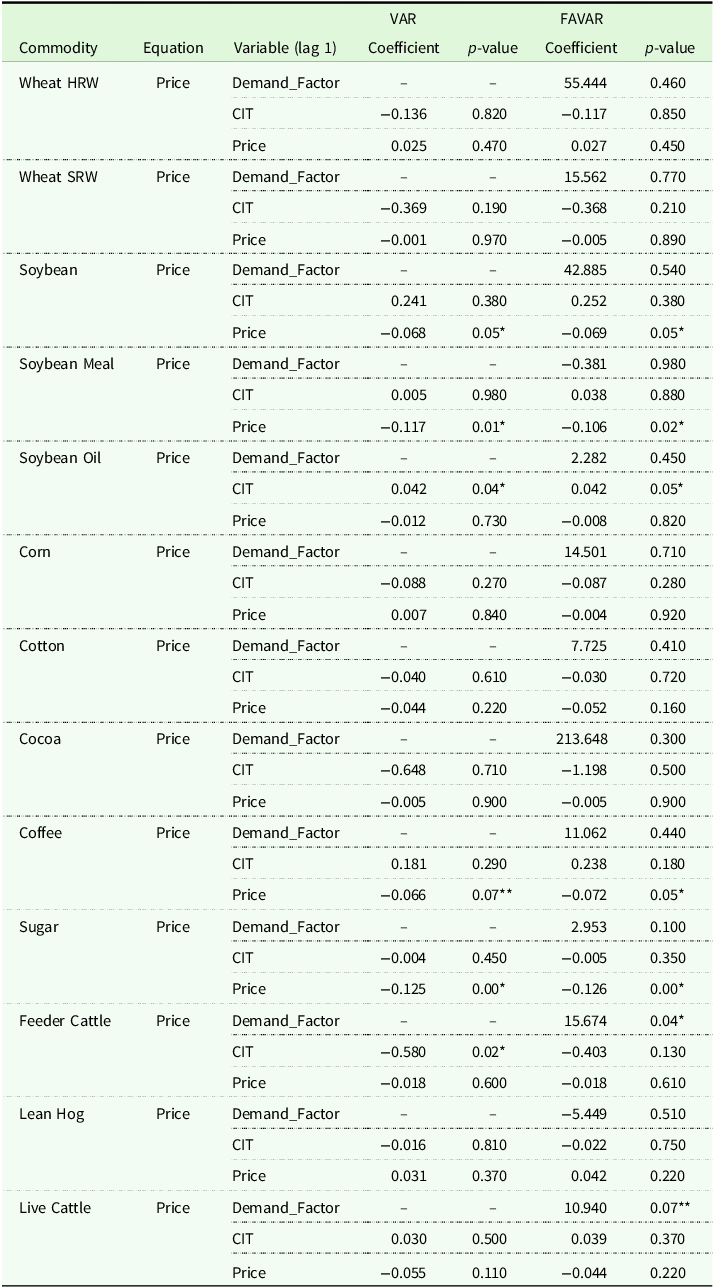
Tables 1 and 2 summarize the results of the VAR model, equation (10), and the FAVAR model, equation (11). Table 1 contains the results for the CIT equations and Table 2 for the futures price equations. Most statistically significant values related to CIT and Price are found in the first lag. The lag order of VAR models is typically 1, so Tables 1 and 2 provide a good initial comparison of the results. The FAVAR model extends the VAR model through the addition of the demand factor, derived from the group of demand-related variables.
Model results’ summary (CIT equation)

Model results’ summary (price equation)
VAR
 $$\matrix{ {{\rm{ CIT}}{{\rm{ }}_t} = {\alpha _1} + \sum\limits_{i = 1}^p {{\beta _{11i}}} \;{\rm{ Price}}{{\rm{ }}_{t - i}} + \sum\limits_{i = 1}^p {{\beta _{12i}}} \;{\rm{ CIT}}{{\rm{ }}_{t - i}} + {e_{1t}}} \hfill \cr {{\rm{ Price}}{{\rm{ }}_t} = {\alpha _2} + \sum\limits_{i = 1}^p {{\beta _{21i}}} \;{\rm{ Price}}{{\rm{ }}_{t - i}} + \sum\limits_{i = 1}^p {{\beta _{22i}}} \;{\rm{ CIT}}{{\rm{ }}_{t - i}} + {e_{2t}}} \hfill \cr } $$
FAVAR
 $$\matrix{ {{\rm{ Demand \;Factor}}{{\rm{ }}_t}} \,{ = {\alpha _1} + \sum\limits_{i = 1}^p {{\beta _{11i}}} \;{\rm{ Factor}}{{\rm{ }}_{t - i}} + \sum\limits_{i = 1}^p {{\beta _{12i}}} \;{\rm{ Price}}{{\rm{ }}_{t - i}} + \sum\limits_{i = 1}^p {{\beta _{13i}}} \;{\rm{ CIT}}{{\rm{ }}_{t - i}} + {e_{1t}}} \hfill \cr {{\rm{ CIT}}{{\rm{ }}_t}} \,{ = {\alpha _2} + \sum\limits_{i = 1}^p {{\beta _{21i}}} {\rm{ \;Factor}}{{\rm{ }}_{t - i}} + \sum\limits_{i = 1}^p {{\beta _{22i}}} \;{\rm{ Price}}{{\rm{ }}_{t - i}} + \sum\limits_{i = 1}^p {{\beta _{23i}}} \;{\rm{ CIT}}{{\rm{ }}_{t - i}} + {e_{2t}}} \hfill \cr {{\rm{ Price}}{{\rm{ }}_t}} \,{ = {\alpha _3} + \sum\limits_{i = 1}^p {{\beta _{31i}}} {\rm\;{ Factor}}{{\rm{ }}_{t - i}} + \sum\limits_{i = 1}^p {{\beta _{32i}}} \;{\rm{ Price}}{{\rm{ }}_{t - i}} + \sum\limits_{i = 1}^p {{\beta _{33i}}} \;{\rm{ CIT}}{{\rm{ }}_{t - i}} + {e_{3t}}} \hfill \cr } $$
All the coefficients for the price impact on CIT positions are positive, with only wheat SRW, coffee and sugar being statistically insignificant for both models (Table 1). The coefficients for the FAVAR model range from 0.002 for cocoa and 0.107 for soybean oil. This indicates that following a 1 USD increase in futures prices, CIT positions tend to increase by 2 to 107 positions. While these results are statistically significant, they are quite marginal considering CIT net long positions for soybean oil are typically around 100,000 positions.
The results for the price equation for both models are almost all statistically insignificant except for soybean oil and feeder cattle for the VAR model, and only soybean oil for the FAVAR model, although the coefficients for feeder cattle are negative in both cases.
These results highlight that the lead lag relationship typically goes from prices to CIT, and not the other way around. This is similar to other research results.
The coefficients for the relationship between CIT and futures prices are very similar for both models in the first lag. This suggests a limiting impact from the demand factor in describing any short-term dynamics between CIT and futures prices.
Demand factor
It is interesting to note the sign of the demand factor coefficients, in particular in the price equation in Table 2. All but two are positive, which is in line with economic theory. As demand increases, so do prices. However, only feeder cattle and live cattle are statistically significant.
In Table 1, which looks at the CIT equations, all but two demand factor coefficients are positive, with corn, cotton, and sugar being statistically significant. This follows economic theory, as demand factors increase, so might the level of Commodity Index Trading, especially if there is a positive price effect with increased demand.
While most of the statistically significant coefficients for the relationship between price and CIT are found in the first lag, the demand factor has many statistically significant coefficients for its effect on both price and CIT in some higher-order lags.
In order to get a better understanding of the contribution of the FAVAR approach to examining the Master’s hypothesis, the models’ BIC, impulse response functions and variance decompositions were also analyzed.
Bayesian Information Criterion (BIC) & lag order
Another way to assess the added value of the FAVAR approach compared to the VAR model is to examine the BIC and lag order. Comparing the BIC values of the models is a good indicator of whether the FAVAR approach may be preferred over a more parsimonious model. For every commodity, the BIC for the trivariate FAVAR model is the lowest. This indicates that the added value of the demand factor outweighs the penalty imposed by the BIC for the additional parameter. It is also interesting to note that the lag order of both FAVAR models is consistently higher than the VAR models, indicating that the additional information may help capture longer-term dynamics not observed in the VAR models (Table 3).
Model BIC and lag order

Impulse response functions
The impulse response functions can be compared to observe some of the longer-term dynamics of the two models. For simplicity, feeder cattle will be used as an example, as it represents many of the trends observed in the other commodities. Figure 2 shows the Impulse Response Functions of the VAR model and Figure 3 the Impulse Response Functions of the FAVAR model.
VAR impulse response functions for feeder cattle.

FAVAR impulse response functions for feeder cattle.

Given that the coefficients in the first lag of both the VAR and FAVAR models are very similar, the initial periods of the impulse response functions are likewise similar. The response functions for the VAR models tend to stabilize after four periods, representing 1 month after the shock (Figure 2). However, due to the longer-term dynamics captured in the FAVAR models, these impulse response functions capture more detailed longer-term effects, as shown in Figure 3.
It is also interesting to note that the impulse responses for the effect of the demand factor on both price and CIT tend to be positive and statistically significant over several periods. This highlights the effect of the higher-order lags in the FAVAR models that were not represented in the summary of Tables 1 and 2.
It is important to note that the orthogonalized impulse response functions allow for a contemporaneous impact from a shock to CIT on prices, but not the other way around.
Variance decomposition
Comparing the variance decomposition of the two models is also a useful way of measuring the added explanatory value of the FAVAR approach. Variance decomposition explains the proportion of a variable’s forecast error variance that can be explained by its own shock versus shocks to the other variables. Table 4 summarizes this for future prices and Table 5 for CIT positions, again focusing on feeder cattle.
Variance decomposition for price (feeder cattle)

Variance decomposition for CIT (feeder cattle)

Table 4 shows that for the VAR model, most of the explanatory value in futures price comes from its own past shocks, with the values stabilizing after a few periods. In the FAVAR model, the explanatory value of CIT diminishes, with the demand factor showing greater explanatory power by the third period. This suggests that the demand factor contributes more to explaining price movements than CIT does.
Table 5 shows a similar trend, with the demand factor contributing more to CIT than price by the second period in the FAVAR model. Additionally, the explanatory value of the futures price increases with the inclusion of the demand factor as compared to the VAR model.
Discussion
The regression results of both models lacked evidence for a lagged effect between index trading and futures prices. This is similar to most of the findings in recent empirical research (Rouwenhorst and Tang, Reference Rouwenhorst and Tang2012; Stoll and Whaley, Reference Stoll and Whaley2010; Gilbert and Pfuderer, Reference Gilbert and Pfuderer2014; Irwin and Sanders, Reference Irwin and Sanders2011; Lehecka, Reference Lehecka2015).
Since FAVAR models are a relatively new approach in the macroeconomic literature, it is common to find their results compared to traditional VAR models (Juvenal and Petrella, Reference Juvenal and Petrella2015; Bernanke et al., Reference Bernanke, Boivin and Eliasz2005). FAVARs tend to outperform VARs when compared side by side, with this research providing further evidence of this in the context of the Masters Hypothesis. While the findings regarding the Masters hypothesis are in line with other research, evidence has been shown in support of using the FAVAR framework, as it clearly adds important information to models that would otherwise suffer from omitted variable bias.
One of the strengths of the research is the volume of commodities analyzed. This allows for a broader view of the potential impact of index trading. However, this approach is limited in its appreciation for commodity-specific characteristics that may play an important role in model specification. Further research refining the demand data used in the factor analysis could improve the results. For example, regional demand data more specific to the main consumers of the commodities may better capture the demand effect on a commodity-specific level. This research used the same metrics from G-7 countries for each commodity, which is a simplifying assumption.
There are several unavoidable data limitations in using CFTC data. It does not disaggregate between different futures contracts, so CIT positions in any one commodity could reflect several different contract periods. The futures prices used in the model all represent the price of the front contracts, i.e., soonest to expire, and are rolled over accordingly to resemble a single continuous contract. Second, weekly data may be too coarse to capture any relationships between CIT investment and futures prices, changes that may take place on a daily or even intra-daily time period (Mayer, Reference Mayer2012). Similarly, the OECD economic data used in the factor analysis was monthly. This degrades the ability of the model that uses weekly futures and CFTC data to capture the effect of these variables.
Conclusion
Futures markets play a vital role in agricultural markets. While there has always been some concern as to the potential consequences of commodity index trading, developments in the financial sector over the last two decades have brought a new wave of interest in the topic, especially after the commodity price bubbles seen in the 2000s and more recently in 2021–2022. Commodity index trading accounts for a significant portion of agricultural futures market activity, the consequences of which are still not fully understood.
This research adds to the growing empirical research on the topic, implementing a more robust approach to looking at the problem through the use of FAVAR models. These models allow for the inclusion of a greater amount of relevant information into a VAR framework, leading to a better understanding of the dynamics at play. Overall, the findings of this research align with similar studies, indicating that prices tend to lead CIT. This research provides evidence that the inclusion of additional market-related information, such as factors influencing commodity demand, improves model performance and should be considered in future studies.
Michael Masters proposes a ban on investment strategies that replicate commodity indexes and advocates for regulation to close the swap dealer loophole (Masters, Reference Masters2009). Todd Petzel, once chief economist at the coffee, sugar, and cocoa exchange, believes that current regulations are more than adequate. He raises the concern that increases in regulation could drive investors to directly invest in commodities, through their physical acquisition and storage. This, Petzel claims, would be a far worse unintended consequence than any potential effect index trading may currently have on markets (Petzel, Reference Petzel2009). Increased financial regulations could also drive hedgers to rely more on insurance products, which typically come with high premiums.
The CFTC acknowledges that excessive speculation can lead to unwarranted price movements and sets specific limits to minimize the impact of speculators (CEA, 2018). Exemptions are made for hedging transactions, which is where much of the swap dealers’ activities are classified. Commodity index traders typically work through swap dealers, sometimes referred to as the swap dealer loophole. The Energy and Environmental Markets Advisory Committee (EEMAC) was formed in 2008 by the CFTC to review the empirical research and to consider a revision of traders’ position limits. In 2016, committee member Michael Cosgrove stated that the impact of index trading appears undetectable in the research, emphasizing the fact that increased regulation was not a high priority for the committee (Irwin and Sanders, Reference Irwin and Sanders2017).
In March 2021, the CFTC expanded the scope of position limit regulations, which now includes 25 commodities. This expansion now covers energy and metal commodities, as well as three new agricultural products: live cattle, feeder cattle, and lean hogs (CFTC, 2024b). Limits on all agricultural commodities were increased to reflect current market conditions. However, CFTC Chairman Benham criticized the decision as no limits beyond the spot month were imposed for the newly added commodities, with too much regulatory oversight held by the exchanges (CFTC, 2024c). This, in turn, could exacerbate the problem of excess speculation. Most recently, CFTC Commissioner Romero reiterated her concerns on the topic and called on the CFTC to “conduct deep-dive studies to look at trading in a number of key commodities that have been experiencing significant volatility or price increases and publicly release our findings” (CFTC, 2024d).
The results of this research do not provide clear evidence that index traders are responsible for the large swings observed in commodity prices. The research does, however, indicate that other important demand-related factors help explain some of the behavior observed in commodities markets, both in terms of CIT positions and futures price movements.
Data availability statement
The data used in the model are publicly available and referenced in the manuscript.
Financial support
Both authors have no relevant material or financial interest in the subject of the research.
Ethical standard
No human subjects were interviewed or used to generate primary data for this research.
Appendix A
Data description


 Open access

