




A devotional record of the Buddhist statues at the famous Tōdaiji 東大寺 monastery in Nara documents as follows:
In 1196, the stone lions at the Middle Gate, the stone guardians in the hall, and the statues of four heavenly kings were all made by four artisans from the Song, and among the artisans was a certain Liulang. They found the stones in Japan difficult to use for sculptures, so they asked permission to purchase stones from China. The transportation and other miscellaneous expenses cost more than three thousand koku. Footnote 1
This record refers to the reconstruction of Tōdaiji after the Genpei War—the civil war in Japan lasting from 1180 to 1185—and given the great importance of Tōdaiji, its reconstruction was a major building project at that time. The sentences above reveal many intriguing points: Why did the prestigious Japanese monastery recruit Chinese stonemasons to make monuments? What made the circulation of personnel and materials between China and Japan possible at that time? Besides the Japanese stones, what would be other challenges that the Chinese artisans faced during their work in Japan, and what would be in their favor? What happened to the Chinese artisans after the Tōdaiji project?
Exploring Chinese and Japanese textual records and visual evidence of the stonework, this article investigates the network that moved the artisans and their materials between China and Japan and sheds light on the relationship between artisans and religious monuments from a transnational perspective. The traveling Chinese artisans were far from an isolated group—they were connected with sea merchants, Buddhist monks, and the monks’ patrons, and meanwhile, they both cooperated with and competed with local Japanese artisans. Benefiting from pioneering studies that have traced the experiences of migrant Chinese stonemasons and their descendants in Japan, this article offers further analysis of the network that facilitated Chinese artisans’ migration to Japan and explores how the traveling artisans’ expertise and connections helped them establish roots in a new society.Footnote 2 Additionally, this study examines the timing of their migration within the broader context of Japan’s societal transformations, aiming to highlight the connectivity fostered by maritime networks in premodern East Asia.
Ningbo: Homebase, Training Site, and a Place of Opportunity
The devotional record above does not mention the origin of the Chinese stonemasons, but their other extant stonework helps to fill in the gaps. An inscription on a stone stupa located in the Hannyaji 般若寺 monastery in Nara links Ningbo, the aforementioned Chinese stonemasons, and Tōdaiji together. It also reveals the fundamental structure of the network that this article investigates.
According to that twenty-line inscription, the stone stupa was built by I no Yukiyoshi 伊行吉 in 1261 to memorialize his late father, I no Yukisue 伊行末, and pray for the well-being of his mother. In the first line of the inscription, Yukiyoshi wrote that his father Yukisue originated in Mingzhou in the Song. In the following sentences, Yukiyoshi emphasized his father’s contribution to reconstructing the Tōdaiji in the late twelfth century. Yukiyoshi mentioned that when his father arrived in Japan, the stone foundation of the Buddha hall of the Tōdaiji had been entirely destroyed. So Yukisue worked with the famous Chinese sculptor Chen Heqing 陳和卿 on the reconstruction project. While Chen Heqing cast the Great Buddha statue, Yukisue rebuilt the stone foundations for several halls of Tōdaiji.Footnote 3
This Hannyaji inscription has provided crucial information for us to investigate the Chinese stonemason group in the Tōdaiji devotional record. It tells us that the stonemason group was from Mingzhou—modern Ningbo—and at least one of the four stonemasons stayed in Japan after the Tōdaiji project, later taking the Japanese-style name I no Yukisue and raising a family in Japan. Considering that Yukisue died about sixty years after the Tōdaiji reconstruction, he must have come to Japan when he was very young. And apparently, Yukisue’s son Yukiyoshi was also a professional stonemason who was able to make stonework for Buddhist monasteries in the Nara area.
This section of this article will examine Ningbo, where the Chinese traveling stonemasons received their initial training and found an opportunity to work in a foreign land. This section will show that it was no coincidence that the stonemasons were from Ningbo. In the twelfth and thirteenth centuries, stone sculptures were rather prevalent in Ningbo, especially among the elites. Furthermore, because Ningbo played a vital role in the exchanges between China and Japan at the time, the established network conveniently facilitated the movement of people and materials from Ningbo to Japan, and the case of the stonemasons further enriches our understanding of the network.Footnote 4
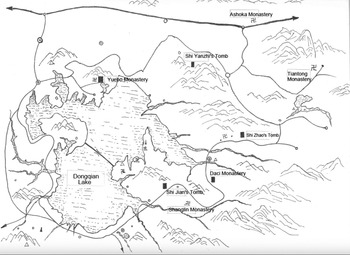
Ningbo is currently the largest repository in China of stone monuments dated to the twelfth and thirteenth centuries. According to a recent survey, the Dongqian Lake 東錢湖 area in eastern Ningbo has around 200 stone sculptures dated to the Southern Song (1127–1276), eighty percent of which are found in the graveyards of the prominent Shi familyFootnote 5 (Map 1). The Shi family was deeply rooted in Ningbo, and because three members of the family—Shi Hao 史浩 (1106–1194), Shi Miyuan 史彌遠 (1164–1233), and Shi Songzhi 史嵩之 (1190–1256)—ascended to the position of Grand Chancellor, they were also among the most notable elite families in the Song dynasty.Footnote 6 Because of the Shi family’s local ties to Ningbo and their prominence, they had both the motivation and the resources to construct magnificent family graveyards. Their family graveyards congregated on the northeast and southeast areas of the Dongqian Lake and were featured with large stone sculptures—stone sheep, stone horses, stone tigers, and stone figures of civil and military officials.Footnote 7 Aligned along the spirit way of almost every graveyard, those stone monuments are larger than life-size—the stone figures are usually more than three meters tall while the stone animals are more than 1.8 meters tall; all the stone sculptures were carefully carved with many decorative details.
The Distribution of Stone Monuments surrounding the Dongqian Lake.

The stone monuments at the Shi family graveyards attest to the existence of a considerable number of highly skilled stonemasons in the area. Those stone monuments’ estimated completion dates span more than a century, from the 1130s to the 1240s, so there were likely multiple generations of stonemasons involved in the projects.Footnote 8 Some Buddhist sites in Ningbo also preserved some—usually fragmentary—Southern Song stonework, and that stonework suggests that the stonemasons probably worked for both the Shi family and local monasteries. For example, the Daci monastery has a stone pillar top that is identical to the stone pillars in Shi Miyuan’s graveyard.Footnote 9
The very large size of those stone monuments also reveals important clues in reconstructing the work organizations of the stonemasons at the time. Although the stonework in Ningbo and Tōdaiji has received scholarly attention, the exact organization and dynamics among the artisans have not yet become a point of discussion. This article endeavors to reconstruct the possible process, which will expand our knowledge not only about this particular group of masons but also about artisans of similar types.
Making a three-meter-high stone monument is a multistep task which undoubtedly required teamwork. In premodern China, artisan teams were often composed of family members, and perhaps sometimes friends and neighbors. The work teams were thus stable, and frequent collaboration among the same members allowed them to improve efficiency. Historical records also show evidence of family teams: the sculptor Chen Heqing mentioned above was recorded as having participated in the Tōdaiji reconstruction project with his brother, Chen Fozhu.Footnote 10 The fact that I no Yukiyoshi followed in his father’s footsteps and became a professional stonemason, too, demonstrates that making the artisanal skills a family profession was quite common then.
The family-based nature of the teamwork also provided training for the novices to those specific professions. For example, the children growing up in the stonemason families were exposed to all the techniques of that profession at an early age and may have participated in simple tasks—such as cleaning up the work sites and preparing the raw materials—from a young age. Therefore, although Yukisue was likely no more than twenty years old when he arrived in Japan from Ningbo, he probably already possessed ample knowledge of stone carving, which was an important asset supporting him in his professional career in the foreign land.
Another key factor contributing to the prevalence of stone culture in Ningbo and actually affecting the stonemasons’ skills was the availability and features of the raw stone materials near Ningbo. About thirty-five kilometers west of the Dongqian Lake, there was a high-quality quarry famous for producing the kind of stone called “Plum Garden stone.”Footnote 11 Plum Garden stone is a type of tuffaceous sandstone, and it has a harder texture than usual tuffs and is also distinctive for its pinkish color. The hard texture makes Plum Garden stone ideal for presenting sophisticated details and providing better resistance against the erosion of the environment and climate.
Many stone sculptures in the Shi family graveyard—especially those made when the Shi family was most prosperous—are made of Plum Garden stone. The geographic location of the quarry was also very convenient—it was near a developed network of waterways. The stones harvested there could be transported to the port in Ningbo via the Yin and Fenghua rivers.Footnote 12 Those waterways not only guaranteed easy transportation to the Shi family graveyard but also facilitated exportation to Japan.
Archaeologists have spotted evidence showing that the stonemason workshops existed in the area of the quarry, suggesting that stonemasons probably processed the stones near the quarry first, then transported the half-finished works to the Shi family graveyard and put the finishing touches on there.Footnote 13 That archaeological discovery is crucial for envisioning the working steps and division of labor among the masons, providing important clues for reconstructing how the Tōdaiji lions were made.
The stone lions at the Tōdaiji monastery, according to scholars’ investigations, were also made of Plum Garden stone, which cost a fortune to be transported to Japan at the Chinese stonemasons’ request. The unique texture of the Plum Garden stone also explains why the traveling Chinese stonemasons found the stones in Japan difficult to work on. The stones in the vicinity of Tōdaiji appeared to be of a softer texture, rather different from the Plum Garden stone with which the traveling stonemasons were familiar.
In the late twelfth century, it was not by chance that both Chinese stonemasons from Ningbo and stones from the same area appeared in Japan. A maritime network comprised of itinerant merchants and pilgrim monks had been developing since the mid-ninth century, tightly linking the lower Yangzi delta in China to northern Kyushu.Footnote 14 Ningbo in the twelfth and thirteenth centuries was the most important trade port in Sino-Japanese exchanges. And more remarkably, Ningbo served as not only a commercial hub but also a popular religious destination for Japanese Buddhist pilgrims. The dual nature of the network and its key nodes prompted exchanges that exerted multifaceted effects.
Therefore, Ningbo also provided a Buddhist link between the stonemasons and Tōdaiji. Ningbo was home to some of the most prestigious Buddhist monasteries in Song China, such as the Ashoka 阿育王 and Tiantong 天童 monasteries, both of which were included in the court-designated Five Mountains system and enjoyed great imperial patronage.Footnote 15 Chōgen 重源, the de facto supervisor of the Tōdaiji project, was recorded to have visited Ningbo and the Ashoka monastery in 1168.Footnote 16 As shown in Map 1, the Ashoka monastery is geographically adjacent to the Dongqian Lake and several Shi family tombs. It is reasonable to assume that Chōgen saw some of the stone monuments during his visit to Ningbo.
Some scholars even speculate that Chōgen might have met some Shi family members in person, and I also favor this possibility.Footnote 17 In the Song period, it was not unusual for Japanese pilgrim monks to connect with Chinese intellectuals, as they had many shared interests in the arts and Buddhist teaching. For example, in the eleventh century, benefiting from his excellent calligraphic skills, the Japanese monk Jakushō 寂照 (962–1034) gained a reputation among the circle of Chinese literati and even became close friends with the high official Ding Wei 丁謂 (966–1037).Footnote 18 Lou Yue 樓鑰 (1137–1213), a prominent scholar-official from another established Ningbo family, wrote an essay for the Tiantong monastery, celebrating the accomplishment of the Pavilion of One Thousand Buddhas there.Footnote 19 In that essay, Lou Yue also specifically mentioned that the Japanese monk Eisai 栄西 (also read as Yōsai, 1140–1215) managed to arrange the shipment of lumber from Japan to Ningbo, in support of the construction of that pavilion. Eisai and Chōgen were close, and some sources indicate that they may have visited the Ashoka monastery in Ningbo together in 1168.Footnote 20 Although arranging the shipment of lumber to Ningbo happened after Eisai’s second visit to China in 1187–1191, it would not be surprising if Eisai and Chōgen both had made contact with local elites during their 1168 visit.
The Shi family themselves were also devout Buddhist patrons, so if an opportunity to meet a Japanese pilgrim monk arose, they would probably take advantage of it. According to the Japanese scholar Kimiya Yasuhiro’s calculation, about twenty Japanese monks visited China in the eleventh century.Footnote 21 The number is likely to have increased in the twelfth century, but the Japanese monks were still rare-enough visitors that they could easily attract local elites’ attention. Furthermore, it is worth noting that the Shi family donated to multiple local monasteries in Ningbo.Footnote 22 They also built a Buddhist Funerary Temple (Gongdefen si 功德墳寺) for their family.Footnote 23 Therefore, it is safe to assume that the stonemasons who made the stone sculptures for the Shi family graveyard probably also worked in other Buddhist-related projects sponsored by the Shi family. Thus, we can see that stonemasons in Ningbo were not merely a group of workers who engaged solely with stones and tools. They were part of a network and were well-connected to local elites, prominent religious institutions, and, very likely, foreign visitors.
Piecing the scattered evidence together shows us that by the end of the twelfth century, commissioning stone sculptures was already popular among the local elites in Ningbo. The stonemasons based in Ningbo probably reached a considerable number, and the abundant supply of high-quality stone materials further prompted the growth of stone monuments in the region. Ningbo, being both the commercial and the religious hub in the network connecting China and Japan, attracted Buddhist pilgrims from Japan and accordingly, opened up a larger world to the Chinese stonemasons.
Tōdaiji: New Workplace, Old Teammates?
Timing played a key role in the migration of the Chinese stonemasons. In the late twelfth century, the political turmoil in Japan had a profound impact on various aspects of society, including the changes in the organization of artisans in Japan. Chinese artisans arrived and joined some very high-profile construction projects. As shown below, since China had long been a source of Japanese Buddhism, Japanese political and religious authorities held Chinese Buddhist arts in high regard. Unlike sutras, which needed translation to be accessible to learners in Japan, Buddhist ritual objects could be put directly into use, so they offered devotees direct access to the Buddha’s power.Footnote 24 The Chinese artisans were likely valued for their ability to produce authentic Chinese artworks. On the one hand, they facilitated the changes in Japan and left a clear mark with their distinctive works; on the other hand, they also faced many challenges when adjusting to the new work environment.
The six-year Genpei war between the Minamoto and Taira clans caused devastating damage to many parts of Nara, and postwar reconstruction became crucial, as it was an important way to announce the power of authority and the restoration of order. Among the buildings that needed timely repair, the Kōfukuji 興福寺 monastery and the Tōdaiji monastery stood out. Both monasteries possessed solid ties to the Japanese court and aristocrats. Tōdaiji was a major monastery built by the former Emperor Shōmu 聖武 (701–756, r. 724–749) in the mid-eighth century, a golden era in Japan, and Kōfukuji was built around the same period and also served as the clan temple for the Fujiwara clan, the most powerful courtiers of the time.Footnote 25
The reconstruction of Kōfukuji and Tōdaiji exhibited distinctive differences in terms of recruiting manpower, reflecting broader transformations occurring in various aspects of Japanese society at that time. In 1181, only a year after the destruction of Kōfukuji, the Japanese court was already ready to repair the monastery. The arrangement for the reconstruction mostly followed the norms of state-sponsored building projects. The court announced the establishment of the office specifically for supervising that project—the Office for Reconstructing Kōfukuji (zō Kōfukuji sho 造興福寺所)—appointed chief artisans in charge of various tasks and also decided how the reconstruction expenses would be distributed among the court, the Fujiwara clan, and the monastery itself.Footnote 26 The artisans participating in the Kōfukuji project were comprised of three groups: court artisans, artisans affiliated with the newly established office, and artisans affiliated with Kōfukuji. Among the three groups, the court artisans, whose title literally means “artisans sent down from the capital” (京下工 kyōkatakumi), enjoyed the highest status—the most prominent ones among them had official ranks as high as the fifth rank. Those court artisans’ names also appeared in the aristocrats’ diaries, which tells us that they participated in building palaces, monasteries, and aristocrats’ residences. At Kōfukuji, they were in charge of reconstructing the most important buildings in the monastic compound, including the Golden Hall, the Lecture Hall, and the Southern Gate.Footnote 27
The artisans affiliated with the Office for Reconstructing Kōfukuji were essentially employed by the court, too, but it looks as though those artisans often received appointments to temporary, project-based posts outside the capital. The last group, the artisans affiliated with Kōfukuji, identified as “monastery artisans” (teratakumi 寺工), were Nara-based and had already participated in many building and maintenance projects at Kōfukuji. It is worth noting that those monastery artisans were not working exclusively for the Kōfukuji. For example, some monastery artisans in the Kōfukuji project belonged to the same family, and their names also appeared in the construction of the Kasuga 春日 shrine—also in Nara—in 1215.Footnote 28 While the court artisans clearly held a higher status and took charge of the most important building tasks, the work division between the office-affiliated artisans and the monastery artisans did not show much of a hierarchical difference. The office-affiliated artisans were responsible for some slightly more important architecture—the middle gate—but the two groups also collaborated in repairing the corridor and both built some monks’ residences.Footnote 29
The reconstruction arrangement for Kōfukuji largely represented the prevailing pattern in Heian Japan, with the court taking the leading role and the monastery sharing part of the responsibility. The situation for the Tōdaiji reconstruction, however, signaled the beginning of a new era. The political turbulence in the late twelfth century took a heavy toll on Japanese governmental administration. For the Tōdaiji reconstruction, because the Japanese court could not afford to sponsor several large building projects all at once, and because Tōdaiji, unlike Kōfukuji, did not have a powerful clan as its main patron, Tōdaiji had to mostly rely on itself to gather enough money, building materials, and human power.
The monk Chōgen, the de facto supervisor of the Tōdaiji reconstruction, was selected primarily because of his outstanding ability to accumulate the resources in demand. Chōgen spent a significant portion of his life as an itinerant monk, and his footprints covered many parts of western Japan.Footnote 30 His experience mingling with people from various social strata equipped him with the ability to solicit donations and recruit workers from a large population base. Following Chōgen’s advice, the Japanese court encouraged the masses to contribute to the Tōdaiji project and issued an edict, saying: “Those who give alms for this purpose, even though it only be a grain of rice, half a penny, a small tool, or a log one foot in length, shall prosper forever and everywhere through the power of their good deeds.”Footnote 31 Notably, inviting donations from the masses was also an effective way to unite people under a good cause, an important step towards restoring social order. Moreover, the Japanese court also granted Chōgen the power to build a network of special sanctuaries (bessho 別所) to collect building materials from various places in western Japan. For example, the lumber needed for the construction was mainly from the Suō prefecture, and the bessho network facilitated the transport of the lumber.Footnote 32 Given the bessho network also included several ports, it very likely made the transportation of the Plum Garden stone possible, too.
What is more directly related to the focus of this article is how Chōgen recruited the artisans into the Tōdaiji project. Although the former governmental organizations of artisans still existed, as mentioned above, the changes had already begun. The court was not able to support multiple large projects at the same time, and the governmental organizations of artisans appeared to be dwindling.Footnote 33 Accordingly, for the Tōdaiji reconstruction, Chōgen mostly relied on the self-employed workers that he recruited. The transformation in the artisan organizations in the twelfth and thirteenth centuries left space for newcomers, too.
The Chinese artisans formed a notable presence in the Tōdaiji reconstruction, but that was probably because they took up prominent positions in the project, and therefore, their names were preserved in historical records. The primary sculptor in charge of repairing the Great Buddha was the aforementioned Chen Heqing, while I no Yukisue’s group took charge of the stonework. Because Buddhism originally spread to the Japanese archipelago via China and the Korean peninsula, the faithful in Japan had long recognized China as a source of teachings and authentic Buddhist devotional arts. Between the ninth and eleventh centuries, it was common for Japanese pilgrims to copy or order Buddhist art—such as Buddhist statues and mandalas—in China and bring them back to Japan. Sometimes, Japanese painters traveled with monks on their pilgrimage trips to China to produce precise sketches of Chinese Buddhist statues, enabling them to make exact copies upon returning to Japan.Footnote 34 In the Song period Ningbo was also home to workshops specializing in producing Buddhist paintings, and a large portion of those paintings were exported to Japan.Footnote 35 Chōgen was particularly passionate about transplanting Song-style arts to Japan.Footnote 36 But unlike the previous practice of purchasing Chinese Buddhist arts, Chōgen directly invited the makers—the artisans—to work in Japan.
Among the countless artisans in China, who were more likely to travel to work in Japan? And what advantages and disadvantages did they possess as foreign workers? When we examine the Chinese artisans who worked at the site of Tōdaiji, it is clear that kinship and geographic ties were very important—not only of great significance among the traveling artisans themselves but also crucial in linking them back to the other side of the sea. The first section of this article mentioned that many Chinese artisan organizations were family-based and discussed the benefits of such arrangements. The situation was similar in Japan. Many artisans appearing in Japanese records were from artisan families and worked with their fathers, sons, and brothers. It was also common to see competition between different families.Footnote 37
The geographical ties deserve a thorough investigation here. The previous section points out how Ningbo became a key factor in the exchange of personnel: Ningbo was the window that allowed Japanese visitors, such as Chōgen, to know about the latest development in Chinese art styles and the existence of such artisans; meanwhile, with all the developed sea routes and experienced travelers, Ningbo was also the gate that led people residing there to the outside world. It is worth emphasizing that not only the stonemasons were from Ningbo; the sculptors, Chen Heqing and his brother were also from Ningbo—more specifically, from Yin County, the region of Dongqian Lake. Chen Heqing and his brother arrived in Japan several years before I no Yukisue and his three fellow stonemasons. Possibly, when the Tōdaiji reconstruction needed stonemasons and Chōgen was interested in transplanting Song-style art, Heqing recommended that Yukisue’s group from Ningbo join the project. It is clear from the inscription that Heqing needed to cooperate with the stonemasons—when Heqing recast the Great Buddha, the stonemasons were expected to repair the stone foundation of the statue.
Language was another factor that enhanced the geographic ties among the traveling artisans. Chen Heqing and the leader of the Song stonemasons would surely have needed to discuss their work among themselves and communicate with Chōgen frequently, as they would have needed to decide on the styles and other details of the Great Buddha statue and the stone sculptures. Translators were probably needed on those occasions. Chinese sea merchants frequently served as translators between Chinese and Japanese parties during that period.Footnote 38 Almost all the Chinese sea merchants at that time that we have detailed records of were from the southeast coastal region of China, especially the lower Yangzi Delta.Footnote 39 Sharing the same dialect was probably very helpful in communication, considering that the artisans (and perhaps many sea merchants, too) might only speak this dialect, which might not have been fully comprehensible to people from the north or far south.Footnote 40
From the twelfth century, a Chinese quarter, “Tōbō” 唐房, started to take shape in the port Hakata of northern Kyushu. Hundreds of households of sea merchants originally from China lived there and frequently traded between southeast China and Kyushu.Footnote 41 The sea merchants in the Chinese quarter must have been crucial intermediaries between Japanese monks and Chinese artisans. Due to the Japanese court’s restrictions on Japanese subjects going abroad, anyone who wanted to cross the sea had to rely on Chinese merchants. The Chinese quarter was where travelers found their means of transportation. Chōgen’s companion in China, Eisai, was recorded as arriving in the Chinese quarter first when he decided to go to China, and that is probably what Chōgen did as well.Footnote 42 The Chinese merchants frequently served as the monks’ messengers and helped them make purchases, so it is only natural that they also helped the monks find and bring Chinese artisans to Japan when needed. The merchants living in the Chinese quarter in Hakata also formed a solid tie linking Ningbo to Japan. Meanwhile, many of those sea merchants were Buddhist patrons or lay Buddhists, eager to get involved in Buddhist projects. For example, the Tianyi Pavilion 天一閣 Museum in Ningbo has preserved three stone bricks, with inscriptions indicating three Chinese merchants residing in Hakata offering donations to pave a pilgrim road for a Buddhist monastery in Ningbo.Footnote 43
The link between Ningbo and Hakata also extended to Nara, which could explain how the Ningbo artisans arrived at Tōdaiji. Although Hakata was not geographically close to the capital area, the material and personnel exchanges between them were vibrant because Hakata was the gateway to the outside world for the aristocrats and religious authorities in Kyoto and Nara. Many prestigious religious institutions in the capital area had their branches in Kyushu to participate in overseas trade and gain access to the most up-to-date knowledge from the continent. Some Japanese monks spent time in both Kyushu and the capital area, which enhanced their connections. The sea merchants’ activities also extended to the capital area: a merchant named Li Yu 李宇 was recorded as being rewarded at the completion ceremony of the Tōdaiji reconstruction for his contribution.Footnote 44
Therefore, I argue that it was no coincidence that the Chinese artisans from Ningbo appeared in Japan soon after the formation of the Chinese quarter. The formation of the Chinese quarter itself, to a large extent, was the result of the Japanese court relaxing its border control.Footnote 45 The political turmoil in Japan in the twelfth century undermined its administration in many aspects, on both the central and the local levels. The dwindling of the court artisan organizations and the court relinquishing its hold on restricting foreign visitors, at first glance, seem to be two unrelated issues. However, together they led to the Chinese artisans coming to Japan. The Chen brothers and I no Yukisue’s group were probably representatives of a larger wave of migration. Given the very limited extant sources, we cannot speculate on the scale of the wave, but one point we can be certain about is that, by then, the infrastructure that made the exchanges possible was already established. With Ningbo and Hakata as the key hubs and people of different professions supporting each other, a network formed and tied people and places closely together.
Being part of the network also meant that when the traveling artisans left their home base, they were still connected there. The successful request for Plum Garden stone serves as a good example. Transporting Plum Garden stone all the way from Ningbo to Nara was a multistep task that required rounds of discussions and negotiations. The itinerant merchants who frequently traded between Ningbo and Japan doubtless played an indispensable role in the process. But still, the merchants needed to know exactly what kind of stones the artisans wanted and where to find the stones, or more likely who to contact about it.
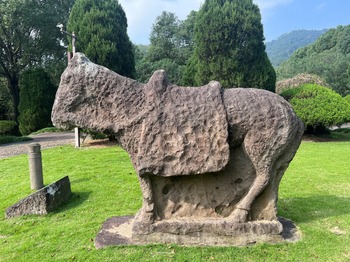
Moreover, I tend to think that the stones transported from Ningbo to Nara were actually not raw materials, but instead, half-finished stone sculptures. The archaeological discoveries near the quarry site and waterways connecting the quarry to the Shi family graveyard lend credibility to the speculation, although the current scholarship has not yet connected those discoveries with the Tōdaiji lions. The archaeological evidence—such as debris that indicate the existence of workshops—shows that most of the stonework was done near the quarry. Most strikingly, a half-finished stone horse sculpture has been retrieved from the riverbed between the quarry and the Shi family graveyard (Figure 1).Footnote 46 The size, texture, and basic structure of the stone horse look very similar to the stone horses at the Shi family graveyard, lacking only the decorative details—such as the sash and the patterns on the saddle—and a polished surface. That stone horse probably fell into the river while being transported to its final destination for display and thus became a crucial piece of evidence for us to investigate the steps in manufacturing the large stone sculptures.
Half-finished stone horse sculpture, Ningbo.

Finishing the main frame of the sculptures near the quarry must have been a reasonable choice, since that could significantly reduce the weight of the cargo for transportation and prevent leaving too much debris at the display site. As the transportation process might cause damage to fine details, the final steps of adding decorations and polishing would be done at the final site, such as the Shi family graveyard.
Similar arrangements for work division would make a good deal of sense for I no Yukisue’s group, too. First, the sea merchants traveled to China from Japan no more than once a year. To make the best use of the seasonal winds, the sea merchants usually left Japan during April and May. In July, when the winds blew from the Yangzi delta eastward toward Kyushu, they would return to Japan. So, after the sea merchants passed along the traveling artisans’ request to their designated person in Ningbo, it would take another year before the merchants came back to pick up the stones for transportation. Considering that the Tōdaiji reconstruction was still a time-sensitive project, having the stones processed and carved first in Ningbo during the year-long waiting period would undoubtedly increase work efficiency—in addition to reducing the weight of the stones for the long-distance voyage.
Secondly, while transporting Plum Garden stone all the way from Ningbo to Nara certainly shows how much the Japanese authorities were willing to pay for successful reconstruction, it also suggests that the newly arrived Chinese stonemasons might have had a difficult time adjusting to the new environment. We know that at least some of those four stonemasons were very young, and lack of sufficient experience working on different materials could make the initial stage of the adjusting process more challenging. Therefore, having extra help from their former colleagues, who, as suggested above, were probably their relatives or neighbors, would be very helpful for the traveling artisans to finish the task in a satisfactory and timely manner.
One more challenge that the Chinese traveling artisans as newcomers needed to deal with was their relationship with the Japanese artisans. Although Heqing and Yukisue’s group were in charge of their own tasks, they still relied on the Japanese workers to do many supporting and assisting tasks. Heqing’s casting work especially required a large supporting team. For example, to repair the giant bronze Buddha statue, Heqing needed to melt a large amount of metal at a very high temperature, making sure that the metallic liquid would not cool down until it reached precisely the right location in the mold. To achieve that goal, dozens of workers needed to work intensively on the oven, putting in fuel and pedaling a fan constantly for ventilation.Footnote 47
Meanwhile, the Chinese artisans sometimes also competed with local Japanese artisans. It is important to bear in mind that for artisans, whether they were from Japan or China, their status and competitors varied according to their skill levels and skill sets. Since Heqing and Yukisue’s group could lead large projects, their main competitors would be those who also possessed high-level skills. Competition existed among Japanese artisanal groups, too. In the Nara area, different groups of Japanese artisans fought to participate in the prestigious projects.Footnote 48 The arrival of the Chinese artisans probably made things more complicated, especially at that time, when ongoing changes in the government administration likely led to an increase in temporary, task-based recruitment.
Before inviting Heqing to supervise the repair of the Great Buddha, Chōgen had first asked some reputable Japanese sculptors, who, after examining the remaining parts of the statue and discussing among themselves, told Chōgen, “the skills needed for the repair are beyond human capabilities.”Footnote 49 Modern scholar Shiozawa Hiroki points out that although the repair work was doubtless challenging, it was also possible that the Japanese sculptors somewhat exaggerated the difficulty in order to demand a large payment and deny liability in case anything went wrong during the work.Footnote 50 If that were the case, the participation of Chinese migrant artisans would have interrupted those Japanese sculptors’ plan. But no matter whether the Japanese sculptors really declined Chōgen’s invitation or not, the fact that the traveling Chinese artisans eventually took important positions in the Tōdaiji reconstruction probably intensified the competition among artisan groups. Under these circumstances, the Chinese artisans’ homebase in Ningbo became even more valuable, as that gave them access to materials, skills, and art styles that would appeal to both the Japanese religious and political authorities.
As mentioned earlier, Buddhist art objects of Chinese origin were highly valued in Japan because of their inherent authenticity. Japanese religious and political authorities were interrelated and interdependent throughout a long period of history, and they commonly believed that the original Chinese Buddhist art objects were more powerful than copies.Footnote 51 In the twelfth century, as wars prevailed across the archipelago, Buddhist communities were also experiencing a crisis. Japanese Buddhists believed that the Final Dharma began in 1052 and that the world was falling into a dark age. The decline in vitality among the Buddhist sects in Japan further confirmed people’s concerns. Consequently, some monks once again turned to China to search for answers.Footnote 52 In that context, Chōgen’s efforts to adopt the new style in buildings and statue-making in the Tōdaiji project appeared to also respond to the crisis, and the courtiers embraced Chōgen’s solution.
The reconstruction of Tōdaiji was a big success. Chen Heqing, in particular, received many rewards from the emperor.Footnote 53 Yukisue’s group, too, left a conspicuous mark in contemporaneous Japanese records. This section suggests that the development of the underlying network that connected the continent and the archipelago significantly contributed to the Chinese artisans coming to work in Japan. The changes in the former governmental organizations of artisans opened up room for the newcomers, while the itinerant sea merchants trading between southeast China and Japan provided crucial assistance to the traveling artisans from China. The well-functioning network made the Chinese artisans’ homebase—Ningbo—part of their assets; they were able to request high-quality materials and enlist technical help from their previous associations there. Their connections to China became an advantage for the traveling artisans in working and even settling in Japan.
Beyond the Tōdaiji: Japanese Name and Chinese Identity
The inscription on the stone stupa at Hannyaji mentioned above tells us that at least one of the four stonemasons from Ningbo remained in Japan, adopted the Japanese-style name I no Yukisue, and passed down the profession to his descendants. Despite the scattered and fragmented records, this section explores the extant works related to the migrant stonemason family and aims to show how the migrant Chinese artisans laid down roots in Japan and how they viewed themselves.
The Tōdaiji reconstruction was a high-profile project with the involvement of the state. It was an ideal opportunity for the traveling artisans to show their skills and establish their reputation. But how they found their next job after the Tōdaiji project was crucial to the next stage of their careers.
A stone inscription excavated in 1993 from Sayama 狭山, of Osaka Prefecture, recorded how Chōgen in 1202 led a group of artisans to rebuild a water reservoir there. According to the inscription, the water reservoir and its channels were originally built in 731 and had gradually collapsed. So, for the sake of the more than fifty counties in that area, Chōgen led a work team there. They started digging the channels in the second month of 1202 and lined them with stone slabs two months later. The whole project was finished on April 24, 1202. And as the inscription states, in addition to Chōgen’s workers, monks and laymen, men and women, and even children and beggars all participated in reconstructing the water reservoir, helping carry and lay the stones.
The inscription ends with a name list of the main workers—Chōgen’s team. That part of the inscription is damaged, but the sentence fragments still reveal important information. The name list starts with “Among twenty builders/ Chief Artisan of the Tōdaiji construction Ise … [words missing]” (造東大寺大工伊勢 …). This sentence directly links the artisans working at the Sayama water reservoir to the Tōdaiji project, which was still in progress then. Even more remarkably, the name list ended with a phrase “among the three people who are Tang [Chinese] people, there is a Chief Artisan Shoubao [Ch.] / Moriyasu [J.]” (唐人三人之內 大工守保).Footnote 54
The sentence fragments indicate that three Chinese migrant workers followed Chōgen to Sayama to rebuild the water reservoir. It is very likely that the three Chinese workers were stonemasons from Yukisue’s group, given that the water reservoir project was temporally close to the completion of Tōdaiji reconstruction and required stone-related techniques.
It was common for Buddhist monks and monasteries to initiate or participate in local projects for improving the ordinary people’s welfare. Paving roads, building or repairing bridges, and constructing dams and water reservoirs were all among the kinds of projects that monks often became involved in.Footnote 55 Those practices were considered good deeds conducted by Buddhist followers and were usually praised in local gazetteers and monks’ biographies. For the Chinese artisans, traveling to Sayama and joining the local project there was probably a crucial step for them to get to know Japanese society outside Tōdaiji and prepare for the next stage of their life in Japan. We may never know why three instead of four Chinese stonemasons went to Sayama. Perhaps one had to stay at Tōdaiji to supervise some unfinished work.
The only extant work that reveals clues about I no Yukisue’s group after the Tōdaiji reconstruction is a cliff-carving Buddha at the Ōnodera monastery 大野寺 in today’s Uda city, of Nara prefecture, a monastery about thirty kilometers from the Tōdaiji. That eleven-meter cliff-carving Buddha was completed in 1208 by a group of Chinese artisans, whose names were “Erlang, Sanlang, Silang, Wulang, and Liulang.”Footnote 56 This name list is very interesting: literally, it means “the second, third, fourth, fifth, and sixth sons of the family.” The name “Liulang” (the sixth son) easily links this group to the Chinese stonemasons who once worked at the Tōdaiji. It appears that those Chinese stonemasons were still working together in Japan about a decade after the Tōdaiji project. The Tōdaiji devotional record mentions that Liulang was in a four-person group, while the cliff-carving Buddha was attributed to five Chinese artisans. Possibly one more stonemason later joined them from Ningbo—perhaps coming to Japan together with the half-finished stone sculpture? Or maybe they just took in another Chinese artisan they met in Japan. After all, the name list was very vague, and those names may have been used just for convenient identification for the Japanese.
As for the Chinese stonemasons’ life after 1208, so far we only know pieces about I no Yukisue and his descendants. The rest of them left no further textual or material traces, as most of the artisans in history. The scattered records that allow us to reconstruct part of I no Yukisue and his son Yukiyoshi’s life are all inscriptions left on their stonework. But first, it is important to note that the name, I no Yukisue, did not appear in any of the Tōdaiji-related records, not even in the cliff-carving Buddha finished in 1208. The Chinese migrant artisan may have started to use this new Japanese-style name only after he laid down roots in Japan. Moreover, all the characters in the name—Yuki 行, Sue 末—were common characters that often appear in Japanese artisan names. And I infer that even the surname, I 伊, was probably inspired by the surname of a legendary artisan in Japanese tales. The legendary artisan’s name was Inabe no Mane 猪名部真根, who was said to be the descendent of migrant artisans from the Korean peninsula and to possess marvelous carpentry skills.Footnote 57 I no Yukisue perhaps took the first character of that surname and changed it to a character of the same pronunciation, as the original character means “pig” in Chinese and was an unfavorable surname for Chinese people. That legendary artisan’s immigrant identity might be a key factor that made I no Yukisue want to create a connection between them.
So far, we have evidence of three stone monuments that were labeled as I no Yukisue’s works.
-
a) In 1240, Yukisue built a thirteen-story stone pagoda (current height: 4.17m; granite) in the Ōkuraji monastery 大蔵寺, Uda City, Nara Prefecture. This site is less than twenty kilometers from the cliff-carving Buddha at the Ōnoji. The inscription mentioned that more than three thousand monks and laymen had made donations to the construction, and I no Yukisue is the only worker with his name left. He was recorded as “Chief Artisan / I no Yukisue from Mingzhou, China” (大工/大唐铭州伊行末).Footnote 58
-
b) In 1253, Yukisue completed building a thirteen-story pagoda (12.6m; granite) at the Hannyaji monastery (the same monastery where his son Yukiyoshi built a stone stupa nine years later to memorialize Yukisue).
-
c) In 1254, Yukisue made a stone lantern (2.7m) and donated it to Tōdaiji, and he signed the inscription as “I no Yukisue, the gon no kami.” (伊権守行末).Footnote 59 “Gon no kami” 権守 was the title for prefecture-level local officials who received appointment from the central government. But the “gon” 権 officials usually did not hold any actual power.
The limited records about I no Yukisue provided several clues about his working conditions after the Tōdaiji project. It appears that Yukisue mainly worked within a relatively small radius of Tōdaiji—all of his extant works are in Nara Prefecture. The Ōkuraji monastery is about forty kilometers from Tōdaiji, while Hannyaji is only two kilometers away from Tōdaiji. The Tōdaiji reconstruction was undoubtedly the highlight of Yukisue’s career—it was the only work mentioned in the devotional inscription written by his son. Also, Yukisue donated a self-made stone lantern to Tōdaiji when he was at an advanced age, suggesting that Yukisue considered his experience at Tōdaiji the most memorable achievement of his entire life.
Like Chen Heqing, who received many rewards from the Japanese court at the completion of the Tōdaiji reconstruction, possibly Yukisue had also drawn attention from the Japanese authorities because of his contribution there. Considering that the governmental organizations of artisans in Japan were shrinking at that time and Yukisue always worked in Nara, Yukisue did not seem to have joined any governmental organizations or become a “court artisan.” It is more likely that he continued to participate in various projects but his affiliations with those projects were task-based. Nonetheless, Yukisue must have continuously built up his reputation in the Nara area, so that by 1240, it was his name that received the recognition and was engraved on the thirteen-story stone pagoda, which undoubtedly was the product of teamwork. It is notable that we have not found any works by Yukisue made between 1210 and 1240. A plausible reason is that he was not yet a team leader then, so it was not his name that had been acknowledged on the finished pieces.
Although I no Yukisue seemingly preferred to sign his name with an official title, “Chief Artisan” or “gon no kami,” neither title represented an actual position. “Chief Artisan” was once a low-ranking official title in the Japanese bureaucratic system, but with the dissolution of the governmental artisan organizations, the title in the thirteenth century merely represented the supervisor of the building project. “Gon no kami,” as mentioned earlier, did not hold actual power, either. But the titles to some extent indicated I no Yukisue’s relationship with the Japanese authorities. All the Buddhist monasteries that Yukisue left works in received patronage from the Japanese royal family, and Yukisue’s extant works are all of large size. He apparently needed more than a few helpers and probably worked with many assistants appointed by the monasteries or the court. The title “gon no kami” then was a recognition of both his excellent work and his leadership among the rest of the workers.
All of Yukisue’s extant works are Buddhist monuments and, given the stupa that his son Yukiyoshi built to memorialize him and the stone lantern he donated to Tōdaiji, Yukisue himself was also a Buddhist devotee. But it is very possible that Yukisue also participated in non-Buddhist projects, just as Chōgen led the repairs of the Sayama water reservoir. Those non-religious and non-governmental monuments simply had a smaller chance to stand for centuries.
Last but not least, the records about Yukisue and his son also reveal how those Chinese migrant artisans viewed themselves. Ningbo was clearly a critical factor that Yukisue and his son used to identify themselves. Half a century after he left there, Yukisue still signed “Mingzhou” in his works. And in the Hannyaji stupa inscription, Yukisue’s son also wrote in the first sentence that Yukisue was from Mingzhou of Song China. The reason for emphasizing their connection to Ningbo could be multifaceted. It is certainly possible that Yukisue still recognized Ningbo as his home, despite the Japanese-style name that he and his descendants were using. However, we should also remember that the ties to Ningbo also generated practical benefits. As discussed earlier, Ningbo was a source of high-quality stones and possible technical assistance to the traveling Chinese artisans. Because the Japanese monks then viewed China as a source of authentic Buddhist arts, so the relationship with Ningbo also enhanced the Chinese artisans’ authority in making Buddhist artifacts.
Furthermore, there were other Chinese artisans from Ningbo working in Japan then, and the “Mingzhou” identification might have been helpful for Yukisue to build connections or even form collaborative groups with other Ningbo-origin artisans. For example, a Chinese-style stele at the Nison’in 二尊院 monastery of Kyoto was made and carved in 1252 by an artisan named Liang Chengjue, who was from “Qingyuan of the country of the Song” (大宋国慶元府).Footnote 60 Ningbo changed its name from Mingzhou to Qingyuan in 1195. Liang Chengjue may have arrived in Japan later than Yukisue and have become accustomed to the new name of the city.Footnote 61
The stoneworks left by I no Yukisue and his descendants partially reflected the migrant family’s strategy. The stone pagodas and the stone lanterns exhibited a mixed style. The thirteen-story pagodas were modeled after the Chinese multi-eave (miyan 密簷) pagodas, while the overall design was adapted to suit the Japanese taste. The stone lanterns, too, had early precedents in northern China, but the stone lantern crafted by Yukisue featured an elegant design that later became a widely adopted model in Japan. Stone-carving techniques were still underdeveloped when the Ningbo stonemasons arrived in Japan, and archaeological evidence shows a notable increase in stonework during the thirteenth and fourteenth centuries.Footnote 62 It is likely that Yukisue and his companions, along with later followers such as the aforementioned Liang Chengjue, were pioneers in driving this development. The I family preserved their own cultural elements in their works while also making adjustments to fit the new environment—just as Yukisue signed his works with both his Japanese name and Chinese heritage. Since almost no Chinese migrants traveled with their female family members to Japan at that time—the Chinese merchants typically started new families in Japan—I no Yukisue likely married a Japanese woman as well.Footnote 63 To some extent, the I family had already integrated into Japanese society, but their Chinese roots remained a source of pride and a defining trademark of their works.
Conclusion
In the late twelfth century, when Chinese stonemasons and sculptors traveled to Japan and worked on one of the most notable building projects there, they were part of the vibrant exchanges between the continent and the archipelago. The traveling Chinese artisans joined a transnational network that had been developing for centuries and had reached a stage of maturity. The network was efficient enough to transport bulky building materials, and it even allowed long-distance collaboration on large works. That well-functioning network made the home base of those Chinese traveling artisans their most valuable asset, as they could access raw materials, technical help, and up-to-date information from there relatively easily. This article has reconstructed many details of the actual working process and dynamics of the Chinese artisans in Japan, because the significance and value of the Chinese artisans’ network can be seen most clearly that way. The Chinese migrant artisans realized that their origin could increase their authority in the foreign land and kept that as part of their self-identification and signature.
This article also suggests that a chain effect existed between China and Japan then. The Genpei War crippled the Japanese court administration and resulted in transformations in various aspects. The ongoing changes in Japanese society, intriguingly, facilitated the exchanges between China and Japan. The coming of artisans from China, to a large extent, relied on the growth of the settlement of Chinese sea merchants in Japan, while the influx of continental migrants synchronized with the social transformation in Japan during the transition from the Heian period (794–1185) to the Kamakura period (1185–1333). Therefore, the case of the migrant artisans reveals much beyond the individual travelers and provides precious evidence for investigating the connectivity within East Asia in the premodern era.
Competing interest
The author declares none.

 Open access

