


1. Introduction
Outside of developed Western countries, access to data about the diverse ways that firms may seek influence is hampered by the lack of public data available about corporate political activities like lobbying and campaign finance (Hollyer et al., Reference Hollyer, Rosendorff and Vreeland2018). This limits our ability to make inferences about how corporate influence-seeking may vary across regimes with higher or lower levels of openness, potentially making our theories tied to a small set of countries with rare political attributes that lead to high transparency.
We help address this problem by building a model-based measure of firm-level influence from comparative international survey data. Employing a measurement model is helpful because we know that firms can have many possible interactions with political decision-makers, and each presents a chance for firms to seek policy concessions and regulatory approvals (Haber et al., Reference Haber, Razo and Maurer2003; Aidt, Reference Aidt2016; Mazaheri, Reference Mazaheri2016; Schnakenberg and Turner, Reference Schnakenberg and Turner2024). To derive the measure, this paper uses original representative surveys of 27,613 firms from a diverse set of 41 countries (mainly in Europe, Central Asia, the Middle East, and North Africa) to understand how firms engage in interactions with public officials to gain influence. While previous studies (notably Weymouth Reference Weymouth(2012)) have provided comparative analyses of firms’ perceived influence, we rely on a novel set of measures of the forms of different channels that firms can use to exact influence. Notably, our data includes a comparable measure of political connections, and this dataset is the first internationally comparative measure of firm-level political influence that includes a wealth of indicators of corporate performance, management, and assets. Crucially, the measurement model we employ is able to endogenize non-ignorable non-response by implementing a two-stage process for companies answering questions about their political activities, which permits us to scale the full survey data without losing records due to listwise deletion.
An increase in measurement resolution necessarily opens up exciting new avenues for empirical inquiry. Because we have internationally comparative data, we can, for the first time, explore how these measures are associated with both institutional factors and firm-level factors simultaneously. Using several measures of governance quality, we find that our influence scores tend to be higher in countries with poorer governance. By contrast, better governance is generally associated with a broader dispersion of influence scores within a country. Within a country, as well, we find that higher influence scores are associated with a higher likelihood that firms face a low number of competitors and that they report a higher level of sales and lower labor input intensity relative to those sales. These findings help us understand better how political institutions may structure influence-seeking in a way that is difficult to capture from single-country studies.
2. Political influence and its measurement
Our aim is to contribute to the research on corporate influence-seeking by focusing on measurement problems that have yet to be satisfactorily addressed. We believe that measurement and conceptual development are inextricably linked (Gerring, Reference Gerring2012); we cannot measure well without understanding the theory underlying our concepts. At the same time, pursuing measurement challenges can elucidate areas of theory that may not have clear observable implications, requiring further development of the causal story. This back-and-forth relationship between theory-building and measurement is important for the development of rigorous tests of hypotheses and ultimately the pursuit of causal knowledge (Blair et al., Reference Blair, Coppock and Humphreys2023; Humphreys and Jacobs, Reference Humphreys and Jacobs2023). Without clear measures derived from substantive theoretical knowledge, it is difficult to even engage in the additional difficulties of causal identification with empirical data.
For this reason, we build our measurement strategy from the extensive literature on influence-seeking by interest groups, of whom firms are a subset. Following Schnakenberg and Turner Reference Schnakenberg and Turner(2024), we can summarize the different approaches to the study of how interest groups obtain influence as involving quid pro quo exchanges (DalBó and DiTella, Reference DalBó and DiTella2003; Aidt, Reference Aidt2016; Stuckatz, Reference Stuckatz2022), informational exchanges (Dellis and Oak, Reference Dellis and Oak2020; Libgober and Carpenter, Reference Libgober and Carpenter2024), or labor and resource exchanges with policymakers (Hall and Deardorff, Reference Hall and Deardorff2006; Abi-Hassan et al., Reference Abi-Hassan, Box-Steffensmeier, Christenson, Kaufman and Libgober2023)—or some combination thereof. It is important to note that many studies have been conducted in Western developed democracies, in part, because lobbying disclosure laws permit a very granular analysis of the nature and outcomes of influence on policymakers (Kim, Reference Kim2018; Egerod and Junk, Reference Egerod and Junk2022). By contrast, fewer studies are able to probe the influence of special interests in authoritarian and weakly-institutionalized democracies (Szakonyi, Reference Szakonyi2018; Bhandari, Reference Bhandari2022; Ruckteschler et al., Reference Ruckteschler, Malik and Eibl2022; Kubinec, Reference Kubinec2023; Berliner et al., Reference Berliner, Kalyanpur and Thrall2024), though not because there is less such influence in these regimes (Earle et al., Reference Earle, Gehlbach, Shirikov and Shpak2019; Harding et al., Reference Robin, Prem, Ruiz and Vargas2023).
To address this gap in a theoretically robust way, we want measures that plausibly map onto activities we can define as quid pro quos, information, and labor or resource exchanges with policymakers. Because this is a measurement exercise, we do not limit ourselves to one type of activity, but rather pool across many types of observable firm traits. Given the observable indicators of influence-seeking activities, we define firm-level political influence as a latent trait  $\Theta_i$ that produces these indicators via an unknown utility function $f(\cdot)$. This latent trait can be understood as a firm-level ideal point (Carroll et al., Reference Carroll, Lewis, James, Poole and Rosenthal2013) such that the realized level of political influence represents the optimal influence for a given firm conditional on both the costs and benefits of obtaining such influence. Because this latent trait is continuous, we assume that the firm-level utility function $f(\cdot)$ is smooth and twice-differentiable, allowing a firm to trade off the pursuit of political influence with other activities that could increase profitability.
In equilibrium, the pursuit of firm-level influence and the choice of different activities that could increase influence reach the market-clearing price for the non-market and market-based investments of firm resources. Utility can obviously involve other types of metrics, but for simplicity, we assume firms maximize profit for owners and shareholders, including via their pursuit of rents (Bhagwati, Reference Bhagwati1982). For this reason, we ignore idiosyncratic factors in the utility function that may predispose some firm owners to have a greater taste for politics apart from profitability. Furthermore, not all firms require political influence to obtain rents, and not all firms require rents to be productive. We note that we can only measure firms’ perceived utility from seeking political influence to obtain rents; it could well be that firm investments in influence do not, in fact, pay off in terms of the value of rents obtained. In essence, then, we want to measure the marginal value of additional influence to firms given other opportunities that firms could invest in.
Consider a number of actions (of length k), indexed by j, which form a vector  $\textbf{J} = (j_1, j_2, ..., j_k)$, which can result in influence of firm i, expressed as $\Theta_{i}$. A firm chooses J to maximize utility $\textit{f}(.)$, which is analogous to time-discounted, expected profit, given a firm’s actions, characteristics, and the associated costs.Footnote 1 Conceptually, it is key that the yielded utility of these actions is considered in combination and not individually. For instance, a politically connected firm may use leverage to avoid demands for bribes from public officials or find collective lobbying to be unnecessary; whereas a firm lacking a political connection may result to such lobbying or even paying bribes. We also express $\textit{f}(.)$ as a function of the chosen actions of all actors (A)—including other firms—operating in the same environment of a given firm. Denote these actions across other actors by the matrix $\mathcal{A}_{-i}$, which therefore has the length k and width A − 1.
We note that there will be associated costs with each political action, denoted by cij, which vary by firm and action. We assume such costs enter negatively into the firm’s utility function. Such costs—bribes, capital spent to secure political connections, or association fees—are easy to conceptualize; however, it is worth focusing on their inclusion for a moment. Expressing action choices as dependent on costs necessarily introduces scarcity: firms are constrained in their choices. Likewise, the structure of other actors’ choices will reflect underlying costs, and firms seeking influence may find themselves in competition with others (Becker, Reference Becker1983). Importantly, these costs are a function of the political environment-a concept we explore later-such that political openness (as often understood in democratic systems) can be seen as lowering the general cost of political actions by pluralistic actors. Under these circumstances, influence-seeking firms may have to compete more dearly to secure meaningful influence. By contrast, more restrictive governance can be considered as raising the general cost of political action, reducing actors vying for influence but potentially yielding greater returns to engaged firms (or other actors).
Lastly, utility will also follow from a vector of firm characteristics,  $X$. This vector represents other factors broadly and may include things like age, location, or even shared social networks, ethnicity, religion, or educational background with government officials. Formally, we define $\Theta_i$, as maximizing profit πi, with a specific choice of politically engaged actions given their associated costs cij,:
 \begin{equation}\Theta_i=\max_{\pi_i}f(J,{\mathcal A}_{-i},\pi_i,c_{ij},X)\end{equation}
 And we assume that  $f(\cdot)$ is a smooth function of class C 2 but otherwise unknown in terms of functional form.
The measurement problem, of course, is that we do not precisely know  $f(\cdot)$ and have only partial information about the inputs to $f(\cdot)$. For these reasons, we adopt a flexible parametric form that is able to marginalize across measurement error while permitting interactions between different observable indicators. While we cannot recover the true causal function $f(\cdot)$, we can recover a reduced-form specification $g(\cdot)$ that permits us to both obtain a robust estimate of $\Theta_{i}$ within a well-calibrated uncertainty interval and learn some partial information about the relationships between the inputs of $f(\cdot)$ and the latent trait $\Theta_{i}$.
2.1. The measurement model
To gain an estimate of  $\Theta_i$ via a reduced form function $g(\cdot)$, we adopt an item response theory (IRT) parameterization of the ideal point model that has been applied to a variety of difficult measurement problems in political science (Fariss, Reference Fariss2014; Carroll et al., Reference Carroll, Primo and Richter2016; Hanson and Sigman, Reference Hanson and Sigman2021). In the model, the data are considered as observed indicators of an unobserved measure, which we have called $\Theta_{i}$. The 2-PL model adopts a Bayesian approach since we are trying to estimate the likelihood of the desired parameters ( $\Theta_i, \gamma_j, \beta_j $) given the data (yij), as opposed to the likelihood of the observed data, given the values of the parameters. The desired likelihood is then given by:
 \begin{equation}
Pr(\gamma_j, \Theta_i, \beta_j | y_{ij}) = \prod_{i=1}^{I} \prod_{j=1}^{J} g (\gamma_{j} \Theta_{i} - \beta_{j})
\end{equation}
\begin{equation}
Pr(\gamma_j, \Theta_i, \beta_j | y_{ij}) = \prod_{i=1}^{I} \prod_{j=1}^{J} g (\gamma_{j} \Theta_{i} - \beta_{j})
\end{equation} In the equation,  $J$ can differ by indicator type and can include binary, categorical, ordinal, or continuous variables. The indicator type will also determine the appropriate link function, given by $g(.)$, with the most applicable in our model being $logit^{-1}(.)$ in the case of a binary response. These link functions are smooth at order C 2 and hence represent plausible candidates for a reduced form specification of $f(\cdot)$ without loss of generality.
For our reduced form parameterization of Eq. 1, we employ multiple parameters per each influence-seeking activity j. The parameter γj is the item (indicator) discrimination parameter. We use the IRT ideal point model parameterization in which the discrimination parameters are unconstrained in real space (Clinton et al., Reference Clinton, Jackman and Rivers2004). For our purposes, not imposing a polarity constraint gives our model significant flexibility in whether the indicators negatively or positively predict influence given that this is a reduced form specification of  $f(\cdot)$. Rather than imposing an assumption on the model, we can learn the likely polarity of the items in general equilibrium, which communicates information about the marginal distribution of the utility of different influence-seeking activities from $f(\cdot)$ across the distribution of firms.
There are two extensions to the standard ideal point model that we employ based on Kubinec Reference Kubinec2019. The first is to allow the probability density function or probability mass function of  $g(\cdot)$ of yij to vary by item. This is an important feature of the model as some of our firm-level measures, such as government ownership and firm size, are continuous in nature, while others are ordinal and binary.
Second, we employ the Kubinec Reference Kubinec2019 method of adjusting for missing data. Missing data rates in firm surveys can be substantial, and in this case, we have reason to be concerned about non-ignorable missingness. Some firms may not want to report political activities they undertake, either because these are quasi-legal or illegal in their economy or because they do not trust the survey enumerators to keep their data private. As a result, missingness may be correlated with the influence score  $\Theta_i$, where high or low influence firms may under- or over-report political activities and connections.
To adjust for this, we implement a two-stage IRT model to account for selection into item response. The first stage is a separate IRT equation with shared influence parameters  $\Theta_i$ but different item parameters $\gamma_j^{'}$ and $\beta_j^{'}$. If a response yij is missing $y_{ijm=1}$, the posterior distribution is equal to the following:
 \begin{equation}
Pr(\Theta_i, \gamma_j^{'}, \beta_j^{'} | y_{ijm=1}) = \prod_{i=1}^{I} \prod_{j=1}^{J} g(\gamma_{j}^{'} \Theta_{i} - \beta_{j}^{'})
\end{equation}
\begin{equation}
Pr(\Theta_i, \gamma_j^{'}, \beta_j^{'} | y_{ijm=1}) = \prod_{i=1}^{I} \prod_{j=1}^{J} g(\gamma_{j}^{'} \Theta_{i} - \beta_{j}^{'})
\end{equation} And if the survey response is observed  $y_{ijm=0}$, we have the following posterior distribution:
 \begin{equation}
Pr(\Theta_i, \gamma_j, \gamma_j^{'}, \beta_j, \beta_j^{'} | y_{ijm=0}) = \prod_{i=1}^{I} \prod_{j=1}^{J} (1 - g(\gamma_{j}^{'} \Theta_{i} - \beta_{j}^{'})) g (\gamma_{j} \Theta_{i} - \beta_{j})
\end{equation}
\begin{equation}
Pr(\Theta_i, \gamma_j, \gamma_j^{'}, \beta_j, \beta_j^{'} | y_{ijm=0}) = \prod_{i=1}^{I} \prod_{j=1}^{J} (1 - g(\gamma_{j}^{'} \Theta_{i} - \beta_{j}^{'})) g (\gamma_{j} \Theta_{i} - \beta_{j})
\end{equation} As such, the missingness mechanism allows for the observed responses to be either inflated or deflated depending on whether higher or lower values of the latent trait are correlated with missingness for a given item j, which is determined by the sign and level of the missingness discrimination parameter  $\gamma_{j}^{'}$. While relatively straightforward, this missingness adjustment will permit us to handle the most likely scenario in which highly influential firms are less likely to report political activities (or vice versa). Importantly, the missingness adjustment also means that our scores are defined over the whole sample regardless of how many responses each firm i answered.
2.2. Identification
There are multiple possible latent variables that could explain the observed data, so we need to fix a reference item that we are quite certain contains information about political influence. For this reason, we fix the discrimination parameter for whether a firm has a political connection to +1. As we noted earlier, this proxy is conservative; however, for identification purposes, it means that there are quite a few false positives. Ceteris paribus, a firm with a board member or owner who is a political official will have more influence than one that does not. This identification assumption is crucial to allow us to further pool information across proxies for which we are less certain as to the amount of information in the proxy about influence. By forcing the model to find the latent variable that predicts political connections positively, we can rule out other latent variables (i.e., concepts) that could also explain our observed proxies. We can also be reasonably confident we are isolating that proportion of variation in our proxies that pertains to a firm’s influence.
2.3. Sparsity
Lastly, we need to model  $\Theta_i$ as a function of several predictor variables, so-called hierarchical covariates, in order to address the fact that our survey data are sparse, i.e., we have only one observation per firm. We can address this issue by modeling the relationship between firm covariates and the latent trait and then predicting the latent trait for the sample conditional on these covariates.
We denote the vector of these predictors as  $\boldsymbol{X}^H_i$, which can be given parameter weights in a matrix $\phi^{'}$, giving $\Theta_i = f(\boldsymbol{X}^H_i\phi^{'})$ (Kubinec, Reference Kubinec2019). This allows the measurement model to take advantage of a wide array of additional covariates that are available in our data for the purposes of alleviating sparsity. Because our survey has only one set of observations per firm, estimating a separate intercept for each firm would result in unstable estimates highly dependent on the prior. By parameterizing $\Theta_i$ with additional survey data— $\boldsymbol{X}^H_i$ can include, for instance, firm perceptions of state-business relations—we can obtain stable predicted influence scores for an individual firm i with intercepts that vary by country and as such incorporate substantial heterogeneity in the sample without being overly sensitive to prior specification.
In the appendix, we include a plot of split- $\hat{R}$ values from a model fit with three independent Markov Chain Monte Carlo (MCMC) chains with the Hamiltonian Monte Carlo sampler Stan (Carpenter et al., Reference Carpenter, Gelman, Hoffman, Lee, Goodrich, Betancourt, Brubaker, Guo, Peter and Riddell2017). The plot shows excellent convergence of the dozens of parameters in the model.
3. Data and measures of political interactions
Our data were collected as part of a new round of the World Bank/EBRD/EIB Enterprise Surveys (ES) in 41 countries in Europe, Central Asia, the Middle East, and North Africa (N=27,613). While these surveys are long-standing and have been used extensively in previous work, we take advantage of a direct measure of political connections that we helped develop for this survey rollout. Section A.3 in the Data Appendix contains basic information about the samples in each country. The surveys cover well-defined sectors in each country, including manufacturing, construction, retail and wholesale trade, accommodation, transport, and IT services. The data follow a complex survey design, with stratification defined by firm size, sector, and location; the surveys carry sampling weights and, so, they are nationally representative of a substantial portion of the private sector economy. The surveys use a standardized instrument and are conducted on a country-by-country basis, though they are frequently implemented in multi-country roll-outs. We include all data from the most recent implementation of the surveys, conducted from 2018 through early 2020.
While the ES have been widely used, including on similar topics as ours (Desai et al., Reference Desai and Olofsgard2011; Weymouth, Reference Weymouth2012), the data we use are unique in that they include a number of measures of political activity, including connections, that are not available in earlier versions of the surveys. Weymouth Reference Weymouth(2012) is the only other paper to make use of data on corporate political activity based on two questions concerning a firm’s influence and lobbying of national legislation and regulation. These questions were only asked in the first round of the Enterprise Survey (2002 to 2005) and were not used in later waves. In addition, the questions available to Weymouth could only look at corporate influence over the text of legislation as opposed to a broader set of corporate political outcomes like the fairness of regulatory enforcement and access to government contracting, outcomes that are of considerable importance in developing countries with weak institutions.
In the next section, we discuss the available survey items and how they are plausible indicators of different influence-seeking mechanisms as detailed in Table 1.
Definition of items used to measure political influence

a These measures are generated indicators from the Enterprise Surveys. For more information, see: https://www.enterprisesurveys.org/content/dam/enterprisesurveys/documents/Indicator-Descriptions.pdf
b Respondents can provide answers in either percentage terms or in local currency units; in the latter case, the data are converted into a percentage relative to given revenues.
c The bribery incidence indicator is measured across five transactions at different points in the full questionnaire module. These are applications for an electrical connection, a water connection, a construction permit, an import license, or an operating permit. Meetings and inspections with tax officials are also included. A single bribe incidence across those transactions is coded as Yes=1.
3.1. Quid pro quo exchanges
Quid pro quo exchanges are relatively straightforward to define, and we can measure them best with our political position, bribery incidence, generalized corruption, and government ownership indicators as shown in Table 1. If a board member or owner has or previously held political office, there is an obvious conflict of interest, in which if that person uses their influence on behalf of the company, it could increase company profitability and consequently the value of that person’s connection to the firm. Our bribery incidence indicator is also a straightforward way of measuring quid pro quo exchanges as it entails a direct transfer of monetary resources to a government or political official.
Our other two indicators have somewhat more nuanced relationships to quid pro quos, but still capture important dimensions of this activity. Our generalized corruption indicators capture how much firms report, generally, that similar firms must pay “to get things done.” Because we have a representative sample of firms within a given country, we know that the inter-firm variation in this question could indicate something about quid pro quo exchanges via multiple plausible mechanisms. If a firm reports that corruption is not an issue, it could mean that they are using connections to offset corruption. Alternatively, a firm could see corruption as less of an issue because they are in a sector in which corruption is less prevalent and connections are unnecessary. In the former case, the indicator would be positively related to influence, while in the latter case, the indicator would be negatively related to influence. Because our model allows for either type of relationship a priori, we can include these indicators so long as they are plausibly indicative of influence.
Finally, government ownership is an important indicator for quid pro quo exchanges because government-owned companies are often a source of rents for politicians and their supporters. The percent ownership by the state gives the state a direct stake in that company’s profits, and in states with weak oversight institutions, this control can be captured by elected or high-ranking government officials to their own ends (Hertog, Reference Hertog2010; Sukhtankar, Reference Sukhtankar2012).
Of course, government ownership does not have to be an indicator of a quid pro quo exchange. As we defined earlier, we believe these to be partial proxies of the latent trait we are measuring. We are assuming measurement error exists and using a model to separate that noise from the signal of influence-seeking. Government ownership could represent many other firm traits, but by capturing the variance due to a single-dimensional latent variable that is measured by these other indicators, we can isolate the portion of variance in government ownership that may be related to quid pro quo exchanges.
3.2. Information and subsidy exchange
Information exchange contrasts with quid pro quo relationships because it entails shifting policy decisions by shaping the information environment available to policymakers. There is relatively less emphasis on information exchange among influence-seeking studies in less-developed countries in part because lower state capacity implies that policymakers will value information less than private resource transfers. However, information could be very valuable for precisely the same reason: due to a lack of quality policy-relevant information provided by state bureaucrats, corporations might be able to shape policy simply by virtue of providing it (Fairfield, Reference Fairfield2015).
The items in our survey that are plausible proxies for this type of behavior include association, lobbying, and firm size. Both association and lobbying map onto activities that are commonly described as pathways that corporations could shape policy through information provision because they involve formal meetings centering on policy discussions as opposed to informal networks that are easier to use for quid pro quo exchanges (Cammett, Reference Cammett2007). Firm size is a less perfect proxy of information provision, but we include it as larger firms will have access to more information about their sector and, in addition, will be more credible providers of information to policymakers. This variable captures some of the structural power of business in which policymakers respond to corporations due to their key role in the economy—only the largest firms are likely to be able to employ such structural power to influence policymakers (Marsh et al., Reference Marsh, Akram and Birkett2015).
We also consider these same indicators to be proxies for the exchange of resources and labor that could assist policymakers, as both activities are likely complementary. If corporations provide information to legislators through a business association, they are also likely to provide labor and other complementary resources to help pro-business legislators write legislation. Lobbying is also the most likely activity through which this kind of resource-sharing is going to occur. Again, these types of resource exchanges are distinct from quid pro quos and are likely to happen through more formal channels of influence.
It is important to note that while we describe how these indicators map onto mechanisms of influence, we cannot know for sure exactly which proxy is a measure of which activity. Information and labor exchange are mechanisms that are difficult to disentangle. Quid pro quo exchanges certainly can overlap with information sharing as well. However, we do not need to perfectly know how each indicator maps onto each activity in order for the measurement exercise to be successful. So long as each indicator plausibly contains some information about the level of influence-seeking at the firm level, it will help us obtain a useful estimate of  $\Theta_i$. The results of the measurement exercise, which we describe next, can further inform us about how these indicators are related to each other and to the latent trait, which can further generate testable hypotheses for evaluating relevant theories in corporate political activity and interest groups.
4. Model results
4.1. Item discrimination
The estimated item discrimination parameters, γj from Eq. 2, are shown graphically in Figure 1. The median point estimates are shown, as well as the lower (the 5th percentile) and upper (95th percentile) quantiles of the empirical posterior estimates. The fact that the bounds of each of our items exclude zero is, in turn, a validation that we have selected relevant items that adequately separate firms with more influence from those with less. Recall, also, that we pin the discrimination parameter for reported political connections to +1 to identify the model, and that this operationalizes our underlying assumption that political connections should, more often than not, increase influence. Generally, parameter values above zero indicate a positive, enhancing relationship with the latent characteristic of political influence,  $\Theta_i$; negative parameters, then, attenuate underlying influence conditional on average values for all other items in the model.
Item discrimination parameters.

In terms of results, the model says that political influence is strongly reflected by membership in a business association—to an even greater magnitude than reported political connections. Both of these proxies are indicators of quid pro quo exchanges, information exchanges, and other types of resource exchanges with policymakers, suggesting that our measurement exercise was successful at capturing a latent trait that aggregates these diverse pathways. For this reason, we believe these results provide at least partial confirmation that these activities share a similar goal of influence-seeking. In other words, if we observe a firm with these traits, we should update our posterior that the firm has higher influence, especially if we observe both traits in combination.
What is interesting to note are the negative item discriminations in Figure 1. If a discrimination parameter is negative, it would suggest that influence is attenuated for those firms that have reported these activities or traits. These indicators include both forms of bribery, state ownership, and size. Again, we need to be careful about over-interpreting the signs of these parameters as we do not know the true causal function  $f(\cdot)$, especially as in equilibrium, we can only learn the marginal distribution of the value of these activities. In other words, we can only learn from the sign of the discrimination parameter the conditional value of bribery for those firms that might also have access to strong business associations and political connections.
Another way of explaining these associations is as a form of Simpson’s paradox, which occurs whenever a selection process is based on an observable trait. For example, among basketball players who are able to play in the elite National Basketball Association in the United States, height can be negatively correlated with performance, even though in the general population, taller people are better at basketball. The reason for this negative association is that, conditional on being short, only exceptionally good players are able to make it into the NBA, while more mediocre tall players are selected. Similarly, even if bribery in general increases influence, conditional on the realized distribution of influence, it can be negatively associated with influence if the firms that obtain influence are substantively different than those that do not.
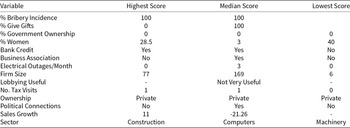
We provide some examples from the data in Table 2 to provide some idea of both the challenge of the measurement model as well as the nuance that the scores are able to capture. Table 2 shows survey response values for three firms in Kyrgyzstan: the firm with the lowest score, the firm with the median score, and the firm with the highest score. We choose Kyrgyzstan because it is a country in the middle of the influence distribution, as we show in Figure 4. We include items from our index and also other survey questions that give evidence of some of the possible downstream causes of political influence, such as access to bank credit, number of electrical outages, and firm performance (sales growth per year). The lowest-scoring firm is a very small company that did not answer many of the questions about political connections, bribery, or lobbying. More interesting are the median-scoring and high-scoring firms, especially because the median-scoring firm has some observable indicators of influence, notably political connections and business association membership, that the highest-scoring firm does not.
Survey values for high, low, and median-scoring firms in Kyrgyzstan

The table shows World Bank Enterprise Survey values for firms with the highest,
lowest, and median political influence scores in Kyrgyzstan.
A closer inspection, though, reveals that this median firm, though it has these observed attributes, has other factors that suggest that these observed connections do not equal total influence. In particular, the median-scoring firm has negative sales growth, rates its lobbying efforts as “Not Very Useful,” and reports at least three electrical outages per month. The highest-scoring firm, by contrast, reports strong sales growth, never has electrical outages, is in the construction sector (which is often rife with issues of political influence), and reports that it is never necessary to give gifts to public officials. This latter item is likely indicative of influence, as successful construction companies nearly always require some kind of influence to obtain permits for building. The fact that this company reports that gifts are never necessary, while the median-scoring firm reports that gifts are always necessary, is most interesting and is likely leading the model to impute a higher influence score for the top-scoring firm. Furthermore, the top-scoring company’s strong sales growth would suggest it is quite successful at completing new projects. For these reasons, even though the company lacks some observable indicators of influence, the posterior distribution suggests it does, in fact, have influence.
For these reasons, we emphasize that the discrimination parameters are marginal associations given the various combinations of political interactions (except for the pinned discrimination parameter of connections). Consider firm size, which has a negative loading as shown in Figure 1. This result does not mean that larger firms have lower influence. To see this, we only need to look at the distribution of influence by firm size, as in Figure 2. The figure clearly shows a positive relationship between firm size and the influence scores—an indication of Simpson’s paradox we explained previously. This recasts the discrimination parameters in a new light. Rather than show that smaller firms, on average, have greater influence, the parameter implies that, all else equal, a more influential firm need not be as large. This finding lends itself to those of Shleifer and Vishny Reference Shleifer and Vishny(1994) and Bertrand et al. Reference Bertrand, Kramarz, Schoar and Thesmar(2018), who each show that political interactions may lead to rent extraction in the form of excess hiring by firms (where jobs for constituents or political friends can be thought of as a means of securing favor). The findings from our model are consistent with this mechanism; however, they extend the analysis in an important way: greater influence can be thought of as a way of minimizing those rents that are extracted from the firm.
Distribution of predicted firm-level political influence by size

4.2. Distributional aspects of political influence
By producing a continuous influence score—over nationally representative samples—we are able to not only analyze the levels of how firms engage politically but also the distributional aspects of our generated index. Figure 3.a. shows a kernel density of the scores rescaled to lie between 0 and 100 for all 41 countries with 0 signifying very low influence and 100 very high influence. The vertical, dashed lines are the 10th, 25th, 50th, 75th, and 90th quantiles of the distribution, with the median bolded for reference. The median value of our influence scores is 28.3 (Table 3). The inter-quartile range is 13.7, but the range from the 10th percentile to the 90th is over 44 points, indicating a notable rightward skew in the distribution.
Distribution of political influence index (0–100)

Summary statistics across all firms

Each measure is indicative of the overall distribution across all countries, regardless of the firm’s location. All measures use sampling weights.
The distribution shown in panel a spans across all 41 countries in our data set, and so it can mask differences across countries. To give a sense of the average distribution of political influence within these countries, panel b centers political influence in all countries around their country-level median; that is, the panel shows the distribution of our index relative to the local country average. In both panels, our influence scores show that the modal firm is one with low to moderate influence, but, importantly, there is a notable rightward skew indicating that a small share of firms exerts notably high influence. This pattern holds both across all countries (panel a) and within countries (panel b).
Figure 4 shows the distribution of influence scores for each of the 41 countries in our data. The countries are sorted in order by their median score, which is represented by the vertical line in each distribution. This ordering gives one sense of the relative averages of scores across the data set—and to help illustrate the figure also shows the highest quartile (i.e., those countries with the highest median values) in the darkest (purple) shade, the middle two quartiles in a mid-color shade, and the lowest-scoring quartile in the lightest (yellow) shade. A quick look at the figure reveals that much of the differences in the distribution of influence scores occurs across countries. Still, we do observe substantial spread in influence within countries as well. Table 4 includes a handful of measures of distributional spread across the 41 countries. On average, the ratio of the 75th percentile to the 25th is 1.2; the ratio of the 90th to 10th percentile is 1.5. These values indicate a substantial difference between the most and least influence firms within countries. However, the more striking finding is that this spread is substantially smaller than that across all firms, regardless of where they are located. That is, the equivalent ratios from Table 3 are 1.6 for the 75th/25th and 3.0 for the 90th/10th (also represented by the spread between the lowest and highest dashed lines in 3.b).
Distributions of political influence scores by country

Mean summary statistics across all countries

Each measure is an average across all 41 countries; that is, they are simple averages of survey-weighted averages within each country.
As described in Section {2, we would expect certain distributional qualities in a well-measured index of influence. In the exercises below, specifically, we explore the idea introduced in Section 2 that political influence is likely to take different distributional forms given the relative costliness of political action. A clear way to express this idea is using measures of governance, which could enable (lower the cost) of more pluralistic political action with the aim of influence or restrict it (raise the cost). To do this, use several well-known measures of governance quality to estimate the movement of the influence scores vis-a-vis the underlying political environment. These include Transparency International’s Corruption Perceptions Index (CPI), which we reverse to 0 to indicate the lowest level of corruption and 100 as the highest, which we find more intuitive. The second measure is Henisz Reference Henisz(2002)’s political constraints score (POLCON), with higher values indicating more veto points in a political system, and thus more constraints on unitary action. Then, we take the six sub-indices from the World Governance Indicators (WGI), which include Voice & Accountability, Political Stability, Government Effectiveness, Regulatory Quality, Rule of Law, and Control of Corruption. For comparison with our index, we re-scale each of these sub-indices from 0 to 100, using the global minimums and maximums, where 100 indicates a higher level of governance quality. Lastly, we include a dummy measure we denote as “Power Shift” if there was a shift in executive power (excluding transitions where the same party retained power) in the last 5 years.Footnote 2
To investigate how the distribution of our influence score may shift under these conditions, we compare the distributions of influence scores across these various governance measures. We can, of course, use OLS to look at how the index varies by the average governance measure for each country. However, OLS will only give an estimate of the comovement of the mean of the influence scores with these governance measures. As we showed in Figure 3, the distribution of influence has a long right tail, and so we may want to estimate the relationship between governance and the influence scores at different quantiles of the distribution. To do this, we use a different tool, known as unconditional quantile regression (UQR). UQR allows for the estimation of the relationship between a right-hand-side variable, in our case, measures of governance quality, and the distributional aspects of the scores.
Since UQR and its interpretation may be unfamiliar to some readers, we provide a descriptive illustration of its aim here. Specifically, Figure 5 shows the distribution of our influence scores for two groups of countries in our data set. Those represented in green (solid lines) are economies that have values for the Voice & Accountability component from the Worldwide Governance Indicators that are equal or greater to the value for the 75th percentile; those represented in red (dashed lines) are below the 25th percentile. The figure also includes vertical lines showing both the 25th and 75th percentiles for both distributions. The movement between the different percentiles, in turn, gives an illustration of what UQR estimates. In this particular case, the figure shows a large and negative movement in the 75th percentile between the low Voice & Accountability countries and the highly-scored ones. Notably, as well, there is a negative movement in the 25th percentile, but the difference is much smaller. In other words, the large improvement in governance represented by moving from the lowest-quartile countries to the highest-quartile ones shifts the distribution of the influence scores downward. However, the associated difference is much larger in the reduction of the rightward tail (that is, the difference in the 75th percentiles is much larger than the difference in the 25th percentiles).
Political influence distributions at high and low levels of voice & accountability.

Firpo et al. Reference Firpo, Fortin and Lemieux(2009) provide a straightforward estimator for UQR using what is called a re-centered influence function (RIF). Rios-Avila and Maroto Reference Rios-Avila and Maroto2024 note that the RIF gives “...a first order approximation of the marginal effect of small location shift changes in the distribution of independent variables on any unconditional quantile,” and that this approximation is possible by using the RIF as a left-hand-side variable using OLS (denoted as RIF-OLS). The RIF is defined as:  $RIF(\Theta ; q_{\tau}, F_{\Theta} ) = q_{\tau} + \frac{\tau - {\mathbb{1}}\{\Theta_{i} \leq q_{\tau}\}}{f_{\Theta}(q_{\tau})}$, where qτ is the value of the index, Θ, at quantile τ and $f_{\Theta}(q_{\tau})$ is the density of Θ at that given quantile. The function $\mathbb{1}\{\Theta_i\leq q_\tau\}$ takes a value of 1 if the value of the index is less than the cutoff given by qτ, and 0 otherwise. Our two main estimations between governance quality and the influence scores are, in turn, given by:
 \begin{eqnarray}
\Theta_i &=& \beta^{OLS}_{0} + \beta^{OLS}_{1}GOVERNANCE_c + \varepsilon^{OLS}_i
\end{eqnarray}
\begin{eqnarray}
\Theta_i &=& \beta^{OLS}_{0} + \beta^{OLS}_{1}GOVERNANCE_c + \varepsilon^{OLS}_i
\end{eqnarray} \begin{eqnarray}
RIF_i(\Theta ; q_{\tau}, F_{\Theta} ) &=& \beta^{RIF}_{0,\tau} + \beta^{RIF}_{1, \tau}GOVERNANCE_c + \varepsilon^{RIF}_i
\end{eqnarray}
\begin{eqnarray}
RIF_i(\Theta ; q_{\tau}, F_{\Theta} ) &=& \beta^{RIF}_{0,\tau} + \beta^{RIF}_{1, \tau}GOVERNANCE_c + \varepsilon^{RIF}_i
\end{eqnarray} where β 1 is the coefficient of interest.  $\beta^{OLS}_{1}$ is straightforward; $\beta^{RIF}_{1,\tau}$ gives the marginal movement of a small change in GOVERNANCE on the quantile τ. The intuition behind UQR/RIF-OLS is worth repeating: a negative coefficient on β RIF implies that as GOVERNANCE increases, there is a downward shift in the distribution of the influence scores at a given quantile (τ). The thing that will be of most interest to many—previewing our results—is the relative size of these coefficients. For example, a larger magnitude of coefficients at higher quantiles of the distribution (e.g., $| \beta^{RIF}_{\tau=75} | \gt | \beta^{RIF}_{\tau=25} |)$, as illustrated in Figure 5), implies that changes in governance have a more dramatic relationship with the long rightward tail of the scores, compared to movements at the leftward parts of the distribution.
Figure 6 graphically shows the results for a number of estimations following Eq. 5 and Eq. 6. All estimations use survey weights and use robust standard errors, adjusted for clustering at the level of stratum, to reflect the representative survey design (Abadie et al., Reference Abadie, Athey, Imbens and Wooldridge2017). The horizontal dashed lines (in grey) show the point estimate and 95% confidence intervals from the OLS estimates ( $\beta_1^{OLS}$). The darker (blue) shaded area in each panel shows the point estimates and 95% confidence intervals from the RIF-OLS estimates, at the 10th, 25th, 50th, 75th, and 90th quantiles ( $\beta_{1,\tau=10,25,50,75,90}^{RIF}$).
β OLS and β RIF at quantiles of the political influence score

Recall that the interpretation of the β RIF is the marginal change in the distributional statistic of our index of a 1-point increase in a measure of governance. To interpret these findings, it is helpful to return to the example of the Voice & Accountability sub-index from WGI. The mean score of Voice & Accountability is 50, and the sub-index has a standard deviation of nearly 18 across the 41 countries. Each point in Figure 6 represents the coefficient  $\beta_1^{RIF}$ from a different run of the RIF-OLS, at different quantiles of the distribution of Political Influence (i.e., $\tau=10, 25,50,75,90$), and so a fairly large increase in Voice & Accountability of +1 S.D. will result in the associated relationship of $\beta_{1,\tau}^{RIF} * 1 SD$. The results then imply that a 1 S.D. increase in Voice and Accountability is associated with small (but statistically significant) reductions in the 10th and 25th quantiles of the influence scores, by 0.6 and 0.8, respectively. This 1 S.D. increase is also associated with a movement in the median of -1.6 points on the index. These small magnitudes make the movements of the 75th and 90th percentiles even more notable: increasing governance quality (+1 S.D. in Voice and Accountability) moves the 75th quantile down by 9 points and the 90th by over 19 (noting that this finding reiterates the illustrative example in Figure 5). Using this example to take a broader view of all the results shown in Figure 6, then, shows that as governance measures generally improve, the distribution of the scores shifts downward, with the most dramatic movements in the distribution occurring by reductions in the right-skewed tail of the distribution.
The results shown in Figure 6 show how the distribution of our influence scores overall moves with different measures of governance quality, regardless of the country in which a firm is located. But, of course, firms exert influence relative to their immediate competitors. To look at how the distribution of the scores changes within countries as governance changes, we modify our RIF-OLS estimations. We specifically want to see how a firm’s relative influence moves when compared to the average level of influence in a country. To do this, in Table 5, we represent RIF-OLS estimates, but now, the left-hand-side outcome, RIFi, is expressed relative to the median level of the influence scores in a country.
RIF-OLS, political influence relative to the country median

* p < 0.10 ; ** p < 0.05 ; *** p < 0.01 To conserve space, R 2 has been omitted as have constants. Robust S.E.s are clustered at the level of survey stratum, within which firms were randomly selected (Abadie et al., Reference Abadie, Athey, Imbens and Wooldridge2017). All estimates are survey-weighted, with weights rescaled so that each country is equally considered, with weights in each summing to 1 by country.
This residual value is then treated as the left-hand-side variable in Eq. 6. Each specification again uses survey weights, only now these are rescaled in order to give each country a total weight of 1 in the pooled estimation. The estimated coefficients 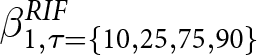 $\beta^{RIF}_{1, \tau = \{10, 25, 75,90\}}$ give the relationship between the governance measures of interest and the distance between the given quantile and the median level of political influence, on average, within a country. We also include a column labeled Movement, which shows the implied direction of the coefficients as each measure increases: $\longleftrightarrow$ indicates greater dispersion, $\rightarrow \leftarrow$ decreased dispersion, $\longleftarrow$ a shift lower (leftward), and $\longrightarrow$ an upward (rightward) shift in the index.
The results shown in Table 5 add a dimension to those shown earlier in this section: specifically, as various measures of governance improve, the RIF-OLS coefficients imply that lower quantiles move further away from the local median, and simultaneously the upper tail (above the 90th quantile) distances itself from that same median. That is, at levels of improved governance, the dispersion of the influence scores increases (Movement  $\longleftrightarrow$). This point is made more boldly by its contrast with the coefficients on Transparency International’s corruption perceptions measure. As corruption increases, dispersion in the scores decreases (Movement $\rightarrow \leftarrow$). Lastly, two measures on the structure of the political environment illustrate the relationship between structural components and the influence scores. In countries with a greater number of political constraints, relative influence shifts downward (Movement $\leftarrow$); the same is the case for countries that have experienced a recent shift in political power. The fact that we observe lower overall levels of influence in environments with more political constraints or ones that have recently had a transition in power suggests that influence may wane when firms have to navigate a more complex political environment.
The end result is that poorer governance has a compressing effect, while improved governance widens a country’s relative distribution of influence scores. This may seem counterintuitive, as often political advantage is framed as influence doled out to a select few firms or interests. However, in the framing that we laid out at the beginning of the paper, these relationships can be squarely understood. If, as governance improves, one would expect openness and the balancing of interests (including the public writ large), so too would one anticipate higher entry and transaction costs to exert political influence. To generalize, the conceptual framework laid out at the beginning of the paper seems to undergird a finding in the data itself: open, transparent, and pluralistic governance renders political influence more expensive, resulting in fewer firms exerting such influence, and a broader distance between the most and least influential.
4.3. Political influence and firm-level outcomes
In Appendix B.4, we estimate additional models examining how political connections are associated with important firm-level attributes. We report results from four regressions of different dependent variables, including whether a company’s market has fewer than 20 competitors, total sales, sales per worker, and the ratio of labor costs to total revenues. Sales per worker and labor costs to total revenues are both ways of measuring productivity. While there is a clear risk of endogeneity in a cross-sectional panel, the results do comport with what is theorized about political influence, namely that more influential firms have fewer competitors and have greater revenues while paying less in labor costs. Furthermore, when we contrast these results with using only a binary indicator for political connections, our measure of political influence is much more strongly associated with these outcomes, which again suggests that it is tapping into theoretically relevant constructs that matter to a company’s bottom line.
5. Conclusion
Importantly, our approach allows us to calibrate a measure of influence and to estimate its distribution across representative samples of companies. We believe this gives us the novel chance to see how political influence moves with underlying governance measures. Our findings generally support the expectations from a framework that recognizes the cost associated with political interactions. Our findings confirm what to many may be intuitive: for example, that influence may be higher across the board in countries with poorer governance, as firms may find that such influence is both necessary and available. But we also uncover what we believe to be informative patterns that are new to the literature, including, for instance, that the spread of influence within a country increases at higher levels of governance, a finding we explain by the higher cost of entry of gaining influence in environments where firms must reasonably compete with other interests, including the public’s.
Supplementary material
The supplementary material for this article can be found at https://doi.org/10.1017/psrm.2025.10046. To obtain replication material for this article, https://doi.org/10.7910/DVN/EVVOGS.
Competing interests
The authors have no competing interests to declare.
Funding declaration
The authors have no funding to declare for this paper.
Data availability statement
Data for this project is available via the World Bank Enterprise Survey data portal. For more details, see the Dataverse repository for the paper at https://dataverse.harvard.edu/dataset.xhtml?persistentId=doi:10.7910/DVN/EVVOGS.
Acknowledgements
The authors would like to thank Ana Paula Cusolito, Asif Islam, Nona Karalashvili, Aart Kraay, Roberta Gatti, Norman Loayza, Jorge Rodriguez Meza, as well as participants in the World Bank DECIG Half-baked Seminar series, two joint World Bank/EBRD/EIB workshops, the 26th annual SIOE conference, and the 2022 Copenhagen Business School Money and Politics conference for helpful and insightful comments. The authors acknowledge funding from the World Bank.




 Open access

