2 - Constitutional Language
Published online by Cambridge University Press: 08 December 2009

Summary
Before a constitution can have effect, its words must be given meaning. Before the words can have meaning, they must be chosen by the constitution's framers. In making choices in the drafting of legal instruments, every word requires thought and precision. However, whereas subconstitutional instruments (e.g., statutes and regulations) can be amended relatively easily if they prove in practice to have been poorly drafted, a constitution is usually difficult to change, and its amendment is intended to be rare. One cannot overestimate the significance of the choice of words in its drafting.
Constitution making typically starts with a commitment to broad principles and sometimes general aspirations. These may be expressed in prior resolutions or motions moved at the start of the formal process; thus, the American framers, meeting at the Philadelphia Convention in 1787, adopted the so-called “Virginia Plan” in which fifteen resolutions set out a rough sketch of constitutional government. Australia's framers voted on several resolutions at the opening of both the first Federal Convention in 1891, and the second in 1897. At the latter, they began with a commitment to writing a constitution “in order to enlarge the powers of self-government of the people of Australia.” In South Africa, thirty-four principles were set down by a multiparty negotiating process in 1993, prior to the election of the National Assembly, which formed the drafting committee for South Africa's post-apartheid Constitution.
Information
- Type
- Chapter
- Information
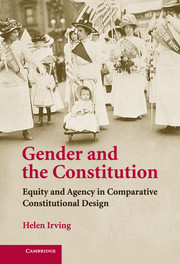
- Gender and the ConstitutionEquity and Agency in Comparative Constitutional Design, pp. 38 - 64Publisher: Cambridge University PressPrint publication year: 2008
Accessibility standard: Unknown
Why this information is here
This section outlines the accessibility features of this content - including support for screen readers, full keyboard navigation and high-contrast display options. This may not be relevant for you.Accessibility Information
Accessibility compliance for the PDF of this chapter is currently unknown
and may be updated in the future.