Book contents
- Frontmatter
- Contents
- List of contributors
- Acknowledgments
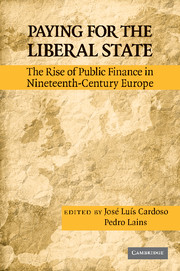
- Paying for the Liberal State
- Introduction: Paying for the Liberal State
- 1 Creating Legitimacy: Administering Taxation in Britain, 1815–1914
- 2 The Development of Public Finance in the Netherlands, 1815–1914
- 3 The Apogee and Fall of the French Rentier Regime, 1801–1914
- 4 The Evolution of Public Finances in Nineteenth-Century Germany
- 5 Public Finance in Austria-Hungary, 1820–1913
- 6 The Rise of the Fiscal State in Sweden, 1800–1914
- 7 Always on the Brink: Piedmont and Italy
- 8 Public Finance and the Rise of the Liberal State in Spain, 1808–1914
- 9 Public Finance in Portugal, 1796–1910
- 10 Conclusion: The Monetary, Fiscal, and Political Architecture of Europe, 1815–1914
- Index
- References
5 - Public Finance in Austria-Hungary, 1820–1913
Published online by Cambridge University Press: 05 June 2012

Book contents
- Frontmatter
- Contents
- List of contributors
- Acknowledgments
- Paying for the Liberal State
- Introduction: Paying for the Liberal State
- 1 Creating Legitimacy: Administering Taxation in Britain, 1815–1914
- 2 The Development of Public Finance in the Netherlands, 1815–1914
- 3 The Apogee and Fall of the French Rentier Regime, 1801–1914
- 4 The Evolution of Public Finances in Nineteenth-Century Germany
- 5 Public Finance in Austria-Hungary, 1820–1913
- 6 The Rise of the Fiscal State in Sweden, 1800–1914
- 7 Always on the Brink: Piedmont and Italy
- 8 Public Finance and the Rise of the Liberal State in Spain, 1808–1914
- 9 Public Finance in Portugal, 1796–1910
- 10 Conclusion: The Monetary, Fiscal, and Political Architecture of Europe, 1815–1914
- Index
- References
Summary
Introduction
Austria-Hungary, which included the complete territories of today's Austria, Hungary, the Czech Republic, Slovakia, Slovenia, Croatia, Bosnia and Herzegovina (from 1878 to 1908 onward), and parts of Poland, Ukraine, Romania, and Italy, was a monarchical union of otherwise separate lands at the beginning of the nineteenth century, and it was a dual monarchy consisting of two constitutional countries (in short, Austria and Hungary) and a common land (Bosnia and Herzegovina) at the eve of the First World War. In 1910, Austria had about 29 million inhabitants; Hungary, 21 million; and Bosnia and Herzegovina, 2 million. Up to 1867, the then so-called Austrian Empire (Kaisertum Österreich) passed through a process of centralization and unification opposed by regional forces that worked toward autonomy or independence, notably in the Italian provinces and Hungary, and led to fundamental changes in territory and constitution in the 1860s. Throughout the period, conflicts between the dominating ethnicities (Germans and Hungarians) and other nationalities remained a disintegrating force, which eventually led to the end of Austria-Hungary.
The territorial and constitutional changes of the 1860s were most important for the fiscal history of Austria. In 1860 and 1866, respectively, following the Italian war of 1859 and the Austro-Prussian war of 1866, Austria lost its Italian provinces of Lombardy and Veneto, which together had formed the Lombardo-Venetian Kingdom.
Information
- Type
- Chapter
- Information
- Paying for the Liberal StateThe Rise of Public Finance in Nineteenth-Century Europe, pp. 132 - 161Publisher: Cambridge University PressPrint publication year: 2010
References
A magyar korona országainak állami zárszámadása, 1868–1913, Budapest 1869–1914.
Ausweis über den Stand der allgemeinen Staatsschuld, verfasst von der Staatsschulden-Commission des Reichsrathes, 1879–86, Beilagen zum amtlichen Theile der “Wiener Zeitung,” Wien 1879–87.
Ausweis über den Stand der gesammten consolidirten Staatsschuld, dann der nicht gemeinsamen schwebenden Schuld und der Grundentlastungs-, endlich der consolidirten garantierten Landesschulden von den im österreichischen Reichsrathe vertretenen Königreichen und Ländern, verfasst von der Staatsschulden-Commission des Reichsrathes, 1868–78, Beilagen zum amtlichen Theile der “Wiener Zeitung,” Wien 1868–79.
Ausweis über den Stand der gesammten österreichischen Staatsschuld, verfasst von der Staatsschulden-Commission des Reichsrathes, 1860–7, Beilagen zum amtlichen Theile der “Wiener Zeitung,” Wien 1860–7.
Ausweis über den Stand der gemeinsamen schwebenden Staatsschuld, verfasst von der Staatsschulden-Commission des Reichsrathes, 1868–86, Beilagen zum amtlichen Theile der “Wiener Zeitung,” Wien 1868–87.
Ausweis über den Stand der Schulden von den im Reichsrathe vertretenen Königreichen und Ländern, verfasst von der Staatsschulden-Commission des Reichsrathes, 1879–86, Beilagen zum amtlichen Theile der “Wiener Zeitung,” Wien 1879–87.
Central-Rechnungs-Abschluß über den Staats-Haushalt der im Reichsrathe vertretenen Königreiche und Länder, 1868–1913, vom k. k. Obersten Rechnungshofe für die im Reichsrathe vertretenen Königreiche und Länder, 1869–1914.
Compass. Finanzielles Jahrbuch für Oesterreich-Ungarn, Wien 1868–1918.
Ergebnisse der Volkszählung und der mit derselben verbundenen Zählung der häuslichen Nutzthiere vom 31. December 1880, vols. 3–4 (Oesterreichische Statistik, vols. 1.3, 2.1), k. k. Direction der administrativen Statistik, Wien 1882.
Die Ergebnisse der Volkszählung vom 31. December 1890 in den im Reichsrathe vertretenen Königreichen und Ländern, vols. 32/3, 33.2–5, 7 (Österreichische Statistik vols. 32.3, 33.2–5,7), Bureau der k. k. Statistischen Central-Commission, Wien 1892–4.
Die Ergebnisse der Volkszählung vom 31. Dezember 1900 in den im Reichsrate vertretenen Königreichen und Ländern, vols. 63/3, 66.2–5, 7 (Österreichische Statistik vols. 63.3, 66.2–5, 7), Bureau der k. k. Statistischen Zentral-Kommission, Wien 1903.
Die Ergebnisse der Volkszählung vom 31. Dezember 1910 in den im Reichsrate vertretenen Königreichen und Ländern, vols. 1/3, 3/2–5/7 (Österrreichische Statistik, vols. N.F. 1.3, 3.2–5,7), bearb. von dem Bureau der k. k. Statistischen Zentralkommission, Wien 1914–15.
Nachweisung über den Stand der Staatsschulden, verfasst von der Staatsschulden-Commission des Reichsrathes, 1887–1903, Beilagen zum amtlichen Theile der “Wiener Zeitung,” Wien 1887–1903.
Nachweisung der Staatsschulden-Kontroll-Kommission des Reichsrates über den Stand der Staatsschulden, 1903–17, Beilagen zum amtlichen Theile der “Wiener Zeitung,” Wien 1904–18.
Rechnungs-Abschluß (Haupt-Rechnungs-Abschluß, Central-Rechnungs-Abschluß) über den gesammten Staatshaushalt der österreichischen Monarchie, 1848–54, 1856–9, Bundesministerium für Finanzen, Bibliothek, XV 777.
Schluß-Rechnung über den allen Königreichen und Ländern der österreichisch-ungarischen Monarchie gemeinsamen Staatshaushalt, vom k. u. k. gemeinsamen Obersten Rechnungshofe, Wien 1868–1913.
Staats-Voranschlag für die am constituirenden Reichstage vertretenen Länder der österreichischen Monarchie für das Verwaltungsjahr 1849, Wien 1848.
[Tafeln zur Statistik der österreichischen Monarchie]: Versuch einer Darstellung der Oesterreichischen Monarchie in statistischen Tafeln (1828), Wien 1829. Darstellung der Oesterreichischen Monarchie in Statistischen Tafeln, 2. Jg, (1829), Wien 1830. Tafeln zur Statistik der österreichischen Monarchie, Jg. 3–21 (1830–1848), Wien 1831–53, Neue Folge 1–5 (1849–65), Wien 1856–71.
Voranschlag des Staatserfordernisses und der Bedeckung, Militärjahre/Verwaltungsjahre 1821–48, Bundesministerium für Finanzen, Bibliothek, XV 777.
(2005) “Das Verkehrswesen,” in (ed.) Die Habsburgermonarchie 1848–1918. Bd. 1: Die wirtschaftliche Entwicklung, 2nd ed. Vienna: Österreichische Akademie der Wissenschaften, 278–322.Google Scholar
(1976) “Europe's gross national product 1800–1975,” Journal of European Economic History, 5, 273–340.Google Scholar
(1993) “Die Finanzierung des Eisenbahnsystems in der Donaumonarchie,” in , , and (eds.) Eisenbahnbau und Kapitalinteressen in den Beziehungen der österreichischen mit den südslawischen Ländern. Wien: Österreichische Akademie der Wissenschaften, 221–231.Google Scholar
(1877) Die Finanzen Oesterreichs im XIX. Jahrhundert. Nach archivalischen Quellen, Prag: Tempsky.Google Scholar
(2007) Die Steuertheorien der Austrian Economics. Von Menger zu Mises. Marburg: Metropolis Verlag.Google Scholar
(1978) Der österreichische Neoabsolutismus. Staatsfinanzen und Politik 1848–1860, 2 vols. Göttingen: Vandenhoek Ruprecht.Google Scholar
(1993) “Staatskredit und Eisenbahnwesen in den österreichischen Ländern im Verlauf des 19. Jahrhunderts,” in , , and (eds.) Eisenbahnbau und Kapitalinteressen in den Beziehungen der österreichischen mit den südslawischen Ländern. Wien: Österreichische Akademie der Wissenschaften, 191–219.Google Scholar
(1989) “Economic policy and economic development in Austria-Hungary, 1867–1913,” in (ed.) The Cambridge Economic History of Europe, vol. 8. Cambridge: Cambridge University Press, 814–86.Google Scholar
(1978) “The Great Depression and Austrian growth after 1873,” Economic History Review, 2nd ser., 31, 290–4.CrossRefGoogle Scholar
(1980) “Modern economic growth in the Habsburg monarchy,” East Central Europe, 7, 248–68.CrossRefGoogle Scholar
(1984) The Economic Rise of the Habsburg Empire, 1750–1914. Berkeley: University of California Press.Google Scholar
(1991) “Austria-Hungary,” in and (eds.) (1991) Patterns of European Industrialization: The Nineteenth Century. London: Routledge, 218–47.Google Scholar
(1994) “The economic lag of Central and Eastern Europe: Income estimates for the Habsburg successor states, 1870–1910,” Journal of Economic History, 54, 869–91.CrossRefGoogle Scholar
(1997) “Proxy data and income estimates: Reply to Pammer,” Journal of Economic History, 57, 456–63.CrossRefGoogle Scholar
and (1998) “New estimates of income levels in Central and Eastern Europe, 1870–1910,” in , , and (eds.) Von der Theorie zur Wirtschaftspolitik – ein österreichischer Weg. Festschrift zum 65. Geburtstag von Erich W. Streissler. Stuttgart: Lucius und Lucius, 147–68.Google Scholar
and (1999). “The economic growth of Central and Eastern Europe in comparative perspective, 1870–1989,” European Review of Economic History, 3, 103–37.CrossRefGoogle Scholar
(1949) “Die österreichische Finanzpolitik von 1848 bis 1948,” in (ed.) Hundert Jahre österreichischer Wirtschaftsentwicklung 1848–1948. Vienna: Springer, 222–309.CrossRefGoogle Scholar
(1966) “Industrialization in Austria in the nineteenth century,” Ph.D. dissertation, University of California, Berkeley.
(1971) “Economic growth and the consumption of coal in Austria and Hungary 1831–1913,” Journal of Economic History, 31, 898–916.CrossRefGoogle Scholar
(1849) Oesterreichs Finanzlage und seine Hilfsquellen. Vienna: Jasper, Hügel und Manz.Google Scholar
(1970) “Economic growth in Hungary during the age of dualism (1867–1913): A quantitative analysis,” in (ed.) Sozial-ökonomische Forschungen zur Geschichte von Ost-Mitteleuropa. Budapest: Akadémiai Kiadó.Google Scholar
(1979) “Österreichs Volkseinkommen 1830 bis 1913. Versuch einer Rückrechnung des realen Brutto-Inlandsproduktes für die österreichische Reichshälfte und das Gebiet der Republik Österreich,” Geschichte und Ergebnisse der zentralen amtlichen Statistik in Österreich 1829–1979. Vienna: Österreichische Staatsdruckerei, 689–720.Google Scholar
(1978) “Is the Depression in Austria after 1873 a ‘myth’?” Economic History Review, 2nd ser., 31, 287–9.CrossRefGoogle Scholar
(ed.) (1983a) Economic Development in the Habsburg Monarchy in the Nineteenth Century: Essays. Boulder, CO: East European Monographs.
(ed.) (1983b) The Habsburg Monarchy as a Customs Union: Economic Development in Austria-Hungary in the Nineteenth Century. Princeton, NJ: Princeton University Press.CrossRef
(1893) Staatsschuldentilgung und Staatsbankerott. Mit besonderer Berücksichtigung der fundirten Staatsschuld. Vienna: Manz.Google Scholar
(1993) Staatskredit und Defizitfinanzierung in der ersten konstitutionellen Periode der Habsburger Monarchie 1860–1867. Frankfurt: Peter Lang.Google Scholar
(1972) Österreichs Wirtschaft 1848–1913. Konjunkturelle Dynamik und gesellschaftlicher Wandel im Zeitalter Franz Josephs I. Berlin: Duncker und Humblot.Google Scholar
(1875) Les finances de l'Autriche. Étude historique et statistique sur les finances de l'Autriche-Cisleithanienne comparées avec celles de la France. Vienna: Braumüller.Google Scholar
(1997) “Proxy data and income estimates: The economic lag of Central and Eastern Europe,” Journal of Economic History, 57, 448–55.CrossRefGoogle Scholar
(1998) “Austrian private investments in Hungary, 1850–1913,” European Review of Economic History, 2, 141–69.CrossRefGoogle Scholar
(2002) Entwicklung und Ungleichheit. Österreich im 19. Jahrhundert. Stuttgart: Franz Steiner Verlag.Google Scholar
(1975) “The pattern of Austrian industrial growth from the eighteenth to the early twentieth century,” Austrian History Yearbook, 11, 3–25.CrossRefGoogle Scholar
(1976) Banking and Industrialization in Austria-Hungary: The Role of Banks in the Industrialization of the Czech Crownlands, 1873–1914. Cambridge: Cambridge University Press.CrossRefGoogle Scholar
(1978) Österreichische Agrarstatistik 1750–1918. Vienna: Verlag fur Geschichte und Politik.Google Scholar
(1995) Ökonomie und Politik. Österreichische Wirtschaftsgeschichte vom Mittelalter bis zur Gegenwart. Vienna: Ueberreuter.Google Scholar
(1996) Engineering and Economic Growth: The Development of Austria-Hungary's Machine-Building Industry in the Late Nineteenth Century. Frankfurt: Peter Lang.Google Scholar
(1997) “The machine-building industry and Austria's Great Depression after 1873,” Economic History Review, 50, 282–304.CrossRefGoogle Scholar
(2000) “Patterns of growth and stagnation in the late nineteenth century Habsburg economy,” European Review of Economic History, 4, 311–40.CrossRefGoogle Scholar
(1975) Infrastruktur und wachsende Staatsausgaben. Das Fallbeispiel Österreich 1868–1913. Stuttgart: G. Fischer.Google Scholar
(1993) “Die österreichisch/ungarische Krone im Goldwährungsmechanismus,” in (ed.) Geld und Währung vom 16. Jahrhundert bis zur Gegenwart. Referate der 14. Arbeitstagung der Gesellschaft für Sozial- und Wirtschaftsgeschichte vom 9. bis 13. April 1991 in Dortmund. Stuttgart: Franz Steiner Verlag, 143–56.Google Scholar
Accessibility standard: Unknown
Why this information is here
This section outlines the accessibility features of this content - including support for screen readers, full keyboard navigation and high-contrast display options. This may not be relevant for you.Accessibility Information
Accessibility compliance for the PDF of this chapter is currently unknown
and may be updated in the future.
- 7
- Cited by