




The influx of European weapons is an oft remarked upon topic in the historiography of Early Modern Southeast Asia, with the most influential monographs on the period seeing it as one of the most important sources of political change (Lieberman Reference Lieberman2003; Reid Reference Reid1982, Reference Reid1988).Footnote 1 Though firearms are prominent in wide-sweeping, theory heavy works on Southeast Asia, there remains a scarcity of in-depth, empirical studies of their actual use in warfare. Empirical studies on firearms trade are even more scarce. This historiographical gap is most easily explained by a lack of appropriate sources, with realistic descriptions of warfare being very rare in Southeast Asian sources (Eoseewong Reference Eoseewong, Baker and Anderson2005). European sources are often unable to report on conflicts that did not involve them. The study of the arms trade is likewise hampered by the fragmentary nature of the sources, which are most often published travelogues or memoirs of Europeans who witnessed weapons trading or even the mere presence of foreign weapons in a place they visited (Charney Reference Charney2004, Chapter 3; Lorge Reference Lorge2008, Chapter 4).
By combining the archive of the Dutch East India Company (VOC) with published sources and literature on Siam, this article charts the Dutch-Siamese weapons trade through the rule of three kings of Ayutthaya: Narai (r. 1658–1688), Phetracha (r. 1688–1703), and Süa (r. 1703–1709). The most important source for this study is the diplomatic letters exchanged between the governor-general of the VOC and the court of Ayutthaya.Footnote 2 The serial nature of these archival sources allows a detailed study of the issue in a single location, complementing the wide-ranging and often highly descriptive information travellers of the region have left us. From this evidence I propose that the trade in muskets, which had been languishing during the long reign of king Narai (r. 1656–1688), was revived by a need to suppress popular revolts against Phetracha, who had usurped Narai’s throne.Footnote 3
This article starts by considering the importance that has been ascribed to European trade, especially in weapons, in Southeast Asia. Then it describes in how relying on imported weapons could aid in gun control measures. After explaining how weapons were traded through diplomatic gift giving, a chronological narrative charts political changes in Siam through the rule of the three kings and how this influenced their approach to arms imports from the VOC, as well as the uses of these weapons. The article ends by concluding that Siamese weapons imports were very responsive to domestic needs, which questions whether the arms trade in Southeast Asia was as large as commonly assumed.
The impact of European (Weapons) trading in Southeast Asia
The region-wide impact of firearms was first postulated by Anthony Reid, in his seminal Age of Commerce, although their impact in many areas had already been described (Lieberman Reference Lieberman1980; Reid Reference Reid1993, 219–233; Sudjoko 1981). He deemed the introduction of firearms, and of foreign mercenaries using them, the two most important military changes in Early Modern Southeast Asia. The impact of these weapons on society “transformed Southeast Asia rapidly, giving rise to states of unprecedented power. It transformed Europe even more rapidly, however, with results which would ultimately be fateful for Southeast Asia as for the rest of the world” (Reid Reference Reid1988, 128–129). The transformation Reid hinted at seems to have been a newfound military superiority of kings over their subjects because only they possessed foreign firearms and mercenaries, while more traditional weapons were in the hands of the whole population. This led to increased royal power and centralisation somewhat reminiscent of the “Military Revolution,” however, without all the important knock on effects which Geoffrey Parker has postulated in the European case (Parker Reference Parker1996).
Victor Lieberman had espoused the importance of imported firearms in Burmese history since the 80s (Lieberman Reference Lieberman1980). In his magnum opus, Strange Parallels, Lieberman saw imported weapons as one of the most important consequences of the growing foreign trade of the mainland Southeast Asian states. He nuanced Reid’s ideas about the impact of firearms by problematising the unequal access to firearms. Not only were the ports of the coastal states the places through which the weapons entered Southeast Asia, they also generated the revenue needed to buy them and to maintain a large army. The poorer landlocked states had more difficulty to raise the funds for the weapons and could also be cut off from their supply by the coastal states. Therefore, the coastal states benefited the most from this trade and dominated their neighbours (Lieberman Reference Lieberman2003, 48). Unlike Reid, Lieberman argued that the primary significance of firearms lay in interstate warfare, rather than in strengthening rulers’ control over their subjects. Some military historians put less emphasis on the impact on firearms, such as Peter Lorge who follows Michael Charney’s idea that “Firearms entered Southeast Asia […] and were integrated into an already mature local system of warfare” without bringing radical change (Lorge Reference Lorge2008, 99–100).
The impact that imported firearms could have on Southeast Asian warfare depended partially on the size of the arms imports. While Lorge contends that the literature on the arms trade is still too thin for firm conclusions, he has claimed that the whole of Asia became part of “the European arms trading system” with Southeast Asians in particular becoming dependent on European weapons (Lorge Reference Lorge2008, 17, 90–92). Literature on specific cases of the use of European weapons in Southeast Asia have focused mostly on the impact Portuguese mercenaries and firearms had towards the end of the sixteenth century. It has been argued that the use of firearms not only enabled the rapid expansion of the Burmese Empire during the sixteenth century, but also the following expulsion of the Burmese from Siam, also supported by Portuguese mercenaries (Lieberman Reference Lieberman1980; Trakulhun Reference Trakulhun and Volker2011). The focus of the literature on the period following the introduction of Portuguese firearms may be reflective of a real trend, in which the impact of these firearms was strongest shortly after their introduction when they interrupted existing patterns of warfare. As Southeast Asian warfare became accustomed to firearms their importance seems to have diminished. At the same time, there was less interstate warfare during the period of this article, which may have further undermined the importance of these weapons.
Like the Portuguese, the VOC acted as arms supplier when it first appeared in Southeast Asia and had close military cooperation with Ayutthaya ending in 1650, when the Dutch helped set up a foundry in Ayutthaya (Verbeek Reference Verbeek2022, 230–232). Nearby Tonkin (Northern Vietnam) on the other hand continued to receive cannon from the VOC until 1680 (Tuan Reference Tuan2007, Part Two; Verbeek Reference Verbeek2022, 223–227). In his efforts to reform the Siamese state after the destruction of Ayutthaya in 1767, King Taksin also turned to the VOC to buy muskets (Blussé Reference Blussé, Davids, Fritschy and Van der Valk1996).
With some interruptions, the VOC was active in Siam from 1613 until 1765, when the impending Burmese conquest convinced the company to abandon its trading post. The company was in to buy export goods for Japan and China, as well as rice and wood for the company’s Asian headquarter at Batavia (Jakarta). Siam was therefore especially important for the VOC during the seventeenth century when its presence on Java was still insecure and when its trade with Japan was at its height (Smith Reference Smith1977).
Contact between the company and the Siamese state was regulated through the Phraklang ministry, which was responsible for both foreign affairs and royal trade. The minister, likewise called Phraklang by the Dutch, was responsible for most Siamese diplomatic exchanges. This consisted primarily in the yearly exchange of diplomatic letters between the governor-general of the VOC and the king and the Phraklang (Dhiravat Reference Dhiravat, Blussé and Gaastra1998). The letters were mainly concerned with the diplomatic and trade relations between the VOC and Ayutthaya and were always accompanied by gifts.
These gifts were a necessity to allow the Dutch presence in Ayutthaya (Bhawan Reference Bhawan2007, 30). Beyond their ritual importance, however, gifting also functioned as a form of trade. The Phraklang usually provided the VOC with a list of gifts which the king desired. In return, the king and Phraklang provided counter gifts consisting of the trade goods which the VOC was buying in Siam. Initially, Siamese gifts were mainly elephants, but in later times tin and sappanwood dominated. The wishes of the king on the other hand were much more varied and changed from year to year. Next to the main post of Indian cloth, they included all sorts of luxuries and curiosities such as European mirrors and glasses, Japanese lacquerware, exotic birds from Southeast Asia, and at times weaponry. The value of the gifts from both sides was supposed to balance out, with a tendency for the king’s gifts to be more valuable than those of the VOC, show his wealth and magnanimity. As the value of the Dutch gifts was determined by the Phraklang, while fixed prices existed for the trade goods which the VOC received, the Siamese had the power to decide how much they were willing to give for the gifts. This sometimes led to disagreements, with the VOC feeling that its gifts were undervalued, so that the king’s generosity only existed on paper.Footnote 4
At times, Dutch weapons also played an important role in the royal gifts. This was the only mechanism through which this arms trade happened, as I have not found evidence for the VOC selling weapons to the Siamese as part of regular trade. This was desirable for the Siamese court, as limiting arms trading to the realm of diplomacy aided its gun control policies, by preventing sales to persons other than the king, who possessed a monopoly on the trade in weapons (Reid Reference Reid1993, 248).
Gun Control in Siam
Throughout the Early Modern world, the proliferation of firearms created new problems, which states tried to solve in various ways. These solutions came with their own drawbacks. The main tension was that between wanting to maintain a strong military and military industry for external defence and limiting the spread of firearms to prevent their use for criminal and seditious purposes. In sixteenth-century Venice and seventeenth-century Denmark, the state eventually decided on a loose gun control policy, encouraging private gun ownership in order to bolster the size of citizen militias (Fletcher Reference Fletcher2023, 14–16; Lind Reference Lind2021, 498–499). The private ownership of guns not only allowed burghers (and in some cases peasants) to train with their weapons in peacetime, it could also shift the cost of armament from the state to the population.Footnote 5 At the same time, both states acknowledged that private gun ownership allowed poaching, threatened the social status of the nobility as the only class which could openly carry weapons, and aided murder and banditry. These evils were accepted to guarantee national defence. In Tokugawa Japan (1603–1876), gun ownership was more strictly regulated but nonetheless permitted. The goal here was not military service, but the use of guns for hunting (Enomoto Reference Enomoto2018, 51, 55). As the state concentrated the production of firearms in a single city and forbade imports, it also took control over the amount of guns in circulation, preventing the nobility from acquiring enough guns to threaten Tokugawa rule (Astroth Reference Astroth2013, 141–142). In its role as a state, gun control was also a concern for the VOC. It therefore at times also issued laws to limit the spread of firearms among its subjects, especially aimed at non-Europeans. Royal monopolies on firearms were common throughout Early Modern Southeast Asia. Guns were monopolised by the ruler and handed out to the troops only when they were to be used. This prevented the use of the guns against the ruler, but also the training required to use them with skill (Charney Reference Charney2004, 67; Reid Reference Reid1993, 224, 228). Such a monopoly has been described by Gervaise and La Loubere for the time under Narai and can also be glimpsed at in the VOC correspondence (de La Loubere Reference de La Loubere1693, 93; Gervaise Reference Gervaise1989, 95). In 1707 for example, Director Arnout Cleur recommended a small gift of only one or two pairs of fine guns to the Phraklang, as “that small number, appears not to be taken away by the king.”Footnote 6 The Phraklang was never gifted more than twenty guns, no matter how many were given to the king.
The non-Siamese communities living in Ayutthaya seem to have been exempt from this gun control. Volkerus Westerwolt reported that during the attack on the palace that made Narai king, “no other than the Malays and the Japanese were armed with muskets” (Bhawan Reference Bhawan2007, 116). He also noted that Siamese men only fought with pikes and swords and did not own firearms. It is understandable that trading communities needed firearms to deal with pirates, but it is strange that they were allowed to keep them with themselves in Ayutthaya and did not have to hand them over to the king during their stay. In Burma, for example, European ships had to leave behind their cannon when entering the Irrawaddy (Charney Reference Charney, Charney and Kaushik2024, 336). This made armed foreigners important factors in succession conflicts.
But guns could also be used to settle issues of succession by the Siamese. When King Phetracha died in 1703, he was followed on the throne by his eldest son Prince Sorasak, now known as King Süa. Phetracha, however, also had a son with the daughter of King Narai Princess Yothathep. Known as Prince Khwan, he had a strong claim to the throne through his descent from Narai. Süa claimed that he would act only as a regent for Khwan until he was old enough to rule by himself. This was understandably doubted by Yothathep. The VOC director in Ayutthaya was told by a Siamese minister, whom he claimed to be a reliable source, that Yothathep planned an assassination of Süa, which however ended up with Khwan dying instead.Footnote 7 When Süa went out in public to visit the corpse of Phetracha, he was to be shot by the pages of Khwan with muskets, as well as by the prince himself, who would fire pistols from horseback. Guns were clearly seen as reliable weapons by the Siamese, as failing to actually kill the king would lead to the demise of all those involved. The problem was getting those guns.
A trusted page of Khwan was sent to the royal armoury, requesting the guns under the pretence that the prince wanted to practice with them. This was initially declined, and the guns were only given out after a second request, in which the page promised to inform the king of taking the guns in the next two days. A lady-in-waiting, who had been humiliated by Yothathep, revealed the plot to Süa who now made plans to kill Khwan. Soon after, the head of the armoury informed the king of the guns given out to the page. The king summoned Khwan, interrogating him on why he needed these guns. While nothing in the country could be denied to the future king, Süa said that he should not exercise with the guns because the gunpowder was not trustworthy and therefore dangerous. Rather, the prince should practise horse riding. Doing just that a few days later, the young prince was lured off his horse by four ministers, taken to a walled-off section of the royal gardens, and beaten to death with a sandalwood club.Footnote 8 While the betrayal by the lady-in-waiting gave the king an advance warning of what was happening, he was ultimately also alerted by the armoury that guns had been taken. At this point, it must have become obvious to him what was happening, as royal succession in Ayutthaya was almost always accompanied by murder. This shows that the royal armoury system could serve as an effective tool to prevent the use of firearms against the king.
At the same time, shooting exercise seems to have been a reason for which guns could be taken from the armoury during peacetime, at least with royal permission. Target shooting was a courtly pastime in the Ayutthaya period (Sewell Reference Sewell1922, 2).Footnote 9 In a letter sent by the Phraklang in 1702, it is stated that many muskets are needed in Siam, as “so many muskets are being sent to all places in the Siamese kingdom, both big and small, to use them everywhere.” The same letter also seems to comment on banditry, as it talks about criminals running away with guns.Footnote 10 So at least by the rule of Phetracha, there must have been more than one armoury at which the royal guns were stored, which understandably also made illicit access to the guns easier. This shows the general dilemma of gun control, as concentrating all the guns in the capital would mean that they cannot be used in the border areas, but allowing guns to leave direct oversight also increases the chance of misuse for rebellion or banditry.
Weapons trading under Narai
King Narai is the most studied Ayutthayan king, in part because of his great interest in and contact with the rest of the world. His rule not only saw foreigners in high government positions, but also the sending and receiving of several foreign embassies, most importantly with the Safavid court of Persia and with Louis XIV of France (Bhawan Reference Bhawan2007, Chapter 5; van der Cruysse Reference van der Cruysse2002). Narai had an especial interest in foreign artefacts, and the list of his desired presents from the VOC frequently included European clocks and optical instruments, and even Dutch hats (Swan Reference Swan, Gerritsen, Riello and Biedermann2017). Weapons on the other hand were very rarely requested by him, even though his early reign saw Siam embroiled in several conflicts with Burma, Northern Thai states, as well as with rebellious vassal states on the Malay peninsula. Nor do other foreign countries seem to have been important sources of weaponry for Narai.
Only a single ship from Cochinchina (Southern Vietnam) was observed by the VOC to be carrying ammunition and weapons to Ayutthaya by the VOC, while none of the many Chinese ships reaching Ayutthaya were noted as carrying weaponry.Footnote 11 The export of weapons from China was illegal, and Sun Laichen’s study of smuggling based on Chinese sources does not mention Siam in this period (Sun Reference Sun, Fujita, Momoki and Reid2013, 163). The Portuguese, once the main source of European firearms and mercenaries in Southeast Asia, were in a marginalised position in Ayutthaya in this period. Narai sent ambassadors to Portugal, but after being shipwrecked off Cape Agulhas the ambassadors returned to Siam without ever having reached Europe. The instructions given to the embassy by Narai do not show any Siamese interest in Portuguese weaponry (Smithies and Dhiravat Reference Smithies and Dhiravat2002, 131–132). The English, Dutch, and French on the other hand all provided weapons to Narai.
Constantin Phaulkon, the Greek favourite of Narai and Phraklang from 1684 to 1688, suggested to the English East India Company (EIC) that some cannons and muskets should be gifted to the king, but it is unclear whether this gift was ever made (Farrington and Dhiravat Reference Farrington and Dhiravat2007, 761). The accounts of EIC employee Edmund Udall, list 104 cannon which were presumably sold in Siam although no customer is listed. The royal firearms monopoly would only leave the king or foreign traders as possible customers (Farrington and Dhiravat Reference Farrington and Dhiravat2007, 991). The English country trader Thomas Abeene visited Siam in 1683 with a cargo including firearms, but was unable to sell off everything before he returned to Europe.Footnote 12
The VOC gifted 2 bronze cannon with ammunition and 3 muskets to Narai in 1660 (Chijs et al. Reference van derChijs, Colenbrander and de Hullu1887, vol. 13, 187). In 1665, Narai requested iron cannon for one of his ships. The governor-general sent twelve pieces to Siam and left the choice to Narai, which he wanted to buy.Footnote 13 That same year, Narai requested a gun founder from the company and attempted to have copper bought in Japan to make cannon. Both endeavours failed, but the king received another two small cannon as a gift in 1666 (Chijs et al. Reference van derChijs, Colenbrander and de Hullu1887, vol. 17, 200). Small numbers of high-quality small arms were also gifted to the king, clearly for consumption at the court and not for use by the royal armies, like in 1684 when the king received three fine muskets, two carbines, and five pairs of pistols. As usual for the diplomatic gifts, the Phraklang gave and received less, in this case only one musket, one carbine, and two pairs of pistols.Footnote 14 On two occasions, Ceylonese weapons were gifted, which clearly found the favour of the king (Chijs et al. Reference van derChijs, Colenbrander and de Hullu1887, Volume 29 562–565; 30 595).
The largest, and most militarily impactful deliveries, must have come from the French embassies, beginning with the first official French-Siamese contact in 1681 when the Siamese received three cannon (Chijs et al. Reference van derChijs, Colenbrander and de Hullu1887, vol. 29, 66). The first proper French embassy in 1685 brought with it “several guns and small pistols, of admirable workmanship.” The Siamese ambassadors who reached Versailles in the following year brought with them two Siamese cannon for the French king. The second French embassy of 1687 was accompanied with a lavish number of presents, which, however, only included twelve muskets and eight pistols. The Siamese ambassador to France, Kosa Pan, also returned to Siam with this embassy. He had made purchases in Paris on the order of his king and bought amongst other things 160 cannon and 200 blunderbusses. These were probably paid for by the French East India Company, which hoped to be compensated with favourable access to the Siamese market. (Riello Reference Riello, Gerritsen, Riello and Biedermann2017, 259–260)
Even though Narai fought various interstate conflicts during his early reign, he showed little interest in foreign weaponry, which according to Lieberman should have given his wealthy, coastal state a crucial advantage over its inland rivals and at least have put him on par with Burma, which also had access to foreign firearms. Siamese interest in Dutch firearms would however grow under the reign of Narai’s successors, Phetracha and his son Süa.
Ayutthaya under the Ban Phlu Luang dynasty
Resistance to Narai, the evermore powerful Phaulkon, and their alliance with the French who were feared to bring about the conversion of the king to Catholicism, gave the impetus for a coup d’état in 1688. When Narai was terminally ill, the courtier Phetracha overthrew him with the support of the sangha, the Buddhist priesthood, as well as the military and had Phaulkon killed. While originally claiming to simply restore the rightful place of Buddhism, Phetracha killed the potential heirs to the throne which he ultimately took himself. After besieging the unfinished French fortress in Bangkok, forcing the 500 French soldiers stationed there to leave the country, Phetracha had overthrown the old system of Narai. His Ban Phlu Luan dynasty would be the last to rule Ayutthaya before its destruction by the Burmese in 1767.
Although older views of Phetracha as a xenophobe are no longer supported by historians, Ayutthaya did have a relative turn inwards under his rule (Bhawan Reference Bhawan2007; Dhiravat Reference Dhiravat and Reid1993; Raben Reference Raben and Locher-Scholten2004). No big embassies were sent abroad or received anymore, and fewer foreigners held powerful positions at court, especially Europeans. The treaties with the VOC were however renewed before news of Phetracha’s ascendance had even reached Batavia. While the elimination of its French competitors could have meant a profitable future for the VOC, its fortunes in Siam soon soured, as the conditions for trade worsened. Phetracha continued policies begun under Narai to strengthen the role of the king in foreign trade as much as possible. The number of products monopolised by the king grew even further, and Siamese merchants were banned from fitting out trade junks (Raben Reference Raben and Locher-Scholten2004, 264). The trade through gifting became dominated by more “practical” goods such as Indian textiles, with an almost complete absence of the rarities which Narai had fancied. To start with, Phetracha gave the VOC director a list of textiles he required, both to carry out the funeral rites for Narai and as gifts for the elite. The new king had to buy loyalty and incurred high costs for it. His first gift to the company was therefore lavish, consisting of large amounts of sappanwood, oil, tin, rice, and copper in order to pay for all he requested (Niemeijer Reference Niemeijer2015, HK 23). He also flaunted his wealth to the company by gifting them gold and jewels worth more than f. 20,000. The VOC was unable to deliver all that was asked of it, citing war in Coromandel as the reason, but a part of the required textiles was delivered from the warehouses in Batavia (Niemeijer Reference Niemeijer2015, HK 23).
The effects of that war were also felt in Siam. Together with conflicts on the Malay peninsula and Bengal, it was one of the reasons for the decline of commerce under Phetracha and Süa (Raben Reference Raben and Locher-Scholten2004, 263–265). Dhiravat na Pombejra had maintained that the VOC was wrong in talking about stagnant trade and that there was only a reorientation of trade towards East Asia (Dhiravat Reference Dhiravat and Reid1993, 266). But Remco Raben has shown that even in the trade with China and Japan fewer ships, both private and royal, participated than in the 1670s, a development that actually already started in the last years of Narai (Raben Reference Raben and Locher-Scholten2004, 264–266). This was especially visible in the trade with South Asia, which collapsed. The steadily worsening condition of foreign merchants confronted by ever stronger royal monopolies, yet at the same time the apparent inability of the royal house to carry out its own trade with South Asia, meant a halving of shipping in Ayutthaya at the end of the century compared to twenty years earlier. While Siam did not intentionally isolate from the rest of the world, domestic policy and foreign crises had nonetheless led to a real collapse in foreign trade (Raben Reference Raben and Locher-Scholten2004, 263–267).
In addition to the decline of trade, Phetracha’s reign was dominated by domestic conflicts which resulted from his usurpation of the throne. Both Korat in Eastern Siam and Ligor on the Malay peninsula saw rebellion shortly after Phetracha took the throne, when their governors refused to come to Ayutthaya to show their allegiance to the new king. Korat, fortified by French engineers under Narai, withstood siege for three years before it was retaken by the royal troops (Baker and Phongpaichit Reference Baker and Phongpaichit2017, 243). The army used cannon in besieging the fortress, but the very long siege hints at the fact that while the French provided the Siamese with a fine fortress, they did not transfer the knowledge on how such a fortress should be besieged.Footnote 15 When Korat fell, its governor and some of his followers fled to Ligor to join the uprising there, which lasted three more years (Baker and Phongpaichit Reference Baker and Phongpaichit2017, 224–225).
Closer to home, a formerly imprisoned monk, claiming to be one of Narai’s brothers that had been killed by Phetracha, led a public uprising to take his rightful place on the throne in 1689. He gathered a large number of commoners, allegedly more than 10,000, and attacked the capital itself. The fight for the capital is said to have lasted for three days before the pretender was either killed in battle, or fled (Baker and Phongpaichit Reference Baker and Phongpaichit2017, 225). In 1699, another pretender rose in Korat and marched on Ayutthaya, also with popular support. His army was defeated in the field and the rebellion brutally suppressed afterwards. This rebellion also led to a purge at court, as it was thought that Narai’s daughter Yothathep was involved in it. In 1691, Pattani, Kedah, and Phatthalung, all on the Malay peninsula, refused to pay tribute necessitating further military action (Baker and Phongpaichit Reference Baker and Phongpaichit2017, 226). The overlordship Ayutthaya claimed over them had always been shaky and this was the perfect opportunity for them to break away. Even in 1709, a Siamese fleet sailed to Pattani to fight a “rebellion against the Siamese king.”Footnote 16 Phetracha’s reign was therefore marked by long and frequent internal wars but did not see any of the offensive warfare which Narai had waged against Burma in the 1660s, which meant that he had to focus much more on domestic than foreign policy. He enlisted foreign groups in Ayutthaya such as Chinese, “Moors,” and the Portuguese mestizos to fight the uprisings, but failed at recruiting the Dutch (Bhawan Reference Bhawan2007, 173).
Phetracha’s desire for Muskets
Guns were not among the presents requested by the new king early on. But in 1693, the Governor-general sent six gilded muskets and three pairs of fine pistols to the king. The director informed the Governor-general that the guns were received very warmly. He sent along a comparison of the value given to each gifted good by the Siamese, compared to the cost that good had incurred for the company, for the years 1692 and 1693.Footnote 17 This comparison revealed that the Siamese had massively undervalued the Dutch presents of 1692 at only 70% of their value. They did much better in 1693, when according to the Phraklang, the Dutch presents were worth 150 catty and 2 tael of silver.Footnote 18 Generously, the king would add another 50 catty of silver to his return present to the company. According to the company accounts, the actual value of the present had been 173 catty and 13 tael of silver. Half of the king’s generosity therefore merely compensated for the low valuation of the Dutch goods. The guns however, had been valued 23% higher by the Siamese than by the Dutch. Giving guns in this trade should therefore have been more profitable than most other goods.
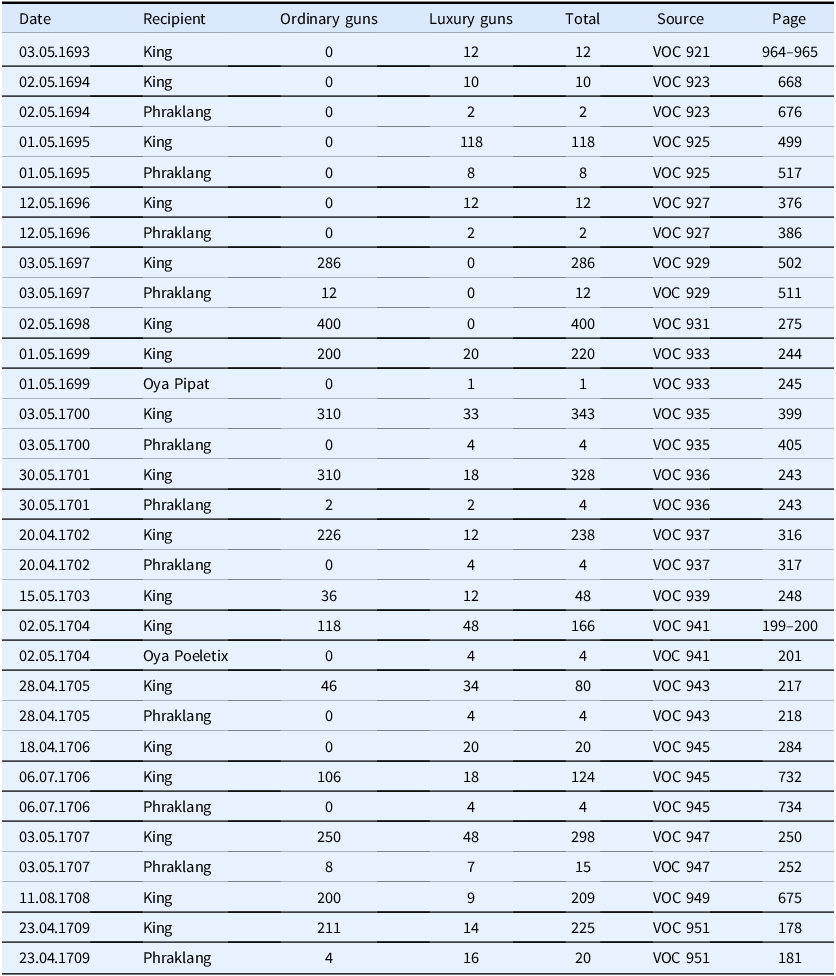
Seeing this favourable pricing, the next gift by the company also included a few guns, this time to both the king and the Phraklang. In 1694, the director sent a list of goods suitable to be presents for the Siamese, which was unfortunately not sent on to the Netherlands and therefore not conserved in the archive.Footnote 19 But the director mentioned that guns were especially wanted, and the same type of list survives from the next year. It is highly likely that it is essentially identical to the one of 1694. In the list of 1695, the king requested fine muskets, with white not blue barrels. The ones that had previously sent had been pleasing. But a request was made to get more muskets instead of any carbines or pistols.Footnote 20 This was only partly followed by the company. The present of 1696 included only fine muskets. However, only fourteen guns were sent, slightly more than a tenth of the previous shipment.Footnote 21 But afterwards, the transfer of guns picked up, with hundreds sent yearly, as can be seen from Table 1.
Guns gifted to Siam by the VOC

Source: Appendix.
* For an explanation of the categories see the appendix.
† All 200 of the pistols of this shipment were returned to the company.
‡ 208 of these guns were returned to the company.
Phetracha must obviously have come to appreciate the guns that had been gifted to him in the previous years. In 1699, an uprising broke out, led once again by a man claiming to be Narai’s brother, likely with the goal to ensure that Prince Khwan, Phetracha’s son with Narai’s daughter Yothathep, would follow Phetracha on the throne instead of his much older son, and at this point co-regent Sorasak (later King Süa). The uprising was defeated by the royal troops. A purge at the court followed, as a result of which many officials were executed, and the old Phraklang Kosa Pan lost his position (Dhiravat Reference Dhiravat, Blussé and Gaastra1998, 109–111). A slew of younger, less experienced officials entered office, including the new Phraklang, who was Chinese. Director Reynier Boom was called for an audience with the new Phraklang, in which he was told of the king’s desire for large numbers of muskets.Footnote 22
The Phraklang informed Boom of what would be sought from the company in the letters about to be sent to Batavia. Boom expressed his surprise at the large order. The king wanted no less than 5,000 ordinary muskets. In addition, as many gilded muskets, carbines, pistols, blunderbusses, gun locks, and flints as possible. The Phraklang asked Boom whether these guns could already be shipped to Siam with the company ships that would sail for Japan via Siam in May and whether the blunderbusses and gun locks could be made in Batavia. Boom had to answer negatively to both questions. Everything had to be ordered from the Netherlands.Footnote 23 The apparent haste of the Phraklang in getting these guns should not be surprising. After all, he had gotten his position only on account of the failed rebellion of the previous year. With the many challenges that were made to Phetracha’s reign, increasing the firepower of the royal troops must have been one of the most rational decisions, especially as there was nothing that Phetracha could do about his status as usurper, short of abdicating the throne in favour of his youngest son, who was still a child, something which his much more powerful and older son would certainly take issue with.
Firearms would be especially advantageous when considering the theories recently advanced by Chris Baker and Pasuk Phongpaichit, as well as by Alan Strathern (Baker and Phongpaichit Reference Baker and Phongpaichit2017, 224–227; Strathern Reference Strathern2022). They argue that while Phetracha’s usurpation of 1688 was not a revolution in the sense of overthrowing the old social order, the way in which the coup was carried out was somewhat revolutionary. Instead of relying only on the nobility and the clients which it could mobilise as was usual during the many palace coups in Ayutthaya, Phetracha utilised the enormous social standing of the sangha, the Buddhist monkhood, to mobilise a much larger number of commoners than he could reach through the networks of the nobles that supported him.
By feigning that he was only interested in protecting Buddhism against Catholic missionaries and would return to a temple after that threat was eliminated, Phetracha had gained the support of the sangha and the masses. But already during the coup against Narai and Phaulkon, Phetracha killed Narai’s brothers that should have succeeded him, to make himself king. This greatly hurt his legitimacy with his supporters, a fact mooted because he had by then got the military on his side. But it came back to bite him later, as most of the popular revolts against his rule were led by monks or by alleged relatives of Narai (or both). While these revolts undoubtedly also had noble supporters, they amassed large groups of commoners, at one point marching on Ayutthaya with around 10,000 men (Strathern Reference Strathern2022, 1316–1318). The popular mobilisation through the monks that had brought him to power, was now used several times in attempts to depose Phetracha. The king mobilised the foreign groups living in Ayutthaya such as the Chinese, “Moors,” and Portuguese. While this was quite usual, an attempt was also made to get the population of the Dutch settlement in Ayutthaya to fight under the command of the VOC officers and to employ the six cannons of the company. The director was able to get out of this obligation, by not only emphasising that the Dutch were in Siam as merchants and not as soldiers but also by pleading that he was not allowed to provide any men or arms without order from Batavia.Footnote 24
Firearms were important in inter-state warfare, including that against rebellious vassals which falls into a grey zone between domestic and foreign conflicts, depending on one’s perspective.(Reid Reference Reid1993, 224) But they must have been an even greater boon in this type of domestic struggle. The 10,000 who marched on Ayutthaya in 1689 were described by Engelbert Kaempfer as an “undisciplined rabble” who brought their own weapons (Kaempfer Reference Kaempfer1998, 37). Firearms were a royal monopoly precisely to prevent their use against the king. Their own arms which the masses could contribute would therefore not include guns, at least if the royal monopoly was successfully enforced. Against such an enemy, the royal firearms must have had a devastating effect, especially if they were fired into this unorganised mass in volleys. It took months of drill to make European soldiers stand their ground under concentrated enemy fire. How great, then, must have been the effect of dozens of their own being struck down in mere seconds on untrained farmers? This effect of course hinges on the number of guns which the king could amass on the battlefield and on how accustomed those fired at were to the use of such weapons. Michael Charney has recently argued that through continual inter-village warfare, the peasants that were pressed into military service by rulers on the Southeast Asian mainland were actually quite experienced fighters.Footnote 25 But whether this assertion, derived mainly from Burmese evidence, applies to the comparatively much more peaceful heartland of late-seventeenth-century Ayutthaya is doubtful.Footnote 26 The ability of the king to bring guns against the rebels can however be scrutinised by looking at his requests and the material that was actually delivered.
In a meeting, Phraklang provided further information on what exactly was required to the director, who then reported this to the governor-general. Through this, we get a surprisingly complete image of what the Siamese wanted. The document is titled “List of goods that are thought to be proper for the king, as well as for the new Phraklang and for the viceroy of Ligor” and is not the first such list compiled by directors, although most of them unfortunately no longer exist.Footnote 27 That the guns were listed here, shows their classification as presents and not ordinary trade goods. The Phraklang had signalled the king’s willingness to buy the guns from the company, but also said that if only a part of the order could be fulfilled it could also be given as part of the presents for the king.Footnote 28 All the guns sent previously or after this report were part of the royal gifts, they were never taken to Siam among the normal trade goods. While guns are described the most extensively in the report, the usual presents consisting of rarities, textiles, spices, sandal wood, and rose water are also listed. It should not be forgotten that while guns were one way of taking care of opposition, the gifting of foreign textiles was also an important way in which the king bound the nobility to himself.
The wording of the list makes it clear that the king was not seeking luxurious weapons for his own use and prestige, but weapons for military use. The 5000 common muskets are at the centre of the request, while everything else is an extra that would be appreciated on top. They were to be like the muskets for soldiers which the Phraklang had requested in 1695.Footnote 29
While the king had previously asked to receive more muskets instead of any carbines, up to 100 carbines were now wanted. However, without shoulder slings as, unlike in Europe, in Siam these short guns did not see much use on horseback. Instead they were used by elephant riders and on boats, sometimes also simply on foot. Pistols, another cavalry weapon, were absolutely not wanted in Siam and none should be sent. Blunderbusses with copper barrels were also wanted.Footnote 30 Blunderbusses can be likened to primitive shotguns and were often used by cavalry, but also for personal defence. As they fired several projectiles at once, if only at a short range and with low accuracy, they would have been ideal to deal with the crowds that formed most of the rebels which threatened the monarchy. The director suggested that some of these could be made in Batavia, which suggests that the company had at least limited production capacity there.Footnote 31 The king wanted up to 400 of these guns.
Most interesting is the last item listed under the weaponry: large snaphaunce locks. These were to be combined with small cannon and would be placed on the back of elephants. Small cannon were popular throughout South-East Asia, especially for use on boats and ships (Reid Reference Reid1993, 230–232). Unlike muskets, cannon were normally not fitted with locks and had to be fired by holding a burning match to the touchhole to ignite the gunpowder. The use of a lock would make it easier to fire the gun on a moving elephant or boat. It would essentially create a massive musket, too heavy to be carried by a person. The combination of cannon with locks instead of touchholes was not common in Europe until it came into use on British warships in the middle of the eighteenth century, but it seems that this was not wholly new to Siam, as the Siamese sent along a sample of what this large lock should look like (La Loubere also described the use of one-pounder cannons from the back of elephants. de La Loubere Reference de La Loubere1693, 92). This is an example of Southeast Asian adaptation of European technology, as flintlocks were not produced locally. The king ordered 300 of these locks, but they were the only item among the requested weapons of which none was delivered in the next ten years, leading to frequent reminders by the Siamese side.Footnote 32 In 1718, the Phraklang more successfully asked for 50 small cannon to be used on elephant back, as in August 1719 the Governor-general made the king a present of 98 small cannon (Niemeijer Reference Niemeijer2018, HK 24). It is not known whether these cannon were fitted with locks by the Dutch, or whether the Siamese may have done so afterwards.
The Phraklang had been warned by the director that such a massive order could not be fulfilled quickly, but what came must nonetheless have underwhelmed the Siamese. In 1701, the Governor-general gifted the king just 310 common guns, as well as 18 luxury pieces, along with 1000 flints. The Phraklang received a paltry four guns.Footnote 33 Most of the value of the present consisted of textiles. Batavia justified this low number of guns neither in the internal letter to Director Gideon Tant nor to the king or Phraklang. The Governor-general’s letter to Amsterdam, however, expressed concern about the “miserable condition of the realm” which had been reported and which was blamed on the wrathfulness of the king, putting his purchasing power in doubt.Footnote 34 The overthrow of the king was, however, seen as an even worse outcome by Batavia, as his replacement might not pay the king’s sizable debt. It should therefore have been in the company’s interest to supply Phetracha with the weapons necessary to uphold his rule. Batavia reported to the Netherlands about the condition in Siam, the debt and difficulty of trading, as well as that the king had sent them samples of hats he wanted to have made in the Netherlands (Coolhaas et al. Reference Coolhaas, van Goor and Schooneveld-Oosterling1960, 151).
The letter to the Netherlands also mentioned the request for guns and included copies of the Siamese letters for more details. Because of the unsure times, Batavia had decided to gift only what was necessary to maintain the king’s favour. These guns were sent from the Batavia armoury, for which replacements were requested from the Netherlands. Samples for hats and textiles the king requested were sent to the Netherlands, but not for guns or the large locks. How much the guns and textiles of the previous year had pleased the king was also mentioned, with his return gift being worth almost 50% more than the company’s gift.Footnote 35 The small consignment of guns therefore seems to have been motivated by Dutch fears that the king might be overthrown soon and that it would then not be repaid. It likely appeared too risky for them to order several thousand guns, which might only arrive two years later and whose utility then was not guaranteed. The considerable debt which the king had with the company, almost 500 catty of silver (f. 76,000) at the end of 1699 and still growing, probably did not help either.Footnote 36 The board of the company was also briefed on the latest revolt and the concern which it had caused in the capital, with the rebel leader rumoured to either be Prince Sorasak or a surviving brother of Narai, while other sources said that Sorasak had been poisoned.Footnote 37
Another issue, which was however not brought up in the diplomatic letters, was the fact that with the War of the Grand Alliance (1688–1697) and the War of the Spanish Succession (1701–1715), the Dutch Republic was involved in European great power wars for almost the whole reign of Phetracha and Süa. This must have taken a toll on their ability to send weapons to the East Indies, especially ones not even intended for use by Dutch troops.Footnote 38 Nonetheless, guns were now always included in the presents and common guns heavily outnumbered luxury pieces. The debt of the king, as well as the worsening trade conditions for the company, however, remained a topic about which the company constantly complained.
King Süa and the return of stability
After Phetracha’s repeated defence of his position, his son Süa did not have to cope with the same extent of domestic unrest. He largely continued the policies of his father. When Phetracha died in 1703, Süa took the throne. Initially, he claimed he would serve as regent for his young brother, Prince Khwan, teaching him the business of kingship until he would be ready to take over the sceptre.Footnote 39 That Süa would ever transfer power to his brother was doubtful from the start, and the failed assassination attempt against his life by Khwan’s supporters provided the perfect pretext to keep the throne. Yothathep had to flee into a nunnery, and Khwan was beaten to death with his body being publicly displayed for days after, probably to prevent the emergence of more alleged relatives of Narai which had so plagued Phetracha.
That an attempt had been made to use what must have been Dutch guns to take Süa’s life certainly did not deter him from ordering more. After all, the system of the royal armoury had clearly worked in preventing the use of guns against the king. Instead of changing his father’s policy, Süa seemed to want to intensify it. After renewing the treaty with the company, the first letter of the Phraklang to the Governor-general complained about the slow delivery of guns. Of the 5000 pieces that had been ordered, only 910 short guns, 850 long guns, and 60 pistols had been delivered in the last four years.Footnote 40 At least another 4090 guns were therefore demanded, as well as the gun locks that had never been delivered.Footnote 41
The company continued to gift guns to Süa, but his exhortations to finally fulfil the old orders did not motivate the company to increase the size of its gifts. This is unsurprising, as the relations between court and company had been deteriorating since early in Phetracha’s reign. From the company’s perspective, its position in Siam was about as bad as it could be. The king constantly had large debts with the company, often took his time to hand over the diplomatic letters meaning the ships had to stay in Siam for long and might miss the monsoon, the tin monopoly of the company was undermined by large royal purchases, while the Indian textiles imported could no longer be sold to anyone but the royal factors, whose prices left the company too little profit.Footnote 42
A commissioner sent from Batavia to negotiate with the king in 1705 failed to restore the old position of the company. Therefore, he oversaw the closing of the VOC’s operations in Siam.Footnote 43 The king’s debt was finally settled through the delivery of 21,223 picul sappanwood, some of it owed for more than a year, 41 catty silver, and 51 bahar tin giving a total value of more than f. 60,000 using the customary prices.Footnote 44 Because of the bulkiness of the more than 2,500,000 lbs of sappanwood, much of it had to remain in the country, in the custody of a few company servants, mostly those with Siamese families that were not allowed to leave.Footnote 45
Negotiations to re-establish the factory in Siam began almost immediately. The need to take away the remaining goods gave a convenient pretext to send ships, servants, and letters to Siam. The company had always emphasised that it did not want to break with Siam and that, even if it had to leave the country, it would do its utmost to keep up the mutual friendship that connected it to the king.Footnote 46 Besides this friendship that was always conjured up in the letters between the king and the Governor-general, Batavia also counted on the wish of the Siamese nobility to continue trading with the company. Considering the ill state of foreign trade in the country, Siam could hardly afford to lose the VOC, which was responsible for most of the trade besides that to China and Japan. According to the Siamese version of the story, they only broke the treaty to punish Dutch breaches of the treaty, namely smuggling carried out by the directors against the wishes and knowledge of the Governor-general.Footnote 47 In the end, all that was necessary for the company to be allowed to return was an apology for the harsh letter the Governor-general had sent to the king, and to admit that previous directors had lied to Batavia about the situation in Siam.Footnote 48 By putting all the blame on Director Aarnout Cleur’s predecessors, the Phraklang found an easy way out, as this meant that those to blame for the dispute between court and Company were either dead or had returned to the Netherlands, so that they could not be punished.
In its effort to re-establish its position, in Siam, the company had sent a consignment of guns among its presents for Süa and the Phraklang in 1706, which was meant to re-enforce the old friendship which had tied together the company and the Siamese court for decades.Footnote 49 In 1707, Batavia sent another present, mostly consisting of guns, showing that the Governor-general must have thought the gifting of guns an especially convincing argument for why Süa would allow the company to return with its old privileges. The director of Ligor had also included guns in the list of presents which should be sent to restore trade.Footnote 50
When considering the importance of guns for the court, it is very interesting to see that weapons were sent back to the company twice. Half of 1698’s shipment, 200 pistols, were sent back while the same number of muskets and carbines were kept. This was the last time that non-luxury pistols were sent to Siam.Footnote 51 Of the large shipment of 1707, 208 muskets were sent back to the company next year. It was explained that these guns were not of the type that was usual in Siam, and therefore not wanted. The next year, 200 others were sent as replacements which were found to be more suitable by the Siamese. Unfortunately, it was not specified what the problem with the guns was.Footnote 52 It is not clear whether it was a quality issue, perhaps the guns were too large.Footnote 53 In jungle warfare, shorter guns were usually preferred, so this might be a possible explanation. Be that as it may, these were the only times that guns were sent back. It is very unlikely that any guns would have been sent back in the time around 1700, when the large request for guns was made and when the kingdom was in upheaval. By 1707, Süa must have felt secure enough in his position that he could afford to give up these guns.
At the end of 1708, the king fitted out a fleet to wage war against Pattani and the sultanate of Johor, at the tip of the Malay peninsula. The pretext for this war was that Johor had prevented Pattani, a Siamese vassal, from sending the flowers made of gold and silver that were the sign of its vassalhood to Ayutthaya, although it is quite possible that the sultan of Pattani did this of his own volition.Footnote 54 That same fleet was observed by the head of the company lodge in Ligor, where it passed through on 15 February 1709. He estimated that the fleet consisted of 7,000 soldiers, on 2 small ships and 150 galleys, equipped with a total of 750 light cannon.Footnote 55 Unfortunately, we are not told anything about the small arms of the soldiers, although the king must have provided some of them to his most loyal troops. The fleet returned sometime in 1709, as Director Cleur reported about its return in his letter of 7 January 1710. According to him, the war with Pattani had been resolved without bloodshed, although it is likely that the army returned because it heard of Süa’s death and not because it had reached its goals.Footnote 56 Cleur contrasted this with the bloody wars between European princes, which looked very different as he could see from the European news that Batavia sometimes shared with him.Footnote 57
The fact that Süa had sent back guns before sending this fleet indicates that he either already had enough of them, or that he did not consider them necessary for this war. As Pattani was a port city, it was possible to bring a massive amount of firepower against it from the sea, which could not be replicated inland, certainly not without the expensive use of many elephants for the transport of the cannon. What seems to have decided the Pattani war in the favour of Ayutthaya was that it proved that it was able to mobilise a big fleet with a large number of cannon. That must have shown to Pattani that it was cheaper to submit to Siamese overlordship, which would be quite weak and could be challenged in the future, than to risk losing a fight. However, it is also possible that the war ended because of Süa’s death and that Pattani remained in rebellion. The picture therefore emerges that imported small arms were especially important to fight domestic enemies in the form of peasant masses, while (shipborne) artillery was more important for inter-state warfare. As Narai was also much more occupied with interstate warfare than with the domestic conflicts that became so important under Phetracha, this also explains his very limited interest in importing weapons from the VOC.
There is some more evidence to support this theory. According to VOC sources, when Phetracha’s troops failed to reconquer Korat in 1700, the army was scattered and lost all of its cannon and other weaponry.Footnote 58 Yet, when an English ship visited Ayutthaya in 1702, they only bartered for some sugar, without being able to sell the iron cannon which they had brought with them.Footnote 59 So even after Phetracha lost a large number of cannon, he declined an opportunity to restock. There was certainly a role for firearms in interstate warfare, as cannot only be seen from the use of many cannons in this attack on Pattani, but also from their prominent role in accounts of the 1767 Burmese invasion, which ended with the conquest of Ayutthaya after which thousands of muskets and cannons were carried off as booty (Soe Thuzar Myint Reference Myint, Chutintaranond and Baker2011, 76–79). It is possible that strained finances were the reason for which Phetracha did not buy the English cannons, as his revenue strongly depended on foreign trade.
The Phraklang estimated the price of one ordinary musket as 10 tical, which for the 5000 guns requested would work out to a sum of 625 catty of silver.Footnote 60 This is a sum far in excess of the usual trade in presents between the VOC and the king, and in some years the whole trade between the two parties barely reached this amount.Footnote 61 The price of the 5000 guns alone would therefore have consumed a large part of the royal trade income in a good year. It must not be forgotten that the king’s main imports were always Indian textiles. Like guns, they were important for domestic stability, as they could be used as presents to buy the loyalty of the nobility and monkhood, but were also sold domestically by the king. So even if royal exports were big enough to cover the cost of such a large number of guns, they would have to be bought at the expense of the Indian textiles, which would have significant repercussions for the king.
Conclusion
Despite the many conflicts in his early reign, Narai showed little interest in foreign weaponry, especially in muskets. The interstate warfare he engaged in does not seem to have required them, with either his existing cannon or perhaps even the more traditional elements of his armies having been sufficient.Footnote 62 Only with Phetracha’s rule did the Siamese show continued interest in Dutch muskets. As has been argued, this was likely because these firearms were most effective against the untrained commoners that came to play such an important role in these attempts at deposing the usurper while they were less crucial in combat between proper armies.
Under Phetracha and Süa, a total of 3221 guns were imported in a span of 16 years, hardly the number one would imagine from the importance often placed on foreign firearms. Muskets were not as long-lasting as modern small arms; especially in humid climates, they were liable to rust. Joseph Miller claims that in West Central Africa, which shares a Tropical savannah climate with Siam, guns had “an average useful life of about a year” (Miller Reference Miller1988, 91). Maintenance was clearly an issue in Siam as well, as complaints were made about some parts breaking easily such as the springs, without any Siamese craftsmen being able to repair them. The Dutch gunmakers were therefore instructed to use steel instead of bad iron in the making of their locks. From this complaint at least, it seems that the locks broke even before the barrels had rusted.Footnote 63 If we believe the often very pessimistic view of the quality of guns sold in the Transatlantic slave trade, but also consider that as they were kept in the royal armoury the Siamese guns would have seen less action, we might assume that guns in Siam lasted twice as long. In that case, the king could seldom put more than 500 men under arms, few compared to the 7500 Süa sent to Pattani or the 40,000 Phetracha reportedly mobilised in 1689 (Baker and Phongpaichit Reference Baker and Phongpaichit2017, 225).
The small volume of these arms imports does not as such disprove the importance that has been ascribed to firearms. The constant Siamese requests for firearms in a time during which the power of the crown was in danger supports Reid’s idea that the main use of imported firearms lay in strengthening royal power vis-à-vis its subjects, who could not access them. At the same time, the inability to import enough firearms, partly caused by the unfavourable economic situation Siam found itself in at the end of the seventeenth century, speaks to the importance of Lieberman’s stressing of the difficulties of accessing firearms, even as Ayutthaya was among the states he sees best positioned to do this. However, the trickle of guns that resulted from this should caution against overestimating the overall volume of the weapons trade in Southeast Asia, especially as it was subject to strong fluctuations depending on political need and economic possibilities. Because of its fickle nature, the weapons import did not lead to the strengthening of state revenues that could sustain high military spending in the long term, making the possibility of arms imports hinge on the fortunes of the export trade.
At the same time, the reliance on limited imports of firearms, wholly through the framework of diplomatic gifts, made gun control much easier than if guns had been available in abundance. As only the king had access to this channel for acquiring guns, it prevented the arming of his enemies, except through smuggling. This goes especially so for the inland areas of Siam, such as Korat, but less so for the Malay “subjects” of the king. Besides the centre’s already weak and often imaginary control over them, these port polities also had their own access to maritime trade. They would therefore have had a much easier time buying foreign firearms than inland vassals or subjects, which could partially explain both the frequency and also the strength of their resistance to the king. Controlling the flow of firearms was therefore crucial to ensure their continued effectiveness in fighting the king’s domestic enemies.
Supplementary material
The supplementary material for this article can be found at https://doi.org/10.1017/S1479591426100758.
Competing interests
The author declares no competing interests.
: Guns gifted by the VOC to Siam, 1693–1709

The division into ordinary and luxury guns is mine. All guns with adjectives such as “fijn,” “verguld,” “opgekapt,” etc, as well as zakpistolen, were classified as luxury guns. All other guns, not just those described as “gemeen” or “ordinair” were classified as common guns.



 Open access

