


Introduction
Hunting is a major threat to several tropical mammalian and bird species worldwide (Benítez-Lopez et al. Reference Benítez-Lopez, Alkemade, Schipper, Ingram, Verweij, Eikelboom and Huijbregts2017). Thousands of indigenous and traditional people in remote areas of Amazonia hunt several species for subsistence, some of which are key for ecosystem functioning (Redford & Robinson Reference Redford and Robinson1987, Doughty et al. Reference Doughty, Wolf and Malhi2013, Stafford et al. Reference Stafford, Preziosi and Sellers2017). This subsistence hunting can impact local wildlife populations and communities, affecting the food security of forest families that rely on wildlife for meat. Therefore, maintaining wildlife populations is crucial for species conservation and the well-being of forest peoples (Milner-Gulland et al. Reference Milner-Gulland and Bennett2003).
As in other tropical forests, hunting with mixed-breed dogs is one of several strategies utilized by indigenous and traditional Amazonian people (Koster Reference Koster2009). Hunting dogs have become integrated into many forest people societies, as they help to prevent agricultural and small livestock losses by barking at potential predators and crop-raiding species, protect women and children from animal threats and eat leftovers that would normally be discarded in gardens (Almeida & Pantoja Reference Almeida and Pantoja2004, Dias & Almeida Reference Dias and Almeida2004, Koster Reference Koster2009, Koster & Noss Reference Koster and Noss2014).
Although domestic dogs are associated with the depletion of several threatened vertebrate species worldwide (Doherty et al. Reference Doherty, Dickman, Glen, Newsome, Nimmo and Ricthie2017), the available research on hunting with dogs in the Neotropics indicates that the harvest composition differs from that of regular hunting. Hunting with dogs usually targets species that are more resilient to hunting, although this practice can also kill endangered species that threaten dogs after being corralled but are not targeted by regular hunting (Trinca & Ferrari Reference Trinca and Ferrari2006, Koster & Noss Reference Koster and Noss2014). Hunting efficiency can increase with the aid of dogs, particularly when combined with the use of shotguns (Koster Reference Koster2008a). The spatial patterns of hunting with dogs and the sex profiles of harvested game species have been particularly understudied (Koster Reference Koster2008b, Koster & Noss Reference Koster and Noss2014).
In Brazil, hunting with dogs is widely believed to have a larger impact on wildlife populations than hunting without dogs because dogs enhance hunter efficiency. Dogs are also believed to scare animals away from hunting grounds because of their barking. These two aspects have led conservation scientists and anthropologists, government members and local residents to agree on local restrictions or bans on hunting with dogs in Brazilian Amazonian traditional communities (Cunha & Almeida Reference Cunha and Almeida2000, Medeiros & Garcia Reference Medeiros and Garcia2006, Figueiredo & Barros Reference Figueiredo and Barros2015, Vieira et al. Reference Vieira, von Muhlen and Shepard2015), although there is little evidence that supports such arguments. Studying the implications of hunting with dogs on wildlife is therefore essential for the conservation of game species and the sustainability of subsistence hunting in Amazonia (Koster Reference Koster2008b, Koster & Noss Reference Koster and Noss2014, Doherty et al. Reference Doherty, Dickman, Glen, Newsome, Nimmo and Ricthie2017). Nevertheless, despite the recent increase in studies on hunting in Brazil, which are mostly focused on Amazonia (Fernandes-Ferreira & Alves Reference Fernandes-Ferreira and Alves2017) and protected areas (Silva Reference Silva2016), research on the use of dogs and its impact on wildlife is still underdeveloped.
Several indigenous and traditional people from the Brazilian Amazonia currently live in protected areas designed to conserve their way of life. Indigenous people in the state of Acre, Southwestern Brazilian Amazonia, hunt in their indigenous lands (ILs). The Huni Kuin (also known as the Kaxinawa) inhabit 12 ILs (33.3% of the ILs in the state) where they frequently hunt, sometimes with dogs (Constantino Reference Constantino2015). The Huni Kuin are central-place foragers who use shotguns and mainly target large prey, particularly ungulates, large rodents and primates, understory birds, tortoises and caimans (Constantino Reference Constantino2016). As in other Neotropical areas (Koster Reference Koster2008b), the Huni Kuin have two main tactics when hunting with dogs: (1) one or more dogs detect the prey and corner it in a burrow, tree or trunk so that a single hunter can kill the animal; or (2) the dogs of two or more hunters chase the prey into a stream, where another hunter is waiting to kill the animal. The Huni Kuin also use their dogs to hunt near their agricultural fields to protect their crops. The IL management plans developed by the Huni Kuin compile norms and agreements that are either already part of the community organization – according to sociocultural traditions – or have been recently adopted as a result of dialogue with surrounding societies. Hunting norms are often part of such plans, and hunting with dogs is often regulated. Other indigenous and traditional people hunt with dogs using similar tactics and have regulated the use of dogs in their ILs or conservation units designated for the sustainable use of natural resources in the Brazilian Amazonia (Medeiros & Garcia Reference Medeiros and Garcia2006, Pezzuti & Chaves Reference Pezzuti and Chaves2009, Figueiredo & Barros Reference Figueiredo and Barros2015) and elsewhere in the Neotropics (Koster Reference Koster2009, Stafford et al. Reference Stafford, Preziosi and Sellers2017).
The aim of this research is to evaluate whether restricting and banning hunting with dogs improves wildlife conservation in protected areas of Brazilian Amazonia. To achieve this goal, I assessed the differences between dog and regular hunting practiced by the Huni Kuin in terms of the hunted species and prey distribution, hunting efficiency and implications for conservation. In addition, I used Huni Kuin hunting information to discuss local agreements on hunting with dogs established by indigenous and traditional people.
Methodology
Data Collection
Huni Kuin hunters from 49 villages in eight ILs participated in a self-monitoring programme led by the local non-governmental organization Comissão Pró-Índio do Acre (CPI-AC) by recording hunting effort (number of hunters, time spent hunting and hunting strategy) and success (species, weight and straight distance from the point of capture to the village) data from 2005 to 2010 (Constantino et al. Reference Constantino, Carlos, Ramalho, Rostant, Marinelli and Teles2012). The recording period varied among villages from 3 to 48 months. I georeferenced 92 hunting features (e.g., saltlick, kill site, fruiting tree) using GPS coordinates to calibrate the estimated distances of hunted animals from these features (Constantino Reference Constantino2015). For the purposes of this paper, I use the terminology ‘regular hunting’ to refer to the hunting strategy locally known as caçada a ponto or caçada a curso, mostly used by the Huni Kuin, in which hunters enter the forest alone or with a few kin to forage for prey with shotguns (for further description, see Constantino Reference Constantino2015).
Hunting Agreements
I surveyed the local agreements on hunting with dogs in the unpublished and published management plans for Huni Kuin ILs in the state of Acre. These local agreements might have been established by the Huni Kuin for years or might have been established during the ethnic zoning of ILs that has been conducted by CPI-AC and the Acre state government together with indigenous representative organizations since 2004. In both cases, the ethnic zoning process leads to the documentation of hunting agreements after a series of at least three meetings with several representatives of all the villages in an IL.
Analysis
Species Diversity, Evenness, Composition, Similarity and Dissimilarity
Because the sample sizes of hunting with dogs and regular hunting differed, I used individual rarefaction analysis to estimate the number of species with an equal number of individuals hunted. I calculated the Shannon H index for the assemblages of animals hunted with and without dogs and used the t-test to test for significant differences. I considered an IL as the sample unit in order to analyse the similarity between regular hunting and hunting with dogs (Igarapé do Caucho and Seringal Independência ILs were not included in these analyses). Principal coordinate analysis (PCoA) with the Bray–Curtis dissimilarity index was used to ordinate the similarity data at the species and order taxonomic levels. I conducted a one-way permutational analysis of variance (PERMANOVA) test with the Bray–Curtis dissimilarity index to examine the statistical significance between the assemblages of animals hunted with and without dogs with 9999 random permutations.
Hunting Success: Mean Prey Weight, Capture Per Unit of Effort and Prey Distance
I used t-tests to analyse differences in the mean prey weight and capture per unit of effort (CPUE) between hunting with dogs and regular hunting, and I repeated the test using data limited to the area within a 2.6-km radius from the village, where 95% of animals hunted with dogs were killed.
Intraspecific analyses between hunting with dogs and regular hunting were conducted for the most hunted species. To select the most hunted species, I ranked the species with the highest numbers of animals killed during hunting with dogs, selecting only those with more than ten prey animals killed, resulting in nine species. I then ranked the most hunted species without dogs and selected the top nine from the ranking. Thus, I compared the distances of hunted animals to the village using the t-test.
Impact on Population: Sex Ratio and Population Dispersal
For the nine most hunted species, I tested whether regular hunting or hunting with dogs targeted a specific prey sex using the chi-square test. For the 15 most hunted species with and without dogs, plus other sensitive species (i.e., the tapir, howler, spider, woolly and capuchin monkeys and the great tinamou and razor-billed curassow), I also tested the association between the frequency of hunting with dogs at the village level and the dispersal of prey from the villages. I used linear regression with the percentage of prey hunted with dogs and the mean distance of prey hunted without dogs.
Hunting Agreements and Actual Hunting
I categorized the different types of agreements on hunting with dogs in the Huni Kuin IL management plans and analysed the Huni Kuin compliance to their own agreements by comparing these agreements to the actual data on hunting with dogs.
Results
Diversity and Similarity of Hunted Assemblages
Huni Kuin from 49 villages in eight ILs recorded hunting 13 824 animals from 69 species, of which 1127 animals from 28 species were hunted with the aid of dogs. The proportion of animals hunted with dogs varied from 0% to 17.9% across ILs. Within 2.6 km of the villages, regular hunting resulted in the killing of 6617 animals from 64 species, whereas hunting with dogs killed 989 animals from 25 species. The rarefaction analysis indicated that the estimated number of species hunted without dogs (45, SE=2.3) was higher than that hunted with dogs (27, SE=0.9), even when the number of individuals was the same. The same pattern was observed within 2.6 km of the villages (S NoDog=48, SE=2.28; S Dog=25, SE=0.33). Only two species were exclusively hunted with dogs: the margay (Leopardus wiedii) and grey-headed tayra (Eira barbara).
The diversities of species hunted with the two hunting methods were significantly different. The Shannon H index was significantly lower in the assemblage of animals hunted with dogs (H Dog=2.02, H NoDog=2.99, t=–27.38, df=1330, p<0.001) than in that hunted without dogs.
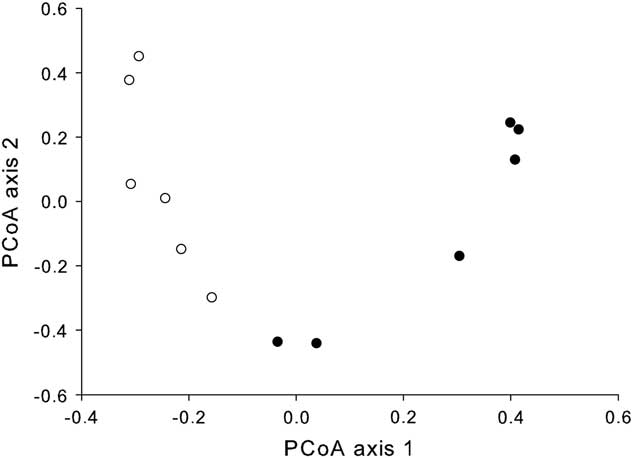
Two groups that explained 49.6% of the variation at the species level (Fig. 1) and 56.5% of the variation at the order level (Supplementary Fig. S1, available online) were formed along PCoA axis 1: one group represented hunting with dogs and other represented hunting without dogs independent of the ILs. PERMANOVA indicated that the assemblages of species hunted with and without dogs were significantly different independent of the taxonomic level of analysis (F species=6.966, df=11, p=0.003; F order=7.558, df=11, p=0.002). The results of the PCoA and PERMANOVA for the assemblages of species hunted within 2.6 km of the villages showed the same pattern: PCoA axis 1 explained 50.1% of the variation, distinguishing prey assemblages hunted with dogs and without dogs (Supplementary Fig. S2), which were significantly different (SS species=2.79, F=6.655, p=0.002). Therefore, further analyses of the assemblage compositions were conducted on only the full assemblages.
Principal coordinate analysis (PCoA) axes 1 and 2 for the abundance of hunted species in Huni Kuin indigenous lands. Open circles – information on hunting without dogs; filled circles – information on hunting with dogs.
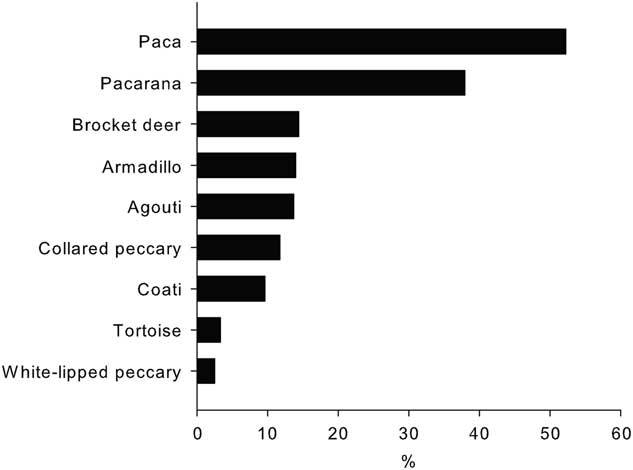
The species exclusively hunted with dogs or with more than 50% of individuals hunted with dogs were very rarely hunted. Except for the paca (Cuniculus paca), the other six species had a maximum of three hunted individuals (Myrmecophaga tridactyla, Tamandua tetradactyla, Panthera onca, Tupinambis spp., E. barbara and Leopardus pardalis). The species most hunted with dogs, comprising more than ten hunted individuals each, included the ground-dwelling white-lipped (Tayassu pecari) and collared (Pecari tajacu) peccaries, red brocket deer (Mazama americana), agouti (Dasyprocta fuliginosa), armadillo (Dasypodidae) and yellow-footed tortoise (Chelonoidis denticulata), which were also among the nine most hunted species without dogs. Among these species were also the ground-dwelling paca and pacarana (Dinomys branickii) and the semiarboreal coati (Nasua nasua), which were rarely hunted without dogs. Instead of these three species, hunters without dogs killed the arboreal species squirrel (Sciurus spp.) and howler (Alouatta seniculus) and spider monkeys (Ateles chamek) (Supplementary Fig. S3). Only nine species accounted for more than 95.5% of prey hunted with dogs; paca alone contributed to 32.3% of the total (Supplementary Fig. S3). Among the species most hunted with dogs, only the paca was more frequently hunted with than without dogs (Fig. 2). Comparatively, the nine most hunted species without dogs accounted for 70.1% of the prey hunted without dogs; white-lipped peccary contributed the most, with a percentage of 15.7%.
Proportions of animals of the nine species most hunted with dogs in relation to the total amount of prey hunted by both strategies.
At a higher taxonomic level, ungulates and rodents were by far the most frequently hunted taxa with dogs, while very few birds and primates were hunted (Supplementary Fig. S4). These taxa contributed nearly the same percentage of the total animals hunted without dogs, and ungulates were also the most hunted order; however, without dogs, the percentage of rodents decreased, while the percentages of primates and birds increased (Supplementary Fig. S4).
Six species hunted by the Huni Kuin are globally threatened. Two of these (margay and pacarana) were hunted more often with than without dogs, whereas four were rarely hunted using dogs (<8% for the giant armadillo (Priodontes maximus), lowland tapir (Tapirus terrestris) and woolly (Lagothrix cana) and spider monkeys).
Hunting Return: Mean Prey Weight, CPUE and Hunting Distance
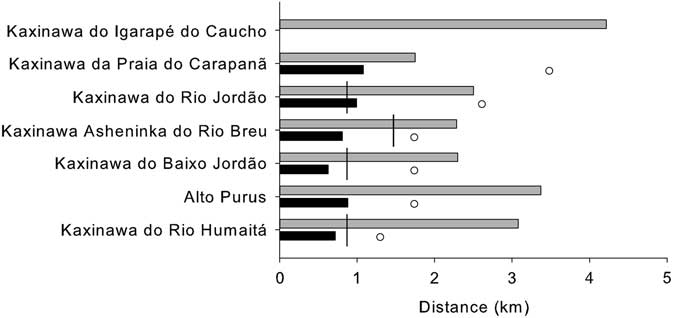
Overall, compared to hunting with dogs, regular hunting led to a 1-kg lower average prey weight and an average of 40% less meat per hunting hour, and animals were killed an average of 1.5 km farther away from villages (Table 1). A total of 95% of animals hunted using dogs were killed within 2.6 km of the village, whereas 95% of animals hunted without dogs were killed within 5.2 km of the village. Only two species (rufescent tiger heron (Tigrisoma lineatum) and emperor tamarin (Saguinus imperator)) were not hunted without dogs closer than 2.6 km to the village. Within each IL, the average distance from the villages to where animals were killed with dogs varied from 0.6 to 1.1 km, but the distance within which 95% of the animals were killed varied from 1.3 to 3.5 km (Fig. 3). Conversely, for regular hunting, the average distance to where animals were hunted varied from 1.8 to 4.2 km (Fig. 3). Among the species most hunted with dogs, eight were killed significantly closer to the villages by hunters using dogs than by those without dogs. Only the pacarana was hunted at a similar distance from the village by hunters both using and not using dogs (Table 2).
Distance of animals hunted by the Huni Kuin with and without dogs and compliance with agreements on hunting with dogs in Huni Kuin indigenous lands. Grey bars: average distance of animals hunted without dogs; black bars: average distance of animals hunted with dogs; white circles: distance where 95% of animals were hunted with dogs; black line: distance limit for hunting with dogs established in local agreements. The Huni Kuin from the Praia do Carapanã and Alto Purus indigenous lands did not agree on a distance limit, but restricted hunting dogs to areas near their houses and around plantations.
t-test comparison of hunting return indices between hunting with dogs and regular hunting in Huni Kuin indigenous lands. CPUE=capture per unit of effort

t-test comparison of distances and sex ratios of the nine most hunted species between hunting with dogs and regular hunting in Huni Kuin indigenous lands

Effects of Hunting with Dogs on Prey Distance and Sex Ratio
Overall, the frequency of hunting with dogs was not related to the distance of the animals hunted without dogs (r 2=0.02, p=0.27). Specifically, the distances of only armadillos and capuchin monkeys hunted without dogs were related to the percentage of hunting with dogs. However, this relationship was weak and, although the capuchin monkey distance increased with the frequency of hunting with dogs (r 2=0.13, p=0.02), the armadillo distance decreased (r 2=–0.09, p=0.05). The mean distance of all other species was not related to the percentage of hunting with dogs at the villages.
Of the nine species most hunted with dogs, only the coati showed a significant sex ratio difference between regular hunting and hunting with dogs, as more males were hunted with dogs (Table 2).
Hunting Agreements on Hunting with Dogs and Actual Prey Distance in Huni Kuin ILs
The Huni Kuin from all ILs studied have agreed to norms that regulate hunting with dogs. In three ILs, hunting with dogs has been completely prohibited; in seven ILs, it was spatially limited; in four ILs, the Huni Kuin banned the use of hunting breeds; and in two ILs, the Huni Kuin limited hunting with dogs to protecting their crops. Among the seven ILs that spatially limited the use of dogs, five established objective distance limits: four set the limit at 870 m and one set the limit at 1470 m.
Considering the average distance of prey hunted with dogs, hunters from only two of these ILs killed animals within the distance limits (Fig. 3). Moreover, when considering the 95% of prey hunted with dogs, hunters from all five ILs killed prey beyond the limits (Fig. 3). The sole IL that agreed to a ban on hunting with dogs did not report any hunting with dogs. The other two ILs did not establish a distance limit, but agreed that hunting with dogs could be permitted only in areas surrounding their field crops and alongside rivers and streams, which was also for protection purposes. Since a distance limit was not established, a comparison with actual hunting data was not possible.
Discussion
Hunting with Dogs Impacts Wildlife Less than Hunting without Dogs
The Huni Kuin hunters with dogs hunt fewer species, focusing on fast-reproducing species that are resilient to hunting pressure. Hunting occurs in disturbed areas near the villages that encompass their agricultural fields, and the prey taken by hunting with dogs have a similar sex ratio to those taken by hunting without dogs. Hunting with dogs kills fewer animals from fewer threatened species than hunting without dogs. Moreover, there is no indication supporting the conventional wisdom that hunting with dogs causes animals to move farther from settlements. The hunting of only capuchin monkeys might be negatively affected by the frequency of dog use since the distance of 18 species, including those most sensitive to hunting, did not vary with increases in the frequency of hunting with dogs.
While hunting with dogs targets mostly the paca, collared peccary, red brocket deer, armadillo and agouti, which are resilient to hunting pressure (Daily et al. Reference Daily, Ceballos, Pacheco, Suzán and Sánchez-Azofeifa2003), hunting without dogs puts pressure on several more vulnerable species, including large primates, tapirs and understory birds (Daily et al. Reference Daily, Ceballos, Pacheco, Suzán and Sánchez-Azofeifa2003). These findings corroborate those from other studies in the Neotropics, which reported that, compared to hunting without dogs, subsistence hunting with dogs is more efficient and selects for species that are more resilient to hunting (Redford & Robinson Reference Redford and Robinson1987, Koster Reference Koster2008a, Reference Koster2009, Koster & Noss Reference Koster and Noss2014).
The allegedly unselective foraging behaviour of mixed-breed dogs potentially leads to the killing of rare threatened species, such as the giant anteater, giant armadillo and jaguar, which are killed because they threaten the dogs, rather than for feeding (Koster Reference Koster2008a). The threatened species most hunted by the Huni Kuin were the Atelinae primates, the woolly and spider monkeys and the lowland tapir, for which regular hunting was much more efficient than hunting with dogs. The other three threatened species killed by the Huni Kuin with dogs – the pacarana, the giant armadillo (both subject to Huni Kuin food taboos; Constantino et al. Reference Constantino, Fortini, Kaxinawa, Kaxinawa, Kaxinawa and Kaxinawa2008) and the margay – were killed to protect either their crops or their dogs. Nevertheless, independent of the hunting strategy, the impact of Huni Kuin hunting on the populations of inedible threatened species might be irrelevant because very few individuals were hunted; only 29 pacaranas, 12 giant armadillos and 2 margays, corresponding to 0.2%, 0.08% and 0.01%, respectively, of all hunted animals, were hunted in this study.
The spatial extent of hunting pressure influences game population depletion and the sustainability of hunting (Robinson & Redford Reference Robinson and Redford1991, Levi et al. Reference Levi, Shepard, Ohl-Schacherer, Wilmers, Peres and Yu2011). Until recently, there was limited evidence that hunters with dogs forage closer to settlements than hunters without dogs (Koster & Noss Reference Koster and Noss2014); therefore, these results have tremendous implications for the management of wildlife because, given that hunting with dogs is spatially restricted compared to regular hunting, this practice should be more sustainable in an environment where source–sink dynamics tend to occur (Salas & Kim Reference Salas and Kim2002). The concentration of hunting with dogs in the disturbed forest area with agricultural fields surrounding the villages reduces the chances of becoming lost while following dogs in long chases and optimizes the protection of crops from raiders that cause severe damage and economic loss. The species most hunted with dogs are those that cause the most damage to manioc crops in Amazonia: agoutis, paca, deer and peccaries (Abrahams et al. Reference Abrahams, Peres and Costa2018). Hunters without dogs also hunt near the villages, targeting a prey ensemble that includes many sensitive species, but range farther into the forest (Constantino Reference Constantino2015).
Compared to hunting without dogs, hunting with dogs may not have an impact on the game population sex ratio because only the sex ratios of coati were significantly different between the two strategies. Thus, the game population sex ratio should not be a conservation concern because more coati males than females were killed with dogs. These findings concur with those of Koster (Reference Koster2008b) in Nicaragua, who observed no difference in the sex ratios of five of the six most hunted species between hunting with and without dogs, but recommended more research on the issue.
The Huni Kuin practice of hunting with dogs contradicts the prediction of local knowledge and conservationists that hunting with dogs scares animals away if the dogs do not kill them (Cunha & Almeida Reference Cunha and Almeida2000, Medeiros & Garcia Reference Medeiros and Garcia2006, Figueiredo & Barros Reference Figueiredo and Barros2015). Instead, other factors, such as the density of indigenous people and the presence of roads, are related to the distance animals are killed from settlements, considering all hunting strategies (Constantino Reference Constantino2016).
Hunting with Dogs Is More Efficient at Providing Meat
In addition to its lower impact on wildlife, for the Huni Kuin, hunting with dogs is more efficient than regular hunting since hunters acquire the same amount of meat with less effort and with fewer animals killed, which means that less ammunition is required. Moreover, animals corralled in burrows or driven into streams require less ammunition because they are captured using smoke and machetes or other non-ballistic weapons (Koster Reference Koster2009). However, the efficiency of hunting with dogs also varies greatly with the ability of the hunter to read the dog signs and the ability of the dog to identify, chase and corral prey (Koster & Tankersley Reference Koster and Tankersley2012). This variability may account for the divergent findings of studies that compared the efficiency of hunting with dogs with that of other strategies in the Neotropics (see Koster Reference Koster2009).
Huni Kuin Agreements on Hunting with Dogs
The agreements that limit hunting with dogs are often based on the belief that dogs enhance the hunting impact on game populations either by killing more animals or by scaring animals away from hunting grounds. However, the results of this research agree with other studies in failing to provide evidence that hunting with dogs has a greater impact on game populations than regular hunting (Koster & Noss Reference Koster and Noss2014).
The norms of hunting with dogs in Huni Kuin ILs are representative of those agreed upon by traditional and indigenous people from protected areas throughout the Brazilian Amazonia (e.g., Figueiredo & Barros Reference Figueiredo and Barros2015, Gavazzi Reference Gavazzi2015, Almeida Reference Almeida2016). These agreements can limit the use of dogs by restricting the permitted hunting area, the breed of dog, the species targeted and the purpose of hunting and by banning the hunting strategy altogether. Banning hunting with dogs has been widely adopted, but is the most drastic measure because this often implies the banning of dogs in settlements. However, banning dogs that are used for crop and livestock protection could result in an economic loss at least ten times higher than that without a ban due to the damage caused by crop raiders (Abrahams et al. Reference Abrahams, Peres and Costa2018). Restrictions on the permitted hunting area are also frequently implemented; this type of regulation seems to maximize the efficiency of hunting with dogs and to reduce the probability of killing threatened species, which are usually more abundant farther from settlements. Conversely, few ILs clearly indicate restrictions on dog breeds, which seems to be appropriate for conservation because dogs from hunting breeds have been shown to impact wildlife populations differently (Koster & Noss Reference Koster and Noss2014).
Agreements That Limit the Area for Hunting with Dogs Reflect Features Intrinsic to the Hunting Strategy
Despite setting distance limits for hunting with dogs, such agreements are not the reason Huni Kuin hunters forage with dogs close to villages. Even immediately after contact, when there were no local agreements on hunting with dogs, the ancient Huni Kuin hunted with dogs near their villages (Kensinger Reference Kensinger1975). Moreover, hunters from certain ILs use dogs to hunt prey beyond the community-established limits, on average. Even hunters from the other ILs that use dogs within the limits established by their community norms, on average, hunt several animals far beyond these limits, showing that community rules might not be the reason limiting the distance of hunting with dogs. Studies in other Neotropical sites have observed that hunters from communities with no written agreements on the distance for hunting with dogs tend to forage closer to the villages than those without dogs (Koster Reference Koster2008b, Koster & Noss Reference Koster and Noss2014). Therefore, instead of rules dictating the practice, the practice was used to create community rules in Huni Kuin ILs. One exception to this, however, might be cases in which hunting with dogs has been banned, such as in the Igarapé do Caucho IL, where there was no record of hunting with dogs. Therefore, insisting on establishing community agreements that limit the use of dogs near settlements does not provide any additional conservation benefit, since the strategy itself, and not the agreement, is the factor that limits the hunting range.
Why Do Specific Regulations Exist if Hunting with Dogs Does Not Impact Wildlife More than Hunting without Dogs?
I found that there are very few conservation motives for imposing severe restrictions on hunting with mixed-breed dogs, except that free-ranging domestic dogs might be a source of disease to wildlife, and the dogs may kill other animals close to villages without owner supervision (Doherty et al. Reference Doherty, Dickman, Glen, Newsome, Nimmo and Ricthie2017). Conversely, hunting with dogs can be a very efficient strategy for families living in remote Amazonia because hunters with dogs acquire more meat with less effort and ammunition while protecting their crops and are less likely to become lost in the forest because they do not travel far. These characteristics led Koster (Reference Koster2008b) to suggest that the use of dogs should be promoted where the costs of shotguns and ammunition are very high and where there is a high abundance of species resilient to hunting and of those targeted by hunting with dogs, such as paca, agouti and armadillo (this includes almost everywhere near to subsistence hunting Amazonian settlements). Additionally, according to Abrahams et al. (Reference Abrahams, Peres and Costa2018), hunting crop-raider species for manioc damage control, even using dogs, may not be problematic for biodiversity conservation.
Therefore, why are there so many regulations on hunting with dogs across the Brazilian Amazonia, particularly in protected areas? The local norms on hunting with dogs are likely related to social conflicts and inequalities. Some studies indicate that hunting with dogs causes social conflicts because hunting dogs do not respect the limits of hunting territories and end up chasing prey in the hunting territories of neighbouring families or communities (Almeida & Pantoja Reference Almeida and Pantoja2004). Additionally, the advantages conferred by hunting with dogs cannot be afforded by everyone in protected areas communities; this strategy requires hunters young enough to follow the dogs in a chase and wealthy enough to purchase, maintain and train dogs that can be killed or hurt while chasing a carnivore (Dias & Almeida Reference Dias and Almeida2004, Koster & Tankersley Reference Koster and Tankersley2012). Therefore, regular hunting is a more democratic strategy to be practiced in protected areas that are intended for the collective use of natural resources. Additionally, regular hunting promotes ecological knowledge about game species and the forest (Dias & Almeida Reference Dias and Almeida2004). In an attempt to solve these conflicts and improve wildlife management, some communities agreed to impose restrictions on hunting with dogs (Dias & Almeida Reference Dias and Almeida2004). Thus, norms on hunting with dogs may function more as a conflict mediator among families within one community hunting in the same area or between communities hunting in nearby areas than as an actual management measure to improve wildlife conservation.
Another important aspect of regulations on hunting with dogs is that rubber patrons, the most powerful local force in the Brazilian Amazonia during the rubber boom, banned hunting with dogs in their seringais, or rubber states. This regulation was strictly followed by rubber tappers, including indigenous people engaging in rubber tapping activities (Almeida & Pantoja Reference Almeida and Pantoja2004). Although communities in Amazonia now live under a different socioeconomic regime, some of the sociocultural values from the seringais system are so strong that they still persist.
Supplementary Material
For supplementary material accompanying this paper, visit http://www.cambridge.org/core/journals/environmental-conservation
Acknowledgements
I would like to thank the Huni Kuin people from Acre and the Comissão Pró-Índio do Acre, who monitored hunting and allowed data collection. Additionally, the Wildlife Conservation Society and the Gordon and Betty Moore Foundation supported the fieldwork. Thanks to AP Antunes, AV Nunes and two anonymous reviewers for their helpful reviews and suggestions.
Financial Support
REDEFAUNA is supported by the MCTIC/CNPq – No. 23/2017.
Conflict of Interest
None.
Ethical Standards
None.



