

I. Introduction
There is currently an ongoing debate at to the effects of external inspections and governmental supervision.Footnote 1 Much is still unknown regarding the causal chain from regulation through inspections to the resulting effects on performance. This article suggests a novel model for studying this causal chain.
II. Method
Three groups of information sources provide the empirical basis for the proposed model. Firstly, we have assessed the growing portfolio of research projects on technological change, risk regulation, the tripartite system and safety management systems within the offshore oil and gas industry, including assessment of texts of laws, regulations and regulatory guidelines, as well as industrial norms and standards.Footnote 2
Secondly, previously suggested theories and models on fundamental strategies, institutions and explanations of regulation as a means of identifying “good” regulation (eg as outlined by Baldwin and CaveFootnote 3 ) have been condensed and included in the model presented here. Based on this, a two-dimensional representation has been developed in the context of co-regulation of offshore oil and gas operations based mainly on the work of Baram and Lindøe.Footnote 4 Responsive regulationFootnote 5 concerns the idea that regulation is more likely to be just and effective when it is contextually responsive to the social and physical environments, particularly to how regulated actors respond to attempts to regulate them, and this is an argument for claiming that the model presented here is relevant even outside the oil and gas industry.Footnote 6
Thirdly, we have conducted interviews with relevant stakeholders in the Norwegian oil and gas industry. In short, this model has been developed based on the two first sets of knowledge and thereafter tested using data collected through interviews.
III. Prescriptive or functional regulation, legal tradition and trust
Baldwin and CaveFootnote 7 discuss the selection of enforcement strategies and accompanying rule types based on an analysis of the kind of regulatee being dealt with. To describe the regulatees’ behaviour, two parameters are used: intentioned (wish to comply) and informed (knowledge of legal requirements and how to meet these). For enforced self-regulation, the expertise of the regulatee is an important prerequisite to being informed.
This perspective is further developed by RipFootnote 8 when describing a contingent regulatory repertoire (C-repertoire) as opposed to a rational repertoire (R-repertoire). In brief, a C-repertoire is characterised by interpretation of the legal requirements based on local discussions between the concerned organisations (firms) and the authorities, whereas an R-repertoire applies a more traditional relationship through which the firms’ (regulatees’) practices are controlled by the external authorities.
Baram and LindøeFootnote 9 discusses modes of risk regulation, the features of co-regulation and regulation and the importance of the regulatees’ resources and expertise to develop legal standards as underpinning and enabling functional regulations.
The selection of the regulation mode may be expressed based on the regulatees’ expected behaviour and the features of the following two dimensions:
-
(1) Intentions
-
(2) Resources and expertise
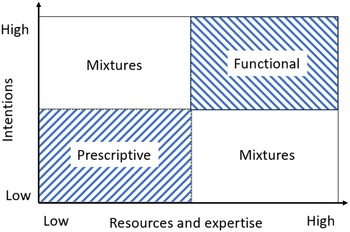
If the regulatees’ performances are divided into high and low for the two dimensions, we get four groups that can be represented in a four-field diagram, as illustrated in Figure 1. It is reasonable to assume that a functional framework is best suited for target groups in the upper-right quadrant of Figure 1. These can be said to represent a decent market. For the group in the lower-left quadrant of Figure 1, a prescriptive framework with detailed set of rules, with explicit norms and precise definitions, is preferred.
Selection of the regulation mode based on the regulatees’ features and expected behaviours.

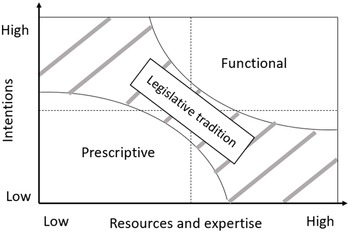
Obiviously, there will not be sharp lines between the preferred regulation modes. In addition, legislative tradition will have an impact. The civil law tradition, which is typical of central European countries (eg France, Germany) and Scandinavia, is characterized by an emphasis upon written law.Footnote 10 Legal practice according to this tradition typically will increase the the “Prescriptive” area and reduce the “Functional” area in Figure 1. The common law tradition, relying on common standards and as seen in the British and US legal systems, will increase the “Functional” area in Figure 1. The nuances between these perspectives to achieve moderate trust (to be discussed below) are illustrated in Figure 2.
Selection of the regulation mode based on the regulatees’ features and expected behaviours and the legislative tradition.

The Norwegian and US legal frameworks address many of the same risk issues. However, there are significant differences between the two regimes with regard to the assignment and scope of responsibilities and how they are to be implemented. In Norway, the regulations set forth in very broad terms the functions that operators should perform regarding internal control and accompanying non-binding guidelines but without prescriptive details. The US law authorising offshore oil and gas operations assigns regulatory responsibilities to several agencies and discusses operators mainly with regard to their duties to comply with prescriptive regulations to ensure that these activities are safely conducted.Footnote 11
The judicial system in Norway belongs to the civil law tradition. The civil law tradition is characterised by an emphasis on written law (statute law), favouring prescriptive norms, which is somewhat in contrast to the common law tradition seen in most states of the USA, where legal practice is also emphasised, favouring functional norms.Footnote 12
In this way, safety regulation in Norway and the USA diverge from each other, and also from the mainstream legal traditions in each of the two countries. Hence, based on the above, here we will characterise the US regulation mode as “Prescriptive” and the Norwegian regulation mode as “Functional”.
It is intriguing that these two nations have selected regulation regimes that are the opposite to their legal traditions for players in a global industry that would be expected to follow the same business model, including intentions to follow rules and levels of resources and expertise, irrespective of where they operate. However, they may both have selected effective/efficient regulation modes given their different regulatory contexts. To explain this, we believe an additional dimension or merit must be added to the two-dimentional “ressource–intention” representation given above; namely, that of trust.
IV. A model for an effective regulation mode
Trust between different parties is a large and complex area. It is outside our scope to cover this extensively here. Nevertheless, we stick to a rather straightforward understanding of the concept of trust. In the context of regulation, one may encounter terms such as “confidence”, “authority”, “legitimacy” and “accountability”. A perspective on trust claims that both trust-based and mistrust-based strategies involve reducing complexity; in other words, trust reduces social complexity by allowing specific unwanted behaviours to be removed from consideration, whereas distrust works to reduce the complexity of unwanted behaviours. Here, trust means an open dialogue between industry and the regulator and the regulatees (industry) trusting that the regulator will exercise their legislative task of mistrust with the best of competence and intentions. This reduction in complexity provides more effective regulation. We have above illustrated the selection of the regulation mode according to the regulatees’ expected behaviours and features in two dimensions, but to obtain a model with a broader perspective we must add a third: trust in the regulator (and vice versa: the regulator’s trust in the regulatees).
-
(1) Intentions
-
(2) Resources and expertise
-
(3) Trust
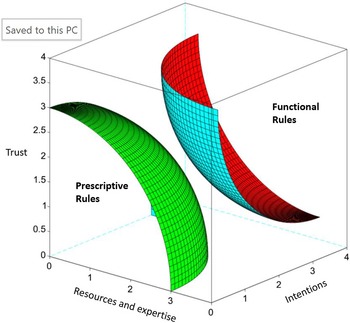
For the reasons given above, for a regulatee with high intentions and high resources and expertise and with high trust in the regulator, a “Functional” regulation mode will be most efficient. For the same regulatee but with low trust, a “Prescriptive” regulation mode will be most effective. In three dimensions, this can be illustrated as in Figure 3, on a scale from 0 to 4.
Three-dimensional model for the selection of the most effective regulation mode.

The model can be used in a dynamic way, not only guiding the choice of the most effective regulation mode in the current situation. Regarding maintaining robust regulations based on functional rules, the model provides guidance, in a causal chain manner, on which features to be improved. This agrees with the perspective of Tyler,Footnote 13 who argues that the procedural justice approach shares a core similarity with the restorative justice approach. The restorative justice approach argues that the goal when dealing with people who may have broken social rules should be to seek ways to heighten the future motivations that those people have to engage psychologically and behaviourally in society. This engagement includes developing or becoming more committed to social values that promote self-regulation and consequently adhering more closely to laws and social regulations in the future. In our model, procedural justice relies on prescriptive rules, while functional rules facilitate restorative justice. Hence, functional rules represent a more effective regulation mode.
To achieve this regulatory mode through self-regulation, the regulator (authority) will also have to change its way of working. There has to be a shift from operating remotely at a desk, assuming that a monetary penalty will magically induce all desired changes, to engaging with how businesses actually operate on the ground.Footnote 14 Furthermore, achieving this will require open and transparent responses to the authority by businesses at all levels. This means that there must be an industry–regulator relationship of trust on an open, full and frank basis.
V. Verifying interviews
Members of the Regulatory Forum, the Safety Forum and the NORSOK-standard Expert Group on Materials representing oil and gas companies, suppliers, labour unions and governmental agencies were contacted and asked to participate in this study. The interviews were conducted using a web-based predefined questionnaire consisting of twelve questions, four of which will be reported here. The request was sent out to sixty respondents by email, endorsed by the forum and group leaders; thirty-one replied, representing a response rate of over 50%. The breakdown by oil company/supplier/other was 10/7/14. No analysis has been conducted regarding the difference in responses between these three groups.
We asked the respondents questions regarding self-assessing the oil companies’ intentions and their resources and expertise. The model for the regulation mode presented in this paper was not represented to the respondents, but the multiple-choice questions were designed to gauge indirectly their behaviours and features:
-
(1) Intentions question: assess the resources and expertise in your organisation in other skill areas than your own with relevance to avoiding major accidents. This is a measure of management’s intentions to follow the regulations.
-
(2) Resources and expertise question: assess the (a) resources and (b) expertise in your own skill areas with relevance to avoiding major accidents. This is a measure of the necessary expertise being present in the organisation to follow the regulations.
The answers from the respondents were given through categorical quantitative assessments; however, we acknowledge that these questions cannot fully gauge all of the qualitative aspects and nuances in this field and may need to be further developed. The responses are rather similar for all four of the questions, as highlighted in Table 1. For resources and expertise, these are calculated together, and the average is used to gauge intentions and resources and expertise. Scores were multiplied by four for “Increasing”, multiplied by two for “Stable” and multiplied by zero for “Declining”, and the final score represents the sum total divided by the number of answers. This process gave scores of 2.22 for intentions and 2.26 for resources and expertise.
Responses from members of the Regulatory Forum, the Safety Forum and the NORSOK-standard Expert Group on Materials regarding assessing their own organisations with relevance to avoiding major accidents.

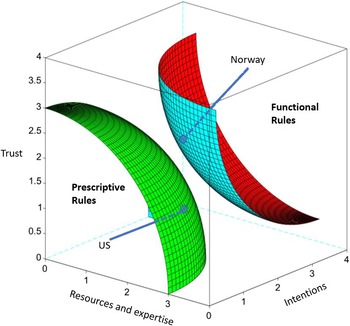
The third feature of trust between the regulatee and the regulator is not investigated separately in this study. We rely upon previously published data on the levels of trust in different countries. Hence, trust is set equal to the “index of legal certainty” of 7.19 for Norway,Footnote 15 with a base deduction of 4.00, which gives 3.19 on a 0–4 scale. These three scores for intentions, resources and expertise and trust are plotted in the model, and they are shown in Figure 4. As can be seen in Figure 4, the “Functional” Norwegian regulation mode is effective given the scores on regulatees’ intentions, resources and expertise and trust between the regulates and the regulator. Furthermore, Figure 4 illustrates that, as the judicial system in Norway belongs within the civil law tradition, favoring prescriptive norms, small negative changes in or deceptions of these features will challenge this regulation mode.
Three-dimensional model for the regulation mode showing the Norwegian and US contexts. Both are deemed effective due to differences in their levels of trust.

VI. Model for an effective regulation mode: validation
Rigorous and extensive studies have been conducted to compare the differences and similarities between the US and Norwegian regulation modes. We have not conducted similar interviews with the US parties in the offshore oil and gas industry as in Norway. However, it would be interesting to seek to understand and categorise the differences between the two countries (Norway = “Functional” and US = “Prescriptive”) and to investigate whether the proposed model could help explain them and thereby validate the model for two different nations and regulation modes.
Given the global nature of the offshore oil and gas industry, we find it reasonable to judge that the intentions and resources and expertise of the industry would be equal in the two nations. The numbers from Norway can therefore be used for both nations. However, the level of trust is different, and so this difference needs to be included in the model. Trust between the parties is set equal to the “index of legal certainty” of 7.19 for Norway and 5.75 for the USAFootnote 16 with a base deduction of 4.00, which gives 3.19 and 1.75, respectively. This is illustrated in Figure 4.
A third nation that could be assessed in order to test the model is Brazil. Brazil, which belongs within a similar legal tradition as Norway, has chosen to regulate the same industry differently. Brazil uses a regulatory framework that is in line with its legal tradition, with detailed requirements in the regulations, thus using prescriptive rules as expected within the civil law tradition. This difference from Norway may be explained by different national expectations and social factors (eg by the fact that tripartite cooperation is not established in the same way in Brazil as in Norway).Footnote 17 In the Norwegian system, continuing dialogue is expected between the authorities, firms (employers) and employees, which suits with the C-repertoire’s requirements,Footnote 18 whereas in Brazil, contact between the parties is more accurately characterised by the R-repertoire.
Using the same rationale as above to judge the intentions and resources and expertise of the industry in the two nations, it can be seen that they are equal. Our investigation in Norway gave scores of 2.22 for intentions and 2.26 for resources and expertise. These values, when inserted into a simple two-dimensional model (given in Figure 1 with a scale of 0–4) are appropriate for functional rules.
Again, the level of trust is different between these two nations, and so this will need to be included in our three-dimensional model. Trust is set equal to the “index of legal certainty” of 5.63 for Brazil, which is slightly less than that of the USA.Footnote 19 The three-dimensional model therefore indicates that a “Prescriptive” regulation mode would be effective in Brazil. Moreover, the fact that Brazil has selected a regulation mode that is in line with its legal tradition will make such regulation more robust if it is challenged by external stakeholders.
VII. Discussion and conclusions
We have presented the rationale and developed a simple, novel model in three dimensions for the evaluation of an effective regulation mode. The axes are: (1) the regulatees’ intentions; (2) resources and expertise; and (3) trust between the regulatees and the regulator. Based on the literature in this area, we argue that the model is relevant for risk governance. Each of these three features can be elaborated further than has been presented here, strengthening the relevance of the model for regulation-mode selection and for suggesting areas that could be improved for both the regulatees and the regulator.
In presenting the model addressing two rule types, we acknowledge that the enforcement strategy is to a large extent a condition of the rule type applied. The notion that enforcement strategies are different for “Functional” and “Prescriptive” rules is embedded in the model.
The presented model for effective regulation should be further developed, and it should be considered whether more quantitative analyses should be carried out. The model should be tested on agencies and authorities that use detailed regulations or have large differences between supervisory objects (or regulatees) in order to investigate whether it is relevant to these contexts as well.
Competing interests
The authors declare none.


 Open access

