


Significant political transformations are reshaping the contemporary world, and Latin America is no exception. Among the most notable developments attracting both academic and public attention is the rise of far-right forces, whose relationship with liberal democracy remains deeply contentious. The reelection of Donald Trump in 2024 and the strong electoral performance of populist radical-right parties across Eastern and Western Europe suggest that the far right is not an ephemeral phenomenon but rather part of a broader process of electoral realignment. As noted at the outset of this book, only recently have Latin American countries witnessed the electoral emergence of far-right actors, some of whom have even attained presidential office. Given the relative novelty of this phenomenon, empirical evidence remains limited regarding both the commonalities and differences among these Latin American far-right forces and their global counterparts.
Drawing from the preceding chapters and existing academic literature, this concluding chapter provides a comparative discussion divided into four sections. We begin by analyzing the ideological (dis)similarities among the case studies presented in the book. This analysis allows us to identify core ideological features that are prevalent across all instances of the far right in Latin America, as well as secondary ideological attributes unique to specific cases. After this, we examine how different party system dynamics influence the emergence, electoral strength, and competitive behavior of the far right across Latin America. In the subsequent section, we highlight some unexpected findings – comparative outcomes that were not anticipated in our initial analytical framework but are crucial for understanding the current situation and potential trajectory of the far right in the region. Finally, we place the Latin American far right in a broader comparative perspective, distinguishing unique aspects of the far right in Latin America and identifying features shared with far-right forces globally.
10.1 Ideological (Dis)Similarities
After the Third Wave of Democratization, the distinction between right and left in Latin America primarily centered on the socioeconomic dimension, particularly the roles assigned to the “market” versus the “state.” In this context, right-wing political leaders and parties were characterized by their support for free-market policies (Roberts, Reference Roberts2012). In fact, the public and scholarly debate surrounding the “Pink Tide” was heavily focused on differentiating various left-of-center forces, mainly in terms of their stance on the economic model. Academic literature often distinguished between moderate and radical versions of the left, based on their willingness to either adapt to or dismantle the capitalist system (Weyland et al., Reference Weyland, Madrid and Hunter2012; see also Levitsky & Roberts, Reference Levitsky and Roberts2011).
However, the emergence of the far right in recent years has shifted the focus of the political distinction between the right and left from socioeconomic to sociocultural issues. Part of this political shift is related to the fact that debates and reforms on sexuality politics in Latin America have created conditions for electoral realignments in favor of religious attitudes at the expense of economic preferences (Smith & Boas, Reference Smith and Boas2024). As highlighted in several chapters of this book, the far right indeed prioritizes the sociocultural dimension, with moral conservatism being a core tenet across the region. Far-right leaders and parties champion traditional values, particularly regarding the role of family and religious institutions within the state. This stance has led to widespread opposition to gender and LGBTQ+ equality policies, with a central element of their discourse being the fight against the so-called gender ideology they claim is corrupting society (Biroli & Caminotti, Reference Biroli and Caminotti2020).
This emphasis on the sociocultural dimension encompasses far-right leaders with diverse trajectories. For instance, José Antonio Kast’s, Jair Bolsonaro’s, and Guido Manini Ríos’s entire careers have been closely associated with moral conservatism (see Chapters 3, 5, and 7, respectively). In contrast, far-right forces in countries like Argentina and El Salvador have gradually incorporated these themes. As highlighted by Meléndez-Sánchez (Chapter 4), Bukele has shifted from his earlier progressive positions on sociocultural issues to adopting strong conservative stances on topics such as abortion and gay marriage. Similarly, the analysis of Argentina shows that Javier Milei has increasingly embraced conservative positions on moral issues, often criticizing the left for allegedly seeking to undermine the moral foundations of Western societies (see Chapter 2). Far-right actors in Peru and Colombia are moving in diverse directions. As pointed out in Chapter 6, Rafael López Aliaga is a member of Opus Dei who re-founded Renovación Popular relying on an ultra-conservativist agenda to distinguish himself from other right-wing electoral platforms. In Colombia, Maria Fernanda Cabal has radicalized the stances of the mainstream right Centro Democrático (CD). At the center of her discourse is the politicization of gender and sexuality, with special emphasis on the “gay lobby” and “gender ideology” (see Chapter 8).
As argued in the introductory chapter and several other chapters, the growing emphasis of far-right actors on sexuality politics and moral conservatism in Latin America is closely connected to recent expansions of rights for historically marginalized groups. The region has witnessed important transformations, including the legalization of abortion in countries such as Uruguay (2012), Argentina (2020), Mexico (2021), and Colombia (2022). Progress has also been notable in the sphere of LGBTQ+ rights, with measures such as the recognition of same-sex marriage and the introduction of legal protections against discrimination (Abreu Maia et al., Reference Abreu Maia, Chiu and Desposato2023). This broader trend toward greater inclusion has triggered a cultural counter-reaction, reflected in the adoption of anti-gender and anti-LGBTQ+ rhetoric by both conservative sectors of society and segments of the political elite (Smith & Boas, Reference Smith and Boas2024). Within this context, debates often framed as “culture wars” serve as an ideological foundation for the far right in Latin America, illustrating how processes of social inclusion unfold alongside intensified conservative resistance. From this perspective, the rise of the far right in the region can be understood through the lens of Ignazi’s (Reference Ignazi1992) canonical work on Western Europe: the expansion of liberal values – the “silent revolution” – paved the way for a backlash – the “silent counter-revolution” – now articulated by diverse far-right actors.
Another ideological element that the far right has emphasized across the region is penal punitivism – that is, a preference for law-and-order policies grounded in the use of force and a punitive state response to crime. This stance reflects the far right’s broader belief in a strictly ordered society, where transgressions against authority must be punished severely (Mudde, Reference Mudde2007, p. 23). Indeed, it is not far-fetched to argue that
key to the far right’s programs around the globe are tough law-and-order issues … For the far right, crime is not related to socioeconomic conditions … and has to be confronted with ruthless law enforcement. It therefore calls for more police on the streets and tougher sentences … as well as less “political meddling” in law enforcement. Many groups also emphasize the need for schools to return to teaching youth discipline, respect, and “traditional values.” (Mudde, Reference Mudde2019, pp. 34–35)
However, penal punitivism holds greater salience in Latin America than in Europe or the United States, where crime levels have remained relatively stable or even declined over time. In contrast, criminality in Latin America has been rising, as scholars have documented the expansion of drug cartels and informal markets that seriously challenge state capacity to impose order (e.g., Arias, Reference Arias2017; Dammert, Reference Dammert2025; Feldman & Luna, Reference Feldman and Luna2022). Under these circumstances, it is hardly coincidental that far-right actors across the region politicize public security and advocate for strengthening the state’s coercive apparatus to combat crime – even if this entails transgressing the formal and informal norms of liberal democracy. Their proposals typically include greater investment in prisons, harsher sentencing, and easier access to firearms.
The most emblematic case is El Salvador, where Nayib Bukele built the largest prison in the Americas and became known in the region for his “war on gangs” (see Chapter 4). With the support of his legislative caucus, Bukele approved an exceptional regime in 2022 that suspended several constitutional rights and has since been characterized by systematic human rights violations, according to several national and international organizations. Penal punitivism is also linked to denying international human rights standards, as Rennó shows in Chapter 3. In addition to promoting punitive policies, Bolsonaro divides society into “normal people” and “delinquents” whose rights should not be respected, even giving the police “license to kill” and “normal people” weapons to defend themselves against these “delinquents.” Nevertheless, even in Colombia, where the far right is just in a “germination process,” this kind of discourse is also present. Maria Fernanda Cabal has renewed and radicalized Uribismo in the country through a strong mano dura discourse, moving beyond firm opposition to the peace processes that have been underway in the country over the last decade and being a constant advocate of tough-on-crime policies such as legal gun ownership (see Chapter 8). In the case of Chile, the far right also advocates for iron-fist policies, often arguing that crime is linked to terrorism in the Araucanía region and to the influx of migrants across the country (see Chapter 5). In Uruguay, Cabildo Abierto followed a similar path to the Latin American far right by defending law-and-order policies on public security. As shown in Chapter 7, this position allows the party to differentiate itself from the mainstream right, whose program was originally focused mainly on socioeconomic issues. Finally, Javier Milei adopts ambiguous positions on penal punitivism, often changing his mind on the free carrying of weapons, for example. As a hallmark of Argentina’s far right, the defense of this agenda is accompanied by a robust neoliberal discourse, proposing to deregulate the legal market (see Chapter 2).
In essence, the far right across Latin America converges on two key ideological pillars: moral conservatism and penal punitivism. These principles form the bedrock, the basic shared ideology, among the far-right examples examined in this book, encompassing countries like Argentina, Brazil, Chile, Colombia, El Salvador, Peru, and Uruguay. Captured in Table 10.1, these commonalities serve as the “minimal common denominator” of far-right forces in the region. However, beyond this foundational alignment, Table 10.1 also delineates additional ideological distinctions specific to certain cases. In the following, we delve into these nuances, elucidating how they contribute to the varied ideological landscapes within the far right. This discussion enables a more fine-grained understanding of the ideological spectrum, discerning between projects of differing levels of complexity and ideological depth.
Populism is one aspect that has received wide attention in the scholarly debate on the far right in Europe and beyond. In fact, there is wide agreement that European radical-right parties tend to articulate a populist worldview, understood as a set of ideas that not only distinguishes between “the pure people” and “the corrupt elite,” but also defends that politics should respect the popular will at any cost (Mudde, Reference Mudde2007; Mudde & Rovira Kaltwasser, Reference Mudde and Rovira Kaltwasser2017). As Table 10.1 reveals, this aspect is present in almost all instances of the far right discussed in this volume. The only exception is Colombia, where the absence of populism may be due to Maria Fernanda Cabal’s association with Uribismo. Given that she is a senator and is part of the political elite, it is not easy for her to use populist rhetoric in a convincing manner (see Chapter 8).
To illustrate how populist tropes are employed by the far right in Latin America, we draw on the case studies analyzed in this book. For example, Rafael López Aliaga, the mayor of Lima, uses populism to distinguish himself from other Peruvian right-wing parties and to oppose elites allegedly involved in corruption scandals as well as those supporting progressive cultural positions (see Chapter 6). In Chile, populism also addresses the broader political elites, but it is more focused on the left and more present in the party than in the leader, most likely because José Antonio Kast originally comes from the establishment and belongs to a family with a long tradition in Chilean politics (see Chapter 5). In Chapter 3 on Brazil, Rennó shows that Jair Bolsonaro is a peculiar populist figure, because he has strong far-right ideological positions, combining elements of the populist radical right and the extreme right. Moreover, in Chile and in Brazil, the “pure people” are very much connected to individuals with specific moral convictions associated with the traditional family and Christian values linked to Catholics and Evangelicals. The far right in Uruguay, which is led by a former army general, leverages populism to revalue the homeland and the military and to revive a nostalgic vision of the country’s past. This blend of populism and (neo)patriotism allows the Uruguayan far right to target the “corrupt elite” while portraying the armed forces as the true representatives of the “pure people,” capable of safeguarding the nation’s fundamental interests (see Chapter 7). In El Salvador, Bukele adopted a populist discourse from the start while only later incorporating far-right positions, especially when he became president. As Chapter 4 shows, Bukele transcends the left–right divide and addresses the traditional parties as corrupt and part of the same oligarchy. In Argentina, Milei also used populist rhetoric from the beginning of his career, except that he combined populism with a strong anti-state discourse, in line with his libertarianism (see Chapter 2).
Another widely shared aspect of the far right in Latin America is a negative political identity toward the left, framed not only in programmatic terms but predominantly in moral language. Scholars have demonstrated that this rhetoric fosters affective polarization, characterized by a strong affinity toward one’s own party and fellow partisans (in-group) and pronounced hostility toward opposing political parties or compatriots with differing political identities (out-group) (Gidron et al., Reference Gidron, Adams and Horne2020; Iyengar et al., Reference Iyengar, Lelkes, Levendusky, Malhotra and Westwood2019; Mason, Reference Mason2018). Left-wing actors are portrayed as malevolent agents intent on undermining the social fabric and the democratic regime. The far right in the region frequently employs terminology targeting both transnational antagonists (e.g., anti-communism, anti-Chavismo) and national enemies (e.g., anti-Peronismo, anti-Petismo, anti-Frenteamplismo). By depicting the left as a sinister force, the far right often merges critiques of local actors with a broader narrative about global agents who are purportedly collaborating and sharing perilous ideologies, such as “cultural Marxism” and “socialism.” This constant critique of left-wing forces and their allies often leads the far right to adopt an anti-pluralist discourse, in which the left is not regarded as a legitimate rival but as an enemy. As Levitsky and Ziblatt (Reference Levitsky and Ziblatt2018) argue in their groundbreaking book, such rhetoric can be understood as an indicator of authoritarian behavior, particularly the denial of the legitimacy of political opponents.
In Argentina, Brazil, and Uruguay, the far right focuses on national enemies due to the existence of solid left-wing political identities in these countries. Milei, again using opportunistic discourse, moved from an anti-establishment to an anti-Peronismo and anti-Kirchnerismo discourse in the second round of the presidential elections. As Chapter 2 shows, this served to form a broader right-wing political coalition and compete against the left-wing candidate, Sergio Massa. Bolsonaro employs an extremely aggressive discourse against the left, associating anti-Petismo with anti-communism to glorify the armed forces and defend the family and God. In the 2022 presidential election, the former president even suggested that his opponent, the then-former and now-current president, Lula da Silva, was the Devil who wanted to install communism in Brazil (see Chapter 3). Manini Ríos’ leadership in Uruguay is marked by a rejection of the fifteen years of Broad Front governments that have allegedly ruined two “family ideals”: the Uruguayan family, with its agenda of gender equality and LGBTQ+ rights, and the military family, in the face of the trial of military personnel linked to human rights violations during the dictatorship (see Chapter 7).
In Chile and Peru, the emphasis on anti-communism predominates. José Antonio Kast uses anti-communism to oppose all the parties of the Chilean left, as well as the government of Salvador Allende and Popular Unity. In this context, it is important to note that the use of anti-communist rhetoric is shared between the far right and the mainstream right to target the left (see Chapter 5). In Peru, anti-communism is also shared by the variety of right-wing actors that exist in the country, who use communism to associate the left with terrorism, alluding to the guerilla past widely rejected in the country. According to Chapter 6, Rafael López Aliaga is the most frequent user of the anti-communist rhetoric, linking the international left with progressive political actors. Last but not least, in Colombia, Maria Fernanda Cabal shows a constant hostility to everything she considers an exponent of the extreme left, whether it’s Fidel Castro, Hugo Chávez, social mobilization, or even the winner of the Nobel Prize for Literature, Gabriel García Márquez (see Chapter 8).
Finally, scholars have been paying growing attention to the link between the far right and climate change denialism, particularly regarding the European populist radical right (Forchtner, Reference Forchtner2019; Huber, Reference Huber2020; Moore & Roberts, Reference Moore and Roberts2022). This attribute is conceived as skepticism concerning global warming and disbelief in the seriousness of climate change and its consequences (Stoll Kleeman et al., 2001). Examining the case studies within this book, two instances stand out where the far right presents rhetoric that contradicts the scientific consensus on issues like global warming and climate change: Brazil and Colombia. In Brazil, the government under President Jair Bolsonaro has frequently downplayed the significance of environmental concerns, advocating for increased deforestation of the Amazon rainforest and casting doubt on climate change science (see Chapter 3). Similarly, in Colombia, the far right has adopted rhetoric minimizing the importance of addressing climate change. This stance often aligns with interests in extractive industries, such as mining and oil drilling, which have significant environmental impacts (see Chapter 8).
While the far right in Latin America has indeed placed significant emphasis on the sociocultural dimension, it would be erroneous to overlook the presence of the socioeconomic dimension within their discourse and policy proposals. On the contrary, a steadfast defense of neoliberal ideas emerges as a prevalent theme across all the cases examined, with the exception of El Salvador. Neoliberalism, broadly defined, encompasses a set of economic principles advocating for limited government intervention in markets, deregulation, privatization of public services, and a focus on free trade and individual responsibility. In the context of Latin America, neoliberal policies have been associated with measures such as austerity programs, structural reforms, and trade liberalization, often promoted under the auspices of fostering economic growth and development (Roberts, Reference Roberts2012).
In the cases under examination, the far right consistently advocates for neoliberal economic agendas, prioritizing market mechanisms and private enterprise while advocating for reduced government intervention in the economy. One striking example is Javier Milei in Argentina, whose unconventional libertarian discourse as a presidential candidate encompassed proposals for fiscal austerity, privatization, currency dollarization, and the closure of the central bank (see Chapter 2). Similarly, in Chile, the far right’s support for a free market economy harks back to the neoliberal policies implemented by the Chicago Boys during Augusto Pinochet’s military dictatorship. This stance also represents a deliberate departure from the mainstream right’s gradual tendency to accommodate the public demand for more involvement of the state in the economy (see Chapter 5). Moreover, the defense of neoliberalism is evident in Brazil and Peru, where figures like Jair Bolsonaro and Rafael López Aliaga have co-opted existing parties (the Liberal Party and Popular Renewal, respectively) to propagate neoliberal discourses. Popular Renewal identifies itself as a defender of a social market economy, reaffirming that although it adopts a neoliberal economic model, it accepts that on some occasions, it needs to be regulated (see Chapter 6). Jair Bolsonaro defends a liberal economic agenda in favor of reducing state intervention in the economy, and it is not for nothing that he privatized the state electricity company Eletrobrás during his presidential term (see Chapter 3). In Colombia, the socioeconomic issue is a recent feature in the electoral and political competition. In this sense, Cabal has presented herself not only as a staunch opponent of the left and Gustavo Petro’s government but also as an open defender of capitalism, without really developing her ideas and discourses on this issue (see Chapter 8). Finally, Uruguay is a country where the neoliberal agenda is less present among the Latin American far right, which instead advances an agenda that remains ambiguous regarding neoliberalism while centered on moral conservatism and penal punitivism. Chapter 7 explains that it might be due to the lack of support for neoliberalism in the country or the fact that the neoliberal agenda is monopolized by the mainstream right, which does not allow Cabildo Abierto to differentiate itself from the rest of the political right.
The exceptional case of El Salvador is analyzed by Meléndez-Sánchez in Chapter 4. Nayib Bukele comes from a left-wing background and even criticized his former party, the Frente Farabundo Martí para la Liberación Nacional (FMLN), for proposing neoliberal measures. In effect, his government agenda concerning socioeconomic issues aims to reduce material inequalities and expand or maintain the state’s economic role. At the same time, in the context of the apparent success of his public security agenda, there is a growing demand for more attention to be paid to the socioeconomic agenda. However, the country’s future is uncertain in the context of authoritarian stabilization.
Interestingly, anti-immigration discourse is notably scarce within the rhetoric of the far right in Latin America, with the exception of Chile. The influx of migrants, primarily from Colombia and Venezuela, in recent years has catalyzed the politicization of this issue in Chilean politics (see Chapter 5; Rovira Kaltwasser et al., Reference Rovira Kaltwasser2023). However, in other Latin American countries where significant increases in migrant populations have not been experienced, there appears to be little interest among the far right in prioritizing this issue. This stands in stark contrast to contemporary Europe and the US, where nativism is often a central or even the paramount issue advocated by far-right forces (Mudde, Reference Mudde2019).
Nevertheless, the absence of an explicit anti-immigration or nativist agenda does not mean that discourses centered on race and ethnicity are absent. While this is not a defining feature of the far right in Latin America as a whole, it can be observed in several national contexts. The most evident case is Chile, where far-right actors have systematically targeted the Mapuche population, portraying their territorial claims and demands for autonomy as threats to national security and public order. This framing is often accompanied by calls for harsher policing, the militarization of Indigenous territories, and the depiction of Mapuche activism as violent or criminal (see Chapter 5). In Brazil, racial and ethnic dimensions are also central, reflected in Bolsonaro’s constant attacks on Indigenous peoples, such as his repeated attempts to reduce protections for Indigenous lands, and his firm opposition to racial quota policies (see Chapter 3). Similar dynamics appear elsewhere. For instance, in Colombia, Cabal has framed Black and Indigenous populations within a discourse of otherization (see Chapter 8). Finally, it is important to highlight the racialization of Venezuelan and Haitian migrants, who are frequently constructed as second-class foreigners, revealing how migration debates also intersect with racial hierarchies in the region.
Overall, there are significant ideological similarities and differences among far-right actors in Latin America. Across the board, they share morally conservative positions and advocate for penal punitivism. Additionally, many cases exhibit further ideological elements such as neoliberalism, populism, and strong rejection of the left (anti-communism/anti-Chavismo). However, issues like climate change denialism and anti-immigration rhetoric are relatively rare within the discourse of the far right in Latin America. Upon examining all the cases presented in this book and summarized in Table 10.1, it becomes evident that El Salvador’s President Bukele represents a unique instance. Bukele’s ideology is characterized by a selective combination of populism, penal punitivism, and moral conservatism. As convincingly argued by Meléndez-Sánchez in Chapter 4, this uniqueness can be attributed to Bukele’s trajectory, starting as a left-wing figure and gradually adopting critical stances toward the political establishment, while also adjusting his policy proposals to maintain popularity. In contrast, other instances of the far right offer more intricate discourses that amalgamate various ideological traits to construct political narratives that resonate with prevalent social grievances in different national contexts.
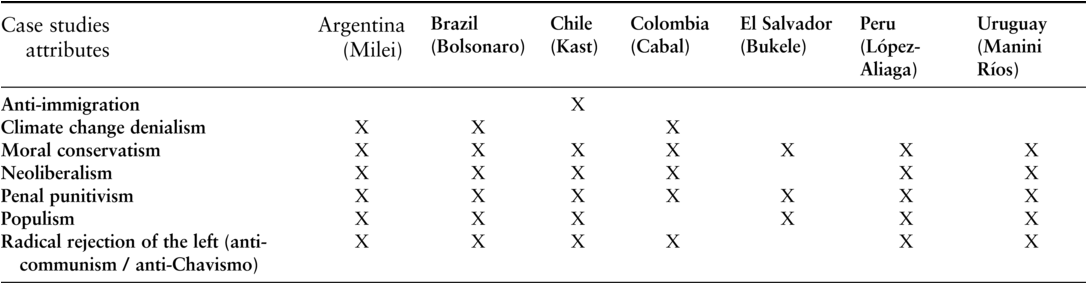
Table 10.1 Long description
The table has eight columns titled Case studies, attributes. Argentina, Milei. Brazil, Bolsonaro. Chile, Kast. Colombia, Cabal. El Salvador, Bukele. Peru, Lopez-Aliaga. Uruguay, Ríos Manini.
Anti-immigration has an X-mark for Chile.
Climate change denialism has an X-mark for Argentina, Brazil, and Colombia.
Moral conservatism has an X-mark in all columns.
Neoliberalism has an X-mark in all columns except for the column, El Salvador.
Penal punitivism has an X-mark in all columns.
Populism has an X-mark in all columns except for the column, Colombia.
Radical rejection of the left, anti-communism or Anti-Chavismo has an X-mark in all the columns except for the column El Salvador.
The rest of the cells are blank.
The note below reads. Author’s own elaboration.
10.2 Party System Dynamics
There is a rich body of academic literature that seeks to explain the rise of far-right parties in Europe since the 1980s. Scholars such as Ignazi (Reference Ignazi1992), Bornschier (2010), and Best (Reference Best2013) have extensively studied the conditions under which far-right parties emerge and gain traction. These conditions include sustained political polarization, the erosion of trust in traditional parties, ideological convergence between mainstream left and right, and increased party system fragmentation. Under such circumstances, far-right actors can position themselves as authentic outsiders or defenders of lost principles, filling programmatic or representational voids left by traditional parties. We think that these arguments could also be relevant to understanding the rise of far-right leaders and parties in Latin America. However, the diversity of right-wing forces in this region complicates the application of a single theory to all the cases examined in this volume.
For instance, Ignazi (Reference Ignazi1992) argues that far-right parties often emerge in response to the perceived ideological convergence of traditional right-wing and left-wing parties, creating a “void” that far-right parties exploit by offering more radical alternatives. This perspective applies to the case of Chile, where the Partido Republicano (PR) emerged as a reaction to the gradual ideological convergence of the mainstream right and mainstream left (Madariaga & Rovira Kaltwasser, Reference Rovira Kaltwasser2020). The PR capitalized on the perceived moderation of the mainstream right, positioning itself as a defender of ultra-conservative values (Díaz et al., Reference Díaz, Rovira Kaltwasser and Zanotti2023). The centrist shift of the traditional right-wing coalition was interpreted by José Antonio Kast as an “abandonment of principles” (see Chapter 5). Thus, the PR seized the space left at the far-right end of the political spectrum after the mainstream right’s moderation, a pattern similar to the emergence of Frente Amplio on the left. In Chile’s case, as Chapter 5 explains, the rise of a far-right party can be seen as the response of ultra-conservative sectors to the increasing ideological convergence between mainstream right and mainstream left coalitions.
In the case of Uruguay, Ignazi’s (Reference Ignazi1992) argument is also relevant. The two traditional right-wing parties, Partido Colorado and Partido Blanco, experienced ideological convergence during the 1990s (Chasquetti & Buquet, Reference Chasquetti and Buquet2004). As Chapter 7 explains, while these parties did not abandon the core issues of the right-wing agenda – in economic and cultural dimensions – and maintained their opposition to the left (which was in power from 2005 to 2020), their distinct party identities became diluted due to growing programmatic overlap. Despite this, the anti-incumbent sentiment was strong, so that there remained space for a right-wing anti-establishment opposition. Cabildo Abierto emerged by challenging the “consensus particracy” (spanning from left to right) and emphasizing punitive measures and moral conservatism. However, its rise did not prevent the electoral victory of the conventional right (Queirolo, Reference Queirolo2020). In fact, after the Partido Blanco returned to power, Cabildo Abierto did not follow the Chilean PR’s example of opposing the new government from a more extreme right-wing stance. Instead, it joined the incumbent Multicolor Coalition and supported the new government, led by the mainstream right.
In turn, Bornschier (2010) argues that far-right parties often thrive in highly polarized political environments, where they can present themselves as the only viable alternative to the established political order. This dynamic is evident in Brazil, where Jair Bolsonaro’s ascent was fueled by widespread disillusionment with both the leftist Partido dos Trabalhadores (PT) and the traditional right-wing parties – Partido da Social Democracia Brasileira (PSDB) and Movimento Democrático Brasileiro (MDB) – particularly after the impeachment of Dilma Rousseff, which was orchestrated by the mainstream right. Bolsonaro capitalized on the discrediting of the political establishment, as both the left (PT) and the right-wing opposition (PSDB and MDB) were embroiled in major corruption scandals. The heightened confrontation between PT and the mainstream right deepened societal polarization (Fuks & Marques, Reference Fuks and Marques2020), undermining the tradition of pluralistic cooperation that had characterized Brazilian coalitional presidentialism from 1994 to 2014 (Power, Reference Power2010). Bolsonaro positioned himself as the only candidate capable of confronting the PT after the decline of the conventional right (PSDB and MDB, with the latter leading the interim government under Temer). As Chapter 3 outlines, Bolsonarismo emerged as a formidable force in the 2018 election by intensifying polarization and replacing the discredited conventional right, aiming to monopolize the right-wing spectrum with a radical anti-establishment platform during a period of moral crisis. The absence of credible right-wing competitors enabled Bolsonarismo to push the boundaries further, reaching an anti-systemic extreme that poses a potential threat to Brazil’s democratic regime.
Polarization also played a crucial role in Argentina, where Javier Milei’s rise occurred amidst a heightened confrontation between Peronism and anti-Peronism (Torcal & Carty, Reference Torcal and Carty2023). Milei’s political movement, La Libertad Avanza, capitalized on the economic failures of both the mainstream right’s previous administration and the incumbent Peronist government’s inability to control inflation. As Chapter 2 explains, this situation allowed Milei to promote an anti-establishment discourse, adopting radical positions on both economic and cultural issues to distinguish himself from the mainstream right, particularly Macri’s Propuesta Republicana (PRO). Once he qualified for the 2023 runoff, Milei shifted strategies. Despite being an outsider with minimal representation in the legislature and no subnational support, Milei secured backing from the anti-Peronist camp, taking advantage of the deep polarization during the runoff. Ultimately, mainstream right-wing sectors rallied behind Milei to avoid becoming temporary allies of Peronism. Upon assuming power, Milei had to rely on the support of mainstream right cadres to sustain his administration.
The rise of Nayib Bukele in El Salvador provides another example of far-right leadership emerging in polarized political contexts. Bukele’s ascent can be understood against a backdrop of widespread disillusionment with traditional parties on both the right Alianza Republicana Nacionalista (ARENA) and the left Frente Farabundo Martí para la Liberación Nacional (FMLN). As Chapter 4 highlights, Bukele exploited the perception of corruption and ineffectiveness in previous governments, positioning himself as a fresh, anti-establishment alternative. His ability to tap into public discontent and political polarization enabled him to solidify his outsider status and challenge the political status quo (Perelló & Navia, Reference Perelló and Navia2022). This approach resonated particularly with younger voters and those weary of traditional politics, allowing him not only to win the presidency in 2019 but also to consolidate power in the 2021 legislative elections, where his party, Nuevas Ideas, secured a significant majority. Bukele’s strategy of positioning himself as the sole leader capable of reforming the system in a time of moral and political crisis closely mirrors the approaches taken by Bolsonaro in Brazil and Milei in Argentina.
Finally, Best (Reference Best2013) highlights the role of party system fragmentation in the success of far-right parties. In Peru, the fragmentation of the right-wing camp, once dominated by Fujimorismo and Peruanos por el Kambio (Meléndez, Reference Meléndez2019), opened the door for Renovación Popular (RP) to emerge as a distinct far-right force. The disintegration of traditional right-wing parties allowed RP to gain autonomy and attract voters disillusioned with existing options. While the Peruvian political landscape is polarized, it differs from Brazil and Argentina due to its extreme fragmentation. According to Chapter 6, the rise of RP is largely explained by the breakdown of the right-wing bloc that was once controlled by Fujimorismo and Peruanos por el Kambio, but has since splintered into smaller factions. In the 2021 presidential election, RP finished third, presenting an ultra-social conservative agenda with a more radicalized style than Fujimorismo, which had adopted a more conventional right-wing economic platform, and Avanza País, a pro-market, culturally liberal party. The simultaneous rise of a radical-left candidate, who ultimately won the presidency, intensified political polarization and prompted conservative voters to abandon the discredited Fuerza Popular and join this new movement (Coronel, Reference Coronel2024). The combination of fragmentation and centrifugal competition among niche parties helped create space for the far-right RP to establish itself as an autonomous force in Peru.
In terms of party-system dynamics, far-right parties in Latin America have emerged in two distinct ways: either incubated within traditional right-wing parties, such as the PR as a spin-off of the Unión Demócrata Independiente (UDI) in Chile, or through the departure of members no longer aligned with the mainstream agenda, as seen with Cabildo Abierto in Uruguay. However, Latin America has yet to witness a case where a mainstream right-wing party fully radicalizes to the far right. In Colombia, María Fernanda Cabal had been positioning herself as a political leader capable of radicalizing the Uribista party CD from within. However, recent developments – such as the assassination of a CD-aligned presidential pre-candidate and the ongoing judicial process that has provisionally sentenced Álvaro Uribe – have reinforced the former president’s control over the party’s security and violence agenda. This dynamic has sidelined other issues, such as the moral conservatism that Cabal had been promoting, and thus diminished her ability to redefine the party’s programmatic direction. These distinct trajectories of party-system engagement by far-right actors are schematically summarized in Figure 1.2 in Chapter 1. The figure illustrates how some actors create new electoral vehicles, others appropriate existing parties, and a few attempt to transform the mainstream right from within – though, as the Colombian case shows, not always successfully. These pathways are shaped by both structural and contingent conditions, including the openness of party systems, elite fragmentation, and the degree to which mainstream right parties maintain internal coherence or ideological distinctiveness.
In summary, the analysis of the cases in this book demonstrates that there is no single pattern of party-system dynamics or competition that fully explains the emergence of far-right parties across Latin America. Both centripetal and centrifugal forms of competition have contributed to the rise of these forces, underscoring the diverse and context-specific pathways involved. As shown in Figure 1.2, these pathways range from outsider-driven party formation to internal contestation within established right-wing parties, each shaped by specific combinations of elite dynamics, electoral incentives, and political opportunity structures. While dominant theories from European contexts offer valuable insights, they are insufficient to provide a comprehensive framework for all instances of far-right emergence in Latin America. This suggests that although some European explanations are relevant, they must be adapted and supplemented to account for the distinct political landscapes of Latin American countries. As in Europe, it is clear that no singular institutional factor, party-system dynamic, or strategic response from establishment parties – whether left or right – can entirely explain the rise of the far right in the region. This variability underscores that far-right emergence is not automatic, but conditional upon a combination of demand- and supply-side factors: voter discontent, elite polarization, and the institutional flexibility of the party system all interact to create (or constrain) opportunities for far-right actors. This means that the far right can emerge under varying party-system conditions, illustrating that a combination of multiple factors and unique contextual circumstances contributes to the success of far-right forces.
10.3 Unexpected Findings
After analyzing the ideological similarities and differences among the far-right cases discussed in this volume, we now turn to several unexpected findings. In this section, we examine aspects that were not fully anticipated when we developed the analytical framework in Chapter 1 but that emerged from the case studies. As we emphasize below, these findings have broader implications for understanding not only region-specific dynamics but also the global evolution of the far right.
10.3.1 The Role of the Judiciary
An intriguing and somewhat unforeseen feature of far-right politics in Latin America concerns the role of the judiciary in shaping the political landscape. While in some countries progressive actors – (new) left-wing forces and/or civil society organizations – have led the politicization of cultural issues, in other contexts, the judiciary has been the key actor in pushing progressive reforms. This shift in the agent of change toward more culturally liberal policies has profound implications for the “political opportunity structure” within which the far right emerges and operates. As Mudde (Reference Mudde2007) notes, the electoral and political success of far-right forces depends not only on internal resources (discursive or organizational), but also on external factors that can facilitate or obstruct their influence (e.g., crises and strategies adopted by civil society, political parties, and international organizations).
Taking this argument into account, a notable pattern across Latin American cases of the far right is the way judicial activism in progressive policymaking alters the dynamics of accountability and blame attribution. Far-right actors in Latin America and elsewhere often gain visibility by attacking political opponents who defend policies they oppose – such as reforms expanding LGBTQ+ rights or promoting multiculturalism – claiming that such initiatives undermine the nation’s well-being. However, when these policies are introduced or upheld by the judiciary – an institution perceived as detached from everyday politics, employing technical legal language, and seldom engaging in public debate – the far right’s ability to directly challenge these progressive changes becomes significantly constrained. This institutional displacement of agency fundamentally reshapes both whom the far right can blame and how it articulates that blame.
Because mobilizing a base against a non-partisan judicial body is more difficult than contesting partisan opponents, the far right in some Latin American contexts encounters a hostile political opportunity structure. Traditionally adept at rallying against progressive political actors, far-right forces must navigate a more complex landscape when the “enemy” is a judiciary that, by virtue of its legalistic and ostensibly non-partisan character, is less vulnerable to the politics of blame attribution typical of the far right. Under these conditions, far-right actors are compelled to reevaluate and recalibrate how they seek to influence both public policy and public opinion. New opportunities emerge through narratives that portray the judiciary as politically biased and denounce international treaties for exerting excessive and corrosive influence.
Colombia exemplifies this phenomenon (Chapter 8). The Constitutional Court has played a crucial role in shaping public policy, especially in areas like LGBTQ+ rights and abortion. Ruling C-355/2006 (Corte Constitucional) recognized the voluntary interruption of pregnancy on three grounds as a fundamental right that the health system must guarantee, with confidentiality protections to avoid revictimization, discrimination, guilt, or stigma. More recently, ruling C-055/2022 decriminalized abortion up to the twenty-fourth week. Despite facing numerous attacks from anti-abortion groups, this ruling positioned Colombia among the most progressive countries in the world regarding reproductive rights for women, trans men, and non-binary individuals who seek to abort; the Ministry of Health and Social Protection later issued Resolution 051 of 2023 to regulate the Voluntary Interruption of Pregnancy (IVE). On marriage equality, ruling C-577/2011 recognized same-sex couples as a family form protected under law, addressing a documented deficit of legal protection (Páez Ramírez, Reference Páez Ramírez2013). Taken together, these rulings have significantly impacted political discourse, challenging far-right actors who usually oppose progressive political forces; attacking a respected judicial institution is more complex than rallying against partisan adversaries (Ruibal, Reference Ruibal2021).
The judiciary’s role in Mexico offers another compelling example, akin to the situation in Colombia. As Castro Cornejo notes in Chapter 9, the Supreme Court’s September 2023 decision to decriminalize abortion at the national level – a reform already legalized in ten of thirty-two states – highlights the distinctive dynamics at play (Payne, Reference Payne, Payne, Zulver and Escoffier2023). Notably, abortion, despite its potential for cultural contention, had been comparatively underdiscussed in Mexico’s public debate, exemplifying the lower level of politicization of culture-war issues relative to other regions.
It is worth emphasizing that both the Colombian and Mexican cases combine judicially driven progressive reforms with the relative absence (until recently) of strong progressive forces deliberately politicizing these issues. As Chapter 9 shows, Andrés Manuel López Obrador (AMLO)’s presidency has been relatively silent on cultural matters or has adopted conservative cues; in Colombia, left-wing actors with clear pro-equality discourses gained traction only very recently (under President Gustavo Petro). This configuration is particularly challenging for the far right. As Bustikova (Reference Bustikova2020) argues, far-right actors are more likely to gain influence when further social advancement of historically marginalized groups is promoted simultaneously by state institutions (e.g., courts) and progressive political entrepreneurs. Given that the latter condition was largely absent in Colombia (until very recently) and Mexico (at the time of writingFootnote 1), this helps explain the relative weakness of far-right forces in these countries.
10.3.2 The Double Meaning of Authoritarianism
As the academic literature on the far right has noted, the latter is characterized – among other things – by its authoritarian nature (Mudde, Reference Mudde2007). In fact, in Chapter 1, an analytical framework has been presented, in which the far right is distinguished by maintaining a semi-loyal or disloyal relationship toward liberal democracy. However, when looking at far-right forces across Latin America, we observe a complex engagement with two different notions of authoritarianism, reflecting both historical legacies and contemporary social attitudes.
The first notion is linked to the authoritarian past, and how its legacies are dealt with by the contemporary expression of the far right in the region. Historically, numerous Latin American countries have experienced authoritarian regimes, particularly during the 1970s and 1980s. These regimes were often characterized by military dictatorships that seized power through coups, justified by the need to combat perceived threats of communism and social unrest (Weyland, Reference Weyland2019). These dictatorships typically centralized power, suppressed political opposition, controlled the media, and employed state violence and repression to maintain control. Countries such as Argentina, Chile, Brazil, and Uruguay experienced some of the most notorious dictatorships of this era, where human rights abuses, including torture, forced disappearances, and extrajudicial killings, were rampant. These historical experiences have had a profound impact on the region’s political culture and societal attitudes toward authority and governance.
Far-right groups and leaders across Latin America, particularly in the Southern Cone, frequently draw upon the legacy of former authoritarian regimes as a foundation for their political ideologies. This involves glorifying past dictatorships and/or incorporating elements of these regimes into their contemporary political platforms. This historical authoritarianism is not merely a remembrance of the past but actively shapes their current political stance, particularly in governance and social policy. For example, during the 2021 presidential election campaign, José Antonio Kast distinguished between the current dictatorship in Nicaragua and Chile under Pinochet by stating: “I believe what happened in Nicaragua reflects what did not happen in Chile; [in Chile] democratic elections were held, and political opponents were not imprisoned.” This statement illustrates how far-right leaders use historical narratives to legitimize their current political agendas and shape public perception. In fact, the rise of José Antonio Kast and the Republican Party signify a ‘re-mainstreaming’ of far-right ideas, reflecting not just continuity but also an evolution in right-wing politics (Chapter 5). This resurgence and renewed visibility of far-right discourse in Chile’s national political arena underscore a period where once-marginalized far-right views are gaining new momentum.
Brazil’s political landscape during Jair Bolsonaro’s presidency vividly demonstrates how the idealization of an authoritarian past functions as a core component of far-right discourse. As Rennó shows in Chapter 3, the evocation of controversial figures from the military regime and the use of nationalist rhetoric are not merely nostalgic gestures but deliberate strategies to shape contemporary political narratives and influence governance and social policy. This approach reflects a sophisticated manipulation of historical authoritarianism, connecting with a significant segment of the Brazilian population (Zanotti et al., Reference Zanotti and Botero2023). Furthermore, Bolsonaro’s actions and statements have consistently reflected his authoritarian inclinations. In 2020, he participated in protests against lockdowns, even calling for a military coup, which he later retracted under media and political pressure. As a federal deputy, Bolsonaro staunchly defended the 1964 military coup and the subsequent dictatorship, openly supporting military torturers and lamenting that the regime did not kill more socialists. He famously stated that the coup should be celebrated as a new Independence Day for Brazil. As president, he appointed numerous military personnel to civilian government positions and repeatedly questioned the integrity of the electoral system. Toward the end of his tenure, he fostered doubt among his followers about the legitimacy of the election results. Following the 2022 elections, Bolsonaro contested the outcome and was subsequently sentenced to twenty-seven years in prison for his involvement in a plot to stage a military coup, a development that further illustrates his authoritarian disposition (Chapter 3).
The second notion of authoritarianism evident in the discourse of the Latin American far right aligns with Theodor Adorno’s concept of social authoritarianism, which is characterized by a strong inclination toward law and order, strict enforcement of social norms, and a preference for traditional, often conservative, social structures. The European experience demonstrates that authoritarianism frequently manifests as support for harsher law-and-order measures or other hardline policies (Mudde, Reference Mudde2007). Moreover, far-right forces often display social authoritarianism in their defense of a “traditional society,” upholding moral values such as the preservation of the heteronormative family and the maintenance of traditional gender roles, while opposing sexual minorities (Mudde, Reference Mudde2019).
In Latin America, these dynamics are not merely theoretical but vividly manifest in political and social discourse, shaping the strategies and ideological foundations of the region’s far right. Understanding this blend of historical and social authoritarianism – with its emphasis on otherization, conformity, and traditionalism – is essential for grasping the logics that drive far-right actors across Latin America. The various cases discussed in this volume reveal that the emphasis on authoritarianism is not only about maintaining order but also reflects a reactionary response to the perceived threat posed by the growing influence of historically marginalized groups. These include ethnic minorities, migrants, and other communities whose increasing visibility and demands for equal rights challenge long-standing hierarchies and power structures (Bustikova, Reference Bustikova2020; Rovira Kaltwasser & Zanotti, Reference Rovira Kaltwasser and Zanotti2023).
Perhaps the most striking example is Nayib Bukele, whose repressive policies against the maras (Salvadoran gangs) have profoundly shaped perceptions of his government both domestically and internationally. This “iron fist” approach represents a radical shift to the right in terms of security policy (Chapter 4) and reflects a broader authoritarian disposition marked by discomfort with pluralism and a desire for control and uniformity. Similarly, Bolsonaro’s policies and rhetoric frequently target these same groups, framing them as threats to national security and social cohesion. By doing so, far-right leaders seek to rally their supporters around a shared nostalgia for a supposedly more “orderly” past and a collective opposition to the progress of marginalized groups. This strategy mobilizes political support by exploiting fears of social change and reinforcing existing prejudices, thereby perpetuating a cycle of exclusion and repression.
Stenner (Reference Stenner2009) argues that authoritarianism is often activated by experiences of normative threat – situations that challenge group authority, cohesion, and uniformity. Such threats tend to produce heightened levels of intolerance, a central behavioral manifestation of authoritarianism. This intolerance frequently takes the form of unease or hostility toward individuals from particular groups, generating dynamics of otherization. Otherization, a core mechanism in far-right ideology, entails constructing certain groups as fundamentally different or alien, thereby reinforcing a stark “us versus them” dichotomy (Chapter 5). This mechanism is central to the rhetoric and policy agendas of far-right leaders and parties, as it enables them to mobilize support by identifying common “enemies” or scapegoats – often defined in terms of nationality, ethnicity, or political belief. Moreover, as Feldman and Stenner (Reference Feldman and Stenner1997) note, this authoritarian orientation encompasses a conformist disposition that is intolerant not only of divergent political opinions but also of any views or behaviors perceived as threatening to the established social order. This extends to religious beliefs, ethnic and racial identities, and even norms of dress and comportment.
In the Latin American context, one of the civic groups most readily cast as “threatening others” are women and sexual minorities. Once symbolically positioned as endangering a shared moral order, gender-equality norms become a privileged vehicle for otherization and a focal point of policy contestation (Bustikova, Reference Bustikova2020; Feldman & Stenner, Reference Feldman and Stenner1997; Kuhar & Paternotte, Reference Kuhar and Paternotte2017). This dynamic connects directly to a second cross-cutting pattern evident in our cases: the centrality of gender and anti-feminism in far-right mobilization (Reyes-Housholder et al., 2025). Anti-feminism – often articulated as resistance to so-called gender ideology – functions as a master frame that unites disparate actors, moralizes policy disputes, and provides a vocabulary of grievance and threat (Fangen & Skjelsbæk, Reference Fangen and Skjelsbæk2020; Kuhar & Paternotte, Reference Kuhar and Paternotte2017). The increasing prominence of gender in both scholarship and politics helps explain why these issues have become a privileged terrain for coalition-building and agenda-setting among far-right entrepreneurs (Fangen & Skjelsbæk, Reference Fangen and Skjelsbæk2020).
The repertoire of “threatening others” remains highly flexible. In some contexts, it fuels a full-fledged anti-gender backlash – targeting sex education, LGBTQ+ rights, and gender studies – while in others it appropriates ostensibly “pro-women” or “pro-gay” claims through strategies of femonationalism and homonationalism to police cultural boundaries and reassert national hierarchies (Fangen & Skjelsbæk, Reference Fangen and Skjelsbæk2020; Farris, Reference Farris2017; Puar, 2018). Even where immigration is not the primary political cleavage, appeals to “protect women and children” from the supposed dangers of “gender ideology” serve to recast equality policies as foreign impositions and to legitimize expansive state intervention in education, family policy, and civil society (Fangen & Skjelsbæk, Reference Fangen and Skjelsbæk2020).
Leaders such as Bolsonaro in Brazil (see Chapter 3), Kast in Chile (see Chapter 5), and López Aliaga in Peru (see Chapter 6) exemplify how the dual nature of authoritarianism – historical and social – can be articulated by the far right in contemporary Latin America. They combine a nostalgic affiliation with historical authoritarian regimes with a contemporary social authoritarianism that champions strict law and order and traditional values. This dual approach highlights a complex relationship with democratic norms and principles and underscores the multifaceted nature of far-right ideologies in the region. Understanding this combination of historical and social authoritarianism is crucial for grasping the discourse that the far right in Latin America is trying to advance across the region.
10.3.3 Different Political Styles
The third unexpected finding in our study of far-right forces in Latin America concerns the markedly divergent political styles of their leaders. In some countries, we observe the rise of figures who are very confrontational and outspoken, while in others, better-behaved and calmer actors emerge. This divergence, while not entirely unforeseen, mirrors similar patterns observed in other contexts, such as in Europe. To better understand this phenomenon, it is important to consider the argument regarding “high” versus “low” politics (Ostiguy, Reference Ostiguy2009; Ostiguy & Roberts, Reference Ostiguy and Roberts2016). “High” politics is characterized by formal, institutional, and policy-focused approaches, often embodied by leaders who maintain measured manners and utilize refined language. In contrast, “low” politics is defined by more confrontational and emotionally charged rhetoric and behavior, appealing directly to the masses with a more informal and provocative style.
Extant research shows that far-right leaders can exhibit both styles. For example, in the European context, Nigel Farage exemplifies “low” politics with his populist, confrontational approach and informal manners, while Marine Le Pen (National Rally) represents “high” politics with her structured and policy-focused behavior. This demonstrates that the far right can encompass both “high” and “low” political styles, and neither of them is a defining characteristic of the far right, something that is reinforced by looking at the case studies included in this book. On the one hand, there is no doubt that figures such as Bolsonaro in Brazil and Milei in Argentina appeal to “low” politics. Bolsonaro, with his inflammatory rhetoric and frequent confrontations with the media, typifies the “low” political style. Similarly, Javier Milei’s aggressive speeches and controversial statements have garnered mass appeal through his provocative approach. On the other hand, leaders such as Kast and Manini Ríos clearly appeal to “high” politics. José Antonio Kast, with his formal demeanor, controlled public discourse, and more formal attire, exemplifies this style. Likewise, Guido Manini Ríos, with his composed and measured speeches and formal dress, also illustrates this approach.
Despite these different political styles, one notable commonality across these leaders is the predominance of masculine leadership. The far right in Latin America, as in many other parts of the world, tends to be dominated by male figures, with few exceptions. Colombia with Maria Fernanda Cabal presents a potential outlier, but overall, the trend remains consistent (see Chapter 8). “Macho politics” is particularly evident in the use of overt displays of traditional masculinity by leaders like Jair Bolsonaro and Javier Milei. Bolsonaro frequently invokes the image of a strong, authoritarian father, often appearing in military attire and making statements that emphasize traditional male roles and toughness. He projects an image of decisiveness and control, which appeals to voters who favor traditional patriarchal values. Similarly, Milei’s public persona is marked by aggressive rhetoric and a flamboyant style that reinforces his image as a non-conformist, alpha-male leader. His outspoken and provocative mannerisms are designed to resonate with a segment of the population that is disillusioned with conventional political figures and is drawn to a more assertive, masculine approach. Leaders such as José Antonio Kast and Rafael López Aliaga also reflect these gendered dynamics, albeit in a more subdued manner. Kast often dons formal attire and speaks in a measured, composed manner that aligns with a more traditional, conservative masculinity (Chapter 5; Díaz et al., Reference Díaz, Rovira Kaltwasser and Zanotti2023). His image is crafted to evoke the classic role of men as calm, rational, and authoritative figures who provide stability and order. Similarly, López Aliaga presents himself as a disciplined, business-oriented leader, emphasizing his role as a protector and provider, which aligns with classic patriarchal ideals (Chapter 6). His rhetoric often includes references to traditional family values and national integrity, positioning himself as a guardian of these principles in the face of modern societal changes.
The prominence of masculine imagery and rhetoric among these leaders aligns with growing literature on the far right and anti-feminism in Latin America and beyond. Far-right forces often intertwine their political ideologies with a rejection of feminist advancements, advocating for a return to traditional gender roles and presenting themselves as defenders of the traditional family and national integrity against perceived external threats. This can be seen in the broader context of their anti-feminist positions, which are used to consolidate their base by appealing to traditional values and a nostalgic vision of gender relations (Berg, Reference Berg, Maik and Thurston2019; Biroli & Caminotti, Reference Biroli and Caminotti2020; Reyes-Housholder et al., 2025).
10.4 The Far Right in Latin America in Broader Comparative Perspective
This edited volume delves into the complexities of the Latin American context against the backdrop of a rising global trend of far-right forces. While the surge of the latter is evident worldwide, cross-regional comparative studies are still in their infancy. To start addressing this research gap and initiating a cross-regional dialogue, this section endeavors to analyze the far right in Latin America within a broader comparative framework. Two central inquiries guide our exploration. Firstly, how does the manifestation of the far right in Latin America differ within the global context of this phenomenon? Secondly, by juxtaposing the far right in Europe and other world regions, what commonalities emerge?
10.4.1 The Peculiarities of the Far Right in Latin America
This edited volume highlights the escalating influence of far-right forces throughout Latin America, underscoring a common ideological thread among them. These groups fervently advocate for conservative stances on moral issues such as abortion, gender equality reforms, and LGBTQ+ rights, alongside endorsing stringent law-and-order measures, even at the expense of disregarding the rule of law. Interestingly, unlike their European and various global counterparts, the discourse of the Latin American far right notably sidelines migration as a central theme.Footnote 2 In fact, scholarly research underscores that xenophobic rhetoric is intrinsic to populist radical-right actors (Mudde, Reference Mudde2007; Mudde & Rovira Kaltwasser, Reference Mudde and Rovira Kaltwasser2013). Some academics argue that nativism, rather than populism, defines radical-right parties in Western Europe and beyond (Art, Reference Art2022). Noteworthy examples such as Donald Trump in the US accentuate this anti-immigrant stance by propagating intolerant narratives targeting Black, Latino, and Muslim communities (Cremer, 2023). Similarly, figures like Narendra Modi in India echo a xenophobic narrative by championing the interests of the native (Hindu) populace against perceived outsiders (Muslims), advocating for their expulsion or secondary status (Leidig & Mudde, Reference Leidig and Mudde2023).
Given that many Latin American countries experience significant emigration rather than substantial immigration inflows, it is unsurprising that xenophobic sentiments are not prominently echoed within far-right forces in this region. However, the absence of overt xenophobia within the Latin American far-right spectrum does not necessarily indicate a higher level of tolerance compared to counterparts in other regions or a resolute endorsement of multiculturalism. Ethnicity remains a pivotal focal point in political discussions within Latin American societies, with Indigenous communities progressively gaining influence, particularly in countries characterized by inchoate party systems and robust social movements that facilitate the formation of new political entities (Van Cott, Reference Van Cott2005; Yashar, Reference Yashar2005).
It is worth noting that emerging research exploring the far right outside of Europe has unveiled the presence of nativist sentiments in the Latin American milieu. However, in this context, the emphasis on preserving the homogeneity of the nation-state primarily revolves around internal rather than external threats, notably Indigenous populations (Rovira Kaltwasser & Zanotti, Reference Rovira Kaltwasser and Zanotti2023). For instance, far-right actors in Brazil and Chile advocate for a unified national identity, challenging the recognition of distinct Amazonian and Mapuche nations, respectively (Díaz et al., Reference Díaz, Rovira Kaltwasser and Zanotti2023; Tanscheit, Reference Tanscheit2023). In this context, reevaluating the concept of “nativism” within the Latin American and broader contexts becomes crucial for comprehending how the far right delineates boundaries between native (in-group) and alien (out-group) populations.Footnote 3 In the case of Latin America, this often involves opposing affirmative action measures aimed at promoting the social advancement of marginalized groups such as Black and Indigenous communities.
Another notable peculiarity of the far right in Latin America is its strong discursive emphasis on neoliberalism. Almost all the case studies analyzed in this book reveal that far-right actors across the region advocate for free-market policies and oppose state intervention in the economy. This contrasts with the far right in most advanced economies of the world. In Europe, scholars have observed a growing shift toward welfare chauvinism, where the far right defends a robust welfare state exclusively for the native population (Schumacher & Van Kersbergen, Reference Schumacher and Van Kersbergen2016). In the US, the far right combines nationalist and producerist rhetoric, supporting the free market to target undeserving groups domestically (Roth et al., 2018) while endorsing economic protectionism internationally (Wraight, Reference Wraight2019).
Part of the explanation for the association between neoliberalism and the far right in Latin America is rooted in recent historical developments. The far right often positions itself as a staunch opponent of the radical left-wing forces that emerged in the region during the 2000s – commonly referred to as the Bolivarian left. The latter pursued an agenda of revolutionary change through constitution making, heavy state intervention in the economy, and anti-imperialism (de la Torre, Reference De la Torre2017). Because the Latin American far right views these radical left-wing forces, as well as more moderate left-wing actors, as their primary adversaries in the political arena, it is unsurprising that they emphasize promoting the free market. Interestingly, most of these radical left-wing forces were not particularly strong proponents of progressive sociocultural positions. While many did advance the recognition of certain rights for historically marginalized groups, they often exhibited significant contradictions and shortcomings in their adherence to feminist and LGBTQ+ agendas (Friedman, Reference Friedman2019). This complexity underscores the distinct ideological battleground in Latin America, where the far right’s neoliberal focus contrasts sharply with the left’s varied commitment to sociocultural progressivism.
Finally, it is important to highlight another distinct characteristic of the far right in Latin America: its tendency to establish links with the military and to reinterpret the authoritarian era. Research on European politics has shown that the rise of populist radical-right parties is marked by their efforts to distance themselves from fascist associations, which are generally viewed as toxic by the electorate (Ignazi, Reference Ignazi1992). To present themselves as legitimate political actors, populist radical-right parties in Europe invest significant energy and resources in combining their nativist agenda with other legitimate ideological elements (e.g., populism). This strategy serves as a shield against accusations of right-wing extremism and anti-democratic tendencies (Ivarsflaten et al., Reference Ivarsflaten, Blinder, Bjånesøy, Suhay, Grofman and Trechsel2020).
In contrast, many far-right actors in Latin America tend to embrace their connections to past authoritarian regimes. They often reframe the authoritarian era in a positive light, portraying it as a time of order and stability. This approach contrasts with their European counterparts, who usually criticize the fascist era while still advocating for authoritarian and nativist ideas. The Latin American far right’s openness to military ties and its redefinition of the authoritarian past highlight a unique regional dynamic that distinguishes it from the European context. As mentioned earlier, in discussing the dual nature of authoritarianism, far-right actors in Latin America often redefine past dictatorships as necessary administrations that confronted the communist threat. They frequently argue that combating crime requires granting more power to the armed forces, often disregarding the potential for human rights violations. In this light, Weyland’s (Reference Weyland2019) approach becomes particularly relevant. He posits that to understand the spread of authoritarian rule in Latin America during the 1960s and 1970s, one must consider that, despite the failures of insurgencies imitating the Cuban Revolution, right-wing elites experienced acute loss aversion. This fear prompted them to support the establishment of dictatorships across the region. Consequently, the current far right’s tendency to be apologetical of the authoritarian era can be seen as a continuation of the same reflex that operated among right-wing elites at the time. Although radical left-wing projects, such as Chavismo in Venezuela, are not particularly strong in the region, they have paved the way for a strong right-wing backlash among certain elites, who employ global far-right frames and tactics while adapting them to the Latin American context.
10.4.2 Similarities between the Far Right in Latin America and Other World Regions
One of the key topics in the scholarly debate about the far right is whether economic or cultural theories better explain its rise (see, e.g., Berman, Reference Berman2021; Norris & Inglehart, Reference Norris and Inglehart2019; Noury & Roland, Reference Noury and Roland2020; Schäfer, Reference Schäfer2022). Economic theories emphasize that growing disparities between the rich and poor, along with declining welfare provisions, are crucial for understanding the emergence of the far right. This perspective suggests that the least protected and poorest sectors of society, whose economic conditions have worsened due to capitalist globalization and transnational economic processes, form a group of “modernization losers” who feel abandoned by the establishment and thus turn to the far right (Arzheimer, Reference Arzheimer and Rydgren2018; Goodhart, Reference Goodhart2017). Conversely, cultural theories argue that increasing societal diversity and the advancement of progressive values have fueled the electoral expansion of far-right forces. According to this perspective, the perception of status loss, rather than actual economic decline, drives support for the far right (Gidron & Hall, Reference Gidron and Hall2017). In effect, scholars note that those who vote for the far right in Europe are often not job market outsiders but job market insiders who feel threatened by ongoing societal transformations that impact their status (e.g., Häusermann et al., Reference Häusermann, Picot and Geering2013).
Given that the evidence in this book focuses primarily on the supply side – that is, the ideas advanced by the far right in Latin America – we do not provide empirical material to determine whether economic or cultural theories better explain the rise of far-right forces in the region at the individual level. However, the different chapters of this edited volume present sufficient evidence to argue that far-right leaders and parties in Latin America actively politicize the sociocultural dimension. While they also tend to adopt neoliberal economic ideas, one of their key strategies is to embrace conservative positions on moral issues, particularly regarding gender and LGBTQ+ rights. This mirrors a significant aspect of the far right in Europe and the United States, where the continuous politicization of cultural rather than economic issues is a defining characteristic.
If “politics of recognition” rather than “politics of redistribution” is indeed the main marker of the far right in a broader comparative perspective, scholars and pundits alike must acknowledge that, at least in terms of the supply side, cultural debates have become significantly more relevant than economic ones. This is not a minor issue. Historically, much of the debate on the resilience of democracy has focused on the level of conflict between the rich and the poor: when the disparities between these groups become too pronounced and neither side is willing to compromise, democratic regimes struggle to survive (e.g., Przeworski, Reference Przeworski1985, Reference Przeworski1991).Footnote 4 Yet, after the third wave of democratization, most Latin American democracies have endured, despite limited progress in addressing the high levels of socioeconomic inequality characteristic of the region. As Bermeo (Reference Bermeo2009) aptly noted, persistent economic inequality does not inherently constitute an insurmountable barrier to democratic durability. Meanwhile, Piketty’s (Reference Piketty2013) groundbreaking study reveals that economic inequalities in Europe and the United States have become so pervasive that inherited wealth is nearing levels reminiscent of the eighteenth century.
How can we then understand that, despite increasing levels of socioeconomic disparities, far-right forces across the globe are gaining traction by promoting ideas centered on the sociocultural dimension? To answer this question properly, it is crucial to emphasize once more that when analyzing the dispute between right and left, we must consider that the inequalities being politicized can be both socioeconomic and sociocultural. From this perspective, the right can differentiate itself from the left by focusing on sociocultural issues that resonate with people’s concerns about issues such as abortion, equal marriage, and migration. Indeed, the far right emerging in Latin America recently distinguishes itself from both the left and the mainstream right through its targeted attacks on political correctness and criticism of progressive ideas (Stefanoni, Reference Stefanoni2021). This strategy is similar to that of the far right in Europe and the United States, which has shifted the focus to cultural rather than economic issues, prompting electoral realignments (Smith & Boas, Reference Smith and Boas2024).
The chapters in this volume reveal that there is little evidence of a widespread backlash in public opinion toward more conservative positions. Consequently, there is no indication that the rise of far-right forces in Latin America stems from a mass-level shift toward extreme right-wing attitudes. This argument resonates with recent scholarship in comparative politics that questions the existence of a large-scale turn against progressive values. Instead, these studies emphasize that the so-called cultural backlash should be understood primarily as a process of politicization from above, rather than a spontaneous reaction from below (Abreu Maia et al., Reference Abreu Maia, Chiu and Desposato2023; Bartels, Reference Bartels2023; Walter, Reference Walter2021). In line with Mudde’s (Reference Mudde2007, Reference Mudde2010) argument, we contend therefore that explaining the rise of the far right requires moving beyond the demand side to examine the supply side of politics. By strategically politicizing certain issues they seek to “own,” far-right actors can become central players in the electoral arena, compelling both their ideological neighbors on the mainstream right and their adversaries on the left to recalibrate their programmatic positions.
This focus on the supply side is the organizing principle of this book. Our goal has been to document the ideas advanced by far-right actors across Latin America and to assess the extent to which these ideas resemble – or diverge from – those promoted by their counterparts elsewhere. While more empirical research is needed on the bases of support and rejection of far-right forces in the region (e.g., Rovira Kaltwasser et al., Reference Rovira Kaltwasser, Espinoza, Meléndez, Tanscheit and Zanotti2024a), it is important to underscore that voters with deeply conservative and even anti-democratic attitudes are not new. The novelty lies instead in the emergence of political actors who have chosen to articulate an explicitly far-right discourse to mobilize constituencies that have long existed.
From this perspective, we urge caution toward the popular narrative claiming that the alleged “wokeness” of the left has left large segments of the working class politically orphaned and ripe for far-right mobilization (e.g., Lilla, Reference Lilla2017; Neiman, Reference Neiman2023). Although intuitively appealing, there is limited empirical evidence supporting this argument (Abou-Chadi et al., Reference Abou-Chadi, Mitteregger and Mudde2021; Häusermann & Kitschelt, Reference Häusermann and Kitschelt2024; Rovira Kaltwasser et al., Reference Rovira Kaltwasser, Arriaza and Tanscheit2025). Moreover, conservative forces have historically found electoral support among segments of the working class holding conservative moral or cultural positions (e.g., Evans & Tilley, Reference Evans and Tilley2017; Lipset, Reference Lipset1959; Van Kersbergen, Reference Van Kersbergen1995). Thus, the current pattern in Latin America is not fundamentally different from developments in Europe or the United States: far-right actors are capitalizing on feelings of status loss and declining political relevance among groups unsettled by the gradual incorporation of historically marginalized populations.
The absence of a large-scale conservative shift in public opinion, however, does not imply that policy backlash is not occurring. The evidence presented in this volume shows that where far-right forces have achieved sufficient electoral strength to capture the executive – such as in Argentina, Brazil, and El Salvador – they have enacted reforms with profound implications, often undermining the liberal component of democracy and weakening the state’s capacity to accommodate marginalized groups. Moreover, in countries where the far right is electorally present but confined to opposition or junior coalition roles – such as Chile, Peru, and Uruguay – these actors nonetheless exert significant influence on the political agenda and the positions of other parties.
In this respect, our findings parallel existing research on Europe, which shows that even when populist radical-right parties remain in opposition, they can meaningfully shift political agendas toward the issues they “own,” thereby generating transformations with major consequences for liberal democracy (Abou-Chadi, Reference Abou-Chadi2016; de Lange & Böckmann, Reference De Lange and Böckmann2025; Minkenberg, Reference Minkenberg2013; Mudde & Rovira Kaltwasser, Reference Mudde and Rovira Kaltwasser2013, Reference Mudde and Rovira Kaltwasser2017; Wagner & Meyer, Reference Wagner and Meyer2017). This influence is often amplified when mainstream parties – particularly on the right – adopt their rhetoric, policy proposals, and political attitudes (Abou-Chadi & Krause, Reference Abou-Chadi and Krause2020; Bale & Rovira Kaltwasser, Reference Rovira Kaltwasser, Zanotti and Greve2021; Minkenberg et al., Reference Minkenberg, Florian, Végh and Zobel2021).
Finally, another striking similarity between the far right in Latin America and their counterparts in Europe, the United States, and elsewhere is their emphasis on nostalgia. The case studies discussed in this book consistently illustrate that the Latin American far right often evokes a golden past characterized by the reverence for specific traditions and values. Figures such as Bolsonaro in Brazil, Milei in Argentina, and Kast in Chile employ rhetoric reminiscent of global far-right leaders who frequently “invoke visions of a glorious past to critique the present, fostering a narrative of national greatness and unity tied to shared sentiments of resentment, pride, and nostalgia” (Homolar & Löfflmann, Reference Homolar and Löfflmann2021, p. 2). This observation reinforces a central argument of this edited volume: the rise of the far right in Latin America and beyond is a reactionary response to the success of democratic regimes in effectively integrating historically marginalized groups. As democracies have become more inclusive compared to previous decades – consider the expanded electoral participation of women and their increasing roles in political parties, representative bodies, and various organizations – far-right actors exploit public sentiment against ongoing cultural transformations affecting societies worldwide. It is precisely the democratic achievement of broadening inclusion that fuels far-right discourses centered on nostalgia for a bygone status quo. Ultimately, this is why combating the far right implies defending democracy itself.

 Open access